
Ashray Infrastructure Vs Commissioner of Central Excise & ST, Surat-I (CESTAT Ahmedabad)
Summary: Ashray Infrastructure, a partnership firm engaged in construction of commercial or industrial buildings and civil structures, challenged a service tax demand arising from freight expenses recorded during financial years 2010-11 to 2012-13. The department treated those expenses as consideration for Goods Transport Agency (GTA) services liable to tax under the reverse charge mechanism. The show cause notice dated 27 July 2015 proposed service tax of ₹11,07,215 with interest and penalty. The adjudicating authority confirmed ₹10,85,973, together with interest and penalties under Sections 77 and 78 of the Finance Act, 1994. The Commissioner (Appeals), Surat-I, upheld that decision on 15 November 2017. The appellant submitted that no transporter had issued a consignment note. It argued that the statutory definition of GTA required both transportation of goods by road and issuance of a consignment note by the service provider. Without that document, payment of freight charges alone could not establish receipt of taxable GTA services. The appellant further explained that some bills concerned the sale of building materials such as kapchi and white sand rather than a standalone transportation service. Another transaction involved supply of tangible goods. It also disputed invocation of the extended limitation period, describing the controversy as one involving interpretation of the statute.
The Revenue representative supported the impugned order. The Tribunal examined the record and accepted that no consignment notes had been issued in the transportation transactions. It also noted that certain invoices were for supply of materials and that the transaction involving tangible goods could not be classified as GTA service. The Tribunal referred extensively to Vedanta Limited, AIMS Industries and Chartered Logistics Limited. Those decisions discussed the distinction between a transporter and a GTA, the mandatory nature of consignment notes, and why invoices or payment vouchers do not automatically substitute for consignment notes. The authorities reproduced in the order included Lakshminarayana Mining Co., South Eastern Coalfields Ltd., Nandganj Sihori Sugar Co. Ltd., Birla Ready Mix, Mahanadi Coalfields Ltd., East India Minerals Ltd. and Narendra Road Lines Pvt. Ltd. They supported the proposition that the statutory definition must be satisfied before reverse-charge GTA liability can arise.
The Tribunal also noted the Supreme Court order reported at 2024 (4) TMI 8, dismissing the civil appeal against the Tribunal’s decision in Service Tax Appeal No. 10857/2022. The Supreme Court order quoted in the judgment did not supply independent detailed reasoning. Applying the cited authorities to the facts, the Tribunal held that the disputed transportation could not be treated as GTA service in the absence of consignment notes. It accordingly set aside the impugned order and allowed Ashray Infrastructure’s appeal on 14 August 2024.
Cases Discussed
- Vedanta Limited v. CGST — 2023 (9) TMI 1062 (CESTAT)
- AIMS Industries v. CCE — 2023 (1) TMI 721 (CESTAT)
- Chartered Logistics Limited v. CCE — 2023 (7) TMI 883 (CESTAT)
- Lakshminarayana Mining Co. — 2009 (16) S.T.R. 69 (Tri.-Bang.); 2012 (26) S.T.R. 517 (Kar.)
- South Eastern Coalfields Ltd. v. CCE — 2016 (41) S.T.R. 636 (Tri.-Del.)
- Nandganj Sihori Sugar Co. Ltd. v. CCE — 2014 (34) S.T.R. 850 (Tri.-Del.)
- Birla Ready Mix v. CCE — 2013 (30) S.T.R. 99 (Tri.-Del.)
- Northern Coalfields Ltd. v. CCE — Final Order No. 53313/2015 dated 29 October 2015
- Bhoramdeo Sahakari Shakhar Utpadam Karkhana v. CC, CE & ST — 2019 (10) TMI 1416 (CESTAT New Delhi)
- JWC Logistics Pvt. Ltd. — Citation not specified in the supplied judgment
- Bharat Swabhiman (Nyas) — Citation not specified in the supplied judgment
- Mahanadi Coalfields Ltd. v. CCE & ST — 2022 (57) G.S.T.L. 242 (Tri.-Kolkata)
- East India Minerals Ltd. v. CCE, C & ST — 2021 (44) G.S.T.L. 90 (Tri.-Kolkata)
- Narendra Road Lines Pvt. Ltd. v. Commissioner — 2022 (64) G.S.T.L. 354 (Tri.-All.)
- National Thermal Power Co. Ltd. v. CIT — 1998 (99) E.L.T. 200 (S.C.)
FULL TEXT OF THE ORDER OF CESTAT AHMEDABAD
The brief facts of the case are that the appellant is a partnership firm and is engaged in providing taxable service under the category of ‘Construction of Commercial or Industrial Building and Civil Structure‘ as defined under Section 65 of the Finance Act, 1994. During the course of audit of the financial records of the assessee for the Financial Year 2010-11 to 2012-13, it is observed that the appellant had made payment towards freight charges for the transportation of goods but no service tax has been paid by them. Accordingly, a show cause notice dated 27.07.2015 was issued to the appellant proposing demand of service tax under the category of GTA Service under reverse charge mechanism, for the amount of Rs. 11,07,215/- along with interest and penalty. The said show cause notice was adjudicated by the Adjudicating Authority vide order-in-original No. 165/ADJ/ADC-KSM/OA/2016-16 dated 29.02.2016 whereby the proposal made in the show cause notice has been confirmed and demand of service tax of Rs. 10,85,973/- along with interest and imposition of penalties under Section 77 and 78 was confirmed. Being aggrieved by the said order-in- original the appellant filed appeal before the Commissioner (Appeals) who vide order-in-appeal No.CCESA-SRT-APPEAL-PS-198-2017-18 dated 15.11.2017 which is impugned herein, upheld the order-in-original and rejected the appeal filed by the appellant. Therefore the present appeal filed by the appellant before this Tribunal.
2. Shri Jigar Shah, learned Counsel with Shri Amber Kumarawat, Advocate appearing for the appellant, at the outset submits that though the appellant have received transportation service but no consignment note was issued by the transporters. It is trite law that to classify transporter service under GTA service, it is necessary that the transporter issues consignment note. However, in the present case no consignment note was issued therefore, as per the statutory provisions, the service of transportation cannot be classified under GTA service. He further submits that some of the transactions of supply of tangible goods as well as supply of material such as kapchi, white sand etc. which is nothing but sale of goods therefore, the Adjudicating Authority has wrongly included those transaction assuming GTA service. Therefore, those transactions which are other than pure transportation cannot be classified under GTA service. He further submits that the issue involved in the present case, the dispute is arising out of interpretation of statute therefore, the demand is also not maintainable on the ground of time-bar.
3. Shri Sanjay Kumar, learned Superintendent (AR) appearing on behalf of the Revenue reiterates the findings of the impugned order.
4. We have carefully considered the submissions made by both the sides and perused the record. We find that the appellant have received transportation service in respect of supply of building material and in some of the cases the transporter itself has raised the bill for supply of material and not for transportation and in all the cases of transportation, there is no consignment note issued by the transporter. In one case there is supply of tangible goods which cannot be regarded as GTA service. As regards the major demand categorized under GTA service which are liable for service tax or otherwise, in number of judgments it has been held that even though there is transportation service but if no consignment note has been issued, the said service cannot be classified as GTA service. In this regard, we rely upon following judgments:-
(a) Vedanta Limited vs. CGST – 2023 (9) TMI 1062-CESTAT
“12. The issue is whether the appellant is liable to pay Service Tax under Goods Transport Agency services. The provisions of law have already been noticed. As per the definition under 60(50b) of the Finance Act, 1994, only if the service provider in relation to the transportation of goods by road issues a consignment note , the levy of Service Tax would be attracted to the carriage of goods by the goods transport agency. The Service Tax Rules under Section 2(1)(b), provides that the recipient of service is liable to pay the Service Tax. In the present case, the demand has been raised upon the appellant alleging that they are the recipient of services of goods transport agency services provided by the CHA. Admittedly, the appellant has not been issued a consignment note.
13. The Tribunal in the case of Carris Pipes and Tubes Pvt. Ltd. (supra) had occasion to consider the similar issue has observed as under:-
“5. The main contention put forward by the appellant is that they had availed the services of individual transporters/truck owners. Appellants had prepared vouchers to evidence the payment of freight charges to these transporters. On perusal of the documents, we find that it does not contain any detail with respect to the goods consigned. These vouchers were nothing but documents for monitoring the payment of freight charges to the transporter and can, in no way, be construed as a consignment note . It does not, therefore, evidence the receipt of goods by the consignee, but merely the details of the vehicle, trip and the freight charges paid. The same cannot be called a consignment note as under Section 65(50b) of the Finance Act, 1994. A similar issue was considered by the Tribunal in South Eastern Coalfields Ltd. (supra). The Tribunal observed as under:
“6. The admitted facts are that the appellants engaged various transporters/contractors for moving coal from pithead to railway sidings. These contractors do not issue ’ consignment note ’ to the appellant. The appellant had issued slips with a view to keep the track of the goods for onwards transportation. We have perused one such slip which is issued at the loading point. The serial numbered form contained certain details like weight, date, etc. The admitted fact is that the consignor and consignee are one and the same and transporter of goods is not issuing any consignment note. In such a situation, the original authority quoting “letter and spirit of the statute” observed that by not issuing consignment note the transporter had violated the provision of Rule 4B of the Service Tax Rules, 1994.
We find that the reasoning followed by ld. Commissioner is devoid of merit. It is relevant to examine the concerned legal provisions :
Section 65(105)(zzp) of the Act defines the taxable service as under : (zzp) to any person, by a goods transport agency , in relation to transport of goods by road in a goods carriage;
Section 65(50b) of the Act defines ‘ goods transport agency ’ as under: (50b) “goods transport agency” means any person who provides service in relation to transport of goods by road and issues consignment note , by whatever name called;
It is clear that to be called “ goods transport agency ” a person should fulfil two conditions, namely, he should provide service in relation to transport of goods by road and issue consignment note , by whatever name called. In the present case, admittedly, no consignment note was issued by the goods transporter. The original authority held that the slip/challans issued for monitoring purposes by the appellant (receiver of service) will satisfy such conditions and tax liability can be upheld. We are unable to understand or appreciate such reasoning. The original authority is creating an amalgamation of service provider and recipient to fit in the definition of Goods Transport Agency. In other words, the transport of coal is done by the transport contractor which satisfied the first condition but no consignment note being issued. The slip issued by the appellant as recipient of service is taken with such activity of transport to bring in tax liability. We find that such attempt is beyond the scope of law and without merit.
7. The matter has come up for decisions on earlier occasions by the Tribunal in NandganjSihori Sugar Co. Ltd. and Others v. C.C.E. Lucknow – 2014 (34) S.T.R. 850 (Tri. –Del.), it was held that the Goods Transport Agency in terms of its definition under Section 65(50b) provides services in relation to transportation of goods and issues consignment note which should have particulars as prescribed in Explanation to Rule 4B.
8. In cases where admittedly no consignment notes have been issued, the said transporter cannot be called Goods Transport Agency . In Birla Ready-mix – 2013 (30) S.T.R. 99 ((Tri. –Del.), it was held that the provisions of the Act has to prevail and the definition at Section 65(50b) has to be understood independent of Rule 4B of the Service Tax Rules, 1994 to decide whether the person concerned is a goods transport agency.
9. In Northern Coalfields Limited v. C.C.E., Bhopal vide Final Order No. 53313/2015, dated 29-10-2015, an identical situation was examined by the Tribunal. There also, the payment slips were generated by the service recipient containing relevant particulars like truck number, weight, etc., for monitoring and paying contractors for their service. No consignment notes were issued by the transporter. The Tribunal held that as no consignment note as generally understood or delineated in Rule 4B was issued by the transporter to the appellant in the transaction the tax liability under GTA does not arise.”
14. In the said case, the Tribunal followed the decision in South Eastern Coalfields Ltd. Vs. Commissioner of Central Excise [2017 (47) STR 93 243 (Tri. Del.)], and held that the demand cannot be sustained if no consignment note has been issued to the service recipient.
15. In the case SK Cars India (P) Ltd. (supra), similar view was taken:-
“7. A portion of the demand also has been raised under the category of GTA. The appellant has paid the freight expenses in connection with transportation of Cars to their customers. However, they have not issued any consignment notes which are necessary to identify the appellant as a goods transport agency . As per the views expressed by the Tribunal in the case of South Eastern Coal Fields Ltd. (supra), in the absence of consignment notes, the activity of the appellant cannot be classified under GTA service. Consequently, we set aside the demand under GTA service.”
16. In the case of Bharat Swabhiman (Nyas) (supra), the Tribunal held as under:-
“17. The next issue that remains to be decided is whether the appellant is liable to pay service tax on the freight amount paid by it on a reverse charge mechanism.
18. ’ Goods transport agency ’ service has been defined in Section 65(26) of the Finance Act to mean any person who provides service in relation to transport of goods by road and issues consignment notes, by whatever name called. In the present case, consignment notes have not been issued and so the activities cannot be said to be covered under ‘goods transport agency’ services.
19. In this connection it would be useful to refer to the decision of the Tribunal in Bhoramdeo Sahakari Shakhar Utpadam Karkhana v. Commissioner of Customs, Central Excise & Service Tax, Raipur [2019 (10) TMI 1416-CESTAT, New Delhi], wherein it has been held that service tax can be levied only if consignment notes are issued.
20. Thus, service tax liability could not have been fastened on the appellant under the reserve charge mechanism.
21. It would, therefore, not be necessary to examine the other contentions raised by the learned counsel on behalf of the appellant.
22. The order dated 13-7-2016 passed by the Commissioner, therefore, cannot be sustained. It is, accordingly, set aside and the appeal is allowed.”
17.1 The Tribunal in the case of JWC Logistics Pvt. Ltd. (supra), had occasion to make a discussion with regard to the distinction between invoices and consignment note . It was held that unless a consignment note is issued, the ingredients of goods transport agency services are not satisfied and therefore the demand under the said category cannot survive.
“7. The case of Revenue is that a transporter has been used and monthly bills, containing essential ingredients of the consignment note , as laid down in Rule 4B of Service Tax Rules, 1994 were issued. According to Learned Authorised Representative, with Rule 4B prescribing the contents of a consignment note, decision in re Bharathi Soap Works on non-issue of consignment note which is normative, tax liability of the recipient does not get erased.
8. It is not the transportation of goods by road that is subject to tax but the services rendered by a goods transport agency in relation to the transportation of goods by road and road transport agency tasked with responsibilities that others connected with road transport are not, with consignment note being the point of difference. There is also no doubt that Rule 4B of the Service Tax Rules, 1994 lays down the contents of a consignment note.
9. Revenue relies upon the invoices or monthly bills raised by M/s. V.B. Enterprises. An invoice, notwithstanding adequacy of details thereon is no substitute for a consignment note . An invoice creates liability of debt on the part of the recipient of the service. A consignment note, on the other hand, carries with it a certain legal burden, the issuing of a consignment note is a contractual undertaking made to the entity that handed over the goods to the agency of responsibility for safe delivery at the stipulated destination. A consignment note also creates binding responsibility for each consignment. In the absence of any evidence of such responsibility having devolved on M/s. V.A. Enterprises and the issue of monthly bills does not, ipso facto, creates such liability and the impugned order is not at fault for having held that tax liability does not arise.
10. In view of the findings recorded in the impugned order which the appeal of Revenue is unable to controvert, the impugned order must survive. Accordingly, the appeal of Revenue is dismissed. Cross-objections also disposed of.”
17.2 After appreciating the facts and following the above decisions, we hold that the demand of Service Tax cannot be sustained. The issue on merits is answered in favour of assessee.
18. The Ld. counsel has argued on the grounds of limitation also. We take note of the fact that the situation is entirely a revenue neutral as well as the fact that several audits have been conducted raising the objection of non-payment of Service Tax under GTA services. The Department had full knowledge about the issue and still the Show Cause Notice has been issued invoking the extended period which in our view cannot be sustained. The appellant succeeds on the ground of limitation also.
19. In the result, the impugned order is set aside. The appeal is allowed with consequential relief.”
(b) AIMS Industries vs. CCE – 2023(1) TMI 721 – CESTAT
“4. On careful consideration of the submission made by both the sides and perusal of record, we find that the facts are not under dispute that the service of transportation was provided by tractor trolley owners themselves and no transport agency is involved. Freight of the transportation was paid by the appellant to such tractor trolley owner for the transportation of goods i.e. Gas cylinder, no LR/ consignment note was issued. In this case even though the transportation activity is involved but the criteria for classifying a transport service under GTA are not fulfilled. Such as no consignment note/LR was issued and the transportation was provided by not the goods transport agency but individual tractor trolley owners Therefore, the service does not fall under the definition of GTA service. Accordingly, in our considered view the same is not taxable in the hands of the appellant. This issue has been considered time and again in the following judgments:
a) In the case of Lakshminarayana Mining Co. 2009 (16) STR (69) Bangalore Tribunal has passed the following decisions:
“4. We have heard both sides. We find that the appellants paid service tax under the head “GTA” as recipient of GTA services in terms of Rule 2(1)(d)(v) of Service Tax Rules, 1994 during the material period. LMC received service of transportation of goods i.e. iron ore by the transporters. The Commissioner rejected the plea of the appellants that they had received service of transportation of goods either from owners of trucks or goods transport operators relying on the following statutory provisions :
“Section 65(50b) “ goods transport agency ” means any person who provides service in relation to transport of goods by road and issues consignment note by whatever name called Section 65(105) (zzp) to a customer, by a goods transport agency, in relation to transport of goods by road in a goods carriage”
4.1 He held that by virtue of the above provisions, the service received by LMC was exigible under the category of “GTA”. He found that the providers of service involved were commercial concerns engaged in the business of transportation of goods in a goods carriage by road. These facts were not in dispute. A couple of bills seen by him indicated that the tax liability was abated from the mutually agreed amount for transport of consignments. He held that goods transport agency themselves could be the owner of the trucks/operators.
5. The appellants had mis-declared the actual taxable value in the ST-3 returns. This warranted invocation of proviso to Section 73(1) of the Act. The plea that penalty was not justified since the appellants had discharged tax liability before issue of show cause notice, was rejected relying on the following judgments of the High Court :
(a) CCE & C Aurangabad v. Padmashri V.V. Patil S.S.K. Ltd. – 2007 (215) E.L.T. 23 (Bom- H.C.)
(b) M/s. Sai Machine Tools Pvt. Ltd. – 2006 (203) E.L.T. 15 (M.P.-H.C)
5.1 From the impugned order it is not obvious that the appellants had short paid Service tax by not paying tax due in certain cases during the material period or paid less tax in respect of all consignments for which it had incurred freight. In any case, we find that the Commissioner has not effectively countered the plea of the appellants that they had not received services from a GTA. The Commissioner has attempted to classify services received from goods transport owners/goods transport operators as GTA service defined under Section 65 (50b) of the Act. We find that the claim of the appellants that the impugned services were not exigible to service tax is amply supported by the following extract of the Budget Speech of the Finance Minister, made while introducing the Finance Bill, 2004.
“149. 58 services have been brought under the net so far. I propose to add some more this year. These are business exhibition services; airport services; services provided by transport booking agents, transport of goods by air; survey and exploration services; opinion poll services; intellectual property services other than copyright; brokers of forward contracts; pandal and shamiana contractors; outdoor caterers; independent TV/radio programme producers; construction services in respect of commercial or industrial constructions; and life insurance services to the extent of risk premium. I may clarify that there is no intention to levy service tax on truck owners or truck operators…………”
5.2 From the above pronouncement by the Finance Minister, the legislative intent not to tax truck owners or truck operators is beyond doubt. In the absence of a finding that the appellants had received the service of transport of goods from any GTA, the impugned demand of Service tax and penalties are liable to be set aside. We also find that this Bench had observed in Final Order Nos. 527 & 528/2009 dated 12-3-2009 [2009 (15) S.T.R. 399 (T)] that “from the definition of the GTA and also the clarification given by the Finance Minister in the Budget Speech, we are of the view that the tax has been paid wrongly and the respondents are not liable to pay any Service tax”. This was in a case where differential Service tax had been demanded in respect of services received from individual truck owners.
6. In the circumstances, we set aside the impugned order and hold the appellants not liable to Service tax under the category of GTA during the material period and allow this appeal.”
b) The above decision of the Tribunal was upheld by the Hon’ble Karnataka High Court reported at Lakshminarayana Mining Company 2012 (26) STR 517 (Karnataka), whereby, an appeal against the aforesaid Tribunal order was dismissed by the Hon’ble Karnataka High Court:
“4. This appeal was admitted to consider the following substantial questions of law :
(i) Whether the order of the CESTAT, based solely on the speech of the Hon’ble Finance Minister made while introducing the Finance Bill, 2004 and not as per the statutory provisions of law was right in holding that the Respondents were not liable to pay Service Tax under the category of “GTA” ?
(ii) Whether the order of the CESTAT was right in holding that the Respondents were not liable to Service Tax under the category of “ Goods Transport Agency ”, contrary to the statutory provisions of law i.e., Section 65(105)(zzp), Section 65(50b), Rule 2(1)(d)(v) of the Service Tax Rules, 1994 & Notification No. 35/2004-S.T. dated 3-12-2004 w.e.f. 1-1- 2005 and thereby setting aside the Order-in-Original dated 21-8-2008?” Therefore the question that arises for consideration in this appeal is as to whether the assessees are liable to pay service tax or not under the category of Goods Transport Agency ? An identical issue came up for consideration before the Division Bench of this Court in CEA No. 121/2009 and connected matters. This court by the order dated 23-3-2011 [2011 (23) S.T.R. 97 (Kar.)] came to the conclusion that service tax is paid on transportation charges fell within the phrase “clearance of final products from the place of removal” and therefore, the assessee was entitled to Cenvat credit.”
4. The question of law that arises for consideration in this appeal having since been answered by the Division Bench in the above referred appeal, the substantial question of law are answered in favour of the assessee and against the revenue.”
c) Similarly in the case of Bharat Swabhiman, this Tribunal has passed the following order:
“18. ‘ Goods transport agency ’ service has been defined in Section 65(26) of the Finance Act to mean any person who provides service in relation to transport of goods by road and issues consignment notes, by whatever name called. In the present case, consignment notes have not been issued and so the activities cannot be said to be covered under ‘goods transport agency’ services.
19. In this connection it would be useful to refer to the decision of the Tribunal in Bhoramdeo Sahakari Shakhar Utpadam Karkhana v. Commissioner of Customs, Central Excise & Service Tax, Raipur [2019 (10) TMI 1416-CESTAT, New Delhi], wherein it has been held that service tax can be levied only if consignment notes are issued.
20. Thus, service tax liability could not have been fastened on the appellant under the reserve charge mechanism.”
d) Similar issue has also been considered by this Tribunal in Mahanadi Coalfields Ltd. (Supra) case, wherein the following view was expressed by the Tribunal:
“9. In the instant case, the issue before us is whether the appellant, who is a recipient of goods transportation services in the mines, is liable to pay service tax under RCM. We find that the service tax liability will arise only if the definition of ‘taxable service’ as contained in Section 65(105)(zzb) of the Act, which was in force during the material period, is fulfilled. As per the said provision, during the period in dispute, the taxable service, in relation to transport of goods in a goods carriage, means any service provided or to be provided to a customer by a goods transport agency service. We note that the term ‘goods transport agency’ has been specifically defined in Section 65(50b) to mean any commercial concern which provides service in relation to transport of goods by road and issues consignment note , by whatever name called.
10. On perusal of the above statutory provisions, it is clearly evident that in order to constitute ‘ Goods Transport Agency ’, the provider of transportation service must issue the consignment notes or any other document by whatever name called. We find that the issue has already been examined in detail by the Tribunal, in Final Order dated 13-8- 2014, in South Eastern Coalfields Ltd. v. CCE, Raipur 2016 (41) S.T.R. 636 (Tri. – Del.), the relevant portion is reproduced below :-
“…5. If the transaction/service provided by the 24 transporters to the appellant fall within ambit of Goods Transport Agency service within the meaning of the aforesaid provisions, the appellant would be liable to tax though being recipient of the service is not contested by the appellant and it is conceded that under this taxable service, recipient of the service is liable to tax. The only issue canvassed is the one presented to the adjudication authority which did not commend acceptance namely, that since no consignment notes were issued by transporters, the services provided to the appellant fall outside the ambit of GTA.
6. The issue is no longer res integra. Learned Division Benches of this Tribunal in Birla Ready Mix v. C.C.E., Noida – 2013 (30) S.T.R. 99 (Tri. – Del.) and in Final Order Nos. ST/A/50679-50681/2014-CU(DB), dated 13-1-2014 [2014 (34) S.T.R. 850 (Tribunal) and in NandganjSihori Sugar Co. Ltd. and others v. C.C.E., Lucknow unambiguously enunciated the principle that qua the definition of “ Goods Transport Agency ” enacted in Section 65(50b) of the Act, to fall within the ambit of the defined expression issuance of a consignment note is non-derogable ingredient.
7. In view of the law declared and the factual matrix of this appeal since where admittedly no consignment notes were issued by the 24 transporters for transportation of the appellant’s coal, the Goods Transport Agency service cannot be held to have been rendered. That being the position the appellant is not liable to tax.”
11. We note that the pursuant to directions of the Hon’ble Chhattisgarh High Court [2016 (41) S.T.R. 608 (Chhattisgarh)], in the remand proceedings, the Tribunal in its Final Order dated 28-7-2016 has re-affirmed the aforesaid legal position to hold that the assessee has not received any GTA service, so as to make them amenable to service tax in absence of consignment notes. The issue of consignment note , is a non-derogable ingredient to make the “goods transporter” as “ Goods Transport Agency ” as defined in the statute.
12. We also find that the same view has been consistently followed by the co-ordinate Benches of the Tribunal, the decisions which have been admitted for consideration before the Hon’ble Supreme Court in Revenue Appeals. We note that though the matter is pending before the Apex Court, the aforesaid Tribunal decisions have not been stayed and therefore, we do not find any reason to take a contrary view. In so far as the decision in Singh Transporter’s case (Supra) is concerned, we agree with the arguments canvassed by the Ld. CA for the appellant that the mandatory requirement of issue of consignment note , in order to constitute “ Goods Transport Agency ” as has been specifically defined in the Act, was not the subject matter of examination so as to decide the taxability in the hands of assessee receiving goods transportation services and therefore, the aforesaid Apex Court’s decision has no application in the instant case.
13. We find it worth taking note of the observation made by the Tribunal in JWC Logistics Pvt. Ltd. (supra) as below :
“8. It is not the transportation of goods byroad that is subject to tax but the services rendered by a goods transport agency in relation to the transportation of goods by road and road transport agency tasked with responsibilities that others connected with road transport are not, with consignment note being the point of difference. There is also no doubt that Rule 4B of the Service Tax Rules, 1994 lays down the contents of a consignment note.”
14. In view of the above discussions and the decisions cited (supra) and taking into consideration the essential requirement of issuance of ‘ consignment note ’, in order to attract the definition of “ Goods Transport Agency ”, we hold that the transport contractors rendering the coal transportation services in mines cannot be said to be “Goods Transport Agency” and therefore, their services cannot be made amendable to levy of service tax in the category of “transportation of goods by road services”. Hence, the impugned demand of service tax, interest and penalty cannot sustain and therefore, the same is set aside.
15. The appeal is allowed with consequential relief as per law.”
e) Similar view was taken by this Tribunal in the case of East India Minerals Ltd as per the following order:
“13. We have carefully gone through the submissions made by the Learned Advocate for the appellant for allowing the misc. applications, seeking incorporation of additional ground. The misc. applications have been filed by the appellant in terms of Rule 10 of CESTAT (Procedure) Rules, 1982 which, for the sake of convenience, is reproduced below : Grounds which may be taken in Rule 10. appeal. – The appellant shall not, except by leave of the Tribunal, urge or be heard in support of any grounds not set forth in the memorandum of appeal or those taken by leave of the Tribunal under these rules : Provided that the Tribunal shall not rest its decision on any other grounds unless the party who may be affected thereby has had a sufficient opportunity of being heard on that ground. In this connection, we take note of the decision of the Hon’ble Supreme Court (Three Member Bench), in the case of National Thermal Power Co. Ltd. v. Commissioner of Income Tax, reported in 1998 (99) E.L.T. 200 (S.C.), which is to the effect that the Tribunal has jurisdiction to examine the question of law which arises on facts, as found by the authorities below, and having bearing on tax liability of assessee, even though said question was neither raised before the lower authorities nor in appeal memorandum before the Tribunal, but sought to be added later as an additional ground by a separate letter.
14. In view of the specific provision under Rule 10 of the CESTAT (Procedure) Rules and the law laid down by the Hon’ble Supreme Court in the aforesaid case, we are inclined to entertain the misc. applications, seeking incorporation of additional grounds. The misc. applications are allowed, which have substantial bearing on the main appeals.
15. We have carefully gone through the relevant documents, such as, the contract between the appellant and the raising contractors, the monthly bills raised by them on the appellant, the transit pass in ‘Form-G’, issued by the mining authority for the purpose of payment of mining royalty, and transportation of iron ore from the mines site. The raising contractors have not issued any other document in the name of the appellant, for the purpose of transportation of iron ore, which can be termed as a consignment note , as stipulated under Rule 4B of the Service Tax Rules, 1994, as amended. As per the legal principles decided by different Benches of Tribunal and relied upon by the appellant, the activities of transportation of iron ore in the present case, do not fall under the GTA service in terms of Section 65(105)(zzp) of the Finance Act, 1994, nor the raising contractors fall under the definition of ‘GTA’ as defined under Sec. 65(50b) of the said Finance Act.
16. In view of the above discussions, the impugned orders are set aside. The appeals filed by the appellant are allowed with consequential relief, as per law.”
In view of the above judgments, it is categorically held that in case transportation made by vehicle operator (in the present case tractor trolley owners) and no consignment note was issued, the service cannot be held as goods transport agency service liable to Service Tax. Therefore, the impugned order is not sustainable.
5. Hence, the impugned order is set aside. Appeal is allowed.”
(c) Chartered Logistics Limited vs. CCE – 2023 (7) TMI 883-CESTAT
“6.5 Accordingly, a person can be said to be Goods Transport Agency , if the person provides services in relation to the transportation of goods by road and issues the consignment note . From the above legal position, it clear that not all the person who transport of goods by road are qualified as Goods Transport Agency. To qualify as services of GTA, the GTA should issue necessarily a consignment note then only services provided by the GTA are taxable under Finance Act, 1994. In the present matter it is admitted fact that in case of supply of transportation of goods services to M/s FCPL. Appellant have not issued any consignment notes. M/s FCPL issued consignment notes/LRs to consignee/consignor of goods. In such circumstance Appellant is not qualified under the Goods Transport Agency as per the above definition of GTA. Services of transportation of goods by a person other than GTA are clearly exempt under Section 66D (P)(i)(A) of the Finance Act, 1994. By observing the above legal position we find that the services of appellant is clearly excluded from the taxable services since it is covered in the ‘Negative List’ Entry under Section 66D (p)(i) of the Finance Act, 1994.
6.6 To substantiate the above a sample copy of ‘Consignment Note’ issued by Fine Tech Corporation Pvt. Ltd. is scanned below:
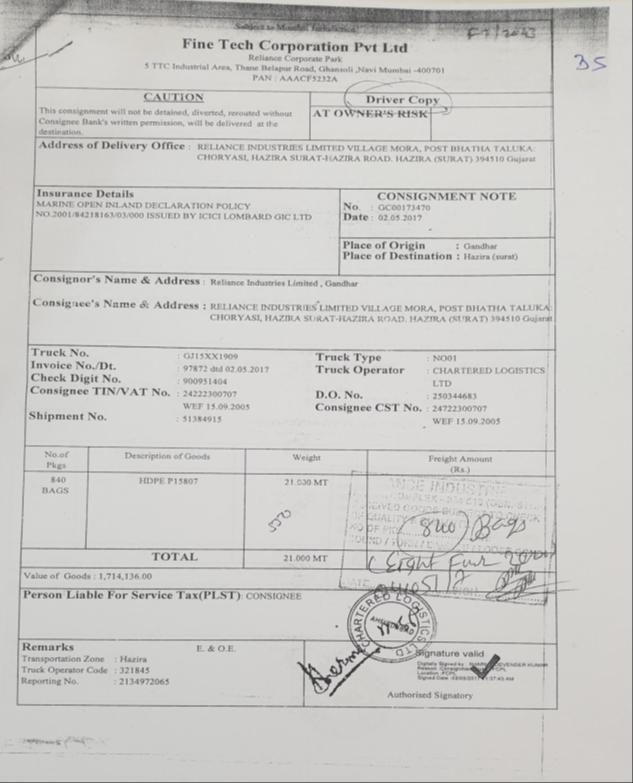
On the basis of above ‘Consignment Note’, the appellant issued their Bills. Sample copy of their bill is scanned below:
From the above ‘Consignment Note’ issued by FCPL and the detail of the same appearing in Appellant’s above bill, it can be seen that for the truck provided by M/S chartered logistic the GTA service was provided by Fine Tech Corporation Pvt. Ltd. who have issued the consignment note therefore the services provided by the appellant to
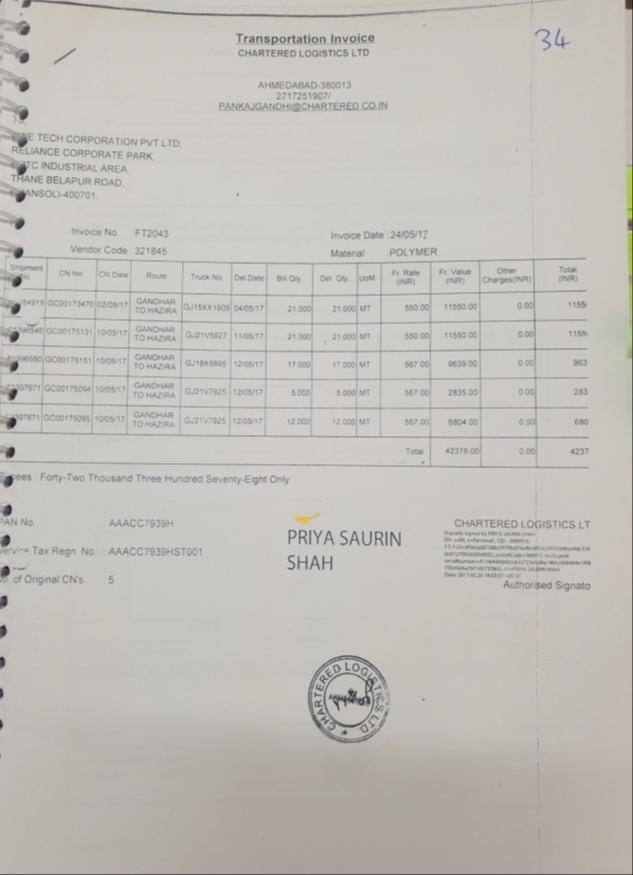
M/S FCPL does not fall under the category of GTA service even though the appellant have provided service of transportation of goods for the reason that the service of transportation provided by the appellant is to the GTA and for the said service consignment note was issued by FCPL to its client M/S Reliance Industries Ltd. therefore, for the entire activity that is transportation of goods by the appellant to FCPL for which the consignment note was issued by FCPL the GTA service provider is FCPL to its client M/S Reliance industries Ltd. Therefore, the activity of the appellant is clearly covered under section 66D (p) (i)(A) of the finance act,1994 which clearly falls under negative list of services which is not taxable.
6.7 Now it is a settled law that even if a person has provided Goods Transport Service but not issued consignment note/LR, Service Tax from that person under GTA cannot be recovered. Some of the Judgments on this issue are given below:
- Narendra Road Lines Pvt. Ltd Vs. Commissioner Of Customs, Central Excise & CGST, Agra, 2022 (64) G.S.T.L. 354 (Tri. – All.)
- Mahanadi Coalfields Ltd Vs. Commissioner Of Central Excise & Service Tax, BBSR-I, 2022 (57) G.S.T.L. 242 (Tri. – Kolkata)
- East India Minerals Ltd Vs. Commissioner Of Central Excise, Customs & Service Tax, Bhubaneswar-Ii, 2021 (44) G.S.T.L. 90 (Tri. – Kolkata)
From the above Judgments, it is settled that a person even if provides Goods Transportation service but if he does not issue Consignment Notes/LR, he cannot be brought under the ambit of GTA. The case of the appellant is on much better footing on the admitted fact that the appellant’s client FCPL is in fact the GTA who issued ‘Consignment Note’ in respect of the Transportation Service provided to M/s Reliance Industries Ltd. Therefore, appellant is not liable to pay Service Tax.”
The above judgments of this Tribunal have been maintained by the Hon’ble Supreme Court reported at – 2024 (4) TMI 8 (SC) wherein the Hon’ble Supreme Court ordered as under:-
ORDER
“1. Delay condoned.
2. We are not inclined to interfere with the impugned judgment passed by the Custom Excise and Service Tax Appellate Tribunal, West Zonal Bench at Ahmedabad in Service Tax Appeal No. 10857/2022.
3. The Civil Appeal is dismissed.”
5. In view of the above decisions, it is settled that as per facts involved in the present case, applying the ratio of the above judgments, the demand under GTA service is not sustainable. Hence the impugned order is set-aside and appeal is allowed.
(Pronounced in the open court on 14.08.2024)



