Summary: The Securities and Exchange Board of India (SEBI), through a consultation paper issued on 20 November 2026, has proposed removing the Additional Disclosure Framework (ADF) applicable to Foreign Portfolio Investors (FPIs) to reduce regulatory burdens and improve India’s attractiveness as an investment destination. The existing framework, introduced through Regulations 22(6) and 22(7) of the SEBI (Foreign Portfolio Investors) Regulations, 2019, requires specified FPIs to disclose granular ownership, economic interest and control information down to natural persons without any ownership threshold. The requirements apply principally where an FPI holds more than 50% of its Indian equity assets under management in a single corporate group or where its equity AUM, individually or with its investor group, exceeds ₹50,000 crore, subject to exemptions. SEBI has highlighted that these obligations exceed beneficial ownership identification requirements under the Prevention of Money Laundering (Maintenance of Records) Rules, 2005, and impose significant compliance costs on global funds. The consultation paper also refers to FPI equity outflows exceeding ₹5.61 lakh crore between October 2024 and October 2026 and the clarification of beneficial ownership thresholds under Press Note 02 of 2026. SEBI proposes removing the ADF requirements for FPIs, Offshore Derivative Instrument subscribers and segregated portfolios. Public comments are invited until 11 December 2026. The proposals are not yet operative regulatory amendments.
Securities and Exchange Board of India
Consultation Paper on proposal to review the Additional Disclosure Framework for Foreign Portfolio Investors
Reports | Nov 20, 2026
Comment on: https://www.sebi.gov.in/sebiweb/publiccommentv2/PublicCommentAction.do?doPublicComments=yes
1. OBJECTIVE
1.1. To improve ease of doing business for Foreign Portfolio Investors (FPIs) by reviewing the Additional Disclosure Framework to provide a more investor friendly regulatory framework, aligned with global standards and thereby making India a preferred investment destination.
2. BACKGROUND
2.1. Foreign capital has been an important constituent in India’s economic expansion especially since the 1991 liberalization reforms. Foreign capital helps in bridging the gap between domestic savings and investment requirements and also provides vital foreign exchange to support a growing economy.
2.2. However, the opportunities that such foreign capital provides also come with their attendant risks. Mitigation of such risks demands that adequate safeguards are in place. Identification of beneficial ownership in the financial system is an important mandate emerging from the need to prevent, control and combat money laundering, terrorism financing and other related threats for the integrity of the international financial system.
2.3. Financial Action Task Force (FATF) is the international policy making body established in 1989 to lead global action to tackle money laundering, terrorist and proliferation financing. Currently, 40 countries/jurisdictions (including India) are members of FATF and more than 200 countries and jurisdictions have committed to implement the FATF’s standards. FATF Recommendations provide a comprehensive framework of measures to help countries tackle illicit financial flows. Recommendation 10 requires financial institutions to undertake Client Due Diligence (CDD) and identify the Beneficial Owner (BO) of their clients. While FATF has provided respective jurisdictions the flexibility to prescribe their own thresholds to determine ownership of client based on ownership interest, it has recommended that such threshold should not exceed 25%.
2.4. In India, ‘The Prevention of Money Laundering Act, 2002’ (PMLA) has been enacted to, inter alia, prevent money-laundering. Prevention of Money Laundering (Maintenance of Records) Rules, 2005 (PMLR), provides for identification of BO of clients on the basis of controlling ownership interest and control. In terms of Rule 9(3) of PMLR, the current threshold for controlling ownership interest is 10% /15% depending on the legal form of the client.
2.5. For accessing Indian securities market, Foreign Portfolio Investors (FPIs) register with SEBI and also enter into an account based relationship with a custodian, bank, depository participant and stock broker as a client. Thus, the PMLR requirements related to CDD norms including identification of BO as per the extant 10%/15% ownership threshold are applicable to FPIs as well.
2.6. A comparative analysis of global practices adopted for identification of BOs indicates that several emerging markets which are FATF members adopt a relaxed ownership threshold (typically 25%). Further, developed markets such as USA, UK, Canada, Luxembourg, Belgium, Portugal, Netherlands, France, Germany, Singapore, Japan and Hong Kong also follow a norm of 25% threshold, with lower threshold applicable in some jurisdictions only for high-risk entities. Thus, going by global standards, India follows a more stringent regime for identification of BOs. There may be a need to review the PMLR, 2005 to make it consistent with other jurisdictions. However, this is under the jurisdiction of Ministry of Finance.
2.7. Over and above the aforementioned requirement of BO identification, SEBI has prescribed an Additional Disclosure Framework (ADF)1. ADF, inter alia, provides the criteria for identification of FPIs that are required to submit granular details of all entities holding any ownership, economic interest, or exercising control in the FPI, on a full look through basis, upto the level of all natural persons, without any threshold. The criteria provided under ADF are as follows:
2.7.1. Concentration criteria: FPI holding more than 50% of their Indian equity Assets Under Management (AUM) in a single Indian corporate group
2.7.2. Size criteria: FPIs, individually or along with their investor group, hold more than INR 50,000 crore of equity AUM in the Indian markets. [original limit was INR 25,000 crore, increased to INR 50,000 crore vide circular dated April 09, 2025]
2.7.3. Exemption criteria: Certain FPIs, including those having a broad based, pooled structure with widespread investor base or those having ownership interest by Government or Government related investors have been exempted from such additional disclosure requirements, subject to conditions.
2.8. An industry-wide Standard Operating Procedure (SOP) has also been adopted in consultation with SEBI, for implementation of the ADF.
3. NEED FOR REVIEW of SEBI’s ADF
3.1. In today’s global financial landscape, capital is highly mobile and responsive. Investors have access to a vast universe of markets and securities, and their allocation decisions are shaped by a range of factors. For any investee jurisdiction, many of these determinants remain exogenous and beyond direct control. In such times, any measure that increases the compliance burdens may reduce the attractiveness of Indian capital markets for foreign investors.
3.2. As stated earlier, the granular disclosure requirements under ADF have been prescribed by SEBI over and above the BO identification requirements specified under PMLR. Further, such granular disclosure requirements under the ADF are unique to India.
3.3. Such disclosure requirements have to be weighed against the prevailing requirements in our own jurisdiction as well as other jurisdictions competing for the same pool of global monies. Disclosure requirements that are not in line with globally accepted practices could potentially place India at a competitive disadvantage vis-à-vis peer jurisdictions with relatively lenient regulatory requirements.
3.4. India has experienced large FPI outflows which have exerted severe pressure on the foreign exchange market and value of INR. FPIs have been net sellers in the Indian equity markets for a sustained period starting late 2024, with an exodus accelerating through 2025 and early 2026. During the period between October 2024 and October 2026, FPIs have pulled out more than ₹5.61 lakh crore ($62.24 billion) from Indian equity market.
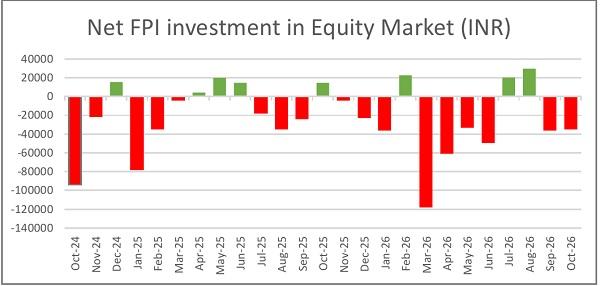
3.5. While there may be several factors behind such FPI outflows, the relatively onerous rules regarding BO identification and disclosures required as per ADF as compared to most of the FATF compliant countries (both developed and emerging) necessitate a review of existing processes and rules.
3.6. Policymaking involves a careful balancing act of minimising both Type I errors (over-regulation that stifles innovation and market efficiency) and Type II errors (under-regulation that may expose the system to risks). Continuous evaluation of policy outcomes, informed by stakeholder feedback and evolving market conditions, is therefore essential. Accordingly, regulatory fine-tuning has to be an ongoing process.
4. ISSUES UNDER CONSIDERATION
4.1. SEBI has received constant feedback from FPIs and other market participants regarding the stringent disclosure requirements especially when no such disclosure requirements are present in other competing jurisdictions. It is observed that ADF is giving rise to several practical challenges, including the following:
a. FPIs are required to identify and collect information from significantly larger number of underlying investors for their Indian investments as compared to investments in other jurisdictions.
b. A global fund which invests in different countries is forced to set up a different fund for its Indian investments as compliance levels are different, resulting in additional operational and compliance costs.
c. In case of pooled investment vehicles such as hedge funds, investor holdings may change frequently due to subscriptions and redemptions, necessitating repeated identification exercises and periodic updates.
d. Many investors may not be accustomed to providing information beyond what is required in their home jurisdictions, leading to practical difficulties in obtaining the requisite information and documentation.
e. In case of FPIs with complex structures, such as ‘fund of fund’ arrangements and segregated portfolios, tracing ownership through multiple layers to identify natural persons for the purpose of regulatory compliance can be time-consuming and costly.
4.2. Many foreign investors looking to invest in India consider the granular disclosure requirements as additional compliance burden. Rather than investing in India and be subject to granular disclosures, many investors may instead choose to avoid investing in India. Therefore, the disclosure requirements for breach of ‘concentration criteria’ have practically become an entry barrier for FPIs looking to invest in India. In any case, even if an FPI holds a concentrated position in a listed entity, such investment is capped at 10% of the shareholding of the listed entity.
4.3. Further, specifically with regard to ‘size criteria’, it may be noted that PN3, inter alia, provided that an entity or a citizen of a country which shares land border with India, or where the beneficial owner of an investment into India is a citizen of any such country, can invest only under the Government route. While the conditions prescribed under PN3 were not made applicable to investments made by FPIs, considering the potential for misuse of the FPI route for circumventing the stipulations of PN3, SEBI had included the ‘size criteria’ under the ADF.
4.4. It may be noted that, in absence of a clear definition of BO under PN3, the term was purported to include any ownership directly or indirectly. Therefore, even a small stake by a person from land bordering countries used to come under the purview of conditions placed by PN3. Vide Press Note 02 of 2026 (PN2) dated March 15, 2026, Government of India reviewed the FDI Policy and modified the investment conditions prescribed via PN3. The definition of ‘beneficial owner’ has now been clarified to include only those persons who hold more than the thresholds prescribed under PMLR.
4.5. As mentioned earlier, FPIs are also required to provide details of the BOs as per the thresholds prescribed under PMLR. Therefore, as far as identification of BO is concerned, the position under PN3 (as clarified by PN2) is similar to requirements already specified for FPIs. Therefore, the additional requirement under ADF to identify all entities holding any ownership or economic interest or control in the FPI in case of breach of ‘size criteria’, may not be required.
5. PROPOSAL
5.1. Considering the challenges faced by foreign investors and the change in FDI policy as mentioned above, it is proposed to remove the Additional Disclosure Framework for FPIs.
5.2. Since the requirements under ADF are also applicable to subscribers of Offshore Derivative Instruments (ODIs) and segregated portfolio(s) maintained by FPI, the provisions under ADF, applicable to ODI subscribers and segregated portfolio(s) of FPI, are also proposed to be removed.
| Question for public comments
1. Do you agree with proposal to remove Additional Disclosure Framework for FPIs? |
6. PUBLIC COMMENTS
6.1. Considering the implications of the aforementioned matters on the market participants, public comments are invited on the above proposals. The comments/ suggestions should be submitted latest by December 11, 2026, through the following link: PublicComments=yesSEBI public comments portal
6.2. Any technical issue in submitting your comment through web based public comments form, may be communicated through email to [email protected] with a subject: “Consultation Paper on proposal to review the Additional Disclosure Framework for Foreign Portfolio Investors”
Issued on: November 20, 2026
1. Through insertion of Regulations 22(6) and 22(7) in SEBI (FPI) Regulations, 2019 and issuance of circular dated August 24, 2023, amended from time to time. The circulars were subsequently subsumed into SEBI’s Master Circular dated May 30, 2024