Kishorbhai C Bhagtani Vs ITO (ITAT Rajkot)
Unsigned Approval Under Section 151 Cannot Confer Reassessment Jurisdiction
Background of the Dispute
The assessee’s appeal concerned Assessment Year 2020–21 and arose from a reassessment order dated 15 March 2025 passed under Section 147 of the Income-tax Act.
The Assessing Officer had made an addition of ₹30,00,000 under Section 69, alleging payment of on-money towards the purchase of property. The assessee challenged the allegation, contending that there was no cogent material establishing such payment and that an opportunity to cross-examine the persons whose statements were relied upon had not been provided.
The assessee also disputed the application of Section 115BBE and challenged the validity of reopening itself.
The CIT(A), through the National Faceless Appeal Centre, upheld the reassessment and addition by an order dated 23 June 2026. The assessee then approached the Tribunal.
The Decisive Objection: Approval Without a Signature
At the hearing, the assessee’s authorised representative drew attention to the approval obtained under Section 151.
The objection was specific: the approval bore neither a digital signature nor a manual signature. The assessee submitted that reassessment proceedings founded on such an approval lacked jurisdiction.
For this proposition, reliance was placed on the Rajkot Tribunal’s decision in M/s Aditya Plastic, ITA No. 185/Rjt/2024, AY 2013–14, where reassessment had been quashed because the statutory approval was defective.
The Departmental Representative supported the findings of the Assessing Officer. However, the Tribunal recorded that the Revenue had not produced material sufficient to controvert the position relied upon by the assessee.
Tribunal’s Examination of the Approval
The Tribunal examined the approval document and reproduced it in the order. It expressly found that the sanction under Section 151 was unsigned in both recognised forms—digital and manual.
It therefore considered the issue covered by Aditya Plastic.
In that earlier case, the approval of the Principal Commissioner was found to be without a signature and without a generated DIN. The coordinate Bench had held that the reassessment could not stand in the absence of valid statutory approval.
In the present appeal, however, the Tribunal’s operative finding specifically concerned the absence of a digital or manual signature. The DIN deficiency mentioned in the reproduced precedent should not be treated as a separate finding against the present approval.
Prior Valid Sanction Is a Jurisdictional Requirement
The decision in Aditya Plastic had relied on Vikas Gupta v. Union of India, [2022] 142 taxmann.com 253 (Allahabad High Court).
The passages reproduced from Vikas Gupta concerned the sequence of statutory approval and issuance of the reopening notice. There, the prescribed authority’s satisfaction was digitally signed after the notice under Section 148 had already been issued.
The High Court held that the Assessing Officer lacked jurisdiction when issuing the notice because valid satisfaction under Section 151 did not exist at that time. Subsequent authentication could not supply the missing jurisdiction retrospectively.
Although the factual defect in Bhagtani’s case was an unsigned approval, rather than the later signing examined in Vikas Gupta, the underlying principle was the same: valid statutory sanction must exist when reassessment jurisdiction is exercised.
Reassessment Quashed; Merits Left Open
The Tribunal followed the coordinate Bench precedent, noting that the Revenue had not shown any material basis for a different conclusion.
It allowed the assessee’s appeal and quashed the reassessment itself.
Once the assessment fell on the jurisdictional ground, the Tribunal held that the remaining issues concerning the addition were academic and infructuous.
Accordingly, the order contains no substantive finding on the alleged on-money payment, the evidentiary value of the material relied upon, the cross-examination objection or the independent applicability of Section 115BBE.
Author’s Comments
Statutory approval is a safeguard against reopening without proper authorisation. Its authentication cannot be treated as an inconsequential formality where the very existence of valid sanction is disputed.
The decision also illustrates why jurisdictional records deserve close examination. A substantial addition may attract attention to the transaction’s merits, but the assessment must first rest on a legally valid exercise of power.
Practically, the approval record should be examined for authentication, identity of the approving authority and timing, wherever relevant. An unsigned document and an approval authenticated only after issuance of the notice raise distinct factual defects, even though both may affect jurisdiction.
The outcome must nevertheless be described accurately. The assessee succeeded because the reassessment was invalid—not because the alleged property payment was disproved. Keeping that distinction clear preserves the legal principle actually decided.
Cases Discussed
- M/s Aditya Plastic, ITA No. 185/Rjt/2024, AY 2013–14 (ITAT Rajkot) — The coordinate Bench decision directly followed by the Tribunal. It concerned defective statutory approval under Section 151, including the absence of the approving authority’s signature and DIN. The present Tribunal considered the unsigned approval issue squarely covered by this decision.
- Vikas Gupta v. Union of India, [2022] 142 taxmann.com 253; 448 ITR 1 (Allahabad High Court) — The High Court held that reassessment notices issued before valid approval under Section 151 had been authenticated were without jurisdiction. The decision was reproduced and relied upon in the Aditya Plastic precedent followed by the Tribunal.
FULL TEXT OF THE JUDGMENT/ORDER OF ITAT RAJKOT
Captioned appeal filed by the assessee, pertaining to assessment year 2020-21, is directed against the order passed under Section-250 of the Income-tax Act, 1961 (hereinafter referred to as ‘the Act’) dated 23.06.2026 by the National Faceless Appeal Centre (NFAC), Delhi/ Commissioner of Income Tax (Appeals) [in short ‘Ld. CIT(A)’], which in turn arises out of an assessment order passed by the Assessing Officer u/s.147 of the Act dated 15.03.2025.
2. Grounds of appeal raised by the assessee are as follows:
1. The learned Commissioner of Income Tax (Appeals) has erred in law and on facts in upholding the validity of reopening of assessment under section 147 of the Act, which is bad in law, without jurisdiction, and liable to be quashed.
2. Without prejudice to the above, the learned CIT(A) has erred in law and on facts in confirming the addition of Rs. 30,00,000/-under section 69 of the Act. The learned CIT(A) has erred in law and on facts in holding that the Appellant had paid on-money for purchase of property, without any cogent material or evidence on record or without any opportunity to cross examine the/deponents.
3. The learned CIT(A) has erred in law and on facts in upholding the applicability of section 115BBE of the Act.
3. When the appeal was called out for hearing, Ld. Counsel for the assessee invited my attention that the issue is squarely covered in favour of the assessee by the judgment of the Coordinate Bench of ITAT Rajkot, in the case of M/s Aditya Plastic, in ITA No. 185/Rjt/2024, for AY 2013-14, wherein it was held that based on the defective approval under section 151 of the Act, the reassessment proceedings initiated by the Assessing Officer was quashed. In the assessee’s case under consideration the approval under section 151 of the Act is neither signed digitally nor manually, therefore, reassessment proceedings initiated based on the defective approval under section 151 of the Act should be quashed.
4. On the other hand, Ld. DR for the revenue relied on the findings of the Assessing Officer.
5. I have heard, both the parties and perused the material available on record. I note that the approval given under section 151 of the Act, which is unsigned that the neither signed digitally nor manually is reproduced below:
6. Since, the above approval under section 151 of the Act, is neither signed digitally nor manually, therefore, the issue is squarely covered by the Coordinate Bench of ITAT Rajkot, in the case of M/s Aditya Plastic, in ITA No.185/Rjt/2024, for AY 2013-14. The findings of the Coordinate Bench are as follows :
“8. We have heard both the parties, perused the material available on record. We note that the approval of the PCIT is without any signature of the Ld.PCIT and without generating any DIN number which is reproduced below:
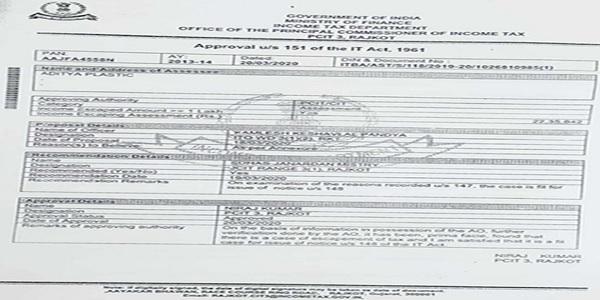
8.1. Therefore, the Ld.Cousel for the assessee has stated that the approval u/s.151 of the Act dated 30/03/2020 is not signed by the Ld.PCIT and, hence, it is not considered as a valid approval/satisfaction and, thus, the notice u/s.148 of the Act issued on the basis of said approval is bad in law and without jurisdiction. For that, reliance is placed on the judgement of Hon’ble High Court of Allahabad in the case of Vikas Gupta reported at (2022) 142 taxmann.com 253 (Allahabad HC). The relevant part of judgement is reproduced:
13. Thus, as per provision of section 151 of the Income-tax Act, 1961, an assessing officer gets jurisdiction to issue notice to an assessee under section 148 of the Act, 1961 after Principal Chief Commissioner or Chief Commissioner or Principal Commissioner or Commissioner of Income-tax is satisfied on the reason recorded by the assessing officer that it is a fit case for issuing such notice. The date and time of the approval granted digitally under section 151 of the Act and the date and time of the notice under section 148 of the Act, shows that the satisfaction was recorded by the PCTT digitally after the notice under section 148 was digitally signed.
29. In the present set of facts there was no valid satisfaction recorded by the by the Prescribed Authority under section 151 of the Act, 1961 when the Assessing Officer issued notice to the assessee under section 148 of the Act, 1961. At the time when the notice under section 148 of the Act, 1961 was issued by the Assessing Officer to the petitioner there was no valid satisfaction recorded by the Prescribed Authority ie. the Principal Chief Commissioner or Chief Commissioner or Principal Commissioner or Commissioner. Subsequent to issuance of the notice under section 148 of the Act, 1961 by the Assessing Officer, the satisfaction under section 151 was digitally signed by the Prescribed Authority. Therefore, the point of time when the Assessing Officer issued notices under section 148, he was having no jurisdiction to issue the impugned notices under section 148 of the Act, 1961. Consequently the impugned notices issued by the Assessing Officer under section 148 of the Act, 1961 were without jurisdiction. The questions no. (a) and (b) are answered accordingly.
8.2. Therefore, based on these facts and circumstances of the case, the assessment order framed by the AO needs to be quashed as there was no approval u/s.151 of the Act for initiating the re-assessment proceedings by the Ld.PCIT, therefore, on this count the assessment order framed by the AO should be quashed.”
7. As the issue is squarely covered in favour of the assessee by the decision of Coordinate Bench of ITAT Rajkot, in the case of M/s Aditya Plastic, in ITA No. 185/Rjt/2024, for AY 2013-14, and there is no change in facts and law and the revenue is unable to produce any material to controvert the aforesaid findings of the Division Bench (supra). I find no reason to interfere in the said order of the Division Bench (supra). Therefore, respectfully following the binding precedent of the Coordinate Bench (supra), I allow the appeal of the assessee.
8. As the reassessment itself is quashed, therefore, all other issues on merits of the additions in the impugned assessment proceedings are rendered academic and infructuous.
9. In the result, the appeal of the assessee is allowed.
Order is pronounced in the open Court on 09/10/2026.