Bandharda Seva Sahkari Mandali Limited Vs ITO (ITAT Rajkot)
Unsigned Section 151 Approval Invalid: ITAT Quashes Co-operative Society’s Reassessment
The Rajkot Bench of the Income Tax Appellate Tribunal (ITAT) quashed reassessment proceedings after finding that the approval under Section 151 was neither digitally nor manually signed. The Tribunal also accepted the society’s objection that reopening concerned cash deposits and withdrawals, whereas the eventual addition arose from denial of deduction under Section 80P, without an addition on the original issue.
The assessee, Shree Bandharda Seva Sahkari Mandali Limited, challenged the CIT(A)/NFAC’s order dated 9 October 2025 sustaining the reassessment.
Reopening arose from bank transactions and non-filing of return
The Department received information through its Insight Portal concerning significant financial transactions with Junagadh Jilla Sahakari Bank Limited and the society’s failure to file its return within the prescribed time.
After proceedings under Section 148A, an order under Section 148A(d) was passed on 18 March 2023. A notice under Section 148 was issued on 25 March 2023 and served on 29 March 2023.
The society subsequently filed its return in response to the notice on 22 February 2024.
Section 80P deduction denied for failure to file timely return
During assessment, the society explained that it was registered under the Gujarat Co-operative Societies Act, 1961 and provided credit facilities to farmer-members. It also facilitated the purchase of agricultural implements, seeds, livestock and other agricultural requirements.
The society submitted that it borrowed from the district co-operative bank and provided loans to members. It maintained that it was a primary agricultural credit society, rather than a co-operative bank serving the public.
It furnished its registration certificate, bye-laws, bank statements, daily cash register, financial statements and audit report, and claimed a deduction of ₹3,74,897 under Section 80P.
The Assessing Officer denied the deduction because the society had not filed its return under Section 139(1). The CIT(A) sustained the disallowance.
Approval lacked both digital and manual signatures
Before the Tribunal, the society challenged the reassessment on the ground that the statutory approval under Section 151 was unsigned.
It relied on the Rajkot Tribunal’s decision in Aditya Plastics, ITA Nos. 185 & 186/RJT/2024, dated 3 September 2025, concerning the validity of an unsigned approval.
After examining the approval in the present case, the Tribunal expressly found that it was neither signed digitally nor manually. Following the coordinate bench decision, it held that the reassessment proceedings deserved to be quashed.
No addition on issue forming basis of reopening
The society also argued that reassessment had been initiated concerning cash deposits and withdrawals, but the final adjustment concerned disallowance of Section 80P deduction.
It relied on the Bombay High Court’s decision in Jet Airways, concerning assessment of an independent issue where no income was assessed on the issue forming the basis of reopening.
The Tribunal accepted this additional jurisdictional plea and quashed the reassessment order dated 5 March 2024.
Accordingly, the society’s appeal was allowed. Since the reassessment itself was quashed, the Tribunal treated the remaining merits as academic and infructuous. It did not independently decide eligibility for Section 80P deduction despite the delayed return.
Cases Discussed
- Aditya Plastics, ITA Nos. 185 & 186/RJT/2024 (ITAT Rajkot), dated 03.09.2025.
- Vikas Gupta, (2022) 142 taxmann.com 253 (Allahabad High Court).
- CIT v. Jet Airways (I) Ltd., (2011) 331 ITR 236 (Bombay High Court).
- Vipan Khanna v. ACIT, (2002) 255 ITR 220 (Punjab & Haryana High Court).
- Travancore Cements Ltd. v. CIT, (2008) 305 ITR 170 (Kerala High Court).
- CIT v. Sun Engineering Works (P.) Ltd., (1992) 198 ITR 297 (Supreme Court).
- V. Jaganmohan Rao v. CIT, (1970) 75 ITR 373 (Supreme Court).
- CIT v. Shri Ram Singh, (2008) 306 ITR 343 (Rajasthan High Court).
- CIT v. Atlas Cycle Industries, (1989) 180 ITR 319 (Punjab & Haryana High Court).
FULL TEXT OF THE ITAT RAJKOT JUDGMENT/ORDER
Captioned appeal filed by the assessee, pertaining to Assessment Year 2019-20, is directed against the order passed under section 250 of the Income Tax Act, 1961 (hereinafter referred to as “the Act”) by National Faceless Appeal Centre (NFAC), Delhi/Commissioner of Income-tax (Appeals), dated 09.10.2025, which in turn arises out of an order passed by the Assessing Officer u/s 147 of the Act, on 05.03.2024.
2. Grounds of appeal raised by the assessee are as follows:
1. The CIT (A) erred in upholding reopening the assessment under 148 of the Act. The reopening of the Assessment is not justified.
2. The CIT (A) erred in upholding reopening the assessment under 148 of the Act. The reopening is beyond the powers of the JAO.
3. The CIT (A) erred in upholding reopening the assessment under 148 of the Act. The reopening of the Assessment is not justified as no addition was made on the basis of the reasons recorded for reopening of the assessment.
4. The CIT (A) erred in upholding the rejection of the claim for deduction under section 80P of the Act.
3. Brief facts qua the issue are that an information has been received in category of Risk Management Strategy (RMS)- Non- Filing of return -PAN Cases on Insight portal that during the period under review, that the assessee had entered into significant financial transaction with the Junagadh Jilla Sahari Bank Limited as per following Details :
| Sr. No. | Type of Transaction | Source | Amount (₹) |
|---|---|---|---|
| 1 | Cash Deposit in an account other than current account | The Junagadh Jilla Sahakari Bank Ltd. | 2,01,681/- |
| 2 | Cash Deposit or cash withdrawals (including through bearer’s cheque) in current account | The Junagadh Jilla Sahakari Bank Ltd. | 68,17,150/- |
| 3 | Cash Deposit in an account other than current account | The Junagadh Jilla Sahakari Bank Ltd. | 93,63,540/- |
| 4 | Cash Deposit in an account other than current account | The Junagadh Jilla Sahakari Bank Ltd. | 1,44,967/- |
| 5 | Cash Deposit in an account other than current account | The Junagadh Jilla Sahakari Bank Ltd. | 1,06,636/- |
| 6 | Cash Deposit in an account other than current account | The Junagadh Jilla Sahakari Bank Ltd. | 18,21,681/- |
| 7 | Cash Deposit in an account other than current account | The Junagadh Jilla Sahakari Bank Ltd. | 59,89,000/- |
| 8 | Cash Deposit in an account other than current account | The Junagadh Jilla Sahakari Bank Ltd. | 9,53,211/- |
| 9 | Cash Deposit or cash withdrawals (including through bearer’s cheque) in current account | The Junagadh Jilla Sahakari Bank Ltd. | 91,000/- |
| Total (as printed in image) | 2,54,88,866/- |
4. The assessing officer noted that as the assessee failed to furnish his/her return of income within the time allowed under section 139 of the Income tax Act, 1961; therefore, after following the procedure laid down under section 148A of the Income tax Act, 1961, a query letter cum show cause notice u/s 148A(b) of the Act, was issued to the assessee. Since, no compliance was made by the assessee, therefore, the raised query in the show cause notice u/s 148A(b) remained unverified and unexplained, therefore, necessary order u/s 148A(d) passed in the instant case with prior approval of specified authority as per section 151 of the I.T. Act, 1961 was passed on dated 18/03/2023. Further, a notice under section 148 was issued on 25/03/2023 along with order passed u/s 148A(d) of the assessee which was duly served upon the assessee on dated 29.03.2023.
5. In response to the notice issued u/s 148 of the I.T. Act, 1961 within given date and time, the assessee was required to file return of income for the period under review within the 30 days from the receipt of the notice u/s 148 of the Act. But the assessee did not file return of income in response to notice issued u/s 148 of the I.T. Act, 1961. Subsequently, the case was taken up by the National e-Assessment Centre, Delhi to finalize the assessment proceedings. The assessee filed return of income u/s 148 of the Act, on dated 22.02.2024. Accordingly, vide notices, the assessee was requested to furnish requisite details w.r.t sources and nature of fund used to perform transaction in question. However, no reply has been received from the assessee in this regard. Therefore, invoking section 133(6) of the I.T. Act, 1961, a notice was issued to the Junagadh Jilla Sahakari Bank Ltd, and called relevant details as uploaded in the data base of the Department. The concerned bank furnished the reply (account opening form and other relevant details of the assessee). On verification of the same, it has been observed by assessing officer from the information received that assessee was maintaining account with the Junagadh Jilla Sahakari Bank Ltd and substantial amount was Deposit in cash. In light of above and considering the refrain and non-co-operative attitude of the assessee, a final show cause notice was issued on 24/01/2024 giving therein a final opportunity to the assessee to respond.
6. In response to the various notices, the assessee submitted reply before the assessing officer, dated 22.02.2024, which is reproduced below:
“It is respectfully submitted that We are a Co-operative Society registered under the Gujarat Co-operative Societies Act, 1961 with object and activities of providing credit facilities to its members as well as it provides facilities to members for purchase of agricultural implements, seeds, livestock or other articles intended for agricultural activities, Our main activity is to provide the credit/loan facility at lower rate of interest to rural farmer who are member of our mandali i.e.” SHREE BANDHARDA SEVA SAHKARI MANDALI LIMITED” our mandali is the fall in the category of primary agricultural credit society. It is submitted that during the year under consideration, We have taken loan from “THE JUNAGADH JILA SAHKARI BANK” at some interest percentage and from this money/fund we provided the loan to our members/farmer-members by charging lower rate of interest in this operation we generate income/cash inflow in form of interest and paid interest expenses to loan provider. Here we respectfully clarified that we are not falling in the category of Co-operative bank/banks under the Banking regulation Act. Because merely giving credit to its members only cannot be said to be the Cooperative Banks. The banking activities under the Banking Regulation Act are altogether different activities. There is a vast difference between the credit societies giving credit to their own members only and the Banks providing banking services including the credit to the public at large also. Credit Co-operative societies are entitle to exemption under Section 80P(2) of the Income Tax Act.
Here we attached detail audit report which is carried out by auditor appointed by authority of Co-operative societies Gujarat.”
7. The assessee submitted the copy of registration certificate, copy of By Laws, Copies of bank statements, daily cash register, profit & loss A/c, Balance sheet, Audit report etc. The assessee also filed the computation of total income, in which the assessee has claimed the deduction u/s 80P of the Act, of Rs.3,74,897/-.
8. However, Assessing Officer noted that the assessee is not eligible for the deduction u/s 80P of the Act, as the assessee did not file return of income u/s 139(1) of the Act. Therefore, assessing officer, disallowed the deduction claimed by assessee u/s 80P of the Act, of Rs. 3,74,897/-.
9. Being aggrieved by the said order of the Assessing Officer, the assessee filed an appeal before the Ld.CIT(A), but remained unsuccessful. Therefore, assessee is left with no other alternative but to knock on the doors of the Tribunal with this appeal praying for justice.
10. I have heard, both the parties and carefully gone through the submission put forth on behalf of the assessee along with the documents furnished and the case laws relied upon, and perused the fact of the case including the findings of the ld CIT(A) and other materials brought on record. Learned Counsel for the assessee argued that approval given under section 151 of the Income Tax Act, is neither signed digitally nor manually, therefore based on the defective approval, the reassessment proceedings under section 147 of the Act is not valid and should be quashed. For that Ld. Counsel for the assessee relied on the judgment of Co-ordinate Bench of ITAT Rajkot in the case of Aditya Plastics in ITA No.185 & 186/Rjt/2024 order dated 03.09.2025, wherein it was held as follows:
“8. We have heard both the parties, perused the material available on record. We note that the approval of the PCIT is without any signature of the Ld.PCIT and without generating any DIN number which is reproduced below:
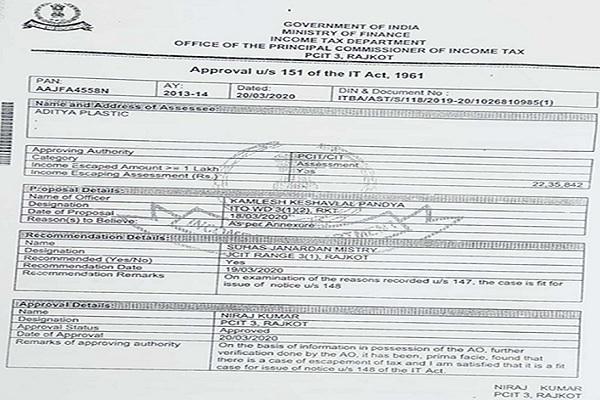
8.1. Therefore, the Ld.Cousel for the assessee has stated that the approval u/s.151 of the Act dated 30/03/2020 is not signed by the Ld.PCIT and, hence, it is not considered as a valid approval/satisfaction and, thus, the notice u/s.148 of the Act issued on the basis of said approval is bad in law and without jurisdiction. For that, reliance is placed on the judgement of Hon’ble High Court of Allahabad in the case of Vikas Gupta reported at (2022) 142 taxmann.com 253 (Allahabad HC). The relevant part of judgement is reproduced:
13. Thus, as per provision of section 151 of the Income-tax Act, 1961, an assessing officer gets jurisdiction to issue notice to an assessee under section 148 of the Act, 1961 after Principal Chief Commissioner or Chief Commissioner or Principal Commissioner or Commissioner of Income-tax is satisfied on the reason recorded by the assessing officer that it is a fit case for issuing such notice. The date and time of the approval granted digitally under section 151 of the Act and the date and time of the notice under section 148 of the Act, shows that the satisfaction was recorded by the PCTT digitally after the notice under section 148 was digitally signed.
29. In the present set of facts there was no valid satisfaction recorded by the by the Prescribed Authority under section 151 of the Act, 1961 when the Assessing Officer issued notice to the assessees under section 148 of the Act, 1961. At the time when the notice under section 148 of the Act, 1961 was issued by the Assessing Officer to the petitioner there was no valid satisfaction recorded by the Prescribed Authority ie. the Principal Chief Commissioner or Chief Commissioner or Principal Commissioner or Commissioner. Subsequent to issuance of the notice under section 148 of the Act, 1961 by the Assessing Officer, the satisfaction under section 151 was digitally signed by the Prescribed Authority. Therefore, the point of time when the Assessing Officer issued notices under section 148, he was having no jurisdiction to issue the impugned notices under section 148 of the Act, 1961. Consequently the impugned notices issued by the Assessing Officer under section 148 of the Act, 1961 were without jurisdiction. The questions no. (a) and (b) are answered accordingly.
8.2. Therefore, based on these facts and circumstances of the case, the assessment order framed by the AO needs to be quashed as there was no approval u/s.151 of the Act for initiating the re- assessment proceedings by the Ld.PCIT, therefore, on this count the assessment order framed by the AO should be quashed.
11. On second technical ground, Ld. Counsel for the assessee submitted that the reassessment was initiated on different issue, (on account of cash deposit/withdrawal), whereas the final addition made by the Assessing Officer on different issue (by making disallowance of deduction under section 80P of the Act) and therefore, reassessment proceedings should be quashed. For that, Ld. Counsel for the assessee relied on the judgment of the Hon’ble Bombay High Court in the case of Jet Airway Limited in Appeal No.1526 of 2008 and 1714 of 2009 dated April 12, 2010, wherein it was held as follows:
“During the course of the hearing of these appeals by the revenue under section 260A of the Income-tax Act, 1961, submissions have been urged before the Court confined to the following substantial question of law:
“Where upon the issuance of a notice under section 148 of the Income-tax Act, 1961 read with section 147, the Assessing Officer does not assess or, as the case may be reassess the income which he has reason to believe had escaped assessment and which formed the basis of a notice under section 148, is it open to the Assessing Officer to assess or reassess independently any other income, which does not form the subject-matter of the notice?”
2. The two appeals by the revenue pertain to assessment years 1994-95 and 1995-96. The Tribunal has noted that an identical issue was agitated by the assessee for assessment year 1997-98 and that the Tribunal, while allowing the claim of the assessee, held that the re-opening of the assessment was not valid in law. The Court has been informed that the appeal against the order of the Tribunal for assessment year 1997-98 has been dismissed for non-compliance of a conditional order of removing office objections. Be that as it may, having regard to the nature of the question of interpretation involved, we have heard arguments on the question of law as framed in these appeals and proceed to answer it on merits.
3. Section 147 of the Income-tax Act, 1961 provides that if the Assessing Officer has reason to believe that any income chargeable to tax has escaped assessment for any assessment year, he may, subject to the provisions of sections 148 to 153, assess or reassess such income “and also any other income chargeable to tax which has escaped assessment and which comes to his notice subsequently in the course of the proceedings under this section”. The proviso deals with reopening of an assessment upon the expiry of a period of four years from the end of the relevant assessment year and does not fall for interpretation in this appeal. Explanation 3 to section 147 was inserted by the Finance (No. 2) Act of 2009, with effect from 1-4-1989. Explanation 3 provides as follows:
Explanation 3.-For the purpose of assessment or reassessment under this section, the Assessing Officer may assess or reassess the income in respect of any issue, which has escaped assessment, and such issue comes to his notice subsequently in the course of the proceedings under this section, notwithstanding that the reasons for such issue have not been included in the reasons recorded under sub-section (2) of section 148.”
4. Prior to its amendment with effect from 1-4-1989, section 147 provided as follows:-147. Income escaping assessment. – If-
(a) the Income-tax Officer has reason to believe that, by reason of the omission or failure on the part of an assessee to make a return under section 139 for any assessment year to the Income-tax Officer or to disclose fully and truly all material facts necessary for his assessment for that year, income chargeable to tax has escaped assessment for that year, or
(b) notwithstanding that there has been no omission or failure as mentioned in clause (a) on the part of the assessee, the Income-tax Officer has in consequence of information in his possession reason to believe that income chargeable to tax has escaped assessment for any assessment year,
he may, subject to the provisions of sections 148 to 153, assess or reassess such income or recompute the loss or the depreciation allowance, as the case may be, for the assessment year concerned (hereafter in sections 148 to 153 referred to as the relevant assessment year).”
5. The condition precedent to the exercise of the jurisdiction under section 147 is the formation of a reason to believe by the Assessing Officer that any income chargeable to tax has escaped assessment. Upon the formation or a reason to believe, the Assessing Officer, before making the assessment, reassessment or recomputation under section 147 has to serve on the assessee a notice requiring him to furnish a return of his income. Upon the formation of the reason to believe that income chargeable to tax has escaped assessment, the Assessing Officer is empowered to assess or reassess such income and also” any other income chargeable to tax which has escaped assessment and which comes to his notice subsequently in the course of the proceedings under section 147.
6. The effect of Explanation 3 which was inserted by the Finance (No. 2) Act of 2009 is that even though the notice that has been issued under section 148 containing the reasons for reopening the assessment does not contain a reference to a particular issue with reference to which income has escaped assessment, the Assessing Officer may assess or reassess the income in respect of any issue which has escaped assessment, when such issue comes to his notice subsequently in the course of the proceedings. The reasons for the insertion of Explanation 3 are to be found in the Memorandum explaining the provisions of Finance (No. 2) Bill of 2009. The Memorandum treats the amendment to be clarificatory and contains the following Explanation:
“Some courts have held that the Assessing Officer has to restrict the reassessment proceedings only to issues in respect of which the reasons have been recorded for reopening the assessment. He is not empowered to touch upon any other issue for which no reasons have been recorded. The above interpretation is contrary to the legislative intent.
With a view to further clarifying the legislative intent, it is proposed to insert an Explanation in section 147 to provide that the Assessing Officer may assess or reassess income in respect of any issue which comes to his notice subsequently in the course of proceedings under this section, notwithstanding that the reason for such issue has not been included in the reasons recorded under sub-section (2) of section 148.”
7. In order to appreciate the reasons for the amendment inserting Explanation 3: it would be necessary to advert to some of the judgments of the High Courts, prior to the amendment.
The Punjab and Haryana High Court, in its decision, in Vipan Khanna v. Asstt. CIT (2002) 255 ITR 220 dealt with the question as to whether, after initiating proceedings under section 147 on the ground that the petitioner had claimed depreciation at a higher rate. the Assessing Officer would be justified in launching an inquiry into issues which were not connected with the claim of depreciation. This question was answered in the negative.
A Division Bench of the Kerala High Court held in Travancore Cements Ltd. v. CIT [2008] 305 ITR 170, that upon the issuance of a notice under section 148(2), when proceedings were initiated by the Assessing Officer on issues in respect of which he had formed a reason to believe that income had escaped assessment, it was not open to the Assessing Officer to carry out an assessment, or reassessment in respect of other issues which were totally unconnected with the proceedings that were already Initiated and which came to his knowledge during the course of the proceedings. The Division Bench held that in respect of an issue which is totally unconnected to the basis on which the Assessing Officer formed a reason to believe that income escaped assessment and issued a notice under section 148, it was open to him to issue a fresh notice by following sub-section (2) of section 148 with regard to the escaped income which came to his knowledge during the course of the proceedings. The Kerala High Court held as follows:
The Assessing Officer gets jurisdiction under section 148 to assess or reassess the income which has escaped assessment only after sub-section (2) of section 148 is. complied with. The question is whether sub-section (2) of section 148 has to be complied with if any other income chargeable to tax has escaped assessment, or which comes to his knowledge subsequently in the course of the proceedings. In other words, when proceedings are already on in respect of one item in respect of the income for which he had already recorded reasons is it necessary that he should record reasons for assessing or reassessing any of the items which are totally unconnected with the proceedings already initiated. Suppose under two heads, income has escaped assessment and those two heads are inter-linked and connected, the proceedings initiated or notice already issued under sub-section (2) of section 148 would be sufficient if the escaped income on the second head comes to the knowledge of the officer in the course of the proceedings. But if both the items are unconnected and totally alien then the assessing authority has to follow sub-section (2) of section 148 with regard to the escaped income which comes to his knowledge during the course of the proceedings.”
Hence, the view of the Punjab and Haryana High Court and the Kerala High Court was that, once the Assessing Officer has reason to believe that income chargeable to tax has escaped assessment and proceeds to issue a notice under section 148, it is not open to him to assess or, as the case may be, reassess the income under an independent or unconnected issue, which was not the basis of the notice for reopening the assessment.
8. Parliament stepped in to correct what it regarded as an incorrect interpretation of the provisions of section 147. The Memorandum explaining the provisions of Finance (No. 2) Bill of 2009 states in this background that some courts had held that the Assessing Officer has to restrict the reassessment proceedings only to issues in respect of which reasons have been recorded for reopening the assessment and that it was not open to him to touch upon any other issue for which no reasons have been recorded. This interpretation was regarded by Parliament as being contrary to legislative intent. Hence, Explanation 3 came to be inserted to provide that the Assessing Officer may assess or reassess income in respect of any issue which comes to his notice subsequently in the course of proceedings under section 147 though the reasons for such issue were not included in the reasons recorded in the notice under section 148(2).
9. The effect of section 147 as it now stands after the amendment of 2009 can, therefore, be summarised as follows: (1) The Assessing Officer must have reason to believe that any income chargeable to tax has escaped assessment for any assessment year; (ii) Upon the formation of that belief and before he proceeds to make an assessment, reassessment or recomputation, the Assessing Officer has to serve on the assessee a notice under sub-section (1) of section 148; (iii) The Assessing Officer may assess or reassess such income, which he has reason to believe, has escaped assessment and also any other income chargeable to tax which has escaped assessment and which comes to his notice subsequently in the course of the proceedings under the section; and (iv) Though the notice under section 148(2) does not include a particular issue with respect to which income has escaped assessment, he may nonetheless, assess or reassess the income in respect of any issue which has escaped assessment and which comes to his notice subsequently in the course of the proceedings under the section.
10. Now the submission of the learned counsel appearing on behalf of the assessee in the present case is that the words “and also” in section 147 postulate that the Assessing Officer may assess or reassess the income which he has reason to believe has escaped assessment together with any other income chargeable to tax which has escaped assessment and which comes to his notice during the course of the proceedings. In other words, unless the Assessing Officer assesses the income with reference to which he had formed a reason to believe within the meaning of section 147, it would not be open to him to assess or reassess any other income chargeable to tax which has escaped assessment and which comes to his notice subsequently in the course of the proceedings. On the other hand, it has been urged on behalf of the revenue that even if, during the course of assessment or, as the case may be reassessment, the Assessing Officer does not assess or reassess the income which he has reason to believe has escaped assessment and which formed the subject-matter of a notice under section 148(2), it is nonetheless open to him to assess any other income which, during the course of the proceedings is brought to his notice as having escaped assessment.
11. The rival submissions which have been urged on behalf of the revenue and the assessee can be dealt with, both as a matter of first principle, interpreting the section as it stands and on the basis of precedents on the subject. Interpreting the provision as it stands and without adding or deducting from the words used by Parliament, it is clear that upon the formation of a reason to believe under section 147 and following the issuance of a notice under section 148, the Assessing Officer has the power to assess or reassess the income, which he has reason to believe had escaped assessment and also any other Income chargeable to tax. The words “and also” cannot be ignored. The interpretation which the Court places on the provision should not result in diluting the effect of these words or rendering any part of the language used by Parliament otiose. Parliament having used the words “assess or reassess such income and also any other income chargeable to tax which has escaped assessment”, the words “and also” cannot be read as being in the alternative. On the contrary, the correct interpretation would be to regard those words as being conjunctive and cumulative. It is of some significance that Parliament has not used the word “or”. The Legislature did not rest content by merely using the word “and”. The words “and”, as well as “also” have been used together and in conjunction.
The Shorter Oxford Dictionary defines the expression “also” to mean ‘further, in addition besides, too’. The word has been treated as being relative and conjunctive. Evidently. therefore, what Parliament intends by use of the words “and also” is that the Assessing Officer, upon the formation of a reason to believe under section 147 and the issuance of a notice under section 148(2) must assess or reassess: (i) ‘such income’; and also (4) any other income chargeable to tax which has escaped assessment and which comes to his notice subsequently in the course of the proceedings under the section. The words ‘such income’ refers to the income chargeable to tax which has escaped assessment and in respect of which the Assessing Officer has formed a reason to believe that it has escaped assessment. Hence, the language which has been used by Parliament is indicative of the position that the assessment or reassessment must be in respect of the income in respect of which he has formed a reason to believe that it has escaped assessment and also in respect of any other income which comes to his notice subsequently during the course of the proceedings as having escaped assessment. If the income, the escapement of which was the basis of the formation of the season to believe is not assessed or reassessed, it would not be open to the Assessing Officer to independently assess only that income which comes to his notice subsequently in the course of the proceedings under the section as having escaped assessment. If upon the issuance of a notice under section 148(2), the Assessing Officer accepts the objections of the assessee and does not assess or reassess the income which was the basis of the notice, it would not be open to him to assess income under some other issue independently. Parliament when it enacted the provisions of section 147 with effect from 1-4-1989 clearly stipulated that the Assessing Officer has to assess or reassess the income which he had reason to believe had escaped assessment and also any other income chargeable to tax which came to his notice during the proceedings. In the absence of the assessment or reassessment of the former, he cannot independently assess the latter.
12. In CIT v. Sun Engg. Works (P.) Ltd. [1992] 198 ITR 297, the Supreme Court dealt with the following question of law in the course of its judgment:-
“Where an item unconnected with the escapement of income has been concluded finally against the assessee, how far in reassessment on an escaped item of income is it open to the assessee to seek a review of the concluded item for the purpose of computation of the escaped income?”
The issue which arose before the Supreme Court was whether, in the course of a reassessment on an escaped item of income could an assessee seek a review in respect of an item which stood concluded in the original order of assessment. The Supreme Court dealt with the provisions of section 147, as they stood prior to the amendment on 1-4-1989. The Supreme Court held that the expression “escaped assessment” includes both “non-assessment” as well as “under assessment”. Income is said to have escaped assessment within the meaning of the section when it has not been charged in the hands of an assessee during the relevant assessment year. The expression “assess” refers to a situation where the assessment of the assessee for a particular year is, for the first time, made by resorting to the provisions of section 147. The expression “reassess” refers to a situation where an assessment has already been made but the Assessing Officer has reason to believe that there is under assessment on account of the existence of any of the grounds contemplated by Explanation 1 to section 147. The Supreme Court adverted to the Judgment in V. Jaganmohan Rao v. CIT [1970] 75 ITR 373, which held that once an assessment is validly reopened, the previous under assessment is set aside and the Income-tax Officer has the jurisdiction and duty to levy tax on the entire income that had escaped assessment during the previous year. The Court held that the object of section 147 enures to the benefit of the revenue and it is not open to the assessee to convert the reassessment proceedings as an appeal or revision and thereby seek relief in respect of Items which were rejected earlier or in respect of items not claimed during the course of The original assessment proceedings.
The judgment in V. Jaganmohan Rao’s case (supra) dealt with the language of sections 22(2) and 34 of the Act of 1922 while the judgment in Sun Engg. Works (P.) Ltd.’s case (supra) interprets the provisions of section 147 as they stood prior to the amendment on 154-1989.
13. The effect of the amended provisions came to be considered in two distinct lines of precedent on the subject. The first line of authority, to which a reference has already been made earlier, adopted the principle that where the Assessing Officer has formed a reason to believe that income has escaped assessment and has issued a notice under section 148 on certain specific issues, it was not open to him during the course of the proceedings for assessment or reassessment to assess or
reassess any other income, which may have escaped assessment but which did not form the subject- matter of the notice under section 148. This view was adopted in the Judgment of the Punjab and Haryana High Court in Vipan Khanna‘s case (supra) and in the judgment of the Kerala High Court in Travancore Cements Ltd. ‘s case (supra). This line of authority would now cease to reflect the correct position in law, by virtue of the amendment which has been brought in by the insertion of Explanation 3 to section 147 by Finance (No. 2) Act of 2009. The effect of the Explanation is that once an Assessing Officer has formed a reason to believe that income chargeable to tax has escaped assessment and has proceeded to issue a notice under section 148, it is open to him to assess or reassess income in respect of any other issue though the reasons for such issue had not been included in the reasons recorded under section 148(2).
14. The second line of precedent is reflected in a judgment of the Rajasthan High Court in CIT v. Shri Ram Singh [2008] 306 ITR 343. The Rajasthan High Court construed the words used by Parliament in section 147 particularly the words that the Assessing Officer ‘may assess or reassess such income and also any other income chargeable to tax which has escaped assessment and which comes to his notice subsequently in the course of the proceedings’ under section 147. The Rajasthan High Court held as follows:
“… if is only when, in proceedings under section 147 the Assessing Officer, assesses or reassesses any income chargeable to tax, which has escaped assessment for any assessment year, with respect to which he had “reason to believe” to be so, then, only in addition, he can also put to tax, the other income, chargeable to tax, which has escaped assessment, and which has come to his notice subsequently, in the course of proceedings under section 147. To clarify it further, or to put it in other words, in our opinion, if in the course of proceedings under section 147, the Assessing Officer were to come to the conclusion, that any income chargeable to tax, which, according to his “reason to believe”, had escaped assessment for any assessment year, did not escape assessment, then, the mere fact that the Assessing Officer entertained a reason to believe, albeit even a genuine reason to believe, would not continue to vest him with the jurisdiction, to subject to tax, any other income, chargeable to tax, which the Assessing Officer may find to have escaped assessment, and which may come to his notice subsequently, in the course of proceedings under section 147.”
15. Parliament, when it enacted the Explanation (3) to section 147 by the Finance (No. 2) Act, 2009 clearly had before it both the lines of precedent on the subject. The precedent dealt with two separate questions. When it effected the amendment by bringing in Explanation 3 to section 147, Parliament stepped in to correct what it regarded as an interpretational error in the view which was taken by certain courts that the Assessing Officer has to restrict the assessment or reassessment proceedings only to the issues in respect of which reasons were recorded for reopening the assessment. The corrective exercise embarked upon by “Parliament in the form of Explanation 3 consequently provides that the Assessing Officer may assess or reassess the income in respect of any issue which comes to his notice subsequently in the course of the proceedings though the reasons for such issues were not included in the notice under section 148(2). The decisions of the Kerala High Court in Travancore Cements Ltd.’s case (supra) and of the Punjab & Haryana High Court in Vipan Khanna‘s case (supra) would, therefore, no longer hold the field. However, insofar as the second line of authority is concerned, which is reflected in the judgment of the Rajasthan High Court in Shri Ram Singh’s case (supra) Explanation 3 as inserted by Parliament would not take away the basis of that decision. The view which was taken by the Rajasthan High Court was also taken in another judgment of the Punjab & Haryana High Court in CIT v. Atlas Cycle Industries [1989] 180 ITR 319. The decision in Atlas Cycle Industries’ case (supra) held that the Assessing Officer did not have jurisdiction to proceed with the reassessment, once he found that the two grounds mentioned in the notice under section 148 were incorrect or non-existent The decisions of the Punjab & Haryana High Court in Atlas Cycle Industries’ case (supra) and of the
Rajasthan High Court in Shri Ram Singh’s case (supra) would not be affected by the amendment brought in by the insertion of Explanation 3 to section 147.
16. Explanation 3 lifts the embargo, which was inserted by judicial interpretation, on the making of an assessment or reassessment on grounds other than those on the basis of which a notice was issued under section 148 setting out the reasons for the belief that income had escaped assessment. Those judicial decisions had held that when the assessment was sought to be reopened on the ground that income had escaped assessment on a certain issue, the Assessing Officer could not make an assessment or reassessment on another issue which came to his notice during the proceedings. This interpretation will no longer hold the field after the insertion of Explanation 3 by the Finance Act (No. 21 of 2009. However, Explanation 3 does not and cannot override the necessity of fulfilling the conditions set out in the substantive part of section 147. An Explanation to a statutory provision is intended to explain its contents and cannot be construed to override it or render the substance and core nugatory. Section 147 has this effect that the Assessing Officer has to assess or reassess the income (“such income”) which escaped assessment and which was the basis of the formation of belief and if he does so he can also assess or reassess any other income which has escaped assessment and which, comes to his notice during the course of the proceedings However, if alter issuing a notice under section 148, he accepted the contention of the assessee and holds that the income which he has initially formed a reason to believe had escaped assessment, has as a matter of fact not escaped assessment, it is not open to him independently to assess some other income. If he intends to do so, a fresh notice under section 148 would be necessary, the legality of which would be tested in the event of a challenge by the assessee.
17. We have approached the issue of interpretation that has arisen for decision in these appeals, both as a matter of first principle, based on the language used in section 147(1) and on the basis of the precedent on the subject. We agree with the submission which nas been urged on behalf of the assessee that section 147(1) as it stands postulates that upon the formation of a reason to believe that income chargeable to tax has escaped assessment for any assessment year, the Assessing Officer may assess or reassess such income “and also” any other income chargeable to tax which comes to his notice subsequently during the proceedings as having escaped assessment. The words “and also are used in a cumulative and conjunctive sense. To read these words as being in the alternative would be to rewrite the language used by Parliament. Our view has been supported by the background which led to the insertion of Explanation 3 to section 147. Parliament must be regarded as being aware of the interpretation that was placed on the words “and also by the Rajasthan High Court in Shri Ram Singh’s case (supra). Parliament has not taken away the basis of that decision. While it is open to Parliament, having regard to the plenitude of its legislative powers to do so, the provisions of section 147(1) as they stood after the amendment of 1-4-1989 continue to hold the field.
18. In that view of the matter and for the reasons that we have indicated, we do not regard the decision of the Tribunal in the present case as being in error. The question of law shall, accordingly, stand answered against the revenue and in favour of the assessee. The appeal is, accordingly, dismissed. There shall be no order as to costs”.
12. On the other hand, the Ld. DR for the Revenue has primarily reiterated the stand taken by the Assessing Officer, which I have already noted in my earlier para and is not being repeated for the sake of brevity.
13. I have considered submissions of both the parties. It note that the approval given u/s. 151 of the Act, in the assessee’s case, is reproduced as below:
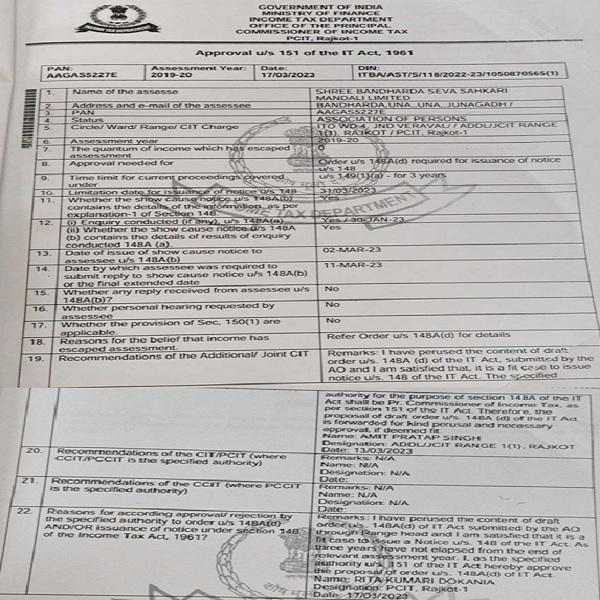
14. I have gone through the above approval under section 151 of the Act and noted that it is neither signed digitally nor manually. Therefore, I note that since the issue is squarely covered by the judgment of the Co-ordinate Bench of ITAT Rajkot, in the case of M/s. Aditya Plastics (supra) and there is no change in the facts and law. Therefore, respectfully following the binding precedent of the Co-ordinate Bench of ITAT Rajkot (supra), the reassessment proceedings should be quashed.
15. I have also gone through the second technical plea raised by the learned Counsel for the assessee, stating that the reassessment was initiated on different issue, (on account of cash deposit/withdrawal) whereas the final addition made by the Assessing Officer on different issue (by making disallowance of deduction under section 80P of the Act) and therefore, reassessment proceedings should be quashed. For that, reliance is placed on the judgment of the Hon’ble Bombay High Court in the case of Jet Airway Limited in Appeal No.1526 of 2008 and 1714 of 2009 dated April 12, 2010 (supra). Based on these facts and circumstances, the reassessment order framed by the assessing officer, under section 147 of the Act, dated 05.03.2024, should be quashed, and accordingly I quash the same and allow the appeal of the assessee.
16. As the reassessment itself is quashed, all other issues on merits of the additions, in the impugned assessment proceedings, are rendered academic and infructuous.
17. In the result, the appeal of the assessee is allowed.
Order is pronounced in the open court on 19/10/2026.