
K. N. Subramaniam Vs PCIT (Madras High Court)
Madras High Court held that Tax Recovery Officer cannot declare sale made by the assessee in favour of 3rd party as void. It is the function of civil court to declare a transaction as null and void and the Tax Recovery Officer cannot exercise the said function.
Facts- The present litigation is between the petitioner and the fourth respondent and the Income Tax Department. The fourth respondent appears as a party in person.
Notably, the 4th respondent defaulted in payment of tax, accordingly, the respondent Income Tax authorities issued a Demand Notice. As the fourth respondent failed to pay the arrears of tax, the property of the fourth respondent were attached vide order dated 25.05.2012 in Form ITCP No.16 issued by the Income Tax Department.
It appears that petitioner and the fourth respondent had earlier entered into a Sale Agreement dated 19.02.2009 for the sale of one of the property. The fourth respondent had executed a Power of Attorney dated 18.08.2009 in favour of the wife of the petitioner also named Buvaneshwari. The said Power of Attorney was later cancelled on 16.08.2011 vide Doc.No.971/2011.
The Income Tax Department had attached the said property on 25.05.2012. Meanwhile, the sale deed dated 24.02.2012 was registered/executed by the fourth respondent in favour of the petitioner. The fourth respondent has stoutly denied the execution of the aforesaid sale deed dated 24.02.2012 in favour of the petitioner.
Conclusion- Held that Tax Recovery Officer cannot declare sale made by the assessee in favour of a 3rd party as void, if he finds that the property of the assessee was transferred by the assessee to a 3rd party with “ an intention to defraud the revenue. As mentioned above, the expression “intention” has been deleted in the amended Section. The Court further held that, the Income Tax Department will have to file a suit in terms of Rule 11 (6) of the 2nd Schedule of the Income Tax Act, 1961, though under Rule 11 (6) of the 2nd Schedule of the Income Tax Act, 1961, the party against whom an order of attachment is made, has to institute a suit in a civil court to establish the right which he claims over the property in dispute and subject to the result of such suit (if any), the order of the Tax Recovery Officer shall be conclusive.
FULL TEXT OF THE JUDGMENT/ORDER OF MADRAS HIGH COURT
The writ petitioner has challenged the impugned order dated 16.02.2023 passed by the second respondent/the Tax Recovery Officer-III under Rule 11(1) of Second Schedule of the Income Tax Act, 1961.
2. The impugned order was passed pursuant to the directions of this Court in WP.No.20953 of 2019 and WMP.No.20137 of 2019 dated 14.10.2022 filed by the petitioner. Para No.8,9,10 of the said order reads as follows : –
8. Hence, it is for the TRO to look into the claim of ownership of the property and, in fact, the impugned communication, a mere notice, is precisely to such effect. Learned counsel for the petitioner would express apprehension that the TRO has pre-determined the issue, since at paragraph 2 he proceeds on the basis that the transfer had taken place for inadequate consideration, and when there was tax arrears.
9. The apprehension expressed by petitioner may be allayed by directing R2 to approach the matter with an open mind, hear the petitioner and R3* by issuance of prior notice, take their submissions into account and passing an order thereafter, in accordance with law and bearing in mind all relevant rules in this regard.
10. This Writ Petition is dismissed though with the directions as above. No costs. Connected Miscellaneous Petition is also dismissed.
[*the fourth respondent in this writ petition]
3. Relevant portion of the impugned order dated 16.02.2023 reads as under:-
“It is interesting to note that the facts of the case of the objector and the case law relied upon, are exactly similar. The aspects with regard to the principle of preponderance of probabilities, the explanation and counter arguments of the objector exhibiting lack of satisfaction and reasonableness, the failure on part of the income-tax returns of the objector to explain the source of investment made and the financial capacity of the objector are symmetric and therefore based on the circumstantial evidence and corroborative evidence (cancellation of sale agreement and immediate execution of sale deed), and essential supporting evidences in the form of disarranged entries in thumb impression register of SRO for the relevant dates, the actual date of execution of the document identified as forged getting executed on 24.02.2012 much ahead of the dated of cancellation of sale agreement systematically illustrate the nonadherence to this principle, and the financial incapacity of the objector as reflected in the ROI filed for A.Y.2012-13, it is hereby ascertained that the execution of deed of sale dated 24.02.2012 in the records of SRO, Annur, Coimbatore District is not genuine and necessarily termed as a ”FORGED DOCUMENT”.
On the final aspect that the criminal complaint filed by the Assessee in default, Smt. Sameer Bhuvaneshwari making a case of land-grabbing was quashed by the Hon’ble Supreme Court and that there is no case of claim of ownership by the assessee in default, it is found that this allegation is not true. As per the pronouncement of the Hon’ble Supreme Court SLP(Criminal) No.9087/2015, the complaint being Civil in nature was directed to be proceeded in that manner and hence criminal proceedings was according to the court uncalled for and hence quashed.
The Honourable Court has not provided any legitimacy to the impugned transaction as being attempted to be made by the objector. Therefore, when this investigation has clearly established that the claim of acquisition by the objector is not genuine, the decision of the Hon’ble Supreme Court which is on a different context and prayer does not absolve the objector from such acts of malfeasance as demonstrated above.
Conclusion: When the vendor has not received the sale consideration as claimed by the objector, the execution of registration of sale deed by the then SRO, Annur is illegitimate and unlawful and therefore the registration authorities are directed to cancel the same and restore title and ownership over the said asset to the Assessee in default and in-turn confirm the attachment of the impugned asset by the income-tax department for the purpose of recovery of tax dues from the Assessee in default.
Schedule of the Asset confirmed for attachment.
All that piece and parcel of land and building situate at Central theatre/Shree Astalakshmi theatre along with Plant and Machinery with 64 Cent land appurtenant to the building thereof at S.F.No.339/6, Annur Village, Avinashi Taluk, Coimbatore. Registered in the Annur Sub- Registrar Office in Document No.3609/2007 and 3608/2007”.
4. There is a long history to the litigation between the petitioner and the fourth respondent and the Income Tax Department. The fourth respondent appears as a party in person . The fourth respondent’s Return of Income Tax for the Assessment Year 2008-09 and Assessment Year 2009-10 resulted in a demand of tax arrears for a sum of Rs.20,69,529/- along with interest under Section 220(2) of Rs.41,390/- for the Assessment Year 2008-09 and a sum of Rs.16,21,470/- along with interest under Section 220(2) of Rs.32,428/- for the Assessment Year 2009-10.
5. As the 4th respondent had defaulted in payment of tax, the respondent Income Tax authorities issued a Demand Notice on 30.05.2011 under Rule 2 of the Second Schedule to the Income Tax Act, 1961. Again on 30.08.2012, another Demand Notice was issued demanding the fourth respondent to pay arrears of tax along with interest. As the fourth respondent failed to pay the arrears of tax, the property of the fourth respondent were attached vide order dated 25.05.2012 in Form ITCP No.16 issued by the Income Tax Department.
6. It appears that petitioner and the fourth respondent had earlier entered into a Sale Agreement dated 19.02.2009 for the sale of one of the property viz., a theater together with land measuring an extent of 4950 Sq. ft. in Survey No.339/6 in Annur Village, Avinasi Revenue Jurisdiction, Coimbatore District. The fourth respondent had executed a Power of Attorney dated 18.08.2009 in favour of the wife of the petitioner also named Buvaneshwari. The said Power of Attorney was later cancelled on 16.08.2011 vide Doc.No.971/2011.
7. The Income Tax Department had attached the said property on 25.05.2012. Meanwhile, the sale deed dated 24.02.2012 was registered/executed by the fourth respondent in favour of the petitioner which was registered as Document No.1981/2012.
8. The fourth respondent has stoutly denied the execution of the aforesaid sale deed dated 24.02.2012 in favour of the petitioner. When the case was taken up for hearing, the fourth respondent appeared in person and submitted that the Sale Agreement dated 19.02.2009 which preceeded the said bogus sale on 24.02.2012 was cancelled on 27.02.2012 vide Deed of cancellation and registered as Document No.1980/2012 and therefore registration of Sale Deed in favour of the petitioner on 24.02.2012 which is registered as Document No.1981/2012 was void.
9. The specific case of the fourth respondent is that the fourth respondent had never executed the aforesaid sale deed dated 24.02.2012 which has been registered in Document No.1981/2012. The fourth respondent filed a copy of certificate dated 19.03.2005 of S1FS India, Forensic Science Organization to substantiate that the aforesaid Sale Deed dated 24.07.2014 registered as Document No.1981 of 2012 was a forged document.
10. The learned Senior Counsel appearing for the petitioner would submit that private complaint was given by the fourth respondent against the petitioner and summons were also issued and therefore the petitioner had filed Crl. O.P.No.14617 of 2015 before this Court. It is submitted that Crl. O.P.No.14617 of 2015 was dismissed by this Court vide order dated 17.06.2015. Meanwhile, a final report was also filed by the Investigating Officer on 07.08.2017 whereby it was confirmed that the sale was irregular. It is submitted that the order of this Court passed in Crl.O.P.No.14617 of 2014 was however, set aside by the Hon’ble Supreme Court of India in SLP(Crl.) No.9087 of 2015, dated 25.10.2017.
11. The learned Senior Counsel for the petitioner has drawn attention to the following passage from the decision of the Hon’ble Supreme Court of India:-
Heard.
We are of the view that the allegations levelled in the criminal proceedings lodged by respondent no.2, are of civil nature and the criminal proceedings are not called for. The same are hereby quashed.
It will be open to respondent no.2 to continue or take any civil proceedings in accordance with law.
The special leave petition is accordingly disposed of. Pending applications, if any, shall also stand disposed of.
12. The learned Senior Counsel appearing for the petitioner further submits that the fourth respondent had an option to file a Civil suit. However, till date, the fourth respondent has not filed a suit against the petitioner. Thus, it is submitted that sale in favour of the petitioner vide registered Document No.1981 dated 24.02.2021 is binding. The learned Senior Counsel appearing for the petitioner further submits that though the second respondent has no jurisdiction to declare that the sale deed dated 24.02.2012 registered as
13. In this connection, the learned Senior Counsel has drawn attention to decision of Bench of this Court in Sri Sivalaya Advances and Ors. Vs. Tax Recovery Officer-2, Income Tax Offices, Madurai reported in [2018] 408 ITR 611(Mad). A specific reference was made to Para 21 from the said decision, wherein it was observed as under:-
“Yet the orders impugned in these writ petitions cannot sustained as such. The Hon’ble Supreme Court in MANU/SC/0600/1998: (1998) 6 SCC 658 has held that it is the function of the civil court to declare a transaction to be null and void and that the Tax Recovery Officer cannot exercise the said function. Therefore, the respondent clearly erred in declaring the transactions to which the petitioners are parties as null and void. Therefore, the orders impugned in these writ petitions stand quashed to that extent. It would certainly be open to the petitioners herein to avail the remedy set out in Rule 11(6) of the second schedule of the Income Tax Act. If the respondent authority wants to have the transactions nullified, it is the respondent who must go to the Civil Court to seek declaration to that effect. If the writ petitioners want the attachment to be lifted, it is for them to move the civil Court and obtain relief as provided in Rule 11(6) of the second schedule of the Income Tax Act.”
14. Learned Senior Counsel would submit that the decision of the Hon’ble Supreme Court in Tax Recovery officer II, Sadar, Nagpur Vs. Gangadhar Vishwanath Ranade (1998) 6 Supreme Court Cases 658 was referred to while passing the above order. It is submitted that the Income Tax Department has also not filed any appeal against the decision in Sri Sivalaya Advances and Ors. Vs. Tax Recovery Officer-2, Income Tax Offices, Madurai case. Therefore, the ratio therein has to be followed in the facts of the present case.
15. Learned Senior Counsel has also drawn attention to the decision of this Court rendered in WP.No.20953 of 2019 filed by the petitioner against summons issued under section 281 of the Income Tax Act on 08.05.2019. Though, the writ petition was dismissed by this Court on 14.10.2022, nevertheless, this Court had directed the Officer namely the second respondent to dispose the case by taking into account of all submissions before passing further orders.
16. Learned counsel appearing for the Income Tax Department submits 11/26 that the sale was void by operation of law in terms of Rule 16(1) of the II Schedule of the Income Tax Act, 1961. It is therefore submitted that the sale which is said to have taken place on 24.02.2012, vide Document No.1981 pursuant to the sale agreement dated 19.02.2009 was void abinitio. It is further submitted that even if the second respondent was not required to declare the sale as void, by operation of Rule 16 of II Schedule of Income Tax Act, 1961, said sale was indeed void.
17. That apart, the learned counsel would further submit that the Sale Agreement on 19.02.2009 was canceled by the fourth respondent herein on 27.02.2012 vide registered Document No.1980/2012. Therefore, there is no merit in the present Writ Petition. That apart, it is submitted that in terms of Rule 11(6) of the second schedule of the Income Tax Act, 1961, only remedy that is available to the petitioner is to file a civil suit.
18. It is submitted that the fourth respondent is Party-in-Person with whom the petitioner had transactions had registered a sale agreement dated 19.02.2009. It is submitted that the fourth respondent’s signature was forged by the petitioner in connivance with the Sub Registrar while registering Sale Deed dated 24.02.2012 registered as Document No.1981 of 2012.
19. It is submitted that the sale agreement dated 19.02.2009 was cancelled vide registered Document No.1980 of 2012 on 27.02.2012 and therefore the sale deed dated 24.02.2012 registered as Document No.1981 of 2012 was void. It is submitted that if the document dated 24.02.2012 had preceded the cancellation of Sale Agreement on 27.02.2012, it should have been numbered prior to 1980 and not after 1980, but it has been registered 1981.
20. Learned counsel for the second respondent has drawn attention to Para 17 of the counter which reads as under:-
17. It is submitted that for proving that the alleged sale deed No.1981/2012 was not executed by the 4th Respondent, I extracted the reason for cancellation of the sale agreement; wherein which was stated in the 2nd paragraph of the cancellation of sale deed No.1980/2012 by the petitioner and the 4th Respondent for easy reference as follows:-
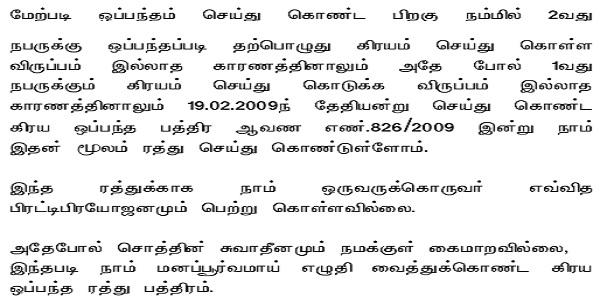
21. I have considered the arguments advanced by the learned counsel for the petitioner and the learned counsel for the Income Tax Department and the 4th respondent who appeared as party in person.
22. The question that arises for consideration is whether the impugned order is liable to be quashed or whether the petitioner or the fourth respondent should be relegated to approach the Civil court in terms of the Section 11(6) of the Second Schedule to the Income Tax Act, 1961 or whether the fourth respondent who has failed to file the Civil suit in terms of decision of the Hon’ble Supreme Court in SLP.(Crl.)No.9087 of 2015, dated 25.10.2017 is entitled to have audience before this Court.
23. The challenge to the impugned order is unsustainable on the grounds stated in the affidavit as admittedly the assets of the 4th respondent were attached by the Income Tax Department on 25.05.2012 in respect of arrears of tax of the 4th respondent for Assessment year 2008-2009 and Assessment year 2009-2010. The alienation/transfer is contrary to section 281 of the Income Tax Act,1961.
24. The sale of the subject property vide Document No1981 dated 24.2.2012 was followed by a order of attachment dated 25.05.2012. The decision of the Hon’ble Supreme Court in Tax Recovery Officer II versus Gangadhar Vishwanath Ranade (1998) 6 SCC 658 cannot be applied to the facts of the present case as it was rendered in the context of Section 281 of the Income Tax Act, 1961 when it read differently.
25. Section 281 of the Income Tax Act, 1961 as it stood during the period when the above decision was rendered and as it reads today is materially








