Akbal Zullur Rahman Vs ITO (ITAT Cuttack)
Seven Days Means Seven Clear Days: ITAT Quashes Reassessment Where Section 148A(b) Notice Allowed Compliance From 13 March to 20 March
Summary: The Cuttack Bench of the Income Tax Appellate Tribunal has held that a notice issued under Section 148A(b) is invalid where the assessee is not granted the statutory minimum period of seven clear days to submit his response. Since the jurisdictional notice itself was invalid, the Tribunal quashed the notice as well as the reassessment order passed on its basis.
Facts of the case
The assessee, Akbal Zullur Rahman, challenged the order passed by the Commissioner of Income Tax (Appeals), National Faceless Appeal Centre, for Assessment Year 2020-21.
The assessee’s appeal before the Tribunal was filed with a delay of 252 days. A petition seeking condonation of delay was filed, explaining the reasons for the belated filing. After considering the contents of the petition, the Tribunal accepted that sufficient cause had been shown, condoned the delay and proceeded to dispose of the appeal on merits.
The central controversy related to the time provided to the assessee under the notice issued in the reassessment proceedings.
The Assessing Officer issued a notice under Section 148A(b) on 13 March 2024, requiring the assessee to furnish his response on or before 20 March 2024.
The assessee contended that the notice did not grant the statutory minimum period of seven days because the period between the date of issue and the date fixed for compliance did not provide seven clear days.
Assessee’s contention
The authorised representative submitted that Section 148A(b) requires the Assessing Officer to provide an assessee with an opportunity of being heard by serving a show-cause notice and granting a period of not less than seven days to furnish a reply.
Although the notice was dated 13 March 2024 and the compliance date was fixed as 20 March 2024, the assessee did not receive seven clear days for filing his response. If the date of issuance and the date fixed for compliance are excluded, the assessee effectively had only the intervening period from 14 March to 19 March 2024.
It was, therefore, argued that the notice failed to comply with the mandatory statutory requirement. Since the defect went to the very foundation of the reassessment proceedings, the notice and every subsequent proceeding founded upon it were liable to be quashed.
The Departmental Representative, on the other hand, strongly supported the order of the Commissioner (Appeals).
ITAT’s findings
The Tribunal examined the dates specified in the notice and accepted the assessee’s objection. It found that the notice under Section 148A(b) was issued on 13 March 2024, while the assessee was directed to comply by 20 March 2024.
According to the Tribunal, the notice did not provide the assessee with the statutorily required seven clear days to respond. Consequently, the notice itself was invalid.
In reaching this conclusion, the Tribunal relied upon the judgment of the Jharkhand High Court in Satish Kumar, where the statutory period prescribed under Section 148A(b) had been considered. Following that decision, the Tribunal held that failure to provide the minimum prescribed period invalidated the jurisdictional notice.
Once the notice under Section 148A(b) was held to be invalid, the reassessment order passed on the strength of that notice could not survive independently.
The Tribunal accordingly:
- condoned the 252-day delay in filing the appeal;
- held the notice issued under Section 148A(b) to be invalid;
- quashed the defective notice;
- quashed the consequential reassessment order; and
- allowed the assessee’s appeal.
Thus, this was not a case of remand or restoration for reconsideration. The reassessment itself was quashed in full.
Author’s comments
The decision underlines that the opportunity contemplated under Section 148A(b) is not an empty formality. The statutory words “not less than seven days” prescribe a minimum period that the Assessing Officer must honour before passing an order under Section 148A(d).
A period stated with reference to calendar dates may appear to cover seven days mathematically. However, where the notice is issued on 13 March and compliance is required by 20 March, seven clear intervening days are not available. The assessee effectively gets only six clear days between the two terminal dates.
The ruling is important because Section 148A constitutes a jurisdictional safeguard introduced to give the assessee a meaningful opportunity to rebut the information suggesting escapement of income before a notice under Section 148 is issued. An opportunity that is shorter than the statutory minimum cannot ordinarily be treated as valid merely because the assessee could theoretically upload a response during the truncated period.
At the same time, the issue may invite further debate. Section 148A(b) refers to a period of not less than seven days “from the date on which such notice is issued.” The Revenue may contend in appropriate cases that the interval between 13 March and 20 March satisfies the requirement of seven days. The Tribunal has, however, adopted the “clear days” principle, excluding the starting and compliance dates, and treated the prescribed minimum opportunity as mandatory.
From a practical perspective, an assessee challenging such a notice should preserve the notice, the date of actual electronic communication, the compliance deadline displayed on the portal and any request for extension. Where fewer than seven clear days are provided, the objection should preferably be raised immediately before the Assessing Officer and reiterated in appeal.
The ruling establishes that failure to grant the minimum statutory response period is not merely a procedural irregularity capable of being ignored. It affects the validity of the jurisdictional process itself and can result in the entire reassessment being quashed.
Cases Discussed
- Satish Kumar in W.P (T) No.2640 of 2023 dated 28.08.2023.
FULL TEXT OF THE JUDGMENT/ORDER OF ITAT CUTTACK
This is an appeal filed by the assessee against the order of the CIT(A), NFAC [hereinafter referred to as the ‘CIT(A)’] in appeal no.NFAC/2019-20/10427234 dated 18.08.2025 for the assessment year 2020-21.
2. Shri Somnath Sahoo, AR appeared on behalf of the assessee and Shri Vijay Singh, Sr. D.R. represented on behalf of the revenue.
3. The appeal of the assessee is delayed by 252 days. In this regard, the assessee has filed a petition for condonation of delay stating sufficient reasons for the delay. Considering the contents of the petition filed by the assessee for condonation of delay, we condone the said delay in filing the appeal before the Tribunal. The appeal of the assessee is being disposed off on merits.
4. At the outset, the ld. AR drew our attention to the notice issued u/s 148A(b) of the Act dated 13.03.2024 and date of compliance was fixed on 20.03.2024, the same reads as under:
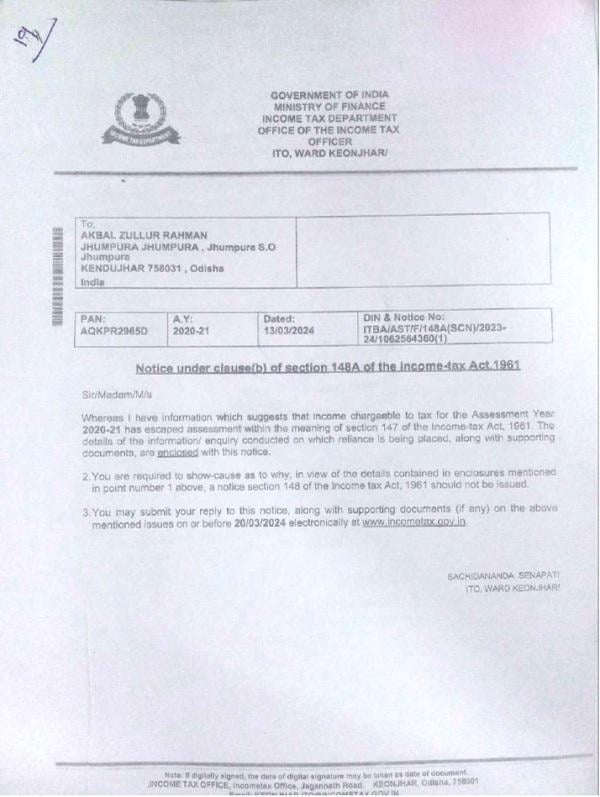
5. It was submitted by the ld. AR that the ld. CIT(A) dismissed the appeal of the assessee without considering the fact that the notice issued u/s 148A did not provide the required 7 days’ time. It was the submission that the notice u/s 148A is dated 13.03.2024 and in the notice itself, it was directed to the assessee to comply by 20.03.2024, hence statutory 7 days’ time has not been provided to the assessee. It was the submission that the notice issued u/s 148A is invalid and consequent proceedings are also invalid.
6. In reply, the ld. CIT-DR vehemently supported the order of the ld. CIT(A).
7. We have considered the rival submissions. A perusal of the facts of the present case clearly shows that the notice u/s 148A was issued on 13.03.2024 and in the notice it was directed to the assessee to comply by 20.03.2024, hence statutory 7 days’ clear time has not been provided to the assessee, notice issued u/s 148A(b) itself is found to be invalid. This view of ours is supported by the decision of the Hon’ble Jharkhand High Court in the case of Satish Kumar in W.P (T) No.2640 of 2023 dated 28.08.2023. This being so and respectfully following the decision of the Hon’ble Jharkhand High Court in the case of Satish Kumar referred to supra, the notice issued u/s 148A of the Act is held to be invalid and consequently is quashed and the assessment order based on the invalid notice also stands quashed.
8. In the result, the appeal of the assessee is allowed.
Order pronounced in the open court on 10/09/2026.