
D Y Patil Innovation Foundation Vs CIT (Exemption) (ITAT Mumbai)
Summary: Both appeals were filed by D Y Patil Innovation Foundation against orders dated 29.03.2026 passed by the Commissioner of Income Tax (Exemption), Mumbai under Sections 12A and 80G of the Income Tax Act, 1961. The appeals concerned the validity of the assessee’s applications for regular registration under section 12AB and approval under section 80G. For convenience, ITA No. 7141/M/2026 was treated as the lead case and the decision was to apply mutatis mutandis to the connected appeal. The assessee, a trust whose activities were stated to relate to charitable purposes within the meaning of section 2(15), had obtained provisional registration in Form 10AC on 27.02.2024, valid from AY 2024-25 to AY 2026-27, and filed Form No. 10AB dated 27.09.2025 seeking regularisation under section 12A.
The CIT(E) considered that, under section 12A(1)(ac)(iii), the assessee should have applied by the end of August 2024, treating the date of provisional registration as the commencement of activities, and rejected the application as delayed by more than 12 months. Before the Tribunal, the assessee relied upon audited financial statements for FYs 2023-24 and 2024-25 and contended that no activities connected with its main charitable objects had commenced during FY 2023-24, apart from petty preliminary and administrative expenditure incurred for setting up the trust’s activities.
It was argued that formation of the trust, opening a bank account, obtaining PAN or provisional registration did not by themselves establish commencement of charitable activity. The Departmental Representative supported the CIT(E)’s view and referred to purchases, employee costs, depreciation, amortisation and administrative expenses during FY 2024-25. The Tribunal held that the expression “commencement of its activities” in section 12A(1)(ac)(iii) required examination with reference to the actual activities undertaken and the material available on record. Mere grant of provisional registration could not, by itself and without verification of underlying facts, be treated as conclusive evidence of the date on which charitable activities commenced. The Tribunal found that the assessee’s contention regarding preliminary and administrative expenditure and absence of activity in furtherance of the main charitable objects required proper factual verification and that the CIT(E) had not examined the issue after giving the assessee an effective opportunity to explain and substantiate the actual date of commencement. The order under section 12A/12AB was therefore set aside and the application was restored to the CIT(E) for fresh consideration, with liberty to the assessee to furnish audited financial statements, expenditure details and documentary evidence regarding commencement of charitable activities. The CIT(E) was directed to verify the actual date of commencement on the basis of the material furnished and adjudicate the application afresh after granting a reasonable opportunity of being heard.
The Tribunal expressly stated that it had not expressed any view on the merits of the assessee’s eligibility for registration. The connected order relating to section 80G was also set aside and restored for fresh adjudication on the connected factual issue. Both appeals were allowed for statistical purposes.
FULL TEXT OF THE ORDER OF ITAT MUMBAI
Both the appeals pertain to the same assessee filed against the order of the Ld. Commissioner of Income Tax (Exemption), Mumbai [for brevity “Ld. CIT(E)”], order passed under Section 12A and 80G(5) of the Income Tax Act, 1961 (for brevity ‘the Act’), date of both the orders 29.03.2026.
2. Both the appeals pertain to the same assessee and arising out from validity of application for registration under Section 12A and 80G of the Act. For sake of convenience ITA No. 7141/M/2026 is taken as lead case and the decision rendered therein shall be applied mutatis mutandis to other appeal.
ITA No. 7141/MUM/2026
3. The brief facts of the case are that the assessee is a trust and its activities are related to charitable purpose within the meaning under Section 2(15) of the Act. The assessee filed the application in Form No. 10AB dated 27.09.2025 under Section 12A of the Act for seeking regularization of provisional registration under Section 12AB of the Act. On verification of application, the Ld. CIT(E) found that the application was incomplete in absence of valid evidence. So, the Ld. CIT(E) issued notice for complying the documents related to the registration. During the process of registration, the Ld. CIT(E) had made the following observations contended in Para No. 3 to Para No. 3.1, which are reproduced as below:
“3. On perusal of above submission of the applicant, details and documents attached with the Form 10AB and data available on ITBA/CPC portal, it is noticed that the applicant has obtained provisional registration vide Order dated 27.02.2024 in Form 10AC having validity from A.Y. 2024-25 to Α.Υ. 2026-27. The condition for making application for regularization of provisional registration in Form 10AB is governed by the provision of Section 12A(1)(ac) (iii) of the Income tax Act, which is as under:-
“where the trust or institution has been provisionally registered under section 12AB, at least six months prior to expiry of period of the provisional registration or within six months of commencement of its activities, whichever is earlier;”
3.1 Thus, as per the above provision, since the trust has been carrying out activities since obtaining provisional registration as on 27.02.2024, the trust should have applied for regularisation of provisional registration latest by the end of the month of August, 2024 (being six months from the commencement of activities). However, the trust has filed present application (Form 10AB) for regularization of provisional registration Order u/s 12A on 27.09.2025 i.e. after delay of more than 12 months, which is not valid as per the above provision as the application is filed beyond permissible time limit.”
The said application was duly rejected. The aggrieved assessee filed an appeal before us by challenging the order of Ld. CIT(E).
4. The Ld. AR argued and filed a paper book comprising pages 1 to 63, which has been placed on record. The Ld. AR contended that the Ld. CIT(E) had rejected the assessee’s application on the ground that the assessee had not applied for registration within six months after due commencement of activities. The assessee is liable for application of provisional registration latest by the end of August 2024, whereas the assessee had made the application dated 27.09.2025. The Ld. AR has opposed the observation of the Ld. CIT(E). The Ld.AR invited our attention to APB pages 22 to 42, where the copies of audited financial statements for Financial Years 2023-24 and 2024-25, along with ITR acknowledgment, are duly enclosed. On perusal of the said financial statement, we find that the assessee had not initiated any activities except some petty expenses for initiating the activities for FY 2023-24. But no such activities were initiated related to the main object of the Trust in the said years. So the ld. AR contended that assessee is not eligible to file the application within six months from starting of activities.
5. The Ld. AR contended that the assessee has not initiated any activity in FY 2023-24. The relevant Income & Expenditure Account for FY 2023-24 is reproduced as below:-
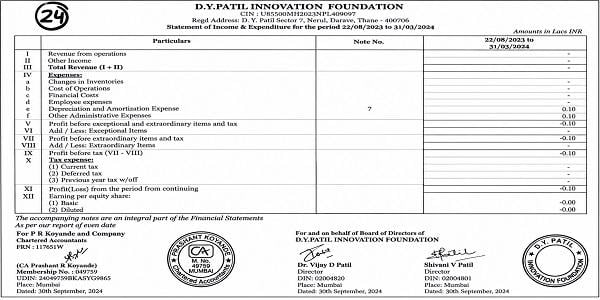
6. The Ld. AR further argued that the assessee is running the educational support service for setting up the process, practices and events to encourage the students and faculties for innovative ideas on artificial intelligence training. So, the actions considered by the assessee are only related to preliminary expenses to run the trust. The Ld. CIT(A) without giving any opportunity to explain the issue rejected the application in arbitrary manner. He argued that commencement of activity is marked by the first actual charitable/religious activity, evidenced typically by the first donation/expenditure incurred towards a charitable object. Mere formation of the trust, opening a bank account, or obtaining PAN/provisional registration is treated as preparatory, not commencement. The date of commencement of activity is not defined under the Act, but it is generally taken as the date when the first donation/expense on the charitable object was incurred, and this is distinct from the date of provisional registration, since that registration can be obtained before commencement of activity. Provisional registration can be, and often is, obtained before any activity begins as it is fast-track and activity-agnostic. Provisional registration is not proof of, and does not fix, the date of commencement. So, the absence of activity is not by itself a ground to refuse registration to a newly formed trust or the trust has provisional registration. A newly formed trust with no activities could still be considered for registration under Section 12AA.
7. The Ld. DR argued and stands in favor of the orders of the Ld. CIT(E). The Ld. DR contended that the assessee had made a purchase during the FY 2024-25 and incurred the employee’s cost, depreciation and amortization expenses, and other administrative expenses. But related the FY 2023-24 the Ld. DR remained silent. He contended that the Ld. CIT(E) is justified to reject the application petition of the assessee.
8. We have heard the rival submissions and perused the material available on record. The limited controversy before us is whether the applications filed by the assessee for regular registration under section 12AB and approval under section 80G of the Act could be rejected on the ground that the applications were filed beyond the prescribed period reckoned from the alleged commencement of activities. On perusal of the impugned order, we find that the Ld. CIT(E) proceeded on the premise that since the assessee had obtained provisional registration on 27.02.2024, it had been carrying on its activities from that date and, consequently, ought to have filed Form No. 10AB by the end of August 2024. However, the contention of the assessee is that obtaining provisional registration by itself cannot be equated with actual commencement of the charitable activities of the trust. In support thereof, the assessee has placed on record the audited financial statements for FYs 2023-24 and 2024-25, along with the corresponding returns of income, which are placed at APB pages 22 to 42.
9. We find that the expression “commencement of its activities” occurring in section 12A(1)(ac)(iii) requires examination with reference to the actual activities undertaken by the trust and the material available on record. The mere date of grant of provisional registration cannot, by itself and without verification of the underlying facts, be treated as conclusive evidence of the date of commencement of the charitable activities. The assessee has specifically contended that during FY 2023-24 it had incurred only preliminary and administrative expenditure for setting up its activities and that no activity
in furtherance of the main charitable objects had actually commenced during the said period. This contention, together with the audited financial statements and other supporting material, requires proper factual verification.
10. We further observe that the aforesaid aspect has not been examined by the Ld. CIT(E) after granting the assessee an effective opportunity to explain the actual date of commencement of its activities and to substantiate the same with relevant evidence. In these circumstances, we consider it appropriate to restore the matter to the file of the Ld. CIT(E) for fresh consideration.
11. Accordingly, the impugned order is set aside and the application under section 12A/12AB of the Act is restored to the file of the Ld. CIT(E). The assessee shall be at liberty to furnish the audited financial statements, details of expenditure, documentary evidence regarding commencement of its charitable activities and such other material as may be relevant. The Ld. CIT(E) shall verify the actual date of commencement of the activities on the basis of the material placed before him and thereafter adjudicate the application afresh in accordance with law. Needless to say, the assessee shall be afforded a reasonable opportunity of being heard. We have not expressed any view on the merits of the eligibility of the assessee for registration.
12. Since the appeal concerning approval under section 80G arises in the case of the same assessee and involves the connected factual issue concerning its charitable activities, the impugned order relating to the application under section 80G is also set aside and the matter is restored to the file of the Ld. CIT(E) for fresh adjudication in accordance with law after considering the material furnished by the assessee and after granting a reasonable opportunity
of being heard. We refrain from expressing any view on the merits of the assessee’s claim for approval under section 80G.
13. In the result, the appeal of the assessee bearing ITA No. 7139 & 7141/Mum/2026 are allowed for statistical purposes.
Order pronounced in the open court on 18th day of August 2026.







