Jagruti Chetan Thakker Vs (ITAT Mumbai)
Mumbai ITAT Deletes ₹35.60 Lakh CCM Addition; Mere Investigation Wing Information Cannot Prove Bogus Client Code Modification
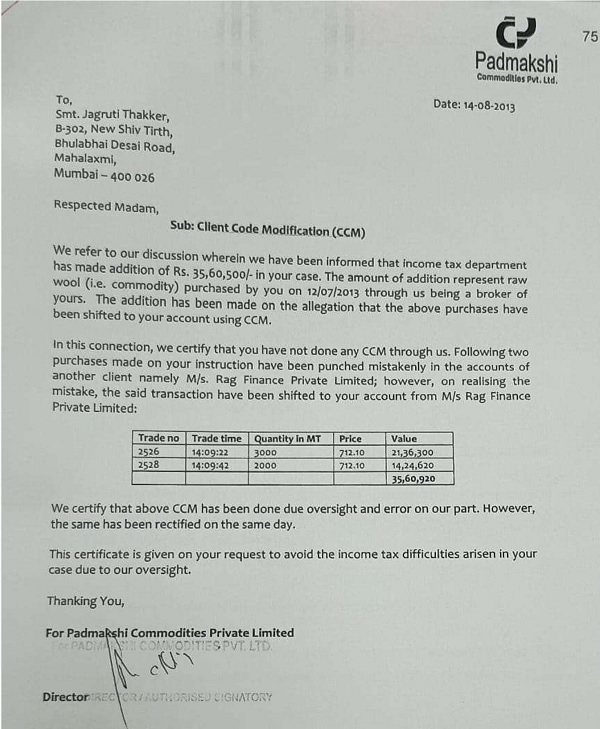
The Mumbai ITAT allowed the appeal of Mrs. Jagruti Chetan Thakker, deleting the addition of ₹35.60 lakh made under Section 69A read with Section 115BBE on the allegation that she had derived fictitious profits through Client Code Modification (CCM) transactions on the National Spot Exchange Ltd. (NSEL) platform. The reassessment was initiated solely on information received from the Investigation Wing alleging that the assessee was a beneficiary of CCM. The assessee, however, produced contract notes, broker’s ledger, warehouse records and a broker’s confirmation stating that any CCM was carried out due to the broker’s own punching error and without any instruction or involvement of the assessee.
The Tribunal relied on its earlier decision in ACIT v. Suman Gandhi (2026) 183 taxmann.com 217 (Mumbai-Trib.), as well as the Bombay High Court decisions in Aashish Niranjan Shah and Pr. CIT v. Pat Commodity Services Pvt. Ltd., which held that Client Code Modification by itself does not justify an addition unless the Revenue establishes that the assessee instructed the broker, colluded in the modification, or actually derived an unlawful benefit. It noted that the Revenue failed to produce any independent or corroborative evidence linking the assessee to any fraudulent CCM arrangement.
The Tribunal observed that the entire addition rested only on information received from the Investigation Wing, without any material showing that the impugned transactions were sham or that the assessee had received accommodation entries. Since the broker had categorically confirmed that the CCM resulted from its own operational error and the Department failed to rebut that evidence, the Tribunal held that the addition under Section 69A was unsustainable in law. Accordingly, it deleted the addition of ₹35.60 lakh, set aside the order of the CIT(A), and allowed the appeal.
Cases Discussed
- ACIT v. Suman Gandhi (ITAT Mumbai), (2026) 183 taxmann.com 217 (Mumbai-Trib.)
- Aashish Niranjan Shah v. UOI (Bombay High Court), [2024] 167 taxmann.com 561 (Bombay)
- CIT v. Pat Commodity Services Pvt. Ltd. (Bombay High Court), IT Appeal No. 1257 of 2016, dated 15-1-2019
FULL TEXT OF THE ORDER OF ITAT MUMBAI
The instant appeal of the assessee filed against the order of the NFAC, Delhi [for brevity “Ld. CIT(A)”], order passed under Section 250 of the Income Tax Act, 1961 (for brevity, ‘the Act’), for Assessment Year 2014-15, date of order 13.02.2026. The impugned order emanated from the order of the National Faceless Assessment Center, Delhi (for brevity ‘Ld. AO’), order passed under Section 147 r.w.s. 144B of the Act, date of order 28.03.2022.
2. The brief facts of the case are that the assessee at an individual capacity filed the return by declaring total income Rs. 2,68,600/-. As per information available with the department, the assessee entered transactions for fictitious profit in equity/derivatives trading through client code modification through NSEL (National Spot Exchange Limited) during the impugned financial year. The assessee’s case was reopened u/s. 147 and, accordingly, notice was duly issued u/s. 148 of the Act. The Ld. AO found that the assessee had failed to explain the profit amount to Rs. 35,60,500/- through the CCM (Client Code Modification) in NSEL platform. So, the addition amount to Rs. 35,60,500/- is hereby confirmed u/s. 69A of the Act r-w-s 115BBE of the Act. The aggrieved assessee filed an appeal before the Ld. CIT(A). The Ld. CIT(A) had confirmed the addition made by the Ld. AO. Being aggrieved, assessee filed an appeal before us.
3. The Ld. AR argued and filed a paper book comprising Pages 1 to 75, which has been placed on record. The Ld. AR contended that the assessee is a regular trader of the equity shares and derivatives and traded through the recognized stock exchange. The assessee’s invited our attention in APB pages 51 to 54 related to broker contract reflecting the warehousing charges charged and bill raised by the broker in respect of the above contract note APB page 55 to 56. Further, the ledger account of the assessee in the books of broker and delivery allocation showing that the commodities have been kept in warehouse on behalf of the assessee is also annexed in APB page 57 to 72. The Ld. AR invited our attention in the in APB page 75, where the broker has submitted the confirmatory letter for the assessee and mentioned that the assessee is not at all involved in any CCM process. The relevant confirmatory letter is reproduced as below:
4. The Ld. AR contended that the identical issue was duly considered by the coordinate bench of ITAT Mumbai in the case of ACIT v. Suman Gandhi reported in (2026) 183 taxman.com 217 (Mumbai-Trib). The relevant paragraphs 7 to 10 of the order of coordinate bench are reproduced as below:
“7. We have considered rival submissions and perused the materials on record. As could be seen from the observations of the first appellate authority, the assessee’s books of accounts of the impugned assessment year indicates that she had total purchases of Rs.9,34,96,345/- and sales of Rs.9,53,59,139/- and shown gross profit of Rs.18,72,794/-through transactions undertaken in NSEL. There is a categorical finding of fact by the first appellate authority that the transactions of purchase and sale at NSEL are pair trade, meaning thereby, against each purchase transaction there is a corresponding sale transaction. Therefore, against each alleged Client Code Modification transaction there is equal quantity of either purchase or sale, hence, only resultant profit/loss arising for such transaction has to be considered. Another crucial factor which has to be borne in mind is, the broker M/s. AnandRathi Commodities Ltd. through whom the assessee had undertaken the transactions had stated before the A.O. that though it had undertaken Client Code Modification, however, it was done without any instructions of the assessee and was done to save time as the trade was punched on a single client code and then shifted to the client on whose name the trade was done. Thus, the statement of broker, unequivocally demonstrates that Client Code Modification, if any, was neither in the knowledge of the assessee, nor she had instructed the broker to do so. Further, A.O. has not specified the details of transactions undertaken by the assessee where client code is modified. Thus, when the Client Code Modification, if any, was undertaken by the broker, without any involvement or knowledge of the assessee, the assessee cannot be punished for such conduct of the broker that too when there is no specific allegation that the assessee derived any positive gain through such transactions. In case of AashishNiranjan Shah v. UOI [2024] 167 taxmann.com 561 (Bombay), the Hon’ble Jurisdictional High Court while dealing with the identical issue has held as under:
24. It is a matter of public knowledge that client codes entered by a stock broker at the time of execution of the trades are permitted to be modified within a stipulated time after execution, if the stock broker finds that there has been any error in entering the correct client code. In the instant case, there is nothing to show whether such modification had been effected by the stock broker to deal with his errors in execution or whether the modification has been effected under instructions of the Petitioner. Besides, every transaction executed under the Petitioner’s client code and thereby captured in his books of accounts have been subjected to scrutiny assessment. If someone else’s client code had been entered by the stock broker and that had been changed to the Petitioner’s client code, the transaction would get captured in the Petitioner’s books and would be part of the material scrutinized. If it is the Petitioner’s client code that had been originally entered by the stock broker, leading to it being modified after execution, it would have no bearing on the income of the Petitioner, since it would be the person whose client code was entered upon modification, whose taxation would be impacted. Therefore, fore, without any basis to show that there had been a failure on the Petitioner’s part in making a full and truthful disclosure of material facts, the very jurisdiction to initiate reassessment as provided for in Section 147 would not be attracted.
8. In case of Pr. CIT v. Pat Commodity Services Pvt. Ltd. (IT Appeal No. 1257 of 2016, dated 15-1-2019] the Hon’ble Jurisdictional High Court has held as under:
3. The respondent assessee is a private limited company engaged in the business of providing commodity services to its clients. In the return of income filed by the assessee for the Assessment Year 2006-07, the Assessing Officer noticed that there were instances of client code modifications. The Assessing Officer believed that the same was done to indulge in circular trading to pass on profits or losses to the clients of the assessee company as per requirements. After bearing the assessee, the Assessing Officer made additions in the income of the assessee on such basis. The Issue eventually reached to the Tribunal. The Tribunal did accept the Revenue’s theory of misuse of client’s code modification facility. However, the Tribunal accepted the assessee’s explanation and discarded the Revenue’s theory that profit of the assessee’s company were passed on to the clients. It was also noticed that the Revenue has not contended that the client code modification facility is often misused by the assessee to pass on losses to investors, who may have sizable profit arising out of commodity trading against which such losses can be set off. The Revenue normally points out number of such instances of client code modifications as well as nature of errors in filling of the client code. At any rate, what can be taxed in the hands of the present assessee is the income escaping assessment. Even if the Revenue’s theory of the assessee having enabled the clients to claim contrived losses, the Revenue if the Revenue’s theory some evidence of the income earned by the assessee in the process, be it in the nature of commission or otherwise. In the pre the Assessing Officer has added the entire amount of doubtful transactions by way of assessees additional income, which is wholly impermissible, we do double the fate of the individual investors in whose cases, the Revenue could have questioned the artificial losses. Be that as it may, we do not think entertaining these appeals would serve any useful purpose. enabled the present case.
9. Keeping in view the ratio laid down in the judicial precedents referred to above, if we examine the facts record, the Revenue has failed to establish that either the Client Code Modification has been done under the Instructions of the assessee or the assessee has derived any benefit out of such transactions. The other decisions relied upon by the Id. Counsel for the assessee are also in similar lines. In any case of the matter, we are unable to understand how the A.O. could have invoked the provisions of section 68 of the Act to make the addition when the disputed amount was not found credited in the books of account of the assessee and was any infirmity in the decision of learned first appellate authority. Grounds are dismissed. merely based on information available in an alleged report of SFIO. In view of the aforesaid, we do not find any infirmity in the decision of learned first appellate authority. Grounds are dismissed.
10. In view of the decisions in departmental appeal, the cross objection of the assessee has become academic, hence, does not require adjudication at this stage. However, the issues raised therein are kept open.”
5. The Ld. DR relied upon the orders of the revenue authorities. However, the Ld. DR was unable to point out any distinguishing facts or place on record any contrary judicial precedent to distinguish the decision relied upon by the Ld. AR.
6. We have heard the rival submissions and carefully considered the material available on record. The assessee originally filed its return by declaring a total income of Rs.2,68,600/-. On the merits of the addition, we find that the revenue has treated the assessee as a beneficiary of alleged Client Code Modification (CCM) transactions and made additions under Section 69A of the Act. However, the issue is no longer res integra. The Coordinate Bench of the ITAT, Mumbai, in Suman Gandhi (supra). has categorically held that, in the absence of cogent material establishing the assessee’s involvement in the alleged CCM arrangement, additions cannot be sustained merely on the basis of information received from the Investigation Wing. The Tribunal further held that unless there is evidence to establish the assessee’s participation in the alleged manipulation, together with corroborative material demonstrating that the impugned transactions were sham or collusive, no addition can be made.
In the present case, except for the information received from the Investigation Wing, the revenue has not brought any independent or corroborative evidence on record to establish that the assessee was a party to any fraudulent CCM activity. The relevant confirmatory letter from broker is also placed on record which is mentioned that the assessee is not involved / beneficiary in CCM. No material has been placed before us to demonstrate any collusion between the assessee and the broker or any other beneficiary, nor has any evidence been brought on record to show that the impugned transactions were fictitious or that the assessee received any accommodation entries. Significantly, the Ld. DR was also unable to distinguish the decision of the Coordinate Bench relied upon by the Ld. AR or cite any contrary judicial precedent.
Respectfully following the decision of the Coordinate Bench in Suman Gandhi (supra), we hold that the addition of Rs.35,60,500/- made under Section 69A of the Act is unsustainable in law. Accordingly, the addition amount to Rs. 35,60,500/- is directed to be deleted and the impugned order of the Ld. CIT(A) is set aside.
7. In the result, the appeal of the assessee bearing ITA No.4764/Mum/2026 is allowed.
Order pronounced in the open court on 30th day of July 2026.