Manchukonda Yethiraja Subrahmanyam Vs ACIT (ITAT Visakhapatnam)
Summary: Penalty under section 271AAB(1) cannot be sustained where the show-cause notice under section 274 does not specify the particular clause of section 271AAB(1) under which penalty is proposed, since clauses (a), (b) and (c) contemplate different factual circumstances and carry different rates of penalty.
Facts. A search under section 132 was conducted on 24.11.2015 at the assessee’s residential premises, during which silver jewellery weighing 17,220.90 grams and valued at Rs. 46,84,044 was found. In his statement under section 132(4), the assessee initially admitted the value of the silver articles as undisclosed income. The assessee subsequently explained that Rs. 23,49,000 represented his share of additional income disclosed by a partnership firm, M/s Navratna Estates, which had been utilised for investment in the silver articles. He filed a revised return declaring the balance Rs. 23,35,044 as additional income. The AO did not accept the explanation regarding Rs. 23,49,000 and made the addition. Penalty proceedings under section 271AAB were initiated.
AO / CIT(A) Finding. The AO imposed penalty under section 271AAB(1) at 60% of Rs. 23,35,044, resulting in a penalty of Rs. 14,01,026. The CIT(A) confirmed the penalty. Before the Tribunal, the assessee challenged the validity of the penalty proceedings on the ground that the notice under section 274 read with section 271AAB merely stated that penalty under section 271AAB was proposed, without specifying whether the proceedings were under clause (a), (b) or (c), or identifying the specific default/conditions alleged.
ITAT Finding. The Tribunal held that section 271AAB(1) contains clauses (a), (b) and (c), which operate in different factual situations and prescribe different rates of penalty. Therefore, the assessee must be informed of the particular clause under which penalty is proposed.
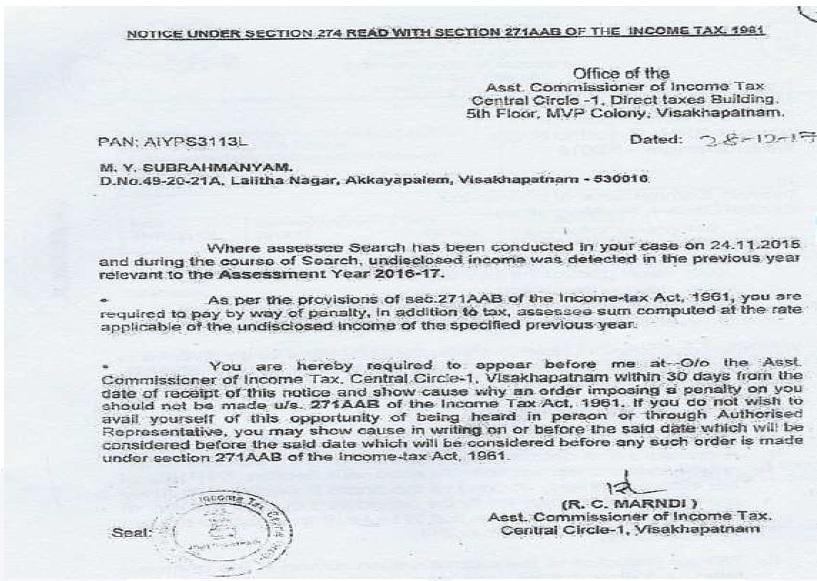
The notice dated 28.12.2017 merely required the assessee to show cause why an order imposing penalty under section 271AAB should not be made. It did not specify the applicable clause or the particular default/conditions alleged against the assessee. The subsequent notices dated 21.01.2021 and 22.02.2021 also did not cure the defect.
Section 274 — Reasonable Opportunity
The Tribunal observed that section 271AAB(3) makes sections 274 and 275 applicable to penalty proceedings under section 271AAB. The requirement under section 274 of providing a reasonable opportunity of being heard necessarily means that the assessee must know the precise statutory basis of the proposed penalty so that an effective defence can be made.
The Tribunal rejected the Revenue’s argument that specification of the particular clause was unnecessary because section 271AAB does not involve the two charges of concealment and furnishing inaccurate particulars applicable under section 271(1)(c). The Tribunal held that the three clauses of section 271AAB(1) themselves prescribe different factual conditions and penalty rates; hence, the assessee is entitled to know which clause is invoked.
Participation Does Not Cure Defect
The Tribunal also rejected the Revenue’s contention that the assessee had not challenged the validity of the notice during the penalty proceedings. It held that participation in penalty proceedings cannot confer jurisdiction where the statutory requirement for valid initiation has not been complied with. The defect went to the root of the proceedings because the assessee was not informed of the particular statutory provision under which he was required to defend himself.
Outcome. The ITAT held that the notice under section 274 read with section 271AAB was defective and the initiation of penalty proceedings was vitiated. Consequently, the penalty of Rs. 14,01,026 under section 271AAB(1) was quashed. The CIT(A)’s order was set aside and the assessee’s appeal was allowed. The Tribunal did not adjudicate the remaining grounds, leaving them open.
Ratio. Where section 271AAB(1) contains different clauses prescribing different factual conditions and rates of penalty, the show-cause notice under section 274 must specify the particular clause under which penalty is proposed. Failure to do so is a foundational jurisdictional defect which is not cured by the assessee’s participation in the penalty proceedings, and the resulting penalty order is liable to be quashed.
Cases Discussed
- PCIT Vs. Shri R. Elangovan, Tax Case Appeal Nos. 770 and 771 of 2018, dated 30.03.2021 – Madras High Court.
- Shri Kishan Kumar Aggarwal, Hyderabad Vs. ACIT, ITA No. 2107/HYD/2025, dated 17.06.2026 – ITAT Hyderabad.
- Baddham Venkateswarlu Vs. ACIT, Central Circle-1, Visakhapatnam, ITA No. 197/VIZ/2026, dated 24.07.2026 – ITAT Visakhapatnam.
FULL TEXT OF THE JUDGMENT/ORDER OF ITAT VISAKHAPATNAM
1. The present appeal filed by the assessee is directed against the order passed by the CIT(A), Visakhapatnam-3, dated 27-09-2025, which in turn arises from the penalty order passed by the AO under Section 271AAB(1) of the Income Tax Act, 1961 (for short, “the Act”), dated 21-01-2022, for A.Y. 2016-17. The assessee has assailed the impugned order on the following grounds of appeal before us:
“1. The order of the learned Commissioner of Income Tax (Appeals) is contrary to the facts and also the law applicable to the facts of the case.
2. The learned Commissioner of Income Tax (Appeals) is not justified in not quashing the order passed u/s 271AAB of the Act on 21.01.2022 as barred by limitation.
3. Without prejudice to the above, the learned Commissioner of Income Tax (Appeals) is not justified in not quashing the notice issued u/s 271AAB of the Act as invalid on the ground that the notice suffers from ambiguity in as much as the assessing officer did not specify the exact clause of the said section under which the penalty was proposed to be levied.
4. Without prejudice to Ground no.2 and 3, the learned Commissioner of Income Tax (Appeals) is not justified in confirming the penalty of Rs.14,01,026 levied by the assessing officer u/s 271AAB of the Act.
5. Without prejudice to Ground no.4, the learned Commissioner of Income Tax (Appeals) is not justified in confirming the penalty levied by the assessing officer @ 60% of the additional income u/s 271AAB(c) of the Act
6. Any other ground that may be urged at the time of appeal hearing.”
2. Succinctly stated, the assessee was subjected to search proceedings under Section 132 of the Act on 24-11-2015. During the search proceedings, silver jewelry (Wt: 17,220.90 grams), valued at Rs. 46,84,044/-, was found in his possession at his residential premises. Ostensibly, the assessee, in his statement recorded under Section 132(4) of the Act on 21-01-2016, when queried about the source of acquisition of the said silver articles, admitted that he was unable to substantiate the source and accepted the value thereof, amounting to Rs. 46,84,044/-, as his undisclosed income for the year under consideration.
3. Thereafter, the assessee filed his return of income for AY 2016-17on 08-03-2017, declaring an income of Rs. 42,93,470/-. However, the assessee did not include the additional income disclosed by him in his statement recorded during the search proceedings in his return of income. On being queried, the assessee submitted that M/s Navratna Estates, a firm in which he was a partner, had filed its return on 19-06-2017, declaring additional income of Rs. 1,17,45,000/- that it had disclosed in the course of the search proceedings, out of which his share worked out at Rs. 23,49,000/-. According to the assessee, the said amount represented unexplained income available in his hands, which was utilized for making investment in silver articles. The assessee thereafter filed a revised return of income on 19-11-2017, disclosing the balance amount of additional income of Rs. 23,35,044/- [Rs. 46,84,044/- (minus) Rs. 23,49,000/-] towards part disclosure of the undisclosed income admitted by him during the course of the search proceedings.
4. However, the AO did not accept the aforesaid explanation and made an addition of the balance amount of investment of Rs. 23,49,000/- (supra). Thereafter, the AO, vide order passed under Section 143(3) of the Act, dated 28-12-2017, determined the income of the assessee at Rs. 89,77,510/- and initiated penalty proceedings under Section 271AAB as well as Section 271(1)(c) of the Act.
5. Thereafter, the AO imposed penalty under Section 271AAB(1) of the Act at the rate of 60% of the undisclosed income of Rs. 23,35,044/- of Rs. 14,01,026/-, which was sustained by the CIT(A).
6. The assessee, aggrieved with the CIT(A) order, has assailed before us the sustenance of the penalty imposed under Section 271AAB(1) of the Act.
7. Shri GVN Hari, Ld. AR submitted that the penalty proceedings were initiated without valid assumption of jurisdiction by the AO, as a result whereof the order imposing penalty under Section 271AAB(1) of the Act, dated 21/01/2022 cannot be sustained and is liable to be vacated on the said ground itself. Elaborating on his contention, the Ld. AR submitted that the AO had imposed the penalty without issuing a valid notice under Section 274 r.w Section 271AAB of the Act. It was submitted that the notice dated 28-12-2017 merely required the assessee to show cause as to why an order imposing penalty under Section 271AAB should not be made, without specifying the particular clause of Section 271AAB(1) or the specific default/conditions alleged against the assessee. It was submitted that the subsequent notices dated 21-01-2021 and 22-02-2021 also did not cure the defect and merely afforded an opportunity of hearing. The Ld. AR, to fortify his contention, relied upon the judgment of the Hon’ble High Court of Madras in PCIT Vs. Shri R. Elangovan, Tax Case Appeal Nos. 770 and 771 of 2018, dated 30-03-2021, and the orders of the ITAT, Hyderabad, in Shri Kishan Kumar Aggarwal, Hyderabad Vs. ACIT, ITA No. 2107/HYD/2025, dated 17-06-2026, and the ITAT, Visakhapatnam, in Baddham Venkateswarlu Vs. ACIT, Central Circle-1, Visakhapatnam, ITA No. 197/VIZ/2026, dated 24-07-2026.
8. Per contra, the Ld. Sr. DR relied upon the orders of the authorities below and submitted that Section 271AAB does not contemplate separate defaults of concealment of income or furnishing of inaccurate particulars of income, as was the case under Section 271(1)(c), but merely prescribes different rates of penalty. It was, therefore, submitted that failure to specify any particular default in the notice could not invalidate the penalty proceedings. The Sr. DR further submitted that the assessee had not challenged the notice’s validity during the penalty proceedings before the AO.
9. We have heard the Authorized Representatives of both parties in the backdrop of the orders of the authorities below, and considered the judicial pronouncements pressed into service by them to drive home their respective contentions.
10. As the search in the present case was conducted on 24-11-2015, therefore, the provisions of Section 271AAB(1) of the Act are applicable. We are of the view that as Section 271AAB contains clauses (a), (b) and (c), which contemplate different factual situations and prescribe different rates of penalty, the particular clause under which the assessee is proposed to be proceeded against assumes significance.
11. Coming to the facts of the present case, the notice issued under Section 274 r.w Section 271AAB of the Act, dated 28-12-2017, merely required the assessee to show cause as to why an order imposing penalty under Section 271AAB should not be made. However, it did not specify the particular clause of Section 271AAB(1) or the specific default/conditions alleged against the assessee. The subsequent notices dated 21-01-2021 and 22-02-2021 also did not cure the said defect. For the sake of clarity, we deem it apposite to cull out the SCN, dated 28/12/2017, as under:
12. We find that Section 271AAB(3) makes the provisions of Sections 274 and 275 applicable, so far as may be, to penalty under the said Section. Accordingly, Section 274 requires that the assessee be afforded a reasonable opportunity of being heard, and such opportunity necessarily postulates that the assessee should be made aware of the precise statutory basis on which the penalty is proposed, so as to enable him to effectively defend himself.
13. We are unable to accept the Ld. Sr. DR’s contention that specification of the particular clause was unnecessary merely because Section 271AAB of the Act, unlike Section 271(1)(c) of the Act, does not contain the two charges contemplated under the latter penal provision. We are of the firm conviction that, as the three clauses of Section 271AAB(1) operate in different factual circumstances and carry different rates of penalty, the assessee is entitled to know the particular clause under which penalty was proposed. Our aforesaid view is fortified by the judgment of the Hon’ble High Court of Madras in PCIT Vs. Shri R. Elangovan, Tax Case Appeal Nos. 770 and 771 of 2018, dated 30-03-2021, wherein failure to specify the applicable category of penalty in the notice was held to vitiate the penalty proceedings. The same principle has been followed by the ITAT, Hyderabad, in Shri Kishan Kumar Aggarwal, Hyderabad Vs. ACIT, ITA No. 2107/HYD/2025, dated 17-06-2026, and the ITAT, Visakhapatnam, in Baddham Venkateswarlu Vs. ACIT, Central Circle-1, Visakhapatnam, ITA No. 197/VIZ/2026, dated 24-07-2026, in the context of Section 271AAB of the Act.
14. Apropos the objection of the Ld. Sr. DR that the assessee had not raised the issue before the AO also does not assist the Revenue. We say so, for the reason that participation in the penalty proceedings cannot confer jurisdiction where the statutory requirement relating to initiation of penalty proceedings has not been duly complied with. In our view, the defect in the present case goes to the root of the proceedings, as the assessee was not informed of the particular statutory provision under which he was required to defend himself.
15. We, therefore, hold that the notice issued under Section 274 r.w Section 271AAB of the Act, dated 28-12-2017, was defective for failure on the part of the AO to specify in the SCN, dated 28/12/2017, the particular clause/default under Section 271AAB(1) of the Act. Also, the subsequent notices did not cure the foundational defect. Consequently, the initiation of penalty proceedings itself stands vitiated and the penalty order passed under Section 271AAB(1), dated 21-01-2022, cannot be sustained.
16. As we have, in terms of our aforesaid observations, quashed the penalty imposed by the AO under Section 271AAB(1) of the Act, dated 21/01/2022 for want of valid assumption of jurisdiction, we refrain from adverting to and adjudicating the other grounds raised by the assessee, which, thus, are left open
17. Accordingly, the order passed by the CIT(A) is set aside, and the penalty imposed by the AO under Section 271AAB(1) of the Act is hereby quashed.
18. In the result, the appeal filed by the assessee is allowed in terms of our aforesaid observations.
Order pronounced in the open court on 09th September, 2026.