Lombard Realty Pvt Ltd Vs DCIT (ITAT Pune)
The Pune Bench of the Income Tax Appellate Tribunal disposed of two appeals of the assessee for Assessment Years 2011-12 and 2013-14 through a common order.
For AY 2011-12, the assessee challenged the reassessment proceedings on the ground that the Assessing Officer (AO) recorded incorrect facts while reopening the assessment. Although the original assessment had been completed under Section 143(3), the recorded reasons incorrectly stated that no scrutiny assessment had been made and that the return had only been processed under Section 143(1). The AO subsequently completed reassessment under Sections 143(3) read with 147 and made an addition of Rs.48,27,72,000 under Section 68 in respect of share capital received from 22 companies. The Tribunal held that the reassessment was founded on factually incorrect reasons and that such incorrect facts could not be treated as a mere clerical error curable under Sections 292B or 292BB. It also observed that the original assessment had examined the relevant issues and that the AO had reopened the assessment merely on the Investigation Wing’s report without independent application of mind. Accordingly, the reassessment proceedings were quashed, and the addition on merits was not examined.
For AY 2013-14, the assessment had originally been processed under Section 143(1). The AO reopened the assessment on the basis of information from the Investigation Wing and made an addition under Section 68 treating amounts received as accommodation entries. The Tribunal noted that the Commissioner (Appeals) had already found that the assessee had not received certain amounts from two of the parties named in the recorded reasons, and the Revenue had not challenged those findings. The Tribunal held that this demonstrated reopening on incorrect facts and absence of independent application of mind. It further held that the reassessment was based solely on the Investigation Wing’s report and was therefore not sustainable. On merits, the Tribunal found that the impugned receipts represented sale proceeds of investments acquired in earlier years, disclosed in the balance sheet and accepted by the Revenue. Consequently, such sale proceeds could not be treated as unexplained cash credits under Section 68. The Tribunal quashed the reassessment proceedings, set aside the order of the Commissioner (Appeals), deleted the additions under Section 68, and allowed both appeals.
Cases Discussed
- Siemens Ltd vs. DCIT (Bombay High Court), [2023] 181 com 448 (Bombay)
- ITO vs. M/s Tia Enterprises Pvt Ltd. (SC), [2024] 468 ITR 10 (SC)
- M/s Tia Enterprises Pvt Ltd. vs. ITO (Delhi High Court), [2024] 468 ITR 5 (Delhi)
- Kissan Fats Limited, BCL Industries Ltd vs. DCIT, 2024 (7) TMI 1554
- S V Jadhav vs. ITO (Bombay High Court), (2024) 163 com 263 (Bom)
- Ashok Commercial Enterprises vs. ACIT (Bombay High Court), [2023] 154 com 144 (Bombay)
- Nitin Nema vs. PCIT (Madhya Pradesh High Court), (2023) 458 ITR 690 (MP)
- Sea Glimpse Investments Pvt Ltd vs. DCIT & ors., Writ Petition No.3172 of 2019 order dated 22.12.2021
- Dhiren Anantrai Modi Vs. ITO, Writ Petition No. 3224 of 2019, order dated 15.12.2021
- Dr. Ajit Gupta vs. ACIT (Delhi High Court), (2016) 383 ITR 361 (Del)
- Baba Kartar Singh Dukki Educational Trust Vs ITO, (2016) 158 ITR 965 (CHD)(TRIB)
- CIT vs. Kamdhenu Steel and Alloys Ltd. & Ors. (Delhi High Court), (2014) 361 ITR 220 (Del)
- ACIT vs. Shri Devesh Kumar, ITA No.2068/Del/2010 order dated 31.10.2014
- ITO vs. M/s. Comero Leasing & Financial, ITA No.4281/Del/2010 order dated 14.08.2014
- CIT vs. Suren International P. Ltd. (Delhi High Court), (2013) 85 CCH 40 (Del)
- CIT vs. Insecticides (India) Ltd. (Delhi High Court), (2013) 357 ITR 330 (Del)
- Signature Hotels P. Ltd. vs. ITO (Delhi High Court), (2011) 338 ITR 51 (Del)
- CIT vs. SFIL Stock Broking Ltd. (Delhi High Court), (2010) 325 ITR 285 (Del)
- Sarthak Securities Co. P. Ltd. vs. ITO (Delhi High Court), (2010) 329 ITR 110 (Del)
- Commissioner of Income Tax. v. Kelvinator of India Limited (SC), (2010) 320 ITR 561 (SC)
- Commissioner of Income Tax V/s. Lovely Exports (P.) Ltd. (SC), [2009] 319 ITR (St.) 5 (SC)
- Asst. Commissioner of Income Tax v/s. Rajesh Jhaveri Stock Brokers (P) Ltd. (SC), [2007] 291 ITR 500 (SC)
- Sagar Enterprises vs. ACIT (Gujarat High Court), 257 ITR 335 (Guj)
- Ankita A. Choksey vs. Income-Tax Officer And Others (Bombay High Court), [2019] 411 ITR 207 (BOM)
- Principal CIT v/s. Shodimen Investments P. Ltd., [2018] (93) taxmann.com 153 (Bom)
- Akshar Builders and Developers vs. ACIT & Anr, W P No.14490 of 2018 order dated 17.01.2019
- Shri Ram Mohan Rawat Vs ITO, ITA No.1014/JP/2018 order dated 10.10.2019
- Van Oord Dredging & Marine Contractors BV Vs ADIT, ITA Nos.495 & 496/Mum/2016 order dated 28.02.2018
- ITO vs. Mrs. Maya Gupta, ITA No.3435/Del/2013 order dated 13.12.2013
- ITO Vs. M/s. Champaklal Mathurbhai Mehta, ITA No.2253/Mum/2022
- ITO Vs. Surendra Dalal, ITA No.7714 & 7490/Del/2019
- Keshav Saran Vs. ACIT, ITA No.382/Del/2019
FULL TEXT OF THE ORDER OF ITAT PUNE
The above 2 appeals filed by the assessee are directed against the separate orders dated 06.01.2026 of the Ld. CIT(A), Pune-12 relating to assessment years 2011-12 and 2013-14 respectively. Since identical grounds have been raised in both the appeals, therefore, these appeals were heard together and are being disposed of by this common order for the sake of convenience.
ITA No.536/PUN/2026 (A.Y. 2011-12)
2. Although a number of grounds have been raised by the assessee, however, the assessee basically challenged the validity of the re-assessment proceedings on account of incorrect facts and without independent application of mind by the Assessing Officer.
3. Facts of the case, in brief, are that the assessee is a company engaged in the business of financing activity and trading in shares. It filed its return of income on 23.01.2012 declaring total loss of Rs.2,88,673/-. The return was duly processed u/s 143(1) of the Income Tax Act, 1961 (hereinafter referred to as ‘the Act’). The case was selected for scrutiny and accordingly the assessment was completed u/s 143(3) of the Act determining the total income of the assessee at Nil vide order dated 13.03.2014. Subsequently the Assessing Officer reopened the assessment by recording the following reasons:
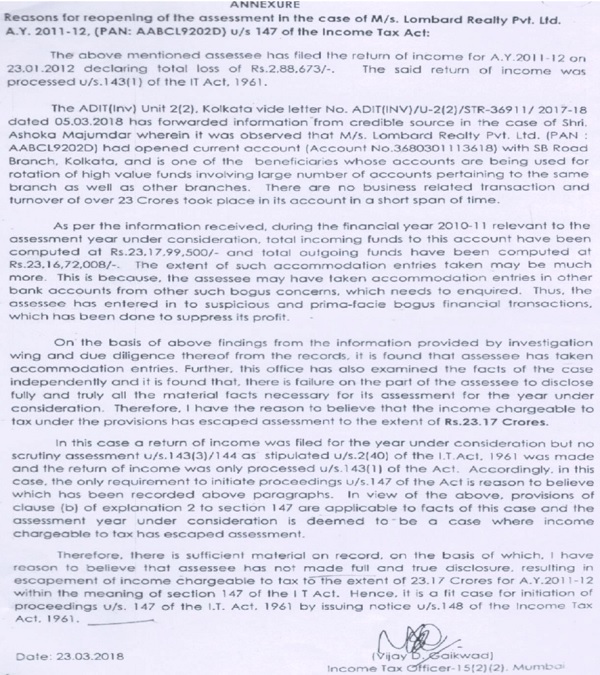
4. Accordingly, notice u/s 148 of the Act was issued and served on the assessee on 29.03.2018. The assessee in response to the same filed its return of income on 09.06.2018 declaring total income at Nil. Thereafter, statutory notices u/s 143(2) and 142(1) of the Act were issued and served on the assessee in response to which the assessee filed certain details. The Assessing Officer in the order passed u/s 143(3) r.w.s. 147 of the Act on 28.12.2018 made addition of Rs.48,27,72,000/- u/s 68 of the Act on account of amounts received from the 22 companies as investment towards share capital in the assessee’s company. While doing so, the Assessing Officer held that the assessee failed to prove the 3 ingredients of section 68 i.e. identity and creditworthiness of the subscribers and the genuineness of the transaction.
5. Before the Ld. CIT(A) the assessee, apart from challenging the addition on merit, challenged the validity of the re-assessment proceedings. It was argued that the reopening of the assessment was made by recording incorrect facts. It was submitted that the Assessing Officer in the reasons recorded has mentioned that the assessment proceedings u/s 143(3) / 144 have not been made in the case of the assessee whereas the scrutiny assessment u/s 143(3) was already completed in the case of the assessee. Therefore, the reasons recorded by the Assessing Officer are itself bad in law and the initiation of re-assessment proceedings by issue of notice u/s 148 of the Act is void ab initio. The Ld. CIT(A) called for a remand report from the Assessing Officer. After considering the remand report of the Assessing Officer and the rejoinder of the assessee to such remand report, the Ld. CIT(A) upheld the validity of re-assessment proceedings by observing as under:
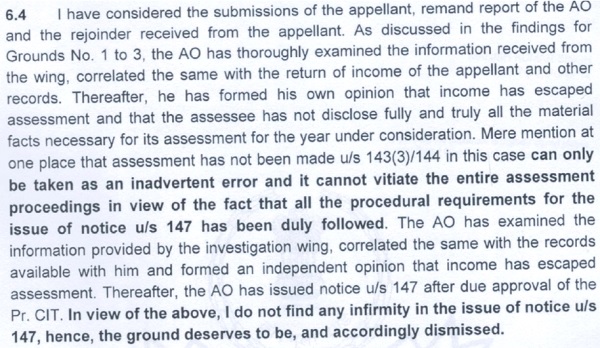
6. So far as the legal ground that the re-assessment proceedings have been initiated on the basis of the report of the Investigation Wing and on borrowed satisfaction without any independent application of mind by the Assessing Officer is concerned, he also dismissed the same. As regards merit of the case, the Ld. CIT(A) upheld the addition made by the Assessing Officer.
7. Aggrieved with such order of the Ld. CIT(A) the assessee is in appeal before the Tribunal.
8. The Ld. Counsel for the assessee referring to the reasons recorded submitted that the Assessing Officer in the said reasons has mentioned that in this case the return of income was filed for the year under consideration but no scrutiny assessment u/s 143(3) / 144 of the Act as stipulated u/s 2(40) of the Act was made and the return of income was only processed u/s 143(1) of the Act. Referring to the original assessment order passed u/s 143(3) on 13.03.2014, copy of which is placed at pages 1 to 5 of the paper book, he drew the attention of the Bench to the same and submitted that the reasons recorded by the Assessing Officer for initiation of re-assessment proceedings are not valid being based on incorrect facts. Relying on various decisions he submitted that assumption of jurisdiction on the basis of wholly incorrect facts is not tenable in law.
9. Referring to the decision of the Hon’ble Gujarat High Court in the case of Sagar Enterprises vs. ACIT reported in 257 ITR 335 (Guj), he submitted that the Hon’ble High Court in the said decision has quashed the re-assessment proceedings where the reasons were recorded de hors the facts i.e. return not filed when the return was actually filed.
10. Referring to the decision of the Hon’ble Delhi High Court in the case of Dr. Ajit Gupta vs. ACIT reported in (2016) 383 ITR 361 (Del), he submitted that the Hon’ble High Court has held that the reasons for reopening of the assessment based on mistaken fact is unsustainable in law.
11. Referring to the decision of the Chandigarh Bench of the Tribunal in the case of Kissan Fats Limited, BCL Industries Ltd vs. DCIT reported in 2024 (7) TMI 1554, he submitted that the Tribunal has quashed the re-assessment proceedings where the re-opening was based on incorrect facts.
12. Relying on various other decision, he submitted that since the reasons recorded for reopening of the assessment are incorrect, therefore, such reassessment proceedings are null and void being not in accordance with law.
13. The Ld. Counsel for the assessee in his next plank of argument submitted that the original assessment was completed u/s 143(3) and the assessment year involved is assessment year 2011-12. Referring to the proviso to section 147, he submitted that when there is no allegation of any failure on the part of the assessee to disclose the material facts fully and truly for completion of the assessment, such re-assessment proceedings are not in accordance with law. For the above proposition, he relied on various decisions.
14. The Ld. Counsel for the assessee referring to various pages of the paper book submitted that during the course of original assessment proceedings the Assessing Officer asked the assessee various details in the questionnaire issued along with notice u/s 142(1) to which the assessee has replied substantiating the identity and creditworthiness of the share subscribers and the genuineness of the transactions. Therefore, the reopening of the assessment on the basis of the report of the Investigation Wing without independent application of mind by the Assessing Officer is not in accordance with law. He also relied on the following decisions:
i. CIT vs. Insecticides (India) Ltd. reported in (2013) 357 ITR 330 (Del)
ii. Nitin Nema vs. PCIT reported in (2023) 458 ITR 690 (MP)
iii. S V Jadhav vs. ITO reported in (2024) 163 com 263 (Bom)
iv. Akshar Builders and Developers vs. ACIT & Anr vide W P No.14490 of 2018 order dated 17.01.2019
v. ITO vs. Mrs. Maya Gupta vide ITA No.3435/Del/2013 order dated 13.12.2013 for assessment year 2003-04
v) ITO vs. M/s. Comero Leasing & Financial vide ITA No.4281/Del/2010 order dated 14.08.2014
15. So far as merit of the case is concerned, the Ld. Counsel for the assessee submitted that all the documents were filed before the Assessing Officer during the course of original assessment proceedings. Referring to the letter dated 13.06.2025 submitted before the Ld. CIT(A), copy of which is placed at pages 160 to 161 of the paper book, he submitted that full details were filed before the Ld. CIT(A) which he has not considered properly. Therefore, the order of the Ld. CIT(A) on merit also be set aside.
16. The Ld. DR on the other hand while supporting the order of the Ld. CIT(A) submitted that this is only a clerical mistake of the Assessing Officer in mentioning that no scrutiny assessment u/s 143(3) / 144 of the Act was made and the return of income was only processed. He submitted that the assessee is becoming hyper technical and no prejudice has been caused to the assessee. He submitted that the assessee has not raised any objection on this issue and whatever objections raised by the assessee were duly disposed off by the Assessing Officer. He submitted that when there is tangible material in the possession of the Assessing Officer from the Investigation Wing and he has applied his mind while recording the reasons, therefore, such re-assessment proceedings are in order.
17. So far as the mistake occurred on the part of the Assessing Officer while recording the reasons is concerned, he submitted that the provisions of section 292B are applicable and such notice cannot be treated as invalid or not in accordance with law.
18. So far as the various decisions relied on by the Ld. Counsel for the assessee are concerned, he submitted that all those decisions are distinguishable and are not applicable to the facts of the present case.
19. The Ld. Counsel for the assessee in his rejoinder referring to page 37 of the paper book submitted that the assessee has categorically stated before the Assessing Officer that the assessee was subjected to regular proceedings u/s 143(3) of the Act. Referring to the provisions of section 292B, he submitted that only the specifically mentioned items cover the provisions of section 292B or 292BB of the Act.
20. We have heard the rival arguments made by both the sides, perused the orders of the Assessing Officer and Ld. CIT(A) and the paper book filed on behalf of the assessee. We have also considered the various decisions cited before us. We find the Assessing Officer in the instant case reopened the assessment as per the provisions of section 147 by recording reasons, the details of which have already been reproduced in the preceding paragraphs. A perusal of the reasons recorded shows that according to the Assessing Officer the return of income was filed for the year under consideration but no scrutiny assessment u/s 143(3) / 144 as stipulated u/s 2(40) of the Act was made and the return of income was only processed u/s 143(1). Under these circumstances, we have to see as to whether the reopening of the assessment is based on wrong appreciation of facts or not.
21. We find an identical issue had come up before the Hon’ble Gujarat High Court in the case of Sagar Enterprises vs. ACIT (supra) where the Hon’ble High Court has quashed the re-assessment proceedings on the ground that the reasons recorded were de hors the facts i.e. return not filed when the return was actually filed. The relevant observations of the Hon’ble High Court read as under:
“6. On going through the reasons recorded and the documents which have been produced on affidavit, it is apparent that the reasons which are recorded are de hors the facts available on record. Mr. Mihir Joshi, learned standing counsel appearing on behalf of the respondent, stated that in para. 2 of the reasons recorded, the respondent has also referred to action under Section 132 of the Act which was carried out at the premises of one Shri G.D. Shah in February, 1992, and has submitted that at least that part of the reasons would survive vesting the respondent with jurisdiction to initiate and continue action under Section 147 of the Act.
7. On going through the entire reasons recorded, it can be seen that in the penultimate paragraph, the respondent has further recorded as under :
“Further, the assessee was required to file the return of the income for the assessment year 1991-92 which the assessee has failed. Moreover, it was the duty of the assessee to declare this transaction and to file the return of income for the assessment year 1991-92. The assessee has failed on both these counts. Therefore, the escapement of assessment of income is solely attributable to the assessee.”
8. Therefore, it is apparent that the factor of non-filing of the return for the assessment year 1991-92 has overbearingly weighed with the respondent for arriving at the satisfaction about the failure on the part of the assessee and escapement of assessment of income.
9. On the basis of the same, even for the sake of argument, if the contention raised by Mr. Joshi is taken into consideration, the settled legal position is that in such circumstances, it would not be possible to say with certainty as to which factor would have weighed with the officer concerned and once it is shown that an irrelevant fact has been taken into consideration, to what extent the decision is vitiated would be difficult to say. On this count alone, the petition requires to be accepted.”
22……. Similar view has been taken by the Hon’ble Bombay High Court in the case of Sea Glimpse Investments Pvt Ltd vs. DCIT & ors vide Writ Petition No.3172 of 2019 order dated 22.12.2021. The Hon’ble High Court has quashed the re-assessment proceedings by observing as under:
4. The reasons to re-open is annexed to the petition. In paragraph no……… 5 it says necessary approval of the Additional Commissioner of Income Tax………… has been obtained………. vide letter No. …….. dated________ , 2019. This is one lacuna that Ms. Hariya pointed out. Secondly, Ms. Hariya submitted that the assessee had filed its e- return of income on 25th November, 2014 as could be seen in the assessment order dated 27th October, 2016 but in the reasons for re-opening it is stated that assessee e-filed its return on 27 th October, 2016 and scrutiny assessment was completed under Section 143(3) of the Act on 27 th October, 2016. This ground itself would show non application of mind not only by the Assessing Officer but also the authority which sanctioned the proposal of re-opening the assessment. Any one reading the first paragraph in the reasons for re- opening would wonder how the filing of return of income and scrutiny assessment under Section 143(3) of the Act can be completed on the same date. It is therefore, clear that the sanction has been granted without application of mind.
One more fact which appears from the reasons for re-opening that exposes total non application of mind by the sanctioning authority and also the person recording the reasons is it says that the assessee holds 0.01% i.e., 10 shares in itself. How can a company hold its own shares?
This erroneous statement of fact in the reasons itself should have made the authority granting sanction to refuse granting the sanction. Moreover, in the petition, position before amalgamation and post amalgamation has been mentioned which is at variance with what is given in the reasons for re-opening. It is also alleged in the petition that change in shareholding pattern as recorded in the reasons for re-opening is erroneous. That has not been denied in the affidavit in reply. The reason to believe that income chargeable to tax has escaped assessment must be on correct fact. If the facts as recorded in the reasons are not correct, it is for the Assessing Officer to establish that the facts stated by him in the reason as recorded are correct. The Division Bench of this court in Ankita A. Choksey vs. Income- Tax Officer And Others1 in paragraph no. 6 and 7 has held as under :
6. It is a settled position in law that the Assessing Officer acquires jurisdiction to issue a reopening notice only when he has reason to believe that income chargeable to tax has escaped Assessment. This basic condition precedent is applicable whether the return of income was processed under Section 143(1) of the Act by intimation or assessed by scrutiny under Section 143(3) of the Act. [See Asst. Commissioner of Income Tax v/s. Rajesh Jhaveri Stock Brokers (P) Ltd., [2007] 291 ITR 500 (SC) and Principal CIT v/s. Shodimen Investments P. Ltd. [2018] (93) taxmann.com 153 (Bom). Further, the reasons to believe that income chargeable to tax has escaped Assessment must be on correct facts. If the facts, as recorded in the reasons are not correct and the assessee points out the same in its objections, then the order on objection must deal with it and prima facie, establish that the facts stated by it in its reasons as recorded are correct. In 1 [2019] 411 ITR 207 (BOM) Purti Parab 4/5 909-WP 3172–2019.doc the absence of the order of objections dealing with the assertion of the assessee that the correct facts are not as recorded in the reason, it would be safe to draw an adverse inference against the Revenue.
7. Thus, we are of the view that even in cases where the return of income has been accepted by processing under Section 143(1) of the Act, reopening of an assessment can only be done when the Assessing Officer has reason to believe that income chargeable to tax has escaped assessment. The mere fact that the return has been processed under Section 143(1) of the Act, does not give the Assessing Officer a carte blanche to issue a reopening notice. The condition precedent of reason to believe that income chargeable to tax has escaped assessment on correct facts, must be satisfied by the Assessing Officer so as to have jurisdiction to issue the reopening notice. In the present case, the Assessing Officer has proceeded on fundamentally wrong facts to come to the reasonable belief/conclusion that income chargeable to tax has escaped assessment. Further, even when the same is pointed out by the Petitioner, the Assessing Officer in his order disposing of the objection does not deal with factual position asserted by the Petitioner. Thus, it would be safe to conclude that the Revenue does not dispute the facts stated by the Petitioner. On the facts as found, there could be no reason for the Assessing Officer to believe that income chargeable to tax has escaped assessment.
5. It is settled law as held by the Division Bench of this court in German Remedies Ltd. vs. Deputy Commissioner of Income Tax 2 that while granting approval it was obligatory on the part of the Principal Commissioner of Income Tax to verify whether there was any failure on the part of the assessee to disclose full and true relevant facts in the return of income filed for the assessment of income of that assessment order.
6. In view of the above, the impugned notice and consequential order justifying reasons recorded are unsustainable. The same are liable to be quashed and set aside. Hence, petition is allowed. Rule made absolute in terms of prayer clause – (a) and (b) which reads as under :
(a) that this Hon’ble Court may be pleased to issue under Article 226 of the Constitution of India an appropriate direction, order or a writ, including a writ in the nature of ‘Certiorari’, calling for the records of the case and after satisfying itself as to the legality thereof quash and set aside the notice dated 31.03.2019 issued by the First Respondent under section 148 of the Income Tax Act, 1961, being Ex. – ‘G’ hereto ;
(b) that this Hon’ble Court may be pleased to issue under Article 226 of the Constitution of India an appropriate direction, order or a writ, including a writ in the nature of ‘Certiorari’, calling for the records of the case and after satisfying itself as to the legality thereof quash and set aside the order dated 14.10.2019, Ex. – ‘L’ herein, passed by the First Respondent, purportedly disposing of the objections raised by the Petitioner against the initiation of the reassessment proceeding by the First Respondent.”
23. We find the Hon’ble Delhi High Court in the case of Dr. Ajit Gupta vs. ACIT (supra) has held that the reasons for reopening of the assessment based on factually erroneous premise are unsustainable in law. The relevant observations of the Hon’ble High Court reads as under:
“23. Since the action of the Revenue was based on a factually erroneous premise, the Court is of the view that the reopening of the assessments for the said AYs is not sustainable in law. The Court is also satisfied that the requirement of the law, as explained by the Court in Commissioner of Income Tax. v. Kelvinator of India Limited (2010) 320 ITR 561 (SC), and reiterated in the later decisions, has not been fulfilled in the present case.”
24. We find Chandigarh Bench of the Tribunal in the case of Kissan Fats Limited, BCL Industries Ltd vs. DCIT vide ITA No.407 & 409/CHD/2023 order dated 01.07.2024 while quashing the re-assessment proceedings on account of wrong facts has held as under:
“7. From the above discussed facts, it is evident that the discrepancy in the reasons, as pointed out on behalf of the assessee, is clear and admitted, that is to say, the reasons recorded by the AO for issuance of notice of re-opening of the completed assessment have been recorded on wrong facts, in as much as firstly, the date of filing of the return of income of the assessee for the year under consideration has been wrongly mentioned. Then, the declared income has wrongly been shown at Rs.1,62,28,910/- as against the actually declared ‘Nil’ income.
8. Now, it is to be seen as to whether in such a scenario, the re-assessment proceedings are liable to be quashed as void, as contended by the assessee.
8.1 In this regard, under similar circumstances, in ‘Smt. Monika Rani Vs the ITO, Ward-2, Kurukshetra’, vide order (copy at the assessee’s case laws Paper Book, pages 308 to 318) dated 28.02.2020, passed for assessment year 2010-11, in ITA No.582/CHD/2019, it was observed that from the reasons recorded, it was clear that the AO had issued the notice u/s 148 of the Act for the reason that the assessee had not filed her return of income and that the assessee had purchased a property for Rs.1,49,02,500/- during Financial Year 2009-10; that further, the said reasons given by the AO for re-opening the assessment were not correct, since the assessee had filed the return of income on 30.03.2011,the copy of which had been placed in the assessee’s compilation; that the assessee had also shown investment in agricultural land amounting to Rs.52,20,000/- in her balance sheet as on 31.03.2010, copy of which had been placed in the assessee’s compilation; that both the reasons given by the AO were, thus, wrong; that the AO had, thus, reopened the assessment on the basis of wrong facts and, therefore, the re-opening was not valid and it was being quashed.
8.2 The Tribunal followed the decisions cited as under :
i. Sagar Enterprises Vs ACIT, 257 ITR 335 (Guj)
ii. Baba Kartar Singh Dukki Educational Trust Vs ITO, rendered by the Chandigarh ‘SMC’ Bench of the Tribunal, (2016) 158 ITR 965 (CHD)(TRIB)
iii. Shri Ram Mohan Rawat Vs ITO, order dated 10.10.2019 passed by the Jaipur Bench of the Tribunal in ITA No. 1014/JP/2018
iv. Van Oord Dredging & Marine Contractors BV Cs ADIT, order dated 28.02.2018, passed by the Mumbai Bench of the Tribunal in ITA Nos. 495&496/Mum/2016.
8.3 Similarly, in ‘Sagar Enterprises’ (supra), it has been held as follows :
” that it was apparent that the fact of non-filing of the return for the assessment year 1991-92 had weighed with the respondent for arriving at the satisfaction about the failure on the part of the assessee and escapement of assessment of income. However, the material on record showed that the return had been filed. In such circumstances, it could not be said with certainty as to which fact would have weighed with the officer concerned and once it was shown that an irrelevant fact had been taken into consideration, to what extent the decision was vitiated would be difficult to say. Moreover the Income-tax Officer had stated that the payment which was stated to be undisclosed income relevant for the assessment year 199192 could have been made during the financial year 1990-91 relevant to the assessment year 1991-92 and hence, “to cover up that probability, protective addition was made in the assessment year 1992-93.” The first appellate authority decided the appeal for the assessment year 1992-93 on January, 1996, and the reason had been recorded thereafter on August 18, 1997. The notice of reassessment was not valid and was liable to be quashed.”
8.4 Likewise, in ‘Baba Kartar Singh Dukki Educational Trust’ (supra), it has been held as follows :
HEAD NOTE:
” Where Assessing Officer processed under section 143(1) returns of income filed by assessee for assessment years 2001-02 to 2003-04 and subsequently he reopened said assessments on sole basis that assessee had not filed returns for years preceding to assessment year 2004-05 and, therefore, its income having escaped assessment, reopening of assessment was on basis of suspicion and non-existent and incorrect facts and it was invalid”
8.5 Further, in ‘Ram Mohan Rawat’ (supra), it has been held as follows :
“Thus the reasons recorded by the AO for formation of belief that income assessable to tax has escaped assessment are based on two counts. One, the assessee has made bogus purchases and the second, that the purchases are not verifiable as the assessee has not filed the return of income. Thus the formation of belief is based on these two factual aspects that the assessee has made bogus purchases which are not verifiable as assessee has not filed the return of income. The reason for non verifiableness of the purchases made by the assessee due to non filing of the return of income as stated by the AO is absolutely incorrect and wrong and contrary to the record when the assessee has filed the return of income electronically on 29.10.2007. This fact was also subsequently accepted by the AO that the assessee filed the return of income under section 139(1). The second aspect of the reasons that the assessee has made bogus purchases is also not based on any enquiry or verification of record by the AO but this is simply reproduction of information received from the Investigation Wing. The said information is also incomplete as regards the details of the purchases and the parties from whom such purchases were made by the assessee. Thus the reasons recorded by the AO manifest that there is no application of mind and the averments as recorded in the reasons are very vague and general and rather inconsistent with the facts available on record so far as the filing of return of income by the assessee. The formation of belief on such incorrect and vague reasons would lead the reopening of the assessment as invalid.”
8.6 Then, in ‘Van Oord Dredging and Marine Contractors BV’ (supra), it has been held as under :
“In AY 2005-06, the A.O. has reopened the assessment on incorrect facts and further the assessing officer has failed to demonstrate that there was failure on the part of ht assessee to disclose fully and truly all material facts during the course of original assessment proceedings. Hence the reopening of assessment of AY 2005-06 is liable to be quashed on these two grounds also. Accordingly we set aside the order passed by Ld. CIT(A) on this issue and hold that the reopening of assessments of both the years are not in accordance with the law and accordingly quash the assessment orders passed for both the years under consideration.”
9. No decision contrary to the above case laws has been cited before us, nor has any of the above decisions been shown to have been reversed by higher authorities.
10. Therefore, respectfully following the ratios of the above discussed decisions, we hold that the re-opening of the completed assessment in the present case was not valid. The plea of the Department, that the recording of wrong facts by the AO in the reasons was an inadvertent mistake, is of no avail and it does not validate the reasons recorded by the AO. It is trite that the reasons recorded are to be read as they are, and the reasons recorded in the present case, read as they are, are factually incorrect reasons which could not have led the AO to arrive at a valid satisfaction that income for the year under consideration had escaped assessment. Accordingly, the initiation of the re-assessment proceedings through the incorrect reasons recorded and the entire re-assessment proceedings, culminating in the order under appeal are quashed as void ab initio.
11. Since the re-assessment proceedings stand quashed, as above, nothing further survives for adjudication. Ordered accordingly.”
25. We find the Hon’ble Bombay High Court in the case of Dhiren Anantrai Modi Vs. ITO vide Writ Petition No. 3224 of 2019, order dated 15.12.2021 has quashed the reassessment proceedings which are passed on totally erroneous and incorrect facts and without non application of mind. The relevant observations of the Hon’ble High Court read as under:
“1. Petitioner is impugning notice dated 26th March, 2019 issued under Section 148 of the Income Tax Act, 1961 (the Act) and the order dated 22nd October, 2019 disposing petitioner’s objections to the re-opening.
2. Petitioner has challenged notice dated 26th March, 2019 on various grounds including non application of mind by the Assessing Officer while issuing notice.
3. We have considered the petition with documents annexed thereto, reply filed by respondent and also heard Mr. Gandhi and Mr. Pinto.
4. On bare perusal of the reasons it is quite evident that the reasons are based on totally erroneous and in correct facts and without due application of mind. In the reasons it is stated “The assessee is an individual and the Return of Income for A.Y. 2012-13 was filed on 24 th September, 2012 declaring total loss of Rs.4,21,11,382/- and the same was processed by the C.P.C. ……….. It is pertinent to mention here that in this case the assessee had filed return of income for the year under consideration but no assessment as stipulated under Section 2(40) of the Act was made and the return of income was only processed under Section 143(1) of the Act. In view of the above, provisions of clause (b) of explanation 2 to section 147 are applicable to facts of this case and the assessment year under consideration is deemed to be a case where income chargeable to tax has escaped assessment”.
5. The fact is the return of income for A.Y. 2012-13 filed by petitioner on 24th September, 2012 has been assessed under Section 143(3) of the Act and the Assessment Order dated 31st March, 2015 has been passed. Therefore, the Assessing Officer has proceeded on erroneous factual basis that the return of income was only processed under Section 143(1) of the Act. That displays total non application of mind. In fact, petitioner’s allegations that Respondent No.1 has sought to re-open the assessment on incorrect factual position that the return of income was only processed under Section 143(1) of the Act has not even been denied in the affidavit in reply which is filed by the same Assessing Officer. In paragraph no.2 of the affidavit in reply which is in response to paragraph no.1 and 2 of the Purti Parab 3/4 420-WP-3224-2019.doc petition, Respondent No.1 simply says that these are factual in nature and the notice under Section 148 dated 26th March, 2019 and the order disposing the objections and the notice dated 22 nd October, 2019 are issued in pursuance of the objective of completing reassessment in accordance with the procedures laid down.
On this ground alone, the notice dated 26th March, 2019 has to be set aside.”
26. Similar view has been taken by the Mumbai Bench of the Tribunal in the case of ITO Vs. M/s. Champaklal Mathurbhai Mehta in ITA No. 2253/Mum/2022 and Delhi Bench of the Tribunal in the case of ITO Vs. Surendra Dalal in ITA No. 7714 & 7490/Del/2019 and in the case of Keshav Saran Vs. ACIT in ITA No. 382/Del/2019. The various other decisions relied on by the Ld. Counsel for the assessee also support his case to the proposition that the re-assessment proceedings which are based on totally erroneous and incorrect facts and without application of mind are not in accordance with law and are liable to be quashed. So far as the argument of the Ld. DR that it was a typographical error and therefore the provisions of section 292B / 292BB will take care of the mistake is concerned, the same in our opinion, is not correct. We, therefore, quash the re-assessment proceedings on this ground.
27. Even otherwise also, we find after obtaining the details from the Investigation Wing the Assessing Officer has not applied his mind to the details received vis-à-vis the return filed by the assessee. It is an admitted fact that the assessment was completed u/s 143(3) and the Assessing Officer during the course of original assessment proceedings has called for various details in the questionnaire issued along with the notice u/s 142(1) to which the assessee has responded by filing the requisite details and the Assessing Officer has accepted the same. Therefore, had the Assessing Officer applied his mind, he would have come to some other conclusion. The approving authority also without verifying the record has given the approval. It has been held in various decisions that the reassessment proceedings cannot be made simply based on certain information received from the Investigation Wing in absence of any other details and without independent application of mind. For the above proposition, we rely on the decision of the Hon’ble Delhi High Court in the case of CIT vs. SFIL Stock Broking Ltd reported in (2010) 325 ITR 285 (Del), Signature Hotels P. Ltd. vs. ITO reported in (2011) 338 ITR 51 (Del), Sarthak Securities Co. P. Ltd. vs. ITO reported in (2010) 329 ITR 110 (Del), CIT vs. Suren International P. Ltd reported in (2013) 85 CCH 40 (Del) and CIT vs. Kamdhenu Steel and Alloys Ltd. & Ors reported in (2014) 361 ITR 220 (Del).
28. In view of the above discussion and in the light of the decisions cited (supra), we hold that the re-assessment proceedings are not in accordance with law being based on wrong facts and also due to non-application of independent mind by the Assessing Officer and purely based on the report of the Investigation Wing. The legal grounds raised by the assessee are accordingly allowed.
29. Since the assessee succeeds on this legal ground, the other grounds challenging the addition on merit are not being adjudicated. The appeal filed by the assessee is accordingly allowed.
ITA No.535/PUN/2026 (A.Y. 2013-14)
30. Facts of the case, in brief, are that the assessee filed its return of income on 12.2013 declaring total income of Rs.22,36,110/- which was processed vide order passed u/s 143(1) of the Act on 26.08.2014. Subsequently, on the basis of information received from the Investigation Wing, Kolkata, the Assessing Officer reopened the assessment by recording the following reasons:
38. Aggrieved with such order of the Ld. CIT(A) the assessee is in appeal before the Tribunal by raising the following grounds:
1. On the facts and circumstances of the case and in law, the Ld. A.O. has erred by initiating the reassessment proceedings u/s 147 of the I.T. Act, 1961 and by issuing the notice u/s 148 of the I.T. Act, 1961 since the same is grossly incorrect, invalid and bad in law.
2. On the facts and circumstances of the case and in law, the Ld. A.O. has erred by only relying on the information received by his office from Investigation Wing. Kolkata for initiating the reassessment proceedings which is merely Borrowed Satisfaction as per the provisions of section 147 of the I. T. Act, 1961 and therefore, notice issued u/s 148 of the I. T. Act, 1961 is grossly incorrect, invalid and bad in law.
3. On the facts and circumstances of the case and in law, the impugned assessment order passed by the learned assessing officer is bad in law and void, since the same is passed without complying with the mandatory requirement of quoting document identification number as per circular 19 of 2019, whereby it was essential to quote DIN in the body of the order. Reliance is placed on the decision of Hon’ble Bombay High Court in case of Ashok Commercial Enterprises vs. ACIT, [2023] 154 com 144 (Bombay).
4. On the facts and circumstances of the case and in law, the Ld. A.O. has erred by issuing an intimation letter dated 17/05/2021 mentioning the DIN for the assessment order passed on 10/05/2021, since a subsequent intimation letter cannot cure the defect. Reliance is placed on the decision of Hon’ble Bombay High Court in case of Siemens Ltd vs. DCIT, [2025] 181 com 448 (Bombay).
5. On the facts and circumstances of the case and in law, the Hon’ble PCIT (Central), Nagpur has erred by giving approval u/s 151 of the I.T. Act, 1961 on the basis of incorrect fact and in a mechanical manner, without independently verifying the facts of the reasons recorded that, there were no transactions done by the appellant with following parties of which approval was given:
| Sr. No. | Particulars | Amount |
|---|---|---|
| 1 | Mr. Anup Agarwal (Prop. Anup Trading Co., SR Trading Co.), PAN: AVPPA8424P | Rs.36,00,000/- |
| 2 | Mr. Gopal Das (PAN: ATSPD3081D) and Mr. Gautam Banerjee (PAN: AIFPB0197E) | Rs.85,00,000/- |
6. On the facts and circumstances of the case and in law, the Ld. A.O. in the reasons recorded has mentioned that sanction to issue notice u/s 148 of the Act is required from Principal Commissioner of Income Tax (Central), Nagpur u/s 151 of the Act. However, the Ld. A.O. while issuing the notice u/s 148 of the I. T. Act, 1961 has erred by taking approval from the Hon’ble PCIT (Central), Pune.
7. On the facts and circumstances of the case and in law, the Ld. A.O. has erred by not providing copy of approval taken by him from the specified authority u’s 151 of the I. T. Act, 1961. Such action of the Ld. A.O. is against the decision of Hon’ble Supreme Court in case of ITO vs. M/s Tia Enterprises Pvt Ltd., [2024] 468 ITR 10 (SC) wherein it has upheld the order of Hon’ble Delhi High Court, of M/s Tia Enterprises Pvt Ltd. vs. ΙΤΟ, [2024] 468 ITR 5 (Delhi).
8. On the facts and circumstances of the case and in law, the Ld. A.O. has erred by providing copy of reasons through a separate letter dated 22/09/2020 which was also not signed by the Ld. A.O. Therefore, it is not clear whether the approval is taken by the Ld. A.O. prior to issuance of notice u/s 148 of the I.T. Act, 1961.
9. On the facts and circumstances of the case and in law, the Ld. A.O. and Hon’ble CIT(A) has erred by not providing the appellant an opportunity of cross examination with the persons on whose statement reliance was placed and treated that the amount received by the appellant is accommodation entry. Such action by the Ld. A.O. and Hon’ble CIT(A) is grossly incorrect, invalid and bad in law.
10. On the facts and circumstances of the case and in law, the Ld. CIT(A) has erred by dismissing the plea of the appellant and upholding the addition made by the Ld. A.O. as unexplained cash credit u/s 68 of the I. T. Act, 1961 of Rs.4,15,00,114/- (partial amount) in respect of amount received by the appellant company against sale of shares (Investment) without understanding the fact and circumstances of the case. Thus, the addition made and the action of the Ld. CIT(A) by upholding the order of Ld. A.O. is grossly incorrect, invalid and bad in law.
11. On the facts and circumstances of the case and in law, the Ld. CIT(A) has erred by enhancing the addition by Rs.99,99,886/- as unexplained cash credit u/s 68 of the I. T. Act, 1961 in respect of amount received by the appellant company against sale of shares (Investment) without understanding the fact and circumstances of the case which is grossly incorrect, invalid and bad in law.
12. On the facts and circumstances of the case and in law, the Ld. A.O. has erred by making addition in respect of sales of shares (Investment) u/s 68 of the I. T. Act, 1961 without understanding the fact that, sale of shares (Investment) is already disclosed by the appellant in its books of accounts. Therefore, making addition of same u/s 68 of the I.T. Act, 1961 is grossly incorrect, invalid and bad in law.
13. The appellant craves leave to add, alter, amend or modify any or all grounds till the disposal of the Appeal.
39. Grounds of appeal No.1 and 13 being general in nature are dismissed. The Ld. Counsel for the assessee did not press grounds of appeal No.3, 4, 6, 7 and 8 for which the Ld. DR has no objection. Accordingly, the above grounds are dismissed as ‘not pressed’.
40. So far as the reasons challenging the validity of re-assessment proceedings are concerned, the Ld. Counsel for the assessee submitted that the reasons recorded are flawed. He submitted that the reasons must show on what basis the case of the assessee is being reopened. However, in the instant case the reopening of the assessment has been made only on the basis of the report of the Investigation Wing and without due application of mind. Referring to para 7.8 of the order of the Ld. CIT(A) he submitted that the Ld. CIT(A) has given a finding that the assessee during the year has not received any amount from Gopal Das and Gautam Banerjee and Anoop Agrawal. The Revenue is not in appeal against the said finding of the Ld. CIT(A) meaning thereby they have accepted that no money has come from the above parties. Therefore, it shows that the Assessing Officer has simply reopened the assessment on the basis of the report of the Investigation Wing and has not applied his mind independently. He has reopened the assessment on incorrect facts. Relying on various decisions cited while arguing for assessment year 201112, he submitted that the said decisions are equally applicable to the facts of the present case. He submitted that prima facie the details must have some live link with the assessee. However, when we read the reasons vis-à-vis the nature of transactions it appears that the reasons are vague. He submitted that the figures given by the Assessing Officer are also wrong and only on the basis of the details given by the assessee the addition has been made. This itself shows that the Assessing Officer has not applied his mind.
41. So far as the merit of the case is concerned, he submitted that the assessee has sold the investments during the year, therefore, once the receipts are on account of sale, there is no question of invoking the provisions of section 68. He submitted that the purchases were made long back and the case of the assessee was scrutinized and the order was passed u/s 143(3) on 13.03.2014 for assessment year 2011-12. Referring to the details filed before the Assessing Officer, he submitted that the assessee vide letter dated 01.02.2021 has categorically stated before the Assessing Officer that the amounts received from the following persons are sale proceeds of investment which are duly recorded in the books of account and the assessee has not escaped any tax:
| Sr. No. | Name of the persons from whom funds received | Amount (in Rs.) |
| 1 | M/s. Tanisha Suppliers Pvt Ltd | 20,00,000 |
| 2 | Dristi Dealers Pvt Ltd | 60,00,000 |
| 3 | Anup Agrawal (Prop. Anup Trading Co., SR trading company) | 36,00,000 |
| 4 | M/s. Axisline Agencies Pvt Ltd | 1,35,00,000 |
| 5 | Gopal Das & Gautam Banerjee | 85,00,000 |
| 6 | Raj Impex | 1,50,00,114 |
| Total | 4,86,00,114 |
42. Relying on various decisions, he submitted that when the investments so sold the purchases of which has already been recorded in the books of account and the assessment has been completed accepting such purchases, no addition u/s 68 can be made for such sale proceeds. He submitted that the assessee in the instant case has purchased the investments in earlier years which were disclosed as “investments’ in the books of account and shown in the Balance Sheet. The assessee has sold certain investments during the year and the profit or loss has been duly accounted for in the books of account. Therefore, the amount received from the sale proceeds of investments which is neither loan nor deposit nor share application money, the provisions of section 68 are not applicable. He accordingly submitted that the Ld. CIT(A) is not justified in sustaining the addition made by the Assessing Officer.
43. The Ld. DR on the other hand heavily relied on the order of the Ld. CIT(A).
44. We have heard the rival arguments made by both the sides, perused the orders of the Assessing Officer and Ld. CIT(A) and the paper book filed on behalf of the assessee. We have also considered the various decisions cited before us. We find the assessee in the instant case has filed its return of income on 23.01.2012 declaring total loss of Rs.2,88,673/- which was processed u/s 143(1). We find, the Assessing Officer on the basis of information received from the Investigation Wing, reopened the assessment by issue of notice u/s 148 dated 29.03.2018. The reasons recorded for reopening of the assessment have already been reproduced in the preceding paragraphs. We find the Assessing Officer in the order passed u/s 147 r.w.s. 143(3) of the Act made addition of Rs.6,36,00,114/- u/s 68 of the Act by treating the amounts credited in the books of the assessee as unexplained cash credit. While doing so, he made the addition on the basis of the report of the Investigation Wing which identified the assessee as a beneficiary of accommodation entries routed through several entities having negligible or nil income, weak financial credentials and in some cases, being struck off as per MCA records. It is the submission of the Ld. Counsel for the assessee that the reassessment proceedings were initiated on wrong appreciation of facts and only on the basis of the report of the Investigation Wing and without due application of mind. It is his submission that in view of the various decisions such reopening of the assessment on the basis of the report of the Investigation Wing and without due application of mind is not sustainable and therefore, the re-assessment proceedings have to be quashed. It is also his argument that the re-assessment proceedings were made on wrong facts and therefore, on that ground also such re-assessment proceedings are liable to be quashed. Even on merit also it is the submission of the Ld. Counsel for the assessee that since the assessee has sold its investments which were purchased in the preceding years and also recorded in the books of account and shown in the Balance Sheet in the asset side, therefore, such sale proceeds out of the investments cannot be added u/s 68 of the Act.
45. We find some force in the above arguments of the Ld. Counsel for the assessee. A perusal of the reasons recorded shows that the Assessing Officer basically reopened the assessment on the ground that the assessee has received an amount of Rs.4,86,00,114/- from the following parties as accommodation entries:
| Sr. No. | Name of the persons from whom funds received | PAN | Amount (in Rs.) |
| 1 | M/s. Tanisha Suppliers Pvt Ltd | AACCT9955C | 20,00,000 |
| 2 | Dristi Dealers Pvt Ltd | AACCD6747N | 60,00,000 |
| 3 | Anup Agrawal (Prop. Anup
Trading Co., SR trading company) |
AVPPA8424P | 36,00,000 |
| 4 | M/s. Axisline Agencies Pvt Ltd | AAJCA3349Q | 1,35,00,000 |
| 5 | Gopal Das & Gautam Banerjee | ATSPD3081D
& AIFPB0197E |
85,00,000 |
| 6 | Raj Impex | ATMPA6382Q | 1,50,00,114 |
| Total | 4,86,00,114 |
46. However, a perusal of the order of the Ld. CIT(A) shows that the assessee has not received any amount during the previous year from Gopal Das and Gautam Banerjee amounting to Rs.85,00,000/- and Anup Agrawal amounting to Rs.36,00,000/-. The relevant order of the Ld. CIT(A) at pages 7.8 and 7.9 reads as under:
47. The Revenue has also not challenged the deletion of the same meaning thereby that it is conclusively proved that the assessee has not received any amount from the above two parties. We, therefore, find merit in the argument of the Ld. Counsel for the assessee that in this case the re-assessment proceedings have been initiated only on the basis of the report of the Investigation Wing and non-application of independent mind by the Assessing Officer. Had he applied his mind independently he would have come to the conclusion that the assessee has not received any amount from Gopal Das & Gautam Banerjee amounting to Rs.85,00,000/- and Anoop Agrawal (Prop. Anup Trading Co., SR Trading Company) amounting to Rs.36,00,000/-.
48. We find the Hon’ble Delhi High Court in the case of CIT vs. SFIL Stock Broking Ltd reported in (2010) 325 ITR 285 (Del) at para 10 of the order has observed as under:
“10. From the above, it is clear that the Assessing Officer referred to the information and the two directions as “reasons‟ on the basis of which he was proceeding to issue notice under Section 148. We are afraid that these cannot be the reasons for proceeding under Section 147/148 of the said Act. The first part is only an information and the second and the third parts of the beginning paragraph of the so-called reasons are mere directions. From the so-called reasons, it is not at all discernible as to whether the Assessing Officer had applied his mind to the information and independently arrived at a belief that, on the basis of the material which he had before him, income had escaped assessment. Consequently, we find that the Tribunal has arrived at the correct conclusion on facts. The law is well settled. There is no substantial question of law which arises for our consideration.”
49. We find the Hon’ble Delhi High Court in the case of Signature Hotels P. Ltd. vs. ITO reported in (2011) 338 ITR 51 (Del) at paras 14 and 15 of the order has observed as under:
“14. The first sentence of the reasons states that information had been received from Director of Income-Tax (Investigation) that the petitioner had introduced money amounting to Rs.5 lacs during financial year 2002-03 as per the details given in Annexure. The said Annexure, reproduced above, relates to a cheque received by the petitioner on 9th October, 2002 from Swetu Stone PV from the bank and the account number mentioned therein. The last sentence records that as per the information, the amount received was nothing but an accommodation entry and the assessee was the beneficiary.
15. The aforesaid reasons do not satisfy the requirements of Section 147 of the Act. The reasons and the information referred to is extremely scanty and vague. There is no reference to any document or statement, except Annexure, which has been quoted above. Annexure cannot be regarded as a material or evidence that prima facie shows or establishes nexus or link which discloses escapement of income. Annexure is not a pointer and does not indicate escapement of income. Further, it is apparent that the Assessing Officer did not apply his own mind to the information and examine the basis and material of the information. The Assessing Officer accepted the plea on the basis of vague information in a mechanical manner. The Commissioner also acted on the same basis by mechanically giving his approval. The reasons recorded reflect that the Assessing Officer did not independently apply his mind to the information received from the Director of Income-Tax (Investigation) and arrive at a belief whether or not any income had escaped assessment.”
50. We find the Hon’ble Delhi High Court in the case of Sarthak Securities Co. Ltd. vs. ITO reported in (2010) 329 ITR 110 (Del) at para 24 of the order has observed as under:
“24. The obtaining factual matrix has to be tested on the anvil of the aforesaid pronouncement of law. In the case at hand, as is evincible, the assessing officer was aware of the existence of four companies with whom the assessee had entered into transaction. Both the orders clearly exposit that the assessing officer was made aware of the situation by the investigation wing and there is no mention that these companies are fictitious companies. Neither the reasons in the initial notice nor the communication providing reasons remotely indicate independent application of mind. True it is, at that stage, it is not necessary to have the established fact of escapement of income but what is necessary is that there is relevant material on which a reasonable person could have formed the requisite belief. To elaborate, the conclusive proof is not germane at this stage but the formation of belief must be on the base or foundation or platform of prudence which a reasonable person is required to apply. As is manifest from the perusal of the supply of reasons and the order of rejection of objections, the names of the companies were available with the authority. Their existence is not disputed. What is mentioned is that these companies were used as conduits. In that view of the matter, the principle laid down in Lovely Exports (P) Ltd. (supra) gets squarely attracted. The same has not been referred to while passing the order of rejection. The assessee in his objections had clearly stated that the companies had bank accounts and payments were made to the assessee company through banking channel. The identity of the companies was not disputed. Under these circumstances, it would not be appropriate to require the assessee to go through the entire gamut of proceedings. It is totally unwarranted.”
51. We find the Delhi Bench of the Tribunal in the case of ACIT vs. Shri Devesh Kumar vide ITA No.2068/Del/2010 order dated 31.10.2014 at para 19 of the order has observed as under:
“19. In the light of aforesaid discussion, we are inclined to hold that in the extant case the AO proceeded to initiate proceedings u/s 147 of the Act and to issue notice u/s 148 of the Act on the basis of information received from Investigation Wing of the department in the form of a CD prepared by Shri Sanjay Shah and Shri Vishesh Prakash, ITOs of Unit V, New Delhi. Subsequently, the AO reproduced details gathered from the CD and without application of independent mind, held that the assessee was beneficiary of accommodation entries amounting to Rs.4,51,000. In the main part of reason to believe, there is no mentioning of nature of transaction to establish and fortify the fact that the impugned transactions were in the nature of accommodation entries. We also observe that there is no mentioning of date therein and it can safely be presumed that the AO had not examined the assessment record of the assessee which was processed u/s 143(1)(a) of the Act on 15.3.2005 for forming a belief that the income of the assessee had escaped assessment.”
52. The various other decisions relied on by the Ld. Counsel for the assessee also support his case to the proposition that the re-assessment proceedings initiated on the basis of the report of the Investigation Wing and without independent application of mind by the Assessing Officer are not in accordance with law and has to be quashed. Since in the instant case admittedly the re-assessment proceedings were initiated on the basis of the report of the Investigation Wing and without independent application of mind by the Assessing Officer which is deciphering from the fact that the assessee has not received any amounts from the two parties out of the six parties mentioned by the Assessing Officer and which is the basis for initiation of re-assessment proceedings, therefore, respectfully following the decisions cited (supra), we hold that the re-assessment proceedings initiated in the instant case are not in accordance with law and are liable to be quashed. Accordingly, we quash the same.
53. Even otherwise on merit also, it is an admitted fact that the investments were made by the assessee in the preceding years and were reflected in the asset side of the Balance Sheet. The assessee during the impugned assessment year has sold part of those investments and received the sale proceeds which were credited into the bank account. Therefore, the amount received by the assessee on account of sale proceeds of investments in our opinion cannot be considered as unexplained cash credit u/s 68 especially when such investments were made in the preceding years which were shown in the Balance Sheet and it has been accepted by the Revenue since neither reopening proceedings were initiated nor any 263 proceedings have taken place. We, therefore, find force in the arguments of the Ld. Counsel for the assessee that the provisions of section 68 are not applicable to the amounts received towards sale proceeds of disclosed investments. We, therefore, hold that no addition u/s 68 is called for. We accordingly set aside the order of the Ld. CIT(A) and allow the grounds raised by the assessee challenging the addition on merit. The appeal filed by the assessee is accordingly allowed.
54. In the result, both the appeals filed by the assessee are allowed.
Order pronounced in the open Court on 17th July, 2026.