
Mahesh Dadhich Vs ITO (ITAT Jaipur)
Summary: The Income Tax Appellate Tribunal (ITAT), Jaipur, in Mahesh Dadhich Vs ITO, decided on 26 October 2026, held that an Indian citizen employed as a crew member of a foreign ship, who stayed in India for fewer than 182 days during the relevant previous year, qualified as a non-resident under Section 6(1) read with Explanation 1(a) of the Income-tax Act, 1961. Consequently, salary of ₹48,86,295 earned from employment aboard foreign ships for services rendered outside India was not taxable in India under Section 5. The Tribunal deleted the addition made by the Assessing Officer and allowed the assessee’s appeal. The assessee was a licensed master and ship captain engaged on LPG tankers operated by foreign shipping management companies. During the relevant period, he worked outside India for 207 days and earned salary income of ₹48,86,295. The Assessing Officer treated him as an Indian resident by applying the ordinary 60-day condition under Section 6(1)(c), together with the requirement of 365 days’ presence during the preceding four years. On that basis, the foreign salary was brought to tax in India. The National Faceless Appeal Centre upheld the assessment through an ex parte appellate order dated 2 December 2025.
The assessee challenged the determination of his residential status, contending that the authorities had overlooked the special statutory treatment available to Indian citizens leaving India for employment abroad. Explanation 1(a) to Section 6(1)(c) substitutes 182 days for the ordinary 60-day requirement in specified circumstances. Since the assessee was employed aboard foreign ships outside India and had stayed in India for only 158 days, he argued that he could not be regarded as a resident merely because his presence during the preceding four years exceeded 365 days. The Tribunal examined the distinction between the general residential-status conditions and the special rule governing Indian citizens leaving India for employment outside India. Under Section 6(1)(a), an individual ordinarily becomes resident if present in India for 182 days or more during the relevant previous year. Section 6(1)(c) provides an alternative test involving presence of at least 60 days during that year and 365 days during the preceding four years. However, Explanation 1(a) modifies the current-year threshold to 182 days for qualifying Indian citizens leaving India for employment abroad.
The Tribunal accepted that the assessee’s employment aboard foreign ships constituted employment outside India. It observed that the Assessing Officer and CIT(A) had applied Section 6(1)(c) without considering Explanation 1(a). This omission was material because the substituted 182-day threshold directly determined whether the assessee could be classified as a resident. The Tribunal held that the assessee’s case fell within the employment-abroad limb of Explanation 1(a), irrespective of the fact that the vessels were foreign ships rather than Indian ships. The assessee relied on judicial precedents concerning seafarers and the taxation of salary earned for services performed outside Indian territorial waters. These included CIT Vs Indo Oceanic Shipping Co. Ltd., CIT Vs Avtar Singh Wadhwan, DIT Vs Prahlad Vijendra Rao, Utanka Roy Vs DIT and Rajeev Biswas Vs Union of India. The decisions were cited to support the proposition that services performed outside India must be examined in accordance with the statutory rules governing the place of accrual and the residential status of the employee.
The Tribunal also considered the statutory distinction between residents and non-residents under Section 5. While a resident’s taxable income may include income accruing or arising outside India, the scope of a non-resident’s total income is generally restricted to income received or deemed received in India and income accruing, arising or deemed to accrue or arise in India. The foreign accrual of the assessee’s salary was not disputed, and the Tribunal proceeded on the basis that the relevant salary was earned for employment performed outside India. The Tribunal found that the assessee’s presence in India was below 182 days during the relevant previous year. Accordingly, neither the ordinary 182-day condition under Section 6(1)(a) nor the modified condition under Section 6(1)(c) read with Explanation 1(a) was satisfied. The fact that the assessee had remained in India for more than 365 days during the preceding four years did not independently establish residential status.
Cases Discussed
- CIT Vs Indo Oceanic Shipping Co. Ltd. — (2001) 247 ITR 247 (Bombay High Court). Relied upon in the assessee’s submissions regarding the territorial meaning of India and employment aboard ships operating outside Indian territorial waters.
- CIT Vs Avtar Singh Wadhwan — (2001) 247 ITR 260 (Bombay High Court). Cited concerning the place of accrual of salary earned by a marine engineer for services rendered aboard a foreign-going ship outside India.
- DIT Vs Prahlad Vijendra Rao — Karnataka High Court, order dated 8 November 2010; 2010 (11) TMI 803. Cited for the treatment of salary earned by an employee working aboard a foreign ship outside India.
- Utanka Roy Vs DIT — Calcutta High Court, order dated 15 December 2016; 2016 (12) TMI 876; (2017) 390 ITR 109. Relied upon concerning remuneration for services rendered abroad by a marine engineer employed by a foreign company.
- Rajeev Biswas Vs Union of India — Calcutta High Court, order dated 22 September 2022; 2022 (9) TMI 1327. Cited regarding the tax treatment of foreign employment income and the consequences of an incorrect disclosure of residential status in an income-tax return.
Assessee was Represented by: Sh. Siddharth Ranka & Sh. Sauravh Harsh, Adv.
FULL TEXT OF THE ORDER OF ITAT JAIPUR
The present appeal has been filed by the assessee against the order passed by the National Faceless Appeal Centre (NFAC), Delhi (hereinafter referred to as “Ld. CIT(A)”), dated 02.12.2025under Section 250 of the Income Tax Act, 1961 (hereinafter referred to as “the Act”).
2. The grounds raised by the assessee read as under:-
1. That in the facts and circumstances of the case the Id. Assessing Officer grossly erred in issuing notice u/s. 148 of the Act, being the non-jurisdictional Assessing Officer of the assessee appellant and that the jurisdiction of the assessee appellant, being a Non-Resident Indian, vested with International Taxation wing of the department.
2. That in the facts and circumstances of the case the Id. Lower Authorities grossly erred in treating the assessee appellant as a Resident Indian whereas the assessee appellant is a Non-Resident Indian as per section 6(1) of the Act for the year under consideration.
2.1. That in the facts and circumstances of the case the Id. Lower Authorities grossly erred in not appreciating the fact that the assessee was neither qualifying the conditions of section 6(1)(a) of the Act nor of section 6(1)(c) of the Act read with Explanation 1(a) thereof, to be treated as a Resident Indian, hence, the assessee appellant was a Non-Resident Indian for the year under consideration.
2.2. That in the facts and circumstances of the case the Id. Lower Authorities grossly erred in ignoring the fact that the assessee appellant being a member of the crew of an Indian ship, the number of days as per section 6(1)(c) read with Explanation 1(a) thereof, ought to have been read as ‘One Hundred Eighty Two days’ instead of ‘Sixty Days’. The Id. Assessing Officer completely overlooked Explanation 1(a) to section 6(1)(c) of the Act.
2.3. That in the facts and circumstances of the case the Id. Lower Authorities grossly erred in ignoring the fact that in order to treat the assessee appellant a Resident Indian as per section both theconditions ought to have been satisfied, i.e., that the assessee should be in India for more than 365 days in past 4 years and that the assessee should be in India for 182 days or more during the year under consideration and that both the conditions ought to be satisfied. In the instant case, since both the conditions were not being satisfied, hence, the assessee appellant could not have been treated as a Resident Indian.
3. That in the facts and circumstances of the case the Id. Lower Authorities grossly erred in treating Rs. 48,86,295/- earned by the assessee appellant on account of salary as taxable income.
4. The appellant craves leave to add, alter, modify or amend any ground on or before the date of hearing.
3. The solitary issue in the present appeal relates to the residential status of the assessee whether non-resident, as contended by the assessee as opposed to resident treated by the authorities below in terms of Section 6 of the Act ,for the purposes of charging the salary income earned by him to tax in India.
4. The facts relating to the issue as noted in the order of the AO is that the assessee is a license holder as master/ship captain and engaged on LPG tankers with Selendia Shi Management and VR Ship Management Companies as seafarer. During the impugned year, the assessee had served out of India for 207 days i.e. from 23rd May to 6th September 2015 (107 days) and from 05th December 2014 to 14th March 2015 (100 days) and earned salary income of Rs.48,86,295/-.
5. The fact that the salary income accrued outside India is not disputed. The only dispute is with regard to the residential status of the assessee. The AO has treated the assessee as resident in India and therefore taxed the income which accrued and arose outside India also as liable to tax in India in terms of Section 5 of the Act. The assessee on the other hand has claimed he is a non-resident and therefore the income which accrue or arose outside India and was received outside India was not liable to tax in India. The position of law in this regard that in the case of a resident global income including that which accrued or arose outside India is liable to tax in India in terms of Section 5 of the Act is not disputed, nor the position of law that in the case of a non-resident, the income which accrue and arose outside India is not liable to tax in India in terms of Section 5 of the Act. The only issue for determination therefore is the residential status of the assessee. The AO treated the assessee as resident in India in terms of Section 6(1)(c) of the Act.
6. The Ld. CIT(A) in an ex parte order passed has confirmed the findings of the AO.
7. The case of the assessee before us is that both the Revenue Authorities have failed to consider Explanation 1(a)/(b) to Section 6(1)(c) of the Act which apply in the assessee’s case and as per which the assessee’s residential status was non-resident. Our attention as drawn to the provisions of Section 6(1) of the Act as under:-
…
Residence in India.
6. For the purposes of this Act,—
(1) An individual is said to be resident in India in any previous year, if he—
a. is in India in that year for a period or periods amounting in all to one hundred and eighty-two days or more ; or
b. [***]
c. having within the four years preceding that year been in India for a period or periods amounting in all to three hundred and sixty-five days or more, is in India for a period or periods amounting in all to sixty days or more in that year.
Explanation 1.—In the case of an individual,—
a. being a citizen of India, who leaves India in any previous year as a member of the crew of an Indian ship as defined in clause (18) of section 3 of the Merchant Shipping Act, 1958 (44 of 1958), or for the purposes of employment outside India, the provisions of sub-clause (c) shall apply in relation to that year as if for the words “sixty days”, occurring therein, the words “one hundred and eighty-two days” had been substituted ;
b. being a citizen of India, or a person of Indian origin within the meaning of Explanation to clause (e) of section 115C, who, being outside India, comes on a visit to India in any previous year, the provisions of sub-clause (c) shall apply in relation to that year as if for the words “sixty days”, occurring therein, the words “one hundred and eighty-two days” had been substituted and in case of such person having total income, other than the income from foreign sources, exceeding fifteen lakh rupees during the previous year, for the words “sixty days” occurring therein, the words “one hundred and twenty days” had been substituted.
Explanation 2.—For the purposes of this clause, in the case of an individual, being a citizen of India and a member of the crew of a foreign bound ship leaving India, the period or periods of stay in India shall, in respect of such voyage, be determined in the manner and subject to such conditions as may be prescribed.
…..
8. As is evident, the residential status of an assessee is determined on the basis of number of days of stay in India. As per the facts of the present case the number of days of stay of the assessee in India for the impugned year and the preceding 7 years is tabulated at page 5 of the assessment order as under:-
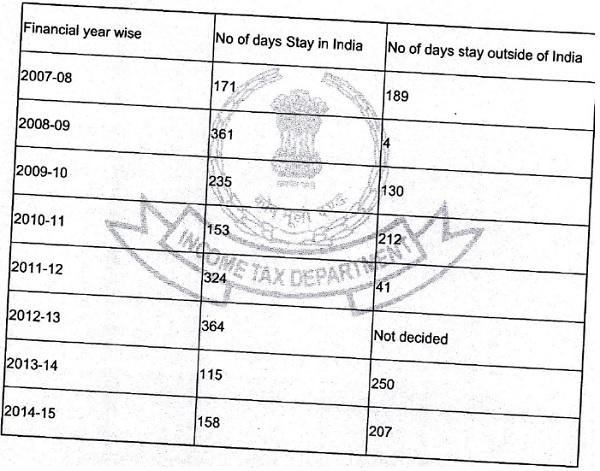
9. The above facts the number of days of stay in India of the assessee is not disputed.
10. Considering the provisions of Section 6(1)(a) and (c) of the Act, the AO and the Ld. CIT(A) has noted that the basic condition for a person to qualify as resident in India of the period of stay in India amounting to 182 days or more is not fulfilled in the present case for the impugned year. Therefore he has ruled out the assessee being treated as a resident as per Section 6(1)(a) of the Act.
11. Thereafter, he considered the provisions of Section 6(1)(c) of the Act and noted that for being treated as resident in India as per Section 6(1)(c) of the Act, the assessee’s period of stay in India ought to have been 60 days or more in the year and 365 days or more in the preceding four years. Applying to the facts of this case, he noted that the assessee stay in India exceeded 60 days in the impugned year and in preceding four years had exceeded 365 days. There is no dispute about the assessee fulfilling the condition specified under Section 6(1)(c) of the Act. The AO/Ld. CIT(A) have applied the provisions of Section 6(1)(c) of the Act and held the assessee to be resident in India.
12. Ld. Counsel for the assessee however has pointed out that the assessee’s case falls under Explanation 1(a)/(b) to Section 6(1)(c) of the Act. He contended that being employed with a foreign shipping company, he qualified as a citizen of India who wasleaving India for the purpose of employment outside India and as per Explanation 1(a) therefore, the requirement of 60 days stay in India specified in Section 6(1)(c) of the Act would extend to 182 days for qualifying as resident .
13. Alternatively, he contended that even treating the assessee as employed outside India and applying clause (b) to Explanation 1, the period of 60 days specified in Section 6(1)(c) of the Act gets extended to 182 days.
14. The contention of the ld. Counsel for the assessee was that the assessee being employed in a foreign ship, he is to be treated as being outside India or leaving India for the purpose of employment outside India, therefore as per clause (a) or clause (b) of Explanation 1 to Section 6(1)(c) of the Act, the 60 days of period of stay in India specified in Section 6(1)(c) of the Act would get extended to 182 days for qualifying as resident in India.
15. The Ld. Counsel for the assessee during the course of hearing before us was asked to explain the purport of including “members of crew of an Indian Ship as defined in clause (18) of Section 3 of the Merchant Shipping Act, 1958 “specified in clause (a) of Explanation 1 to Section 6(1)(c) of the Act and how it would affect the determination of residential status of a crew of a foreign ship.
16. To this ld. Counsel for the assessee responded by stating that crew members of Indian Ship were included in clause (a) of Explanation 1(a) by the Finance Act 1990 w.e.f. 01.04.1990 for the purpose of bringing them on par with crew members of foreign ships who were employed outside India sailing outside Indian territory for whom clause (a) of the explanation applied. That crew members of Indian Ship were included so as to be governed by the same rules determining residential status as applicable to crew members of foreign shipping companies.
17. He contended that the Revenue earlier was taking a stand that crew members of Indian ship were to be treated as employed in India even when sailing outside the territories of India as defined in Section 2(25A) of the Act which defined the term India used in the Act to mean the territory of India as referred to in Article 1 of the Constitution, its territorial waters, seabed and subsoil underlying such waters, continental shelf, exclusive economic zone or any other maritime zone as referred to in the territorial waters, continental shelf, exclusive economic zones and other maritime zones Act, 1976 and the air space above its territory and territorial waters. The stand of the Revenue was that foreign going Indian Ships, remained in the territory of India even when sailing outside India by virtue of the provisions of Merchant Shipping Act, and therefore services rendered by crew members on Indian ships outside India would amount to services being rendered in India. The Hon’ble Bombay High Court in the case of CIT Vs. M/s Indo Oceanic Shipping Co. Ltd. 247 ITR 247 (Bomb.) held that Indian Ships operating beyond Indian territorial waters do not come within the term “India” as defined u/s 2(25A) of the Act. Even as per the definition of the word “India” under the General Clauses Act, it was held ,that Indian Ships outside territorial waters of India are not included. The Hon’ble Bombay High Court held that the provision of the Merchant Shipping Act cannot be read into the Income Tax Act. The Hon’ble Bombay High Court referred to CBDT Circular No.586 dated 28th November 1990 (186 ITR (St.) 167) dated November 28, 1990 which indicated that if a crewman is outside India for more than 182 days on an Indian Ship, he will not be treated as resident of India. This view was reiterated by the Hon’ble Bombay High Court in the case of CIT Vs. Avtar Singh Wadhwan dated 20.11.2000 247 ITR 260. That as a consequence an amendment was made in the statute by Finance Act 2015w.e.f. 01.04.2015 clarifying that members of crew of an Indian Ship needed to be brought on par with crew members of a foreign ship, to be treated as employed outside India and hence for the purposes of qualifying as resident in India, the number of days of stay in India was to be extended to 182 days as opposed to 60 days specified in Section 6(1)(c) of the Act by virtue of Explanation 1(a) of the Act. He referred to several decisions treating the period of stay in India of less than 182 days of crew of a foreign shipping company being treated as non-resident in India. His submissions in this regard are reproduced hereunder:-
1. The Appellant had entered into contracts of employment with two foreign shipping companies engaged in maritime transport and thus qualified as a Non-Resident under the provisions of the Act. The appellant had no taxable income during the relevant assessment year and the salary earned for services rendered outside India while serving in international waters was not chargeable to tax in India. Salary amount was received by the appellant in its NRE Account.
2. For ready reference, Explanation 1(a) to section 6(1) of the Act prior to amendment made vide Direct Tax Laws (Second Amendment) Act, 1989 w.e.f. 01-04-1990 and subsequent to amendment reads as under:
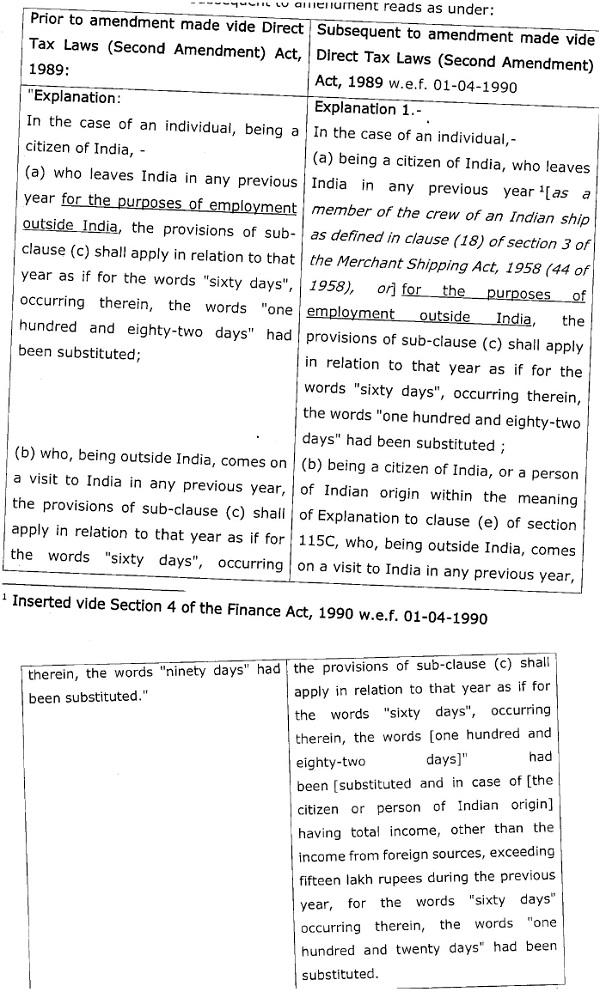
3. It can be seen that by the afore-said amendment, the crew members of Indian Ships who are employed in India and who are sailing outside Indian territory were brought on par with crew members of Foreign Ships who are employed outside India and who are sailing outside Indian territory.
4. It is submitted that the assessment order dated 30.01.2023 is a mere reproduction of contents of show cause notice dated 28.12.2022,without appreciating/considering/controverting the reply dated 06.01.2023 filed by the appellant. Thus, the assessment order was passed without considering /referring to the Explanation 1 to section 6(1)(c) of the Act.
5. It is submitted that the Explanation 1(a) to the Section 6(1) of the Act makes the statutory requirement regarding the number of days of stay clear and unambiguous and leaves no room for interpretation. From the above, it is evident that Explanation 1 to Section 6(1) contains three distinct limbs. Explanation (a) comprises two independent limbs, namely: (i) a citizen of India who leaves India as a member of the crew of an Indian ship, and (ii) a citizen of India who leaves India for the purposes of employment outside India. Explanation (b) constitutes the third limb and applies to a citizen of India, or a person of Indian origin, who, being outside India, comes on a visit to India during the previous year. In each of these three situations, the reference to “sixty days” in clause (c) of Section 6(1) stands substituted by “one hundred and eighty-two days”.
6. In the present case, the first limb of Explanation 1(a), relating to a citizen of India leaving India as a member of the crew of an Indian ship, is admittedly not applicable since the Appellant served on board foreign ships. Accordingly, no finding as to whether the vessels on which the Appellant served qualify as an “Indian ship” within the meaning of Section 3(18) of the Merchant Shipping Act, 1958 is required in the present case, as that requirement pertains exclusively to the first limb of Explanation 1(a), which the Appellant neither Invokes nor is required to establish.
7. However, the second limb of Explanation 1(a) squarely applies, as the appellant left India for the purposes of employment outside India. Thus the period of “60 days” specified in clause (c) of Section 6(1) is to be read as “182 days”.
8. Additionally the appellant’s case also falls within Explanation (b) and thus the legal consequence remains unchanged. Under Explanation (b) also, the period of “60 days” specified in clause (c) of Section 6(1) is to be read as “182 days”.
9. Consequently, irrespective of whether the Appellant’s case is considered under the second limb of Explanation (a) or under Explanation (b), the threshold under clause (c) remains 182 days, and since the Appellant was in India for only 158 days during the relevant previous year, he cannot be treated as a resident under Section 6(1) (c) of the Act.
10. It has not been disputed by the Assessing Officer that the number of days of the appellant’s stay in India is less than 182 days during the Financial Year 2014-15 (158 days). In the instant case, although the appellant has, cumulatively in the preceding 4 previous years been in India for a period in excess of 365 days yet in relevant Financial Year 201415 he has not been in India for a period of 182 days or more. Therefore, the Appellant was not a resident of India. The interpretation adopted by the Ld. A.O. is contrary to the plain language of the statute and cannot be sustained.
18. Ld. Counsel for the assessee has placed reliance on the decision of Karnataka High Court in the case of DIT Vs. Prahlad Vijendra Rao [2010 (11) TMI 803 vide order dated 08.11.2010]wherein the Hon’ble High Court held as under:-
……
6. Having heard the learned advocates appearing for the parties and after perusing the orders passed by the authorities and after having given our anxious consideration to the contentions raised, we are of the consideredview that there is no substantial question of law involved in this appeal for being formulated and adjudicated for the following reasons:-
a. The Revenue does not dispute that assessee had worked as a chief engineer on the board of a ship belonging to his employer “M/s Live Stock Transport and Trading Co.”, Kuwait and during the relevant period the assessee had stayed outside India for a period of 225 days and the salary that was earned by him was on account of the work discharged by him on board during the said period which is outside the shores of India.
b. The CIT(A) has placed reliance in the case of CIT vs. Avtar Singh Wadhwan (2001) 165 CTR (Bom) 414: (2001) 247 ITR 260 (Bom) wherein it has been held that salary received by the non-resident marine engineer for services rendered by him on a foreign going Indian ship which mainly remained away from the Indian coast during the relevant accounting year accrued outside India and was not taxable in India. While answering the question of law thereunder with reference to s. 9(1)(ii) in the said case it has also been held that the salary which is earned in India will alone be regarded as income arising in India and not otherwise. The principle laid down in the said case is squarely applicable to the facts of present case also.
c. The criteria of applying the definition of s. 5(2)(b) would be such Income which is earned in India for the services rendered in India and not otherwise.
d. Under s. 15 of the Act even on accrual basis salary income is taxable i.e., it becomes taxable irrespective of the fact whether it is actually received or not; only when services are rendered in India it becomes taxable by implication. However, if services are rendered outside India such income would not be taxable in India.
…….
19. Counsel for the assessee has also placed reliance on the decision of the Hon’ble Calcutta High Court in the case of Utanka Roy v. DIT [2016 (12) TMI 876 vide order dated 15.12.2016] wherein the Hon’ble High Court held as under:-
……
The petitioner is an Indian citizen. He is an income tax assessee. He has filed a return for the assessment year 2011-2012 with the Income Tax authorities. The petitioner claims to be an engineer and to be engaged as such by a foreign company. The petitioner claims that, he has worked as an engineer with the foreign company for 286 days during the assessment year. He hasfiled income tax return for the assessment year disclosing an income of 5,63,850/-. He has thereafter received an assessment cum intimation notice under Section 143(1) of the Income Tax Act, 1961. He has applied under Section 264 of the Income Tax Act, 1961 against such intimation under Section 143(1). In course of hearing of the proceedings under Section 264, the petitioner has claimed that, he has received 27,92,417/-from his employer during the assessment year in question instead of the sum of 5,63,850/-.
The question whether the petitioner has rendered services in India or not is a question of fact. It is not disputed that the petitioner as a marine engineer had rendered services outside India for the period of 286 days. He has received his remuneration for such work from a foreign company. Consequently, the income received by the petitioner for services rendered outside India has to be considered as income received out of India and treated as such.
……
20. Ld. Counsel for the assessee has also placed reliance on the decision of the Hon’ble Calcutta High Court in the case of Rajeev Biswas v. Union of India [2022 (9) TMI 1327 vide order dated 22.09.2022] wherein the Hon’ble High Court held as under:-
…….
The legal issue involved in the instant case is whether the income of the assessee could have been taken to have accrued in India only because it was mistakenly shown by the assessee to have accrued in India while filing the return of income on 11th January, 2013. Even in the said return the name of the employer of the assessee was shown as M/s. MSC Ship Management Hongkong Limited. Therefore, admittedly the assessee was employed outside the Indian Territory. The return was processed and an intimation under Section 143(1) dated 2nd March, 2013 was issued computing the tax liability at Rs.4,40,070/-. Thereafter, the assesseefiledthe application for rectification under Section 154 of the Act. The same was rejected by the assessing officer by communication dated 23rd July, 2014 on the ground that tax has been correctly computed on the income return by the assessee and a fresh claim of change of income is not liable under Section 154 as the same is not a mistake apparent from the record.
Thereafter the assessee filed another petition before the Deputy Commissioner of Income Tax (International Taxation) Circle 2(1). On 27.7.2015 this petition was filed by the Chartered Accountant of the assessee stating that on perusal of the client’s record it was found that theassessee was an NRI during the period as he had to stay outside the Country due to his employment and he was outside the country for totally 210 days during the previous year relating to the assessment year 2012-13 and the income has been assessed without considering the assessee’s NRI status. Therefore, it was requested that necessary rectification be made under section 154 of the Act. This request was rejected by the Deputy Commissioner of Income Tax (International Taxation) by order dated 28th January, 2016 on the ground that there is no mistake which is apparent from the records that can be rectified.
For all the above reasons, the appeal filed by the assessee is allowed. The order passed by the learned Tribunal dated 15th March, 2017 and the order passed in the Miscellaneous Application dated 5th January, 2018, the order passed by the CIT(A) dated 28th January, 2016, the order passed by the DCIT (International Taxation) dated 28th January, 2016 and the order of rejection of the application under Section 154 as per the communicated dated 23.7.2014 issued by the Centralised Processing Centre (CPC), Bangalore are quashed. Consequently, the order passed by the Assessing Officer computed the tax liability as per the intimation under Section 143 (1) of the Act dated 23.3.2013 and the assessment stands restored to the file of the Assessing Officer who shall review the assessment in terms of the observation made in the preceding paragraphs and also the law on the subject including the circular issued by the CBDT and grant the relief to the assessee by excluding the foreign income received by the assessee excluding the foreign income under Section 10(6)(viii) of the Act and such order shall be passed by the Assessing Officer within six weeks from the date of receipt of the server copy of this order.
……
21. Ld. DR relied on the order of the Authorities below.
22. We have heard the rival contentions, and we find merit in the contention of the ld. Counsel for the assessee. Undoubtedly, the assessee has been treated as resident in India by the Revenue Authorities, considering the provisions of Section 6(1)(c) of the Act. The applicability of Explanation 1(a) for determination of the residential status of the assessee has not been considered by the authorities below at all. We agree with the ld. Counsel for the assessee that the assessee being employed as a crew member of foreign ship, the number of days of stay in India to qualify as resident in terms of Section 6(1)(c) of the Act r.w. Explanation 1(a) was to be treated as 182 days. The assessee undoubtedly was employed outside India and therefore the provisions of Explanation 1(a) were attracted and 60 days period specified in Section 6(1)(c) of the Act was to be considered as 182 days in terms of Explanation 1(1) to Section 6(1)(c) of the Act.
23. In the facts of the present case, having not stayed in India for 182 days at all, we have no hesitation in holding that the assessee did not qualify as resident in India in terms of Section 6(1)(c) of the Act read with Explanation 1(a). The assessee was to be treated as non-resident and the salary which he earned on his employment in foreign ships sailing outside India was to be treated as accrued outside India. Therefore the assessee being non-resident and the salary not accruing and arising in India, the same was not taxable in India in terms of Section 5 of the Act. The addition made to the income of the assessee of the salary earned in India amounting to Rs.48,86,295/- by treating him as a resident of India is accordingly directed to be deleted. All the grounds raised by the assessee on merits are allowed.
24. In effect, the appeal of the assessee is allowed in above terms.
Order pronounced in the Open Court on 26.10.2026




