Late Shyam Sunder Vs ITO (ITAT Delhi)
Remand Is No Escape: CIT(A) Must Decide Reopening Objections
Sending an assessment back to the Assessing Officer does not discharge the CIT(A)’s duty to decide the assessee’s jurisdictional objections. In Late Shyam Sunder through Legal Heir Deepak Mangla v. ITO, the Delhi ITAT set aside appellate orders which directed fresh assessments without deciding the challenges to the validity of reopening. Following the Delhi High Court’s decision in Akasaki Technology (P.) Ltd., the Tribunal restored all four appeals to the CIT(A) for reasoned adjudication, including the jurisdictional grounds.
Background: Four Years, Common Reopening Dispute
The consolidated order concerned Assessment Years 2013-14 to 2016-17. The Tribunal treated the appeal for AY 2013-14 as the lead case because the parties and factual background were common.
For that year, the assessee had filed a return on 31 July 2013, declaring income of ₹3,32,210, which was processed under Section 143(1).
The assessment was subsequently reopened through a Section 148 notice dated 30 March 2021. The assessee did not respond to that notice or the subsequent notices under Section 142(1). Following a show-cause notice under Section 144, the Assessing Officer completed a best judgment assessment, making an addition of ₹55,82,620 under Section 68.
The dispute involved alleged investments in the Piyush Group of companies and interest income attributed to those investments.
Before the CIT(A), the assessee challenged both the additions and the jurisdiction to reopen the assessments.
CIT(A) Sent the Matter Back Without Deciding Jurisdiction
The CIT(A) recorded that the assessee had filed exhaustive written submissions questioning the reopening, the statutory approval and the evidentiary basis of the additions.
The objections included allegations of borrowed satisfaction, absence of independent inquiry, lack of tangible material and deficiencies in the approval under Section 151.
The CIT(A) also noticed that complete information concerning the alleged transactions, supporting documents and approval had not been provided by the Assessing Officer. At the same time, the authority referred to the assessee’s non-compliance during assessment.
Instead of returning findings on the legal objections, the CIT(A) invoked the proviso to Section 251(1)(a) and set aside the assessments for fresh consideration by the Assessing Officer.
The assessee challenged this course before the Tribunal, contending that the jurisdictional grounds required appellate adjudication.
Delay Condoned and Legal Heir Brought on Record
The four Tribunal appeals involved delays of 279, 279, 280 and 281 days.
After considering the explanation, the Tribunal found sufficient cause and condoned the delays. It relied on Collector, Land Acquisition v. Mst. Katiji & Others [1987] 167 ITR 471 (SC) and the principle of adopting a liberal approach to advance substantial justice.
The appeals were pursued through Deepak Mangla, the deceased assessee’s legal heir. After examining the substitution application and supporting documents, including the certified death certificate, the Tribunal allowed substitution under Section 159 and permitted filing of amended Forms 36.
The order does not hold that the assessments were invalid because of the assessee’s death. Substitution enabled the legal heir to continue the appellate proceedings.
Section 250(6) Requires Actual Findings
The Tribunal identified the central question: could the CIT(A) restore the matter to the Assessing Officer without deciding the jurisdictional grounds raised before it?
Section 250(6) requires an appellate order to state the points for determination, the decision on those points, and the reasons for the decision.
The CIT(A)’s observation that the assessee should receive another opportunity to counter the reopening did not answer the objections already presented in appeal.
The Departmental Representative acknowledged that the jurisdictional grounds had not been adjudicated and did not oppose restoration to the CIT(A) in light of the jurisdictional High Court ruling.
Delhi High Court: The Appellate Defect Must Be Corrected by CIT(A)
The Tribunal followed Akasaki Technology (P.) Ltd. v. PCIT, ITA No.241/2025, Delhi High Court, order dated 27.11.2025.
In that case, the CIT(A) had remanded a Section 144 assessment without deciding the objection concerning absence of a Section 143(2) notice.
The High Court held that the CIT(A) needed to determine whether the notice had been issued, the consequence of its absence and whether remand was permissible in those circumstances.
Since the defect arose in the exercise of appellate jurisdiction, the issue had to be decided by the CIT(A), rather than left to the Assessing Officer.
The Tribunal found the present case covered by that reasoning.
Fresh Appellate Decision Ordered
The Tribunal set aside the impugned appellate orders and directed the CIT(A) to decide all grounds afresh, including the jurisdictional grounds, after providing an effective opportunity of hearing.
All four appeals were allowed for statistical purposes.
The Tribunal did not annul the reassessments or delete the additions. Nor did it accept the separate objections concerning DIN, sanction, faceless assessment or the application of reopening precedents. Those contentions remain open for adjudication.
Author’s Comments
A fresh assessment opportunity cannot substitute for a decision on whether the original proceedings were legally initiated. The ruling requires the appellate authority to address that foundational challenge through findings and reasons.
Its scope is equally important: the Tribunal did not prohibit every remand under Section 251(1)(a). It held that the remand in these cases failed to satisfy Section 250(6) because the jurisdictional objections remained undecided.
For practitioners, the decision supports insisting on a reasoned appellate determination where reopening validity is specifically challenged, even when the assessment was completed ex parte.
Cases Discussed
- Akasaki Technology (P.) Ltd. Vs PCIT, ITA No.241/2025, order dated 27.11.2025 (Delhi High Court) — Direct jurisdictional High Court precedent followed by the Tribunal. The High Court held that where the CIT(A) had failed to decide a jurisdictional objection before remanding the assessment, the defect had arisen at the CIT(A) level and the issue had to be decided by the CIT(A), not the AO. No exact TaxGuru case page was verified; therefore, being a 2025 case, it is shown in purple.
- Collector, Land Acquisition, Anantnag Vs Mst. Katiji & Ors. [1987] 167 ITR 471 (SC) — Relied upon by the Tribunal while condoning delays of 279 to 281 days and applying a liberal, substantial-justice-oriented approach.
FULL TEXT OF THE ORDER OF ITAT DELHI
These appeals o f the assessee are directed against the orders even dated 04 .02.2025 of ld. CIT(A)/NFAC , Delhi passed u/s 250 of the Income-tax Act, 1961 (hereina f ter referred to as ‘the Act’) wherein assessment order dated 16.03.2022 , 27.03 .2022 respectively, was se t aside to the file of the AO to make a fresh assessment after giving opportunity to the appellant af ter verification o f the fac ts of the case and the principles o f law .
2. By this common order, we propose to decide the ITA Nos. 1267 , 1268, 1295 & 1339/Del/2026 as the parties are same and fac tual matrix is also same and in order to avoid multiplicity of decision, the same are being disposed of f accordingly. ITA No . 1267/Del/2026 is taken as lead case.
3. The assessee has filed an applica tion seeking condonation of delay of 279 days (ITA No s. 1267 & 1268/Del/2026) , 280 days (ITA No . 1295/Del/2026) and 281 days (ITA No . 1339/Del/2026) in filing the appeals. The contents o f the application are reproduced as under:
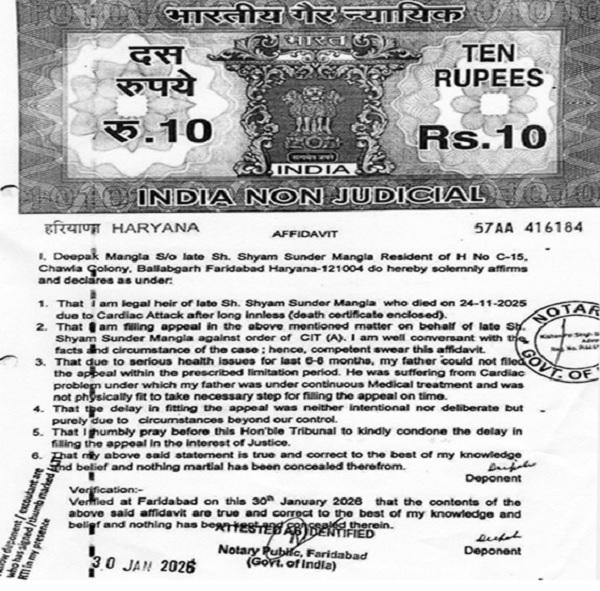
4. We have considered the contents of the condonation application and the submissions made by the ld. AR . We find tha t the assessee has satis factorily explained the reasons for the delay . In view of the principles laid down by the Hon’ble Supreme Court in the case of Collector, Land Acquis it ion vs. Mst . Katiji & Ors. (1987) 167 ITR 471 (SC), wherein it has been held tha t a liberal approach should be adopted while considering applications for condonation of delay to substantial justice, we are satisfied that the assessee has shown sufficient cause. Accordingly, the 279 days (ITA Nos. 1267 & 1268/Del/2026), 280 days (ITA No . 1295/Del/2026) and 281 days (ITA No . 1339/Del/2026) in filing the appeals are condoned in the larger interest of justice , and the appeals are admitted for ad judication on merits .
5. Facts in brief as culled out from the orders of the authorities below are that the assessee who is an individual filed return of income for A.Y . 2013-14 on 31.07 .2013 declaring total income of Rs.3 ,32,210/- and the same was processed u/s 143(1) o f the Ac t on 07 .10.2013. However, the case was reopened u/s 147 of the Act by issuing a no tice u/s 148 of the Act dated 30 .03.2021 and af ter obtaining necessary approval from Pr. CIT, Faridabad, as per section 151 of the Ac t. The assessee did no t file any response u/s 148 of the Act. Hence , notice u/s 142(1) o f the Act was issued on 25.11.2021 which was duly served . However, no response was filed to the said notice and another notices u/s 142(1) o f the Act was issued to the assessee on 14.12 .2021, 06 .01.2022 and 01.02 .2022. The assessee did not comply with the requirements of the notices and hence the Assessing O fficer proceeded u/s 144 of the Act for passing best judgment assessment by issuing show-cause notice u/s 144 of the Act dated 11 .02.2022 asking for the details of investment amounting to Rs .48,53,745/- as unexplained income u/s 68 o f the Act. No compliance was received from the asse ssee. The asse ssee repeatedly failed to comply the various notices and show-cause notices issued. Hence, assessment was completed u/s 144 of the Act by making addition o f Rs .55,82,620/- u/ s 68 of the Act and penalty proceedings were also initiated .
6. Aggrieved, by the assessment order, the assessee filed appeal before the ld. CIT(A) who has set aside the assessment order vide impugned order dated 04 .02.2025 by restoring the matter to the file of the AO, however without deciding the jurisdictional grounds raised be fore him.
7. Aggrieved by the impugned order, the assessee is in appeal before us which is instituted through legal heir Mr . Deepak Mangla who has moved an application for substituting himself u/s 159 of the Act for bringing legal heir on re cord. Along with application, necessary documents including certified copy of death certificate of the deceased asse ssee has been filed . We have examined the documents and the contents o f the application and the said application for substituting Mr . Deepak Mangla as legal heir o f the assessee is allowed . The assessee may file the necessary amended Form 36 by substituting the title accordingly. The assessee has raised the following grounds of appeal:
“ITA No. 1267/De l/2026
1 . That the learned CIT(A) has erred in law and on fac ts in not appreciating tha t the reassessment order dated 16 .03.2022 is void ab initio, as the notice u/s 148 da ted 30 .03.2021 falls wi thin the transitional period (20 .03 .2020 to 31 .03 .2021) covered by the Hon’ble Supreme Court in Ra jeev Bansal & Anr. v. Union of India (2023) 469 ITR 46 (SC). As per the binding ratio, such notices are deemed to be show-cause notices u/s 148A(b), requiring compliance with Sec tion 148A procedure. Since no noti ce u/s 148A(b) was issued nor order u/s 148A(d) passed , the reassessment order dated 16 .03.2022 is without jurisdiction and deserves to be annulled.”
2 . Misapplication o f di scretionary power u/s 251(1)(a)
“The learned CIT(A) gravely erred in law and on facts in invoking powers u/s 251(1)(a) o f the Act to set aside the assessment , despite recording clear findings that (i) the Assessing Of ficer failed to produce any tangible material/evidence during appellate proceedings , (ii) the sanction u/s 151 was mechanical and without application o f mind , and (iii) the ex parte order u/s 144 was invalid. Once such jurisdictional de fects were established , the CIT(A) ought to have annulled the assessment rather than remanding the ma tter to A .O . to make fresh assessment .
3 . Invalid “Reasons to Believe”
That the learned CIT(A) failed to appreciate that the Assessing O f ficer recorded “reasons to believe” on the basis of vague, uncorroborated and borrowed informa tion from a police complaint , which does not cons titute tangible material as required under settled law (Ganga Saran & Sons (P) Ltd . v . ITO , 130 ITR 1 (SC); ITO v. Lakhmani Mewal Dass, 103 ITR 437 (SC)).
4 . No Prior & Mechanical Approval u/s 151
That the learned CIT(A) erred in law and on fac ts in not appreciating tha t reassessment proceedings are bad in law as the manda tory approval u/s 151 was received late by A .O . on 8 .4 .2022 agains t issuance o f 148 dt . 30 .3 .2021 and in a mechanical manner , without application o f mind , and on borrowed satis fac tion, which vitiates the jurisdiction assumed by the Assessing Of ficer.
5 . Files inspection not allowed
That the learned CIT(A) erred in not apprecia ting tha t Ld. AO has erred in law and on facts in not allowing files inspec tion under circular no . 17(XL-36 ) dt. 28 .06 .1965 and section 76 of Indian Evidence Ac t, 1872 on 28 .03.2022 & 7 .4 .2022 . Even i f files inspection was not allowed upon appli cation to Additional Commissioner , Range-1 , Faridabad on 7 .4 .2022 and grievance was uploaded on as sessee’s Income Tax Por tal on 6 .4 .2022 & 11 .04.2022 . (Copies o f files inspec tion enclosed 6) .
6 . Additions Based on Suspicion and Con jecture
That the learned CIT(A) erred in sus taining additions of Rs.7 ,28 ,875/- (alleged unexplained inves tment) and Rs. 48 ,53,745/- (alleged interest income) especially when (i) alleged intere st income is nearly 7 times o f alleged inves tment and (ii) without any corrobora tive/tangible evidence, merely on suspicion and unveri fied police information, which is agains t the settled principle tha t suspicion, however strong, canno t take the place of proo f.
7 . Absence of Nexus Between In formation and Escapement of Income
That the learned CIT(A) failed to appreciate that the information relied upon by the AO , on borrowed satis faction o f Department , had no live nexus with the alleged escapement of income, as no independent inquiry u/s 131 , 133(6), or 142(2) was conduc ted to es tablish tha t the appellant had made such investment or earned such interest .
8 . Assessment Based on “Reasons to Suspect” Instead of “Reasons to Believe”
That the reassessment order su f fers from fundamental illegality as the additions were made on “reasons to suspect” rather than “reasons to believe ,” contrary to the mandate of section 147 and the cons ti tutional safeguard under Ar ticle 265 of the Constitution of India .
9 . Denial of E ffec tive Appellate Adjudication
That the learned CIT(A) erred in setting aside the assessment to the AO without ad judica ting the jurisdictional grounds raised by the appellant , thereby failing to discharge the appellate function vested u/s 250(6) and 251(1)(a) of the Act.
ITA No. 1268/De l/2026
“1 . That the learned CIT(A) has erred in law and on fac ts in not appreciating tha t the reassessment order dated 27 .03.2022 is void ab initio, as the notice u/s 148 da ted 30 .03.2021 falls wi thin the transitional period (20 .03 .2020 to 31 .03 .2021) covered by the Hon’ble Supreme Court in Ra jeev Bansal & Anr. v. Union of India (2023) 469 ITR 46 (SC). As per the binding ratio, such notices are deemed to be show-cause notices u/s 148A(b), requiring compliance with Section 148A procedure. Since no noti ce u/s 148A(b) was issued nor order u/s 148A(d) passed , the reassessment order dated 27 .03.2022 is without jurisdiction and deserves to be annulled.”
2 . Misapplication o f di scretionary power u/s 251(1)(a)
“The learned CIT(A) gravely erred in law and on facts in invoking powers u/s 251(1)(a) o f the Act to set aside the assessment , despite recording clear findings that (i) wrong reasons recorded trea ting assessee as Non-PAN despite valid PAN and hence filed no ITR, (ii) the sanction u/s 151 was mechanical and without applica tion o f mind , (iii) the Assessing O fficer failed to produce any tangible material/evidence during appellate proceedings , iv) reassessment order dated 27 .03.2022 u/s 147 r.w .s. 144 directly as Jurisdi ctional AO , instead o f through the Na tional Faceless Assessment Centre (NFAC), which i s mandatory under sec tion 151A of the Income Tax Act, 1961 & CBDT Noti fica tion No . 76/2020 dated 25 .09 .2020 and CBDT Circular No.19/2020 da ted 13 .08 .2020 which mandate that a ssessments and reassessments for speci fied years mus t be conducted through NFAC and (v) the ex parte order u/s 144 was invalid. Once such jurisdictional de fects were es tablished , the CIT(A) ought to have annulled the assessment ra ther than remanding the ma tter to A .O . to make fresh assessment.
3 . Invalid “Reasons to Believe”
That the learned CIT(A) failed to appreciate that the Assessing O f ficer recorded “reasons to believe” on the basis of vague, uncorroborated and borrowed informa tion from a police complaint , which does not cons titute tangible material as required under settled law (Ganga Saran & Sons (P) Ltd . v . ITO , 130 ITR 1 (SC); ITO v. Lakhmani Mewal Dass, 103 ITR 437 (SC)).
4 . No Prior & Mechanical Approval u/s 151
That the learned CIT(A) erred in law and on fac ts in not appreciating tha t reassessment proceedings are bad in law as the mandatory approval u/s 151 was given by ‘Non Jurisdictional’ Pr . CIT (Chandigarh) on wrong reasons of ‘NON PAN CASE’ in the absence o f Tangible Material in Hand and in a mechanical manner , without application of mind , & on borrowed satis faction, which vitiates the jurisdiction assumed by the ‘Non Jurisdic tional’ Assessing O f ficer , Wa rd 1(1) Nangal .
5 . Additions Based on Suspicion and Con jecture
That the learned CIT(A) erred in sus taining additions of Rs.4 ,68 ,35 ,000/- (alleged unexplained investment u/s 69A without es tablishing ownership of gold , bullion, jewellery , cash etc .) and Rs. 83 ,64 ,605/- (alleged interes t income which was not found credited in books of assessee) without bringing any corrobora tive/tangible evidence on record and exercising wrong jurisdiction merely on suspicion and unveri fied police in forma tion, which is against the settled principle that suspicion, however strong, cannot take the place of proof .
6 . Absence of Nexus Between In formation and Escapement of Income That the learned CIT(A) failed to appreciate that the information relied upon by the AO , on borrowed satis faction of Police Commissioner/Investigation Wing was wi thout non application of mind , which had no live nexus with the alleged escapement of income, as no independent inquiry u/s 131 , 133(6), or 142(2) was conduc ted to es tablish tha t the appellant had made such inves tment or earned such interest .
7 . Assessment Based on “Reasons to Suspect” Instead of “Reasons to Believe”
That the reassessment order su f fers from fundamental illegality as the additions were made on “reasons to suspect” rather than “reasons to believe ,” contrary to the mandate of section 147 and the cons ti tutional safeguard under Ar ticle 265 of the Constitution of India .
8 . Denial of E ffec tive Appellate Adjudication
That the learned CIT(A) erred in setting aside the assessment to the AO without ad judica ting the jurisdictional grounds raised by the appellant , thereby failing to discharge the appellate function vested u/s 250(6) and 251(1)(a) of the Act.
9 . Violation o f section 151A and CBDT Circulars applicable
That the learned CIT(A) erred in law and on fac ts in not appreciating tha t the reassessment order was passed manually by the Jurisdictional AO, which is contrary to sec tion 151A and CBDT ins tructions No. 76/2020 dated 25 .09.2020 and CBDT Ins truc tions No . 19/2020 da ted 13 .08.2020 which mandated that as sessments and reassessments for spe ci fied years must be conduc ted through NFAC.
10 . Invalid Notice u/s 148 dated 30 .03 .2021 (without DIN)
That the notice u/s 148 dated 30 .03 .2021 was issued without DIN , contrary to CBDT Circular No. 19/2019 dated 14 .08 .2019 , which mandates that all notices mus t bear a DIN unless covered by exceptional circumstances . The AO wrongly invoked para 3(iv) o f the circular , whereas the asses see had valid PAN and had filed ITR . As held in CIT v. Laxman Das Khandelwal (2019) 417 ITR 325 (SC) , absence o f valid notice renders reassessment void . Hence, the notice is invalid and deemed never to have been issued .”
ITA No. 1295/De l/2026
“1 . That the learned CIT(A) has erred in law and on fac ts in not appreciating tha t the reassessment order dated 27 .03.2022 is void ab initio, as the notice u/s 148 da ted 30 .03.2021 falls wi thin the transitional period (20 .03 .2020 to 31 .03 .2021) covered by the Hon’ble Supreme Court in Ra jeev Bansal & Anr. v. Union of India (2023) 469 ITR 46 (SC). As per the binding ratio, such notices are deemed to be show-cause notices u/s 148A(b), requiring compliance with Sec tion 148A procedure. Since no noti ce u/s 148A(b) was issued nor order u/s 148A(d) passed , the reassessment order dated 27 .03.2022 is without jurisdiction and deserves to be annulled.”
2 . Misapplication o f di scretionary power u/s 251(1)(a)
“The learned CIT(A) gravely erred in law and on facts in invoking powers u/s 251(1)(a) o f the Act to set aside the assessment , despite recording clear findings that (i) wrong reasons recorded i .e. without tangible or cogent materials in hand, (ii) the sanc tion u/s 151 was mechanical received on 8 .4 .2022 by JAO and without application of mind, (iii) the Assessing O ffi cer failed to produce any tangible ma terial/evidence during appellate proceedings, iv) 148 notice dt .30 .3 .2021 without prior approval and without following up 148А procedure (v) the ex pa rte order u/s 144 was invalid. Once such jurisdictional de fec ts were , established, the CIT(A) ought to have annulled the assessment ra ther than remanding the ma tter to A .O . to make fresh assessment.
3 . Invalid NFAC DSC without ‘Signature Properties’
That the learned CIT(A) has erred in law and on fac ts in not appreciating that the NFAC assessment order da ted 16 .03.2022 was digitally signed with the notation “Validity Unknown” , failing to sa tis fy Section 282A o f the Income-tax Act , 1961 read with Sections 3 and 5 o f the In formation Technology Act , 2000 . Such an order is void ab initio and incapable of being revived by remand.
4 . Non-Service o f Notice u/s 148
That the learned CIT(A) has erred in law and on fac ts in directing fresh as sessment despite the appellant never having been served wi th any notice u/s 148 . No such notice is available on the assessee’s portal , and mere citation in para 3 of the NFAC order cannot substitute valid service . The absence of notice is a jurisdictional defect that cannot be cured by remand.
5 . Jurisdictional Defect Not Curable by Remand
That the learned CIT(A) has erred in law and on facts in directing de novo assessment despite multiple jurisdictional defects-invalid DSC authentication, non-service of notice u/s 148 , lack of valid jurisdictional approval , violation o f Section 149(1)(b) and Section 148A , and absence of DIN. These de fectss trike at the root of jurisdiction and cannot be cured by remand under Section 251(1)(a).
6 . Invalid “Reasons to Believe”
That the learned CIT(A) failed to appreciate that the Assessing O f ficer recorded “reasons to believe” on the basis of vague, uncorroborated and borrowed informa tion from a police complaint , which does not cons titute tangible material as required under settled law (Ganga Saran & Sons (P) Ltd . v . ITO , 130 ITR 1 (SC); ITO v. Lakhmani Mewal Dass, 103 ITR 437 (SC)).
7 . No Prior & Mechanical Approval u/s 151
That the learned CIT(A) erred in law and on fac ts in not appreciating tha t reassessment proceedings are bad in law as the mandatory approval u/s 151 was given by ‘Non Jurisdictional’ Pr . CIT (Chandigarh) on wrong reasons of ‘NON PAN CASE’ in the absence o f Tangible Material in Hand and in a mechanical manner, without application of mind , & on borrowed sa tis faction, which vitiates the jurisdiction assumed by the ‘Non Jurisdic tional’ Assessing O f ficer , Wa rd 1(1) Nangal .
8 . Approval from Non-Jurisdi ctional Authority
That the learned CIT(A) has erred in law and on fac ts in overlooking tha t the approval dated 28 .03 .2021 was accorded by the Principal CIT , Chandigarh, who was not the jurisdictional authority. The alleged approval was received by the Jurisdictional AO only on 08 .04 .2022 , well a fter issuance o f the alleged 148 notice da ted 30 .03.2021 . Such invalid approval vitiates the reassessment proceedings and cannot be cured by remand .
9 . Viola tion of Sec tion 149(1)(b) and Section 148A
That the learned CIT(A) has erred in law and on facts in directing fresh assessment despite clear violation of Section 149(1)(b) and Section 148A. The alleged notice dated 30 .03.2021 was issued without tangible material in hand and without following the mandatory procedure under Section 148A. These jurisdictional defects render the proceedings void ab initio.
10 . Additions Based on Suspicion and Conjecture
That the learned CIT(A) erred in sustaining additions of Rs.3 ,49 ,25 ,000/- (alleged unexplained investment u/s 69A without establishing ownership of gold , bullion, jewellery , cash etc.) and Rs. 1 ,14 ,15 ,985/- (alleged interest income which was not found credited in books of assessee) especially when in ) when interest is higher side i .e . @ 33% p .a . ii) without bringing any corroborative/tangible evidence on record and exercising wrong jurisdiction merely on suspicion and unverified police in formation, which is against the settled principle tha t suspicion, however strong, cannot take the place of proof.
11 . Absence of Nexus Between In formation and Escapement of Income
That the learned CIT(A) failed to appreciate that the information relied upon by the AO , on borrowed satisfaction of Police Commissioner/Investigation Wing was without non application of mind, which had no live nexus with the alleged escapement of income, as no independent inquiry u/s 131 , 133(6), or 142(2) was conducted to establish that the appellant had made such investment or earned such interest.
12 . Assessment Based on “Reasons to Suspect” Instead o f “Reasons to Believe”
That the reassessment order su f fers from fundamental illegality as the additions were made on “reasons to suspect” rather than “reasons to believe ,” contrary to the mandate of section 147 and the cons ti tutional safeguard under Ar ticle 265 of the Constitution of India .
13 . Denial o f E f fec tive Appellate Adjudication
That the learned CIT(A) erred in setting aside the assessment to the AO without ad judica ting the jurisdictional grounds raised by the appellant , thereby failing to discharge the appellate function vested u/s 250(6) and 251(1)(a) of the Act.
14 . Invalid Notice u/s 148 dated 30 .03 .2021 (without DIN)
That the notice u/s 148 dated 30 .03 .2021 was issued without DIN , contrary to CBDT Circular No. 19/2019 dated 14 .08 .2019 , which mandates that all notices must bear a D IN unless covered by exceptional circumstances and in the absence o f valid notice renders reassessment void . Hence, the notice is invalid and deemed never to have been issued .”
ITA No. 1339/De l/2026
1 . That the learned CIT(A) has erred in law and on facts in not appreciating tha t the reassessment order dated 27 .03.2022 is void ab initio, as the notice u/s 148 da ted 30 .03.2021 falls within the transitional period (20 .03 .2020 to 31 .03 .2021) covered by the Hon’ble Supreme Court in Rajeev Bansal & Anr. v. Union of India (2023) 469 ITR 46 (SC). As per the binding ratio, such notices are deemed to be show-cause notices u/s 148A(b), requiring compliance with Section 148A procedure. Since no noti ce u/s 148A(b) was issued nor order u/s 148A(d) passed , the reassessment order dated 27 .03.2022 is without jurisdiction and deserves to be annulled.”
2 . Misapplication o f di scretionary power u/s 251(1)(a)
“The learned CIT(A) gravely erred in law and on facts in invoking powers u/s 251(1)(a) o f the Act to set aside the assessment , despite recording clear findings that (i) wrong reasons recorded treating assessee as Non-PAN despite valid PAN and hence filed no ITR, (ii) the sanction u/s 151 was mechanical and without application o f mind , (iii) the Assessing Officer failed to produce any tangible material/evidence during appellate proceedings , iv) reassessment order dated 27 .03.2022 u/s 147 r.w .s. 144 directly as Jurisdictional AO , instead o f through the National Faceless Assessment Centre (NFAC), which is mandatory under section 151A of the Income Tax Act, 1961 & CBDT Notification No . 76/2020 dated 25 .09 .2020 and CBDT Circular No.19/2020 dated 13 .08 .2020 which mandate that assessments and reassessments for specified years must be conducted through NFAC and (v) the ex parte order u/s 144 was invalid. Once such jurisdictional defects were established , the CIT(A) ought to have annulled the assessment ra ther than remanding the matter to A .O . to make fresh assessment.
3 . Invalid “Reasons to Believe”
That the learned CIT(A) failed to appreciate that the Assessing O f ficer recorded “reasons to believe” on the basis of vague, uncorroborated and borrowed informa tion from a police complaint , which does not cons titute tangible material as required under settled law (Ganga Saran & Sons (P) Ltd . v . ITO , 130 ITR 1 (SC); ITO v. Lakhmani Mewal Dass, 103 ITR 437 (SC)).
4 . No Prior Approval & Mechanical Approval u/s 151
That the learned CIT(A) erred in law and on facts in not appreciating tha t reassessment proceedings are bad in law as the mandatory approval u/s 151 was given by ‘Non Jurisdictional’ Pr.CIT (Chandigarh) on wrong reasons of ‘NON PAN CASE’ in the absence o f Tangible Material in Hand and in a mechanical manner, without application of mind , & on borrowed satisfaction, which vitiates the jurisdiction assumed by the ‘Non Jurisdictional’ Assessing Officer , Ward 1(1) Nangal .
5 . Additions Based on Suspicion and Conjecture
That the learned CIT(A) erred in sustaining additions of Rs.2 ,27 ,36 ,000/- (alleged unexplained investment u/s 69A without establishing ownership of gold , bullion, jewellery , cash etc .) and Rs. 84 ,77 ,125/- (alleged interest income which was not found credited in books of assessee) without bringing any corroborative/tangible evidence on record and exercising wrong jurisdiction merely on suspicion and unverified police in formation, which is against the settled principle that suspicion , however strong, cannot take the place of proof .
6 . Absence of Nexus Between In formation and Escapement of Income
That the learned CIT(A) failed to appreciate that the information relied upon by the AO , on borrowed satis faction of Police Commissioner/Inves tigation Wing was without non appli cation of mind, which had no live nexus with the alleged escapement of income, as no independent inquiry u/s 131 , 133(6), or 142(2) was conduc ted to establish that the appellant had made such inves tment or earned such interes t.
7 . Assessment Based on “Reasons to Suspect” Instead of “Reasons to Believe”
That the reassessment order su f fers from fundamental illegality as the additions were made on “reasons to suspect” rather than “reasons to believe ,” contrary to the mandate of section 147 and the cons ti tutional safeguard under Ar ticle 265 of the Constitution of India .
8 . Denial of E ffec tive Appellate Adjudication
That the learned CIT(A) erred in setting aside the assessment to the AO without ad judica ting the jurisdictional grounds raised by the appellant , thereby failing to discharge the appellate function vested u/s 250(6) and 251(1)(a) of the Act.
9 . Violation o f section 151A and CBDT Circulars applicable
That the learned CIT(A) erred in law and on fac ts in no t appreciating tha t the reassessment order was passed manually by the Jurisdictional AO, which is contrary to section 151A and CBDT instructions No. 76/2020 dated 25 .09.2020 and CBDT Instructions No . 19/2020 da ted 13 .08.2020 which mandated that assessments and reassessments for specified years must be conducted through NFAC.
10 . Invalid Notice u/s 148 dated 30 .03 .2021 (without DIN) by Non Jurisdictional A.O . Tha t the notice u/s 148 dated 30 .03 .2021 was issued by Non Jurisdictional A.O . without D IN , contrary to CBDT Circular No .19/2019 dated 14 .08 .2019 , which mandates that all notices must bear a DIN unless covered by exceptional circumstances . The AO wrongly invoked para 3(iv) of the circular , whereas the assessee had valid PAN and had filed ITR . As held in CIT v. Laxman Das Khandelwal (2019) 417 ITR 325 (SC), absence of valid notice renders reassessment void . Hence , the notice is invalid and deemed never to have been issued.”
8. We have heard the ld . AR and the ld. DR and examined the record. The ld . AR at the very outse t drew our attention to the ground No. 9 as produced above with re spect to non-exercising of the jurisdiction by the ld. CIT(A) u/s 250(6) o f the Act as the ld . CIT(A) has not ad judica ted the jurisdictional ground raised by the appellant before him? The only question be fore us is whether the ld. CIT(A) was right in restoring the matter to the file of the AO without deciding the jurisdictional ground raised be fore him . In that regard, it is argued on behalf o f assessee tha t the ld. CIT(A) was duty bound to ad judicate the legal grounds and has wrongly restored the file to the AO without deciding the jurisdictional ground. In that regard, the ld. AR has relied upon the case o f Hon’ble Delhi High Court in the case of Akasaki Technology (P) Ltd . Vs. PCIT in ITA 241/2025 vide order dated 27.11.2025 stating that the matter needs to be restored to the ld. CIT(A) for deciding the jurisdictional ground raised before him.
9. The ld. DR, on the other hand, submitted that the ld . CIT(A) has no t adjudicated the jurisdic tional ground while passing the impugned order and the Hon’ble Tribunal may in its own discretion take a decision on tha t aspect accordingly . The ld . DR has not opposed for restoring the matter to the file o f the ld . CIT(A) in view o f judgment of Hon’ble High Court in Akashaki Technology (P) Ltd . referred (supra).
10. We have examined the order o f Hon’ble High Court and noticed that the facts and circumstances were identical to the fac ts and circumstances o f the case in hand , as the assessment order in that case was also passed u/s 144 of the Act and the ld . CIT(A) has not returned any finding on the jurisdictional ground raised before him and has restored the matter to the file of the AO. In these circumstances, the Hon’ble jurisdictional High Court in para 14 & 15 was pleased to hold as under:
“14 . A perusal of the order would reveal that the ITAT does not deal with the pleas urged by the appellant before it. Even the CIT(A) wi thout dealing with the submissions , has primarily by observing that the appellant had submi tted that the assessment order was passed under Section 144 of the Ac t without issuing notice under Section 143(2) of the Act, has remanded the mat ter back to the AO . There i s no finding o f the CIT(A) on the said aspect inasmuch as it ought to have to come to the conclusion whether such a notice had in fact been issued , i f not what is the e f fec t and also, in such circums tances , the ma tter could have been remanded back to the AO , as it is the case of Mr . Krishnan that as no valid order under Section 144 of the Ac t was pas sed , the matter could not have been remanded back to the AO. Similarly , the ITAT has also without deciding the issue as raised by the appellant , upheld the order passed by the CIT(A).
15 . Since an in firmity has arisen a t the level o f the CIT(A) , who was exercising jurisdiction under Sec tion 251 of the Act , the issue raised need to be decided by the CIT(A) and not by the AO . We accordingly, se t aside the order passed by the ITAT dated 07 .05 .2025 and also the order of the CIT(A) dated 25 .10 .2024 and remand the mat ter back to the CIT(A) who shall decide the appeal afresh including on the plea advanced by Mr . Krishnan, as noted above .”
11. We have also examined the impugned order wherein the ld . CIT(A) has decided the appeal making following observation in para 5.1 onwards as under:
“5 .1 During the course o f appellate proceedings , appellant filed exhaustive written submission mainly challenging the jurisdiction of the AO to the issue of notice u/s 148 o f the I.T . Ac t on the grounds that appellant’s name was not appearing in the list of approval u/s 151 of the I.T. Act granted by Pr .CIT Chandigarh whereas as per letter no . 2528 dated 28 .03.2021 Addl .CIT Chandigarh granted approval u/s 151(1) of the I.T . Ac t to non- jurisdictional ITO Wd .1(1) Nangal on the basis of said approval letter of Pr .CIT Chandigarh, that the AO has not made any independent enquiry into veracity o f alleged information and that the re-opening was based on borrowed satis faction and the additions were made without applica tion of mind , that as per the in formation provided by Faridabad Police Commissioner there were investments in flats agains t receipt o f Rs. 12 ,000/- only whereas additions were made against investment and interest thereon, that the AO has not brought any tangible material / corrobora tive evidences on record to show that the appellant has undisclosed income or una ccounted funds , e tc . etc . and therefore impugned assessment order passed is bad in law . Appellant also relied upon plethora o f judgements in support of contentions raised .
5 .2 I have carefully perused the written submission filed by the appellant during appellate proceedings . I have also carefully perused the findings given by the AO in the impugned assessment order and found tha t the AO has not provided complete in formation related to information and documentary evidences received by him rela ting to appellant’s said inves tment in Piyush Group of companies and interes t received thereon as also approval accorded u/s 151(1) of the I.T. Act . At the same time , it is noted that the appellant has also failed to comply to any o f the s tatutory notices issued by the AO including notices u/s 148 and u/s 142(1) o f the I.T. Act during the course o f assessment proceedings and thus failed to provide required details and documentary evidences to show tha t the re-assessment proceedings initiated by the AO is not in accordance wi th provision of law and that the said in forma tion received by the AO is not correct. Therefore in the absence of complete in formation and the view o f the AO in the mat ter of re-opening of assessment and said in formation received, thi s of fice is unable to ad judicate grounds of appeal raised by the appellant .
5 .3 Therefore, considering the totality of the case and considering the fact that the impugned assessment order has been passed by the AO ex-par te u/s 147 r.w.s. 144 o f the I.T. Act mainly for the reason that the appellant failed to respond to any o f the statutory notices issued by the AO, and thus failed to provide requi red details / explanations and necessary documentary evidences, I am o f the considered view that the AO need to properly veri fy and bring evidences on records to show tha t appellant has ac tually done the said transac tion of inves tment of Rs.7 ,28 ,875/- in Piyush Group of companies and earned interest income o f Rs.48 ,53 ,745/- on such investment and taxability of the same . The appellant should also get an opportunity to present his case and file written submission and necessary documentary evidences to give rebuttal to the findings of the AO and countering the arguments of the AO related to re-opening o f assessment and investment of Rs. 7 ,28 ,875/- in Piyush Group of companies and taxability of interest income earned of Rs .48 ,53 ,745/- on such investment .
5 .4 Therefore, in view of powers vested in the undersigned vide proviso under clause (a) o f sub-section (1) of section 251 of the Ac t , in my considered opinion, it would meet the ends o f jus tice i f the assessment i s set aside to the file o f the A .O . to make a fresh assessment after of fering suf ficient and reasonable opportuni ty of being heard to appellant and a fter veri fi cation of the fac ts of the case and in the principle o f law . The impugned assessment order passed by the A.O . is therefore set aside to the file o f the A .O . to make the same de-novo.
6 . In the resul t, the appeal is set aside.”
12. On perusal o f the contents of the impugned order extracted above, we have noticed that the ld. CIT(A) has not followed the provision of section 250(6) of the Act and has no t ad judicated the appeal as per requirement of law while restoring the matter to the file of the AO. Sec tion 250(6) of the Act reads as under:
“250 . .. … . .. .
(6) The order o f the Joint Commissioner (Appeals) or the Commissioner (Appeals) disposing o f the appeal shall be in writing and shall state the points for determination, the decision thereon and the rea son for the decision.”
13. The ld . CIT(A) has observed that “the appellant should also get an opportunity to present his case and file written submissions and necessary documentary evidence to give rebuttal to the finding o f the AO and countering the arguments of the AO related to reopening o f assessment” . It is thus clear tha t the ld . CIT(A) has not adjudicated the legal grounds taken be fore him alleging tha t the reopening o f assessment was bad in law. These facts and circumstances and the contents o f the impugned order, bring the case within the parameters of the law laid down by the Hon’ble jurisdictional High Court in ITA No . 241/2025 referred (supra) . For the above reasons, we are of the considered opinion that the impugned order has been passed without following the principle of section 250(6) of the Act. Accordingly , ground No . 9 (ITA No . 1267/Del/2026), ground No . 8 (ITA No. 1268/Del/2026) , ground No . 13 (ITA No. 1295/Del/2026) and ground No . 8 (ITA No. 1339/Del/2026), raised by the assessee in this regard are allowed and the impugned order is set aside . The matter is restored to the file of the ld. CIT(A) for deciding the same afresh, after affording the assessee an effective opportunity of hearing , and for deciding all the grounds raised before him , including the jurisdictional ground , in accordance with law .
14. The finding of ITA No. 1267/Del/2026 shall mutatis mutandis apply to ITA Nos. 1268, 1295 & 1339/Del/2026 .
15. In the result, the appeals o f the assessee are allowed for statistical purposes.
Order Pronounced in the Open Court on 30/09/2026.