
Triburg Sourcing Services Private Limited Vs ACIT (ITAT Delhi)
Section 69C Addition Cannot Survive When Cash Bonus Is Refunded & Repaid Through Banking Channels in the Same Year
Summary: The Delhi ITAT deleted additions under Section 69C read with Section 115BBE where employees returned the cash bonus they had received earlier in the financial year and the assessee subsequently paid the same employees through banking channels after deducting tax at source. The Tribunal accepted the evidence of the original cash payments. It also found that the employees had refunded those amounts within the same year and that the Assessing Officer had accepted the subsequent bank payments recorded as bonus expenditure.
Search Revealed Cash Bonus Payments
A search and survey operation on the Triburg Group on 2 March 2021 yielded loose papers, WhatsApp chats and other material concerning cash payments to employees. Page 15 of Annexure A-19 contained entries against certain names. The group’s accountant and other personnel gave statements indicating that cash had been paid to employees. The Chief Financial Officer described the payments as bonus and identified cash received in connection with a property sale as a major source.
In the lead appeal, the Assessing Officer concluded that ₹96 lakh had been paid in cash to seven employees outside the regular books. The assessee explained that Anuradha Bakshi and Malika Bakshi, its directors, had made the payments from cash available with them. The Assessing Officer found the linkage between the directors’ cash and the bonus payments insufficient and invoked Section 69C. An addition of ₹2,23,48,000 was made in the companion appeal on similar facts. The CIT(A) confirmed both additions.
Employees Returned the Cash Before the Bonus Was Paid Through Banks
The assessee acknowledged the initial cash payments. Its explanation was that the employees had returned the amounts to the directors, who deposited the recovered cash in their bank accounts. The assessee then paid the bonuses to the employees on 31 March 2021 through banking channels after deducting TDS. The bonus expenditure claimed in the profit and loss account represented the bank payments.
The assessee also placed the directors’ income-tax returns on record to support the availability of cash. Each director had offered ₹2.35 crore of cash receipts connected with a property sale to tax. The assessment order itself recorded aggregate cash availability of ₹6,21,25,706 with the two directors, including other disclosed receipts. The Tribunal considered the cash trail secondary once the refund and subsequent bank payments were established.
Revenue Relied on the Presumption Under Section 292C
The Revenue argued that the seized paper identified employees and that the statements recorded on oath corroborated the entries. Relying on Section 292C, it contended that the seized material carried evidentiary weight and that the payments should be attributed to the companies because the recipients were their employees. The Revenue also argued that the explanation about the return of cash and subsequent bank payments had never been placed before the authorities below.
The Tribunal examined the paper book and found that the assessee had furnished details in response to two notices issued by the Assessing Officer. The CIT(A) had also reproduced the relevant submissions in the appellate order. Both authorities had proceeded without addressing the evidence concerning the refund of cash and repayment of the bonus, even though those facts directly affected the basis of the additions.
Why Section 69C Did Not Apply
The Tribunal examined the complete sequence of transactions. The initial cash payments were made earlier in the year, the employees refunded those amounts to the original payers, and the same employees received their quantified bonuses through banking channels within FY 2020–21. The Assessing Officer had accepted the bank payments reflected in the accounts.
On these facts, the Tribunal held that the initial cash payments had effectively been squared up. The expenditure actually claimed was the bonus paid through banks. Accordingly, the earlier cash payments could not sustain a separate addition as unexplained expenditure under Section 69C. The Tribunal applied the same reasoning to the companion appeal, deleted both additions and allowed both appeals. It left the grounds concerning jurisdiction and limitation open because the assessee had succeeded on merits.
Author’s Comments
The practical significance of this ruling lies in the distinction between proof of an initial payment and proof of a separate expenditure chargeable under Section 69C. The seized paper and sworn statements established the initial cash payments. The evidence of refund, followed by payment to the same employees through banking channels, established what ultimately happened to those sums. The Tribunal considered both parts of the transaction in deciding whether the addition could stand.
The same-year refund, the identity of the employees who received the subsequent bank payments, and the acceptance of the bonus recorded in the accounts were central to the outcome. In a similar assessment, the strength of the explanation will depend on whether the records connect the original payment, the employee’s refund and the final bank payment. A later bank payment or TDS deduction, by itself, does not establish that the earlier cash payment was returned.
FULL TEXT OF THE ORDER OF ITAT DELHI
1. These are a batch of two appeals pertaining to the same group of cases, in which the issues are similar and arise from the same search dated 02.03.2021. Considering the commonality of issues, these two cases are being disposed of through a single order.
1.1 ITA No.1788/Del/2026 arises from order dated 10.12.2025, passed u/s 250 of the Income Tax Act, 1961 (hereafter as “the Act”), by Ld. CIT(A)-24, New Delhi. ITA No.1789/Del/2026 arises from order dated 10.12.2025, passed u/s 250 of the Act, by Ld. CIT(A)-24, New Delhi.
1.2 It is seen that additions in both the cases have been made on an allegation that bonus was paid to employees outside of the regular books of account, in cash, and therefore the provisions of Section 69C of the Act were invoked r.w.s. 115BBE of the Act. For the sake of convenience, the facts in ITA 1788 will be used to understand the factual matrix and this case will also be taken as the lead case. In this case, following a search and survey operation dated 02.03.2021 on the Triburg Group of cases, certain allegedly incriminating documents, WhatsApp chats etc. were seized to indicate that Rs.96,00,000/- was paid to 7 employees of the assessee company as bonus. The said payment was made in cash and was apparently paid outside the books of accounts. It is seen that a bunch of loose papers seized as Annexure A-19 from 182, Udhyog Vihar, Phase-1, Gurgaon, indicated that some amounts had been paid to certain persons with a total of “70.70”. Since this particular document has some relevance to the adjudication at hand, the same may be reproduced as under:
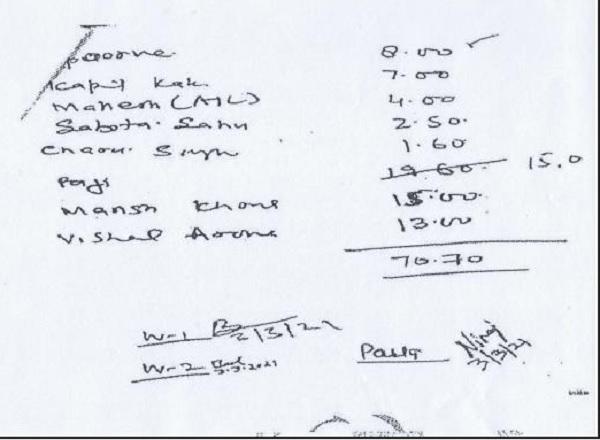
This particular document was confronted to Shri Suraj Mohan, Accountant who admitted under oath that the entries represented cash paid to employees of various Triburg Group of Companies. Another employee named Shri Malaya Pradhan (of M/s Triburg Consultants) also confirmed the earlier statement by saying that the entries represented cash payment to various employees of the Triburg Group of Companies. Thereafter, Mr. Robindra Sharma (CFO of the Triburg Group) was also confronted with this document and he recorded a statement under oath that the entries represented payments in cash by way of bonus to employees of the Triburg Group and the major source of the cash payment was a recent sale of property amounting to Rs.25 crores (being registered value of the same) in the name of Anuradha Bakshi and Malika Bakshi. It was recorded in this statement that the cash of Rs 4.7 crores (page 10 of Ld. AO’s order) was received over and above the registered value of the property purchased from one Mr. Dhoot. The receipt in cash was confirmed by one Mr. Sanjay Shukla, employee also. In the Ld. AO’s order, there are considerable details about bonus being paid in cash to certain employees and thereafter the assessee was confronted with these evidences and statements. The assessee responded by stating that some cash was received through sale of property, over and above the registered value and thereafter it was stated that cash to the tune of Rs.235,00,000/- each was received by Mrs. Anuradha Bakshi and Ms. Malika Bakshi, in addition to Rs.1,20,00,000/- again received by Ms. Malika Bakshi and a final amount of Rs.31,25,706/- received by Mrs. Anuradha Bakshi through cash sales in a proprietary concern of hers. It is noteworthy that this is the cash receipt admitted by the assessee and there is also a further contested cash receipt of Rs.18,45,00,394/- which represented additions made by the Department with respect to suspected on-money received and other cash receipts on account of sales not forming part of regular books of accounts, by various entities controlled by the main persons of the Triburg Group. It was stated before the Ld. AO that the impugned cash bonus was paid by Mrs. Anuradha Bakshi and Ms. Malika Bakshi out of cash available with them and such cash had been disclosed to the Department. However, the Ld. AO did not find the linkage between the cash disclosed by the main persons of the Triburg Group and the bonuses paid to the concerned employees. Eventually an addition u/s 69C r.w.s. 115BBE of the Act was made of Rs.96,00,000/-. Similarly in ITA 1789, on this very same ground, an addition of Rs.2,23,48,000/- was made under identical circumstances.
1.3 The aggrieved assessee approached the CIT(A) where also he could not succeed on the basis of findings given in the impugned order to the extent that the source of bonuses paid in cash could not be reconciled with the cash available with the main persons of the Triburg Group and therefore the additions (impugned) in the two cases were confirmed. It may also be mentioned that the assessee had claimed that the assessment orders in both the cases were time barred on the basis that the assessment should have been completed by 30.09.2022 instead of the actual completion date of 29.03.2024. This ground was summarily dismissed by the Ld. CIT(A).
1.4 Further aggrieved, the assessee has approached the ITAT with grounds challenging the assumption of jurisdiction; the contention that the assessment order is time barred; and the grounds on merits which claim that the source of cash bonuses was duly explained.
2. Before us the Ld. AR requested that the grounds on merits may be adjudicated first and thereafter, if required, the contention of the assessee regarding the jurisdictional grounds, which have been duly submitted before the Bench in the shape of detailed written submissions, may be considered. The Ld. AR drew our attention to page 15 of Annexure A-19 (supra) and stated that the Ld. AO has utilized this particular piece of paper for making the impugned additions. It was the submission that this paper does not indicate any nexus with the additions ultimately made on account of bonuses paid in cash to specific employees of the two concerns under adjudication at present. It was pointed out that a few names in this sheet of paper may be relatable to employees but the Ld. AO has made out a case for addition on the basis of statements recorded of Shri Sanjay Shukla, Shri Robindra Sharma and Shri Sudhir Kumar Singh etc. to arrive at the conclusion that the impugned amounts were paid to select employees out of undisclosed funds and thereby additions u/s 69C of the Act were merited. It was the submission that the statements relied on by the Ld. AR were recorded behind the back of the assessee and in any case only the factual situation was indicated through such statements, since while actually the cash bonus was paid but it was never paid by the assessee, rather it was paid by the Directors of the assessee company out of cash consideration declared and assessed to tax in their personal hands. It was the further submission that during the course of the very same year (FY 2020-21) all the recipients of bonus invariably refunded back the amounts received by them as bonus in cash and the said amounts were duly deposited in the bank accounts of the Directors. Furthermore, during this very same financial year bonuses were again paid to the concerned employees on 31.03.2021 through banking channels after deduction of tax at source by the assessee company. The Ld. AR again explained that while cash bonuses had been paid earlier in the year, however the same were duly returned back to the Directors and thereafter the bonuses were re-paid by the assessee companies to the employees. It was the submission that whatever amount has been claimed as expenditure by the two assessees in respect of bonuses paid to eligible persons, was eventually done through banking channels, after deduction of tax at source. The Ld. AR elaborated on the point of availability of cash with the Directors with the caveat that the availability of cash with Directors of the Company, being Mrs. Anuradha Bakshi and Ms. Malika Bakshi, was duly explained in assessment proceedings concerning them, and this fact was a matter of record, but for the sake of completeness it deserves to be mentioned that both these Directors had already disclosed cash received of Rs.2,35,00,000/- each as received through sale of property where the allegation was of certain amounts being received as on-money. It was submitted that the total amount of on-money received of Rs.4,70,00,000/- was duly offered to tax in the hands of Mrs. Anuradha Bakshi and Ms. Malika Bakshi. It was also mentioned that even though there was no clear evidence of receiving any on-money by the said Directors of these companies but the said amounts were offered to buy peace of mind and avoid unnecessary litigation. The Ld. AR placed on record the return of income of these two Directors for our perusal and as proof of the claim regarding the cash in hand available of Rs.4,70,00,000/- with the two persons. It was the submission that the Ld. AO has actually accepted the payment of bonuses to eligible employees as shown in the Profit & Loss Account of the assessees, ignoring the fact that the addition being made u/s 69C of the Act was of same amounts that were actually refunded back and repaid through banking channels. As an alternative argument the Ld. AR stated that it was a case of double addition of same amounts. The Ld. AR also pointed out that the authorities below have not discussed or taken into account the very specific explanation offered by the assessee in regard to the cash bonuses being returned back to the payers and thereafter being paid again through banking channels. It was pointed out that this fact was duly brought to the notice of the Ld. AO in response to his notice dated 27.03.2023 for which a detailed response was filed as can be seen on pages 213 to 214 of the Paper Book. It was also emphasized by the Ld. AR that these details were again filed before the Ld. AO in response to his notice dated 20.02.2024 for which response was filed on 26.02.2024 and the same can be seen at pages 234 to 244 of the Paper Book.
2.1 Regarding the issue of assessment orders being barred by limitation, the Ld. AR took us through the facts of the case with respect to the dates of search and punchnamas recorded. For this purpose the Ld. AR again repeated that their detailed submissions may be taken on record and utilized for adjudication in case the discussion on merits was not sufficient for assessing the true and correct income of the assessees under consideration. The Ld. AR also placed on record a compendium of case laws in support of his arguments on merits as also on the legal grounds regarding the assumption of jurisdiction by the Ld. AO.
3. The Ld. DR relied on the orders of the authorities below and stated that the assessee has all along tried to make light of the importance of document seized from his possession. It was the submission that Section 292C of the Act prescribes that the presumption as to assets, books of accounts, etc. being found in possession of or control of any person would be presumed to belong to such person. It was also required to be presumed that the contents of such documents and books of accounts are true. Considering the provision of this section the documents found from the possession of the assessee have absolute value for determining the correct income of the assessee. It was the submission that the document listed as page 15 of Annexure A-19 (supra) is not a “dumb” document but it mentions the name of certain identifiable employees of the assessee companies. Thus, such a document has considerable evidentiary value. It was the submission that the assessees’ contention regarding the limited or no utility of the statements recorded under oath, was misplaced. The statements relied on by the Ld. AO of persons connected to the assessee companies has considerable evidentiary value since the said statements have been recorded under oath. The statements also tended to corroborate the notations on the seized material relied on by the Ld. AO. Thereafter, the Ld. DR took us through the statements of Shri Suraj Mohan, Accountant, Shri Malaya Pradhan, Accountant and Shri Robindra Sharma, CFO of the Triburg Group, and stated that clearly payments in cash had been made to employees of the assessee company and therefore such payments are deemed to have been made by the assessee companies out of undisclosed income. It was argued that the beneficiary employees are employees of the company and not personal employees of either Mrs. Anuradha Bakshi or Ms. Malika Bakshi and therefore the impugned amounts have to be presumed to belong to the assessee companies only. Regarding the allegation that the statements were recorded behind the back of the assessee, it was averred that the assessees being companies are being run by various responsible persons and the statements recorded are of a few such responsible persons. It was averred that it is not understood how the assessee, being companies, can say that the statements were recorded behind their back. Regarding the contention of the assessee that the cash bonuses paid were duly returned to the payers, being Mrs. Anuradha Bakshi and Ms. Malika Bakshi, and thereafter repaid through banking channels, was not before the authorities below since there is no mention about the so called return of cash bonus and thereafter the said employees being re-paid the bonus amounts through banking channels. The Ld. DR drew our attention to para 5.2.7 at page 13 of the impugned order (ITA 1788) to demonstrate that the source of Rs.96,00,000/- was not proved even before the Ld. CIT(A). The Ld. DR concluded his arguments by stating that the source of cash in the hands of the assessees was not explained and Section 69C of the Act has been rightly applied to the facts of this case.
3.1 Regarding the issue of the assessment being time barred, the Ld. DR relied on the case of Mrs. Anuradha Bakshi, a connected person of this group, reported in 156 taxmann.com 331 (Del), to state that the proceedings were not time barred.
4. We have considered the rival submissions and have gone through the documents placed before us. At this stage, it needs to be mentioned that we deem it fit to examine the impugned additions from the factual angle first. Admittedly, there was a document seized bearing no. Annexure A-19 (page 15 thereon), which indicates some amounts ostensibly paid to certain identified employees of the assessee companies. It is also an admitted fact that several connected persons of the assessee companies were interrogated under oath and have admitted to the fact that cash payment of bonus was made to certain eligible employees. However, we find that the detailed submissions in this regard by the assessees before both the Ld. AO and CIT(A) regarding the fact that such amounts were returned back to the payers, being Mrs. Anuradha Bakshi and Ms. Malika Bakshi, and thereafter bonuses were re- paid through banking channels, after deduction of tax at source. These transactions, importantly, happened within the same financial year. The evidences filed by the assessees in this respect have been disregarded and not taken note of by the authorities below. We find from the details in the paper books before us that the claim of cash payment was never doubted or disputed by the assessees but it was simply stated that the employees returned back the cash amount and were once again paid the bonuses due to them through banking channels. The assessee is seen to have filed necessary details in response to the notices given by the Ld. AO from time to time (the same has been discussed earlier in this order and hence is not repeated here), but the same has not been taken into consideration at all; in fact we find that in para 5.2.7 at page 13 of the impugned order (ITA 1788) that in spite of extracting the assessees’ submissions in this regard at pages 8 to 10 of the impugned order (ITA 1788), no cognizance has been taken of this fact by the Ld. CIT(A). We find that the contention of the assessee in this regard has met with a similar fate even before the AO where we are not able to see that there is any discussion on the assessees’ contention in this regard in spite of the situation of cash being refunded by the concerned employees and then once again coming to their account through banking channels, has been taken note of. The Ld. AO has completely disregarded the facts placed before him in response to two notices issued by him, as discussed earlier. Furthermore, we find that in the Ld. AO’s order at page 13 (ITA 1788) there is a description of the cash available with Mrs. Anuradha Bakshi and Ms. Malika Bakshi at Rs.6,21,25,706/- which is the cumulative availability as reflected in their individual returns of income. Thus, the assessees have gone back one step to show that there was ample cash available with the Directors of the assessee companies to have made the payment of bonus in cash. We find that this trail of cash is only of academic interest as of now since what has been established by the assessee is that even though cash payment of bonus was made to certain employees, but the same was duly returned back and thereafter the same set off employees got the bonus paid to them through banking channels by the assessee companies, within the same year. We also note that the Ld. AO has not doubted the payment of bonus to the said employees through banking channels and the contention of the assessee in this regard, as would be presented in the Profit & Loss account etc, is seen to have been accepted. Accordingly, it deserves to be held that while cash payments were made earlier in the year under consideration to select employees but the same was refunded back by them and thereafter, they received back the quantified bonuses through banking channels. We may also dwell briefly on the provisions of the Act u/s 69C to understand that firstly the assessee has not claimed the impugned amount as an expenditure but rather has claimed the payment of bonus through banking channels as expenditure. It is not understood as to how once an alleged expenditure has been effectively squared up with the said employees refunding the amounts paid to them in cash, can still be considered u/s 69C of the Act. Be that as it may, the assessee deserves relief on this addition and we direct as much.
4.1 Since the facts in ITA 1789 are virtually identical even though the amount of addition u/s 69C of the Act defers to the extent that it is Rs.223,48,000/- in this case, we direct that the decision for ITA 1788 shall apply, mutatis mutandis, to the facts of ITA 1789 also. The relief here is also at par with the relief given in the other case being adjudicated commonly through this order.
4.2 Regarding the other grounds on legal and jurisdictional issues, we deem it fit to decline any comment or adjudication since the assessee has succeeded on the grounds of merit. The said legal issues are left open at this stage.
5. In the result, both the appeals are allowed.
Order pronounced in the open court on 18.11.2026



