
Who Stole Your GST Savings?
Jaago Grahak Jaago!
Stand Up, Speak Out.
Raise Your Voice: Demand Your Rights.
Stop Corporate Greed.
The Corporate GST Grab: Relief Becomes Loot
“GST relief was meant for consumers, not corporate profiteering. It’s time we speak out, demand accountability, and claim what rightfully belongs to us.”
This is not a casual observation — it is a meticulously documented exposé of deliberate exploitation within India’s organized retail sector.
What I witnessed firsthand reveals how a leading retail chain twisted a major government tax relief — meant to ease the burden on consumers — into a vehicle for corporate profiteering. Instead of passing on the benefit, they cleverly recalibrated discounts and pricing structures to pocket the entire gain themselves.
The evidence is undeniable: this is not a one-off exception, nor the play of market forces. It is a calculated, systematic subversion of public policy — a tax relief intended for citizens, converted into private financial gain by corporate manipulation.
This Is Not a Story — It’s an Exposé of Retail Exploitation.
On Friday, September 20th, 2025, my wife and I walked into a prominent outlet of a major retail shopping mall in Bhubaneswar to buy a skincare beauty product (HS Code: 33049990), marked with an MRP of ₹899. At first glance, the offer was tempting: a 40% discount, bringing the price down to ₹539.
But I knew something more significant was around the corner. With the GST Council’s announcement of rate cuts on beauty products from 28% + 1% cess (29%) to 18%, I suggested patience.
“Let’s wait two days,” I told my wife. “From September 22nd, the new GST rates kick in. That’s an 11% tax relief for this product, and we’ll save even more.”
Fast-forward to September 24th, 2025. We walked back to the same store, picked up the very same product, and approached the same counter — certain that the reduced GST rates would now reflect in the final bill. But the screen flashed the same figure as before: ₹539.
I raised the concern immediately at the payment counter, pointing out the GST reduction and asking why no benefit had been passed on. The staff simply shrugged and replied, “As per the system, this is the billing. We can’t help.”
The 11% GST cut for this item, which should have translated into direct savings for us, had vanished without a trace. The relief promised by law had not reached the consumer — it was silently absorbed, leaving the price frozen and our trust broken. The anticipated consumer relief had evaporated completely.
This incident provides undeniable proof of the retail chain’s calculated exploitation, turning a government-mandated consumer benefit into corporate profits. The manipulation is hidden within the dynamic application of the retail discount.
When the GST rate dropped, the retailer did not lower the final price. Instead, they recalibrated their retail discount to stealthily absorb the entire benefit. The retail chain simply adjusted its actual effective discount offered to the consumer from the original 40% down to 36.60%.
They had taken the tax saving intended for the consumer and converted it entirely into corporate profit margin.
The result was a final price that remained fixed at ₹539, ensuring the consumer received zero relief.
This is not accidental pricing; this is not the free market at work. This is deliberate, systematic theft of a tax benefit that was legislatively intended for consumer relief.
The Anatomy of Greed: A Documented Exposé of India’s Retail Chains:
Invoice No: 1035901224017143; Dated: 24th Sep’2025
Product: Beauty or Make-Up Preparation for the Care of the Skin – Lakme
HS Code : 33049990
MRP (Shown on Product – Old)= ₹899
Discount Offered : 40% on MRP
Tax – Prior to 22nd Sep’2025: GST 28% + Cess 1%
Tax – wef 22nd Sep’2025: GST 18% – No Cess
Final Price : Maintained Same @ 539.40
The Hidden Conspiracy of Discounts & Deception – Turning Consumer Relief to Corporate Robbery
Let’s understand from below table how the Discount is adjusted to 34.41% from 40% and accordingly kept the Final Price Same.
| Particulars | Before 22-Sep-25 (Old GST – 28% +1% Cess) in ₹ | After 22-Sep-25 (New GST – 18%) As per Invoice Discount Adjusted to keep Final price Same as Previous | After 22-Sep-25 (New GST – 18%) Supposed to be in ₹ |
|---|---|---|---|
| MRP | 899.00 | 899.00 | 822.34 |
| Discount Amount on MRP | ₹359.60 (40%) | ₹359.60 (40%) | ₹328.94 (40%) |
| Final Price to Customer | 539.40 | 539.40 | 493.40 |
| Dicount Appleid on Old MRP | Keeping the Same Discount of 40% on New MRP (Supposed to be) | ||
| Invoice Treatment | |||
| Original Taxable Value – Back Calculation (Old GST – 28% +1% Cess) | 696.90 | 696.90 | 696.90 |
| Discount on Taxable Value% | 40% | 34.41% | 40% (Supposed to be) |
| Back Calculation Based on Taxable Value Shown in Invoice | |||
| Discount Amount | 278.76 | 239.78 | 278.76 |
| Taxable Value after discount | 418.14 | 457.12 | 418.14 |
| Discount reduced from 40% to 34.41% & Taxable Value Increased from ₹418.14 to ₹457.12 | If the Same Discount of 40% Maintained | ||
| GST + Cess | 121.26 | 82.28 | 75.27 |
| Final Invoice Value | 539.40 | 539.40 | 493.40 |
| (Chanrged in Invoice) – No Change -Kept the Final Price Same as Previous | Supposed to be | ||
| MRP | 899.00 | 822.34 | |
| Original Taxable Value + GST 28% + 1% Cess | New MRP supposed to be – Original Taxable Value + GST @18% | ||
| Extra Charged | 46.00 | ||
A copy of the invoice and product packaging is shown below, from which all relevant details can be clearly observed.
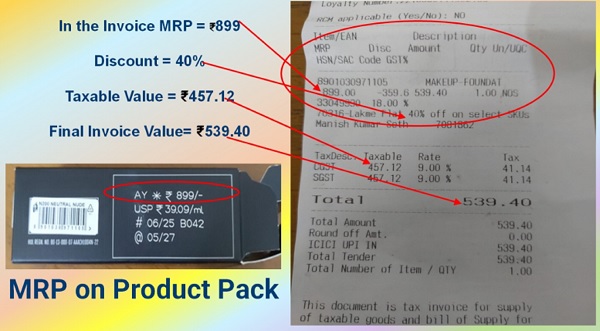
Discount Adjustments: Turning Consumer Savings into Corporate Profit
From the above it is clear that the sophistication of this deceptive practice lies in its legal camouflage. The new, reduced Goods and Services Tax (GST) rates are meticulously applied correctly on the final invoice, maintaining a façade of tax compliance and neutralizing any immediate challenge regarding tax remittance itself.
However, the manipulation occurs in the parallel adjustment of discounts. The discount percentage is quietly reduced in such a way that the final billed price remains unchanged, despite the lower tax burden.
This mechanism creates an illusion of compliance while ensuring that the consumer sees no reduction in the final price. The entire benefit of the GST rate cut — intended by legislation to reduce consumer expenditure — is instead diverted as additional profit for the business unit.
Such practices by so-called “organized retailers” undermine both the spirit of the law and the government’s policy intent, turning consumer relief into corporate enrichment.
The Systematic Loot Exposed
This is not an isolated incident, nor the tale of a single store. It is a firsthand exposé of a nationwide racket, where organized retail chains across India have systematically transformed consumer relief into corporate enrichment.
What the shopping mall and other major retailers have done is nothing short of betrayal. By subtly recalibrating discounts, they absorbed the full benefit of the GST reduction—ensuring that consumers gained nothing while corporate profit margins swelled.
This was not oversight. This was not the market at play. This was premeditated theft—the calculated diversion of tax benefits that were legally and ethically intended for citizens.
The government reduced GST to ease consumer burden and stimulate spending during the festive season. Instead, organized retail hijacked this policy, subverting its intent and converting public welfare into private windfall profit.
Turning Consumer Relief into an Organized Corporate Loot Masquerading as Business Strategy : A Nationwide Epidemic
Ignorance or operational constraints may, at best, provide a narrow defense for small, unorganized traders who fail to pass on GST benefits. Unregistered retailers, who purchase goods at the earlier MRP and are not entitled to Input Tax Credit (ITC), face genuine difficulty in passing on the benefits of a GST reduction to customers until their existing stock is exhausted. I have previously examined these challenges in my article, “GST 2.0: Reductions vs Retail Reality – Impact of Rate Cuts on Unregistered Sellers,” published in TaxGuru on September 22, 2025.
However, when giant, sophisticated retail chains—equipped with world-class accounting systems and expert legal counsel—engage in this exact deception, it strips away any possibility of accidental error. This is not a mistake; it is a deliberate, calculated corporate betrayal of both the consumer and the government’s legislative intent. The sheer scale and sophistication of the perpetrator transform the act from a potential oversight into a systematic criminal intent.
These corporations are not helpless. They operate with:
- Cutting-edge inventory and ERP systems
- Real-time pricing algorithms
- Dedicated legal and compliance teams
- Robust corporate governance structures
- A duty of public accountability
- Advanced Technologies
And yet, with all this power and capability, they chose profit over principle, manipulation over transparency, and exploitation over consumer trust.
This is not commerce. This is organized loot—dressed up as business strategy.
A Systemic National Betrayal
This practice is not merely confined to one chain, a single store or region; it is an alarming, systemic national phenomenon executed by many organized retailers across the country. This reveals an institutionalized, industry-wide policy designed to systematically defraud millions of consumers nationwide. The sheer scale of the deception elevates this from mere isolated misconduct to a national commercial crime demanding immediate and decisive regulatory intervention.
When Flexibility Breeds Fraud: How Compliance Turned into Exploitation
The government first directed manufacturers to revise MRPs on unsold stock after GST rate cuts (September 9, 2025). But just nine days later, on September 18, 2025, it completely reversed this position — making MRP revisions voluntary and even waiving the requirement for public newspaper notices.
This U-turn opened the door for abuse. Retailers were suddenly free to continue selling goods with old, inflated MRPs until March 31, 2026, while quietly enjoying the reduced tax rates. The direct consumer benefit of the GST cut vanished, exactly as I witnessed in my own purchase.
What was meant to be mandatory relief for citizens has been diluted into optional charity by corporations. The compliance relaxation, intended to ease industry pressure, has instead become a loophole. Retailers exploit it by leaving MRPs untouched and merely tweaking discounts — ensuring they pocket the entire GST relief while consumers get nothing.
In effect, this government flip-flop has legalized retail malpractice, leaving buyers exposed to profiteering with no accountability, no transparency, and no real enforcement to safeguard their rights.
CBIC’s Crackdown: Ensuring GST Relief Reaches Consumers
Following the September 22, 2025 GST rate cuts, the Central Board of Indirect Taxes and Customs (CBIC) has launched a nationwide monitoring and grievance redressal mechanism. The goal is clear — to prevent retailers from absorbing tax benefits and to ensure that reduced GST directly translates into lower prices for consumers.
- CBIC has instructed field officials nationwide to collect price information from dealers and retailers on various goods including food, toiletries, stationeries, consumer durables and medicines before and after September 22 GST rate cuts
- CBIC to track 54 commoditiesfor six months post-GST rate cut (Sept 22, 2025).
- Field formations must submit monthly reports (first by Sept 30, 2025, then by the 20th of each month till Mar 2026) comparing pre- and post-cut prices.
Data gathered from field checks, trade associations, and industry inputs.
- The National Consumer Helpline (NCH) Facility, established by India’s Department of Consumer Affairs, is a central platform for consumers to resolve grievances with companies before they escalate to litigation. You can register a complaint through its integrated portal via toll-free numbers (1915, 1800-11-4000), WhatsApp, SMS, the NCH App, or the gov.inweb portal, with support for multiple languages.
From Tax Relief to Consumer Rights: Strengthening Accountability in Retail – Suggestions
I. Strengthened Audit and Reporting Requirements
Mandated Comparative Audit Reporting: Statutory auditors must specifically assess and report the pricing mechanism for all products affected by GST rate changes. This report should clearly compare MRP, applied discounts, and final billed prices before and after the tax adjustment (e.g., pre- and post-September 22, 2025).
Authentic Verification: Auditors must certify the accuracy of accounts, validate billing software logic, and verify actual customer invoices to ensure that the tax reduction is fully passed on to consumers, leaving no room for manipulation.
II. Proactive Government Monitoring and Enforcement
Direct System Audits: The GST Council or Anti-Profiteering Authority (APA) should be empowered to conduct forensic audits of ERP and billing systems, not just paper records, to detect deliberate pricing manipulations.
Mandatory Price Transparency: Legislate that invoices for GST-sensitive goods carry a ‘Tax Relief Impact’ statement, showing the price difference due to the tax reduction alongside the original price.
National Price-Watch Portal: The National Consumer Helpline (NCH) provides a single, multi-channel platform for consumers to report grievances before they escalate to litigation. However, the present system is very cumbersome — navigating multiple channels, uploading bills, and tracking resolutions can be confusing and time-consuming for many users. A dedicated Price-Watch Portal aims to simplify this by allowing instant reporting of discrepancies, seamless bill uploads, and real-time monitoring of complaint progress.
Severe Penalties and Profit Disgorgement: Impose deterrent penalties—for example, three times the illegally retained profit—and ensure full disgorgement to a Consumer Welfare Fund, making profiteering financially unattractive.
Whistleblower Protection: Provide legal protection and financial incentives to internal whistleblowers, including accounting and IT staff, who expose systematic price manipulation within retail chains.
Raise Your Voice: Demand Your Rights, Stop Corporate Greed
The time for quiet observation is over. I have taken decisive action by formally filing a complaint against this retail chain for exploiting mandated GST relief and systematically denying consumers their rightful savings. The official Grievance Number is 7889101. Let this serve as a clear warning: Accountability cannot and will not be ignored!
We must unite against this calculated deception. “Know Your Rights. Demand Your Savings. Stop Corporate Greed!” This is more than just a price discrepancy; it is a fundamental betrayal of public trust. Every single consumer who enters these stores must now act with vigilance. “Check the Price, Claim Your Right!”—scrutinize every bill and compare it against the legislated tax change. Do not allow their manufactured “discounts” to mask their systematic theft. “Don’t Let Discounts Deceive—Fight for Fairness!”
“Jaago Grahak Jaago!
Stand Up, Speak Out, and Take Back What’s Rightfully Yours!”
Our collective voice is the only weapon that can shatter this institutionalized fraud. Become a vigilant participant in this fight. We must prove that we are “Smart Consumers, Strong Voices—Stop Corporate Cheats!” Join the protest, demand transparency, and ensure justice is served.







The write up is excellent and depict the true scenarios.
This is going to happen as Government has no control on Corporates, Govt.should find a solution for it, otherwise GST Cut has no meaning.
Sir
Govt. can Exercise some Controls by Mandating Audit Reports of Pre & Post 22nd Sep’25 reports on MRPs, Discounts & Final Price.