In re Piyush Jayantilal Dobaria (Jay Khodiyar Agency) (GST AAAR Gujarat)
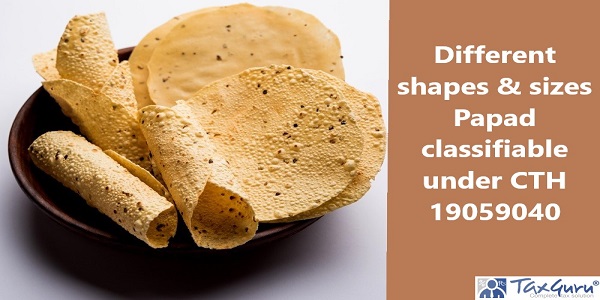
The product different shapes and sizes Papad involved in the present case merit classification under Tariff heading No. 19059040 of the Customs Tariff Act, 1975 and chargeable to NIL rate of Goods and Services Tax as per Sl. No. 96 of Notification No. 02/2017-CT (Rate) dated 28.06.2017 and Notification No. 02/2017-IGST (Rate) dated 28.06.2017
FULL TEXT OF THE ORDER OF AUTHORITY OF APPELLATE ADVANCE RULING, GUJARAT
At the outset we would like to make it clear that the provisions of Central Goods and Services Tax Act, 2017 and Gujarat Goods and Services Tax Act, 2017 (hereinafter referred to as CGST Act, 2017 and SGST Act, 2017) are in pari materia and have the same provisions in like matter and differ from each other only on a few specific provisions. Therefore, unless a mention is particularly made to such dissimilar provisions, a reference to the CGST Act would also mean reference to the corresponding similar provisions in the SGST Act.
2. The present appeal has been filed under Section 100 of the CGST Act, 2017 and SGST Act, 2017 by M/s. Piyush Jayantilal Dobariya (hereinafter referred to as Appellant) against the Advance Ruling No. GUJ/GAAR/R/60/2020 dated 30.7.2020.
3. The appellant has raised the following question for advance ruling in the application for Advance Ruling filed by it.
“Under which tariff Heading PAPAD of different shapes and sizes manufactured/ supplied by the appellant would attract CGST and SGST”?
4. The appellant has submitted that they are engaged in the business of manufacturing and trading of “Papad” of different shapes and sizes which is raw pellet that are neither fully cooked nor ready to eat and needs to be cooked first either by frying or roasting before consuming. The Papad turns out to be a papad when the dough is moulded and given the shape, usually a palm size round or may be smaller or bigger. The shape and size may vary but the ingredients, the proportion of ingredients, the composition and the recipe remains similar, if not exactly the same. The appellant has submitted that with changing of time and considering the different demands of different class of consumers innovations are made in shapes and sizes also and now Papad comes in different shapes and sizes. The Papad of different shape and size are not ready and suitable for human consumption till they are fried/baked as deemed fit and as and when deemed fit by the consumer. The appellant further submitted that their product “Papad” of different shapes and sizes that are neither fully cooked nor ready to eat condition eligible to be classified under Chapter Tariff Heading- 1905 of Customs Tariff Act, 1975 accordingly, vide entry at Sr. No. 96 under Not. No. 02/2017-CT (Rate) dated 28.06.2017 product in question is exempted from the levy of tax.
5. The Gujarat Authority for Advance Ruling (herein after referred to as ‘the GAAR’), vide Advance Ruling No. GUJ/GAAR/R/60/2020 dated 30.7.2020, inter-alia observed that ‘Papad’ has not been defined or clarified under Customs Tariff Act, 1975, the Central Goods and Services Tax Act, 2017 (hereinafter referred to as the ‘CGST Act, 2017), or the Notifications issued under the CGST Act, 2017/GGST Act, 2017/IGST Act, 2017. It is well settled principle of interpretation of statute that the word not defined in the statute must be construed in its popular sense, meaning ‘that sense which people conversant with the subject matter with which the statute is dealing would attribute to it’. It is to be construed as understood in common language. Further, it is observed that for proper and correct classification not only ingredient of the product but use of the product, common parlance test and marketability of the product is equally a deciding factor. It is also observed that in common parlance or in market, Fryums are not sold as “PAPAD” instead of “PAPAD” sold as papad and Fryums are sold as “Fryums”. Both the products are different and have their individual identity. Accordingly, in common parlance test, the appellant’s product i.e. “different shapes and sizes of Papad” is not “Papad” but is “Un-fried Fryums”. Thus, Heading 2106 is an omnibus heading covering all kind of edible preparations, not elsewhere specified or included. Chapter Note 5 provides an inclusive definition of this heading and covers preparations for use either directly or after processing, for human consumption. Chapter Note 6 pertaining to Tariff Item 2106 90 99 also provides inclusive definition and products mentioned therein are illustrative only. In view of the foregoing, the GAAR ruled as follows :-
Question: Under which tariff Heading PAPAD of different shapes and sizes manufactured/ supplied by the appellant would attract CGST and SGST?
Answer: The product ‘Un-fried Fryums’ manufactured and supplied by applicant is classifiable under Tariff Item 2106 90 99 of the First Schedule to the Customs Tariff Act, 1975. Goods and Services Tax rate of 18% (CGST 9% + GGST 9% or IGST 18%) is applicable to the product ‘Un-fried Fryums’ as per Sl. No. 23 of Schedule III of Notification No. 1/2017-Central Tax (Rate), dated 28-6-2017, as amended, issued under the CGST Act, 2017 and Notification No. 1/2017-State Tax (Rate), dated 30-6-2017, as amended, issued under the GGST Act, 2017 or IGST Act, 2017.
6. Aggrieved by the aforesaid advance ruling, the appellant has filed the present appeal.
7. During the course of personal hearing held on 15.12.2020, the appellant reiterated the submissions made in the appeal dated 29.08.2020.
8. The appellant in the ground of appeal has submitted that they are in the business of manufacturing and trading of “Papad” of different shapes and sizes. The Papad, turns out to be a papad when the dough is moulded and given the shape, usually a palm size round or may be smaller or bigger. The dough remains the same with minor variations in proportion of ingredients and the dough is moulded in the desired shape and size may be round, square, semi circle, hollow circle with bars in between or may be square with bars in between intersecting each other or may be of the shape of any instrument, equipment, vehicle, aircraft, animal, etc. The shape may vary, the size may vary but the ingredients, the proportion of ingredients, the composition and the recipe remains similar, if not exactly the same. The different shapes and sizes are obtained with the help of a die and there is no difference in either the ingredients used or in the process of manufacture. A pictorial representation providing overview of papad product manufacturing process is reproduced hereunder.
Raw materials consisting of wheat flour, superfine wheat flour, rice flour, starch, corn flour, cereal flour, potato starch, chana, potato lentils, papad khar, bicarb, vegetables like tomato, salt, water, food colour etc. (proportion and ingredients to be decided as per the shape and requirement of the customer)
⇓
Blended in a steering/ mixture machine with water and oil to make a dough
⇓
Dough is passed through various die to form various shapes
⇓
Product is dried through various stages (also includes sun drying in some cases)/ processes to maintain moisture level at a specific percentage level.
⇓
Product is cooled and breakages are removed
⇓
Product is packaged (branded or unbranded) as per the specific requirement
9. The appellant has submitted that principal raw materials for their product i.e. different shapes and sizes papad are: rice flour, corn flour, wheat flour, super fine wheat flour, cereal flour, tapioca starch, potato starch, salt, water and flavour, as the case may be. Similar raw-materials including pulses, salt, water etc. are used for making papad. They manufacture Papad of different shape and size that are in neither fully cooked form nor ready to eat form till it reaches the actual consumer. When the consumer desires to consume/eat, the consumer needs to either fry it or bake it before consumption.
10. The appellant has submitted that as per their understanding their product in question of different shapes and sizes papad that are in neither fully cooked nor ready to eat condition seems squarely eligible to be classified under Chapter Tariff Heading –1905 and covers under Entry number 96 of Notification No.2/2017 –Central Tax (Rate) Dt:-28/06/2017 which exempts the supplies from the levy of tax, reads as under:-