Summary: The Goods and Services Tax Appellate Tribunal (GSTAT) has issued two important Standard Operating Procedures (SOPs) covering electronic filing of replies by respondents and transfer of appeals involving an identical question of law pending before different Benches. The Reply Filing SOP operationalises the GSTAT (Procedure) Rules, 2025 by allowing respondents to file replies and supporting documents electronically through the GSTAT portal. A reply under Rule 36 must be distinguished from a statutory cross-objection under Section 112(5) of the CGST Act: while a reply answers the appellant’s case, a cross-objection is the mechanism for challenging an adverse part of the order. The Transfer of Appeals SOP has wider systemic significance. Based on Sections 109(5) and 109(6) of the CGST Act and S.O. 4219(E) dated 17 September 2025, it enables connected appeals pending before different State Benches and involving an identical question of law to be identified for transfer to the Principal Bench. The facility is particularly relevant to businesses operating through multiple GSTINs under a common PAN, where the same legal issue may otherwise generate separate proceedings before several State Benches. The SOPs extend GSTAT’s digital architecture beyond filing of appeals and cross-objections to subsequent pleadings, documents and jurisdictional applications, supporting greater procedural consistency and nationally uniform GST adjudication.
GSTAT Moves Towards a Fully Digital Appellate System
SOPs on Filing of Replies and Transfer of Appeals
- Introduction
- I. Reply Filing SOP: A Structured Digital Voice for the Respondent
- Table 1: Statutory and procedural linkage
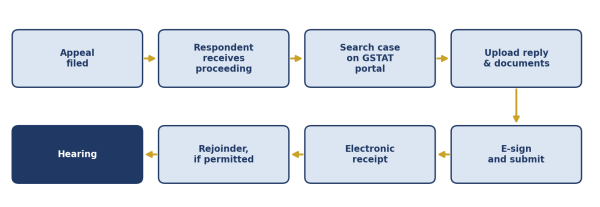
- Figure 1: Reply filing flow
- Reply Is Not a Cross-Objection
- II. Transfer of Appeals: Towards Uniformity in National GST Jurisprudence
- Table 2: Relevant provisions compared
- III. Continuity with the Existing GST Framework
- Table 3: Traditional requirement and its digital equivalent
- IV. Why the Transfer Facility Matters
- Table 4: Effect of consolidation
- A Word of Appreciation for GSTAT
- Conclusion
Introduction
The Goods and Services Tax Appellate Tribunal (“GSTAT”) has recently issued two Standard Operating Procedures (“SOPs”): one on the filing of replies by respondents, and another on the transfer of appeals involving an identical question of law pending before different Benches. Though procedural in appearance, both carry considerable practical significance for taxpayers, the Department and professionals appearing before GSTAT.
In the author’s view, GSTAT is not merely digitising the traditional appellate process. It is building an integrated national appellate architecture suited to GST – a tax administered State-wise but founded upon a common national statute.
I. Reply Filing SOP: A Structured Digital Voice for the Respondent
Under this SOP, the respondent logs into the GSTAT portal, navigates to Respondent Corner → File Reply, searches the appeal by case number, uploads the reply with supporting documents, selects the mode of electronic signature and submits it. A receipt is generated on successful filing.
The SOP gives practical effect to the GSTAT (Procedure) Rules, 2025. Rule 36 permits a respondent to file its reply and supporting documents, ordinarily within one month of receipt, personally or through an authorised representative. The applicant must then specifically admit, deny or rebut the facts introduced, and Rule 37 enables a rejoinder where additional facts require an answer.
Table 1: Statutory and procedural linkage
| Subject | Statutory Basis | GSTAT Rules | Effect of SOP |
|---|---|---|---|
| Appeal | Section 112(1), CGST Act | Institution rules | Proceeding to which the respondent must answer |
| Cross-objection | Section 112(5); Rule 110(2) – FORM GST APL-06 | Rule 35 | Separate remedy against an adverse part of the order |
| Reply | No form comparable to APL-06 | Rule 36 | Electronic filing of reply and documents |
| Rejoinder | No specific form | Rule 37 | Rebuttal of additional facts |
| Hearing | Section 113 | Rule 41 | Appellant heard, then respondent, then appellant in reply |
Figure 1: Reply filing flow
Reply Is Not a Cross-Objection
A reply defends. A cross-objection challenges.
Section 112(5) gives the respondent a substantive right to file a memorandum of cross-objections within 45 days against any part of the order appealed against, even without an independent appeal. Rule 110(2) requires it to be filed electronically in FORM GST APL-06. A Rule 36 reply is merely the respondent’s answer to the appellant’s case. Neither a taxpayer nor Revenue should assume that a favourable result can be enlarged by a prayer in the reply; where an adverse portion of the order is to be overturned, the safer course is a cross-objection under Section 112(5).
II. Transfer of Appeals: Towards Uniformity in National GST Jurisprudence
The second SOP is, in the author’s view, even more significant. Where a business holds multiple GSTINs under the same PAN and similar appeals are pending before different State Benches, the taxpayer can log in through a linked GSTIN, view connected cases, select appeals involving an identical question of law and initiate a single Transfer of Appeal proceeding. The portal then requires verification of party details, addition of an authorised representative, document upload, a checklist, a final preview and electronic submission, followed by an acknowledgement.
Legal foundation. The facility rests on Section 109 of the CGST Act. Section 109(5) distributes jurisdiction between the Principal Bench and State Benches, and its third proviso empowers the Government, on the GST Council’s recommendation, to notify cases to be heard only by the Principal Bench. Section 109(6) authorises the President to distribute business and transfer cases between Benches. By S.O. 4219(E) dated 17 September 2025, the Government notified cases pending before two or more State Benches, where the President is satisfied that an identical question of law is involved, as cases for the Principal Bench. The SOP is thus the electronic machinery for invoking an already existing statutory jurisdiction.
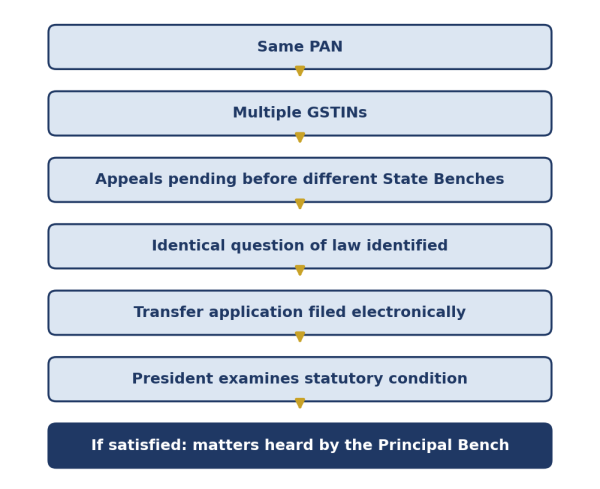
An important qualification: selecting cases on the portal does not itself establish that the legal questions are identical. The statutory satisfaction under the notification remains that of the President.
Table 2: Relevant provisions compared
| Issue | Provision | Practical Consequence |
|---|---|---|
| Jurisdiction of Benches | Section 109(2)–(5) | Determines Principal Bench versus State Bench |
| Power to transfer | Section 109(6) | President may transfer cases between Benches |
| Identical question of law | Third proviso to Section 109(5); S.O. 4219(E) | National consolidation becomes possible |
| Applications | Section 112(10); Rule 35 | Basis for registering transfer applications |
| Electronic filing | Rule 110, CGST Rules | Transfer proceeding is digitally traceable |
| Single-Member allocation | Section 109(8); Rule 110A | Matters involving a question of law are sent back for reconsideration |
Rule 110A is an instructive parallel. If a Single Member, hearing an appeal allocated as one not involving a question of law, concludes that such a question arises, the matter must be sent back. The scheme repeatedly attaches importance to the existence of a question of law in determining the appropriate forum.
III. Continuity with the Existing GST Framework
Rule 110 already requires appeals (FORM GST APL-05) and cross-objections (FORM GST APL-06) to be filed electronically. The two SOPs extend the same philosophy to proceedings after the appeal is instituted.
Table 3: Traditional requirement and its digital equivalent
| Traditional Requirement | Digital GSTAT Equivalent |
|---|---|
| Appeal / cross-objection | Electronic APL-05 / APL-06 |
| Reply or counter | Online “File Reply” facility |
| Supporting evidence | Electronic document upload |
| Authentication | E-sign / DSC |
| Procedural scrutiny | Online checklist |
| Acknowledgement | System-generated filing receipt |
| Jurisdiction application | “Transfer of Appeal Filing” module |
IV. Why the Transfer Facility Matters
Consider a company registered in Delhi, Maharashtra, Karnataka, Tamil Nadu and West Bengal. A single issue, such as valuation of an inter-company service, may generate five orders, five first appeals and five GSTAT appeals.
Table 4: Effect of consolidation
| Without Transfer | With Transfer | |
|---|---|---|
| Path | 5 GSTINs → 5 State Benches → 5 hearings | 5 GSTINs → common PAN → identical legal question → Principal Bench |
| Outcome | Risk of divergent rulings | One consistent legal determination |
The notification speaks of an “identical question of law”, not merely similar facts. Applications should therefore formulate the common legal question precisely. For instance, “Whether allocation of common Head Office expenditure to distinct persons constitutes a taxable supply under Schedule I read with Sections 7 and 25 of the CGST Act?” is substantially better than merely stating, “Issue relates to cross-charge.”
A Word of Appreciation for GSTAT
GSTAT deserves genuine appreciation. Within a short span of its operationalisation, it has introduced a functional portal, clear rules and practical SOPs supported by screenshots and step-by-step instructions. Such user-friendly guidance reflects a Tribunal responsive to the needs of litigants and professionals. It should continue this practice as new electronic functionalities are introduced.
Conclusion
The two SOPs mark another important step in GSTAT’s institutional development. The Reply Filing SOP creates a structured digital exchange of pleadings under Rules 35 to 37, although practitioners must keep the ordinary reply distinct from the statutory cross-objection under Section 112(5).
The Transfer of Appeals SOP has greater systemic significance. By operationalising Sections 109(5) and 109(6) and the notification of 17 September 2025, it offers a portal-based route to identify appeals involving an identical question of law across State Benches and seek their consolidation. GST is a national tax administered through multiple registrations and jurisdictions; a mechanism that brings nationally recurring questions before one forum promotes what an appellate tribunal must ultimately deliver – consistency, certainty and uniformity of interpretation. Clear SOPs, read with the Act and the Rules, will reduce procedural disputes and let taxpayers and Revenue focus on the real controversy: the interpretation and application of GST law.