Sai Sponge (India) Limited Vs Principal Commissioner of Central Goods & Service Tax (CESTAT Kolkata)
Summary: The Customs, Excise and Service Tax Appellate Tribunal (CESTAT) examined appeals arising from a demand of central excise duty amounting to Rs. 63,82,269 against a manufacturer of sponge iron, along with interest and penalties. The Department alleged that the appellant had clandestinely manufactured and cleared 4,994.899 metric tonnes of sponge iron, valued at Rs. 6,34,26,016, to its sister concern, M/s Sai Electrocasting Pvt. Ltd., Koderma, during financial years 2009-10 and 2010-11 without payment of excise duty. A show cause notice dated 23 September 2013 invoked the extended period of limitation. The adjudicating authority confirmed the demand and imposed penalties on the appellant company and other noticees. The Commissioner (Appeals) upheld the adjudication orders, prompting the appellants to approach the Tribunal.
The Department’s allegations were primarily based on handwritten notebooks, vehicle-driver records, cash books, transport documents and statements obtained during investigations involving M/s Satyam Roadlines and the appellant’s sister concern. The alleged clandestine clearances were divided into seven categories covering quantities of 789.66 MT, 1,528.402 MT, 197.17 MT, 1,658.587 MT, 536.94 MT, 129.64 MT and 154.50 MT. The appellant disputed the reliability of these records, contending that several documents contained illegible handwritten entries, unidentified transactions, unexplained calculations and no clear references to the appellant or the alleged recipient. It was further submitted that the Department had failed to establish how precise quantities of clandestine clearances had been calculated from such records. The appellant also questioned the absence of supporting evidence connecting individual consignments with actual manufacture and removal of sponge iron.
A principal objection concerned the evidentiary value of statements recorded from Jitesh Kumar Singh, the transporter, his employee Ashish Kumar Singh, vehicle drivers and the appellant’s directors. The appellant submitted that the mandatory procedure prescribed under cross-examination” target=”_blank” rel=”noopener”>Section 9D of the Central Excise Act, 1944 had not been followed before relying upon these statements. Although cross-examination of material witnesses had specifically been requested, the adjudicating authority rejected the request on grounds involving possible delay and expense. The appellant also pointed out discrepancies regarding the identity of the transporter’s proprietor, with certain statements referring to a person named Rupesh Singh instead of Jitesh Kumar Singh. Further objections concerned the endorsement made by Ashish Kumar Singh on Jitesh Kumar Singh’s statement without an independent summons under Section 14 of the Act. The appellant maintained that these irregularities undermined the reliability and admissibility of the statements.
Upon examining the seized records, the Tribunal observed that the handwritten entries did not adequately explain the precise quantification adopted by the Department. The records lacked a consistent format identifying the quantities allegedly removed, and different handwriting suggested that more than one person might have prepared them. The authors of the entries had not been properly identified. The Tribunal also examined the statement of Jitesh Kumar Singh and noted that he had attributed the maintenance of the records to his employee Ashish Kumar Singh. Consequently, the Tribunal questioned his ability to explain the contents of those documents from personal knowledge. The endorsement subsequently made by Ashish Kumar Singh on the same statement was considered unusual and insufficient to constitute an independently recorded statement under Section 14. Since the prescribed cross-examination” target=”_blank” rel=”noopener”>Section 9D procedure had not been followed and the requested cross-examination had been denied, the Tribunal held that Jitesh Kumar Singh’s statement had no evidentiary value. The retracted statement of the appellant’s director also required compliance with cross-examination” target=”_blank” rel=”noopener”>Section 9D.
The Tribunal further found that the Revenue had not produced independent corroborative evidence establishing clandestine manufacture or removal of finished goods. There was no supporting material demonstrating excess consumption of electricity, additional procurement or consumption of raw materials, cash payments to suppliers, or statements from vendors confirming unaccounted purchases. The Tribunal distinguished between suspicion arising from private records and legally sufficient evidence establishing clandestine clearances. It observed that documents recovered from a third party could raise questions about certain transactions but could not, without reliable supporting evidence, establish the quantities allegedly removed or justify the corresponding duty demand. In examining the requirements of Section 9D and the need for corroboration, the Tribunal referred to the decision in Section 9D” target=”_blank” rel=”noopener”>Surya Wires Pvt. Ltd. v. Principal Commissioner, CGST, Raipur, Final Order Nos. 50453-50454/2025 dated 1 April 2025, which discussed the admissibility of investigation statements and the evidentiary requirements applicable to allegations of Corroborative evidence for clandestine removal” target=”_blank” rel=”noopener”>clandestine removal.
On the overall appreciation of the material, the Tribunal concluded that the Department’s case rested substantially on uncorroborated private records and statements that had not been subjected to the prescribed statutory procedure. The absence of reliable evidence linking the disputed documents to actual clandestine manufacture and clearance, coupled with denial of cross-examination and non-compliance with Section 9D, materially weakened the Revenue’s allegations. The Tribunal therefore found that the demand could not be sustained merely on the basis of the seized documents and recorded statements. The impugned orders confirming central excise duty of Rs. 63,82,269, together with the consequential interest and penalties, were set aside, and the appeals were allowed. The decision emphasises that allegations of Corroborative evidence for clandestine removal” target=”_blank” rel=”noopener”>clandestine removal must be established through credible, legally admissible and corroborated evidence rather than unexplained private entries or unsupported statements.
Cases Discussed
- Surya Wires Pvt. Ltd. Vs Principal Commissioner, CGST, Raipur — Final Order Nos. 50453–50454/2025, dated 1 April 2025.
- CCE v. Gujarat Cypromet Ltd. — 2017 (345) ELT 520 (Guj.).
- Jindal Drugs Pvt. Ltd. v. Union of India — 2016 (340) ELT 67 (P&H).
- G-Tech Industries v. Union of India.
- Drolia Electrosteel Pvt. Ltd. v. Commissioner.
- Ambika International v. Union of India.
- Additional Director General (Adjudication) v. Its My Name Pvt. Ltd.
- J & K Cigarettes Ltd. v. Collector of Central Excise — 2009 (242) ELT 189 (Del.).
- Hi Tech Abrasives Ltd. v. Commissioner — 2018 (362) ELT 961.
- Basudev Garg v. CCE — 2013 (294) ELT 353 (Del.).
- Meenakshi Re-rollers Pvt. Ltd. v. CCE — 2010 (249) ELT 255.
- CC v. Junaid Kudia — (2024) 16 Centax 504 (SC)
- Swastik Stockists v. CC, Kolkata — 2025 (8) TMI 1235 (CESTAT Kolkata)
FULL TEXT OF THE CESTAT KOLKATA ORDER
The appellant company is manufacturer of Sponge Iron falling under Chapter 72 of the First
Schedule to the Central Excise Tariff Act, 1985. On the ground that they have cleared their finished goods clandestinely to their sister unit, without payment of Excise Duty, a Show Cause Notice was issued on 23.09.2013 by invoking the extended period provisions. The appellant filed a detailed reply dated 20.02.2017 to the show cause notice denying all charges of clandestine manufacture and removal of sponge iron by them during the period FYs 2009- 10 and 2010-11. The appellant also sought cross- examination of various persons. On the basis of the submissions made, the adjudicating authority was requested to drop the proceedings. After due process, the Adjudicating authority confirmed the demand along with interest and penalty against the appellant company and also imposed penalties on the other noticees. Being aggrieved, they all filed their Appeals before the Commissioner (Appeals), who vide the impugned Orders in Appeal, has dismissed their appeals. Being aggrieved, the appellants have filed the present appeal before the Tribunal.
2. The Ld. Counsel, appearing on behalf of the appellant makes the following submissions:
2.1. It is submitted the allegation that the appellant company has clandestinely removed 4994.899 MT of sponge iron to M/s Sai Electrocasting Pvt. Ltd., Koderma (hereinafter referred to as Sai Electrocasting), involving excise duty of Rs. 63,82,269/-, for which the demand is based on the following documents:
| Sl. | Period | Weight (in MT) | Value (Rs) | Quantification n (see pages 51 -52 & 95-96 of Appeal) |
Co mp. P age No. | RUD |
|---|---|---|---|---|---|---|
| 01 | 2009 -10 |
789.66 | 85,63,200 | Annexure I- SCN | 01 | 1(P), 5, 7, 9 (S) |
| 02 | 2010 -11 |
1528.402 | 1,91,72,386 | Annexure 2(i), SCN | 02 | 1(P), 5, 7, 9 (S) |
| 03 | 197.17 | 27,60,380 | Annexure 2(ii), SCN | 05 | 1(P), 6, 7, 9 (S) | |
| 04 | 1658.587 | 2,14,34,930 | Annexure 3( i), SCN | 06 | 2(P), 9 (S), 10,11 | |
| 05 | 536.94 | 75,17,160 | Annexure 3(ii), SCN | 08 | 2(P), 12 | |
| 06 | 129.64 | 18,14,960 | Annexure 4, SCN | 09 | 3(P),15 (S) | |
| 07 | 154.50 | 21,63,000 | Annexure 5, SCN | 10 | 4(P), 18, 19 | |
| 4994.899 | 6,34,26,016 | [Duty Demanded: Rs. 63,82,269/- ] | ||||
2.2. For the demand made under seven headings of the above Table, the detailed submissions of the appellant for the alleged quantities of clandestine clearance, is as per the following table:
I. Clearance of Sponge Iron of 789.66 MT valued at Rs. 85.63 Lakhs
| RUD | Defence | ||
|---|---|---|---|
| 789.66 MT SSIL, Jhinkpani to SSL, Koderma |
5 | Vehicle Driver Copy [see pp.39, 74 Appeal, p.29 of Comp]. |
|
| 7 | Cash Book seized from Satyam Road Lines (see p. 40 Appeal; p. 47 Comp) |
|
|
| 9 | Statement of Jitesh Kumar Singh dt. 30.3.2011 [(i) – see pgs. 11, 67 of Comp; p. 40 Appeal] |
|
|
| 26 | Statement of Deepak Kr. Agarwal, Director of SSIL, SSL [see p.50, 93 Appeal; p. 173 of Comp] |
|
|
| 31 | Statement of Sita Ram Agarwal [see p.51, 94 of Appeal, p.178 of Comp] |
|
|
II. Clearance of Sponge Iron of 1528.402 MT valued at Rs. 1.91 Crores
| RUD | Defence | ||
|---|---|---|---|
| 1528.402 MT SSIL, Jhinkpani to SSL, Koderma |
5 | Vehicle Driver Copy [see pp.39, 74 Appeal, p.29 of Comp]. |
|
| 7 | Cash Book seized from Satyam Road Lines (see p. 40 Appeal; p. 47 Comp) |
|
|
| 9 | Statement of Jitesh Kumar Singh dt. 30.3.2011 [(i) – see pgs. 11, 67 of Comp; p. 40 Appeal] |
|
|
| 26 | Statement of Deepak Kr. Agarwal, Director of SSIL, SSL [see p.50, 93 Appeal; p. 173 of Comp] |
|
|
| 31 | Statement of Sita Ram Agarwal [see p.51, 94 of Appeal, p.178 of Comp] |
|
|
III. Clearance of Sponge Iron of 197.17 MT valued at Rs. 27.60 Lakhs
| RUD | Defence | ||
|---|---|---|---|
| 197.17 MT SSIL, Jhinkpani to SSL, Koderma |
6 | Extract of Cash Book seized from Satyam Road Lines (see p. 39, 40 Appeal; p. 45 Comp) |
|
| 9 | Statement of Jitesh Kumar Singh dt. 30.3.2011 [(i) – see pgs. 11, 67 of Comp; p. 40 Appeal] |
|
|
| 26 | Statement of Deepak Kr. Agarwal, Director of SSIL, SSL [see p.50, 93 Appeal; p. 173 of Comp] |
|
|
| 31 | Statement of Sita Ram Agarwal [see p.51, 94 of Appeal, p.178 of Comp] |
|
|
V. Clearance of Sponge Iron of 536.94 MT valued at Rs. 75.17 Lakhs
| RUD | Defence | ||
|---|---|---|---|
| 536.94 MT SSIL, Jhinkpani to SSL, Koderma |
12 | Manually prepared chart being record no. 79 of Panchnama dt. 30.3.2011 – RUD 2 [see pp. 41, 42 of Appeal, p.14-17, 73, 109 of Comp]. |
|
| 9 | Statement of Jitesh Kumar Singh dt. 30.3.2011 [(i) – see pgs. 11, 67 of Comp; p. 40 Appeal] | (iv) Statement obtained in the presence of Ashish Kumar Singh, who provided a written endorsement thereon, in spite of not being summoned in violation of Section 14 CEA 44. Evidence taken in presence of another witness involved in the giving of evidence, which leads to its contamination.
(v) Statement obtained on the same day of the search conducted at the premises of SSL, wherefrom the chart at Sl. 79 of Panchnama dt. 30.3.2011 was allegedly obtained. Coincidentally, Ashish Kumar Singh had prepared this chart, and he endorsed the same in spite of not being summoned for interrogation in the presence of Jitesh Kumar Singh. (vi) Statement only deals with a few of the truck details mentioned in the chart; the rest remain uncorroborated. (vii) Translated true typed copy of this handwritten statement was never provided to the appellant [see Meenakshi Re-rollers Pvt. Ltd. v. CCE, 2010 (249) E.L.T. 255 (Tri. – Mumbai)] (viii) Given the above deficiencies, cross examination was sought by the appellant of JKS (see p. 116, 119, 127 of Appeal), but denied on the apprehension by the adjudicating authority that the appellant was trying to delay the proceeding (see pgs.226-227 OIO, particularly para 100 thereof). The adjudication is therefore in violation of natural justice principles [see Basudev Garg Vs. CCE reported in 2013 (294) ELT 353 (Del.)] (ix) Statement inadmissible also due to being in contravention of Section 9D inasmuch as the statements relied upon were given to the inquiry officers and not the adjudicating authority [see CC v. Junaid Kudia, (2024) 16 Centax 504 (S.C.) affirming, Junaid Kudia v. Commissioner – (2024) 16 Centax 503 (Tri. – Mumbai)] |
|
| 26 | Statement of Deepak Kr. Agarwal, Director of SSIL, SSL [see p.50, 93 Appeal; p. 173 of Comp] |
|
|
| 31 | Statement of Sita Ram Agarwal [see p.51, 94 of Appeal, p.178 of Comp] | (x) No mention of any quantity or tonnage of goods cleared, or any discussion as to any consignment or record seized. Broad agreement with witness statements, most of which have not been relied upon during adjudication and/or for which no corresponding document/evidence has been made available by the Dept. either.
(xi) Repeats the error of Deepak Kr. Agarwal and mentions the proprietor of the transporter as “Rupesh Singh” instead of Jitesh Kumar Singh. Reveals non-application of mind and unfamiliarity with facts and duress. This becomes apparent when he agrees with a Panchnama dt. 30.3.2011 being a proceeding that was undertaken in his absence. Statement thus, unreliable and obtained under coercion and duress as maintained in his reply (see p.183 of Appeal) |
|
IV. Clearance of Sponge Iron of 1658.587 MT valued at Rs. 2.14 Crores
| RUD | Defence | ||
|---|---|---|---|
| 1658.587 MT SSIL, Jhinkpani to SSL, Koderma |
10 | Driver Notebook being Record Nos. 21 to 26 of Panchnama dt. 30.3.2011 – RUD 2 [see pp. 41 of Appeal, p.16, 81 of Comp]. | (i) 600 pages of Handwritten notes, obscure and indecipherable scribblings containing mutilations and scratched out entries. No extract thereof or page reference provided within the RUD to show from where the tonnage has been determined
(ii) No mention of any party, location, period, truck number readily obtainable from notes allegedly maintained by the driver, Kameshwar Gupta/Shaw. (iii) Seized outside the factory premises of SSL, hence there is no ready presumption that the records contained therein pertained to the operations of the factory of SSL or had any connection with SSIL (appellant). |
| 11 | Statement of driver, Kameshwar Gupta/Shaw of Truck No. JH-02R-8616 dt. 30.3.2011 [see p. 14, 41 of Appeal, p.99 of Comp.] | (i) No summons issued, statement recorded in violation of Section 14 CEA 44; no summons mentioned in SCN and not provided in list of RUDs (see pp. 41, 67, 99). There were also police officers attending the search as mentioned in Panchnama dt. 30.3.2011 – RUD 2
(i) No cross examination permitted in spite of evidence obtained in presence of police officers [JA Naidu v. State of Maharashtra, 1983 (13) ELT 1611(SC); CC v. Sheo Shankar Jaiswal, 2010 (261) E.L.T. 187 (Tri. – Del.)] (ii) It is also acknowledged in the SCN at page 41 of the Appeal, that the driver admitted to have “never mention(ed) the description of the material being transported”. (iii) Translated true typed copy of this handwritten statement was never provided to the appellant [see Meenakshi Re-rollers Pvt. Ltd. v. CCE, 2010 (249) E.L.T. 255 (Tri. – Mumbai)] (iv) Given the above deficiencies, cross examination was sought by the appellant (see p. 129, 116, 119, 127 of Appeal), but denied on the apprehension by the adjudicating authority that the appellant was trying to delay the proceeding (see pgs.226-227 OIO, particularly para 100 thereof). The adjudication is therefore in violation of natural justice principles [see Basudev Garg Vs. CCE reported in 2013 (294) ELT 353 (Del.)] (xii) Statement inadmissible also due to being in contravention of Section 9D inasmuch as the statements relied upon were given to the inquiry officers and not the adjudicating authority [see CC v. Junaid Kudia, (2024) 16 Centax 504 (S.C.) affirming, Junaid Kudia v. Commissioner – (2024) 16 Centax 503 (Tri. – Mumbai); Hi Tech Abrasives Ltd. v CC, 2018 (362) ELT 961 (Chhatisgarh)] |
|
| 9 | Statement of Jitesh Kumar Singh dt. 30.3.2011 [(i) – see pgs. 11, 67 of Comp; p. 40 Appeal] | (ii) Statement obtained in the presence of several police officials loses evidentiary value [JA Naidu v. State of Maharashtra, 1983 (13) ELT 1611(SC); CC v. Sheo Shankar Jaiswal, 2010 (261) E.L.T. 187 (Tri. – Del.)]
(iii) Statement was general, vague and overarching in nature, without explaining handwritten contents of the entries made by drivers in “Vehicle Driver Copy” seized from the transporter. (iv) Translated true typed copy of this handwritten statement was never provided to the appellant [see Meenakshi Re-rollers Pvt. Ltd. v. CCE, 2010 (249) E.L.T. 255 (Tri. – Mumbai)] (v) Given the above deficiencies, cross examination was sought by the appellant of JKS (see p. 116, 119, 127 of Appeal), but denied on the apprehension by the adjudicating authority that the appellant was trying to delay the proceeding (see pgs.226-227 OIO, particularly para 100 thereof). The adjudication is therefore in violation of natural justice principles [see Basudev Garg Vs. CCE reported in 2013 (294) ELT 353 (Del.)] (xiii) Statement inadmissible also due to being in contravention of Section 9D inasmuch as the statements relied upon were given to the inquiry officers and not the adjudicating authority [see CC v. Junaid Kudia, (2024) 16 Centax 504 (S.C.) affirming, Junaid Kudia v. Commissioner – (2024) 16 Centax 503 (Tri. – Mumbai); Hi Tech Abrasives Ltd. v CC, 2018 (362) ELT 961 (Chhatisgarh)] |
|
| 26 | Statement of Deepak Kr. Agarwal, Director of SSIL, SSL [see p.50, 93 Appeal; p. 173 of Comp] | (iv) In answer to Q.7, he clearly fails to identify the proprietor of the transporter, Satyam Roadlines and mentions one “Rupesh Singh” as the owner. The SCN and OIO presumed that he stated “Jitesh Kumar Singh”, which is inaccurate and shows that the statement contradicts the allegations made and is unreliable.
(v) No discussion on quantum or tonnage of clearance; or any specific record or document or any period; very general, non-specific and vague; has little evidentiary value (Swastik Stockists v. CC, Kolkata, 2025 (8) TMI 1235-CESTAT KOLKATA). (vi) Claimed that statement was obtained under duress (see p. 149 of Appeal) |
|
| 31 | Statement of Sita Ram Agarwal [see p.51, 94 of Appeal, p.178 of Comp] | (i) No mention of any quantity or tonnage of goods cleared, or any discussion as to any consignment or record seized. Broad agreement with witness statements, most of which have not been relied upon during adjudication and/or for which no corresponding document/evidence has been made available by the Dept. either.
(ii) Repeats the error of Deepak Kr. Agarwal and mentions the proprietor of the transporter as “Rupesh Singh” instead of Jitesh Kumar Singh. Reveals non-application of mind and unfamiliarity with facts and duress. This becomes apparent when he agrees with a Panchnama dt. 30.3.2011 being a proceeding that was undertaken in his absence. Statement thus, unreliable and obtained under coercion and duress as maintained in his reply (see p.183 of Appeal) |
|
VI. Clearance of Sponge Iron of 129.64 MT valued at Rs. 18.14 Lakhs
| RUD | Defence | ||
|---|---|---|---|
| 129.64 MT SSIL, Jhinkpani to SSL, Koderma |
– | Computerised printout from weighing scale at SSIL (see p. 44 of Appeal; p. 116 of Comp.) |
|
VII. Clearance of Sponge Iron of 154.50 MT valued at Rs. 21.63 Lakhs
| RUD | Defence | ||
|---|---|---|---|
| 154.50 MT SSIL, Jhinkpani to SSL, Koderma |
18, 19 |
Files “A” and “B” seized from Cash Office of SSIL [see pp. 45, 84, 97 of Appeal, p.132, 154 of Comp.] |
|
2.3. He submits that as per the above Table, it can be observed that the demand has been quantified primarily based on the records seized from the Transporter’s office and statements recorded by the Transport Owner / his employee. While the quantity of alleged clearances has been given at Sl. No.1 to 7, the same is not supported by way any documentary evidence, as gets clarified from column 4 of the above Table.
2.4. The Statement of the Satyam Transport’s owner Jitesh Kumar Singh was recorded on 30.03.2011. Statements were also recorded by some drivers engaged by the Transporter. The persons recording the Statements were not subjected to Section 9D of CEA 1944, which is mandated before letting in the Statements as evidence by the Adjudicating authority. In many other recorded statements, the owner of the Transport company is mentioned as “Roopesh” and not as “Jitesh”. Therefore, the very ownership of the transport company by Jitesh is questionable Further even as the appellant had specifically asked for the Cross- examination of Shri Jitesh Kumar Singh, proprietor of M/s Satyam Roadlines, Shri Kameshwar Gupta/Shaw, driver and Shri Ashish Kumar Singh as well as various drivers of vehicles who had allegedly maintained notebooks which have been relied upon by the Department, the request was denied by the lower authorities on the ground that “the cross examination of these persons cannot be obtained without an amount of delay or expense. Thus, the demand of cross-examination of the transporters of the Appellant is hereby rejected”. In this regard it is submitted that the show cause notice was issued to the appellant in the year 2013 while the Departmental authorities woke up after four years to take up the case for adjudication. To cover up the delay on their part, the Department cannot shift the blame on to the appellant and consequently deny the cross-examination of witnesses.
2.5. In the statement recorded by Shri Jitesh Kumar Singh, Proprietor of M/s Satyam Roadlines confirmed that the said records had been prepared by Shri Ashish Kumar Singh, who is one of his employees. In his statement, Shri Ashish Kumar Singh admitted to this fact by endorsing at the bottom of the statement of Shri Jitesh Kumar Singh, dated 30.03.2011. Recording of the Ashish Kumar Singh’s endorsement below the signature of Jitesh Kumar Singh, is illegal and is not in terms of Section 14 of the CEA, since no independent summons were issued to Ashish Kumar Singh. Therefore, on this ground also the statement of Jitesh Kumar Singh, cannot be entertained as evidence. On this ground also the conclusions arrived at are required to be set aside.
2.6. The Gujarat High Court has held in CCE vs Gujarat Cypromet Ltd. [2017 (345) ELT 520 (Guj)] that “When the Revenue is placing heavy reliance on certain statements of the witnesses recorded during the course of investigation, without their being anything peculiar, the Appellants were well within their right to seek cross-examination. The High Court has further held that merely because the statements, according to the adjudicating officer, were recorded without threat, duress or coercion or that the witness at no stage retracted their statements, cannot be a ground for rejecting the request for cross- examination.” The Gujarat High Court has observed that using a deposition that is not cross-examined, may amount to using evidence, which the party concerned has no opportunity to question.
2.7. Apart from this, there is no corroborative evidence in the form of clandestine purchase of raw materials, vehicle movement towards inputs received, cash transaction with respect of the alleged clandestine purchase, excess electricity consumption etc.
3. In view of the above submissions, the Ld. Counsel prays that the present appeal may be allowed.
4. The Ld. AR submits that simultaneous investigation was taken up at the end of the appellant as well as at the end of their sister concern, who were receiving the clandestinely manufactured goods at their end. After elaborate investigation and verification, the Revenue could get hold of the private records being maintained at the premises of the Transporter. The Statement recorded by the Owner of the Transport company, clearly states that the goods were being cleared without any proper documents to their sister concern. All the details have been maintained privately in the records of the transporter. Therefore, the details gathered therefrom along with the statements recorded by the drivers, transport owner, his employee and the officials of the company go on to confirm that the goods were being cleared without payment of Excise Duty. The Adjudicating authority has given a very detailed findings while confirming the demands. The same is relied on and reiterated by the Ld. Authorized Representative.
5. As we could gather from the Table reproduced above, wherein the appellant has given their submissions on consignment-wise basis, it primarily shows that the private documents were seized from the premises of the Transporter. Since the Revenue has specifically given the quantity of the consignments with proper two or three decimel levels, we had a look at the seized diary / private record. Some of them are reproduced below.
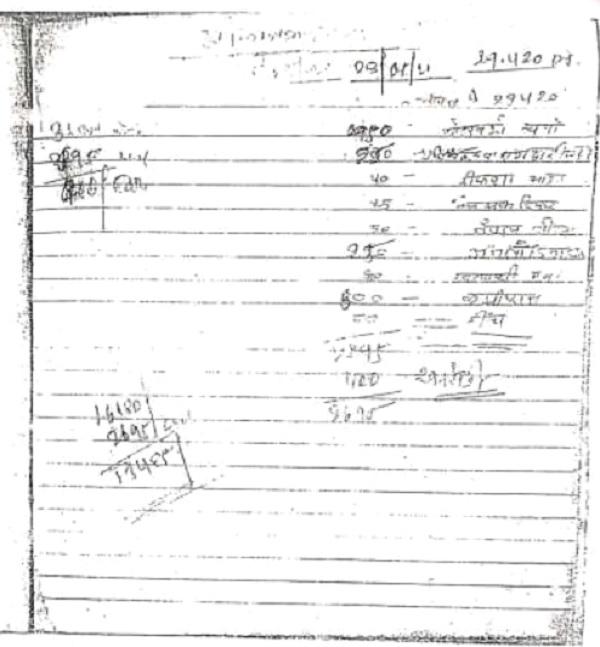
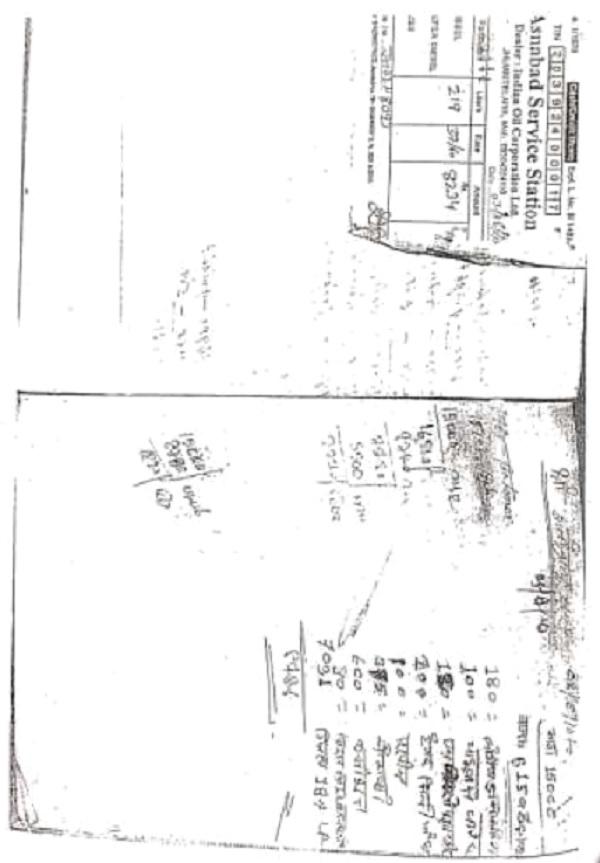
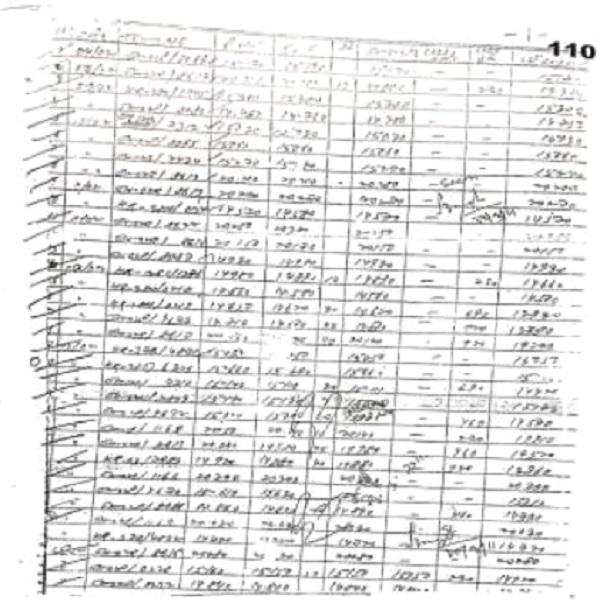
6. We are not in a position to see as to how such precise quantification has been arrived at by the Revenue, when the diary entries do not have any such specific entries. The entries do not have any particular form to show the quantities alleged to have been clandestinely cleared. Since there are different handwritings, the author s also may be more than one person. Such authors have not been properly identified by the Revenue. 7. In terms of Section 9D of CEA 1944, when the statement is recorded by any person, the same is required to be reiterated by that person before the Adjudic ating authority and only after that the statement can be entered as an evidence by the Revenue. In this case, this procedure was all the more required because the entire premise of seized from a third party’s premises and the statement about clandestine removal has been recorded by that third party.
8. We have gone through the statement recorded by the Transport owner Jitesh Kumar Singh. The relevant page is reproduced below:
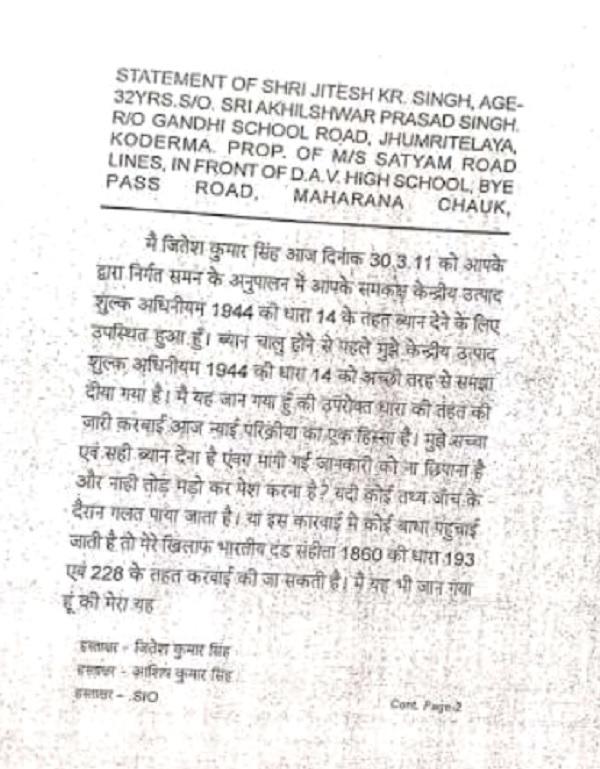
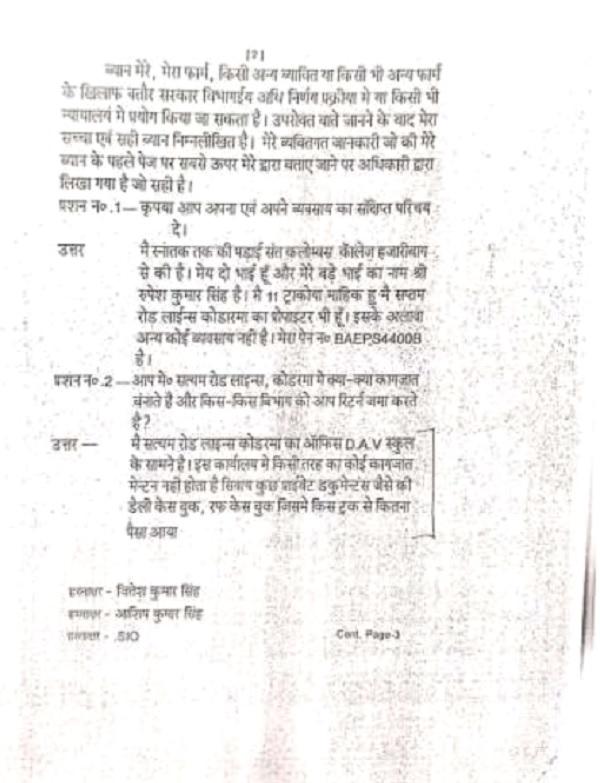
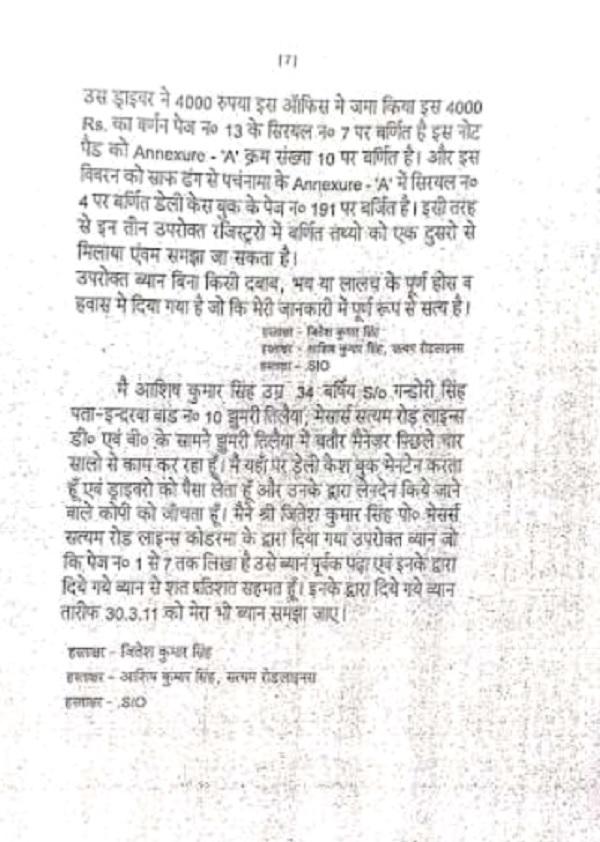
9. It is seen that he has stated that the records have been maintained by his employee Ashish Kumar. After the signature of Jitesh, just below the employee has vouched to the effect that he has gone through the pages recorded by his employer and he stands by the same and he has signed the statement. This is quite unusual for the Statement recorded under Section 14 of CEA 1944. There is nothing to indicate that the employee Ashish Kumar was issued the summons and was made aware that the statement is being recorded in terms of Section end of the page serves no purpose and cannot be even taken as a statement recorded under Section
14. Coming to the statement recorded by the, Jitesh, when he states the records are maintained by his employee, then he is not qualified to comment on the records which are being put up before him. On this count his statements veracity gets vitiated. The Revenue’s case meets further fatality, firstly when Jitesh was not put through the procedure under Section 9D and secondly, when even after his cross- examination being sought by the appellant, the same was not granted. Hence, we take the view that his statement has no evidentiary value.
10. So far as the statement recorded by the Director is concerned, he has retracted the same subsequently. Therefore, even he should have been put through the procedure under Section 9D. The fact he is an official of the appellant company, does not absolve the Revenue from following the prescribed procedure under Section 9D.
11. In the present case, we find that apart from relying on the recorded statements and private records recovered from the transporter’s premises, no other corroborative evidence with reference to excess consumption of Electricity, usage of raw materials for manufacturing of undeclared finished goods, cash transactions with the purported vendors of the raw material, recorded statement of any vendor about cash purchase of the raw materials etc., have been brought in by the Revenue. Therefore, the recovery of private records would at best would point out about certain doubts on the transactions shown therein, but they on their own would not be sufficient to quantify the demand and corroborate the stand of the Dept to confirm the demand.
12. In respect of both the issues of procedure to be followed under Section 9D of the CEA 1944 and about the requirement of corroborative evidence, we have for reference a recent decision of the Principal Bench, CESTAT New Delhi on an identical, in the case of Surya Wires Pvt. Ltd Vs Principal Commissoner, CGST, Raipur (EXCISE APPEAL NO. 51096 OF 2022) – Final Order No. 50453- 50454/2025 dated 1.4.2025. The Tribunal has held:
4. It is stated that on 08.04.2016, the Central Excise Officers of the Preventive Wing of the department conducted an investigation in the factory premises of the appellant. The Officers scrutinized the records found in the premises and some documents were also seized for further scrutiny. A panchanama was drawn on 08.04.2016. Statements of Harsh Agrawal and Surendra Kumar Jain (Directors of the appellant), Narendra Kumar Rathod (security guard), Satyanand Soi (security-in-charge) and Ishwar Prasad Verma (loading-in-charge) were recorded under section 14 of the Central Excise Act.
5…………The relevant portions of the show cause notice are as follows:
“4.4 Thus the officers in the presence of two independent Panchas and Shri Harsh Agrawal, Director of the Noticee No. 1 ascertained shortages of stock as declared by Shri Harsh Agrawal, Noticee No. 2 in respect of GI Wire, HB Wire, Wire Rod & Waste – Scrap as 476.206 MT, 7759.274 MT and 245.306 MT & 112.088 MT respectively. On being asking about the shortage of stock, so ascertained, Shri Harsh could not tender any satisfactory reply to the officers and accepting such shortage of stock, he assured of paying total Central Excise Duty of Rs. 3,04,24,623/- thereon shortly. He also deposed in reply to question no. 7 of his Statement dated 08/09.04.2016 (RUD-2), recorded under Section 14 of the Central Excise Act, 1944 as also inter-alia deposed in reply to question no. 1 of his another statement dated 11.04.2016 (RUD-3), recorded under Section 14 of the Central Excise Act, 1944, that he has perused his statement recorded on 09.04.2016 and signed on it in token of having seen the same. He reiterated that the said statement had been given by him in his complete senses and was very much true to the best of his knowledge. Shri Harsh Agrawal, Noticee No. 2 in his statement dated 08/09.04.2016 submitted that they had debited CENVAT Credit Account of Rs. 65,00,000/- dated 08.04.2016 and assured to pay the remaining Central Excise Duty within 30 days.
6. The show cause notice also deals with duty liability arrived at on the basis of loose papers recovered from the premises of the appellant. The relevant portions of the show cause notice relating to this allegation are reproduced below:
“11.1 Loose papers recovered from the premises of the Noticee No. 1 containing details of truck number, Estimated Bill of loaded vehicle, description of goods, name of the party, Kanta Parchi in respect of GI Wire, Steam Coal, HB Wire, Stay Wire, Wire Rod and Barbed Wire loaded for dispatch containing pages from 1 to 277. The details of such loose papers recovered from the factory premises of the Noticee No. 1 are mentioned in the Panchnama dated 08.04.2016. Each of the documents was perused by Shri Harsh Agrawal, Director of Noticee No. 1 and he accepted in very unambiguous terms that all the documents recovered and which were perused by him, pertained to his factory and prepared by his staff as deposed in reply to question no. 5 of his statement dated 08/09.04.2016 (RUD-2) recorded under Section 14 of the Central Excise Act, 1944. On verification/comparison from/with Sales Register for the month of April 2016, submitted by the Noticee No. 1 vide their letter dated 07.06.2018, it appeared that in some cases, clearance of said goods have been made clandestinely without accounting for in its books of accounts, without issuing of Central Excise Invoice and without payment of Central Excise Duty.
11.2 On the basis of the aforesaid documents recovered from the factory premises of the Noticee No. 1, containing entries of movement of goods, a chart was prepared showing the entire clearances of excisable goods from the factory premises of the Noticee No. 1, during the period from 06.04.2016 to 08.04.2016 in Chart B.
9. Shri K. Krishnamohan Menon, learned counsel for the appellant assisted by Ms. Parul Sachdeva and Ms. Prerna Jain made the following submissions: (i) Statements of witnesses recorded under section 14 of the Central Excise Act before a Gazetted Central Excise Officer during the course of investigation cannot be relied upon unless the procedure contemplated under section 9D of the Central Excise Act is scrupulously followed. Such statements would have no evidentiary value if the persons making them are not examined before the adjudicating authority and they are admitted in evidence in the interests of justice as is contemplated under section 9D(1)(b) of the Central Excise Act. In this connection reliance has been placed on the following decisions:
(a) Jindal Drugs Pvt. Ltd. vs. Union Of India6;
(b) G-Tech Industries vs. Union of India7;
(c) M/s. Anjani Steels Ltd. vs. Commissioner of Central Excise and Service Tax, Raipur8;
(d) M/s. Drolia Electrosteel P. Ltd. vs. Commissioner, Customs, Central Excise & Service Tax,
12. A perusal of the impugned order shows that it is based primarily on the statements of Harsh Agrawal, Director of the appellant, Narendra Kumar Rathod, security guard of the appellant, Satyanand Soi, security-in-charge of the appellant and Ishwar Prasad Verma, loading-in-charge of the appellant. These statements were recorded by the Officer under section 14 of the Central Excise Act.
13. The first and foremost issue that arises for consideration is whether such statements could have been considered as relevant and relied upon without following the procedure contemplated in section 9D of the Central Excise Act relating to relevancy of statements under certain circumstances.
14. The statement of witnesses are recorded under section 14 of the Central Excise Act and section 9D of the Central Excise Act deals with relevancy of these statements under certain circumstances.
15. The statement of witnesses are recorded under section 108 of the Customs Act, 196223 and section 138B of the Customs Act deals with relevancy of statements under certain circumstances.
16. It would, therefore, be appropriate to examine these sections of the two Acts at length. Central Excise Act 17. Section 14 of the Central Excise Act deals with power to summon persons to give evidence and produce documents in inquiries under the Central Excise Act. Any Central Excise Officer duly empowered by the Central Government in this behalf has the power to summon any person whose attendance he considers necessary either to give evidence or to produce a document in any inquiry which such Officer is making for any of the purposes of the Central Excise Act. 18. Section 9D of the Central Excise Act deals with relevancy of statements under certain circumstances and it is reproduced below: “9D. Relevancy of statements under certain circumstances
(1) A statement made and signed by a person before any Central Excise Officer of a gazetted rank during the course of any inquiry or proceeding under this Act shall be relevant, for the purpose of proving, in any prosecution for an offence under this Act, the truth of the facts which it contains,—
(a) when the person who made the statement is dead or cannot be found, or is incapable of giving evidence, or is kept out of the way by the adverse party, or whose presence cannot be obtained without an amount of delay or expense which, under the circumstances of the case, the court considers unreasonable; or
(b) when the person who made the statement is examined as a witness in the case before the court and the court is of opinion that, having regard to the circumstances of the case, the statement should be admitted in evidence in the interests of justice.
(2) The provisions of sub-section (1) shall, so far as may be, apply in relation to any proceeding under this Act, other than a proceeding before a court, as they apply in relation to a proceeding before a court.”
21. It would be seen section 14 of the Central Excise Act and section 108 of the Customs Act enable the concerned Officers to summon any person whose attendance they consider necessary to give evidence in any inquiry which such Officers are making. The statements of the persons so summoned are then recorded under these provisions. It is these statements which are referred to either in section 9D of the Central Excise Act or in section 138B of the Customs Act. A bare perusal of sub-section (1) of these two sections makes it evident that the statement recorded before the concerned Officer during the course of any inquiry or proceeding shall be relevant for the purpose of proving the truth of the facts which it contains only when the person who made the statement is examined as a witness before the Court and such Court is of the opinion that having regard to the circumstances of the case, the statement should be admitted in evidence, in the interests of justice, except where the person who tendered the statement is dead or cannot be found. In view of the provisions of sub-section (2) of section 9D of the Central Excise Act or sub-section (2) of section 138B of the Customs Act, the provisions of sub-section (1) of these two Acts shall apply to any proceedings under the Central Excise Act or the Customs Act as they apply in relation to proceedings before a Court. What, therefore, follows is that a person who makes a statement during the course of an inquiry has to be first examined as a witness before the adjudicating authority and thereafter the adjudicating authority has to form an opinion whether having regard to the circumstances of the case the statement should be admitted in evidence, in the interests of justice. Once this determination regarding admissibility of the statement of a witness is made by the adjudicating authority, the statement will be admitted as an evidence and an opportunity of cross-examination of the witness is then required to be given to the person against whom such statement has been made. It is only when this procedure is followed that the statements of the persons making them would be of relevance for the purpose of proving the facts which they contain.
22. It would now be appropriate to examine certain decisions interpretating section 9D of the Central Excise Act and section 138B of the Customs Act. 23. In Ambika International vs. Union of India24 decided on 17.06.2016, the Punjab and Haryana High Court examined the provisions of section 9D of the Central Excise Act. The show cause notices that had been issued primarily relied upon statements made under section 14 of the Central Excise Act. It was sought to be contended by the Writ Petitioners that the demand had been confirmed in flagrant violation of the mandatory provisions of section 9D of the Central Excise Act. The High Court held that if none of the circumstances contemplated by clause (a) of section 9D(1) exist, then clause (b) of section 9D(1) comes into operation and this provides for two steps to be followed. The first is that the person who made the statement has to be examined as a witness before the adjudicating authority. In the second stage, the adjudicating authority has to form an opinion, having regard to the circumstances of the case, whether the statement should be admitted in evidence in the interests of justice. The judgment further holds that in adjudication proceedings, the stage of relevance of a statement recorded before Officers would arise only after the statement is admitted in evidence by the adjudicating authority in accordance with the procedure contemplated in section 9D(1)(b) of the Central Excise Act. The judgment also highlights the reason why such an elaborative procedure has been provided in section 9D(1) of the Central Excise Act. It notes that a statement recorded during inquiry/investigation by an Officer of the department has a possibility of having been recorded under coercion or compulsion and it is in order to neutralize this possibility that the statement of the witness has to be recorded before the adjudicating authority. The relevant portions of the judgment are reproduced below:
“15. A plain reading of sub-section (1) of Section 9D of the Act makes it clear that clauses (a) and
(b) of the said sub-section set out the circumstances in which a statement, made and signed by a person before the Central Excise Officer of a gazetted rank, during the course of inquiry or proceeding under the Act, shall be relevant, for the purpose of proving the truth of the facts contained therein.
16. Section 9D of the Act came in from detailed consideration and examination, by the Delhi High Court, in J.K. Cigarettes Ltd. v. CCE, 2009 (242) E.L.T. 189 (Del.). Para 12 of the said decision clearly holds that by virtue of sub-section (2) of Section 9D, the provisions of sub-section (1) thereof would extend to adjudication proceedings as well. *****
22. If none of the circumstances contemplated by clause (a) of Section 9D(1) exists, clause (b) of Section 9D(1) comes into operation. The said clause prescribes a specific procedure to be followed before the statement can be admitted in evidence. Under this procedure, two steps are required to be followed by the adjudicating authority, under clause (b) of Section 9D(1), viz. (i) (ii) the person who made the statement has to first be examined as a witness in the case before the adjudicating authority, and the adjudicating authority has, thereafter, to form the opinion that, having regard to the circumstances of the case, the statement should be admitted in evidence in the interests of justice.
23. There is no justification for jettisoning this procedure, statutorily prescribed by plenary parliamentary legislation for admitting, into evidence, a statement recorded before the gazetted Central Excise Officer, which does not suffer from the handicaps contemplated by clause (a) of Section 9D(1) of the Act. The use of the word “shall” in Section 9D(1), makes it clear that, the provisions contemplated in the sub-section are mandatory. Indeed, as they pertain to conferment of admissibility to oral evidence they would, even otherwise, have to be recorded as mandatory.
24. The rationale behind the above precaution contained in clause (b) of Section 9D(1) is obvious. The statement, recorded during inquiry/investigation, by the gazetted Central Excise Officer, has every chance of having been recorded under coercion or compulsion. It is a matter of common knowledge that, on many occasions, the DRI/DGCEI resorts to compulsion in order to extract confessional statements. It is obviously in order to neutralize this possibility that, before admitting such a statement in evidence, clause (b) of Section 9D(1) mandates that the evidence of the witness has to be recorded before the adjudication authority, as, in such an atmosphere, there would be no occasion for any trepidation on the part of the witness concerned.
25. Clearly, therefore, the stage of relevance, in adjudication proceedings, of the statement, recorded before a gazetted Central Excise Officer during inquiry or investigation, would arise only after the statement is admitted in evidence in accordance with the procedure prescribed in clause (b) of Section 9D(1). The rigour of this procedure is exempted only in a case in which one or more of the handicaps referred to in clause (a) of Section 9D(1) of the Act would apply. In view of this express stipulation in the Act, it is not open to any adjudicating authority to straightaway rely on the statement recorded during investigation/inquiry before the gazetted Central Excise Officer, unless and until he can legitimately invoke clause (a) of Section 9D(1). In all other cases, if he wants to rely on the said statement as relevant, for proving the truth of the contents thereof, he has to first admit the statement in evidence in accordance with clause (b) of Section 9D(1). For this, he has to summon the person who had made the statement, examine him as witness before him in the adjudication proceeding, and arrive at an opinion that, having regard to the circumstances of the case, the statement should be admitted in the interests of justice.
26. In fact, Section 138 of the Indian Evidence Act, 1872, clearly sets out the sequence of evidence, in which evidence-in-chief has to precede cross examination, and cross- examination has to precede re-examination.
27. It is only, therefore, -after the person whose statement has already been recorded before a gazetted Central Excise Officer is examined as a witness before the adjudicating authority, and (ii) the adjudicating authority arrives at a conclusion, for reasons to be recorded in writing, that the statement deserves to be admitted in evidence, that the question of offering the witness to the assessee, for cross examination, can arise. 28. Clearly, if this procedure, which is statutorily prescribed by plenary parliamentary legislation, is not followed, it has to be regarded, that the Revenue has given up the said witnesses, so that the reliance by the CCE, on the said statements, has to be regarded as misguided, and the said statements have to be eschewed from consideration, as they would not be relevant for proving the truth of the contents thereof.” (emphasis supplied)
24. The Punjab and Haryana High Court in Jindal Drugs that was decided on 21.06.2016 also held that unless and until one of the circumstances contemplated by clause (a) of section 138B(1) of the Customs Act applies, the adjudicating authority is bound to strictly follow the procedure contained in clause (b) of section 138B(1) of the Customs Act, before treating a statement recorded under section 108 of the Customs Act as relevant.
25. In Hi Tech Abrasives Ltd. vs. Commissioner of C. Ex. & Cus., Raipur25 decided on 04.07.2018, the Chhattisgarh High Court also examined the provisions of section 9D of the Central Excise Act. The allegation against the appellant was regarding clandestine removal of goods without payment of duty and for this purpose reliance was placed on the statement of the Director of the Company who is said to have admitted clandestine removal of goods. The contention of the appellant before the High Court was that the statement of the Director could be admitted in evidence only in accordance with the provisions of section 9D of the Central Excise Act. After examining the provisions of sub-sections (1) and (2) of section 9D of the Central Excise Act, and after placing reliance on the judgment of the Punjab and Haryana High Court in Ambika International, the Chhattisgarh High Court held: “9.3 A conjoint reading of the provisions therefore reveals that a statement made and signed by a person before the Investigation Officer during the course of any inquiry or proceedings under the Act shall be relevant for the purposes of proving the truth of the facts which it contains in case other than those covered in clause (a), only when the person who made the statement is examined as witness in the case before the court (in the present case, Adjudicating Authority) and the court (Adjudicating Authority) forms an opinion that having regard to the circumstances of the case, the statement should be admitted in the evidence, in the interest of justice. 9.4 The legislative scheme, therefore, is to ensure that the statement of any person which has been recorded during search and seizure operations would become relevant only when such person is examined by the adjudicating authority followed by the opinion of the adjudicating authority then the statement should be admitted. The said provision in the statute book seems to have been made to serve the statutory purpose of ensuring that the assessee are not subjected to demand, penalty interest on the basis of certain admissions recorded during investigation which may have been obtained under the police power of the Investigating authorities by coercion or undue influence. 9.5 ***** The provisions contained in Section 9D, therefore, has to be construed strictly and held as mandatory and not mere directory. Therefore, unless the substantive provisions contained in Section 9D are complied with, the statement recorded during search and seizure operation by the Investigation Officers cannot be treated to be relevant piece of evidence on which a finding could be based by the adjudicating authority. A rational, logical and fair interpretation of procedure clearly spells out that before the statement is treated relevant and admissible under the law, the person is not only required to be present in the proceedings before the adjudicating authority but the adjudicating authority is obliged under the law to examine him and form an opinion that having regard to the circumstances of the case, the statement should be admitted in evidence in the interest of justice. Therefore, we would say that even mere recording of statement is not enough but it has to be fully conscious application of mind by the adjudicating authority that the statement is required to be admitted in the interest of justice. The rigor of this provision, therefore, could not be done away with by the adjudicating authority, if at all, it was inclined to take into consideration the statement recorded earlier during investigation by the Investigation officers. Indeed, without examination of the person as required under Section 9D and opinion formed as mandated under the law, the statement recorded by the Investigation Officer would not constitute the relevant and admissible evidence/material at all and has to be ignored. We have no hesitation to hold that the adjudicating officer as well as Customs, Excise and Service Tax Appellate Tribunal committed illegality in placing reliance upon the statement of Director Narayan Prasad Tekriwal which was recorded during investigation when his examination before the adjudicating authority in the proceedings instituted upon show cause notice was not recorded nor formation of an opinion that it requires to be admitted in the interest of justice. In taking this view, we find support from the decision in the case of Ambica International v. UOI rendered by the High Court of Punjab and Haryana.” (emphasis supplied)
26. In Additional Director General (Adjudication) vs. Its My Name Pvt. Ltd.26 decided on 01.06.2020, the Delhi High Court examined the provisions of sections 108 and 138B of the Customs Act. The department placed reliance upon the statements recorded under section 108 of the Customs Act. The Delhi High Court held that the procedure contemplated under section 138B(1)(b) has to be followed before the statements recorded under section 108 of the Customs Act can be considered as relevant. The relevant paragraphs of the judgment of the Delhi High Court are reproduced below:
“76. We are not persuaded to change our view, on the basis of the various statements, recorded under Section 108 of the Act, on which the Learned ASG sought to rely. Statements, under Section 108 of the Act, we may note, though admissible in evidence, acquire relevance only when they are, in fact, admitted in evidence, by the adjudicating authority and, if the affected assessee so chooses, tested by cross- examination. We may, in this context, reproduce, for ready reference, Section 138B of the Act, thus: ***** A Division Bench of this Court has, speaking through A.K. Sikri, J. (as he then was) held, in J & K Cigarettes Ltd. v. Collector of Central Excise [2009 (242) E.L.T. 189 (Del.)] that, by virtue of sub-section (2), Section 138B(1) of the Act would apply, with as much force, to adjudication proceedings, as to criminal proceedings. ***** We express our respectful concurrence with the above elucidation of the law which, in our view, directly flows from Section 138B(1) of the Act – or, for that matter, Section 9D of the Central Excise Act, 1944.
77. The framers of the law having, thus, subjected statements, recorded under Section 108 of the Act, to such a searching and detailed procedure, before they are treated as relevant in adjudication proceedings, we are of the firm view that such statements, which are yet to suffer such processual filtering, cannot be used, straightaway, to oppose a request for provisional release of seized goods. The reliance, in the appeal before us, on various statements recorded during the course of investigation in the present case cannot, therefore, in our view, invalidate the decision, of the Learned Tribunal, to allow provisional release of the seized 25400.06 grams of gold jewellery, covered by Bill of Entry No. 107190, dated 20th April, 2019.” (emphasis supplied)
27. In Drolia Electrosteel decided on 30.10.2023, a Division Bench of the Tribunal examined the provisions of section 9D of the Central Excise Act and after placing reliance upon the decision of the Punjab and Haryana High Court in Jindal Drugs, observed that if the mandatory provisions of section 9D(1)(b) of the Central Excise Act are not followed, the statements cannot be used as evidence in proceedings under Central Excise Act. The relevant portions of the decision of the Tribunal are reproduced below:
“14. Evidently, the statements will be relevant under certain circumstances and these are given in clauses (a) and (b) of subsection (1). There is no assertion by either side that the circumstances indicated in (a) existed in the case. It leaves us with (b) which requires the court or the adjudicating authority to first examine the person who made the statement and form an opinion that having regard to the circumstances of the case, the statement should be admitted in evidence. Of course, the party adversely affected by the statement will have to be given an opportunity to cross examine the person who made the statement but that comes only after the statement is, in the first place, after examination by the adjudicating authority, admitted in evidence. This has not been done in respect of any of the 35 statements. Therefore, all the statements are not relevant to the proceedings.
15. It has been held in a catena of judgments including Jindal Drugs Pvt. Ltd. versus Union Of India [2016 (340) E.L.T. 67 (P&H)] that section 9D is a mandatory provision and if the procedure prescribed therein is not followed, statements cannot be used as evidence in the proceedings under Central Excise Act. *****
16. Therefore, the 35 statements relied upon in the SCN are not relevant and hence also not admissible.” (emphasis supplied)
28. It, therefore, transpires from the aforesaid decisions that both section 9D(1)(b) of the Central Excise Act and section 138B(1)(b) of the Customs Act contemplate that when the provisions of clause (a) of these two sections are not applicable, then the statements made under section 14 of the Central Excise Act or under section 108 of the Customs Act during the course of an inquiry under the Acts shall be relevant for the purpose of proving the truth of the facts contained in them only when such persons are examined as witnesses before the adjudicating authority and the adjudicating authority forms an opinion that the statements should be admitted in evidence. It is thereafter that an opportunity has to be provided for cross-examination of such persons. The provisions of section 9D of the Central Excise Act and section 138B(1)(b) of the Customs Act have been held to be mandatory and failure to comply with the procedure would mean that no reliance can be placed on the statements recorded either under section 14D of the Central Excise Act or under section 108 of the Customs Act. The Courts have also explained the rationale behind the precautions contained in the two sections. It has been observed that the statements recorded during inquiry/investigation by officers has every chance of being recorded under coercion or compulsion and it is in order to neutralize this possibility that statements of the witnesses have to be recorded before the adjudicating authority, after which such statements can be admitted in evidence.
34. The confirmation of demand of central excise duty to the extent of Rs. 3,04,24,623/- is based on the statements of persons who were not examined by the department before the adjudicating authority. This examination was absolutely necessary in terms of the provisions of section 9D of the Central Excise Act. In the absence of examination of such persons before the adjudicating authority and in the absence of admission of such statements in evidence, such statements would not be relevant. For the reasons stated above, the said demand would have to be set aside.
40. In the present case, the alleged authors of the loose papers were not examined. The demand of Rs. 1,76,650/- based on loose papers recovered from the factory premises of the appellant, therefore, cannot be sustained and deserves to be set aside.
41. It also needs to be remembered that a demand based solely on shortage of stock cannot be sustained in the absence of corroborative evidence. In this connection, reference can be made to the judgment of the Punjab and Haryana High Court in Anand Founders & Engineers and the relevant portion of the judgment is reproduced below:
“6. The Commissioner (Appeals) set aside the findings of the clandestine removal of the goods recorded by the adjudicating authority by holding that the assessee’s record which were admittedly lying in the adjoining sister concern M/s. Adhunik Industrial Corporation were not scrutinized. Further, it was held that the assessee had clarified the stock position vide letter dated 9-8-2008 which was rejected summarily as an after-thought without making the verifications. Shri Kamal Kant in his statement has admitted only shortages and not the fact of clandestine removal and there was no evidence to show the clandestine activities as no further investigation was conducted to establish the identity of the buyers or the suppliers of the raw materials. The adjudicating authority had mentioned that the production was recorded by weight but in the sale invoices, the goods were sold by numbers without indicating the weight of the finished goods but nothing was proved that how the stock position was verified regarding sale invoices which only showed numbers without giving their weight. Accordingly, the Commissioner (Appeals) extending the benefit of doubt to the assessee had set aside the order passed by the adjudicating authority. The aforesaid findings of the Commissioner (Appeals) were affirmed by the Tribunal by observing that there was no other evidence on record to prove the clandestine activities of the assessee as the Revenue has not conducted further investigations to establish the identity of the buyers or the suppliers of the raw materials or the transporters. Further, it was held by the Tribunal that mere shortages detected at the time of visit of the officers cannot ipso facto lead to the allegations and findings of clandestine removal. The relevant findings recorded by the Tribunal read thus: –
“7. The Revenue has again reiterated the same stand that as shortages detected at the time of visit of the officers, which has to be held that the respondents had cleared their final product in a clandestine manner. Admittedly, there is no other evidence on record so as to relate to the clandestine activities of the assessee. The Commissioner (Appeals) has rightly relied upon the various decisions of the Tribunal including the decision in the case of Jai Timber Company v. CCE & C, Bhopal [2009 (234) E.L.T. 457 (Tri.-All.)] and has rightly concluded that mere shortages detected at the time of visit of the officers cannot ipso facto lead to the allegations and findings of clandestine removal.”
7. No illegality or perversity could be pointed out in the aforesaid findings of fact recorded by the Commissioner (Appeals) as well as the Tribunal which may warrant interference by this Court. Accordingly, no substantial question of law arises in this appeal.” (emphasis supplied)
43. What also needs to be noticed is that an inference regarding clandestine removal can be drawn only after detailed investigation and consideration of relevant incriminating material which could be based on the stock of raw material, finished product, use of consumption of electricity, employment of labour and many other relevant materials as has been noticed by the Chhattisgarh High Court in Hi Tech Abrasives. The relevant portion of the judgment is reproduced below: “12.2 ***** The inference regarding clandestine removal ought to be outcome of a detailed investigation and consideration of other relevant incriminating material which could be based on the stock of raw material, finished products, use of consumption of electricity, employment of labour and many other relevant material as noticed in the decisions reported in 2014 (309) E.L.T. 411 and 2017 (345) E.L.T. 187 rendered by the High Court of Allahabad and High Court of Jharkhand, respectively. What, amongst other things, could be relevant consideration of clandestine removal, was discussed as below:
“12. Further, unless there is clinching evidence of the nature of purchase of raw materials, use of electricity, sale of final products, clandestine removals, the mode and flow back of funds, demands cannot be confirmed solely on the basis of presumptions and assumptions. Clandestine removal is a serious charge against the manufacturer, which is required to be discharged by the Revenue by production of sufficient and tangible evidence. On careful examination, it is found that with regard to alleged removals, the department has not investigated the following aspects:
(i) To find out the excess production details.
(ii) To find out whether the excess raw materials have been purchased.
(iii) To find out the dispatch particulars from the regular transporters.
(iv) To find out the realization of sale proceeds.
(v) To find out finished product receipt details from regular dealers/buyers.
(vi) To find out the excess power consumptions.
(vii) Several decisions have been given by the Tribunals which have been confirmed by the High Courts that electricity consumption alone if adopted as a basis of the demand, the same is not tenable. The respondents can take the electricity consumption pattern as a corroborative piece of evidence, but, in absence of substantive proofs like –
(a) Details about the purchase of the raw material within the manufacturing units and no entries are made in the books of account or in the statutory records.
(b) Manufacturing of finished product with the help of the aforesaid raw material, which is not mentioned in the statutory records.
(c) Quantity of the manufacturing with reference to the capacity of production by the noticee unit.
(d) Quantity of the packing material used.
(e) The total number of the employees employed and the payment made to them In this case, statements of the labourers ought to have been reduced in writing, by the department which ought to refer that over and above of the salary paid by the noticee, some other type of remunerations in cash or kind have been paid by the noticee, such statements are must.
(f) Ostensible discrepancy in the stock of raw materials and the finished product.
(g) Clandestine removal of goods with reference to entry/exit of vehicles like Trucks, etc. in the factory premises.
(h) If there is any proof about the loading of the goods in the Truck, like weight of truck, etc. at the weighbridge, security gate records, transporter documents such as lorry receipts, statements of the truck drivers, entries of the trucks/vehicles at different check-post. Different types of forms which are supplied by the Commercial Tax Department, like Road Permit supplied by the commercial tax department, receipts by the consignees, etc. These documents ought to have been collected by the respondent department, if at all, they are interested in collector of the correct central excise duty from the noticee upon whom or upon which allegation of clandestine removal of the finished product is levelled. The electricity consumption report like Dr. N.K. Batra report can hardly be treated as a substantive evidence. Time and again, the decisions have been given by the Tribunals but the respondents-departments are turning deaf-ear to. In this case, they are also turning deaf-ear to their own circular dated 26-6-2014 (Annexure-3 to the memo of this writ). In this case, the respondents are relying upon Dr. N.K. Batra’s report, also upon the allegation that much less salary has been paid to the employee and the unit is running in losses. All these are nothing but the possibilities, for clandestine removal, but, for proving the clandestine removal, the substantive piece of evidence is must. Few such evidences have been referred by this Court. The list of these evidences is not exhaustive. (I) The department should have collected the proof of amount received from the consignees, statement of consignees, receipts of sale proceeds by the consignor and its disposal.” (emphasis supplied)
44. The inevitable conclusion, therefore, that would follow from the aforesaid discussion is that the impugned order dated 09.06.2020 passed by the Principal Commissioner in so far is it confirms the demand with interest and penalty cannot be sustained and would have to be set aside.
13. We find that to the factual matrix of present appeal, the above decision, which in turn has relied on several High Court decisions, is squarely applicable both in respect of non-following of Section 9D procedure as well as on account of non-bringing in of corroborative evidence towards the alleged clandestine removal. Applying the ratio laid down in the cited case law, we set aside the impugned Order and allow the appeal on merits.
14. Since the confirmed demand is not sustainable on merits as per our detailed observations above, the question of charging interest and imposing penalty would not arise.
15. Since the confirmed demand against the appellant company is set aside, consequently, the penalties imposed on other appellants also get set aside.
16. As a result the appeals are allowed. The appellants would be eligible for consequential relief, if any, as per law.
(Order Pronounced in Open court on 24.09.2025)