In re Gayatri Exports (CAAR Mumbai)
Summary: The Customs Authority for Advance Rulings, Mumbai, disallowed Gayatri Exports’ applications seeking classification of proposed imports of roasted areca nuts under CTH 2008 19 91. The five applications, received on 18 May 2026, concerned imports through Tuticorin, Mundra, JNCH, Chennai and Kolkata. The applicant proposed sourcing the goods from Indonesia, Sri Lanka, Myanmar, Cambodia, Burma, Bangladesh, Thailand and Vietnam, as recorded in the order. It described de-husking, cleaning and repeated oven heating and cooling over two to three days. Its initial process description referred to reducing water content to 10–15%, while later submissions and the departmental account referred to moisture below 10%. The applicant relied on HSN Explanatory Notes, the specific entry for roasted nuts, earlier advance rulings, import data and DGFT Notification No. 43/2025-26 dated 15 October 2025. It submitted that the earlier tariff item 2008 19 20 had been replaced by 2008 19 91.
Mundra Customs referred to earlier rulings, including In re Konet Technology Inc., and submitted that fresh comments on the same classification issue would be repetitive. Chennai-II Customs questioned whether the described treatment amounted to roasting rather than drying or moderate heat treatment. It sought verification of actual goods through accredited laboratory testing, including moisture, physical characteristics, arecoline and other chemical parameters. It also questioned the absence of samples, photographs and consignment-specific evidence in the original application, and referred to packing, food-safety requirements, tariff valuation and the duty differential between Chapters 8 and 20. These were departmental submissions; the Authority did not decide them on their merits. Chennai-II further submitted that the ₹351-per-kilogram minimum import price was a trade-policy measure and did not resolve tariff classification. It referred to the Unik Traders order and stated that a departmental writ appeal challenging that order was pending.
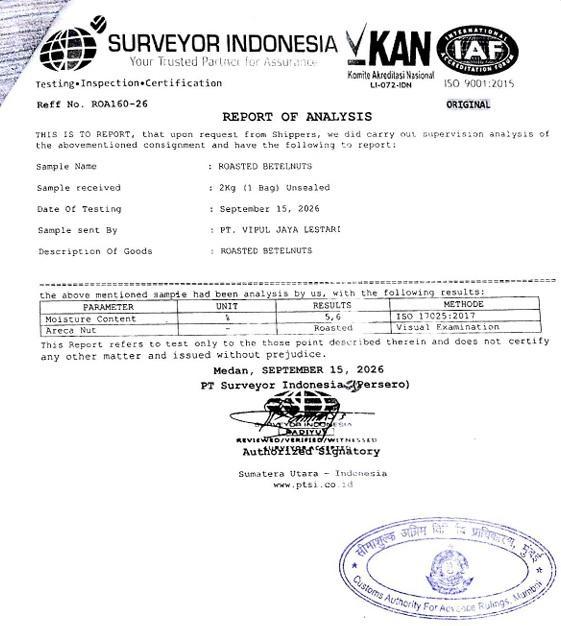
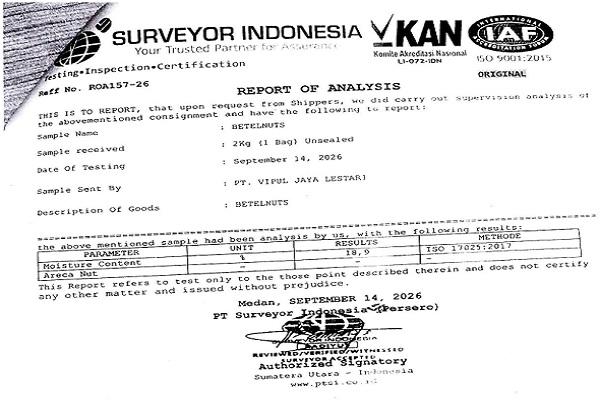
At the personal hearing on 22 September 2026, the applicant’s advocate reiterated the classification claim and sought time to rebut the port’s comments; nobody appeared for the Department. On 21 October 2026, the applicant furnished a letter-cum-undertaking and a process letter from its Indonesian supplier, PT Vipul Jaya Lestari. The supplier described gradual heating, principally at 130°C–150°C during roasting and drying, sorting, polishing and final inspection, without adding lime or tobacco. Reports of PT Surveyor Indonesia recorded moisture of 18.9% in the raw sample tested on 14 September 2026 and 5.6% in the roasted sample tested on 15 September 2026. The supplier’s letter expressly confined those reports to the particular samples tested. The applicant undertook that its proposed imports would undergo the stated process and contain moisture below 10%, and that it would produce the supplier’s letter when required.
The Authority first examined maintainability under Section 28-I(2)(b) of the Customs Act, 1962. It held that the bar applies where the question is the same as one already decided by the Appellate Tribunal or any court, regardless of whether the present applicant was a party to the earlier proceedings. It referred to the Madras High Court’s judgment dated 1 August 2023 in Commissioner of Customs v. Shahnaz Commodities International Pvt. Ltd. and connected matters, C.M.A. Nos. 600, 1206 and 1750 of 2023, and its subsequent consideration in W.A. Nos. 3647 and 3648 of 2024. Finding no material distinguishing feature taking the present question outside those decisions, it held the applications barred. The claim for concessional basic customs duty under Sl. No. 172 of Notification No. 46/2011-Customs dated 1 June 2011 depended on classification and could not be separately proceeded with. The applications were therefore disallowed and disposed of, without any ruling on the merits of classification or the consequential exemption/concession claim.
Cases Discussed
- In re Konet Technology Inc., Order Nos. CAAR/MUM/ARC/4, 5, 6 & 7/2026-27, dated 29.04.2026 (CAAR Mumbai) — Mundra Customs cited this order and other similar rulings in submitting that fresh classification comments would be repetitive.
- Unik Traders, W.P. No. 36557 of 2025, order dated 14.10.2025 (Madras High Court) — Chennai-II Customs referred to the clearance order and stated that the Department had filed a writ appeal challenging reliance on a 10% moisture threshold.
- Commissioner of Customs v. Universal Impex & Neena Enterprises, W.A. Nos. 3647 & 3648 of 2024, judgment dated 04.03.2025 (Madras High Court) — The Authority referred to the subsequent consideration of the classification issue in applying Section 28-I(2)(b).
- In re NBG International Private Limited, 2024 taxguru.in 1388 (CAAR Mumbai) — Listed by the applicant among earlier rulings supporting classification under the former CTH 2008 19 20.
- Commissioner of Customs v. Shahnaz Commodities International P. Ltd. and connected matters concerning Universal Impex and Neena Enterprises, C.M.A. Nos. 600, 1206 & 1750 of 2023, judgment dated 01.08.2023 (Madras High Court) — The earlier judicial determination of the classification question formed the basis of the statutory bar applied by CAAR.
- In re Universal Impex, Ruling Nos. CAAR/Mum/ARC/39, 40 & 41/2023, dated 12.05.2023 (CAAR Mumbai) — Cited in the departmental comments as an earlier classification ruling. The present order records its date as 07.12.2022; the primary ruling bears 12.05.2023.
- In re Shahnaz Commodities International Private Limited, Ruling Nos. CAAR/Mum/ARC/44, 45 & 46/2022, dated 07.12.2022 (CAAR Mumbai) — The applicant referred to the earlier ruling classifying roasted areca nuts under Chapter 20.
- In re Shapphire Trading Corporation (CAAR) — Listed by the applicant in paragraph 3.4; ruling number and date are not supplied.
- In re R.R. Exports (CAAR) — Listed by the applicant in paragraph 3.4; ruling number and date are not supplied.
FULL TEXT OF THE ORDER OF CUSTOMS AUTHORITY OF ADVANCE RULING, MUMBAI
M/s Gayatri Exports (IEC No.: 5211022327) (hereinafter referred to as ‘the Applicant’) filed Five applications (CAAR-1) for advance ruling in the Office of Secretary, Customs Authority for Advance Ruling (CAAR) Mumbai. The said applications were received in the secretariat of the CAAR, Mumbai on 18.05.2026 along with its enclosures in terms of Section 28H(1) of the Customs Act, 1962 (hereinafter referred to as ‘the Act’ also). The Applicant is seeking advance ruling on the issue of classification of the “Roasted Areca Nuts” under the First Schedule of the Customs Tariff Act, 1975.
2. Submission by the Applicant:
2.1 Statement _of relevant facts having a bearing on the question(s) on which the advance ruling is required Facts of the Case: The Applicant, Gayatri Exports, prefers this Application for Advance Ruling under Section 28H of Chapter V-B of the Customs Act, 1962 (hereinafter referred to as “the Act”) on the question of law as to:
Whether the goods sought to be imported namely Roasted Areca Nuts which are subjected to de-hulling/de-husking and roasting by repeated cycle of application of heat in oven followed by cooling at room temperate for two to three days for reducing the water content of the nuts classifiable under Customs Tariff Heading 2008 19 91?
2.2 The facts relevant for the purpose of this Application are summarised as follows:
2.2.1 Gayatri Exports (hereinafter referred to as “the Applicant” is a Proprietorship-firm and is having its registered office in Surat, Gujarat.
2.2.2. The Applicant is proposing to procure and import into India, Roasted Arecanuts from Indonesia, Srilanka, Myanmar, Cambodia, Burma, Bangladesh, Thailand & Vietnam.
2.2.3. The manufacturers of the exporting countries implement the following process in preparation of the above-mentioned products:
Roasted Arecanut — For roasting of Areca nuts, the raw Areca nuts are de-hulled/dehusked and then subjected to roasting by application of heat in oven followed by cooling at room temperature and such cycle of heating and cooling is repeated over two to three days for reducing the waster contents of the nuts.
2.2.4 The Applicant has obtained GSTIN Registration Number 24BROPK8241F1Z0, Importer Exporter Code 5211022327. The applicant is proposing to import Roasted Arecanut from Indonesia, Srilanka, Myanmar, Cambodia, Burma, Bangladesh, Thailand & Vietnam under Chapter 2008 19 91.
2.2.5 In view of the aforesaid, the Applicant submits this Application for Advance Ruling for determination of the following questions:
Whether the goods sought to be imported namely Roasted Areca Nuts which are subjected to de-hulling/de-husking and roasting by repeated cycle of application of heat in oven followed by cooling at room temperate for two to three days for reducing the water content of the nuts classifiable under Customs Tariff Heading 2008 19 91?
2.3 Submission on Admission/Maintainability of Advance Ruling
The Applicant’s submission on admission of Advance Ruling are as follows:
2.3.1 Eligibility
The Section 28E of the Act deals with Advance Ruling and states that an Application under the respective provisions can be made by a person who qualifies to be an “Applicant” as per Section 28E(c) (i) of the Act. The relevant extract of the definition of the term “Application” is as below:
“application” means any person –
(i) Holding a valid Impoter-Exporter Code Number granted under Section 7 of the Foreign Trade (Development and Regulation) Act, 1992 (22 of 1922); or
(ii)…
(iii)……”
who makes application for advance ruling under Section 28H;
The applicant is holding a valid Importer-Exporter Code Number 5211022327 and has been registered under GST having registration Number as 24BROPK8241F1Z0. Therefore, the Applicant is eligible person to make an Application of Advance Ruling.
2.3.2 QUESTION ON LAW WHICH CAN BE RAISED BEFORE ADVANCE RULING
(i) Section 28H of the Act lays down the provisions in relation to Application for Advance ruling,
(ii) Sub-section 2 of Section 28H of the Act specifically covers the question pertaining to the classification of goods under the Customs Tariff Act and in this regard an extract of the respective clause is as follows:
“(a) classification of goods under the Customs Tariff Act, 1975 (51 of 1975):”
2.3.3 PENDENCY OF QUESTTION OF LAW IN APPELLATE TRIBUNAL OR ANY COURT
i. The Applicant submits that they have not made any application, on the question of law sought in this application, before any Central Excise or Service Tax Office, CESTAT or any other Court of Law.
ii. The Applicant further submits that to the best of its knowledge and information, no decision have been issued or provided either by CESTAT or any Court of Law on the question of law raised by the Applicant in the present Application for Advance Ruling in relation to the service providers.
iii. Accordingly, the Applicant submits that this Application of Advance Ruling satisfies the above condition and should be allowed by the Hon’ble Members.
3 STATEMENT CONTAINING APPLICANT’S INTERPRETATTION OF LAW AND /OR FACTS, AS THE CASE MAY BE, IN RESPECT OF THE Q QEUSTION(S) ON WHICH ADVANCE RULING IS REQUIRED.
3.1 CHAPTER 2008 19 91
The Applicant states that the said goods proposed to be imported from Indonesia, Sri Lanka, Myanmar, Cambodia, Burma, Bangladesh, Thailand, Vietnam, are “Roasted Areca nuts” through the seaports Tuticorin, Mundra, JNCH, Chennai and Kolkatta. The said entry in the Customs Tariff Act, 1975, is reproduced hereinbelow:
| Tariff Item | Description of the goods |
|---|---|
| 2008 | Fruits, nuts and other edible parts of plants, otherwise prepared or preserved, whether or not containing added sugar or other sweetening matter or spirit, not elsewhere specified or included |
| – Nuts, ground-nuts and other seeds, whether or not mixed together | |
| 2008 19 | — Other, including mixtures: |
| —Other: | |
| 2008 19 91 | — Other roasted nuts and seeds |
3.2 The applicant submits that the process of ‘roasting’ is not defined in the Customs ‘Tariff nor in the HSN Explanatory Note nor in any of the Sections/Chapters. In the absence of such a definition, recourse is sought to the dictionary and other literature meaning of the word ‘roasting’ that is defined as follows:
Merriam- Webster:
a.: to cook by exposing to dry heat (as in an oven or before a fire) or by surrounding with hot embers, sand, or stones
b: to dry and porch by exposure to heat,
Britannica:
Roasting, cooking, primarily of meats but also of corn ears, potatoes, or other vegetables thus prepared, by exposure to dry radiant heat either over an open fire, within a reflecting-surface oven, or in some cases within surrounding hot embers, sand, or stones.
3.3. The Applicant submits that with the above background regarding the process of roasting, the process involved in the proposed imported goods is detailed as follows:
3.3.1 Firstly, the raw Areca nut is de-husked, and its outer shell is removed. Thereafter, the de-husked nut is scattered to check for any visible impurities and the same is cleaned, pursuant to which the raw de-husked Areca nut is left to dry.
3.3.2 Secondly, the cleared and dried de-husked Areca nuts are fed into the – seed roasting oven/machine and heated in the temperature of above 100 degree Celsius: The roasting is done using firewood/palm kernel-based ovens/machine and the temperature of the flames is above 400 to 600 degree Celsius. As a result, the Areca nuts would be roasted well beyond 100 degree Celsius, usually in the range of 130-150 degree Celsius.
3.3.3. Thirdly, the Areca nuts are removed from the roasting oven and allowed to cool at normal room temperature, with the assistance of cooling fans.
3.3.4 Fourthly, when the Areca nuts have cooled and attained normal room temperature, they are again fed back into the oven at enormous heat, so as to evenly roast the Areca nuts.
3.3.5 The aforesaid process is performed repeatedly, until the water content of the fresh Areca nuts is reduced to 10 to 15 per cent. Thereby, the Areca nuts shrink and becomes brittle.
The process of repeatedly heating, roasting and cooling the Areca nuts is to ensure that the same are quickly cooled and shrunk after thermal expansion, such that the roasted Areca nuts have higher quality.
3.4 The Applicant further states that CTH 2008 19 20 was substituted by CTH 2008 19 91 vide the Finance Bill, 2025. It is stated that this Hon’ble Authority has passed numerous Advance Ruling with respect to Areca nuts falling within CTH 2008 19 20 which are as follows:
1. Shapphire Trading Corporation;
2. NBG International Pvt. Ltd.;
3. R.R. Exports.
3.5 The Applicant states that under the Harmonized System of Nomenclature (“HSN”) Explanatory Notes, Heading 20.08 covers fruit, nuts and other edible parts of plants, whether whole, in pieces or crushed, including mixtures thereof, prepared or preserved otherwise than by any of the processes specified in other Chapters or in the preceding headings of this Chapter.
3.6 The Applicant states that the classification as far as possible must – be in conformity and consonance with the HSN Explanatory Notes. It is a trite law that whenever there is a specific entry, the same would prevail over general entry. In the present case, CTH 2008 19 91 specifically if for Roasted nuts, thereby making it clear that Roasted -Areca nuts will fall under CTH 2008 19 91.
3.7 The Applicant states that it is a settled law that the Indian Customs Tariff is based on the HSN and therefore, the HSN Explanatory notes are relevant for interpretation of the Indian Customs Tariff The said interpretation has also found favour with the Customs Advance Ruling Authority in the following cases which have ruled that roasted Areca nuts are correctly classifiable under CTH 2008 19 20 (Now 2008 19 91):
1. Shahnaz Commodities International Pvt. which is also upheld by the Hon’ble Madras High Court.
3.8 The Applicant further places reliance on the NIDB data, which, according to the Applicant, evidences that Roasted Areca Nuts are being imported by various importers through the ports under the jurisdiction of Mumbai Customs under CTH 2008 19 91.
3.9 The Applicant further submits that it is pertinent to mention that, vide DGFT Notification No. 43/2025-26 dated 15.10.2025, the import of Roasted Areca Nuts falling under CTH 2008 19 91, having a CIF value of less than ₹351/- per kilogram, has been prohibited.
4. Port of Import and reply from Jurisdictional Commissionerate’s
4.1 In terms of the provisions of Section 28-I(1) of the Customs Act, 1962, read with Sub- Regulation (7) of Regulation 8 of the Customs Authority for Advance Rulings Regulations, 2021, upon receipt of the said application, the office of the CAAR, Mumbai forwarded copies of the application/submissions to the concerned jurisdictional Customs Commissionerate’ s, calling upon them to furnish the relevant records along with their comments, ifany, in respect of the said application. The details of the Commissionerate’s and the dates on which the comments were called for areas under:
1. The Commissioner of Customs, Customs House, New Harbour Estate, Tuticorin, Tamil Nadu – 628004: Comments were called for on 08.05.2026, 01.06.2026, 03.07.2026 and 23.07.2026.
2. The Principal Commissioner of Customs, Customs House, Mundra, 5B, Port User Building, Mundra Port, Mundra, Kutch, Gujarat – 370421: Comments were called for on 08.05.2026 and 01.06.2026.
3. The Commissioner of Customs, Customs House, NS-I, JNCH, Nhava Sheva, Mumbai Zone-II, Taluka Uran, District Raigad, Maharashtra – 400707: Comments were called for on 08.05.2026, 01.06.2026, 03.07.2026 and 23.07.2026.
4. The Commissioner of Customs, Chennai-II (Import), Customs House, 60, Rajaji Salai, Chennai- 600001: Comments were called for on 08.05.2026, 01.06.2026, 03.07.2026 and 23.07.2026.
5. The Commissioner of Customs (Port-Import), Custom House, 15/1 Strand Road, Kolkata – 700001: Comments were called for on 22.05.2026 and 23.07.2026.
The concerned Commissionerate’s were accordingly requested to furnish their comments, along with the relevant records, for consideration in the matter.
4.2 In response to the above, comments were received only from Mundra Customs and Chennai-II Commissionerate.
4.3 Comments received from Mundra Customs Commissionerate:
Mundra Commissionerate vide letter F.No.CUS/APR/2327/2026-Gr1 Dated 01.06.2026, has furnished the following comments, as sought by this Authority:
4.3.1 In its comments, the Commissionerate, inter alia, stated that the issue of classification in respect of goods described as “Roasted Areca Nut” had already been decided by the Customs Authority for Advance Rulings, Mumbai in the case of M/s. Konet Technology Inc. vide Order No. CAAR/MUM/ARC/4, 5, 6 & 7/2026-27 dated 29.04.2026, as well as in other similar Advance Rulings.
4.3.2 The Commissionerate further submitted that the issue of classification of goods described as “Roasted Areca Nut” has consistently been decided in a series of similar Advance Rulings passed by the CAAR, Mumbai. It was, therefore, submitted that the classification of “Roasted Areca Nut” has already been the subject matter of such rulings. In view of the above, the Commissionerate stated that calling for fresh comments from the Mundra Commissionerate on the same issue of classification would serve no useful purpose and would be repetitive and redundant. It was, accordingly, submitted that the matter may be proceeded with on the basis of the existing Advance Rulings.
4.4. Comments received from CHENNAI-2 Customs Commissionerate
Chennai-2 Commissionerate vide letter F. No. CUS/APR/MISC/4378/2026-GR 1 dated 05.08.2026, has furnished the following comments, as sought by this Authority:
4.4.1. Eligibility of applicant, in terms of Section 28E (c) of Customs Act, 1962 to seek such advance ruling.
Comments: Section 28E(c) provides definition of ‘applicant’ which defines applicant as any person-
(i) holding a valid Importer-exporter Code Number granted under section 7 of the Foreign Trade (Development and Regulation) Act, 1992 (22 of 1992); or
(ii) exporting any goods to India; or
(iii) with a justifiable cause for advance ruling under section 28H
The Applicant possesses the IEC Code 5211022327 and is registered under GST vide Registration No. 24BROPK8241F1Z0, as declared in their application, and hence qualifies the above eligibility criterion to file application for advance ruling.
4.4.2. Applicability of proviso (1) of Section 281 (2) of the Customs Act, 1962 regarding the question raised in the application.
Comments: Proviso (1) of Section 281(2) of the Customs Act, 1962 provides that the authority shall not allow the application where the question raised in application is,-
a. Already pending in the applicant’s case before any officer of Customs, the appellate tribunal or any court
b. Same as in a matter decided by the Appellate Tribunal or any court
As per records available in the section, no such application of the Applicant is pending before Customs or any tribunal/court.
4.4.3. Specify whether the claim of applicant regarding the nature of activity, ie. it is ongoing/proposed is correct.
Comments: As declared by applicant. The Applicant is under the bona fide belief that, by virtue of the process of roasting as detailed in the present application, the proposed import product, namely Roasted Areca Nuts (proposed to be imported from Indonesia, Sri Lanka, Myanmar, Cambodia, Burma, Bangladesh, Thailand & Vietnam), merits classification under Customs Tariff Heading (CTH) 2008 19 91 as “Other roasted nuts and seeds”, and further submits that the said product is distinguishable from raw/dried betel nut classifiable under CTH 0802 80, on the ground that the process involved is that of dry roasting by repeated application of heat in an oven followed by cooling at room temperature over two to three days, in line with the guidance contained in the HSN Explanatory Notes. Accordingly, the present application has been filed before the Hon’ble Authority seeking an advance ruling on the appropriate classification of the said product.
| Sl. No. | Subject Goods | Proposed CTH Classification |
|---|---|---|
| 1 | ROASTED ARECANUTS | CTH 2008 19 91 |
4.4.4 . Points raised by the applicant vide Annexure I & Annexure II of the application are as under:
PROCESS FLOW: It is submitted that the process involved in the goods proposed to be imported, as declared by the applicant, is as follows:
A, De-husking the raw betel/areca nut and drying the same before being fed into the roasting oven;
B. Feeding the fresh areca nuts into a seed roasting oven, heating up the nuts well beyond 100 degrees Celsius, usually in the range of 130-150 degrees Celsius, the roasting being carried out using firewood/palm kernel-based ovens of the seed roasting machine, the temperature of the flames being around 600 degrees Celsius;
C. Taking the areca nuts out of the oven, cooling at room temperature and feeding back into the oven, heating and roasting them again, and performing this cycle until the moisture content of the fresh areca nuts goes below 10%; and
D. The fresh areca nuts are repeatedly heated, roasted and cooled to ensure that the areca nuts are quickly cooled and shrunk after thermal expansion, the roasting time being around 2-3 days, and thereafter packed in industrial packs of 30 kgs to 80 kgs. By virtue of the aforesaid ‘roasting’ process, the applicant claims that the goods proposed to be imported would fall under CTH 2008 19 91 as ‘Other Roasted Nuts and seeds’, and the present Application before the Hon’ble Authority is to seek a Ruling on the same.
ROASTED ARECA NUT (Whole/Spilit/Cut)
Comments on the merits of the question raised in the application, along with all materials thereof
4.4.5 In view of the submissions made by the Applicant, reference is invited to the relevant facts, notes, and other relevant details of the 2008 subheading under Chapter 20.
| Heading/Subheading | Description |
|---|---|
| 20.08 | Fruit, nuts and other edible parts of plants, otherwise prepared or preserved, whether or not containing added sugar or other sweetening matter or spirit, not elsewhere specified or included. |
| – Nuts, ground-nuts and other seeds, whether or not mixed together: | |
| 2008.11 | — Ground-nuts |
| 2008.19 | — Other, including mixtures |
| 2008.20 | – Pineapples |
| 2008.30 | – Citrus fruit |
| 2008.40 | – Pears |
| 2008.50 | – Apricots |
| 2008.60 | – Cherries |
| 2008.70 | – Peaches, including nectarines |
| 2008.80 | – Strawberries |
| – Other, including mixtures other than those of subheading 2008.19: | |
| 2008.91 | — Palm hearts |
| 2008.93 | — Cranberries (Vaccinium macrocarpon, Vaccinium oxycoccos); lingonberries (Vaccinium vitis-idaea) |
| 2008.97 | — Mixtures |
| 2008.99 | — Other |
4.4.6. This heading covers fruit, nuts and other edible parts of plants, whether whole, in pieces or crushed, including mixtures thereof, prepared or preserved otherwise than by any of the processes specified in other Chapters or in the preceding headings of this Chapter. It includes, inter alia, almonds, groundnuts, areca (or betel) nuts and other nuts, dry-roasted, oil-roasted or fat roasted, whether or not containing or coated with vegetable oil, salt, flavours, spices or other additives. The products of this heading are generally put up in cans, jars or airtight containers; or in casks, barrels or similar containers.
4.4.7. It is further submitted that the subject goods are generally imported in bulk quantities, packed in 50 kg bags and stuffed in containers. Such manner of packing does not correspond with the general mode of packing contemplated in the HSN Explanatory Notes to Heading 2008, wherein the goods are generally stated to be put up in cans, jars, airtight containers, casks, barrels or similar containers
4.4.8 It is the considered opinion of the Commissionerate that the claims made by the applicant and the ruling sought are devoid of substantive evidence and are legally untenable on the following grounds:
For the sake of clarity and comprehensive understanding, it is imperative to reproduce Note 3 of Chapter 08 in its entirety:
“3. Dried fruit or dried nuts of this Chapter may be partially rehydrated, or treated for the following purposes:
(a) for additional preservation or stabilisation (for example, by moderate heat treatment, sulphuring, the addition of sorbic acid or potassium sorbate);
(b) to improve or maintain their appearance (for example, by the addition of vegetable oil or small quantities of glucose syrup), provided that they retain the character of dried fruit or dried nuts.”
4.4.9 It is crucial to note that the item “Areca Nut/Betel Nut” is specifically and unambiguously covered under CTSH 0802 80 of the First Schedule of the Customs Tariff Act, 1975. Chapter heading 0802 provides a clear and comprehensive description, which reads as “Other nuts, fresh or dried, whether or not shelled or peeled”. This explicit inclusion undeniably encompasses areca nuts in their dried/heat-treated form, regardless of whether they have been shelled or peeled, under the chapter heading 0802.
4.4.10 The import of Areca Nut under 0802 80 as well as under 2008 19 91 is subject to important regulatory and revenue measures, namely:
a. The Minimum Import Price (MIP) requirement prescribed vide DGFT Notification No. 43/2025-26 dated 15.10.2025;
b. The Tariff Value/Rate of valuation applicable to Areca Nuts under CTSH 0802 80;
c. The differential rate of Basic Customs Duty applicable under CTSH 0802 80 as compared to CTI 2008 19 91.
4.4.11 It is observed that vide DGFT Notification No. 43/2025-26 dated 15.10.2025, the Central Government has amended the import policy condition applicable to Areca Nuts falling under ITC (HS) Codes 08028090 as well as 20081991, prescribing a uniform Minimum Import Price (MIP) of Rs. 351/- per kilogram (CIF) for both the said codes, below which import is Prohibited. It is, therefore, seen that the said Notification, being applicable equally to raw/dried Areca Nuts as well as roasted nuts and seeds, is not, by itself, determinative of the classification dispute; the MIP compliance obligation would apply to the applicant’s goods regardless of whether the same are classified under CTH 080280 or CTH 2008 19 91.
4.4.12. Notwithstanding the above, it is pertinent to note that import of Areca Nuts is also subject to a Tariff Value as stipulated in CBIC Notification No. 36/2001-Customs (N.T.), dated 03.08.2001, as amended from time to time, which prescribes a Tariff Value for Areca Nuts classifiable under CTH 0802.
4.4.13. The rate of Basic Customs Duty (BCD) applicable to Areca Nuts under CTSH 0802 80 is 100% (Standard) / 90% (Preferential Areas), whereas the rate of BCD applicable under CTI 2008 19 91 is only 30%. It is therefore evident that a substantial revenue implication, in the form of a duty differential of 70 percentage points, arises depending upon the classification adopted, thereby furnishing a strong incentive for importers to seek classification of the impugned goods under CTH 2008 rather than under CTH 0802.
4.4.14 It is further observed that the strategic deployment of the descriptor “Roasted Areca Nuts” by some importers, leveraging the term “roasted” as it appears in the Explanatory Notes to Chapter 20, appears in several cases to be a calculated attempt to artificially situate the goods under CTH 2008 so as to avail the lower duty rate, notwithstanding that the degree of processing undergone may not be sufficient to take the goods out of Chapter 08. This raises legitimate questions warranting verification in the present case as well.
4.4.15. Furthermore, the process described by the applicant itself indicates that even after repeated heating up to 130-150°C over a cycle of 2-3 days in a firewood/palm-kernel based oven, the object of the process, as declared, is only to bring down the moisture content of the areca nuts to “below 10%”. If, after such elaborate and repeated processing, the moisture content is targeted only at a level below 10% (and not appreciably lower), it suggests that the process is primarily directed towards drying/moisture-reduction of the nuts rather than effecting any fundamental change in their character. The product, therefore, remains nothing more than moderately heat-treated/dried areca nuts. Consequently, the so-called “Roasted Areca Nuts” may, on verification, be found to be moderately heat-treated areca nuts, more appropriately classifiable under Chapter 08, specifically under CTSH 0802 80, notwithstanding the elaborate description of the roasting oven and flame temperature furnished by the applicant.
4.4.16. As per Standard 2.3.55 of the FSSAI Food Safety and Standards Regulations, 2011, the maximum moisture content permitted for Areca Nuts is 7%. In view of this, the applicant’s claim of roasting the de-husked nuts multiple times at high temperatures merely to bring down the moisture content to “below 10%” appears inadequate to satisfy even the food-safety moisture threshold applicable to areca nuts, and is not, by itself, indicative of a distinct “roasted” product. As per the HSN Explanatory Notes to Chapter 08, nuts may undergo processes such as drying, heating or other treatments undertaken solely to ensure better preservation, facilitate transport or storage, or render the product marketable, without altering their essential character, and such processes do not take the goods out of Chapter 08.
4.4.17. It is pertinent to note that the determination of whether areca nuts have been “roasted” cannot rest solely on moisture content or on the applicant’s description of the oven/firewood process. Roasted ness is a multifactorial attribute and must be assessed with reference to other essential chemical parameters, more particularly tannin content, alkaloid content, arecoline content, and protein content. The applicant’s own Annexure I and Annexure II refer to a change in tannin and arecoline content on account of roasting, relying upon a general article on “Estimation of arecoline content of various forms of areca nut preparations”; however, no sample-specific chemical analysis of the goods actually proposed to be imported has been furnished. Arecoline, the principal alkaloid naturally occurring in areca nut, continues to be present even after roasting or heat treatment, albeit in a reduced or chemically altered form, and does not stand eliminated. It is therefore submitted that the mere assertion of a roasting process and temperature, unsupported by consignment-specific chemical analysis, cannot be relied upon to establish that the goods have undergone a transformative process sufficient to alter their essential nature or classification. In the absence of internationally or nationally recognised standards prescribing definitive parameters for “roasting”. and in the absence of any test report of the actual goods proposed to be imported, the applicant’s claim of classification under Chapter 20 remains unsubstantiated.
4.4.18. It is important to note that while chapter headings are provided for ease of reference and do not have legal force in themselves, they do offer valuable guidance in interpretation. As per Rule 1 of the General Rules for the Interpretation of the Harmonized System, the chapter heading of Chapter 20 reads as “Preparations of Vegetables, Fruits, Nuts or other parts of plants.” This indicates that for goods to be classifiable under this Chapter, there should be some degree of preparation beyond mere drying or heat treatment.
4.4.19. Therefore, by applying the Specific vs General Entry Rule 3(a) of the General Interpretative Rules, which states that “the heading which provides the most specific description shall be preferred to headings providing a more general description,” it is submitted that, subject to verification, the impugned goods, i.e., areca nuts subjected to moderate roasting/heat treatment, may more appropriately be classifiable under Chapter 08, since Chapter Heading 0802 80 specifically covers areca nuts/betel nuts, providing a precise description of the goods in question, as against the general residuary description under CTI 2008.
4.4.20 The applicant in the present application has relied upon the Ruling of this very Authority (CAAR, Mumbai) in Ruling No. CAAR/Mum/ARC/39,40&41/2023 dated 07.12.2022 in the matter of M/s Universal Impex, Mumbai, wherein identical goods were held classifiable under CTH 2008 19 20, and has also placed reliance on the judgment dated 01.08.2023 of the Division Bench of the Hon’ble High Court of Madras in Commissioner of Customs, Chennai-II v. Shahnaz Commodities International Pvt. Ltd. and connected appeals (CMA Nos. 600, 1206 & 1750 of 2023), whereby the Department’s appeals against similar Rulings of this Authority came to be dismissed.
4.4.20 (i). At the outset, it is respectfully submitted that while this Commissionerate is conscious of the binding nature of the aforesaid judgment of the Hon’ble High Court of Madras qua the parties and goods therein, the said Ruling(s)/judgment were rendered on the basis of the facts, processes and material placed before the Authority/Court in those particular cases.
4.4.20 (ii) In the case of M/s Unik Traders, the Hon’ble Madras High Court, vide Order dated 14.10.2025 in W.P. No. 36557 of 2025, allowed clearance of roasted areca nut consignments by following the ratio laid down in the judgment dated 04.03.2025 in W.A. Nos. 3647 & 3648 of 2024 (Commissioner of Customs vs. M/s Universal Impex & M/s Neena Enterprises). It is, however, pertinent to note that the Department has filed a Writ Appeal against the Order dated 14.10.2025 on the ground that the said order mechanically adopts a 10% moisture-content threshold for determining “roasted areca nut”, without any statutory or scientific basis, and erroneously extends the limited factual findings in the earlier Division Bench judgment to all future cases. the issue is presently sub judice before the Hon’ble Division Bench.
4.4.20 (iii) The classification of the goods sought to be imported by the present applicant must, nonetheless, be independently examined and determined strictly in accordance with the statutory provisions of the Customs Tariff Act, 1975, read with the relevant Section Notes, Chapter Notes, and the HSN Explanatory Notes, applied to the specific facts, processes and, more importantly, the actual goods presented for import by the present applicant.
4.4.20 (iv) Chapter 08 of the Customs Tariff covers “Edible fruit and nuts; peel of citrus fruit or melons.” Heading 0802 specifically includes areca nuts. The HSN Explanatory Notes to Chapter 08 clearly provide that the Chapter covers nuts which are fresh or dried, whether or not shelled or peeled, and further clarify that processes such as drying, heating, or mild thermal treatment undertaken solely for the purpose of preservation do not alter the essential character of the nuts so as to exclude them from Chapter 08.
4.4.20 (v) In contrast, Chapter 20 covers “Preparations of vegetables, fruit, nuts or other parts of plants.” Note 1 to Chapter 20 excludes goods of Chapter 08, unless they have been prepared or preserved by processes other than those specified in Chapter 08. Thus, unless the processing results in a substantial transformation giving rise to a product distinct from raw or dried areca nuts, classification under Chapter 20 would not be warranted. In the present case, on the applicant’s own submissions, the process undertaken is directed at reducing moisture content to “below 10%” through repeated cycles of heating and cooling; such a process, without independent verification through testing of the actual samples proposed to be imported, cannot conclusively be said to result in the substantial transformation contemplated for classification under Chapter 20.
4.4.21 All these parameters have to be verified by testing of the samples of the imported goods in the designated Customs Accredited Laboratories to confirm whether the imported goods are Roasted Areca Nuts or not, based on parameters like moisture content, physical characteristics, arecoline content, etc. Only after testing of the goods can it be conclusively determined whether the imported goods are Roasted, Dried or Raw Areca Nuts.
4.4.22. From the foregoing discussion, it is submitted that, in view of the repeated litigation encountered in the assessment and clearance of “Roasted Areca Nuts”, this Commissionerate has faced repeated difficulties in the assessment and clearance of such goods due to the absence of clearly defined standards and parameters to determine the classification. The issue of classification of “Roasted Areca Nuts” has, therefore, already been referred to the National Assessment Centre (NAC) (1 & 1B), Kolkata, as well as vide letter to the CBIC Board, for formulating uniform criteria and standards for classification of areca nuts as raw, dried, or roasted, and for evolving a uniform national assessment practice.
4.4.23. In the instant application, the applicant has merely listed the processes claimed to have been undertaken/proposed to be undertaken in respect of the goods to be imported, without producing any corroborative technical literature, internationally or nationally recognized standards, or consignment-specific scientific/laboratory evidence to establish that the goods would, in fact, satisfy the criteria of being “roasted” at the temperatures stated by them. In this regard, it is submitted that, at the time of importation, representative samples of the imported nuts may be drawn and subjected to appropriate testing by the jurisdictional Customs Commissionerate at the stage of Customs Compliance Verification (CCV), prior to Assessment and before grant of Out of Charge (OOC), through a competent Accredited FSSAI laboratory, in order to ascertain whether the goods satisfy the criteria of being “roasted”. and to ensure conformity with the declarations made in the import documents. The applicant has also not specified whether the goods proposed to be imported would be in ready-to-eat form, or whether they would require further processing, including addition of salt, sugar, oil, or other additives. No photographs or visual/physical samples of the goods proposed to be imported have been furnished. In the absence of such essential and material particulars, the applicant’s claim that the goods would merit classification under CTH 2008 19 91 remains unsubstantiated at this stage.
4.4.24 It is reiterated that DGFT Notification No. 43/2025-26 dated 15.10.2025 prescribes an identical Minimum Import Price of Rs. 351/- per kilogram (CIF) for import of Areca Nuts under both ITC (HS) Codes 08028090 and 20081991, and further clarifies that the said MIP is not applicable to imports by 100% Export Oriented Units (EOUs), units in the SEZ, and imports under the Advance Authorization Scheme. The said Notification, being a trade policy measure regulating value of imports and not a classification provision, does not define or prescribe the manufacturing process, degree of processing, or technical parameters for determining when an areca nut product qualifies as “roasted areca nuts” under ITC (HS) Code 2008 19 91, and accordingly cannot be treated as conclusive on the question of classification, which must be independently determined on the basis of the process actually undergone by the goods, duly verified through testing.
4.4.25. In view of the comprehensive analysis of the statutory provisions presented above, and strict adherence to Rule 1 of the General Rules for the Interpretation of the Harmonized System, which unequivocally states that “classification shall be determined according to the terms of the headings and any relative Section or Chapter Notes,” the HSN Explanatory Notes, and the relevant judicial precedents, it is submitted that the classification of the impugned goods, i.e., Roasted Areca Nuts (Whole), Roasted Areca Nuts (Split) and Roasted Areca Nuts (Cut), ought to be determined only upon due verification of the actual processes undergone and testing of representative samples by an Accredited Customs/FSSAI laboratory at the time of import, and cannot be conclusively decided merely on the basis of the process narrated in the application, without such verification. Subject to the result of such testing, and in the absence thereof, the goods, being areca/betel nuts subjected at best to moderate heat treatment, would merit classification under Chapter 08, specifically under CTH 0802 80, and not under CTI 2008 19 91 as claimed by the applicant.
4.4.26. The aforesaid comments received from the Mundra and Chennai-II Customs Commissionerate’s were forwarded to the Applicant for their comments and rebuttal. in response no reply has been received from the Applicant
5 Records of Personal Hearing
5.1 A personal hearing was granted to the applicant on 22.09.2026. The applicant’s Advocate reiterated stand taken in written submissions about classification. However, she sought some more time to submit rebuttal to comments from Port of import. He further submitted that the imported goods, namely, “Roasted Areca Nuts”, merit classification under HS Code 2008 19 91, in accordance with the judgment of the Hon’ble Madras High Court in the case of Shahnaz Commodities.
Nobody appeared for PH from the Department.
6. Additional Submissions:
The Applicant submitted a letter-cum-undertaking to the CAAR Section on 21.10.2026. The details of the same are as follows:
6.1 The Applicant has submitted a letter received from its overseas supplier, M/s PT Vipul Jaya Lestari, Indonesia, setting out the process undertaken for converting raw areca nuts into roasted areca nuts. A copy of the said supplier’s letter has been annexed to the letter-cum-undertaking and marked as Annexure “A”.
6.2 The overseas supplier has confirmed in the said letter that the areca nuts supplied by it undergo the roasting and drying process described therein and that, upon completion of the said process, the moisture content of the roasted areca nuts is reduced to below 10%.
6.3 Relying upon the aforesaid confirmation furnished by the supplier, the Applicant has undertaken that the roasted areca nuts proposed to be imported pursuant to the subject applications shall have undergone the process described in the supplier’s letter and shall have a moisture content of below 10% after roasting.
6.4 The Applicant has further undertaken to produce the supplier’s letter before the proper officer or any other competent authority, as and when required, in connection with the import of the subject goods. The Applicant has accordingly requested that the supplier’s letter and the letter-cum-undertaking submitted by it be taken on record in the present proceedings.
6.5 The letter issued by the overseas supplier, M/s PT Vipul Jaya Lestari, Indonesia, setting out the process undertaken for roasting and drying of areca nuts has been submitted by the Applicant as Annexure “A” to the aforesaid letter-cum-undertaking which is as follows:
PT VIPUL JAYA LESTARI
Jl. Lingkar Timur II Rt. 03
Payo Selincah, Paal Merah
Kota Jambi – Jambi – Indonesia
Telp. 0741 – 3065 483
Email : [email protected]
TO WHOMSOEVER IT MAY CONCERN
Re: Processing of raw areca nuts into roasted areca nuts and the resulting reduction in moisture content
We, PT. VIPUL JAYA LESTARI, being a supplier and processor of areca nuts, hereby state and confirm the following in relation to the processing of raw areca nuts into roasted areca nuts undertaken at our facility:
1. Receipt of Raw Material
Raw areca nuts harvested by farmers are brought to our factory in the form locally known as “Fadcha.” The raw areca nuts received from farms generally have a moisture content ranging between approximately 16% and 25%. The moisture content of the raw material is checked because it is an important factor in determining its placement inside the oven and the extent of processing required. Upon arrival at the factory, the raw material undergoes a preliminary inspection before it is taken up for further processing.
2. Cleaning of Raw Material
The raw areca nuts are thoroughly cleaned to remove soil, dust, waste material, foreign matter and other impurities. The purpose of this cleaning process is to ensure that the raw material is as clean as reasonably possible before it is placed inside the oven. After cleaning, the moisture content of the raw material is checked and considered before the material is loaded into the oven.
3. Placement in the Oven
The cleaned raw areca nuts are placed in different layers or locations inside the oven, depending upon their respective moisture content. This arrangement enables raw material having different moisture levels to receive the appropriate degree of heat according to its processing requirements. The oven used for this process has an approximate capacity of 25 metric tonnes.
4. Controlled Heating and Drying
During the heating and drying process, the temperature is not increased suddenly. It is increased gradually and in a controlled manner. At the commencement of the oven process, the temperature is maintained at approximately 30°C to 35°C. It is thereafter gradually increased, depending upon the processing requirements, up to approximately 200°C. The temperature is controlled throughout the process so that the raw material receives the required heat without being subjected to sudden or uncontrolled heating.
5. Roasting and Moisture Reduction
When the temperature reaches approximately 130°C to 150°C, it is maintained within that range for the required processing period. This is the principal roasting and drying stage during which moisture is removed from the areca nuts and the raw material is converted into roasted areca nuts.The moisture content of the material is checked at regular intervals to monitor the progress of drying. Air is also circulated through the material by using a blower to facilitate proper airflow and controlled drying. The temperature, processing time, moisture content and airflow are monitored and controlled according to the condition of the raw material and the standard operating procedures followed at the processing facility.
6. Removal and Manual Sorting
Upon completion of the required roasting and drying process, the areca nuts are removed from the oven. The roasted material is inspected to verify its condition, quality and moisture level before it is sent for further processing. Manual sorting is thereafter carried out to remove burnt, over-roasted, damaged, spoiled or otherwise unsuitable areca nuts. All rejected or defective material is segregated from the acceptable product. Only the material meeting the required quality parameters is forwarded to the next stage.
7. Polishing
The acceptable roasted areca nuts are transferred to a polishing machine. Inside the polishing machine, the areca nuts are rotated to remove loose dust, surface impurities, small fragments and other unwanted material. The polishing process also improves the appearance of the finished product. Any loose fragments, dust or other undesirable material generated or identified during the polishing process are removed and segregated.
8. Final Quality Inspection
After polishing, the finished roasted areca nuts undergo a final quality inspection.
During the final inspection, the following parameters are checked:
-
-
- Appearance of the material;
- Size and grade;
- Cleanliness;
- Required quality parameters;
- Moisture level;
- Overall condition; and
- Suitability of the finished product.
-
Only the roasted areca nuts meeting the required quality parameters are released for final packing.
9. Final Packing
After completion of the final quality inspection, the roasted areca nuts are packed according to the customer’s requirements and the applicable product specifications.
10. No Addition of Lime or Tobacco
We further confirm that no lime (chuna), tobacco or tobacco-related substance is added or used at any stage of the aforesaid processing procedure.
Moisture-Content Analysis
For the purpose of verifying the reduction in moisture content resulting from the aforesaid roasting and drying process, samples of the raw and roasted areca nuts were submitted by us to PT Surveyor Indonesia (Persero) for analysis.
The analysis reports record the following results:
| Sample/Stage | Report Reference | Date of Testing | Moisture Content |
|---|---|---|---|
| Raw/unprocessed betelnuts | ROA157-26 | 14 September 2026 | 18.9% |
| Roasted betelnuts | ROA160-26 | 15 September 2026 | 5.6% |
The analysis report for the raw/unprocessed betelnut sample records a moisture content of 18.9%. After the aforesaid roasting and drying process, the analysis report for the roasted betelnut sample records a moisture content of 5.6%, which is below 10%. The aforesaid reports demonstrate that the roasting and drying process results in a substantial reduction in the moisture content of the areca nuts. Each analysis report is, however, confined to the particular sample described therein and must be read subject to the terms and limitations stated in the respective report.
Annexures
The following reports are enclosed with this submission:
Annexure I: Report of Analysis bearing Reference No. ROA157-26, dated 14 September 2026, relating to raw/unprocessed betelnuts and recording moisture content of 18.9%.
Annexure II: Report of Analysis bearing Reference No. ROA160-26, dated 15 September 2026, relating to roasted betelnuts and recording moisture content of 5.6%.
This submission is issued in good faith for the purpose of explaining the process undertaken by us and placing the supporting analysis reports on record.
Jambi, 17 Oct. 26
Yours faithfully,
For and on behalf of PT. Vipul Jaya Lestari
Gaurang R. Dalal
Director
PT. Vipul Jaya Lestari
—
7. Discussions and Findings:
7.1 I have gone through the application for advance ruling, the submissions made by the Applicant, the records of the case and the relevant provisions of the Customs Act, 1962. Since the issue of maintainability of the application is required to be examined before proceeding to consider the question raised therein on merits, I shall first examine the maintainability of the present application.
7.2 Before proceeding further, it is pertinent to refer to Section 28-I (2) of the Customs Act, 1962, which governs the procedure to be followed by the Authority upon receipt of an application for advance ruling. The relevant portion thereof reads as under:
“28-I. Procedure on receipt of application. —
(2) The Authority may, after examining the application and the records called for, by order, either allow or reject the application:
Provided that the Authority shall not allow the application where the question raised in the application is—
(a) already pending in the applicant’s case before any officer of customs, the Appellate Tribunal or any Court;
(b) the same as in a matter already decided by the Appellate Tribunal or any Court.”
7.3 From the above statutory provision, I find that an application for advance ruling cannot be allowed where the question raised therein is already pending in the applicant’s own case before an officer of Customs, the Appellate Tribunal or any Court, or where the question is the same as that in a matter already decided by the Appellate Tribunal or any Court. The latter clause, i.e. Section 28-I(2)(b), is concerned with the identity of the question raised, and does not make its applicability dependent upon the applicant having been a party to the earlier proceedings.
7.4 In the present case, the Applicant has sought an advance ruling, inter alia, on the classification of the subject goods, namely, “Roasted Areca Nut/Betel Nut”. I observe that the precise issue relating to the classification of roasted areca/betel nuts has already been considered and decided by the Hon’ble High Court of Madras vide judgment dated 01.08.2023 in C.M.A. Nos. 600/2023, 1206/2023 and 1750/2023, in the matter of Commissioner of Customs, Chennai-II Commissionerate v. M/s Shahnaz Commodities International Pvt. Ltd. and connected matters concerning M/s Universal Impex and M/s Neena Enterprises. The said judgment concerned the classification of roasted areca/betel nuts under the tariff entry applicable at the relevant time.
7.5 I further observe that the aforesaid decision was subsequently considered by the Hon’ble High Court of Madras in W.A. Nos. 3647 and 3648 of 2024, wherein the classification adopted in the concerned advance rulings under CTH 20081920, corresponding to CTH 20081991 under the present tariff, was upheld. Thus, the question relating to the classification of roasted areca/betel nuts has already been adjudicated upon by the Hon’ble Court.
7.6 It is also observed that this Authority, as well as the Customs Authority for Advance Rulings, Delhi, has pronounced various advance rulings in respect of applications concerning the proposed import of “Roasted Areca Nuts” through different ports and Inland Container Depots. The classification issue involved in those applications is the same as, or substantially similar to, the issue already considered and decided by the Hon’ble High Court of Madras. In the present application also, the question raised by the Applicant concerns the classification of the same category of goods and no material distinguishing feature or new factual circumstance has been brought on record so as to take the question outside the ambit of the aforesaid judicial decision.
7.7 I am conscious of the fact that the Applicant was not a party to the proceedings before the Hon’ble High Court of Madras in C.M.A. Nos. 600/2023, 1206/2023 and 1750/2023. However, Section 28-I(2)(b) of the Customs Act, 1962 does not stipulate that the earlier matter must have been decided in the applicant’s own case. The statutory test is whether the question raised in the application is the same as a question in a matter already decided by the Appellate Tribunal or any Court. In the facts of the present case, I find that the question concerning classification of roasted areca/betel nuts satisfies this statutory test.
7.8 The Applicant has also sought the benefit of the concessional rate of Basic Customs Duty under Sl. No. 172 of Notification No. 46/2011-Customs dated 01.06.2011, as amended. I observe that the question of eligibility for the said exemption/concession is consequential to and dependent upon the classification of the subject goods under the relevant tariff entry. Since the classification question raised in the present application is hit by the statutory bar contained in Section 28-I(2)(b) of the Customs Act, 1962, the application cannot be proceeded with for the purpose of rendering an advance ruling on the consequential claim of exemption/concession.
8 In view of the foregoing facts and circumstances, and upon examination of the records of the case, I find that the question raised in the present application, insofar as it relates to the classification of the subject “Roasted Areca Nut/Betel Nut”, is the same as the question already decided by the Hon’ble High Court of Madras vide judgment dated 01.08.2023, as referred to above, and subsequently considered in W.A. Nos. 3647 and 3648 of 2024. Accordingly, the said question falls within the ambit of Section 28-I(2)(b) of the Customs Act, 1962.
9 In the circumstances, the application is not maintainable for consideration of the questions raised therein and is accordingly disallowed under Section 28-I(2)(b) of the Customs Act, 1962. No ruling is therefore being pronounced on the merits of the classification of the subject goods or on the consequential claim of exemption/concession under the aforesaid notification.
10. Accordingly, the application is disallowed and disposed of.