Husain Kasam Mukadam & Sons Vs Principal Commissioner of Customs (General) (CESTAT Mumbai)
Summary: CESTAT Mumbai partly allowed the appeal of Husain Kasam Mukadam & Sons against revocation of its Customs Broker licence, forfeiture of the entire security deposit and penalty imposed under the Customs Brokers Licensing Regulations, 2018 (CBLR). The proceedings arose from the import by M/s K.K. Traders, Satara of a consignment declared as 27,000 kg of “Raw Cashew Nuts in shell” under Bill of Entry No. 7580019 dated 21.02.2022. After clearance from JNCH, Nhava Sheva, Pune Customs intercepted the container on specific intelligence and detailed examination revealed only 2,487 kg of declared raw cashew nuts while 24,753 kg consisted of undeclared broken cashew kernel, commercially known as cashew baby bits.
DGFT Notification No. 08/2015-2020 dated 12.06.2019 prescribed minimum import prices for cashew kernels, and the Tribunal found that the importer had violated those conditions by importing kernels below the applicable threshold. However, on examining the investigation material and statements, the Tribunal found that the Customs Broker was not involved in the importer’s scheme of mis-declaration; the material instead indicated the role of the importer and Shri Chetan Yadav of M/s Ninai Shipping Agency. Significantly, the goods had earlier undergone Customs examination at JNCH without the concealment being detected.
As regards Regulation 10(e), the Tribunal held that the Broker had filed the Bill of Entry on the basis of documents supplied to it and the concealment could not be attributed to the Broker merely because it was subsequently discovered on specific intelligence. Relying on Kunal Travels (Cargo) Vs. Commissioner of Customs (I&G), IGI Airport, New Delhi, the Tribunal reiterated that a Customs Broker is a processing agent and cannot be expected to function as a Customs officer capable of independently detecting every mis-declaration.
Regarding Regulation 10(n), the Broker had obtained the importer’s IEC, PAN, GST registration, Aadhaar, UDYAM registration and bank certification. Referring to CBIC Circular No. 09/2010-Customs dated 08.04.2010 and Perfect Cargo & Logistics Vs. Commissioner of Customs, the Tribunal held that the prescribed KYC requirements had been met and the alleged violation of Regulation 10(n) was unsustainable. [TaxGuru – Regulation 10(n) of Customs Brokers Licensing Regulations not mandates physical verification](https://taxguru.in/custom-duty/regulation-10n-customs-brokers-licensing-regulations-mandates-physical-verification.html?utm_source=chatgpt.com) The Tribunal also found no sustainable violation of Regulations 13(3) and 13(4). It nevertheless reached a different conclusion on supervision under Regulation 13(12).
The subsequent detailed examination showed that only 50 bags in five pallets contained declared goods while the remaining 493 bags contained undeclared processed cashew kernels. Considering the manner in which the cargo had been presented and the earlier direction for 100% examination with specific instruction to look for concealment, the Tribunal found that proper examination should have disclosed the undeclared cargo. Shri Mustaqeem Siddiqui, the Broker’s H-card holder, had been present during the JNCH examination.
The Tribunal therefore found a failure of supervision attributable to the Broker under Regulation 13(12). Referring to the Supreme Court’s decision in Commissioner of Customs Vs. K.M. Ganatra & Co. concerning the important responsibilities of Customs Brokers, it considered penal action justified for this limited lapse. Consequently, the Tribunal set aside revocation of the Customs Broker licence and forfeiture of the security deposit, rejected the findings of violation of Regulations 10(e), 10(n), 13(3) and 13(4), but imposed a penalty of ₹10,000 under Regulation 18 for failure to supervise the employee in accordance with Regulation 13(12). The appeal was accordingly partly allowed.
Cases Discussed
- Kunal Travels (Cargo) Vs. Commissioner of Customs (I&G), IGI Airport, New Delhi — 2017 (354) E.L.T. 447 (Del.)
- Perfect Cargo & Logistics Vs. Commissioner of Customs (Airport & General), New Delhi — 2021 (376) E.L.T. 649 (Tri. – Del.)
- Commissioner of Customs Vs. K.M. Ganatra & Co. — Civil Appeal No. 2940 of 2008; 2016 (332) E.L.T. 15 (S.C.)
- Noble Agency v. Commissioner of Customs, Mumbai — 2002 (142) E.L.T. 84 (Tri. – Mumbai)
FULL TEXT OF THE CESTAT MUMBAI ORDER
This is an appeal filed by M/s Husain Kasam Mukadam & Sons, Mumbai (herein after, referred to as ‘the appellants’ for short) assailing the Order-in-Original CAO No. 64/CAC/PCC(G)/SJ/CBS Adj. dated 30.12.2022 (referred to as ‘the impugned order’).
2. In the impugned order the learned Principal Commissioner of Customs (General), Mumbai in exercise of powers conferred upon him under Regulation 17 (7) of the Customs Brokers Licensing Regulations, 2018 (CBLR) had revoked the CB license issued to the appellants for acting as a Customs Broker under the above regulations ibid, besides imposition of penalty and forfeiture of entire security deposit furnished by the appellants. Being aggrieved against the impugned order, the appellants have filed this appeal before the Tribunal.
3.1 The brief facts of the case are that appellants had been issued with a Customs Broker (CB) license No. 11/194 granted by jurisdictional Principal Commissioner of Customs (General), Mumbai, under Regulation 7(1) ibid. An offence report dated 08.03.2022 was received from Special Intelligence & Investigation Branch (SIIB) of Jawaharlal Nehru Custom House, Nhava Sheva (JNCH) stating that the Customs authorities at Pune had initiated an enquiry against an importer namely M/s K.K. Traders, Satara for having illegally imported cashew kernel broken/whole into India by mis-declaration of the description and value of the goods, with intention to evade the legitimate Customs duty and to circumvent the prohibition in force. The appellants, on behalf of the importer M/s K.K. Traders, had filed the Bill of Entry (B/E) No.7580019 dated 21.02.2022, in which the customs examination order was given as “open and examine (100% at item level) and look for concealment”; the appellants CB had got the mis-declared imported goods cleared from JNCH, Customs by mis- representation during examination; however, during transit, the said imported goods transported in the container No.WHLU5762951 was intercepted by Pune Customs (Preventive) and during its detailed examination, it was found that as against the declared goods ‘Raw Cashew Nuts in shell’, the imported goods were actually found to be “Processed Cashew Kernels”. Based on the above, the jurisdictional Principal Commissioner of Customs (General), Mumbai had immediately suspended the appellants’ CB license vide Order No. No.01/2022-23 dated 01.04.2022. After giving post decisional hearing the suspension of the CB license of the appellants was continued vide Order No.08/2022-23 dated 23.05.2022. Subsequently show cause notice No.11/2022-23 dated 23.06.2022 was issued for the act of omission and commission of appellants CB, leading to contravention of Regulations 10(e), 10(n), 10(q), 13(3), 13(4), 13(7) and 13(12) of the Customs Brokers Licensing Regulations, 2018 (CBLR). The enquiry report was submitted on 30.09.2023, concluding that the customs broker had contravened Regulations 10(e), 10(n), 13(3), 13(4) and 13(12) of CBLR, 2018 and other charges under Regulations 10(q) and 13(7) as having been not proved. Accordingly, the Commissioner of 3 C/85104/2023 Customs (General) had revoked the CB license No. 11/194, which had been issued to the appellants for acting as a Customs Broker under CBLR, besides imposition of penalty and forfeiture of entire security deposit furnished by the appellants vide the impugned order dated 30.12.2022.
3.2 Learned Advocate appearing for the appellants submitted that the appellants had not violated any of the Regulations under CBLR. In respect of Regulation 10(e), he stated that the appellant had exercised due diligence regarding the information to be declared in respect of imported goods. The subject bill of entry was filed on the basis of documents received from the importer and there was no mis- declaration with respect to invoice. However, the appellants were not aware of the cargo concealed behind the declared goods. Thus he claimed that the appellants have not violated Regulation 10(e). Further, he stated that all the documents relating to import were received through e-mail on 21.02.2022 from M/s Ninai shipping agency, who is the intermediary through whom they got the business. The documents such as Aadhaar card, Permanent Account Number (PAN), Import Export Code (IEC), Goods and Service Tax Identification Number (GSTIN), Certificate issued by the bankers i.e., ICICI bank; MSME Certificate have been examined, verified which enabled them to identify their client at the declared address, and this was acceptable as having done verification of the client by using reliable, independent, authentic documents, data or information. Further, Shri Abdur Rehman Dalvi, authorized representative of the appellants along with one agent/sub-agent Shri Sambhaji Bosale have also personally visited the importer’s premises at Satara, Maharashtra on 13.02.2022 before accepting the client by the appellants. The appellants had cooperated with customs investigation and the importer had also given his statement before the customs authorities explaining the concealment planned with the help of one Shri Chetan Yadav, working in M/s Ninai Shipping Agency and the appellants were not aware of the said concealment. He further stated that the Shri Abdul Rehman Dalvi, authorised representative of the appellants had given his statement before customs authorities mentioning that Shri Mustaqeem Siddiqui, ‘H’ card holder of the appellants CB was present before whom 100% Customs examination of the imported goods was 4 C/85104/2023 conducted which is a crucial evidence to prove their non-involvement. Hence, the Advocate pleaded that there was no violation of Regulations 10(n), 13(3), 13(4) and 13(12) of CBLR, by the appellants and the impugned order be set aside.
4. Learned Authorised Representative (AR) appearing for the Revenue reiterated the findings recorded in the impugned order. He stated that the import of cashew kernel (whore) is prohibited and the same is allowed for import, only if the minimum CIF value is above Rs.680/- kg. in terms of notification No.08/2015-20 dated 12.06.2019 issued by the Director General of Foreign Trade (DGFT). In the present imports the declared price of the cashew kernel was Rs.106.67/- per kg. and thus the imported goods are prohibited. Further, as against the declaration in the bill of entry for import of 27,000 kgs. of ‘Raw Cashew Nuts in shell’, the physical examination of the goods by Pune Customs revealed that it actually contained 2487 Kg. of raw cashew nuts and the rest of 24,753 kg. were undeclared broken cashew kernel commercially known as cashew baby bits, on which DGFT’s prohibition was in force. In this context, the appellants did not exercise due diligence during 100% examination of goods, to identify and to bring the mis-declaration to the knowledge of Customs. There was no communication between the appellants and the importer, as the importer had mentioned in his statement dated 26.02.2022, that he was not aware of the appellants. Further, the importer had given blank letterheads duly signed which are being used for appointing the appellants as Customs Broker. The appellant had failed to exercise close supervision over their employees and also used the services of one Shri Suraj Singh for examination of the imported goods, who was not authorised and without obtaining the approval of the customs authorities. In view of the above, the learned AR submitted that the impugned order is legally sustainable in the appeal filed by the appellants may be dismissed.
5. Heard both sides and perused the case records. We have also considered the additional written submissions given in the form of paper books by learned Advocate for the appellants as well as Authorised Representative for the Revenue.
5 C/85104/2023 6.1 On perusal of the records, it transpires that a specific information was received by Pune Customs to the effect that there is mis-declaration of description of goods in an import consignment cleared from JNCH, Nhava Sheva which had been imported by M/s K.K. Traders, Satara in Bill of Entry (B/E) No.7580019 dated 21.02.2022, container No. WHLU 5762951 and it is being transported through a trailer lorry/vehicle Regn. No. MH 46 BB 9089, by availing incorrect ‘country of origin’ certificate in order to circumvent the prohibition imposed by DGFT. On the basis of such specific information, the said container was intercepted by Pune Customs enroute near Lonavala on 25.02.2022 and detailed physical verification of imported goods was done at ICD, Talegaon, Pune in the presence of importer i.e., Shri Krishnat Shankar Kadam, Proprietor of M/s K.K. Traders, Satara. The said detailed examination under Panchnama proceedings 25/26.02.2022 revealed that imported goods in the above consignment actually contained only 2487 Kg. of declared goods i.e., ‘raw cashew nuts’ and the rest of 24,753 kg. were undeclared broken cashew kernel commercially known as ‘cashew baby bits’.
6.2 It is seen that DGFT had issued a notification No.08/2015-2020 dated 12.06.2019, whereby the import policy conditions in respect of ‘Cashew Kernel, broken’ classifiable under Exim code 0801 3210 and ‘Cashew Kernel, whole’ 0801 3220, prescribed as “Free” was amended to be notified as “Prohibited”; along with revision of the minimum CIF value condition by enhancing it from Rs.288/per Kg. to Rs.680/- per kg. and Rs.400/per Kg. to Rs.720/- per kg., respectively. In other words, import of ‘Cashew Kernel, broken’ classifiable under Exim code 0801 3210 with CIF value above Rs.680/- per Kg. was allowed “Free”; and similarly for ‘Cashew Kernel, whole’ under Exim code 0801 3220 with CIF value above Rs.720/- per Kg. was also allowed “Free”. During the enquiry proceedings, as the importer had stated that a similar consignment with mis-declaration is arriving at JNCH, Nhava Sheva, the import of ‘raw cashew nuts’ in B/E No. 7614852 dated 23.02.2022 with mis-declaration of goods, which was handled by another customs broker M/s Shiv Kumar Gupta, was put on hold by JNCH Customs. Detailed examination of the said imported goods also 6 C/85104/2023 revealed that declared goods of 27,000 kgs. of ‘Raw Cashew Nuts in shell’, the physical examination of the goods by SIIB(I), JNCH Customs revealed that it actually contained 2500Kg. of raw cashew nuts and the rest of 24,500 kg. were undeclared broken cashew kernel commercially known as cashew ba by bits.The above details indicate that the said Shri Krishnat Shankar Kadam, Proprietor of importer M.s K.K. Traders, had in collusion with some persons planned about the illegal activities in import of the prohibited cashew kernel from Vietnam and one Shri Chetan Yadav, working in M/s Ninai Shipping Agency had played major role in this modus operandi, and the appellants were not involved. Further, at the time of examination of imported goods under B/E No.7580019 dated 21.02.2022, in which the customs examination order was given as “open and examine (100% at item level) and look for concealment”; the JNCH Customs officers had got the goods examined in the presence of the appellants CB, before releasing it from Customs; however, JNCH Customs did not find any concealment. It is only on specific information, when the imported goods were checked again by the Pune Customs Preventive, they identified the specific mis-declaration of the imported goods ‘Cashew Kernel’ imported under the guise of ‘raw cashew nuts’.
6.3 We also find from the records that the representative samples of imported goods were sent for testing with the Director State Public Health authorities, Referral Food Laboratory to ensure whether these are ‘fit for human consumption’ and to the FSSAI approved/ NABL approved lab to see whether the imported goods meets the requirements and the parameters for compliance with FSSAI Rules and Regulations, 2018. The test reports received from the laboratories indicated that the samples meets the requirements for the quality parameters specified as per provisions of said Food Safety Standards Rules and Regulations, 2018.
7.1 From the perusal of the records and above factual matrix, we find that the mis-declaration of imported goods is limited to the extent that the CIF prices of imported goods were not conforming to the permitted higher threshold limits under the DGFT Notification. In other words, the imported goods of value below threshold limit had been imported, which is prohibited by prescribing Minimum Import 7 C/85104/2023 Price (MIP). The Foreign Trade Policy (FTP) notified by the Ministry of Commerce & Industry, Directorate General of Foreign Trade provide under para 2.07, the Principles of Restrictions for which DGFT may, through a Notification, impose ‘Prohibition’ or ‘Restriction’ for various purposes specified therein. If the export or import of any goods is ‘Restricted’, then it may be allowed only in accordance with an Authorisation/Permission or in accordance with the Procedures prescribed in a Notification / Public Notice issued in this regard. Furthermore, every such Authorisation shall, inter alia, be subjected to certain specified terms and conditions (as applicable in terms of the para under which the Authorisation has been issued), in addition to such other conditions as may be specified, such as: (a) Description, quantity and value of goods; (b) Actual User condition; (c) Export Obligation; (d) Minimum Value addition to be achieved; (e) Minimum export/import price (f) Bank guarantee/ Legal undertaking / Bond with Customs Authority/RA (g) Validity period of import/export as specified in Handbook of Procedures. In the present case, the requirement is that the import should be above the threshold price notified as Minimum Import Price (MIP) under Notification No.08/2015-2020 dated 12.06.2019.
7.2 From the above factual matrix, we are of the considered view that the importer M/s K.K. Traders, Satara, had violated the conditions prescribed in the FTP by import of cashew kernels below the threshold MIP, and the appellants had no role in the said violations of MIP. Rather, the appellants had performed their duties as customs broker in filing the declarations by properly filing the B/E and in clearance of the goods from Customs control as the mis-declaration of goods is only to the extent of MIP, and the same was not identified by the Customs examination by JNCH, Nhava Sheva; and such mis- declaration came to the fore only on the basis of examination of goods enroute by Pune Customs on the basis of specific information and the same details being shared with SIIB of JNCH, Nhava Sheva for further action to be taken in the next similar consignment of import cargo at JNCH, Nhava Sheva.
7.3. It is true that as an individual person Shri Chetan Yadav, of M/s Ninai Shipping Agency who assisted the importers in the violation, 8 C/85104/2023 and the appellants as a Customs Broker associated with such imports may be responsible for the omission and commission which had led to import of prohibited goods in violation of the Customs Act, 1962 read with relevant Rules and Regulations. We also find that separate show cause proceedings have been initiated by the department against the importer, Shri Chetan Yadav, M/s Ninai Shipping Agency besides the appellants CB and other customs brokers M/s Shiv Kumar Gupta, M/s MRB Logistics under the Customs Act, 1962 for their individual role played in omission and commission in the illegal import of goods vide SCN in F.No. SG/Misc.-846/2022-23/Gr.I&IA/JNCH dated 08.12.2022. In view of the above factual details, we are of the considered view that the appellants have not been involved as a customs broker in the violation of mis-declaration of description and MIP of imported goods in the aforesaid transaction in B/E No.7580019 dated 21.02.2022. Thus, there cannot be a case for taking action against violations of CBLR. Hence, the impugned order does not sustain on grounds of factual matrix of the case as detailed therein and also as explained in the SCN dated 08.12.2022.
8.1 We also find that legal provisions governing the issue of customs brokers in contained in Section 146 of the Customs Act, 1962, which provide that no person shall carry on business as a customs broker relating to the entry or departure of a conveyance or the import or export of goods at any customs station unless such person holds a license granted in this behalf in accordance of regulations. The CBLR, 2018 has been framed under this section and it provides, inter-alia, for the circumstances in which a licence may be suspended or revoked.
8.2 Under CBLR, 2018, a customs broker license is issued to a person who qualified the conditions prescribed in terms of Regulation 5 and had passed the examination conducted under Regulation 6, for grant of Customs Broker licence under Regulation 7. The applicant who seeks to be licenced as a customs broker could be an individual, be it a proprietor or Director or managing director or partner or an authorized employee, who had qualified in the prescribed examination and possessing requisite knowledge and experience for handling the customs processes in respect of import or export of goods or in entry
9 C/85104/2023 or departure of a conveyance. In cases, where any customs broker is found deficient in fulfillment of his obligations as prescribed in Regulation 10 CBLR, 2018 or in any way contravened the provisions of Customs Act and/or Rules and Regulations made thereunder, then necessary action in initiating an inquiry, adjudication of the case on the basis of such inquiry report action for suspension, imposition of penalty, and/or revocation of license etc. are decided by the jurisdictional Commissioner as per the procedure and time lines given under the Regulations 16,17 and 18 of CBLR, 2018.
8.3 From the facts of the case and on perusal of the records, it transpires that the appellants have not handled any customs documentation or any process involving importation of goods where such mis-declaration of MIP or description of goods can be attributable to the appellants. Even the examination of goods before the JNCH, Customs officers has been done and the department did not find anything contrary to the declarations made by the importer. It is apparently evident from the documents, statements, investigation proceedings and from the factual details given in the SCN dated 08.12.2022, that there was a specific information received by Pune Customs providing details of mis-declaration of description of goods in the import consignment cleared from Nhava Sheva by the importer M/s K.K. Traders, in B/E No. 7580019 dated 21.02.2022, container No. WHLU 5762951 and that it is being transported through a trailer lorry/ vehicle Regn. No. MH 46 BB 9089, by circumventing the prohibition imposed by DGFT. On acting upon the said information, firstly the Pune Customs (Preventive) had conducted search proceedings at the residence of Shri Krishnat Shankar Kadam, Proprietor of M/s K.K. Traders, Satara on 25.02.2022; after such search proceedings the said Shri Krishnat Shankar Kadam had taken the help of the Pune Customs for generating E-way bill for his consignment in the laptop belonging to the Customs officers; then when the officers told that they are going to verify the contents of the imported goods in the container on its way to Satara, then Shri Krishnat Shankar Kadam, Proprietor of the importer at his request, had accompanied the Pune Customs officers and participated in the entire proceedings starting from interception of imported goods at 10.30 PM on 25.02.2022 near Lonavala at the expressway and 10 C/85104/2023 continued to be present during the detailed examination of the imported goods on 26.02.2022 at ICE, Talegaon. Further, he also gave his voluntary statement before the Pune Customs investigation authorities on 26.02.2022 at 22.30–23.45Hrs., continued it again on 27.02.2022 at 13.00-23.00Hrs., and gave another statement on 28.02.2023 at 12.00-22.00Hrs. In such statements, the entire modus of evading the DGFT requirements on MIP, mis-declaration with the help of Shri Chetan Yadav of M/s Ninai Shipping Agency and other persons have been brought out. However, no where the appellants CB were indicated as being responsible for the omission and commission in illegal import by Shri Krishnat Shankar Kadam, proprietor of the importer. He had in fact stated that as per his knowledge, Shri Chetan Yadav of M/s Ninai Shipping Agency is the customs house agent/ customs broker and he is not aware of M/s Husain Mukadam & Sons.
9. From the above, it is seen that there is no role of appellant’s CB firm, and they were not involved in the violations of mis-declaration of import goods. Thus, in the absence of any legal basis for initiating action under CBLR, 2018 as explained in paragraphs 6.1 and 8.3 above, we are of the considered opinion that the impugned order is not legally sustainable.
10. In order to further examine the specific Regulations which are alleged to have been violated by the appellants, we would also like to examine these individually on the basis of factual matrix of the case. The relevant part of the CBLR, 2018 dealing with the obligations of the Customs Broker is extracted below:
“Regulation 10. Obligations of Customs Broker: –
A Customs Broker shall –
xxx xxx xxx xxx
(e) exercise due diligence to ascertain the correctness of any information which he imparts to a client with reference to any work related to clearance of cargo or baggage;
xxx xxx xxx xxx
(n) verify correctness of Importer Exporter Code (IEC)number, Goods and Services Tax Identification Number (GSTIN), identity of his client and functioning of his client at the declared address by using reliable, independent, authentic documents, data or information;
xxx xxx xxx xxx
(q) co-operate with the Customs authorities and shall join investigations promptly in the event of an inquiry against them or their employees.
xxx xxx xxx xxx
Regulation 13. Engagement or employment of persons: –
13(3) A Customs Broker may, having regard to the volume of business transacted by him, employ any number of persons other than an F card holder to assist him after verifying their antecedents and identity at the declared address by using reliable, independent, authentic documents, data or information:
Provided that such an employed person shall possess the Aadhaar number issued to him and that the minimum educational qualification of such persons so employed shall be 10+2, or equivalent.
13(4) Employment of a person referred to in sub-regulation (3) shall be made only after obtaining the approval of the Deputy Commissioner of Customs or Assistant Commissioner of Customs, as the case may be, who shall in granting approval,take into consideration the antecedents and any other information pertaining to the character of such person.
xxx xxx xxx xxx
13(7) A Customs Broker shall authorise only such employee who has been issued a photo identity card in Form F or Form G as the case may be to sign the declaration on the bills of entry, shipping bills, annexure thereof or any other document generated in connection with the proceedings under the Act or the rules or regulations made thereunder.
xxx xxx xxx xxx
13(12) The Customs Broker shall exercise such supervision as may be necessary to ensure proper conduct of his employees in the transaction of business and he shall be held responsible for all acts or omissions of his employees during their employment.”
11.1 In respect of the obligation under Regulation 10(e) and 10(n), the learned Principal Commissioner had placed reliance on the statement of Shri Krishnat Shankar Kadam, proprietor of the importer in which he had stated that he was not aware of the appellants CB M/s Husain Mukadam & Sons and he thought that Shri Chetan Yadav of M/s Ninai Shipping Agency is the customs house agent (CHA), since he had assisted him with the customs clearance and documentation etc.. Further, learned Principal Commissioner had also concluded that CB was not authorized by the importer, as the said Shri Krishnat Shankar Kadam, had stated that he had signed 4 to 5 blank letter head papers for use by M/s Ninai Shipping Agency through their employee Shri Manish Ronaldo. Thus, in the impugned order it was concluded that the appellants CB never imparted any correct
12 C/85104/2023 information as there was no means of communication with the importer; that the whole purpose of KYC verification was defeated by the appellants CB in receiving the documents through e-mail through an intermediary. Thus, he concluded that the appellants have violated Regulations 10(e) and 10(n) ibid.
11.2 In this regard, we find that as per Regulation 10(e) ibid, the information/records that are required to be verified for its correctness in filing the check list for Bill of Entry are invoice, packing list etc., The appellants have accordingly filed the Bill of Entry on the basis of the data given to them and such details entered by appellants were verified during customs examination and there was no mis-declaration in these documents. It is the case of concealment of undeclared goods which could not be identified during 100% examination by customs, but could be detected only on the basis of specific information received by another Customs authority at Pune, who, on examination conducted subsequent to customs clearance at JNCH, Nhava Sheva, had identified the mis-declaration. The modus operandi identified in this case brings out clearly the role of importer, and Shri Chetan Yadav as the key players in such mis-declaration; further the appellants CB were not aware of the fraud committed by the importer or other persons. In view of the aforesaid factual position, we are unable to find force in the legality of the conclusion arrived at the impugned order holding that the appellants have violated the Regulations 10(e) ibid.
11.3 We also find that our above views are also concurred in the order of the Hon’ble High Court of Delhi in the case of M/s Kunal Travels (Cargo) Vs. Commissioner of Customs (I&G), IGI Airport, New Delhi reported in 2017 (354) E.L.T. 447 (Del.), holding that the appellants CB is not an officer of Customs who would have an expertise to identify over valuation or under valuation of goods. The relevant portion of the above order is extracted below:
“12. Clause (e) of the aforesaid Regulation requires exercise of due diligence by the CHA regarding such information which he may give to his client with reference to any work related to clearance of cargo. Clause (l) requires that all documents submitted, such as bills of entry and shipping bills delivered etc. reflect the name of the importer/ exporter and the name of the CHA prominently at the top 13 C/85104/2023 of such documents. The aforesaid clauses do not obligate the CHA to look into such information which may be made available to it from the exporter/ importer. The CHA is not an inspector to weigh the genuineness of the transaction. It is a processing agent of documents with respect to clearance of goods through customs house and in that process only such authorized personnel of the CHA can enter the customs house area. What is noteworthy is that the IE Code of the exporter M/s H.M. Impex was mentioned in the shipping bills, this itself reflects that before the grant of said IE Code, the background check of the said importer/ exporter had been undertaken by the customs authorities, therefore, there was no doubt about the identity of the said exporter. It would be far too onerous to expect the CHA to inquire into and verify the genuineness of the IE Code given to it by a client for each import/ export transaction. When such code is mentioned, there is a presumption that an appropriate background check in this regard i.e. KYC etc. would have been done by the customs authorities. There is nothing on record to show that the appellant had knowledge that the goods mentioned in the shipping bills did not reflect the truth of the consignment sought to be exported. In the absence of such knowledge, there cannot be any mens rea attributed to the appellant or its proprietor. Whatever may be the value of the goods, in the present case, simply because upon inspection of the goods they did not corroborate with what was declared in the shipping bills, cannot be deemed as mis-declaration by the CHA because the said document was filed on the basis of information provided to it by M/s H.M. Impex, which had already been granted an IE Code by the DGFT. The grant of the IE Code presupposes a verification of facts etc. made in such application with respect to the concern or entity. If the grant of such IE Code to a non-existent entity at the address WZ-156, Madipur, New Delhi – 63 is in doubt, then for such erroneous grant of the IE Code, the appellant cannot be faulted. The IE Code is the proof of locus standi of the exporter. The CHA is not expected to do a background check of the exporter/client who approaches it for facilitation services in export and imports. Regulation 13(e) of the CHALR 2004 requires the CHA to: “exercise due diligence to ascertain the correctness of any information which he imparts to a client with reference to any work related to clearance of cargo or baggage” (emphasis supplied). The CHAs due diligence is for information that he may give to its client and not necessarily to do a background check of either the client or of the consignment. Documents prepared or filed by a CHA are on the basis of instructions/documents received from its client/importer/exporter. Furnishing of wrong or incorrect information cannot be attributed to the CHA if it was innocently filed in the belief and faith that its client has furnished correct information and veritable documents. The mis-declaration would be attributable to the client if wrong information were deliberately supplied to the CHA. Hence there could be no guilt, wrong, fault or penalty on the appellant apropos the contents of the shipping bills…”
12.1 We further find from the records, that the appellants have verified the existence of the importer through the certificate of Importer-Exporter Code issued by the Ministry of Commerce, DGFT indicating the name of the importer along with address, name of the proprietor; Permanent Account Number (PAN) card of the proprietor; GST Registration Certificate GST REG-06 indicating the GST Registration No. and address of the principal place of business having been verified by Sales Tax Officer, Maharashtra State VAT/Sales Tax authorities; Aadhaar Card of the proprietor Shri Krishnat Shankar Kadam; UDYAM Registration certificate issued by the Ministry of Micro, Small and Medium Enterprises; letter of ICICI bank dated 17.11.2021, in their letter head certifying the maintaining of current account held by importer with their bank at Satara main branch. 12.2 We find that CBIC had issued instructions in implementing the KYC norms for verification of identity, existence of the importer/exporter by Customs Broker in Circular No. 9/2010-Customs dated 08.04.2010,, the extract of the relevant paragraph is as given below:
“(iv)Know Your Customs (KYC) norms for identification of clients by CHAs:
6. In the context of increasing number of offences involving various modus-operandi such as misuse of export promotion schemes, fraudulent availment of export incentives and duty evasion by bogus IEC holders etc., it has been decided by the Board to put in place the “Know Your Customer (KYC)” guidelines for CHAs so that they are not used intentionally or unintentionally by importers/exporters who indulge in fraudulent activities. Accordingly, Regulation 13 of CHALR, 2004, has been suitably amended to provide that certain obligations on the CHAs to verify the antecedent, correctness of Import Export Code (IEC) Number, identity of his client and the functioning of his client in the declared address by using reliable, independent, authentic documents, data or information. In this regard, a detailed guideline on the list of documents to be verified and obtained from the client/customer is enclosed in the Annexure. It would also be obligatory for the client/customer to furnish to the CHA, a photograph of himself/herself in the case of an individual and those of the authorised signatory in respect of other forms of organizations such as company/trusts etc., and any two of the listed documents in the annexure.
| No | Form of organisation | Features to be verified | Documents to be obtained |
|---|---|---|---|
| 1 Individual (i) Legal name and any other names used (ii) Present and | Permanent address, in full, complete and correct. (i) Passport (ii) PAN card (iii) Voter’s Identity card (iv) Driving licence (v) Bank account statement (vi) Ration card Note: Any two of the documents listed above, which provides client/customer information to the satisfaction of the CHA will suffice.” |
We find that the above CBIC circular clearly explains the provision of CBLR/CHA Regulations which require the Customs Brokers to verify the antecedents, correctness of Import Export Court (IEC) Number, identity of his client and the functioning of his client in the declared address by using reliable, independent, authentic documents, data and information. The said guidelines provide for the list of documents that is required to be verified and that are to be obtained from the client importer/exporter. it is also provided that any two documents of among such specified documents is sufficient for fulfilling the obligation prescribed under Regulation 10(n) of CBLR, 2018. We find that in the present case, the appellants CB had obtained the KYC documents and submitted the same to the Customs Department.
12.3 We also find that in the case of M/s Perfect Cargo & Logistics Vs. Commissioner of Customs (Airport & General), New Delhi 2021 (376) E.L.T. 649 (Tri. – Del.), the Tribunal had decided the issue of KYC verification of the importer/exporter by the Customs broker and the requirements specified in the CBLR, 2018. The relevant paragraphs in the said order are extracted below:
“34. The basic requirement of Regulation 10(n) is that the Customs Broker should verify the identity of the client and functioning of the client at the declared address by using, reliable, independent, authentic documents, data or information. For this purpose, a detailed guideline on the list of documents to be verified and obtained from the client is contained in the Annexure to the Circular dated April 8, 2010. It has also been mentioned in the aforesaid Circular that any of the two listed documents in the Annexure would suffice. The Commissioner noticed in the impugned order that any two documents could be obtained. The appellant had submitted two documents and this fact has also been stated in paragraph 27(a) of the order. It was obligatory on the part of the Commissioner to have mentioned the documents and discussed the same but all that has been stated in the impugned order is that having gone through the submissions of the Customs Broker, it is found that there is no force in the submissions. The finding recorded by the Commissioner that 16 C/85104/2023 the required documents were not submitted is, therefore, factually incorrect.
35. The Commissioner, therefore, committed an error in holding that the appellant failed to ensure due compliance of the provisions of Regulation 10(n) of the Licensing Regulations.”
Thus, on the factual matrix as well as on the basis of the orders passed by the Tribunal, we do not find any legal basis for upholding of the alleged violation of Regulation 10(n) CBLR, 2018 by the appellants in the impugned order on the above issue.
13. In respect of the Regulation 10(q) and 13(7) ibid, the Principal Commissioner had concluded that the appellants have not violated the said Regulation, by agreeing to the conclusion arrived in the Inquiry Report dated 30.09.2022 and on the grounds that there was no evidence/document on record to show that the appellants CB had evaded inquiry/investigation; and to show that any unauthorized person had signed the declarations filed by the appellants in connection with the proceedings under the Customs Act or the rules or regulations. Thus, we do not consider it necessary to further examine this aspect, as the appellants are not aggrieved on this issue.
14. Learned Principal Commissioner had concluded that the appellants have not violated Regulation 13(3) and 13(4) ibid, on the grounds that the appellants CB had took assistance in examination of the imported goods through Shri Suraj Singh, who is an unauthorized person and the appellants could not exercise supervision over the conduct of Shri Mustaqeem Siddiqui (H-card holder) and thus failed to fulfill the obligations under Regulation 13(12) ibid. From plain reading of the provisions contained under Regulation 13, it transpires that the same provide for the manner of regulating the employment of persons by a Customs Broker, verification of the antecedents of individuals before their engagement under employment with CB, minimum educational qualifications of such persons, passing of examination conducted by Customs to prove the adequacy of knowledge in handling goods or baggage for customs clearance, issue of ID cards, restriction of unauthorized persons etc., and holds the Customs Broker for failure for proper supervision and for any act of omission or commission done by its employees. It is also seen that such provisions under Regulation 13 (9) ibid, provide for the employees of CB, who did not pass the requisite examination to be issued with a photo-identity card in Form H for a period of five years, to be issued by the Deputy Commissioner of Customs or Assistant Commissioner of Customs, as the case maybe. Thus, the essential requirements of the employment of persons by a Customs Broker is that having regard to the volume of business transacted by a CB, they employ any number of persons other than an F card holder to assist them after verifying their antecedents and obtaining necessary permission, photo ID card. Further, CBEC in its Circular No. 09/2010-Customs dated 08.04.2010 had inter-alia clarified the scope of employment of persons by a Customs Broker by reiterating the provisions of the Regulation, that only those persons who have qualified themselves in the examination conducted by Customs and who have been authorized by CB/CHA in terms of said regulations alone are allowed to sign the declarations filed before Customs for transacting the work at any Custom station. However, those persons who have not qualified in the examination but who are still in employment with CB/CHA can work with ‘H’ card for assisting the CB/CHA in his work. However, the Commissioner of Customs in a Custom House / Station shall undertake an annual review of such ‘H’ Cardholders with each CB/CHA to ensure that discredited individuals are not being allowed to work as ‘H’ Cardholders. It is not the case of Revenue that Shri Suraj Singh is one such discredited individual identified by Customs. Further, in the statement dated 19.04.2022 given by Shri Abdul Rehman Dalvi, authorised representative of appellants CB before the Customs authorities, he had stated that Shri Mustaqeem Siddiqui (H- card holder) of the appellants CB was present during physical examination of imported goods by Customs officers at JNCH, Nhava Sheva and the said Shri Suraj Singh, his friend was also present there with no specific official work on behalf of appellants. Hence, we find that there is no strong ground or any evidence against the appellants CB for proving that they have violated the Regulations 13(3) and 13(4) ibid.
15. Further, on careful examination of the factual records of the case, we find that the Panchnama drawn on 26.02.2022 by Pune Customs (Preventive) for detailed examination of imported goods in container No. WHLU 5762951, after cutting open the Customs seal, revealed that out of total 543 bags of declared “raw cashew nuts in shell”, only in 50 bags they found the declared goods and in the rest of 493 bags the goods contained were ‘cashew kernel’ commercially known as cashew baby bits which were a type of processed cashew nut and the same was not declared to Customs, as they were prohibited for import. The 50 bags of declared goods contained in 5 pallets, after it being taken out from container was weighed and found to be of 2487 Kgs. in net weight and the rest of 493 bags of undeclared processed cashew kernel found to be of 24753 Kgs. net weight. From the manner of destuffing the entire cargo from the container, the said Panchnama also mentioned that the declared ‘Raw cashew nuts in shell’ was used for concealment of the mis-declared goods and thus both were seized for further action under the Customs Act, 1962. We also find from the statement given on 19.04.2022 by Shri Abdul Rehman Dalvi, authorised representative of the appellants CB he had admitted that 100% examination of the subject cargo was carried out by Customs Docks officers at ‘Take Care Logistics’ CFS in the presence of Shri Mustaqeem Siddiqui, H-card holder of the appellants CB. In practice 100% destuffing of the cargo was not possible so the cargo at one end was removed and a gully/small narrow pathway was made from start to end and the inspection was done. However, it seems that the undeclared cargo could have been on the other side of the container, which was completely unknown. In order to appreciate the facts of the specific issue that despite the customs examination order being given for the imported goods to be opened and examined completely/100% at item level, and to look for concealment, how the same could not have been identified, we would like to examine this aspect in detail.
16. The imported goods as described in the panchnama dated 26.02.2022, if it could be schematically drawn in a representative diagram, providing for one box each for each of the bags and for total 543 bags of imported goods, for better appreciation and easy understanding, it would look like the one given below:
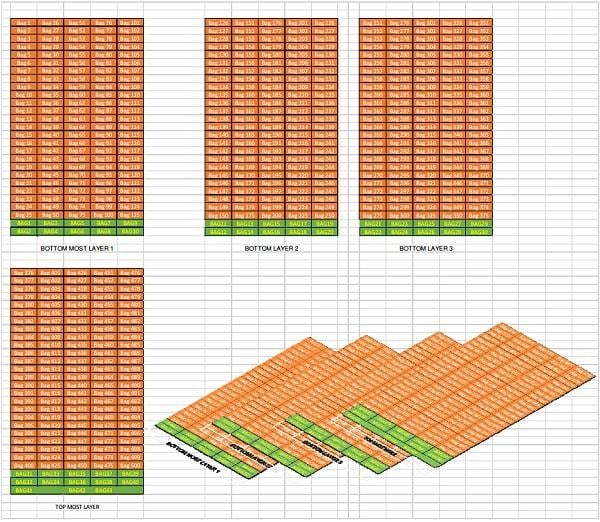
Schematic diagraph of imported goods in 543 bags
Note:
Declared goods in 50 bags (given Green in colour)
Un-declared goods in 493 bags (given Orange in colour)
In our understanding of the above factual details, out of the total 543 bags, only 50 bags in 5 pallets, which perhaps was shown (in green colour boxes) in the front end of the container alone had declared goods and the rest of 493 bags which were stuffed behind the declared consisted of undeclared goods (shown in orange colour boxes). Thus, it can be straightforwardly concluded that from the manner of presentation of imported goods in the container, concealment of undeclared goods, that the examination of imported goods at JNCH, Nhava Sheva has not been done properly as per the examination order given and any one could have very easily found out the concealment and undeclared goods, if all the goods in any one row from start to end was examined by opening the bags. Hence, to this extent there is definite an angle of collusion between the Shri Mustaqeem Siddiqui, H-card holder of the appellants CB and the concerned Customs officers who had examined the said cargo and 20 C/85104/2023 have failed to examine the undeclared cargo. In any case, the appellants CB or his employee having found such non-compliance to the examination order or on having found undeclared goods, if any, the same should have been brought to the notice of Customs for taking necessary further action. On the other hand, the appellants CB and their employee Shri Mustaqeem Siddiqui, H-card holder have failed to act properly as laid down in the CBLR, 2018. Thus, the appellants CB has failed to fulfill the obligations under Regulation 13(12) ibid. Accordingly, we are of the considered view that to this limited extent, the appellants CB are liable for penal action under CBLR, 2018.
17. We having taken into account the various facts and evidences in the present case, also appreciate the importance of the role of Customs Broker/Custom House Agent and the timely action which could prevent the frauds being committed by unscrupulous persons/ importers/ exporters taking the gullible CBs/CHAs, by relying on the judgement of the Hon’ble Supreme Court in affirming the decision of the Co-ordinate Bench of this Tribunal in the case of Commissioner of Customs Vs. K.M. Ganatra & Co. in Civil Appeal No.2940 of 2008 reported in 2016 (332) E.L.T. 15 (S.C.). The relevant paragraph of the said judgement is extracted below:
“15. In this regard, Ms. Mohana, learned senior counsel for the appellant, has placed reliance on the decision in Noble Agency v. Commissioner of Customs, Mumbai2002 (142) E.L.T. 84 (Tri. – Mumbai) wherein a Division Bench of the CEGAT, West Zonal Bench, Mumbai has observed:-
“The CHA occupies a very important position in the Customs House. The Customs procedures are complicated. The importers have to deal with a multiplicity of agencies viz. carriers, custodians like BPT as well as the Customs. The importer would find it impossible to clear his goods through these agencies without wasting valuable energy and time. The CHA is supposed to safeguard the interests of both the importers and the Customs. A lot of trust is kept in CHA by the importers/exporters as well as by the Government Agencies. To ensure appropriate discharge of such trust, the relevant regulations are framed. Regulation 14 of the CHA Licensing Regulations lists out obligations of the CHA. Any contravention of such obligations even without intent would be sufficient to invite upon the CHA the punishment listed in the Regulations…..”
We approve the aforesaid observations of the CEGAT, West Zonal Bench, Mumbai and unhesitatingly hold that this misconduct has to be seriously viewed.”
In view of the above discussions and on the basis of the judgement of the Hon’ble Court in the case of K.M. Ganatra supra, we find that the appellants should have been more prudent in their obligation as Customs Broker for exercising due diligence when they were handling new clients and involving imported goods which has been prescribed with certain restrictions such as MIP notified by DGFT, particularly when 100% of the imported goods are required to be examined and to rule out the possibility of concealment, as in the present case. Thus, we deem it appropriate that in respect of the failure to fulfill the obligations under Regulation 13(12) ibid, the appellants are required to be imposed with a penalty of Rs.10,000/- under Regulation 18 ibid.
18. In view of the above and on the basis of our discussions, detailed analysis and the findings recorded in paragraphs 11.1 to 17 above, and on the basis of various decisions taken by the coordinate benches of the Tribunal and higher judicial forums on the adherence to obligations prescribed under CBLR, 2018, we are of the considered view that it is factually incorrect to state that the appellants had for their acts of omission and commission in dealing with importer in mis- declaration of imported goods have failed to adhere to the responsibilities expected in terms of Regulations 10(e), 10(n), 13(3) and 13(4) of CBLR, 2018. Thus, we find that the conclusions arrived at by the Principal Commissioner in the impugned order is contrary to the factual position and thus it is not legally sustainable.
19. In view of the foregoing discussions, we modify the impugned order by setting aside the same in respect of revocation of CB license of the appellants and for forfeiture of security deposit as there was no violation of Regulations 10(e), 10(n), 13(3) and 13(4) of CBLR, 2018. Further, by modifying the impugned order for imposition of penalty,
22 C/85104/2023 we impose a penalty of Rs.10,000/- on the appellants under Regulation 18 ibid on account of their failure to supervise their employee for compliance with the law in examination of goods as per provisions of Regulation 13(12) ibid.
20. In the result, the appeal is partly allowed.
(Order pronounced in open court on 29.11.2023)