Commissioner of Customs Vs International Flavours and Fragrances India Pvt. Ltd. (CESTAT Chennai)
Summary: The Chennai Bench of CESTAT dismissed the Customs Department’s appeal against an order accepting classification of imported Cheese Polvaromas, Cheese Parmesan Polvaromas and Butter Cream Polvaromas under Customs Tariff Heading 3302 1090. The Department had proposed reclassification under CTH 2106 9060 as food flavouring material, with a differential duty demand of Rs.5,49,77,838/-, confiscation proposals and penalties. It argued that the goods originated from cheese and therefore could not qualify as synthetic aromatics. The importer maintained that the goods were mixtures of odoriferous substances used as industrial raw materials to manufacture dry mix seasoning, not food preparations for direct consumption.
The Tribunal examined the relevant tariff headings, Chapter Note 2 to Chapter 33 and HSN Explanatory Notes, along with laboratory findings and the manufacturing process. It observed that the products contained aroma components including fatty acids and ketones, were not directly edible and were used to impart flavour in subsequent industrial manufacturing. It held that animal origin did not preclude classification as a mixture of synthetic aromatics under CTH 3302. The Tribunal also referred to its decisions concerning tomato dry flavour and Britco Foods, and upheld the original classification under CTH 3302 1090. The Department’s appeal was rejected and the respondent’s cross-objections were disposed of. The order was pronounced on 9 October 2023.
Cases Discussed
- Commissioner of Central Excise v. Wockhardt Life Sciences Ltd. — 2012 (277) ELT 299 (SC): specific tariff entry prevails over residuary entry.
- Symrise Private Limited v. Commissioner of Customs, Chennai — 2023 (6) TMI 1258 (CESTAT Chennai): tomato dry flavour classifiable under CTH 3302.
- Britco Foods Company Ltd. v. Commissioner of Central Excise, Pune — 2001 (127) ELT 73 (Tri.-Mumbai), affirmed at 2007 (213) ELT 490 (SC)
FULL TEXT OF THE CESTAT CHENNAI ORDER
Customs Appeal No. C/41552/2018 has been filed by the Department on review of the Order-in-Original No. 62031/2018 dated 28.02.2018 passed by the Commissioner of Customs-Imports, Chennai which has confirmed the classification of products viz., Cheese Polvaromas (semi-finished) / Cheese Polvaromas (semi-finished flavour compound) under CTH 3302 1090 imported by International Flavours and Fragrances India Pvt. Ltd. and setting aside the demand of differential duty and also dropping the proposals for confiscation and penalty as made in the Show Cause Notice No. 22/2015 dated 11.07.2011.
2.1 Brief facts are that the Respondent, M/s. International Flavours & Fragrances India Pvt. Ltd. (the importer) is engaged in the manufacture of various flavours and fragrances which are used in the food and cosmetics industry. The Respondent imports various raw materials and semi-finished goods which are used in their factory in the manufacture of flavours and fragrances.
2.2 The Respondent, M/s. International Flavours and Fragrances India Pvt. Ltd. have filed Bills of Entry Nos. 3685255, 3685345 and 3685451 all dated 22.12.2015 for clearance of goods declared as Cheese Polvaromas / Cheese Parmesan Polvaromas / Butter Cream Polvaromas which were self-assessed. The goods were classified by the Respondent under CTH 33021090.
2.3 Not accepting the classification of the imported goods, an investigation has been initiated and representative samples were drawn and tested vide test report No. 1 to 3 / DSM / 2204.2016 dated 13.06.2016 issued by the Customs lab which stated that the sample is in the form of off – white powder having pleasant odour, that it is composed of complex organic compounds including the cellulose, carbohydrate and reducing sugar and that the presence of organic acids including hexanoic acid, octanoic acid, decanoic acid and dodecanoic acid could be detected in the sample. Investigation has concluded that the said goods were a preparation based on cheddar cheese product which is of animal origin and therefore would not be covered under the heading 3302 in view of the Chapter Notes 2 to Chapter 33 of Customs Tariff Act, 1975.
2.4 Consequently, a Show Cause Notice No. 22/2015-SIIB dated 11.07.2017 was issued proposing to reject the classification of the imported goods under CTH 3302 basing on the interpretation of the description of the entry in the heading 3302 read with 3301 on the Chapter Notes 2 to Chapter 33. The Department‟s proposal is for classification of the imported goods under CTH 2106 9060 on the ground that the imported goods are a preparation based on flavouring substances derived from cheese and used as a flavouring ingredient in food. The larger period of limitation was invoked for the past imports on the ground that despite knowing the composition of the goods, their origin, and scope of the heading 3302, the noticee wilfully classified the goods under the heading 3302 suppressing the fact of the animal origin of the goods. Duty of Rs.5,49,77,838/- was demanded in the Show Cause Notice under Section 28 (4) of the Customs Act, 1962. Live consignments valued at Rs.49,56,315/- were proposed to be confiscated under Section 111 (m) of the Customs Act, 1962. It was also proposed that the goods covered in the past consignments and valued at Rs.19,80,33,924/- were proposed to be held liable for confiscation under Section 111(m) and penalty under both Sections 112 (a) and 114 A of the Customs Act, 1962 was also proposed.
2.5 The Respondent in their reply to the Show Cause Notice has contended as follows:-
a. The cheese polvaromas being semi-finished flavouring compound is a mixture of synthetic aromatics and therefore classifiable under CTH 3302;
b. The products in question are not Enzyme Modified Cheese.
c. It is not their case nor that of the department that the products in question are based on the products of the heading 3301 or the constituents isolated from the products of that heading.
d. The impugned products are based on synthetic aromatics. The impugned goods contain ingredients that have pleasant aromas and that they are synthesised through a process of enzyme modification of cheese and hence should be treated as synthetic aromatics.
e. The term “synthetic aromatics” used in the context of “odoriferous substances” should refer to only products having a distinct, Strong smell or odour. It is not the contention of the department that the products does not have any odour
f. The show cause notice has accepted the Custom House Laboratory report in as much it has placed reliance on the same.
g. The products in question should be classified in accordance with the “terms of the heading” or the relevant „Section or Chapter Notes‟.
h. They classified the subject goods under the heading 3302 on the basis that they are a mixture of synthetic aromatics in terms of Note 2 to Chapter 33.
i. The HSN Explanatory Notes to the heading 3302 covers mixtures of synthetic aromatics provided they are of a kind used as raw materials in the perfumery, food or drink industries, food or drink flavourings or in the industries (e.g., soap making).
j. The show cause notice has acknowledged on the basis of test reports submitted that they contained mixture of synthetic aromatic compounds.
k. The 21%, flavouring material present in the product is nothing but organic acids present in the products and it is this mix of organic acids that carry and impart the distinct flavouring characteristic to the products in question.
l. Flavour and Extract Manufacturers Association (FEMA) of the US is the national association of flavour manufacturers and represents the vast majority of flavour companies. The members of FEMA also include the suppliers of those ingredients and they create flavours for use in a wide variety of food and beverage products.
m. Generally Recognised as Safe (GRAS) status may be achieved through FDA’s voluntary GRAS notification program (FDA 1997) or through a properly conducted GRAS determination made by a private party. The expert panel of FEMA is the primary body for the safety evaluation of food flavouring for the flavour industry and the public as “generally recognized as safe” assessment of flavouring substances and they are the most widely recognized GRAS assessment program.
n. All the essential ingredients present in the products in question have a flavour Profile given by FEMA and CFR reference number given under the FDA.
o. It could be seen from the Book Titled “Perfume and Flavour Chemicals (Aroma Chemicals)” by Stephen Arctander (Consultants Lecturer: Rutgers University, The State University of New Jersey, University Extension Division, Newark NN. USA) which provides GRAS FEMA reference that each flavour / aroma ingredient has a distinct flavour and aroma The impugned products are a mixture of all these individual organic acids used to impart a distinct cheese flavour and aroma to the food product to which these are added.
p. The impugned products cannot be directly used by end users or consumers in their food manufacturing process. This is used as industrial raw material and mixed with other ingredients to manufacture a dry mix seasoning, their final product. The dry mix seasoning is thereafter used by Customers as an industrial raw material in manufacture of the customers’ finished consumer products.
q. The impugned products have a very high organoleptic profile and therefore the recommended dosage level is 0.01% to 0.06% in the Customer’s product.
r. They are not directly edible and are used to impart flavour/ olfactory characteristics to the products in which it is used. In addition, they have a very low nutritional value and since nutritional content is an important criteria for any food product, the product in question may not be considered as an edible preparation.
s. There is a distinction between cheese and EMC and the cheese polvaroma.
t. It can be seen in various patents mixture of acids and ketones are used for preparing nature identical cheese flavourings. EM Care used as a starting material for the products of cheese flavouring mixtures.
u. The cheese flavouring mixtures contain a mix of free fatty acids and ketones possessing ‘strong aroma’. The synthetic cheese flavouring compositions can thus be prepared from the aromatic free fatty acids, ketones, esters, amines and other organic compounds.
v. These acids and ketones have pleasant odour and therefore are to be treated as synthetic aromatics.
w. There is no requirement under the HSN classification that the products have to be of vegetable origin to merit classification under CTG 3302.
x. Mixture of synthetic aromatics are given as one of the examples under the HSN Explanatory notes to the heading 3302.
y. Essential oils and extracted oleo resins of heading 3301 are all extracted from plant materials and mixtures of essential oils are also covered under the said heading viz., 3302.
z. The question of vegetable origin or not will arise only in cases of essential oils. But it is not the case of the show cause notice that the said items are mixtures of essential oils. It is not the claim of the noticee that the subject products are mixture of essential oils. They are a mixture of organic acids as accepted in the show cause notice itself. The show cause notice does not state that they are not mixtures of synthetic aromatics. Therefore, the proposal to deny classification under CTH 3302 for the reason that it is not of vegetable origin is not right.
aa. As to the proposal for classification of the goods under the heading 2106, the said heading covers two categories of food preparations. From the examples given in the HSN Explanatory Notes indicate that they should be used as food or beverages either as such or after a minimum processing such as dilution, cooking, etc.
bb. Moreover, the heading 2106 is a residuary heading.
cc. The subject preparations are a mixture of synthetic aromatic compound and therefore finds a specific coverage under the heading 3302. They are not meant for direct consumption by humans at all but a raw material for use in the manufacture of a flavouring preparation that in turn will be used in the food products to add to the distinct flavour to the food preparations.
dd. Once the classification adopted by the department cannot sustain, the classification adopted by the noticee would prevail.
ee. There is neither mis representation nor suppression of any fact. Therefore, there is no situation for invoking larger period of limitation. Thus, the demand covering the import prior to 10.07.2015 is time barred.
ff. The department had questioned the classification of the products in question and sent samples from two consignments of the products in question to the Central Food Technology Research Institute, Mysore for analysis. The said Institute submitted a report in August 2015 which gave certain values and stated the product in question was for industrial use. Between February and August, 2015 i.e., from the time the samples were sent to CDFTRI for analysis and the submissions of CFTRI’s report, they were required to submit test bond for all clearances of the product in question. After submission of test report the department accepted the classification under CTH 3302. Therefore, the allegation of misrepresentation and suppression of information is not correct. Extended period cannot be invoked in cases of different interpretation on classification of a particular product.
gg. Demand itself is not sustainable thus ruling out the question of interest.
hh. Impugned goods are not liable for confiscation in absence of any intentional or deliberate wrong declaration or mis declaration. Similarly, penalty either under Section 112 a / 114A of the Customs Act, 1962 cannot be imposed. Penalty cannot be imposed on cases involving classification.
2.6 On adjudication, the Commissioner of Customs (Imports) has dropped the proceedings, initiated by the above Show Cause Notice which has been reviewed by the Department on the following grounds:-
i) To be classified under CTH 3302 the subject goods namely Cheese Polvaromas should be mixtures of odoriferous substances and mixtures with a basis of one or more of these substances whereas from the description of the impugned goods declared by the importer as “Semi Finished Flavour Compound” the subject goods can be understood that they are compounds in nature and are obtained from food. Hence, the goods under import cannot be treated as synthetic. As against the above facts as admitted by the importers themselves, the adjudicating authority observed that the subject goods are mixtures of synthetic aromatics.
ii. Manager-QA of M/s. International Flavours & Fragrances India P Limited, Dr. Ramesh Babu, in his statement dated 11.04.2016 stated that the flavouring preparations were obtained by an enzymatic process, but in Para 2(b) it is observed and recorded that the noticee had claimed the products in question to be “not Enzyme Modified Cheese” and in Para 2(d) of the order the noticee themselves stated that the impugned goods contain ingredients that have pleasant aromas are synthesised through a process of enzyme modification of cheese from which it can be inferred that the base product for obtaining the flavours is a food material and that the flavours are not synthesised artificially solely out of any organic acids/compounds or fatty acids/compounds which is further confirmed by the suppliers letter dated 09/04/2016 inferring that flavouring material is not synthetic aroma as claimed by the noticee. The above facts have not been considered by the adjudicating authority.
iii. The suppliers vide their letter dated 22/02/2016 had clarified that as per the European Regulation the flavouring preparations as “shall mean a product, other than a flavouring substance, obtained from (i) food by appropriate physical, enzymatic or microbiological processes either in the raw state of the material… (ii) Material of vegetable animal or microbiological origin, other than food, by appropriate physical, enzymatic or microbiological processes, the material…” implying that the flavouring preparation which constitutes 21% of Cheese Polvaromas obtained from food / material of vegetable, animal or microbiological origin. Thus the product under dispute cannot be synthetic aromas. The above facts have not been considered by the adjudicating authority. Further, Para 10 of the Order in Original observes that the noticee had explained in detail that the Enzyme Modified Cheese is the starting material for the products of cheese flavouring mixtures. From the above facts of the products, it can be inferred that the imported goods, Cheese Polvaromas, have their origin from cheese, which is enzyme modified and hence cannot be synthetic aromas. When the subject goods are not synthetic aromas the same cannot be classified under CTH 3302.
The Adjudicating authority did not take into account the above facts while passing the present order in original while arriving at the conclusion that they are classifiable under CTH 3302.
iv. Further as per Note 2 of Chapter 33, the expression “odoriferous substances” in heading 3302 refers only to the substances of heading 3301 to odoriferous constituents isolated from those substances or to the synthetic aromatics. Since, imported goods are a preparation based on Cheddar Cheese Paste and not synthetic aromas, it cannot be classifiable under the CTH 3302 Explanatory Note to the Heading 2106 specifically covers the flavouring materials and the Tariff Item 21069060 specifically covers the goods of description “Food flavouring material”. As the imported goods are derived from Cheddar Cheese paste are rightly classifiable under the heading 2106 as food preparations not specified elsewhere.
v. Further, from the statements by the Manager -QA and the technical documents and the material available in the supplier’s website, it may be seen that the imported goods are made from Cheddar Cheese paste which is subjected to enzymatic action; that this enzyme modified cheese is then spray dried with maltodextrin and gum Arabic. Here, maltodextrin appears to act as a carrier and to encapsulate the flavour material to preserve the flavour materials. By the above process it appears that the imported goods which are only a food preparation with 21% flavouring material and 75% maltodextrin used as carrier, necessitates them to be appropriately classified under the heading 2106 as food preparations not specified elsewhere as per the Explanatory Notes to the Heading 2106 specifically covers the flavouring materials.
vi. To sum up, the Adjudicating Authority failed to consider the following while passing the present order:-
“The imported goods namely “Cheese Polvaromas (Semi Finished Flavour Compound)” is a preparation based on ingredients derived through enzymatic process of Cheddar Cheese Paste with maltodextrin as carrier and gum Arabic as additive and are not of vegetable origin. The active ingredient in the imported item is a mixture of acids and ketones with acids as the major components. As they are a preparation based on flavouring substances derive from Cheese and used as flavouring ingredient in food, they are rightly classifiable under the heading 2106 and more specifically under the Tariff Item 21069060 as “Food flavouring material” as against the heading 3302 which covers only the goods with the basis of either single or mixture of substances.”
3.1 The Ld. Authorised Representative Shri R. Rajaraman representing the Department has asserted that the impugned goods are classifiable under CTH 2106 9060 as “food flavouring material”. The manufactured goods have their origin from cheese, which is not of vegetable origin. These are enzyme modified and hence cannot be treated as synthetic. Synthetic aromas are those which are synthesized solely out of any organic acids / compounds or fatty acids / compounds. When the goods are not synthetic aromas, they cannot be classified under CTH 3302 as per Note 2 of the Chapter 33.
3.2 The Ld. AR has submitted that Explanatory Note to 2106 specifically covers the flavouring materials and Tariff Item 2106 9060 specifically covers the goods of description “Food Flavouring Materials”. He has adverted to the grounds of Review Order by the Department and as the impugned goods are derived from cheddar cheese paste and used for flavouring, they are rightly classifiable under heading 2106 as “Food preparations not elsewhere specified”.
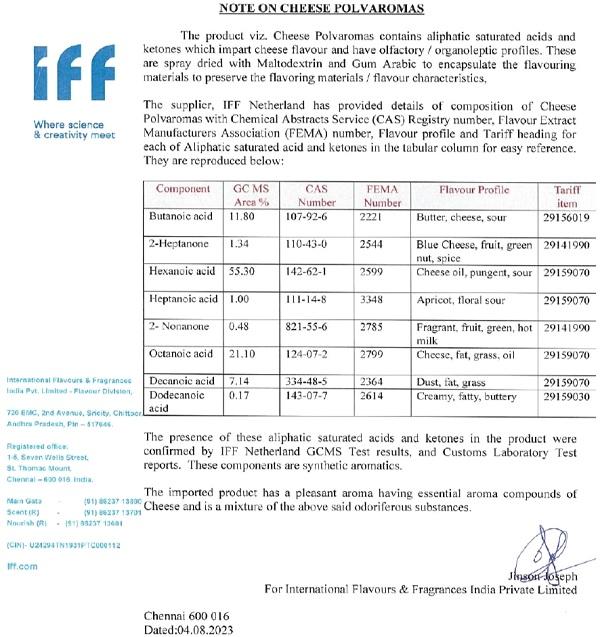
4.1.1 The Ld. Advocate Shri R. Srinivasan, Consultant representing the Respondent has stated that the subject goods are imported to be used in the manufacture of their final product viz., “Dry Mix Seasoning” and the impugned product contains various aroma components that have pleasant odour as detailed below:-
| Component | Flavour profile | FEMA * No. |
|---|---|---|
| Butanoic acid | Butter, cheese, sour | 2221 |
| 2 heptonanone | Blue cheese, fruit, green nut, spice | 2544 |
| Hexanoic acid | Cheese oil, pungent, sour | 2599 |
| Heptanoic acid | Apricot, floral, sour | 3348 |
| 2 nonanone | Fragrant, fruit, green, hot milk | 2785 |
| Octanoic acid | Cheese, fat, grass, oil | 2799 |
| Decanoic acid | Dust, fat, grass | 2364 |
4.1.2 It is submitted by the Ld. Consultant that these components are nothing but fatty acids / ketones which are contained in cheese. These flavours / materials are extracted from cheese separately by an enzymatic process and are compounded together on a carrier (maltodextrin) which does not change the design of the flavours.
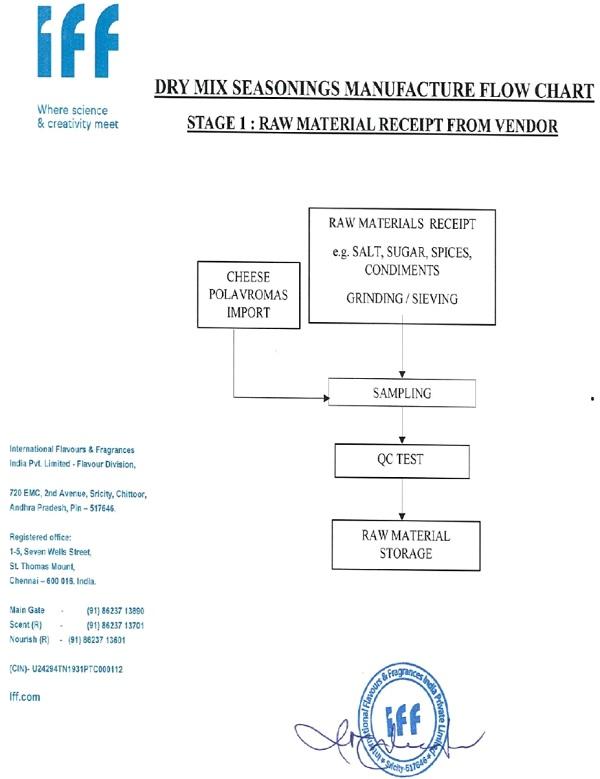
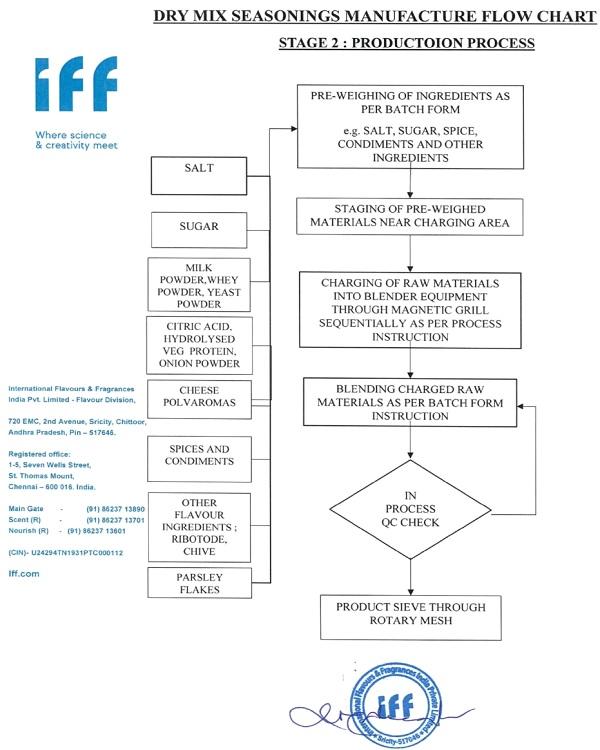
4.1.3 The impugned products cannot be directly used by end users or consumers in their food preparations. This is used as industrial raw material with a dosage of 0.5 to 2.5% and mixed with other ingredients to manufacture dry mix seasoning product by the Respondent.
4.1.4 This Dry Mix Seasoning is used by the customers of the Respondent in their end products at a dosage level of 1.0 to 4.0%. For e.g., the mixed seasoning powder manufactured by the Respondent using the impugned goods is purchased by M/s. Pepsico and used in their end product Fritto Lays Chips. The impugned products are strong and have a very high organoleptic profile.
4.1.5 Being a mixture of odoriferous substances which are of a kind used as raw material in food industry, the Respondent has rightly classified them under Tariff Heading 3302 1090.
4.2.1 The Respondent in their cross objections filed has submitted that the subject goods are „mixtures of synthetic aromatics‟ and so classifiable under CTH 3302.
4.2.2 For a product to be termed as synthetic, it is not necessary that the product should be produced artificially, and the synthesis can be achieved from natural ingredients also. The impugned product contains various aroma components with unique FEMA numbers that have pleasant odour. All these components are nothing but fatty acids / ketones and are contained in cheese. These flavour materials are extracted separately by an enzymatic process and are compounded together on a carrier (maltodextrin).
4.2.3 As per Note 2 of Chapter 33 the term odoriferous substances also include “synthetic aromatics” amongst other substances. Therefore, the subject product which is a product of synthesis, and a mixture of aromatic substances is covered under CTH 3302. This position is also affirmed from a perusal of HSN EN to CTH 3302.
4.2.4 The subject goods are nothing but mixtures of synthetic aroma compounds with Maltodextrin as carrier. This was also proved in the test conducted by the Customs House Lab Laboratory.
4.2.5 Further, it is incorrect to hold that for a product to fall under CTH 3302, it has to be of plant origin. The heading 3302 covers, inter alia, products based on essential oils and synthetic aromatics. When they are based on essential oils, they would be of plant origin. On the other hand, when these products are based on synthetic aromatics, there is no such requirement that the product synthetic aromatic should be of plant origin.
4.2.6Further, the Ld. Consultant for the Respondent stated that the subject goods are not classifiable under CTH 2106. Heading 2106 covers Food preparations “not elsewhere specified or included”. As such, it is a residuary entry.
4.2.7From a perusal of the HSN Explanatory Notes to CTH 2106 it is seen that the nature of food preparations covered under this Heading are such preparations which are used as food or beverages either as such or after a minimum processing such as dilution or cooking etc. The „Food Preparation‟ to be classified under 2106 should satisfy two conditions namely (a) capable of being consumed either directly or after some processing by humans and (b) preparation consisting of foods stuffs either for making beverages or making foods preparations for human consumption. The impugned product does not satisfy any of the above conditions to merit classification under CTH 2106.
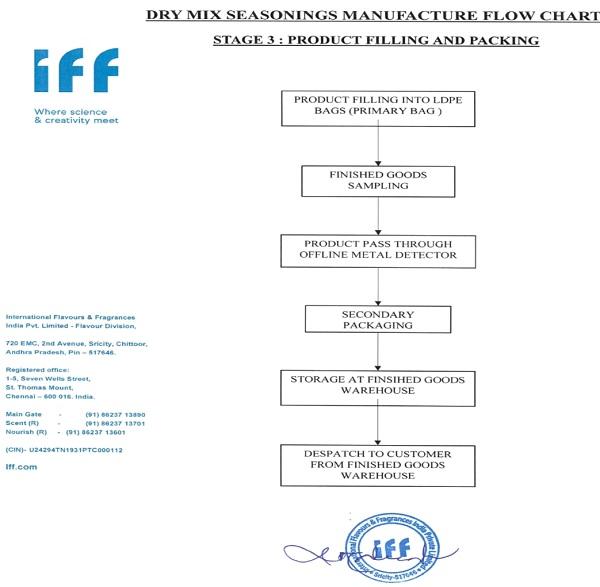
4.2.8 Ld. Consultant has submitted that the subject goods cannot be directly used by end-users or consumers even as flavouring in food preparations. The subject goods are used as an industrial raw material and mixed with other ingredients to manufacture Dry Mix Seasoning product by the Respondent. The Dry Mix Seasoning is thereafter used by the Respondent’s customers as another industrial raw material in manufacture of the consumer products. Further, the Dry Mix seasoning which is manufactured using the impugned goods as raw material itself is classified under CTH 2103 as mixed condiment or mixed seasoning. Thus, when the final product itself is classified under CTH 2103 as a seasoning, Department’s case that the raw materials used in the manufacture of the same is a food preparation classifiable under CTH 2106 is unsustainable.
4.2.9 Further, he has put forth that the stand of the Department is against the principles of classification and contrary to the ratio laid down by the Supreme Court on the classification of goods under residuary headings inCommissioner of Central Excise vs. Wockhardt Life Sciences Limited [2012 (277) ELT 299 (SC)] wherein the Apex Court held that a residuary entry can be taken refuge of only in the absence of a specific entry. As demonstrated above, when the subject goods are specifically covered under CTH 3302, they cannot be sought to be classified under CTH 2106, which is a residuary entry. The impugned order has also dealt with in detail about the inapplicability of Chapter 2106.
4.3 During the hearing before the Tribunal, the Ld. Consultant for the Respondent was asked to submit a write-up on cheese polvaromas and its usage and also the manufacturing process of Dry Mix Seasoning their final product using the imported raw materials. To specific query whether the impugned product contains components of synthetic aromatics or not, the following note was filed:-
–
–
–
4. The Ld. Consultant has also referred to the decision rendered by the CESTAT, Chennai, in the case of M/s. Symrise Private Limited Vs. Commissioner of Customs, Chennai [2023 (6) TMI 1258 (CESTAT, CHENNAI)], wherein the imported tomato dry flavour was determined to be classified under CTH 3302 1010 on the grounds that Chapter 3302 covers both the natural and synthetic mixtures of odoriferous substances.
5. We have considered the submissions made by the Revenue and the Respondent. We have perused the records as available in this appeal.
6.1 The main issue involved in the present appeal relates to the proper classification of goods described as „Cheese Polvaromas / Cheese Parmesan Polvaromas / Butter Cream Polvaromas under the Customs Tariff Act, 1975. Connected issues are the invocation of extended period for demand of differential duty and confiscability of the impugned goods besides imposition of penalties.
6.2 We note that the present appeal filed by the Department is directed against the impugned order No. 62031/2018 dated 28.02.2018 passed by Commissioner of Customs (Imports), Chennai holding the classification of subject goods under CTH 3302 1090 and for rejecting the proposal to reclassify the same under CTH 2106 9060. So, it is important to examine relevant Chapter Headings, Chapter Notes and HSN Explanatory Notes.
6.3 For ease of reference, the Chapter Headings 2106 and 3302, are extracted below: –
| 2106 | FOOD PREPARATIONS NOT ELSEWHERE SPECIFIED OR INCLUDED |
|||||
|---|---|---|---|---|---|---|
| 2106 | 10 00 | – | Protein concentrates and textures
protein substances |
kg. | 30% | – |
| 2106 | 90 | – | Other : | |||
| — | Soft drink concentrates : | |||||
| 2106 | 90 11 | —- | Sharbat | kg. | 150% | – |
| 2106 | 90 19 | —- | Other | kg. | 150% | – |
| 2106 | 90 20 | — | Pan masala | kg. | 150% | – |
| 2106 | 90 30 | — | Betel nut product known as “Supari” | kg. | 150% | – |
| 2106 | 90 40 | — | Sugar-syrups containing added flavouring or colouring matter, not elsewhere specified or included; lactose syrup; glucose syrup and malto dextrine syrup | kg. | 150% | – |
| 2106 | 90 50 | — | Compound preparations for making non-alcoholic beverages | kg. | 150% | – |
| 2106 | 90 60 | — | Food flavouring material | kg. | 150% | – |
| 3302 | MIXTURES OF ODORIFEROUS
SUBSTANCES AND MIXTURES (INCLUDING ALCOHOLIC ONE OR MORE OF THESE MANUFACTURE OF BEVERAGES |
|||||
| 3302 | 10 | – | Of a kind used in the food or drink industries: | |||
| 3302 | 10 | 10 | — | Synthetic flavouring essences | kg. | 100% |
| 3302 | 10 | 90 | — | Other | kg. | 100% |
| 3302 | 90 | – | Other : | |||
6.4 The Supplementary Chapter Note 5 to Chapter 21:- Heading 2106 (except tariff items 2106 90 20 and 2106 90 30), inter alia, includes:
a. protein concentrates and textures protein substances;
b. preparations for use, either directly or after processing (such as cooking, dissolving or boiling in water, milk or other liquids), for human consumption;
c. preparations consisting wholly or partially of foodstuffs, used in the making of beverages of food preparations for human consumption;
. . . .
6.5 HSN Explanatory Notes to Chapter Heading 2106: –
“21.06 – FOOD PREPARATIONS NOT ELSEWHERE SPECIFIED OR INCLUDED.
2106.10 – Protein concentrates and textured protein substances 2106.90 – Other
Provided that they are not covered by any other heading of the Nomenclature, this heading covers :
a. Preparations for use, either directly or after processing (such as cooking, dissolving or boiling in water, milk, etc.), for human consumption.
b. Preparations consisting wholly or partly of foodstuffs, used in the making of beverages or foodpreparations for human consumption. The heading includes preparations consisting of mixtures of chemicals (organic acids, calcium salts, etc.) with foodstuffs (flour, sugar, milk powder, etc.), for incorporation in food preparations either as ingredients or to improve some of their characteristics (appearance, keeping qualities, etc.) (see the General Explanatory Note to Chapter 38).
However, the heading does not cover enzymatic preparations containing foodstuffs (e.g., meat tenderisers consisting of a proteolytic enzyme with added dextrose or other foodstuffs). Such preparations fall in heading 35.07 provided that they are not covered by a more specific heading in the Nomenclature.
.
.
This heading excludes preparations of a kind used for the manufacture of beverages, based on one or more odoriferous substances (heading 33.02).”
(Emphasis supplied)
6.6 Similarly, the Chapter Note 2 to Chapter 33 states that: –
“The expression “odoriferous substances” in heading 3302 refers only to the substances of heading 3301, to odoriferous constituents isolated from those substances or to synthetic aromatics.”
(Emphasis supplied)
6.7 The HSN Explanatory Note to Chapter Heading 3302 reads as follows: –
“33.02 – MIXTURES OF ODORIFEROUS SUBSTANCES AND MIXTURES (INCLUDING ALCOHOLIC SOLUTIONS) WITH A BASIS OF ONE OR MORE OF THESE SUBSTANCES, OF A KIND USED AS RAW MATERIALS IN INDUSTRY; OTHER PREPARATIONS BASED ON ODORIFEROUS SUBSTANCES, OF A KIND USED FOR THE MANUFACTURE OF BEVERAGES.
3302.10 – Of a Kind used in the food or drink industries 3302.90 – Other
This heading covers the following mixtures provided they are of a kind used as raw materials in the perfumery, food or drink industries (e.g., in confectionery, food or drink flavourings) or in other industries (e.g., soap-making) :
-
- Mixtures of essential oils.
- Mixture of resinoids.
- Mixtures of extracted oleoresins.
- Mixtures of synthetic aromatics.
- Mixtures consisting of two or more odoriferous substances (essential oils, resinoids, extracted oleoresins or synthetic aromatics).
- Mixtures of one or more odoriferous substances (essential oils, resinoids, extracted oleoresins or synthetic aromatics) combined with added diluents or carries such as vegetable oil, dextrose or starch.
(7) Mixtures, whether or not combined with a diluent or carrier or containing alcohol, of products of other Chapters (e.g., spices) with one or more odoriferous substances (essential oils, resinoids, extracted oleoresins or synthetic aromatics), provided these substances form the basis of the mixture.
…”
6.8 A scrutiny of the above Tariff Items and HSN Notes thereon clearly indicates that the imported products are not meant to be directly used for human consumption. These are said to be for industrial use. In this case, impugned goods are imported for use in manufacture of dry seasoning powder. The products that are classifiable under Chapter Heading 2106 mostly consist of food and edible preparations which are meant to be used either directly or after processing such as cooking, dissolving or boiling in milk or water or other liquids, for human consumption. As per the HSN Notes, the said heading i.e., 2106 excludes mixture of odoriferous substances, which can be either natural or synthetic or mixed or both, which are used as raw materials in the perfumery, food or drink industries.
6.9 We note that the Respondent‟s submission is that the subject goods -consist of various odoriferous substances and are of synthetic origin, which make them classifiable under CTH 3302 1090. Whereas, the Department has relied on Chapter Note 2 to Chapter 33 of the Customs Tariff Act, 1975, which states that “odoriferous substances” in Chapter Heading 3302 refers only to substances of Chapter Heading 3301 to odoriferous constituents isolated from those substances or to synthetic aromatics, and also referred to the HSN, which states that the goods which qualify for classification under Chapter Heading 3302 should be mixtures, whether or not combined with a diluent or carrier or containing alcohol, of products of other Chapters (e.g., spices) with one or more odoriferous substances (essential oils, resinoids, extracted oleoresins or synthetic aromatics), provided these substances form the basis of the mixture. But, in this case, the odoriferous substances can be of synthetic origin.
6.10 We find that there is no dispute and it is an admitted fact that the impugned products cannot be directly used by the end users or consumers in any food/food preparation and they are used as industrial raw materials and mixed with other ingredients to manufacture their final product „Dry Mixed Seasoning’. Dry Mixed Seasoning is used by their customers as raw material in manufacture of the customers’ finished products. Impugned goods are not directly edible and meant to be used to impart flavour / olfactory characteristics to the products in which it is used. To be classified under CTH 2106, the product should be used as food or beverages either as such or after a minimum processing such as dissolving, boiling in water / milk or other liquids for home consumption. What is imported are not edible but merely used to impart cheese flavour.
6.11 We note that impugned goods were tested by Central Food Technology Research Institute, Mysore which has reported that the impugned goods are meant for industrial use.
6.12 We have also considered the appellant’s statement that impugned goods contains various aroma components that have pleasant odour viz., Butanoic acid, 2 Heptonanone, Hexanoic acid, Heptanoic acid, 2 nonanone, Octanoic acid, Decanoic acid. The subject goods are reported to be mixtures of synthetics aromatics.
6.13 As such what is imported may be of animal origin i.e., Cheese, but, having components of synthetic aromatics, their appropriate classification is under CTH 3302 of the CTA, 1975.
6.14 We refer to the decision of the Tribunal, Mumbai in the case of M/s. Britco Foods Company Ltd. v. Commissioner of Central Excise, Pune [2001 (127) E.L.T. 73 (Tri. – Mumbai)], wherein it was categorically held that the Chapter Heading 2106 excludes preparations of food or drink industry based on odoriferous substances from that heading and put them under Chapter Heading 3302, and the above judgement has been maintained by the Hon’ble Supreme Court as reported in 2007 (213) E.L.T. 490 (S.C.).
6.15 Thus, Chapter Heading 3302 covers both natural and/or synthetic mixtures of odoriferous substances.
7. On scrutiny of the note submitted by the Respondent on Cheese Polvaromas and also the manufacturing process of the Dry Mix Seasoning which is a final product using the imported Cheese Polvaromas and considering the importer‟s submissions that some components in the Cheese Polvaromas are synthetic aromatics, the appropriate classification of the impugned goods would be falling under CTH 3302 as determined by the Original Adjudicating Authority vide order dated 28.02.2018. Relevant findings are extracted below:-
“11. Thus from the above, it becomes clear that the impugned product is a mixture of synthetic aroma compounds and are combined with the carrier namely maltodextrin and that they are used in the food stuffs.
12. Having known the nature of the impugned products it has now to be seen the appropriate classification. The rival headings are 3302 and 2106.
13. The chapter 33 covers “essential oils and resinoids; perfumery, cosmetic or toilet preparations”. The entry against the heading 3302 reads as follows::
“Mixtures of odoriferous substances and mixtures (including alcoholic solutions) with a basis of one or more of these substances, of a kind used as raw materials in industry; other preparations based on odoriferous substances, of a kind used for the manufacture of beverages.”
This heading has got two single dash sub headings. One is 3302 10 (of a kind used in the food or drink industries) and the second one 3302.90 (other). It has been seen above that the impugned products are a mixture of synthetic aroma compounds and are for use in the food industry. The HSN Explanatory Notes to the heading 33.02 while listing out the items that shall be covered under that heading has mentioned “mixtures of synthetic aromatics” in serial No.4.
2. The objection raised in the show cause notice is that the subject goods are of animal origin and not of plant origin and thus it does not fulfill the condition laid down in the Note 2 to Chapter 33. The said Notes is extracted below:
“2. The expression “odoriferous substances in heading 33:02 refers only to the substances of heading 33.01, to odoriferous constituents isolated from those substances or to synthetic aromatics”
According to the above notes, odoriferous substances refers to three types of categories. They are::
33. Substances of heading 33.01
34. To odoriferous constituents isolated from those substances
35. Synthetic aromatics
The above three categories are independent of each other. It could be seen that there is no condition or any tag attached to the terms “synthetic aromatics”. The requirement or condition envisaged in one category cannot be interpolated into the other category. It could be seen that the items mentioned in the heading 33.01 are all from plant origin. Therefore, there is no possibility to insist that “Synthetic aromatics” should be of substances of heading 33.01. Thus, verification of the origin of the substances in the said “synthetic aromatics” is not warranted. It emerges accordingly that the expectation of the show cause notice that the impugned product should have originated from plant sources.
15. It is seen that the investigation was having the test report of the samples drawn from the consignment and the other evidences produced by the noticee. The show cause notice has not raised any dispute / objection to calling / treating the goods as synthetic aromatics or their use in the food industry. The only reservation expressed is that the products are of animal origin. Now that it has been found that there is no basis for such expectation, there is no bar for classification of the goods under the heading 33.02. In the sub heading level it is seen that 3302 10 90 is appropriate. It also turns out that the noticee has been classifying only in the CH 3302 10 90. Therefore, the duty as paid by the noticee at the rate as against the CTH 3302 10 90 should be taken as appropriate duty.
In this regard, reference is drawn to the “Classification Decisions Taken By the Harmonized System Committee from the 1st to 26th Sessions (1988- 2000) 2002 in Sl. No. 168(relevant document 35.700 E/4 35 100 F/1 34.732 and decision (HSC/4) has decided that beverage bases- mixtures of esters (ethyl acetate, amylacetage, ethyl butyrate, isoamylbutyrate and others) as flavours and artificial colour in ethanol (52% v/v) and higher alcohol under the heading 33.02 treating them as a product described in the latter part of heading 33.02 which specially referred to mixtures with a basis of odoriferous substances of a kind used as a raw materials in industry.
Having held that the CTH 3302 1090 is appropriate for the impugned goods, it obviates the necessity to find out the applicability of the heading 21.06 as contended in the show cause notice. However, the same is also being taken up for a discussion.
The entry against the heading 21.06 reads as “food preparations not elsewhere specified or included”. The entries under this heading are extracted below:
| 2106 | 10 | 00 | – | Protein concentrates and textures
protein substances |
| 2106 | 90 | – | Other : | |
| — | Soft drink concentrates : | |||
| 2106 | 90 | 11 | —- | Sharbat |
| 2106 | 90 | 19 | —- | Other |
| 2106 | 90 | 20 | — | Pan masala |
| 2106 | 90 | 30 | — | Betel nut product known as “Supari” |
| 2106 | 90 | 40 | — | Sugar-syrups containing added flavouring
colouring matter, not elsewhere specified |
| 2106 | 90 | 50 | — | Compound preparations for making non-alcoholic beverages |
| 2106 | 90 | 60 | — | Food flavouring material |
| 2106 | 90 | 70 | — | Churna for pan |
| 2106 | 90 | 80 | — | Custard powder |
| — | Other : | |||
| 2106 | 90 | 91 | —- | Diabetic foods |
| 2106 | 90 | 92 | —- | Sterilized or pasteurized millstone |
| 2106 | 90 | 99 | —- | Other |
The two conditions required for coverage under this heading is that the subject item should not find any place elsewhere in the Tariff and next it should be a food preparation ready for use. HSN Explanatory Notes have stated that this heading covers preparations for use, either directly or after processing (such as cooking, dissolving or boiling in water, milk, etc) for human consumption. So, it has to be decided whether the subject item can be used directly or with processing like cooking, dissolving or boiling in water, milk, etc. stand covered in this heading. Lab report or the analysis as furnished by the noticee does not state or give indication that the subject flavours can be consumed directly with food or whatsoever. The noticee has stated that the product in question is a raw material and is not meant for direct consumption and having a high organoleptic profile and therefore the recommended level is 0.01% to 0.06% in the customer’s product. In fact the description states that the impugned flavours are semi finished and the show cause notice has not disputed the same. Whereas the heading 2106 covers ready to use items only. The show cause notice has also not made any case to the effect that the impugned preparations can be consumed directly. In such circumstances, the impugned product cannot be brought under the scope of the heading 2106. Without prejudice to the discussions above on the merit of the classification of the goods under the heading 3302, it is seen that the inapplicability of the heading proposed in the show cause notice (i.e. 2106) for the impugned goods, the alternative heading 3302 gets deemed as the appropriate heading by default.”
8. In view of the above discussions, we hold that the impugned goods are classifiable under CTH 3302 1090 of the Customs Tariff Act and there is no merit in the appeal filed by the Department. Accordingly, the appeal is rejected. The cross objections filed by the Respondent thus, are disposed of.
(Order pronounced in open court on 09.10.2023)