In re Siemens Limited (CAAR Mumbai)
Summary: The Customs Authority for Advance Rulings (CAAR), Mumbai, examained an application filed by Siemens Limited concerning the classification of three components proposed to be imported for manufacturing and assembling its SIMATIC Industrial Computing Platform (IPC), model RW-543B, in India. The components comprised a motherboard, chassis and power supply unit (PSU), which Siemens proposed to import from China. The applicant explained that the complete industrial computer was an Automatic Data Processing (ADP) machine classifiable under Heading 8471, but sought separate classification of the three imported components under the Customs Tariff Act, 1975. The principal questions concerned their classification under the First Schedule to the Customs Tariff Act and the eligibility of the power supply for exemption under Serial No. 4 of Notification No. 25/2005-Cus., dated 01.03.2005.
The Authority examined the technical characteristics of the proposed imports, the General Rules for the Interpretation of the Customs Tariff, the relevant Section and Chapter Notes, and the HSN Explanatory Notes. It observed that the motherboard constituted the principal printed circuit board of the IPC, providing electronic connectivity between the processor, memory, storage and other components. The chassis was a specifically designed mechanical structure intended to house and support the components of the industrial computer. Both were intended for incorporation into the complete SIMATIC IPC and, in their imported condition, did not independently constitute complete ADP machines. Applying the provisions governing parts and accessories of machines falling under Heading 8471, the Authority held that the motherboard was classifiable under Tariff Item 8473 30 20 and the chassis under Tariff Item 8473 30 99.
Regarding the power supply unit, the Authority found that its principal function was to receive alternating current (AC), convert it into regulated direct current (DC) and supply the resulting power to electronic components. Since the PSU performed the identifiable function of a static converter, it was covered independently under Heading 8504 rather than being classified merely as a part of an ADP machine under Heading 8473. Applying Note 2(a) to Section XVI and the relevant HSN Explanatory Notes, the Authority classified the PSU under Tariff Item 8504 40 29. It further held that the PSU, being a static converter specifically designed and intended for use with an ADP machine falling under Heading 8471, was eligible for exemption under Serial No. 4 of Notification No. 25/2005-Cus., dated 01.03.2005, subject to fulfilment of the notification conditions and applicable BIS certification requirements.
The Authority accordingly ruled in favour of the stated classifications of all three components and the conditional exemption eligibility of the power supply unit. It expressly confined the ruling to the goods, technical specifications, documents and submissions examined, leaving the appropriate customs authorities to verify the imported goods, their intended use, compliance with technical requirements and fulfilment of statutory and notification conditions at the time of importation.
Cases Discussed
- Commissioner of Customs Vs. Data Enterprises (CESTAT) – 2013 (5) TMI 467. Relied upon in paragraph 10.20 for the proposition that plain motherboards are classifiable under Tariff Item 8473 30 20, as distinguished from printed circuit boards under Tariff Item 8473 30 30.
Five SEO Titles (5ST)
CAAR Mumbai Classifies Siemens IPC Motherboard, Chassis and Power Supply Separately
CAAR Mumbai Rules Siemens Industrial PC Motherboard Falls Under CTH 84733020
CAAR Mumbai Classifies Industrial Computer Chassis Under Customs Tariff 84733099
CAAR Mumbai Holds Industrial PC Power Supply Classifiable Under CTH 85044029
CAAR Mumbai Allows Conditional Customs Duty Exemption for Siemens Power Supply
FULL TEXT OF THE ORDER OF CUSTOMS AUTHORITY FOR ADVANCE RULINGS, MUMBAI
M/s Siemens Limited (hereinafter referred to as “the applicant”) has filed an application in Form CAAR-1 before the Customs Authority for Advance Rulings, Mumbai (hereinafter referred to as “CAAR” or “the Authority”). The application, along with the prescribed fee and supporting documents, was received in the Secretariat of CAAR, Mumbai on 27.03.2026 in terms of Section 28H(1) of the Customs Act, 1962. The applicant namely, M/s Siemens Limited is the flagship listed company of Siemens AG, a German multinational technology conglomerate, in India, having its registered office at I3irla Aurora Level, Plot No. 1080, Dr. Annie Besant Road, Worli, Mumbai, Maharashtra — 400 030. The Applicant is engaged in developing and providing solutions aimed at enabling resource efficient manufacturing facilities, resilient supply chains, intelligent buildings and power grids and sustainable transportation systems. Leveraging its diversified portfolio, technological capabilities and extensive industry expertise, the Applicant contributes significantly to India’s industrial development, infrastructure expansion and technological modernisation. In furtherance of its diverse industrial and infrastructure projects, the Applicant procures and imports a wide range of electrical, electronic and industrial components from various countries, including Germany, China, the United Kingdom, France among others. The Applicant maintains robust systems and procedures to ensure strict compliance with applicable customs laws, regulations and tariff classification requirements. Its commitment to regulatory compliance is further reinforced through periodic internal audits, legal and compliance oversight and continuous training of relevant personnel, thereby ensuring a high standard of diligence and transparency in its import operations and enabling the Applicant to consistently discharge its obligations as a responsible and law-abiding importer in India. The Applicant holds a valid Importer Exporter Code (IEC) bearing No. 0388070005 and is duly eligible to undertake import transactions in accordance with the applicable provisions of the customs and foreign trade laws and regulations. In this regard, the Applicant has sought an advance ruling under Section 281-I of the Customs Act, 1962, in respect of the following questions relating to the classification and applicable customs duty on the products proposed to be imported:
Question 1: Whether the products in question, namely ‘Motherboard’, ‘Chassis’ and `Power supply’ to be imported for use in manufacture and assembly of Industrial Computing Platform (IPC), in the present application are classifiable under Tariff Item 8473 30 20, 8473 30 99 and 8504 40 29 respectively, of the First Schedule to the Customs Tariff Act, 1975 (Customs Tariff)?
Question 2: If answer to the above question is in the positive, then, is Power Supply classifiable under Tariff Item 8504 40 29 eligible for exemption in terms of Sr. No.4 of Notification No.25/2005-Cus. dated 01.03.2005?
Question 3: If the answer to the above questions is in the negative, then what would be the correct classification of ‘Motherboard’. ‘Chassis’ and ‘Power supply’ respectively, for use in manufacture and assembly of Industrial Computing Platform under the Customs Tariff, and what will he the applicable rate of customs duties on their import?
2. Submission by Applicant:
2.1 The Applicant has been importing Industrial Computing Platform (IPC) for several years. The IPC is a flexible and innovative computing platform designed to provide digital capabilities for machines and plants with the benefit of long-term availability. The IPC qualifies as an Automatic Data Processing (ADP) machine, as it satisfies the parameters prescribed under Note 6(A) to Chapter 84 of the Customs Tariff. Accordingly, the IPC proposed to be imported by the Applicant is classifiable under Chapter heading 8471, more specifically under Customs Tariff Item (CTI) 8471 50 00, covering “Processing units other than those of sub-heading 8471.41 or 8471.49, whether or not containing in the same housing one or two of the following types of units: storage units, input units, output units”. There is no dispute regarding the classification of’ the IPC under Chapter Heading 8471 (Tariff Item 8471 50 00) as an ADP machine, as the Applicant has, in the past, imported IPCs of different models under the same Ileading and Tariff Item.
3. Proposed import of certain parts/components for use in the manufacture and assembly of SIMATIC IPC, namely, ‘Motherboard’, ‘Chassis’ and ‘Power Supply Unit’ (PSU), in respect of which the present application is being filed
3.1 The following parts/components are required for the manufacture and assembly of the SIMATIC IPC:
a. Motherboard
b. Chassis
c. Power Supply Unit (PSU)
d. WS SSD Card
e. RAM
f. CPU with Fan
(g) Operating System
Out of the’aforesaid seven (7) parts/components, the Applicant proposes to import only the following three (3) components from Siemens China, in a kit, for use in .the manufacture and assembly of the Siemens “SIMATIC Barebone — RC 543B”:
(a) Motherboard
b. Chassis
c. Power Supply Unit (PSU), which is accompanied by. a valid 131S Certificate and hears the requisite 1315 logo.
3.2 Through the present application, the Applicant seeks a determination of the appropriate classification of the aforesaid products proposed to be imported, namely, the Motherboard, Chassis and Power Supply Unit, under the Customs Tariff and the remaining parts/components required for the manufacture and assembly of the IPC, including the CPU, RAM, processor, operating system software, etc., will be procured by the Applicant domestically and are, therefore, not the subject matter of the present application.
4. About the SIMATIC IPC 12W-543B and the Products in Question
4.1 Industrial PCs (“IPCs”) arc specialised computing systems designed to operate reliably in demanding industrial environments. Unlike conventional personal computers, which are generally designed for controlled office or residential environments, IPCs arc engineered to withstand harsh operating conditions, including, extreme temperatures, dust, moisture, vibrations, and electromagnetic interference. Notwithstanding their specialised construction and ruggediscd design, the SIMATIC IPC in question performs the functions of an Automatic Data Processing (“ADP”) machine. It operates using a Microsoft operating system and an Intel processor and is capable of performing data processing functions in accordance with user-defined instructions.
4.2 Owing to their scalable portfolio and versatile computing capabilities, SIMATIC IPCs are suitable for a wide range of industrial applications. They serve as industrial computing platforms across the manufacturing and process industries and are also deployed in industry-related applications, including transportation systems, building management systems, and warehouse management systems.
4.3 The SIMATIC IPC in question is capable of storing and executing programmes, performing user-defined computations, and operating autonomously without human intervention during processing operations. It is also capable of storing the processing programme or programmes required for the immediate execution of processing functions.
4.4 The typical applications of SIMATIC IPCs include, inter alia, the following:
a. instrumentation and control tasks, including through SIMATIC Software Controller applications and fail-safe applications;
b. operator control and monitoring, including through SIMATIC HMI software;
c. data acquisition;
d. image processing;
e. communication and gateway applications;
f. artificial intelligence (“Al”) applications; and
(g) edge-based architectures.
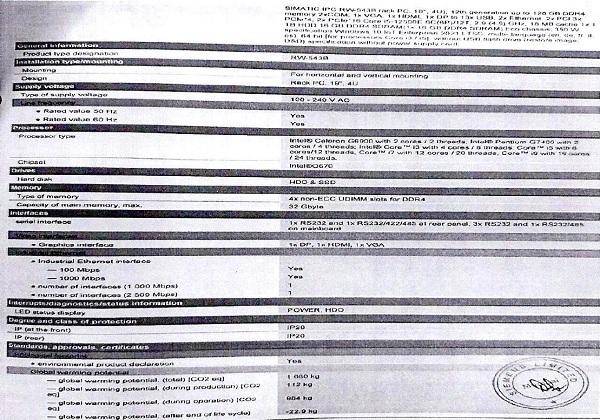
4.5 SIMATIC IPCs are equipped with features that facilitate self-diagnosis and preventive maintenance, thereby assisting in identifying and mitigating potential system failures. Such functionalitics arc implemented through both hardware features, including front status LEDs, and diagnostic software. The IPCs also incorporate features such as RAID systems and preventive data backup mechanisms to minimise system downtime and protect data. Further, the installed and activated Microsoft operating systems facilitate efficient system installation and configuration, thereby reducing installation time. Copy of the datasheet of SIMATIC IPC is reproduced as below:
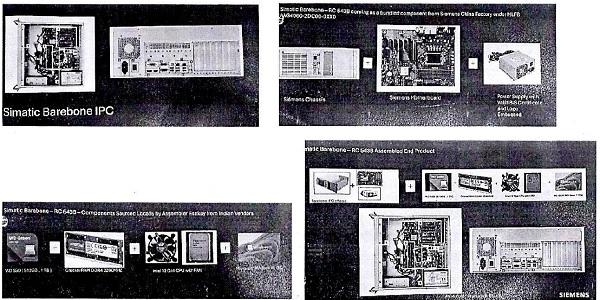
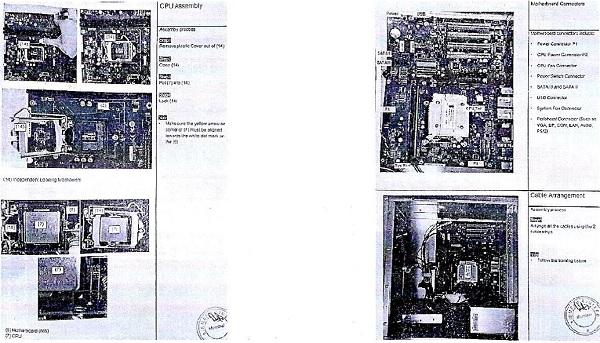
4.6 Photographs depicting the various parts/components of the SIMATIC IPC, including the components proposed to be imported as well as those to be procured domestically, along with photographs illustrating the process of manufacture and assembly of the complete SIMAFIC IPC, are reproduced hereinbelow for ease of reference.
–
A. Motherboard
4.7 The Motherboard constitutes the central backbone of a computer system or an Autoinatic Data Processing (“ADP”) machine and facilitates communication among the various components thereof. It is the principal printed circuit board (“PCB”) of a computer and serves to connect and coordinate essential hardware components, including the processor, memory, storage, graphics, and power-delivery systems. The Motherboard also distributes power, facilitates data communication between the various components, and provides the necessary connectors for peripherals and expansion devices. In the absence of a functioning Motherboard, the computer system cannot operate.
4.8 The Motherboard proposed to be imported by the Applicant is not a complete or fully populated printed circuit board. Certain essential components, including the CPU and RAM, are proposed to be mounted on the Motherboard subsequently, during the manufacture and assembly process in India. Accordingly, in its as-imported condition, the Motherboard constitutes a part of an ADP machine and does not, by itself, constitute a complete ADP machine or a fully functional computer system. Therefore, the Motherboard is appropriately classifiable under Heading 84.73, which specifically covers parts and accessories suitable for use solely or principally with machines of Heading 84.71. Further, Tariff Item 8473 30 20 specifically covers “Motherboards” and, accordingly, the Motherboard proposed to be imported by the Applicant merits classification under the said Tariff Item.
B. Chassis
4.9 The Chassis proposed to be imported by the Applicant is constructed from a basic Mild Steel (“MS”) frame, specifically designed and fabricated in accordance with the dimensional and structural requirements of the Industrial PC (“IPC”). It serves as the primary supporting structure for the IPC and provides the necessary mechanical stability, protection, and durability required for its operation in demanding industrial environments.
4.10 The Chassis is manufactured to a precise shape, configuration, and size in accordance with the design specifications applicable to each particular model of IPC. It does not incorporate any integrated electrical, electronic, or other technical or functional components and performs a purely structural function. However, the Chassis is specifically designed for use with an IPC and, more particularly, is model-specific. Accordingly, each Chassis is designed and configured exclusively for the manufacture and assembly of a particular model of IPC and cannot be ordinarily used for the manufacture or assembly of other models or types of computing systems.
C. Power Supply Unit (“PSU”)
4.11 The Power Supply Unit (“PSU”) proposed to be imported by the Applicant is an Alternating Current (“AC”) to Direct Current (“DC”) switching power supply designed to provide reliable, regulated, and efficient power to computing and industrial applications.
4.12 The primary function of the PSU is to receive the incoming AC power supply and convert it into regulated DC power required for the safe and stable operation of the various components of the Industrial PC (“IPC”), including the CPU, RAM, storage devices, and other electronic components. The PSU performs this function through voltage conversion and current regulation, thereby ensuring that the requisite DC power is supplied to the individual components within the prescribed electrical parameters. Accordingly, the PSI1 performs the function of a static converter and is appropriately considered as such for the purposes of classification under the Customs Tariff.
5. APPLICANT’S ELIGIBILITY FOR ADVANCE RULING
5.1 In order to maintain an application before the Authority for Advance Rulings, the Applicant is required to satisfy the conditions and fulfil the requirements prescribed under the Customs Act, 1962 (hereinafter referred to as the “Customs Act”).
5.2 The provisions governing advance rulings arc contained in Chapter VB of the Customs Act. In this regard, clause (c) of Section 28E of the Customs Act defines the term “Applicant” as follows:
…In this chapter, unless the context otherwise requires,
(c) “applicant” means-
(i) holding a valid Importer-exporter Code Number granted under section 7 of the
Foreign Trade (Development and Regulation) Act, 1992 (22 of 1992);
5.3 The Applicant has been granted a valid Importer-Exporter Code (“I EC”) under Section 7 of the Foreign Trade (Development and Regulation) Act, 1992. The Applicant’s IEC is 0388070005. Accordingly, the Applicant is duly recognised as an importer under the applicable foreign trade and customs laws and is eligible to seek an advance ruling in respect of the proposed import transactions.
Further, clause (b) of Section 28E of the Customs Act, 1962 defines the term “advance ruling” as follows:
” (b) “advance ruling” means a written decision on any of the questions referred to in section 2811 raised by the applicant in his application in respect of any goods prior to its importation or exportation;
5.4 The questions in respect of which an application for an advance ruling may be made are specified under Section 28H of the Customs Act, 1962. In terms of Section 28H(2) of the Customs Act. an applicant may make an application for an advance ruling in respect of questions relating to the following matters:
(a) Classification of Goods under the Customs TariffAct
5.5 The present application is being made by the Applicant to confirm classification of parts for manufacture/assembly of IPC namely. ‘Motherboard’, ‘Chassis’, and ‘Power supply’ under the Customs Tariff.
Non-Applicability of Bar under Section 281:
5.6 The present application is not barred by Section 281 of the Customs Act, 1962. Section 281 of the Customs Act, 1962 is as follows:
“SECTION 28-1 Procedure on receipt of application. — (1) On receipt of an application, the Authority shall cause a copy thereof to be forwarded to the [Principal Commissioner of Customs or Commissioner of Customs and, f necessary, call upon him to furnish the relevant records:
Provided that where any records have been called for by the Authority in any case, such records shall, as soon as possible, be returned to the Principal Commissioner of Customs or Commissioner of Customs.
(2) The Authority may after examining the application and the records called .for, by order, either allow or reject the application:
Provided that the Authority shall not allow the application where the question raised in the application is –
A. already pending in the applicant’s case before any officer of customs, the Appellate Tribunal, or any Court;
B. the same as in a matter already decided by the Appellate Tribunal or any Court:
Provided further that no application shall be rejected under this sub-section unless an opportunity has been given to the applicant of being heard:
Provided also that where the application is rejected, reasons for such rejection shall be given in the order.”
5.7 Thus, the conditions prescribed under Section 281 of the Customs Act, 1962 are duly satisfied, inasmuch as:
A. the questions raised in the present application concerning the classification of parts proposed to be imported for use in the manufacture and assembly of Industrial PCs (“IPC”), namely, the ‘Motherboard’, ‘Chassis’ and ‘Power Supply’, arc not pending in the Applicant’s own case before any officer of Customs, the Appellate Tribunal, or any Court; and
B. no order has been passed by the Appellate Tribunal or any Court in the Applicant’s own case in respect of the aforesaid questions concerning the classification of the ‘Motherboard’, `Chassis’ and ‘Power Supply’.
5.8 Accordingly, the Applicant cumulatively satisfies all the statutory conditions prescribed for filing an application for advance ruling under the Customs Act, 1962, as set out below:
A. the Applicant has been granted a valid Importer-Exporter Code (IEC) under Section 7 of the Foreign Trade (Development and Regulation) Act, 1992;
B. the present application is being filed in respect of goods proposed to be imported into India, prior to their importation;
C. the questions raised in the present application fall within the scope of clauses (a) and (b) of Section 28H(2) of the Customs Act, 1962; and
D. the present application is not barred under Section 281 of the Customs Act, 1962.
5.9 In view of the foregoing, the Applicant submits that all the statutory requirements for seeking an advance ruling stand duly satisfied.
A. MOTHERBOARD AND CHASSIS ARE INTREGAL & INSEPARABLE PARTS OF THE IPC WHICH IS AN AUTOMATIC DATA PROCESSION (ADP) MACHINE. ACCORDINGLY, THEY WILL BE CLASSIFIABLE UNDER HEADING 84.73 OF THE CUSTOMS TARIFF.
A.1 The Applicant proposes to import the ‘Motherboard’ and ‘Chassis’ for use in the manufacture and assembly of Industrial PCs (1PC) in India.
A.2 An IPC is an Industrial Computer and constitutes a specialised form of an Automatic Data Processing (ADP) machine. When imported as a complete unit, the IPC is classifiable under Customs Tariff Item 8471 50 00, which specifically covers “Processing units other than those q. sub-headings 8471.41 or 8471.49, whether or not containing in the same housing one or two of the following types of units: storage units, input units, output units.” The Applicant has, in the past, imported IPCs of different models and classified the same under Heading 84.71, as ADP machines, more specifically under Tariff Item 8471 50 00. Such classification has not been disputed or objected to by the Customs authorities.
A.3 However, for ease of reference, relevant portion of Heading 84.71 is extracted below:
| 8471 | Automatic data processing machines and units thereof; magnetic or optical readers, machines for transcribing data on to data media in coded form and machines for processing such data, not elsewhere specified or included |
| 8471 50 00 | Processing units other than those of sub-headings 8471 41 or 8471 49, whether or not containing in the same housing one or two of the following types of unit: storage units, input units, output units |
A.4 In order to qualify as an Automatic Data Processing (“ADP”) machine classifiable under I leading 84.71, the goods must satisfy all the conditions prescribed under Note 6(A) to Chapter 84 and must not be excluded from the scope of I leading 84.71 by virtue of Notes 6(D) and 6(E) to Chapter 84. The relevant provisions of Notes 6(A), 6(D) and 6(E) to Chapter 84 are reproduced hereinbelow:
[6]. (A) For the purposes of heading 8471, the expression “automatic data processing machines” means machine capable of:
i. storing the processing programme or programmes and at least the data immediately necessary for the execution of the programme;
ii. being freely programmed in accordance with the requirements of the user;
iii. performing arithmetical computations specified by the user; and
iv. executing, without human intervention, a processing programme which requires them to modify their execution, by logical decision during the processing run.
(D) 1-leading 8471 does not cover the following when presented separately, even if they meet all of the conditions set forth in paragraph (C):
i. printers, copying machines, facsimile machines, whether or not combined;
ii. apparatus for the transmission or reception of voice, images or other data, including apparatus for communication in a wired or wireless network (such as a local or wide area network);
iii. loudspeakers and microphones;
iv. television cameras, digital cameras and video camera recorders;
v. monitors and projectors, not incorporating television reception apparatus.
(E) Machines incorporating or working in conjunction with an automatic data processing machine and performing a specific function other than data processing arc to be classified in the headings appropriate to their respective functions or, failing that, in residual headings.
A.5 The Applicant submits that the SIMATIC IPC in question satisfies all the requirements prescribed under Note 6(A) to Chapter 84 for classification as an Automatic Data Processing (“ADP”) machine under Heading 84.71. The SiMAfIC IPC is capable of storing and executing programmes, performing user-defined computations, and operating autonomously without human intervention during processing operations. The Applicant has been importing SIMATIC IPCs for several years and has consistently classified the same under Heading 84.71, more specifically under Tariff Item 8471 50 00. Such classification has been accepted by the Customs authorities and has not been disputed. Accordingly, the SIMATIC IPC in question is appropriately classifiable under Heading 84.71, specifically under Tariff Item 8471 50 00, as an ADP machine. The SIMATIC IPC is equipped with a Microsoft operating system and an Intel processor, which, inter alia, enable it to perform the requisite data processing functions satisfy the conditions prescribed under Note 6(A) to Chapter 84.
A.6 As mentioned above, it satisfies the functionalities as mentioned in Note 6(A) of Chapter 84 which is evident from the below table:
| Requirements under Note 6(A) | Present in the SIMATIC IPC |
|---|---|
| Storing the processing programme or programmes and at least the data immediately necessary for the execution of the programme. | Yes |
| Freely programmed in accordance with the requirements of the user. | Yes |
| Capable of performing arithmetic computations specified by the user. | Yes |
| Executing, without human intervention, a processing programme which requires them to modify their execution, by logical decision during the processing run. | Yes |
A.7 Therefore, SIMATIC IPC fulfils all the requirements of Note 6(A) of Chapter 84 and hence, it is rightly classifiable as an ADP machine under I leading 84.71. The SIMAI’IC IPC being a processing unit is specifically classifiable under Tariff Item 8471 50 00.
B. Classification of ‘Motherboard’ and ‘Chassis’ under heading 84.73
B.1 The Applicant submits that the Motherboard constitutes a fundamental component of the IPC and is designed to accommodate and interconnect the CPU, RAM, storage interfaces, and other essential controllers, thereby enabling the assembled IPC to perform the functions of an Automatic Data Processing (“ADP”) machine. The Motherboard provides the requisite connectivity and interfaces for the various peripheral and internal components and is indispensable to the functioning of the IPC. However, the Motherboard proposed to be imported by the Applicant is not populated with the Intel processor, RAM, SD card, and other essential components at the time of importation. These components will be procured separately and mounted or assembled onto the Motherboard in India as part of the manufacturing and assembly process. Upon completion of the hardware assembly, the Microsoft operating system will be installed/flashed onto the system to render the completed IPC operational.
B.2 The Chassis is a precision-engineered mechanical enclosure specifically designed to house, support, and integrate the critical components of an IPC, including the Motherboard, Power Supply Unit (“PSU”), storage carriers such as HDD/SSD, PCI card holder, and cooling assembly. The Chassis proposed to be imported by the Applicant is specially designed and manufactured for use in the manufacture and assembly of the SIMATIC IPC and is not a generic or interchangeable enclosure. It is specifically configured for the relevant IPC model and cannot ordinarily be used with other products or computing systems. In fact, the Chassis is model-specific, such that each Chassis is intended for use in the manufacture and assembly of a particular model of IPC. Accordingly, the Chassis constitutes an essential and dedicated part of the IPC.
B.3 Neither the Motherboard nor the Chassis, in their respective as-imported conditions, is capable of performing the functions of an ADP machine, as neither item, individually, satisfies the requirements prescribed under Note 6(A) to Chapter 84. Further, even when the imported Motherboard, Chassis, and Power Supply Unit (“PSU”) are considered together, the resulting combination would not qualify as an ADP machine, since essential components required for the functioning of a complete ADP machine, including the CPU, operating system, storage devices, and other requisite components, are not imported as part of the said combination. Such components will instead be procured domestically and subsequently assembled and integrated with the imported components in India for manufacture of the complete IPC. Accordingly, in their as-imported condition, the Motherboard, Chassis, and PSU cannot be regarded as complete ADP machines classifiable under Heading 84.71 and arc required to be considered as parts/components of an ADP machine.
C. Classification of ‘Motherboard’ and ‘Chassis’ under Sub-Heading 8473.30
C.1 As submitted hereinabove, the ‘Motherboard’ and ‘Chassis’ are essential and dedicated parts of the IPC. Parts and accessories suitable for use solely or principally with machines of Heading 84.71 are specifically covered under Heading 84.73, which pertains to “parts and accessories (other than covers, carrying cases and the like) suitable for use solely or principally with machines of headings 8470 to 8472.”
C.2 The relevant portion of Heading 84.73 and Sub-Heading 8473.30 is reproduced below for case of reference:
| Tariff Item | PARTS AND ACCESSORIES (OTHER THAN COVERS, CARRYING CASES AND THE LIKE) SUITABLE FOR USE SOLELY OR PRINCIPALLY WITH MACHINES OF HEADINGS 8470 TO 8472 |
|---|---|
| 8473 30 | Parts and accessories of the machines of heading 8471: |
| 8473 30 20 | Motherboards |
| Other: | |
| 8473 30 99 | Other: |
C.3 As is evident from the above, Sub-Heading 8473.30 specifically covers “Parts and accessories of the machines of heading 8471. ” Since the IPC is classifiable under Heading 84.71, the Motherboard and Chassis, being parts specifically designed and intended for use in the manufacture and assembly of the IPC, merit classification under Sub-Heading 8473.30.
C.4 Further, the IISN Explanatory Notes to Heading 84.73 provide that, subject to the general provisions regarding the classification of parts, the Heading covers parts and accessories suitable for use solely or principally with machines of Headings 84.70 to 84.72. The relevant portion of the IISN Explanatory Notes is reproduced hereinbelow:
“Subject to the general provisions regarding the classification of parts (See the General Explanatory Note to Section XVI), this heading covers parts and accessories suitable for use solely or principally with the machines of headings 84.70 to 84. 72.
The accessories covered by this heading are interchangeable parts or devices designed to adapt a machine for a particular operation, or to perform a particular service relative to the main function of the machine, or to increase its range of operations.”
C.5 In view of the foregoing, the Motherboard and Chassis, being components integral and dedicated to the IPC and suitable for use solely or principally with an ADP machine of I leading 84.71, fall within the scope of Heading 84.73, more specifically Sub-Heading 8473.20.
C.6 In particular, the Motherboard proposed to be imported is not populated with all the components necessary for the functioning of the completed IPC. Components such as the Intel processor, RAM, storage devices, and operating system software will be procured separately by the Applicant and installed or integrated onto the Motherboard in India subsequent to importation. The Motherboard, in its as-imported condition, therefore constitutes a part of an ADP machine and does not itself constitute a complete ADP machine.
C.7 Similarly, the Chassis is not merely a protective cover or a generic, general-purpose enclosure. It is a specially designed mechanical frame and an essential component of the IPC, intended to house, support, and facilitate the integration of the various components required for assembly and operation of the IPC. The Chassis is specifically designed for use with the IPC and is model-specific, such that it is suitable for use solely or principally with the particular IPC for which it has been designed. Its design, configuration, and intended use therefbre establish its essential connection with the ADP machine of Heading 84.71 and support its classification as a part thereof under Heading 84.73.
D. Classification of ‘Motherboard’ under Tariff Item 8473 30 20:
D.1 As per Rule 1 of GRI, classification shall be determined according to the following:
a. Terms of the Headings; and
b. Any relative Section or Chapter Notes
D.2 The Motherboard, by its specific description, is expressly covered under Tariff Item 8473 30 20 of the Customs Tariff. Further, the IIon’ble CES’IAT, in CC v. Data Enterprises — 2013 (5) TMI 467, at paragraph 5, has also held that motherboards are classifiable under Tariff Item 8473 30 20.
In view of the specific tariff description and the aibresaid judicial precedent, it is respectfully submitted that the Motherboard proposed to be imported by the Applicant is appropriately and correctly classifiable under Tariff Item 8473 30 20.
E. Classification of ‘Chassis’ under Tariff Item 8473 30 99
E.1. Note 2 to Section XVI prescribes the rules for classification of parts of machines falling under the principles governing the classification of parts which are suitable for use solely or principally with a particular machine or class of machines. The relevant portion of Note 2 to Section XVI is reproduced hereinbelow:
“2. Subject to Note 1 to this Section, Note I to Chapter 84 and to Note 1 to Chapter 85, parts of machines (not being parts of the articles of heading 8484, 8544, 8545, 8546 or 8547) are to be classified according to the following rules:
a. parts which are goods included in any of the headings of Chapter 84 or 85 (other than headings 8409, 8431, 8448, 8466, 8473, 8487, 8503, 8522, 8529, 8538 and 8548) are in all cases to be classified in their respective headings;
b. other parts, if suitable for use solely or principally with a particular kind of machine, or with a number of machines of the same heading (including a machine of heading 8479 or 8543) arc to be classified with the machines of that kind or in heading 8409, 8431, 8448, 8466, 8473, 8503, 8522, 8529 or 8538 as appropriate. [However, parts which are equally suitable for use principally with the goods of headings 8517 and 8525 to 8528 arc to be classified in heading 8517, and parts which are suitable for use solely or principally with the goods of heading 8524 arc to be classified in heading 8529];
c. all other parts are to be classified in heading 8409, 8431, 8448, 8466, 8473, 8503, 8522, 8529 or 8538 as appropriate or, failing that, in heading 8487 or 8548.”
E.2 As submitted hereinabove, the Chassis is appropriately classifiable under Sub-Heading 8473.30, which specifically covers parts and accessories of machines of Heading 84.71. IIowever, the Chassis is not covered by any specific tariff item within Chapter 84 other than the residual entry applicable to parts of machines of Heading 84.71. Accordingly, Note 2(a) to Section XVI is not applicable to the present case.
E.3 In terms of Note 2(b) to Section XVI, parts which are suitable for use solely or principally with a particular machine, or with a particular class of machines, and which are not covered by Note 2(a), are to be classified with the machines of that kind. Accordingly, parts which are designed and intended for use solely or principally with a particular machine are classifiable as parts of that machine, subject to the applicable tariff provisions.
E.4 The Applicant submits that the Chassis proposed to be imported is a specifically customised and purpose-built component designed for the manufacture and assembly of the IPC. The Chassis is not merely IPC-specific but is also model-specific, with each Chassis being designed and configured for use with a particular model of IPC. As submitted hereinabove, the IPC is classifiable under Heading 84.71. Accordingly, the Chassis, being a specially designed part suitable for use solely or principally with the IPC, merits classification under Sub-Heading 8473.30, which covers “Parts and accessories of the machines of heading 8471”, and, more specifically, under Tariff Item 8473 30 99, covering “Other:
F. CLASSIFICATION OF ‘POWER SUPPLY’ IN QUESTION IN THE PRESENT APPLICATION
F.1 The Applicant submits that one of the subject goods proposed to be imported is a Power Supply Unit (“PSU”), which performs the function of converting incoming Alternating Current (“AC”) into regulated Direct Current (“DC”) required for the operation of the various components of the Industrial PC (“IPC”). Such conversion of electrical energy from AC to DC constitutes the function of a static converter. Accordingly, the classification of the PSU is required to be examined with reference to the tariff provisions applicable to static converters under the Customs Tariff.
F.2 Heading 85.04 covers ‘Electrical transformers, static converters (for example, rectifiers) and inductors’. Relevant portion of Heading 85.04 is extracted below:
| Tariff Item | ELECTRICAL TRANSFORMERS, STATIC CONVERTERS (FOR EXAMPLE, RECTIFIERS) AND INDUCTORS |
| 8504 40 | Static converters |
| Rectifier | |
| 8504 40 29 | Other |
F.3 Further, relevant extract of the FISN Explanatory Notes to Heading 85.04 is extracted below:
“(II) ELECTRICAL STATIC CONVERTERS
The apparatus of this group are used to convert electrical energy in order to adapt it for further use. They incorporate converting elements (e.g., valves) of different types. They may also incorporate various auxiliary devices (e.g., transformers, induction coils, resistors, command regulators, etc.). Their operation is based on the principle that the converting elements act alternately as conductors and non-conductors.
The fact that these apparatus often incorporate auxiliary circuits to regulate the voltage of the emerging current does not affect their classification in this group, nor does the fact that they are sometimes referred to as voltage or current regulators.
This group includes:
a. Rectifiers by which alternating current (single or polyphase) is converted to direct current, generally accompanied by a voltage change.
b. Inverters by which direct current is converted to alternating current.
c. Alternating current converters and cycle converters by which alternating current (single or polyphase) is converted to a different frequency or voltage.
d. Direct current converters by which direct current is converted to a different direct current voltages.
***
This heading also includes stabilised suppliers (rectifiers combined with a regulator), e.g., uninterruptible power supply units for a range of electronic equipment.
F.4 As submitted hereinabove, the Power Supply Unit (“PSU”) proposed to be imported by the Applicant is an Alternating Current (“AC”) to Direct Current (“DC”) switching power supply designed to provide reliable and efficient power to computing and industrial applications.
F.5 ‘Ile primary function of the PSU is to receive incoming AC power and convert the same into regulated DC power required for the safe and stable operation of various components of the Industrial PC (“IPC”), including the CPU, RAM, storage devices, and other electronic components. The PSU performs this function through voltage conversion and current regulation, thereby ensuring that the requisite DC power is supplied to the individual components within the prescribed electrical parameters.
F.6 The Applicant submits that, upon examination of the technical specifications of the PSU alongside the HSN Explanatory Notes, it is evident that the PSU possesses the characteristics and performs the functions of a static converter, more specifically, a rectifier, as described therein. The HSN Explanatory Notes further clarify that static converters may incorporate additional or auxiliary components without altering their essential character as static converters classifiable under Sub-Heading 8504.40.
F.7 Accordingly, the PSU, being a static converter and, more specifically, a rectifier, is appropriately classifiable under Tariff Item 8504 40 29, which specifically covers “Rectifier” by description.
F.8 In view of the foregoing, since the primary and essential function of the PSU is to convert AC electrical power into regulated DC power. the PSU constitutes a rectifier and merits classification as a static converter under Sub-Heading 8504.40, more specifically under Tariff Item 8504 40 29.
F.9 The aforesaid classification is also supported by Note 2(a) to Section XVI, which provides that parts which are goods included in any of the Headings of Chapter 84 or 85, other than the specifically excluded Headings, are to be classified in their respective headings. Since the PSU is itself a good specifically covered under Heading 85.04 and, more specifically, under Tariff Item 8504 40 29, it merits classification under its own specific tariff provision rather than as a part of the IPC under Heading 84.73.
G. PSU being a Static Converter for an ADP Machine is eligible for exemption in terms of Sr. No. 4 of Notification No. 25/2005-Cus., dated 01.03.2005
G.1 Serial No. 4 of Notification No. 25/2005-Cus., dated 01.03.2005 provides for full exemption from payment of Basic Customs Duty (“BCD”) in respect of “Static converters for automatic data processing machines and units thereof and telecommunication apparatus” falling under Sub-Heading 8504.40. The relevant portion of the said Notification is reproduced hereinbelow:
| Sr. No. | Heading, Sub – heading or Tariff item | Description of goods |
|---|---|---|
| 4 | 8504 40 | Static converters for automatic data processing machines and units thereof, and telecommunication apparatus, other than static converters for cellular mobile phones |
G.2 As submitted hereinabove, the PSU satisfies the substantive conditions prescribed under Serial No. 4 of Notification No. 25/2005-Cus., dated 01.03.2005, inasmuch as:
a. the PSU is a static converter classifiable under Sub-Heading 8504.40;
b. the PSU is specifically designed and intended for use with an Automatic Data Processing (“ADP”) machine, namely, the Industrial PC (“I PC”); and
c. the PSU is not intended for use with cellular mobile phones.
G.3 Accordingly, all the conditions prescribed for availing the exemption under Serial No. 4 of Notification No. 25/2005-Cus., dated 01.03.2005 are duly satisfied in the present case. The PSU, being a static converter falling under Sub-IIeading 8504.40 and specifically intended for use with an ADP machine, is therefore eligible for the benefit of the said exemption from payment of Basic Customs Duty (“BCD”).
6. ISSUES REQUIRING ADVANCE RULING AND APPLICANT’S UNDERSTANDING
In light of the foregoing submissions, the Applicant respectfully sets out below its understanding of the questions raised for consideration before the Authority for Advance Rulings:
a. Question 1: Whether the products in question, namely, the ‘Motherboard’. ‘Chassis’ and `Power Supply’ proposed to be imported for use in the manufacture and assembly of an Industrial PC (“IPC”), are classifiable under Tariff Items 8473 30 20, 8473 30 99 and 8504 40 29, respectively, of the First Schedule to the Customs Tariff Act, 1975 (hereinafter referred to as the “Customs Tariff)?
Applicant’s Understanding: Yes. The Motherboard is classifiable under Tariff Item 8473 30 20, the Chassis under Tariff Item 8473 30 99, and the Power Supply under Tariff Item 8504 40 29.
b. Question 2: In the event the answer to Question 1 is in the affirmative, whether the Power Supply, classifiable under Tariff Item 8504 40 29, is eligible for the exemption from payment of Basic Customs Duty (“BCD”) in terms of Serial No. 4 of Notification No. 25/2005-Cus., dated 01.03.2005?
Applicant’s Understanding: Yes. The Power Supply, being a static converter falling under Sub-Heading 8504.40 and intended for use with an Automatic Data Processing (“ADP–) machine, namely, the IPC, is eligible for the benefit of the exemption under Serial No. 4 of the said Notification.
(c) Question 3: In the event the answer to Question I is in the negative, what would be the appropriate classification of the ‘Motherboard’, ‘Chassis’ and ‘Power Supply’, respectively. under the Customs Tariff, and what would be the applicable rate of customs duty on their import? Applicant’s Understanding: Not Applicable. Without prejudice even if the subject goods are considered as a complete ADP machine they will be classifiable under Heading 84.71. The applicable rate of Basic Customs Duty (“BCD”) for goods falling under Heading 84.71 is Free under the Customs Tariff.
6. Applicant’s eligibility for Advance Ruling:
The applicant holds a valid IEC No. 0388070005 and therefore qualifies as.an “applicant” under Section 28E(c) of the Customs Act’ 1962. The questions on which the advance ruling is sought is in respect of classification and the eligible for exemption in terms of Sr. No. 4 of notification no. 25/05-Cus dated 01.03.2005, which is admissible under Section 28H (2). The applicant has declared that the questions raised in the present application is not pending in the applicant’s own case before any officer of customs, the appellate tribunal, or any Court and is not a matter already decided by the appellate tribunal or any court. Accordingly, the application appears admissible under Section 28-1 of the Customs Act, 1962.
7. Port of Import and reply from jurisdictional Commissionerate: The applicant in their Form CAAR-1 indicated that they intend to import the subject goods at the jurisdiction of Office of the Commissioner of Customs (Import), Air Cargo Complex, Sahar, Andheri East, Mumbai 400099. The application was forwarded to the concerned Commissionerate for their comments on 09.04.2026.
8. Details of Personal Hearing: A personal hearing in the matter was held on 02.06.2026. Shri Akhilesh Kangsia, Advocate, the authorised representative of the applicant, appeared on behalf of the applicant and reiterated the submissions made in the application and the written submissions filed in support thereof. During the course of the personal hearing, they demonstrated the subject goods by producing a real unit before the. It was submitted that the complete unit, i.e. IPC, comprises various parts, including the parts proposed to be imported as described above.
8.1 Nobody appeared for the PH from the Department.
9. Reply from jurisdictional Commissionerate: The comments from the jurisdictional commissionerate i.e. The office of the commissioner of Custom (Import), Air Cargo Complex, Sahar, Andheri East, Mumbai were received vide letter dated 29.06.2026 F. No. CUS/APR/MISC/4278/2026-Ur-5A. The comments of the jurisdictional Commissionerate are reproduced hereunder:
9.1 The subject item, as described in the application and supporting technical documents, is an Alternating Current (AC’) to Direct Current (‘DC”) switching power supply designed for reliable and efficient power delivery in computing and industrial applications. The primary role of an IPC power supply is to take incoming AC power and convert it into regulated DC power so that the IPC components such as CPU, RAM, Storage devices, etc., car ,LQ1y use the required DC current. This involves both voltage conversion and current regulation to ensure stable operation. Thus, Power Supply Unit (PSU) is a Static Converter.
9.2 As per the application and technical literature submitted by the applicant, the subject goods are Power Supply Units intended for use in the manufacture and assembly of Industrial Computing Platforms (IPC). The PSU receives alternating current (AC) from the mains supply and converts the same into regulated direct current (DC) output required for operation of various electronic components such as processors, memory modules, storage devices, controllers and peripheral interfaces installed in the IPC. The essential function of the Power Supply Unit (PSU) is, therefore, conversion of electrical energy from one form to another while maintaining stable voltage and current parameters.
9.3 Heading 8504 of the First Schedule to the Customs Tariff Act, 1975 covers:
| 8504 | “Electrical transformers, static converters (for example, rectifiers) and inductors.” |
| 8504 40 | Static Converters”. |
9.4 The HSN Explanatory Notes to Heading 8504 provide that static converters are apparatus used to convert electrical energy in order to adapt it for further use. The Notes further clarify that such apparatus may incorporate transformers, resistors, regulators and other auxiliary devices, without affecting their classification under Heading 8504. The explanatory notes specifically include rectifiers, which convert alternating current into direct current, within the scope of static converters. In this instance case, the technical specifications furnished by the applicant indicate that the Power Supply Unit (PSU) performs precisely the above function, namely conversion of Alternating Current (AC’) to Direct Current (‘DC”). Accordingly, the product exhibits the essential characteristics of a static converter as contemplated under the HSN Explanatory Notes.
9.5 Classification of parts of machines falling under Chapters 84 and 85 is governed by Note 2 to Section XVI. Note 2(a) prbvides that parts which are themselves goods covered by a specific heading of Chapters 84 or 85 are to be classified in their own respective headings.
9.6 In the instant case, although the Power Supply Unit (PSU) is intended for use in an Industrial Computing Platform, it is itself an independently identifiable electrical apparatus performing the specific function of power conversion. Since such goods are specifically covered under I leading 8504 as static converters, their classification is governed by Note 2(a) to Section XVI and not by the provisions relating to parts of automatic data processing machines.
9.7 The fact that the Power Supply Unit (PSU) is designed for installation in an Industrial Computing Platform does not alter its essential character as a static converter. Classification under Heading 8473 as a part of an Automatic Data Processing (ADP) machine would arise only where the goods are not more specifically covered elsewhere in the tariff. In view of the specific coverage available under Heading 8504, the Power Supply Unit (PSU) is required to be classified in its own heading in accordance with General Rule for Interpretation 1 read with Note 2(a) to Section XVI. It is a settled principle of tariff classification that a specific heading takes precedence over a general heading relating to parts and accessories. Therefore, the Power Supply Unit (PSU) cannot be classified merely as a part of an IPC when a specific tariff entry exists covering its principal function.
9.8 The applicant has stated that the Power Supply Unit (PSU) converts AC power into DC power and, therefore, functions as a rectifier. The tariff structure under sub-heading 8504 40 contains a specific entry for rectifiers. Subject to verification of the technical specifications, circuit design, operating characteristics and actual functionality of the imported goods, the PSU appears to be appropriately classifiable under Tariff Item 8504 40 29 as a Static Converter (Rectifier).
9.9 In view of the foregoing discussion, the Department is of the considered view that the subject Power Supply Unit (PSU) is an electrical apparatus performing the function of conversion of AC power into regulated DC power and is, therefore, covered by the description of “Static Converter” under Heading 8504. Further, in terms of Note 2(a) to Section XVI, the goods are required to be classified in their own specific heading and not as parts of an Automatic Data Processing Machine. Accordingly, the subject goods merit classification under CTH 8504 40 29, subject to verification of the technical literature, specifications and the actual nature of the goods at the time of import.
9.10 Without prejudice to the above classification, the question of eligibility to exemption under Notification No. 25/2005-Cus. dated 01.03.2005 would depend upon fulfilment of all conditions prescribed therein and verification that the imported PSU qualifies as a static converter for automatic data processing machines and is covered by the scope of the relevant entry of the notification. The applicability of the exemption may be examined independently on the basis of the facts and documents produced by the applicant.
10. Discussion and Findings
10.1 I have carefully considered the application, statement of facts, written submissions and documents furnished by the applicant, the technical literature and photographs of the subject goods, the submissions made during the course of Personal hearing held on 02.06.2026 and the comments furnished by the jurisdictional Commissionerate. I have also examined the relevant provisions of the Customs Act, 1962, the First Schedule to the Customs Tariff Act, 1975, the General Rules for the Interpretation of the Import Tariff (GIR), the relevant Section and Chapter Notes.
10.2 “Mc issues that arise for determination are: (i) the classification of the goods proposed to he imported by the applicant for use in the manufacture and assembly of an Industrial PC (1PC), namely, (a) “Motherboard”, (b) “Chassis”, and (c) “Power Supply Unit (Static Converter)”; (ii) whether the said goods are appropriately classifiable under Customs Tariff Items (CTIs) 8473 30 20, 8473 30 99 and 8504 40 29, respectively; and (iii) whether the “Power Supply Unit (Static Converter)”, classifiable under CTI 8504 40 29 and intended for use with an Automatic Data Processing (ADP) machine, is eligible for exemption from payment of Basic Customs Duty (BCD) in terms of Sr. No. 4 of Notification No. 25/2005-Cus., dated 01.03.2005.
10.3 At the outset, classification under the Customs Tariff is required to be determined in accordance with the General Rules for the Interpretation of the Import Tariff. In terms of Rule I of the GRI, classification is to be determined according to the terms of the headings and any relevant Section or Chapter Notes. Therefore, the nature, characteristics and function of each of the subject goods in the condition in which they are proposed to be imported have to be examined independently.
10.4 The Applicant has submitted that the SlMAIIC Industrial Computing Platform (IPC) is a specialized industrial computing system designed for use in demanding industrial environments. Unlike conventional personal computers, the IPC is designed to operate reliably under conditions such as temperature variations, dust, moisture, vibrations and electromagnetic interference. The Applicant has stated that, notwithstanding its specialised and ruggedised construction, the IPC performs the functions of an Automatic Data Processing (ADP) machine, being capable of storing and executing programmes, performing user-defined computations and processing data in accordance with user-defined instructions. The IPC operates using an Intel processor and Microsoft operating system and is intended for deployment in various industrial applications.
10.5 The Applicant has further submitted that the complete SIMATIC IPC is assembled from various components, namely, Motherboard, Chassis, Power Supply Unit (PSU), WS SSI) Card, RAM, CPU with Fan and Operating System. Out of these components, only the Motherboard, Chassis and PSU are proposed to be imported from Siemens China in a kit for manufacture and assembly of the Siemens “SIMATIC Barebone — RC 543W’. The remaining components, including CPU, RAM, processor-related components and operating system, are proposed to be procured domestically and are not the subject matter of the present application.
10.6 The Motherboard proposed to be imported is the central printed circuit board of the IPC on which the principal electronic components and interfaces required for assembling the computing system are provided. The Applicant has submitted that, in the imported condition, the Motherboard does not constitute a complete or independently functional ADP machine, as certain essential components, including the CPU and RAM, are procured separately and installed during the assembly of the complete IPC. The Motherboard is specifically intended for integration into the SIMATIC IPC and forms the principal electronic platform connecting and enabling communication between the various components of the computing System.
10.7 The Chassis proposed to be imported is a specially fabricated mechanical enclosure intended to house and mechanically support the components of the SIMATIC IPC. The Applicant has stated that the Chassis is manufactured from a mild-steel frame and is designed according to the specific dimensional and structural requirements of the relevant IPC model. It provides mechanical support, protection and stability to components such as the Motherboard, PSU, cooling assemblies and storage devices. The Chassis does not incorporate independent electronic or computing functionality and performs essentially a structural and protective function. The Applicant has further submitted that the Chassis is model-specific and is designed for the particular SIMATIC IPC for which it is intended.
10.8 The Power Supply Unit (PSU) proposed to be imported is an Alternating Current (AC) to Direct Current (DC) switching power supply. As submitted by the Applicant, its primary function is to receive the incoming AC electrical supply and convert it –itito regulated DC power required for the operation of the various electronic components of the IPC, including the CPU, RAM, storage devices and other associated circuitry. The PSU accordingly performs electrical functions of voltage conversion and current regulation and supplies the requisite regulated DC power to the IPC components.
10.9 Thus, from the description and material placed on record, I find that the three products proposed to be imported are distinct components having different functions in the assembly of the SIMATIC IPC. The Motherboard provides the principal electronic platform, the Chassis provides the mechanical enclosure and structural support and the PSU provides conversion of AC electrical power into regulated DC power for operation of the computing system. The classification of each of these products is required to be examined having regard to its nature and function in the condition in which it is imported.
10.10 ‘Me Applicant has submitted that a complete SIMATIC IPC of a different model had earlier been imported by it and classified under I-leading 8471 of the First Schedule to the Customs Tariff Act, 1975, specifically under Tariff Item 84715000.
10.11 Before examining the classification of the Motherboard and Chassis, it is necessary to determine the nature of the complete IPC with which the subject components are intended to be used. The Applicant has submitted that the IPC is an Automatic Data Processing (ADP) Machine and that the complete SIMATIC IPC is capable of storing and executing programmes, performing user-defined computations and executing processing programmes without human intervention. The Applicant has further stated that the IPC is equipped with an Intel processor and Microsoft operating system and performs data processing functions. The Applicant has also submitted that a complete ADP machine, in the form of an IPC of a different model, had been imported by it in the past under ‘leading 8471, specifically under Tariff Item 84715000. It is, therefore, necessary to examine whether the complete SIMAFIC IPC satisfies the requirements for classification under I leading 8471.
10.12 Heading 8471 covers “Automatic data processing machines and units thereof magnetic or optical readers, machines for transcribing data on to data media in coded form and machines for processing such data, not elsewhere specified or included”
Tariff Item 84715000 covers:
“Processing units other than those of sub-headings 8471 41 or 8471 49, whether or not containing in the same housing one or two of the following types of unit: storage units, input units, output units.”
10.13 Further, Note 6(A) to Chapter 84 of the Customs Tariff provides as follows:
“(A) For the purposes of heading 8471, the expression ‘automatic data processing machines • means machine capable of.
i. storing the processing programme or programmes and at least the data immediately necessary for the execution of the programme;
ii. being freely programmed in accordance with the requirements of the user;
iii. peiforming arithmetical computations specified by the user; – – –
(iv) executing, without human intervention, a processing programme which requires them to modi,n, their execution, by logical decision during the processing run.”
10.14 From the technical description and material placed on record, I find that the complete SIMATIC IPC satisfies the conditions prescribed under Note 6(A) to Chapter 84. The IPC is capable of storing the processing programme or programmes and at least the data immediately necessary for the execution of the programme; it can be freely programmed in accordance with the requirements of the user; it is capable of performing arithmetical computations as specified by the user; and it can execute processing programmes without human intervention, including modifying their execution by logical decisions during the processing run. Thus, the complete SIMATIC IPC possesses all the essential functionalities specified in Note 6(A) for an “automatic data processing machine”. I, therefore, find that the complete SIMAI’IC IPC qualifies as an ADP machine for the purposes of Heading 8471.
10.15 However, the issue before me is not the classification of the complete IPC but the classification of the individual components proposed to be imported, namely, the Motherboard, Chassis and PSU. It is an admitted factual position that the Motherboard, in its imported condition, is not populated with all the components necessary for operation of the complete IPC. The Intel processor, RAM, SD card and other components arc to be procured separately and assembled in India. Similarly, the Chassis is only a mechanical structure intended to house and support the various components of the IPC, while the PSU performs the function of converting AC electrical power into regulated DC power required for operation of the electronic components. Thus, none of the subject goods, in the condition in which they arc imported, constitutes a complete ADP machine. Accordingly, the Motherboard, Chassis and PSU cannot, merely by virtue of their intended use in the SIMAI’IC IPC, he classified as complete ADP machines under Heading 84.71. Their classification is therefore required to be determined independently, having regard to their individual nature, characteristics, function and the specific tariff provisions applicable to them.
10.16 At the same time, the fact that the subject goods arc imported separately does not detract from their character as components intended for incorporation into the SIMATIC IPC. The material placed on record establishes that the Motherboard, Chassis and PSU are specifically designed for and intended to be incorporated into the particular Industrial Computing Platform (IPC) under consideration. The Motherboard constitutes the principal printed circuit board of the computing system; the Chassis is a specially designed mechanical structure for housing and supporting the components of the IPC; and the PSU is intended to provide the regulated electrical power required for operation of the IPC. Thus, while the subject goods are not themselves complete ADP machines, the Motherboard, Chassis and PSU are identifiable as parts/components intended for incorporation into the ADP machine. Accordingly, their classification is required to be examined in accordance with Note 2 to Section XVI, having regard to the specific provisions applicable to each of the subject goods.
10.17 The classification of parts of machines falling under Chapters 84 and 85 is governed by Note 2 of Section XVI. The relevant provisions of Note 2 read as follows:
“2. Subject to Note 1 to this Section, Note 1 to Chapter 84 and to Note 1 to Chapter 85, parts of machines (not being parts of the articles of heading 8484, 8544, 8545, 8546 or 8547) are to be classified according to the following rules:
(a) parts which are goods included in any ofthe headings gfChapter 84 or 85 (other than headings 8409. 8431, 8448, 8466, 8473, 8487, 8503, 8522, 8529, 8538 and 8548) are in all cases to be classified in their respective headings;
(B) other parts, if suitable for use solely or principally with a particular kind of machine, or with a number of machines of the same heading (including a machine of heading 8479 or 8543) are to be classified with the machines of that kind or in heading 8409, 8431, 8448, 8466, 8473, 8503, 8522, 8529 or 8538 as appropriate. However, parts which are equally suitable for use principally with the goods of headings 8517 and 8525 to 8528 are to be classified in heading 8517, and parts which are suitable for use solely or principally with the goods of heading 8524 are to be classified in heading 8529;
(c) all other parts are to be classified in heading 8409, 8431, 8448, 8466, 8473, 8503, 8522, 8529 or 8538 as appropriate or, failing that, in heading 8487 or 8548.”
The above provisions make a distinction between parts which are themselves goods specifically covered by a heading of Chapter 84 or 85 and other parts suitable for use solely or principally with a particular kind of machine. I also find that the Motherboard, Chassis and PSU are not parts of the articles covered under headings 8484, 8544, 8545, 8546 or 8547. Therefore, the exclusion contained in the opening part of Note 2 to Section XVI does not apply to the subject goods. Accordingly, the classification of each of the subject goods has to be examined with reference to the specific tariff coverage of the individual article and the applicable provisions of Note 2 to Section XVI.
Classification of “Motherboard”
10.18 Heading 84.73 specifically covers “Parts and Accessories (other than covers, carrying cases and the like) suitable for use solely or principally with machines of Heading 8470 to 8472 “and Sub-I leading 8473.30 covers “Parts and accessories of the machines ()I heading 8471” with the following tariff items:
| 8473 | Parts and Accessories (other than covers, carrying cases and the like) suitable for use solely or principally with machines of Heading 8470 to 8472 |
| 847330 | Parts and accessories of the machines of heading 8471 |
| 84733010 | Microprocessors |
| 84733020 | Motherboards |
10.19 I find that the tariff structure specifically provides for classification of Motherboards under Tariff Item 8473 30 20. The subject Motherboard is specifically designed for incorporation in the SIMATIC IPC, which has been found above to be an ADP machine of Heading 8471. The Motherboard constitutes the principal printed circuit board of the computing system and provides the necessary interfaces and connectivity for the processor, memory, storage and other components. It is, therefore, identifiable as a part of and suitable for use with, the ADP machine of Heading 8471.
10.20 The applicant has also relied upon judicial precedent in support of the above classification, specifically the decision of the Hon’ble CESTA1′ in CC Vs. Data Enterprises 2013 (5) MI 467, particularly paragraph 5 thereof. In the said case, the Hon’ble Tribunal observed that plain motherboards arc classifiable under Tariff Item 84733020. The relevant portion of the order is reproduced below:
“5. We have considered the submissions made by both the sides and perused the records. In this case, we.find that which at the time of import the declared per unit price of mother board imported by the respondent is 16 USD, the Assistant Commissioner has enhanced the same to 26.85 USD without assigning any reason. It is well settled law that the declared transaction value can be rejected only if it does not satisfy the criteria as prescribed for the same in proviso to Rule 3(2) of the Customs Valuation Rules 2007 or that the proper officer after following, the procedure prescribed in Rule 12 of the valuation Rule had come to conclusion that there are reasons to doubt the correctness of the declared transaction value. In fact, in this case no reasons have been given by the assessing officer for rejecting the declared value and enhancing the per unit price from 16USD to 26.85 USD. We also ,find that bill of entry which is relied upon by the department for rejecting the declared value and enhancing the same is in respect ofgoods classifiable under sub heading 8473,3030 which covers the printed circuit boardwhile the goods imported in this case are plain mother boards classifiable under 84733020 and thus bill of entry relied upon by the department is also not applicable to this consignment. We therefore do not, find any infirmity in the impugned order The appeal is dismissed.”
I find that the aforesaid decision recognises plain motherboards as classifiable under Tariff Item 8473 30 20, distinguishing them from printed circuit boards covered under Tariff Item 8473 30 30. In the present case also, the subject Motherboard is imported without the processor, RAM and other essential components and is specifically designed for incorporation into the SIMATIC I PC. The said decision therefore lends support to the classification of the subject Motherboard under Thrift’ Item 8473 30 20.
10.21 Further, the subject Motherboard does not constitute a complete ADP machine in its imported condition, as essential components such as the Intel Processor and RAM arc not mounted thereon at the time of importation and are to be integrated subsequently in India. Consequently, the imported Motherboard does not satisfy the requirements of an automatic data processing machine under Note 6(A) to Chapter 84 and cannot be classified as a complete ADP machine under Heading 8471. Since the tariff specifically provides for “Motherboards” under Tariff Item 8473 30 20, the subject goods are squarely covered by the specific tariff description.
10.22 The first schedule to the Customs Tariff Act, 1975 mandates the General Rules of Interpretation (“GRIs”) which are to be applied to determine classification under the Customs Tariff. Classification of Goods in the Nomenclature shall be governed by the following principles:
1. The titles of Sections, Chapters and sub-ChapterS are provided for ease of reference only; for legal purposes, classification shall be determined according to the terms of the headings and any relative Section or Chapter Notes and, provided such headings or Notes do not otherwise require, according to the following provisions:
Accordingly, applying Rule 1 of the General Rules for Interpretation, which requires classification to be determined according to the terms of the headings and the relevant Section and Chapter Notes. I find that the Motherboard proposed to be imported is appropriately classifiable under Tariff Item 84733020 of the First Schedule to the Customs Tariff Act, 1975.
Classification of “Chassis”
10.23 As regards the Chassis, the Applicant has submitted that the same is a Mild Steel frame specifically designed and fabricated according to the dimensional and structural requirements of the particular IPC model. It is intended to house, support and integrate the Motherboard, PSU, storage carriers and other components of the IPC. The Applicant has further submitted that the Chassis is model-specific and cannot ordinarily be used for other models or types of computing systems.
10.24 I find from the description and technical particulars available on record that the subject Chassis is not a generic enclosure or a general-purpose metal article. It is specifically designed and configured for the particular IPC model and performs the structural and supporting function necessary for assembly of the complete1PC. Its design, dimensions and configuration establish its suitability for use solely or principally with the particular class of IPCs of Ileading 8471.
10.25 Since the Chassis is not itself a separately specified good covered under heading of Chapter 84 or 85, Note 2(a) to Section XVI (supra para 10.17) is not attracted to its classification. Its classification is therefore required to be considered in terms of Note 2(b) to Section XVI, which provides that other parts, if suitable for use solely or principally with a particular kind of machine, are to be classified with the machines of that kind or under the specifically prescribed headings including Heading 8473, as appropriate.
10.26 The HSN Explanatory Notes to Beading 84.73 further state:
“Subject to the general provisions regarding the classification of parts (see the General Explanatory Note to Section XVI), this heading covers parts and accessories suitable.* use solely or principally with the machines of headings 84.70 to 84.72.”
The subject Chassis is specifically designed and intended for incorporation into the SIMAFIC IPC, which is an ADP machine of Heading 84.71, is therefore appropriately covered under Heading 84.73. The tariff structure of Ileading 8473 is as follows:
| 8473 | Parts and Accessories (other than covers, carrying cases and the like) suitable for use solely or principally with machines of Heading 8470 to 8472 |
| 847330 | Parts and accessories of the machines of heading 8471 |
| 84733010 | Microprocessors |
| 84733020 – | Motherboards |
| 84733030 | Other mounted printed circuit boards |
| 84733040 | Head stack |
| Other: | |
| 84733091 | Network access controllers |
| 84733092 | Graphic and Intelligence based Script Technology (GIST) cards for multilingual computers |
| 84733099 | Other |
Sub-Heading 847330 specifically covers parts and accessories of machines of Heading 8471. Since there is no specific tariff item under Sub-I leading 847330 for such Chassis, the same falls under the residual tariff item “Other”, namely tariff item 8473 30 99.
10.27 Accordingly, I find that the Chassis, being a specially designed and model-specific part suitable for use solely or principally with the Industrial PC classifiable under [leading 8471, and not being specifically covered by any other tariff item under Sub-heading 8473.30, is appropriately classifiable under Tariff Item 8473 30 99 of the First Schedule to the Customs Tariff Act, 1975.
Classification of “PSU”
10.28 I now proceed to examine the classification of the Power Supply Unit (“PSU”). From the technical description furnished by the Applicant and the material available on record, I find that the PSU is an AC-to-DC switching power supply. Its primary function is to receive incoming AC electrical power and convert the same into regulated DC power required for operation of the CPU, RAM, storage devices and other electronic components of the IPC.
10.29 The IISN Explanatory Notes to Heading 8504, under “Electrical Static Converters”, state that such apparatus is used to convert electrical energy in order to adapt it for further use. The Notes further include rectifiers by which alternating current is converted to direct current, generally accompanied by a voltage change. The Notes also clarify that such apparatus may incorporate auxiliary devices for regulation of voltage or current without affecting their classification as static converters. The relevant portion the HSN Notes is reproduced below:
“(II) ELECTRICAL STATIC CONVERTERS
The apparatus of this group are used to convert electrical energy in order to adapt it for further use. They incorporate converting elements (e.g., valves) of different types. They may also incorporate various auxiliary devices (e.g, transformers, induction coils, resistors, command regulators, etc.). Their operation is based on the principle that the converting elements act alternately as conductors and non-conductors.
The fact that these apparatuses often incorporate auxiliary circuits to regulate the voltage of the emerging current does not affect their classification in this group, nor does the fact that they are sometimes referred to as voltage or current regulators.
This group includes:
A. Rectifiers by which alternating current (single or polrphase) is converted to direct current, generally accompanied by a voltage change.
B. Inverters by which direct current is converted to alternating current.
C. Alternating current converters and cycle converters by which alternating current (single or polyphase) is converted to a different frequency or voltage.
D. Direct current converters by which direct current is converted to a different direct current voltages. ***
This heading also includes stabilised suppliers (rectifiers combined with a regulator), e.g., uninterruptible power supply units for a range of electronic equipment.
10.30 In the present case, the PSU receives incoming AC electrical power and converts it into regulated I)C power required for the operation of the electronic components of the IPC. I find that its essential function is, therefore, the conversion of electrical energy from AC to I)C and that it possesses the essential characteristics of an electrical static converter (rectifier) covered under Ileading 8504.
10.31 Since the PSU is itself a good specifically covered under a heading of Chapter 85, Note 2(a) to Section XVI (supra para 10.17) requires it to be classified in its respective heading, notwithstanding that it is designed for installation in the IPC. Accordingly, its classification is to be determined under 1-16ading 8504 rather than as a part of the ADP machine under Heading 8473
10.32 Heading 8504 of the Customs Tariff covers “Electrical transformers, static converters (for example, rectifiers) and inductors”. The relevant tariff structure is reproduced below:
8504 – Electrical transformers, static converters (for example, rectifiers) and Inductors
850410 – Ballasts for discharge lamps or tubes:
* * *
850440 – Static converters:
85044010 – UPS (Static Converters)
85044010 – Electric inverter Rectifier:
85044021 – Dip bridge rectifier
85044029 – Other
10.33 Applying Rule 1 of the General Rules for the Interpretation of the Customs Tariff, read with Note 2(a) to Section XVI, I find that the subject Power Supply Unit, being an AC-to-DC switching power supply having the essential characteristics of a static converter (rectifier) and not being covered by the specific tariff items for UPS, electric inverter or dip bridge rectifier, is appropriately classifiable under Tariff Item 85044029 of the First Schedule to the Customs Tariff Act, 1975.
10.34 The jurisdictional Commissionerate has also examined the technical description of the PSU and has opined that the same performs the function of conversion of AC power into regulated DC power and is therefore covered under Heading 8504 as a static converter. TheCommissionerate has further agreed that, in terms of Note 2(a) to Section XVI, the PSU is required to be classified in its own specific heading and has specifically indicated Tariff Item 8504 40 29, subject to verification of the technical specifications and actual nature of the goods at the time of importation.
10.35 I find the above view of the jurisdictional Commissionerate to be consistent with the tariff provisions and the technical characteristics of the PSU placed on record. Accordingly, the Power Supply Unit proposed to be imported is appropriately classifiable under Tariff Item 85044029 of the First Schedule to the Customs Tariff Act, 1975.
BIS Requirement
10.36 I further find that, having been classified under Tariff Item 8504 40 29, the subject Power Supply Unit (PSU) falls under CTH 8504 40, which is specifically covered at Sr. No. 18 of the First Schedule to the Machinery and Electrical Equipment Safety (Omnibus Technical Regulation) Order, 2024, notified vide S.O. 3649(E) dated 28.08.2024. The relevant of the First Schedule is reproduced below:
The First Schedule
fSee rules 1(3), 3(1), 3(2), 4 and8i
List of Machinery and Electrical Equipment covered under this Order:
| S No | Description of Machinery and Electrical Equipment | HS Code |
| 2 | ||
| 18 | All types of Power Semiconductor Converter and (or) their assemblies/sub-assemblies/components | 850440 |
The aforesaid entry covers “All types of Power Semiconductor Converter and (or) their assemblies/sub-assemblies/components” falling under CITI 850440. Since the subject PSU is classifiable under Tariff Item 85044029 and consequently falls under CTH 850440, I find that it is covered within the scope of the said regulatory requirement. Accordingly, the subject PSU shall be required to comply with the applicable BIS certification requirements at the time of importation, in accordance with the provisions of the said Order.
Eligibility of PSU for exemption under Notification No. 25/2005-Cus. dated 01.03.2005
10.37 Having determined the classification of the PSU under Tariff Item 85044029, the next issue for consideration is whether the same is eligible for exemption from Basic Customs Duty under Serial No. 4 of Notification No. 25/2005-Cus. dated 01.03.2005.
10.38 Serial No. 4 of Notification No. 25/2005-Cus. dated 01.03.2005 provides exemption in respect of the following goods:
| Sr. No. | Heading/Subheading/Tariff Item | Description of goods |
| 4 | 850440 | Static converters for automatic data processing machines and units thereof, and telecommunication apparatus, other than static converters for cellular mobile phones |
10.39 From the above entry, it is evident that the exemption is not linked merely to the tariff classification under Sub-Heading 850440, but also to the nature and intended use of the static converter, namely, for automatic data processing machines and units thereof or telecommunication apparatus, subject to the exclusion specified in the notification.
10.40 In the present case, I have already found that the-complete SIMATIC IPC is an Automatic Data Processing machine falling under I leading 8471. The technical documents and submissions establish that the subject PSU is specifically designed and intended to supply regulated DC power to the various components of the said IPC. The PSU is therefore a static converter intended for use with an Automatic Data Processing machine.
10.41 I further find that there is no material indicate that the subject PSU is a static converter specifically designed for use with cellular mobile phones. On the contrary, the material placed on record establishes that the PSU is specifically designed and intended for use in the manufacture and assembly of the Industrial Computing Platform (IPC). Therefore, its use with the IPC is clearly established on record.
10.42 Accordingly, I find that the subject PSU satisfies the description of goods specified at Serial No. 4 of Notification No. 25/2005-Cus. dated 01.03.2005. The Power Supply Unit, being a static converter falling under Sub-I leading 850440 and specifically designed and intended for use with an Automatic Data Processing machine, is therefore eligible for the benefit of the exemption under Serial No. 4 of the said Notification, subject to fulfilment of the other applicable conditions, if any, prescribed therein and compliance at the time of importation.
10.43 In view of the foregoing discussion and findings, I hold that the classification of the subject goods proposed to be imported by the Applicant is required to be determined independently on the basis of the nature, characteristics and specific tariff description of each item in its imported condition. The Motherboard and Chassis, being parts of an Industrial Computing Platform classifiable under Heading 84.71, fall under Heading 84.73, whereas the PSU, being itself a static converter specifically covered under Heading 85.04, is required to be classified in its own heading in terms of Note 2(a) to Section XVI.
10.44 Accordingly, I find that:
i. the Motherboard is classifiable under Tariff Item 84733020;
ii. the Chassis is classifiable under Tariff Item 84733099; and
iii. the Power Supply Unit (PSU) is classifiable under Tariff item 85044029 and is subject to the applicable BIS Certification requirements
10.45 Further, the Power Supply Unit, being a static converter falling under Sub-Heading 850440 and specifically designed and intended for use with an Automatic Data Processing machine, is eligible for the benefit of exemption under Serial No. 4 of Notification No. 25/2005-Cus. dated 01.03.2005, subject to fulfilment of the conditions prescribed under the said notification.
11. In view of the foregoing, it is clarified that the present ruling is confined to determination of the classification of the subject Motherboard, Chassis and Power Supply Unit (PSU) on the basis of the facts, technical specifications, documents and submissions placed on record. The ruling determines the classification of the subject goods under the respective tariff items as set out hereinabove and, in the case of the PSU, also examines the applicability of the relevant regulatory requirement under the Machinery and Electrical Equipment Safely (Omnibus Technical Regulation) Order, 2024. The ruling is based on the technical literature, product descriptions, model details and other documents furnished by the Applicant. The jurisdictional Customs authorities shall, however, be at liberty to undertake such examination, sampling and verification of the imported goods as may be deemed necessary at the time of importation, including verification with reference to the relevant technical literature, catalogues, model numbers, specifications and other accompanying documents, to ascertain that the goods imported conform to the goods and technical particulars considered in the present ruling and comply with the applicable Acts, Rules, Regulations and other statutory requirements.
12. In view of the foregoing discussion, findings, and the legal provisions discussed hereinabove, I rule as under:
I. The subject goods, namely (i) Motherboard, (ii) Chassis, and (iii) Power Supply Unit (PSU), being parts of an Automatic Data Processing (ADP) machine falling under I leading 8471, are appropriately classifiable under Customs Tariff Items (CTIs) 8473 30 20, 8473 30 99 and 8504 40 29, respectively, of the First Schedule to the Customs Tariff Act, 1975.
II. The subject goods, namely, “Power Supply Unit (PSU)”, being a static converter for an Automatic Data Processing (ADP) machine falling under Heading 8471, is covered under SI. No. 4 of Notification No. 25/2005-Cus. dated 01.03.2005, as amended and is accordingly eligible for exemption from the applicable Basic Customs Duty (13CD) under the said notification, subject to fulfilment of the prescribed conditions, including the production of the requisite BIS Certificate, and verification thereof by the jurisdictional Customs authorities at the time of importation.
13. I rule accordingly.