Commissioner of Customs (Preventive) Vs Reliance Industries Ltd (CESTAT Hyderabad)
Summary: The appeal filed by the Commissioner of Customs (Preventive), Vijayawada concerned the eligibility of a Mono Ethylene Glycol (MEG) Reclamation Plant imported by Reliance Industries Ltd under Notification No. 50/2017-Cus dated 30.06.2017.
The plant was imported in an unassembled condition through 10 Bills of Entry between 03.01.2023 and 17.06.2024 and classified under CTH 84198990. The imports were initially cleared on payment of customs duty under protest with provisional assessment. The dispute centred on Serial No. 404 of Notification No. 50/2017-Cus and, particularly, Serial No. 4 of List 33, which described “Oil and Gas Rigs (Onshore) Petroleum and Gas well Drilling Machinery and Equipment/Units for specialized services for Offshore and Onshore petroleum operations” against tariff heading 8430. The department contended that the goods were required to fall within the tariff heading specified in column 2 of List 33 and that the subsequent insertion of a specific entry covering the relevant goods from 24.07.2024 demonstrated that the goods were not previously eligible. Reliance was also placed on the strict interpretation principle stated in CC (Import), Mumbai Vs Dilip Kumar & Company.
The respondent contended that Notification No. 50/2017-Cus required satisfaction of the description in column 3, the chapter/heading requirement in the main notification and the applicable conditions, and that the heading mentioned in List 33 was not exhaustive or controlling where it conflicted with the specific description. The Tribunal noted that the main notification refers to goods specified in column 3 of the relevant List and separately prescribes the chapter, heading, sub-heading or tariff item in column 2 of the main table. It found that the wider description of equipment or units for specialized services for offshore and onshore petroleum operations could not sensibly be confined to tariff heading 8430, which principally covers excavation, drilling, digging and similar machinery.
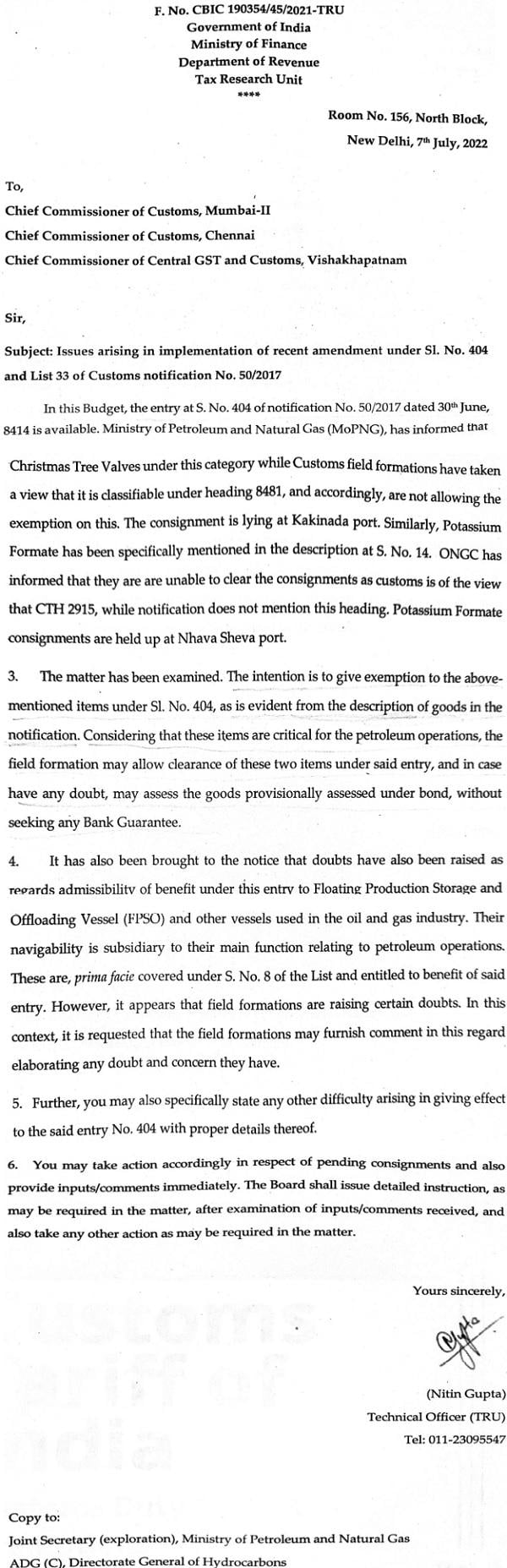
The Tribunal also relied upon the Tax Research Unit clarification dated 07.07.2022, which addressed mismatches between tariff headings and descriptions under Serial No. 404, and the certification of the Directorate General of Hydrocarbons that the MEG Reclamation Plant was meant for specialized services for offshore and onshore petroleum operations and was necessarily required for production of natural gas.
The Tribunal held that the 2024 specific entry did not retrospectively deprive the goods of exemption available under the general description in Serial No. 4 for the earlier period. It distinguished LM Wind Power Blades, Hardeep Singh and Vivo Mobile India on their facts and statutory context. The Tribunal further held that the strict ambiguity principle in Dilip Kumar was not attracted because the notification, on a plain reading, was not ambiguous.
Referring to Government of Kerala Vs Mother Superior Adoration Convent and other decisions concerning beneficial exemptions, it held that the purpose of the notification—facilitating petroleum and natural gas exploration, production and processing—was relevant to its interpretation. The Tribunal ultimately found no infirmity in the Commissioner (Appeals)’s reasoning and dismissed the department’s appeal.
List of Cases Discussed / Relied Upon:
- Jain Engineering Co. Vs Commissioner of Customs [1987]
- Tata Tea Ltd Vs CCE [2004 (164) ELT 315 (Tri-Del)]
- Share Medical Care Vs Union of India [2007 (209) ELT 321 (SC)]
- Coca Cola India P Ltd Vs CCE [2009 (15) STR 657 (Bom)]
- Jetlite India Ltd Vs CCE, New Delhi [2011 (21) STR 119 (Tri-Del)]
- CC (Import), Mumbai Vs Dilip Kumar & Company [2018 (361) ELT 577 (SC)]
- Hardeep Singh Vs State of Punjab & Others [2014 (3) SCC 92]
- CCE, Nagpur Vs Universal & Allied Chemicals Ltd [2020 (372) ELT 14 (SC)]
- LM Wind Power Blades (India) Pvt Ltd Vs CC, Tuticorin [2015 (327) ELT 641 (Tri-Chennai)]
- Vivo Mobile India Pvt Ltd [2024 (20) Centax 393 (Tri-Del)]
- Datex Ohmeda India Pvt Ltd Vs CC, Bangalore [2018 (362) ELT 866 (Tri-Bang)]
- Government of Kerala Vs Mother Superior Adoration Convent [2021 (376) ELT 242 (SC)]
- CCCE & ST, Patna Vs Shapoorji Pallonji and Co Pvt Ltd & Ors [2023 (10) TMI 748 (SC)]
- CCE, Hyderabad Vs Sunder Steels Ltd [2005 (181) ELT 154 (SC)]
- CCE (Preventive), Gujarat Vs Reliance Petroleum Ltd [2008 (227) ELT 3 (SC)]
FULL TEXT OF THE CESTAT HYDERABAD ORDER
The Commissioner of Customs (Preventive), Vijayawada (hereinafter referred to as the department) has come in appeal against Order-in-Appeal No.VJD-CUSTM-000-APP-62-2025-26 dt.16.10.2025 (Impugned Order). Vide the aforesaid impugned order, the Commissioner (Appeals) has set aside the order dt.04.09.2024 passed by the Assistant Commissioner of Customs, Kakinada (Original Adjudicating Authority).
2. The issue, in brief, is that M/s Reliance Industries Ltd (hereinafter referred to as the respondent) had imported a Mono Ethylene Glycol (MEG) Reclamation Plant (impugned goods) under the cover of 10 Bills of Entry during the period starting from 03.01.2023 to 17.06.2024, classifying the same under the CTH 84198990 and claiming exemption from payment of Customs duty in terms of S.No.404 of Notification No. 52/2017-Cus dt.30.06.2017 (hereinafter referred to as the said notification). The concerned authorities had allowed the import of the impugned good under the cover of 8 different consignments covered by 10 Bills of Entry. Since the department had not agreed with the aforesaid claim of exemption, the respondents were allowed to clear the said consignments on payment of duty at merit rate under protest, keeping the assessment provisional.
3. The Adjudicating Authority, for the purpose of finalizing provisional assessment of the said BoEs, gave personal hearing and accordingly, the respondents availed the said opportunity and also gave written submissions. After having regard to their submissions, wherein they, inter alia, emphasized that the impugned good was purchased under one purchase order dt.28.06.2021 even though it was imported under various consignments in an un-assembled condition and by virtue of Rule 2(a) of General Rules of Interpretation of Tariff, same are classifiable under the same tariff heading as that of assembled plant. Insofar as notification was concerned, they argued that in order to avail the benefit of Notification No. 50/2017-Cus dt.30.06.2017, as amended and applicable during the relevant period, only three conditions have to be fulfilled, as under.
a) The goods should be of the description specified in Column 3 of the Table read with the relevant List,
b) The goods should fall within the Chapter, heading, sub-heading or tariff item as specified in Column 2 of the Table and
c) The condition, if any, specified in Column 6 of the Table must be satisfied.
Since they have met all the three requirements, they are eligible for the said exemption notification. They also relied on the ratio of the decision of Hon’ble Supreme Court in the case of Jain Engineering Co Vs CC [1987
4. The adjudicating authority has gone through the said notification and the List 33, as it existed prior to 02.02.2022, as also from 24.07.2024, apart from as it existed during the relevant period i.e., 02.02.2022 to 23.07.2024. He, inter alia, held that keeping in view the amendments in the notification, when the equipment/units for MEG Reclamation & Regeneration Facilities under tariff item 841989 was specifically mentioned w.e.f. 24.07.2024, same was not covered for the period prior to that, as the said entry cannot have any retrospective effect. Additionally, he also held that since during the relevant period, in List 33, there was Column 2 also indicating heading/tariff item, apart from the description, it has restricted the scope of exemption. Against the said order, on appeal by the respondents, the Commissioner (Appeals) has examined the entire issue in the impugned order. He examined various grounds taken by the respondent including, inter alia, the following.
a) That the Notification No. 50/2017-Cus dt.30.06.2017 grants exemption from duty to the goods of the description specified in column 3 of the table read with relevant list appended to the notification and falling within the chapter, heading, sub-heading or tariff item of the first schedule of the Customs Tariff Act, 1965, as are specified in column 2 of the said table, in addition to the condition specified in column 6 of the table. Therefore, in order to avail the said exemption, three conditions are required to be met, as mentioned above.
b) That the adjudicating authority has nowhere disputed the respondent’s claim that the MEG Reclamation Plant answers the description viz., ‘Equipment/Units for specialized services meant for Offshore and Onshore Petroleum Operations’, given at S.No.4 in column 3 of the List 33.
c) That there is no dispute that this is a plant/unit meant for specialized services meant for offshore and onshore petroleum operations and is necessarily required for production of natural gas.
d) That they have met the criteria of description of goods in column 3 of the table of List 33 and that they have met the criteria of chapter specified in column 2 of the table.
e) That, as held in the following judgments, each entry in a notification is a distinct, separate and self-contained exemption and the scope of an
(4) C/30057/2026 entry in the notification has to be determined independently based on the words/ terms used therein and not by comparison with or reference to the terms of some other entry in the notification.
a) Tata Tea Ltd Vs CCE [2004 (164) ELT 315 (Tri-Del)] b) Share Medical Care Vs UOI [2007 (209) ELT 321 (SC)] c) Coca Cola India P Ltd Vs CCE [2009 (15) STR 657 (Bom)]
f) That holding that the imported goods must fall within the tariff heading mentioned at S.No.4 in column 2 of List 33 would render redundant the specific description of goods given in the later part of the said S.No.4, which broadly covers two categories of goods viz., a) Oil and Gas Rigs (Onshore) Petroleum and Gas Well Drilling Machinery and b) Equipment/Units for specialized services meant for Offshore and Onshore Petroleum Operations.
g) That the second category of goods are for other specialized services other than Drilling, which, by their very nature cannot fall under heading 8430 and accordingly, if the scope of S.No.4 is to be restricted only to goods of heading 8430, it would render redundant and omit the specific mention of the second category of goods for specialized services.
5. The Commissioner (Appeals) has examined the said notification and List 33 to the said notification at S.No.404. According to him, the Central Government has exempted the goods of the description specified in column 3 of the said list. He, inter alia, held that subject goods are imported by the respondent, who is the specified person, as is required in terms of condition of the notification and also that the said goods have been imported in relation with the petroleum operations under the New Exploration Licensing Policy (NELP). He also held that said goods would be falling under chapter 84, which has been reflected in column 2 of the table of the said notification. He also took into account that Directorate General of Hydrocarbons (DGH), vide its letter dt.16.12.2022, inter alia, certified that the said plant/unit was meant for specialized services for offshore and onshore petroleum operations and is necessarily required for production of natural gas.
6. Further, keeping in view the HSN explanatory notes to CTH 8430, he observed that but for limited category of goods covered under ‘drilling machinery in relation to petroleum’, as reflected in one category of goods at column 3 of S.No.4 of List 33, no other equipments for specialized services for offshore and onshore petroleum operations can possibly be covered within the scope of heading 8430. Therefore, the interpretation adopted by the adjudicating authority would not only water down the notification but tantamount to striking down the wordings ‘Equipment/Unit for specialized services meant for Offshore and Onshore Petroleum Operations’, as reflected in column 3 of List 33.
7. Insofar as the effect of amendment to the List 33 by inserting S.No.3, vide Notification No. 30/2024-Cus dt.23.07.2024, being a specific entry vis- à-vis List 33 Entry No.4, which is a general entry, he held that the said specific entry has to operate prospectively, whereby, the impugned goods would be covered under the specific serial number i.e., S.No.3, however, prior to amendment, the goods shall legitimately be covered under general entry. He has relied on ratio decidendi of the Tribunal Mumbai in the case of Jetlite India Ltd Vs CCE, New Delhi [2011 (21) STR 119 (Tri-Del)] and decision of Hon’ble Supreme Court in the case of Jain Engineering Co Vs CC (supra). He has also considered the implication of the judgment of Hon’ble Supreme Court in the case of CC (Import), Mumbai Vs Dilip Kumar & Company [2018 (361) ELT 577 (SC)]. He has observed that there is no ambiguity in the said notification and as evident from plain reading itself, they are eligible for exemption and hence the ratio is not applicable.
8. The department has essentially held that the impugned order is not legal and proper on the following grounds.
a) Insofar as criterion of three conditions adopted by the Commissioner (Appeals), cited supra, the findings and observations relating to third criteria are not correct.
b) That the exemption is applicable to the goods described in column 3 of the table subject to their falling within chapter, heading, sub-heading or tariff item as specified in the corresponding entry in column 2 of list 33 and therefore, in addition to column 2 and column 3 of the table, list 33 should also be read for the exemption and list 33 has column 2 also specifying heading/tariff item. Therefore, the goods specified (6) C/30057/2026 under column 3 of entry 404 have to necessarily fall under relevant heading/tariff item mentioned in column 2 of list 33.
c) That in the case of Hardeep Singh Vs State of Punjab & Others [2014 (3) SCC 92], as referred in the case of CCE, Nagpur Vs Universal & Allied Chemicals Ltd [2020 (372) ELT 14 (SC)], the Constitution Bench of the Hon’ble Supreme Court has held that “No word in a statute has to be construed as surplusage. No word can be rendered ineffective or purposeless. Courts are required to carry out the legislative intent fully and completely. While construing a provision, full effect is to be given to the language used therein, giving reference to the context and other provisions of the statute. …”.
d) That the findings of the Commissioner (Appeals) that only one category of the goods viz., the ‘petroleum drilling machinery’ falls under chapter sub-heading 8430 and the other category of goods viz., ‘equipment/units for specialized service for offshore and onshore petroleum operations’ are not covered at chapter sub-heading 8430 is not correct.
e) That there could be more goods falling under CTH 8430 in addition to drilling machinery.
f) That though there is no dispute with regard to letter of the DGH mentioning that the subject goods i.e., MEG Reclamation Plant, which is a plant/unit meant for specialized services for offshore and onshore petroleum operations and is necessarily required for production of natural gas. However, in order to get eligible for exemption, the said good has to fall within the scope of list 33 and merely because said goods are required for petroleum operations, it cannot be inferred that said goods are eligible for exemption.
g) That DGH is not proper authority to decide the eligibility under the said notification.
h) That the observation of the Commissioner (Appeals) as regards subject goods were being rightly classifiable under general entry of S.No.404 until specific entry came into force is not correct as even after amendment, S.No.4 of the list remained same as it was prior to the amendment and the subject goods falling under chapter heading 8419 has now been mentioned specifically at S.No.3, which indicates that the same was not covered under the scope of S.No.4 and the (7) C/30057/2026 intention of the Government was to extend exemption to subject goods only w.e.f. 24.07.2024. i) That the Commissioner (Appeals) has not applied the ratio of the decision of Hon’ble Supreme Court in the case of CC (Import), Mumbai Vs Dilip Kumar & Company (supra).
9. Learned Special Counsel for the department has taken us through the grounds of appeal filed by the department, wherein, inter alia, the department has pointed out that the findings to the effect that column 2 of list 33 is not relevant for determining the eligibility of the goods is not proper and legal for various reasons including the fact that in case any list is appended specifying the goods, exemption is applicable to the goods of the description as specified in column 3 of the said table read with relevant list, which would obviously mean and cover all the entries therein including column 2 of the list. He has pointed out that interpretation of the Commissioner (Appeals) is not legally permissible as held by Hon’ble Supreme Court in the case of CCE, Nagpur Vs Universal & Allied Chemicals Ltd (supra). Further, the inference of the Commissioner (Appeals) that the goods described as ‘equipment/units for specialized services meant for offshore and onshore petroleum operations’ are not covered under the heading 8430 is not correct as the same covers several items of machinery in addition to drilling machinery and that the said machinery falling under the heading 8430 can be used to provide support/ preparatory services. It was also pointed out that the impugned good is a part of the manufacturing facility and is not for providing any specialized services such as technical, engineering, consultancy and maintenance, etc. services.
10. He has relied on the judgment in the case of LM Wind Power Blades (India) Pvt Ltd Vs CC, Tuticorin [2015 (327) ELT 641 (Tri-Chennai)], whereby the Tribunal, while interpreting an identically worded Notification No. 06/2002 dt.01.03.2002, inter alia, held that only after classifying the goods into correct chapter headings, under respective chapter of CTA or CETA, the question of extending of notification benefit or rate of duty to be finalized and not vice versa. He has also pointed out that the DGH is not the proper authority to decide the eligibility for exemption in the said notification. In this regard, he has relied on the judgment of Coordinate Bench in the case of Vivo Mobile India Pvt Ltd [2024 (20) Centax 393 (Tri- (8) C/30057/2026 Del)], which was later on affirmed by the Hon’ble Supreme Court. Thus, each entry in list 33 has to be construed independently, untrammeled by anything contained in any other entry, as observed by the Tribunal in the case of Tata Tea Ltd Vs CCE, Kochi (supra). Insofar as the observation of the Commissioner (Appeals) that the amending notification in 2024 is not relevant, he has pointed out that the said observation is not based on any legal authority or statutory basis, as the tariff heading shown against general entry ‘equipment/units for specialized services for offshore and onshore petroleum operations’ was 8430 prior to 2024, whereas, the heading applicable all along to the impugned good was 8419. Furthermore, the 2024 amendment has placed impugned plant with ‘equipment required for process and production platform’ and therefore, if it was already covered under S.No.4, there is no need to specify it and club it under ‘equipment required for process and production platform’.
11. Insofar as reliance placed by the Original Authority on the decisions of Hon’ble Supreme Court in the case of CC (Import), Mumbai Vs Dilip Kumar & Company (supra), the same is applicable to the facts of the case as there is an ambiguity in the notification and hence, the benefit should go to the Revenue.
12. Learned Advocate for the respondent, on the other hand, has, inter alia, highlighted the fact that department has not disputed that the impugned good is ‘equipment/units for specialized services for offshore and onshore petroleum operations’, which has also been certified by the DGH, vide letter dt.16.12.2022. He has submitted that the Original Authority has primarily proceeded on the basis that by an amendment dt.24.07.2024, the impugned good was specifically incorporated in S.No.3 of list 33 and therefore, it was inferred that prior to the said date, the impugned goods were not eligible for exemption under Notification No.50/2017. He has taken us through the basis on which the Commissioner (Appeals) has passed the impugned order, which are as under.
a) That the subject good is ‘equipment/units for specialized services for offshore and onshore petroleum operations’, which is specified at S.No.4 of list 33.
b) That merely because by subsequent amendment, it was specifically added at S.No.3 of said list, it would not make the subject good (9) C/30057/2026 ineligible for exemption under S.No.4 of the said list for the period prior to the said amendment. c) That the view of the department that merely because heading 8419, which is applicable to the impugned good was not appearing in column 2 of list 33 at S.No.4 and therefore, it would make the impugned good ineligible, is not correct as the list 33 is only relevant for the description of the goods and not for tariff heading and as far as chapter, heading, sub-heading or tariff item are concerned, the same have to be specified in column 2 of the table and admittedly, chapter 84 is appearing at column 2 of the table.
13. He has further submitted that in order to be eligible for the said notification, only three conditions have to be fulfilled and since the impugned goods fulfill and satisfy all the three requirements, hence eligible for exemption. He has specifically taken us through the wordings in the notification, wherein S.No.404 specifies, inter alia, Chapter 84 in column 2 of the table and there is no mention of any heading or sub-heading or tariff item in the said column 2 of the table. Further, it provides exemption to the goods of the description specified in column 3 of the table or as specified in column 3 of the list 33, when imported by a specified person in relation with petroleum operations undertaken, inter alia, under the NELP. He has specifically submitted that the requirement of the notification is that the impugned goods must fall within the chapter, heading, sub-heading or tariff item as specified in column 2 of the table and not column 2 of the list and therefore, there is no stipulation in the notification that the goods must fall within the chapter headings specified in column 2 of list 33. Therefore, mentioning of heading 8430 and non-mentioning of heading 8419 in column 2 of list 33 at S.No.4 is entirely irrelevant to the issue of eligibility. He has also submitted that at best the headings mentioned in column 2 of list 33 are indicative or illustrative and not exhaustive and therefore not relevant. In this regard, he has given various examples of various entries in column 3 read with headings shown in column 2, as under.
a) The very first serial number in list 33 mentions in column 2 the heading 7304, but amongst the description of goods in column 3 there is mention of couplings which specifically fall under heading 7307. Column 2 in S.No.1 does not mention the heading 7307 under which (10) C/30057/2026 couplings fall and yet couplings are specifically mentioned in the description of goods in column 3. This clearly shows that the headings mentioned in column 2 of list 33 are not exhaustive and/or not fully accurate or aligned with description given in column 3 of list 33.
b) S.No.3 in list 33 mentions ‘gas turbine’ in column 3 under description of goods. Gas turbines fall under heading 8411. However, there is no mention of heading 8411 in column 2 of list 33 at S.No.3. This clearly shows that the headings mentioned in column 2 of list 33 are not exhaustive and/or not fully accurate.
c) S.No.8 in list 33 mentions ‘barges’ in column 3 under description of goods. Barges fall under heading 89011030. However, there is no mention of heading 89011030 in column 2 of list 33 at S.No.8. This clearly shows that the headings mentioned in column 2 of list 33 are not exhaustive and/or not fully accurate.
d) S.No.11 in list 33 mentions ‘survey vessel required for petroleum operations’ in column 3 under description of goods. However, there is no mention of chapter 89 under which vessels fall, mentioned in column 2 of list 33 at S.No.11. Though no heading of vessel is mentioned in column 2 at S.No.11, survey vessels are mentioned in description of goods in column 3. This clearly shows that the headings mentioned in column 2 of list 33 are not exhaustive and/or not fully accurate.
e) S.No.13 in list 33 mentions ‘fire and gas detection equipment including H2S monitoring equipment’ in column 3 under description of goods, whereas, column 2 mentions heading 90301000, which covers instruments and appliances for measuring or detecting ionizing radiations, which has nothing to do with fire, gas or H2S. This clearly shows that the headings mentioned in column 2 of list 33 are not exhaustive and/or not fully accurate.
14. Therefore, the headings mentioned in column 2 of list 33 are not exhaustive and/or not fully accurate or aligned with the description of the goods, which has also been clearly acknowledged and recognized by the department as is apparent from letter dt.07.07.2022 of Tax Research Unit (TRU), Ministry of Finance, Government of India, Department of Revenue. In this regard, he has also relied on the ratio of the decision of Hon’ble Supreme Court in the case of Jain Engineering Co Vs CC (supra), wherein, (11) C/30057/2026 the description of the goods mentioned in the particular entry was both internal combustion piston engines and parts, whereas, the heading mentioned was only that of the engines and not of the parts. The Hon’ble Supreme Court held that when parts are specified in the description of the goods, the exemption cannot be denied for parts for reason of non-mention of the heading applicable to parts.
15. Insofar as reliance placed on the entry at S.No.3 of list 33 w.e.f. 24.07.2024 by the original authority is concerned, it is a settled issue that each entry in a notification is distinct, separate and self-contained exemption and the scope of an entry in the notification has to be determined independently based on the words/terms used therein and not by comparison with or reference to the terms of some other entry in the notification. He has relied on the following decisions.
a) Tata Tea Ltd Vs CCE [2004 (164) ELT 315 (Tri-Del)] b) Share Medical Care Vs UOI [2007 (209) ELT 321 (SC)] c) Coca Cola India P Ltd Vs CCE [2009 (15) STR 657 (Bom)]
16. Therefore, the impugned goods though specifically indicated at S.No.3 w.e.f. 24.07.2024, it does not mean that the said good was not covered for the earlier period by the general description given in another entry i.e., S.No.4, which existed even prior to 24.07.2024. Therefore, they were well within their rights to claim exemption under S.No.4 for the period prior to 24.07.2024 and for the period beyond 24.07.2024, the same would now be covered under S.No.3.
17. Heard both sides and perused the records.
18. We find that the core issue to be decided in this appeal is that whether the impugned goods are eligible for exemption in terms of S.No.4 of list 33 of Notification No. 50/2017-Cus dt.30.06.2017 (S.No.404), as amended or otherwise.
19. We find that the respondent had imported impugned good under the cover of various BoEs though they had placed the order for the subject good under one purchase order, which for the sake of transportation were imported in an unassembled condition and therefore, they had filed several BoEs during the period 03.01.2023 to 17.06.2024. The assessment was kept (12) C/30057/2026 provisional and finally, it was finalized where the exemption was denied. Against the said denial, the respondent went before the Commissioner (Appeals), who allowed their appeal and held that they are eligible for said exemption. It is against the said order of Commissioner (Appeals), the department has come in appeal before us.
20. Before we proceed further, we are reproducing the said notification, as amended vide Notification No. 02/2022-Cus dt.01.02.2022, as under. Exemption and Effective rates of Customs Duty and IGST for specified goods of Chapter 1 to 98 – In exercise of the powers conferred by sub-section (1) of section 25 of the Customs Act, 1962 (52 of 1962) and sub-section (12) of section 3, of Customs Tariff Act, 1975 (51 of 1975), and in supersession of the notification of the Government of India in the Ministry of Finance (Department of Revenue), No. 12/2012 -Customs, dated the 17th March, 2017 published in the Gazette of India, Extraordinary, Part II, Section 3, Sub-section (i), vide number G.S.R. 185
(E) dated the 17th March, 2017, except as respects things done or omitted to be done before such supersession, the Central Government, on being satisfied that it is necessary in the public interest so to do, hereby exempts the goods of the description specified in column (3) of the Table below or column (3) of the said Table read with the relevant List appended hereto, as the case may be, and falling within the Chapter, heading, sub-heading or tariff item of the First Schedule to the said Customs Tariff Act, as are specified in the corresponding entry in column
(2) of the said Table, when imported into India,-
(a) from so much of the duty of customs leviable thereon under the said First Schedule as is in excess of the amount calculated at the standard rate specified in the corresponding entry in column (4) of the said Table; and
(b) from so much of integrated tax leviable thereon under sub- section (7) of section 3 of said Customs Tariff Act, read with section 5 of the Integrated Goods and Services Tax Act, 2017 (13 of 2017) as is in excess of the amount calculated at the rate specified in the corresponding entry in column (5) of the said Table, subject to any of the conditions, specified in the Annexure to this notification, the condition number of which is mentioned in the corresponding entry in column (6) of the said Table.
TABLE
| S.No. | Chapter or Heading or sub- Heading or tariff item | Description of go ods | Standard rate | Integrated Goods and Service Tax | Condition No. |
|---|---|---|---|---|---|
| 404 | 27, 29, 31,38, 39, 73,82, 84, 85,87, 89 or 90 | Goods specified in column (3) of List 33 when imported by a specified person, in relation with petroleum operations or coal bed methane operations undertaken under: a) petroleum exploration licenses or mining leases | Nil | 12% | 48 |
(13) C/30057/2026 b) the New Exploration Licensing Policy c) the Marginal Field Policy d) the Coal Bed Methane Policy e) the Hydrocarbon Exploration Licensing Policy or Open Acreage Licensing Policy.
21. Similarly, list 33, as was applicable and which is relevant for the issue, is cited below. Heading/Tariff
| S.No. | Heading/Tariff Item | Description |
|---|---|---|
| 4. | 8430 | Oil and Gas Rigs (Onshore) Petroleum and Gas well Drilling Machinery and Equipment/Units for specialized services for Offshore and Onshore petroleum operations. |
22. Before we proceed further, some of the admitted facts are also required to be summarized for further appreciation of issues involved. The respondent had signed a Production Sharing Contract (PSC) with the Government of India for exploration, development and production of oil and gas in KGD6 block, where they are the operator for the block. Further, there is no dispute that the said plant imported by them in unassembled condition has to be treated as complete MEG Reclamation Plant and not as parts, etc., in view of Rule 2(a) of General Rules of Interpretation of Tariff. This, in any case, has not even been disputed that it is not a complete plant and that the said plant was being used to reclaim the MEG, which is injected at the well heads in the course of oil or gas exploration for preventing any hydrate formation. It is also not disputed that said processing is being done at the onshore processing terminal located at Kakinada after transportation of production fluid containing natural gas with associated condensate, produced water and injected MEG from offshore production facility. There is also no dispute that during the relevant period, they were a specified person and they were undertaking petroleum operations under NELP of the Government of India.
23. The main dispute is on account of the fact that while S.No.4 of the list 33 provides description as ‘oil and gas rigs (onshore) petroleum and gas well drilling machinery and equipment/units for specialized services for offshore and onshore petroleum operations’, but according to department, this description has to fit into the heading/tariff item indicated in column 2 of the said list i.e., 8430, whereas, as per Commissioner (Appeals), the plain (14) C/30057/2026 reading of the entry at S.No.404 would only indicate that it exempts goods specified in column 3 of list 33, when imported by a specified person in relation with petroleum operations. Thus, the entry 404 does not speak about column 2 of list 33 and it extends the exemption to the description of the goods subject to certain conditions, as indicated above. There is no dispute about their not meeting any conditions stipulated under S.No.404 except for the dispute that column 2 of list 33 has to be read along with the description.
24. The Commissioner (Appeals) has taken a view that as is evident from the main body of the notification, the Government has exempted goods of the description specified in column 3 of the table or in column 3 of said table read with relevant list appended thereto, as the case may be, and falling within the chapter, heading, sub-heading or tariff item of the first schedule to the said Customs Tariff Act, as are specified in the corresponding entry in column 2 of the said table.
25. We note that the Commissioner (Appeals) has based his conclusions regarding the eligibility of impugned goods under said notification primarily on the ground that a plain reading of the notification would invariable lead to the conclusion that the exemption is available to impugned goods i.e. ‘equipment/units for specialized services meant for offshore and onshore petroleum operations’. Additionally, he has also examined the basis for denial of the exemption by the Original Adjudicating Authority. According to him, the Original Authority has relied heavily on the fact that since a specific entry for the impugned goods has been inserted in the said notification w.e.f. 24.07.2024, therefore, prior to that date the said impugned goods would not be eligible. Commissioner (Appeals) felt that this inference of the adjudicating authority is not correct as even though the impugned goods will be covered under the specific entry w.e.f. 24.07.2024, it cannot be said that the said impugned goods was not covered under general entry during the preceding period. In this regard, his observation is that it has generally been held that if a new entry is inserted for certain goods, it is normally prospective and relied on the judgment of Coordinate Bench in the case of Jetlite India Ltd Vs CCE, New Delhi (supra), wherein, inter alia, it was held that introduction of specific entry does not mean that such goods covered (15) C/30057/2026 under specific entry was not covered under general entry prior to the said date.
26. The Commissioner (Appeals), has also examined the averment of the Original Adjudicating Authority at para 10.4 of original order, where he had observed that revamping of an exemption and insertion of tariff is to restrict the scope of exemption and to cast responsibilities on importers to import the goods. He has also examined the proposition that the description in column 3 has to be read along with chapter heading 8430 appearing in column 2 for giving benefit of exemption. He examined the scope of chapter 8430 and concluded that out of two distinct categories of goods as serial no. 4, this heading would only cover one item i.e., petroleum and gas well drilling machines and there is no scope for classifying the other item. Therefore, the insertion of ‘equipment/unit for specialized service’ under the same heading would become irrelevant and such averment of the Adjudicating Authority defeats the plain reading of the said notification’s object, intent, purpose and functionality.
27. He has also examined the applicability of the ratio of Dilip Kumar Company, supra, by holding that there is no ambiguity in reading of the said notification. The ratio of the said judgment cannot be applied. He has also relied on the judgment of Coordinate Bench in the case of M/s Datex Ohmeda India Pvt Ltd Vs CC, Bangalore [2018 (362) ELT 866 (Tri-Bang)].
28. A plain reading of this notification would indicate that the goods are either exempted, with or without condition, in the main table itself, where there is omnibus indication of chapter or heading or sub-heading or tariff item in column 2 and different entries have different classifications, either at 2 digit level, 4 digit level or 8 digit level. Therefore, insofar as the main table is concerned, it is very obvious that it provides not only the description in column 3, which is relevant, but the same has to be also specified in the corresponding entry in column 2, which may be in terms of chapter, heading, sub-heading or tariff item. It is important to note that the condition for meeting the entry in column 2 is either chapter, heading, sub-heading or tariff item. Therefore, when it comes to S.No.404, the description in column 3 is not sufficient as it has to also meet the chapter or heading or sub- heading or tariff item as indicated in column 2 of the said main table in the notification. Therefore, unless the goods of the description also are (16) C/30057/2026 otherwise covered within the chapters indicated at column 2 of entry at S.No.404, they will not be eligible for the exemption. It is, however, obvious that apart from the main table, there is a provision for extending the said exemption to the goods specified in column 3 of list 33 subject to certain conditions. Therefore, there is a clear wording of the main notification and table that the exemption is being extended to the goods as specified in column 3 of list 33 and it does not speak of goods specified in column 3 read with heading, sub-heading or tariff item as specified in column 2 of list 33.
29. This is the plain reading, which has been adopted by the Commissioner (Appeals), who, in support of this view, has pointed out that even otherwise if it is to be held that the classification as indicated in column 2 of list 33 i.e., 8430 has to be read along with the description of the goods at column 3, it would lead to a situation where no equipment/unit for specialized services for offshore and onshore petroleum operations can be covered and at best, only drilling machinery in relation to petroleum would get covered. We find that this observation is only to point out that the wider scope of goods described in a generic term would not get covered within the limited scope of tariff entry at 8430. Therefore, the said entry is not relevant, though Revenue has tried to argue that this observation is not correct essentially on the ground that there are many items, which may still be covered within the expression ‘equipment/units for specialized service for offshore and onshore petroleum operations’ and still fall under 8430. Revenue has given a few examples in support that there are certain items, which could still be falling under generic description and yet classifiable under heading 8430. We find that the entry is primarily covering grading, levelling, scraping, excavating, tamping, compacting, extracting or boring machinery for earth, minerals or ores and generally covers machinery for excavation, digging, drilling or for preparing or for compacting the terrain. Therefore, the scope of heading 8430 obviously cannot cover the vast compass of the expression used in column 3, which covers clearly oil and gas rigs (onshore) petroleum and gas well drilling machinery as well as ‘equipment/units for specialized services for offshore and onshore petroleum operations’.
30. We have gone through the tariff entry 8430 and HSN explanatory note thereto. It is essentially for excavation, drilling, digging, etc., and are very (17) C/30057/2026 clearly identifiable equipment. There is only one specific item viz., petroleum and gas well drilling machinery. We note that neither the expression ‘petroleum operations’ nor ‘specialized services’ have been defined in notification. Hence, inference has to be drawn from the context in which it has been used. We find both these terms have been mentioned in the list 33 of S.No.404 of Notification No. 50/2017 at S.No.4 & 5 for the period prior to amendment. While at S.No.4, it covers marine vessels of several types supporting ‘petroleum operations’, S.No.5 indicates illustrative list of specialized services. S.No.4 & 5 are cited below. “4) All types of marine vessels to support petroleum operations including work boats, barges, crew boats, tugs, anchor handling vessels, lay barges and supply boats, marine ship equipment including water maker, DP system and Diving system.
5) All types of equipment/units for specialized services like diving, cementing, logging, casing repair, production testing, simulation and mud services, oil field related lab equipment, reservoir engineering, geological equipment, directional drilling, stimulation, Coil Tubing units, Drill Stem Testing (DST), data acquisition and processing, solids control, fishing (as related to down hole retrieval in oil field operations or coal bed methane operations), well control, blowout prevention (BOP), pipe inspection including Non Destructive Testing, coring, gravel pack, well completion and work-over for oil gas/CBM wells including wire line and down-hole equipment.”
31. As could be seen, none of these equipment except for directional drilling would get covered in 8430. Thus, the expression ‘equipment/units for specialized services for offshore and onshore petroleum operations’ is having a wider amplitude and covers multiple equipment/units with a common thread that it has to be used for ‘specialized service for offshore and onshore petroleum operations’. It is therefore inconceivable as to how all possible equipment and units for specialized purposes could be covered within the scope of one single entry i.e., 8430.
32. Further, even though the expression ‘specialized services’ has not been defined anywhere in the notification, however, the regulator for the Hydrocarbons sector has clarified/certified that the said equipment is meant for specialized services for offshore and onshore petroleum operations and is necessarily required for production of natural gas. Thus, the observation of the Commissioner (Appeals) was only to indicate the redundancy and irrelevancy of column 2, as such column would restrict the very plain meaning of the notification, which provides for exemption in terms of goods as described in column 3. Therefore, it was only to point out the irrelevance (18) C/30057/2026 of column 2 to the extent it militated against the specific description in column 3, which the department is insisting must also be fulfilled apart from description in column 3. At this juncture, it is important to see the clarification issued by TRU, vide letter dt.07.07.2022. For ease of reference, this letter is reproduced below.
33. As is apparent from the said letter, this is a clarification in respect of entry at S.No.404 of list 33 of the Notification No. 50/2017-Cus, post the amendment dt.02.02.2022, where the department, based on certain reference made by Nodal Ministry i.e., Ministry of Petroleum and Natural Gas, examined the issue in respect of certain denial of exemption to a few products on the grounds that there is a mismatch between chapter heading and description. After examination of the same, they clarified that the intention was to give exemption to those items under S.No.404, as is evident from the description of the goods in the notification and considering that these items are critical for the petroleum operations, the field formation may allow clearance of these two items under said entry. Therefore, in other words, this clearly supports the view of the respondent and the Commissioner (Appeals) that intention was to give the exemption to the goods as described in column 3 without having much regard to the chapter headings indicated in column 2 in case there is any dispute in the coverage of the said items under the aforesaid chapter heading. This would also (21) C/30057/2026 support the view that the notification was essentially intended for extending exemption to all the specified items falling under respective headings when imported by a specified person in relation with petroleum operations. It is on record that the Regulator for the Hydrocarbons has clearly pointed out that the impugned goods are meant for specialized services for offshore and onshore petroleum operations and is necessarily required for production of natural gas. The clarification issued by DGH under the Ministry of Petroleum and Natural Gas, Government of India, cannot be ignored especially in the face of any evidence to the contrary to the effect that the impugned goods are not required for any offshore or onshore petroleum operations or for production of natural gas. Even by the very description of the use of the said plant, it is obvious that without the use of the said plant, the petroleum operations cannot be carried out and impugned good is integral to production/processing of natural gas.
34. Therefore, there is no scope for doubt that the impugned good is not covered within the expression ‘equipment/units for specialized services for offshore and onshore petroleum operations’. Insofar as the observation of the Commissioner (Appeals) that the amendment brought in 2024, whereby specific entry was created at S.No.3 to cover the impugned good, the same cannot be applied retrospectively in the sense that prior to said amendment, the goods were not eligible for exemption under any other entry as was in existence during the relevant time, it is observed that it is nobody’s case that the said entry has to be applied prospectively. However, it is also obvious that if the goods are otherwise covered by any expression or general entry even during the earlier period, the same goods would also be eligible under the respective heading and therefore, in this case, for the period prior to amendment in 2024, the goods were covered at S.No.4 and post amendment, it would be covered under S.No.3, after specific entry was carved out. In this regard, we find that reliance placed by Commissioner (Appeals) on the case of Jetlite India Ltd Vs CCE, New Delhi (supra) is relevant. We also find that he has placed reliance in the case of Jain Engineering Co Vs CC (supra), as in the said judgment, the Hon’ble Supreme Court has taken a view that even if heading mentioned in the notification was only that of engines and not that of parts, still the parts would be eligible for exemption as they are specified in the description of the goods and the exemption cannot be denied to parts for reason of non- (22) C/30057/2026 mentioning of the heading applicable to parts. Therefore, he has correctly relied on the said judgment in support that if the description of the goods covers the impugned good, even if it does not fall within the heading 8430, it would still be eligible for exemption. Reliance placed by Commissioner (Appeals) on the ratio to the facts of the case is correct.
35. Therefore, we find that the inference drawn by the Commissioner (Appeals) to the effect that amendment in 2024 would not have any impact on the exemption as was available during the relevant time in terms of general description of the said impugned goods in the notification itself and that even if there was any incongruity or non-mentioning of the relevant heading 8419 at S.No.4, it would still be entitled for exemption, is based on sound reasons and interpretation of wordings used in the said notification.
36. We find that the both sides have also relied on various case laws, as cited supra. We now proceed to examine the cited case laws. The department has relied on the case of LM Wind Power Blades (India) Pvt Ltd Vs CC, Tuticorin (supra) in support that the description has to be read along with tariff item number. We find that in this case, list 9A for the entry at S.No.237A of the table of Notification No. 06/2002 indicated not only the description but also respective tariff item. For example, it indicated at S.No.(1) ‘Injection resin, falling under tariff item 39073090’. We find that the facts in the present appeal is there is no tariff item indicated in column 3 while describing the goods or otherwise independently. Hence, in view of the same, the said judgment cannot be applied to the facts of the case.
37. Insofar as reliance placed by the department on the judgment of Hardeep Singh Vs State of Punjab & Others (supra) is concerned, we find that the Hon’ble Supreme Court in that case was examining the scope of proviso to section 5A of Central Excise Act in the given factual matrix. Section 5A granted certain exemption from payment of Central Excise duty and also carried a proviso that unless specifically provided in such notification, no exemption therein shall apply to excisable goods, which are produced or manufactured in, inter alia, 100% EOU. In this context, the Hon’ble Supreme Court felt that since the word used is ‘unless specifically provided in such notification’, has to be given full effect and the expression cannot be ignored. The specific findings are at Para 48. Thus, it is obvious that this judgment was in the context of an expression in the statute itself, (23) C/30057/2026 which clearly provided for certain conditionalities, which have to be followed before giving effect to notificational benefit. In the present appeal, there is no such situation and here, the plain reading of notification itself is leading to the conclusion arrived at by the Commissioner (Appeals) and no expression used in the statutory provisoin has been ignored while arriving at the said conclusion. Hence, we find that the case law cited is distinguished and not applicable in the present factual matrix.
38. The reliance placed on the case of Vivo Mobile India Pvt Ltd (supra) is also not relevant, as here, the DHG, which is the upstream regulatory body for petroleum and gas sector, has not classified or offered any apparent classification in the context of claim of any notification but has merely clarified the scope and end use of impugned goods as well as status of importer. Hence, the cited judgment, to our mind, is not relevant to the factual matrix of this appeal.
39. As regards the applicability of the judgment in the case of CC (Import), Mumbai Vs Dilip Kumar & Company (supra), we find that the said judgment of Hon’ble Supreme Court, inter alia, provided that every taxing statute including charging, computation and exemption clause (at the threshold stage) should be interpreted strictly and further, in case of ambiguity in the charging provision, the benefit must necessarily go in favour of the subject/ assesse but in case of ambiguity in an exemption notification, the benefit of notification must be strictly interpreted in favour of Revenue. We find that in order to apply the ratio of the said judgment, what is required first and foremost is that there has to be ambiguity while interpreting the exemption notification. In this case, Commissioner (Appeals) has held that a plain reading of the notification and entries thereto itself does not leave any room for ambiguity. We agree with this observation as we find that plain reading itself would indicate that it is the description of the goods as indicated in column 3, which is relevant as long as said goods are otherwise also covered in column 2 of the main notification. There is also no other ambiguity regarding coverage in terms of specified person or intended use. Therefore, holistically looking at the facts of the case, we find that Commissioner (Appeals) has rightly held that since there is no ambiguity, the ratio of aforesaid judgment of Hon’ble Supreme Court is not applicable.
40. Apart from the above, we also find force in the reliance placed by the respondent on the judgment of Hon’ble Supreme Court in the case of Government of Kerala Vs Mother Superior Adoration Convent [2021 (376) ELT 242 (SC)], which has examined the exemption provisions and, inter alia, held that the beneficial purpose of the notification must be given full effect to as opposed to exemptions generally in tax statutes. They distinguished the judgment in the case of CC (Import), Mumbai Vs Dilip Kumar & Company (supra). The relevant paras are cited below.
“16. However, there is another line of authority which states that even in tax statutes, an exemption provision should be liberally construed in accordance with the object sought to be achieved if such provision is to grant incentive for promoting economic growth or otherwise has some beneficial reason behind it. In such cases, the rationale of the judgments following Wood Papers (supra) does not apply. In fact, the legislative intent is not to burden the subject with tax so that some specific public interest is furthered. Thus, in CST v. Industrial Coal Enterprises – (1999) 2 SCC 607, this Court held:
“11. In CIT v. Straw Board Mfg. Co. Ltd. – 1989 Supp (2) SCC 523 this Court held that in taxing statutes, provision for concessional rate of tax should be liberally construed. So also in Bajaj Tempo Ltd. v. CIT – (1992) 3 SCC 78 it was held that provision granting incentive for promoting economic growth and development in taxing statutes should be liberally construed and restriction placed on it by way of exception should be construed in a reasonable and purposive manner so as to advance the objective of the provision.
12. We find that the object of granting exemption from payment of sales tax has always been for encouraging capital investment and establishment of industrial units for the purpose of increasing production of goods and promoting the development of industry in the State. If the test laid down in Bajaj Tempo Ltd. case – (1992) 3 SCC 78 is applied, there is no doubt whatever that the exemption granted to the respondent from 9-8-1985 when it fulfilled all the prescribed conditions will not cease to operate just because the capital investment exceeded the limit of Rs. 3 lakhs on account of the respondent becoming the owner of land and building to which the unit was shifted. If the construction sought to be placed by the appellant is accepted, the very purpose and object of the grant of exemption will be defeated. After all, the respondent had only shifted the unit to its own premises which made it much more convenient and easier for the respondent to carry on the production of the goods undisturbed by the vagaries of the lessor and without any necessity to spend a part of its income on rent. It is not the case of the appellant that there were any mala fides on the part of the respondent in obtaining exemption in the first instance as a unit with a capital investment below Rs. 3 lakhs and increasing the capital investment subsequently to an amount exceeding Rs. 3 lakhs with a view to defeat the provisions of any of the relevant statutes. The bona fides of the respondent have never been questioned by the appellant.”
20. Likewise, even under the Customs Act, this Court in Commr. of Customs (Preventive) v. M. Ambalal & Co. – (2011) 2 SCC 74 = 2010
(25) C/30057/2026
(260) E.L.T. 487 (S.C.) made a clear distinction between exemptions which are to be strictly interpreted as opposed to beneficial exemptions having as their purpose – encouragement or promotion of certain activities. This case felicitously put the law thus follows:
“16. It is settled law that the notification has to be read as a whole. If any of the conditions laid down in the notification is not fulfilled, the party is not entitled to the benefit of that notification. The rule regarding exemptions is that exemptions should generally be strictly interpreted but beneficial exemptions having their purpose as encouragement or promotion of certain activities should be liberally interpreted. This composite rule is not stated in any particular judgment in so many words. In fact, majority of judgments emphasise that exemptions are to be strictly interpreted while some of them insist that exemptions in fiscal statutes are to be liberally interpreted giving an apparent impression that they are contradictory to each other. But this is only apparent. A close scrutiny will reveal that there is no real contradiction amongst the judgments at all. The synthesis of the views is quite clearly that the general rule is strict interpretation while special rule in the case of beneficial and promotional exemption is liberal interpretation. The two go very well with each other because they relate to two different sets of circumstances.”
21. This judgment was followed in CCE v. Favourite Industries – (2012) 7 SCC 153 (see paragraph 42) = 2012 (278) E.L.T. 145 (S.C.).
22. A recent 5-Judge Bench judgment was cited by Shri Gupta in Commr. of Customs v. Dilip Kumar & Co. – (2018) 9 SCC 1 = 2018 (361) E.L.T. 577 (S.C.). The 5-Judge Bench was set up as a 3-Judge Bench in Sun Export Corporation v. Collector of Customs – 1997 (6) SCC 564 = 1997 (93) E.L.T. 641 (S.C.) was doubted, as the said judgment ruled that an ambiguity in a tax exemption provision must be interpreted so as to favour the assessee claiming the benefit of such exemption. This Court after dealing with a number of judgments relating to exemption provisions in tax statutes, ultimately concluded, as follows:
“66. To sum up, we answer the reference holding as under:
66.1 Exemption notification should be interpreted strictly; the burden of proving applicability would be on the assessee to show that his case comes within the parameters of the exemption clause or exemption notification.
66.2 When there is ambiguity in exemption notification which is subject to strict interpretation, the benefit of such ambiguity cannot be claimed by the subject/assessee and it must be interpreted in favour of the Revenue.
66.3 The ratio in Sun Export case [Sun Export Corpn. v. Collector of Customs, (1997) 6 SCC 564] is not correct and all the decisions which took similar view as in Sun Export case stand overruled.”
23. It may be noticed that the 5-Judge Bench judgment did not refer to the line of authority which made a distinction between exemption provisions generally and exemption provisions which have a beneficial purpose. We cannot agree with Shri Gupta’s contention that sub-silentio the line of judgments qua beneficial exemptions has been done away with by this 5-Judge Bench. It is well settled that a decision is only an authority for what it decides and not what may logically follow from it
(26) C/30057/2026 [see Quinn v. Leathem – [1901] AC 495 as followed in State of Orissa v. Sudhansu Sekhar Misra – (1968) 2 SCR 154 at 162, 163].
24. This being the case, it is obvious that the beneficial purpose of the exemption contained in Section 3(1)(b) must be given full effect to, the line of authority being applicable to the facts of these cases being the line of authority which deals with beneficial exemptions as opposed to exemptions generally in tax statutes. This being the case, a literal formalistic interpretation of the statute at hand is to be eschewed. We must first ask ourselves what is the object sought to be achieved by the provision, and construe the statute in accord with such object. And on the assumption that any ambiguity arises in such construction, such ambiguity must be in favour of that which is exempted. Consequently, for the reasons given by us, we agree with the conclusions reached by the impugned judgments of the Division Bench and the Full Bench.”
41. Similarly in the case of CCCE & ST, Patna Vs M/s Shapoorji Pallonji and Co Pvt Ltd & Ors [2023 (10) TMI 748 (SC)], similar view has been taken. The relevant para is cited below.
“30. Ms. Bagchi heavily relied on the decision of a five-judge Bench of this Court in Dilip Kumar (supra) to urge that in case of any ambiguity in interpreting an exemption notification, the interpretation that favours the revenue must be adopted; also, the burden of proving applicability of the exemption notification would be on the assessee to show that his case comes within the parameters of the exemption clause or exemption notification. At the outset, we record that there is absolutely no quarrel with the proposition laid down therein. We, however, reject the contention of Ms. Bagchi based on Dilip Kumar (supra) because the ratio is not applicable to the facts and circumstances of this case. This, for the simple reason, that there exists no ambiguity insofar as the interpretation of clause 2(s) is concerned. We are endorsed in our opinion by the Latin maxim quoties in verbis nulla est ambiguitas, ibi nulla expositio contra verba expressa fienda est, which means that when there is no ambiguity in the words, then no exposition contrary to the words is to be made. It is, therefore, clear as a sunny day that there arises only one plausible construction of clause 2(s) which is the one the Patna High Court adopted, and which we are inclined to uphold.”
42. Thus, we note that the said notification (S.No.404) was clearly intended for providing specific exemption to particular sector i.e., petroleum and natural gas sector, where India had gone for exploration under NELP in order to increase the production of oil and natural gas in India. In order to facilitate that, the Government has extended various incentives and exemptions for various items used for such exploration, production, processing, etc., of oil and natural gas. Therefore, the intended purpose was to promote production and exploration of natural gas, which was beneficial to the economy. In view of the same, this entry of the notification has to be construed as beneficial notification and has therefore, to be taken to its logical end. Therefore, we find that the adjudicating authority has rightly distinguished the applicability of the judgment of Hon’ble Supreme Court in (27) C/30057/2026 the case of CC (Import), Mumbai Vs Dilip Kumar & Company (supra) in the facts of the case.
43. Insofar as various other case laws cited by the respondent, we find that in the case of Share Medical Care Vs UOI (supra), the Hon’ble Supreme Court has, inter alia, examined the scope of the notification and held that it is a well settled law that in case an applicant is entitled for benefit under two different notification or under two different heads, he can claim whichever is more beneficial. The relevant para is cited below.
“16. In the instant case, the ground which weighed with the Deputy Director General (Medical), DGHS for non-considering the prayer of the appellant was that earlier, exemption was sought under category 2 of exemption notification, not under category 3 of exemption notification and exemption under category 2 was withdrawn. This is hardly a ground sustainable in law. On the contrary, well settled law is that in case the applicant is entitled to benefit under two different Notifications or under two different Heads, he can claim more benefit and it is the duty of the authorities to grant such benefits if the applicant is otherwise entitled to such benefit. Therefore, non-consideration on the part of the Deputy Director General (Medical), DGHS to the prayer of the appellant in claiming exemption under category 3 of the notification is illegal and improper. The prayer ought to have been considered and decided on merits. Grant of exemption under category 2 of the notification or withdrawal of the said benefit cannot come in the way of the applicant in claiming exemption under category 3 if the conditions laid down thereunder have been fulfilled. The High Court also committed the same error and hence the order of the High Court also suffers from the same infirmity and is liable to be set aside.”
44. Similarly, the Coordinate Bench in the case of Tata Tea Ltd Vs CCE (supra), after referring to catena of judgment of Hon’ble Supreme Court, inter alia, held as under.
“6.2. In the case of Johnson & Johnson (supra), the Hon’ble Supreme Court held that the legislative intent behind an Exemption Notification could be gathered from a subsequent notification on the same subject. In Sun Export Corporation (supra), the Apex Court held that, where two views were possible in a taxation matter, the one favourable to the assessee was to be preferred. The decision in Belapur Sugar & Allied Industries (supra) was that, unless there was anything to the contrary in the taxing statute, rules or the notification itself, if there be two possible interpretations of an Exemption Notification, that interpretation which subserved the object and purpose of exemption should be accepted. But, in the instant case, we have not heard anybody say that ‘consumable’ could be so construed as to exclude fuels like furnace oil used in boilers. In the cases of Mangalore Chemicals and Fertilizers (supra) and Novopan India (supra), it was held by the Court that, once an assessee was found to fall within the ambit of an Exemption Notification, full effect should be given to the exemption by a liberal interpretation of the terms of the notification. This ruling appears to have a say in the instant case. The appellants had, admittedly, satisfied all the substantive conditions of Notification No. 1/95-C.E. to come within its purview. The only dispute (28) C/30057/2026 was whether the “furnace oil” which was procured without payment of duty fell within the coverage of “consumables” under Entry No.
7. When construed in terms of the Apex Court’s ruling, the entry would squarely cover the appellants,’ furnace oil. We need not consider the learned Counsel’s plea for giving retrospective effect to Notification No. 40/2000- C.E.”
45. We find that this is relevant to the facts of the case and as discussed supra, the intent of the said entry, including before and after amendment, has always been to extend the exemption to the entire gamut of equipment/units which are used for oil and gas exploration, production, processing, etc., which also gets manifested by clarification issued by TRU, clarification issued by DGH, as also subsequent amendment brought in to cover the impugned good specifically. Thus, the intent of the Government behind the entry is also in support of the findings in the impugned order and respondent’s submissions.
46. In the case of CCE, Hyderabad Vs Sunder Steels Ltd [2005 (181) ELT 154 (SC)], the Hon’ble Supreme Court has, inter alia, observed, as under. “5. The Notification has to be interpreted on its wording. No words, not used in the Notification, can be added. To accept submission of Appellants one would have to read into the Notification words to the effect that 100% of the manufacture or production of ingots or billets or rolled products must be from products manufactured or produced within the same premises. No such words appear in the Notification. If the intention was to restrict benefit to only those plants in which the entire production, from iron ore stage to ingots, was to be in the same premises the Notification would have so specified. The Notification does not even provide that if any item is purchased from outside then the benefit would be lost. In the absence of any such restrictions it must be held that the Notification merely requires that all the four conditions be fulfilled. If all four conditions are fulfilled, their benefit cannot be denied on the ground that certain percentage of production is from material purchased from outside. As in this case all four conditions are fulfilled, in our view, the Tribunal was right in holding that the benefit of the Notification was available.”
47. We find this is relevant inasmuch as a plain reading of the notification itself does not provide for any requirement to refer to column 2 of list 33 for extending the benefit of notification.
48. In the case of CCE (Prev.), Gujarat Vs Reliance Petroleum Ltd [2008 (227) ELT 3 (SC)], the Hon’ble Supreme Court was examining the scope of an entry in Notification No. 11/1997-Cus dt.01.03.1997, where the entry described at column 3 of the notification as ‘goods specified in list 8A required for setting up crude petroleum refinery’. The Hon’ble Supreme Court, inter alia, held that exemption was granted to equipment made to be (29) C/30057/2026 used for a particular purpose and the purpose for which exemption was granted must be considered in entirety. The relevant paras are cited below. “20. In our opinion, the entire order has to be read as a whole. Exemption was granted to equipments made to be used for a particular purpose. A contextual meaning to the entries, keeping in view the nature of exemption sought to be granted by reason of the said notification, must be assigned. The crane was to be shifted from place to place covering a huge area. Its services were required at a large number of places. It has been found that the description of the crane, technically given as Heavy Duty Crane was, in fact, a mobile crane. Only with a view to provide mobility thereto, a self-propelled modular transport system had been provided.
It had to be consigned in different parts for convenience of transport so as to enable the importer to reassemble the same. It was on that basis, the equipment was found classifiable under Heading 84.26 and not 8724.90. In the alternative, the goods were found to be falling under serial No. 18 of the notification. This finding of fact is not in question.
What is in question is that only the crane part of the equipment would come within the purview of the exemption notification and not the entire equipment.
We do not agree with the said contention. The purpose for which the exemption was granted must be considered in its entirety. The purpose of grant for exemption cannot be lost sight of. The Central Government must be held to be aware, if not of the equipment itself, but about the nature thereof which would be required for setting up a crude oil refinery.
We are not oblivious of the proposition of law that an exemption notification should be construed directly but it is also well settled that interpretation of an exemption notification would depend upon the nature and extent thereof. The terminologies used in the notification would have an important role to play. Where the exemption notification ex facie applies, there is no reason as to why the purport thereof would be limited by giving a strict construction thereto.
21. The comparison made by the learned Solicitor General that mobility of a person would depend upon his personal fitness and not when he is placed on a wheelchair, in our opinion, is not apposite. The purpose of grant of exemption is different. The object for grant of notification shall be considered in a broad based manner. The wordings used therein have to be given its natural meaning. The purpose must be allowed to be achieved. The words ‘all types of materials’ should be construed widely.
22. We, therefore, are of the opinion that in view of the entries an furthermore the purport and object the notification sought to achieve, the Commissioner (Appeals) and the Tribunal cannot be said to be wrong in their findings that the equipment in question would be entitled to the benefit of exemption.”
49. This reliance is also relevant as the purpose for this notification is clearly to provide tax relief on import of equipment by specified persons for exploration, production or processing of petroleum products including (30) C/30057/2026 natural gas. It is obvious that S.No.404 is essentially for the items for petroleum sector. Therefore, the intention was to rationalise the list of items used in petroleum operations, as it existed prior to the amendment by Notification No.02/2002 dt.02.02.2022. It would also be obvious that all the items, which were eligible for exemption relating to petroleum sector under the un-amended notification only got rationalised and hence whatever goods were exempted earlier continued to remain exempted even after amendment, though in a rationalised format. This aspect has been duly acknowledged by the Government, vide its letter dated 07.07.2022, cited supra.
50. Therefore, we find that the grounds adopted by the Commissioner (Appeals) to extend the benefit of the notification are well reasoned and based on plain reading of the notification itself. We find that a plain reading of the said notification, entry 404 and list 33 itself does not leave any scope for any ambiguity in the interpretation and therefore, the reliance placed by the Original Authority as well as the department in the present appeal in the case of CC (Import), Mumbai Vs Dilip Kumar & Company (supra) is also not applicable to the facts of the case. We find that in view of the admitted factual position about their admissibility in terms of being a specified person, as also, for the intended use for specialized services, there is no scope to have any doubt about its coverage within the scope of S.No.404 of the said notification. Therefore, we do not find any infirmity in the conclusions arrived at by the Commissioner (Appeals).
51. Accordingly, the appeal filed by the department is dismissed.
(Pronounced in the Open Court on 04.09.2026)