Summary: The seizure of laptops, mobile phones, servers and other electronic devices during criminal investigations raises two distinct legal questions: whether the seizure itself is lawful and what access investigators may subsequently have to the information stored on the devices. This article examines the safeguards available under the Bharatiya Nagarik Suraksha Sanhita, 2023 (BNSS), particularly Section 94 concerning production of documents and electronic communications, Section 105 requiring audio-video recording of searches and seizures, Section 106 empowering police to seize property, and Section 185 governing searches during investigation. It explains that recording the seizure process can improve accountability but does not independently regulate every subsequent forensic examination, extraction or copying of data. The discussion also considers Section 63 of the Bharatiya Sakshya Adhiniyam, 2023, concerning admissibility of electronic evidence, and the constitutional right to privacy recognised in K.S. Puttaswamy v. Union of India. Judicial developments involving the seizure of electronic devices, including interim proceedings associated with Santiago Martin and the Supreme Court’s October 2025 ruling on advocates’ privileged communications, illustrate the importance of examining the particular circumstances of each case. Practical examples address seizure without video recording, mixed personal and corporate information, overbroad production demands and preservation of forensic evidence. The article concludes with precautions for businesses, including documenting search authority, obtaining detailed seizure records, identifying privileged information, preserving hash values and seeking timely judicial safeguards where appropriate.
- Police Seizure of Laptops and Phones Under BNSS: Can Investigators Access All Your Data?
- The Main Legal Issue
- Applicable Legal Framework
- Section 94 BNSS: Summons to Produce Documents and Electronic Devices
- Sections 185 and 106 BNSS: Search and Seizure Powers
- Section 105 BNSS: Mandatory Audio-Video Recording of Search and Seizure
- Section 63 BSA: Admissibility of Electronic Evidence
- Judicial Position
- Right to Privacy: K.S. Puttaswamy v. Union of India
- Supreme Court Proceedings on Electronic-Device Seizure Guidelines
- Santiago Martin Case: Restrictions on Accessing Seized Devices
- January 2026: Supreme Court Declines Interim Protection Against Device Examination
- Lawyers' Devices and Confidential Client Communications
- Practical Examples
- Example 1: Laptop Seized Without Video Recording
- Example 2: Personal Phone Containing Company Information
- Example 3: Summons for Email Server Data Under Section 94
- Common Mistakes
- Practical Steps
- Conclusion
Police Seizure of Laptops and Phones Under BNSS: Can Investigators Access All Your Data?
Investigators arrive at the company’s offices at 7 a.m. with a search warrant. By noon, they’re hauling out three laptops, two phones and a server backup and bagging them up. “So we get to find out what’s on these devices?” the finance head asks, a question any client would want answered at this point.
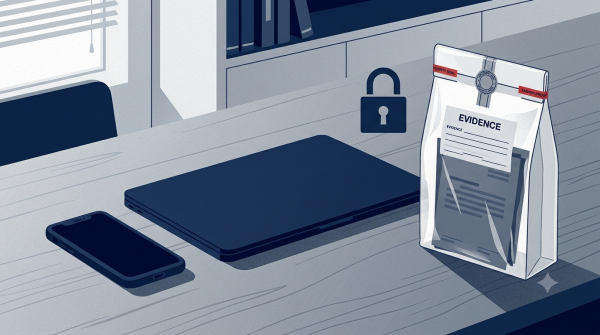
The honest answer is that the law protects the process of seizure better than it protects the content of what is seized. Understanding that gap helps a business prepare before a raid and respond after one.
The Main Legal Issue
A device is not a filing cabinet or ledger. A single laptop may hold years of emails, board papers, client privileged material, personal photos, and banking credentials. There are two sides to the legal matter. First, was the seizure lawful? Second, what can the agency do with the information?
The first has fairly clear statutory answers. The second is still being worked out by the courts.
Applicable Legal Framework
Section 94 BNSS: Summons to Produce Documents and Electronic Devices
Section 94 BNSS lets a court or police officer summon a person to produce a document or thing considered necessary for investigation. From my reading of the provision, it covers communication through electronic media as well, which may include communication devices containing digital evidence. Summonses for production and searches are two separate things.It gives the recipient a chance to produce the material and raise objections.
Sections 185 and 106 BNSS: Search and Seizure Powers
Section 185 BNSS permits a police officer to search a place without a warrant in specified circumstances. Section 106 BNSS deals with the power of police to seize property. Together, these are the usual routes by which devices end up in police custody.
Section 105 BNSS: Mandatory Audio-Video Recording of Search and Seizure
Section 105 BNSS is the provision businesses should know best. It requires search and seizure to be recorded through audio-video electronic means, preferably by mobile phone, and the recording to be sent to the Magistrate. The definition of “audio-video electronic means” in Section 2(1)(a) BNSS brings an ordinary phone within the requirement.
The practical value of Section 105 is clear. A video of the seizure shows which devices were taken, from where, in whose presence and in what condition. The weakness is equally clear. The section records the moment of seizure. It says nothing about what happens to the data once the device is mirrored, imaged or examined in a forensic lab.
Section 63 BSA: Admissibility of Electronic Evidence
Where the evidence is later relied upon in court, the usual rules on admissibility apply, including the certificate requirement under Section 63 of the Bharatiya Sakshya Adhiniyam, 2023.
Judicial Position
Right to Privacy: K.S. Puttaswamy v. Union of India
Privacy as the starting point. K.S. Puttaswamy v. Union of India, (2017) 10 SCC 1, recognised privacy as a fundamental right. Seizing a device engages that right because of how much personal and business data it holds.
Supreme Court Proceedings on Electronic-Device Seizure Guidelines
Guidelines still awaited. In 2023, in petitions that included one by the Foundation for Media Professionals, the Supreme Court asked the Centre to frame guidelines on the seizure of electronic devices. The Centre later told the Court that, until guidelines were in place, central agencies would follow the CBI manual for search and seizure of such devices.
Santiago Martin Case: Restrictions on Accessing Seized Devices
The Santiago Martin order. On 13 December 2024, the Supreme Court passed an interim order restraining the Enforcement Directorate from accessing and copying content from devices seized in searches linked to Santiago Martin, his relatives and employees of Future Gaming and Hotel Services. The petition argued that unrestricted access violated privacy and fundamental rights. This was an interim order in a specific matter. It is not a general rule that agencies can never examine seized devices.
January 2026: Supreme Court Declines Interim Protection Against Device Examination
The Court has not closed the door to examination. In January 2026, the Supreme Court declined to grant interim protection to a Kolkata businessman against the ED examining his seized phone, according to LiveLaw’s report. Read together with the Martin order, the position is that outcomes depend on the facts, the agency, the stage of investigation and the relief sought.
Lawyers’ Devices and Confidential Client Communications
Lawyers’ devices. On 31 October 2025, in a suo motu matter on summoning advocates during investigation, the Supreme Court decided that in the case where police require a lawyer to produce digital devices under Section 94 BNSS, the production should take place only before the court jurisdictionally competent to try the case, which will then determine the validity of any objection raised by the lawyer. The Court noted that the confidentiality of clients other than the law his client must be protected.
Practical Examples
Example 1: Laptop Seized Without Video Recording
Example 1. A manufacturing company’s accounts laptop is seized without any video recording. Non-compliance with Section 105 is a point to raise before the Magistrate. Whether it makes the material inadmissible is a separate question and depends on the facts. Courts have generally been reluctant to exclude relevant evidence solely for procedural irregularity, so the safer view is that it weakens the prosecution’s position on reliability and chain of custody rather than automatically defeating it.
Example 2: Personal Phone Containing Company Information
Example 2. An employee’s personal phone, which also carries company WhatsApp groups, is taken. The company’s confidential data and the employee’s private data are now in the same device. A prompt application seeking restriction on access, or return of the device with a clone retained, is the type of relief parties have pursued.
Where data from a seized phone later becomes the basis for a tax addition, a different set of evidentiary questions arises, which I have discussed in WhatsApp chats, Excel sheets and seized phones as the basis for a tax addition.
Example 3: Summons for Email Server Data Under Section 94
Example 3. A summons under Section 94 asks a company to “produce” its email server data. Here the company has an opportunity to respond, seek clarity on scope, and object to overbroad demands before handing anything over.
Common Mistakes
- Handing over passwords informally without noting what was requested and by whom.
- Not asking whether the search is being recorded, and not noting down if it is not.
- Allowing seizure of the main server when a targeted copy would have satisfied the requirement.
- Failing to flag privileged client communications or personal data at the time of seizure.
- Waiting weeks before approaching the court, by which time the data may already have been examined.
- Assuming the Santiago Martin interim order protects every device in every case.
Practical Steps
- Ask for the authority under which the search is made and note the section invoked.
- Check whether Section 105 recording is being done. Make a written note of times, officers present and devices taken.
- Get a seizure memo listing each device with make, model and serial number.
- State on record any privileged or personal data on the devices.
- Ask for the hash values or imaging details if the devices are cloned, and keep your own record of the data held. Keeping your own preserved copy matters, and the principles are covered in preserving electronic records for litigation.
- Consult counsel immediately on applying to the Magistrate or High Court for return, restricted access, or safeguards on examination.
- For the long term, keep personal and company data separate, maintain backups, and have an internal protocol for raid day.
Conclusion
Section 105 BNSS offers something that earlier legislation did not – an account of how a seizure occurred. But the legislation remains silent on what extent of investigation is permissible once the device is in agency control. Until Parliament or the Supreme Court provides direction, the intelligent approach is to compile the account at the time of seizure. Observations, objections and documentation in the first hours are likely to influence the questions that can be asked months down the line.
******
Disclaimer: This article is for general information and does not constitute legal advice. Readers should obtain advice specific to their facts. Interim orders and pending matters may have developed since publication.