Summary: A statutory demand notice under Section 138 of the Negotiable Instruments Act, 1881, must be issued in writing within 30 days of receiving information about cheque dishonour, giving the drawer 15 days from receipt of notice to make payment. Although the provision does not expressly prescribe registered post as the exclusive mode of service, the validity of notices sent through email or WhatsApp depends on statutory compliance, proof of dispatch and receipt, and the applicable judicial position. Sections 4 and 13 of the Information Technology Act, 2000, recognise electronic records and regulate their dispatch and receipt, while Sections 61 and 63 of the Bharatiya Sakshya Adhiniyam, 2023, govern the admissibility and proof of electronic evidence. The Allahabad High Court’s decision in Rajendra v. State of U.P. supports the validity of electronic demand notices subject to statutory requirements. The Supreme Court’s decision in C.C. Alavi Haji v. Palapetty Muhammed establishes a rebuttable presumption of service where a notice is correctly addressed and dispatched by registered post. In Sanjabij Tari v. Kishore S. Borcar, the Supreme Court also encouraged electronic service of court summons, although this does not conclusively determine the validity of electronic statutory demand notices. Accordingly, email records, WhatsApp messages, delivery acknowledgments, electronic evidence certificates and proof connecting the recipient to the relevant account may become crucial in cheque dishonour proceedings. Sending notices through registered post alongside email, with WhatsApp as an additional communication channel, remains the more prudent approach to minimise disputes concerning service and limitation.
Introduction
A supplier receives a cheque for ₹8 lakh from a customer. The bank returns it with the remark “funds insufficient. The supplier’s lawyer is travelling, so the accountant sends a demand message on WhatsApp and an email to the customer’s usual business address. Both are read, and the customer replies with a thumbs-up emoji. Later, in court, the customer says: “I never received a legal notice. Nobody posted anything to me.”
Does that defence work? The answer depends on how the notice was sent, whether it can be proved, and which court is hearing the matter.
The Legal Question
Dishonour of cheques is an offense according to Section 138 of the Negotiable Instruments Act of 1881 when specific conditions are met. Firstly, the payee should demand payment “in writing” within 30 days after receiving information regarding the dishonour from the bank. Within 15 days of receipt of such notice, the drawer will have to make the payment. Failure to do so, the case shall be filed within one month as per Section 142(1)(b).
The act mandates the serving of written notice. The act does not mention that the notice should be served by post. The issue which is arising in practicality is whether the email or WhatsApp notice constitutes a “notice in writing.”
The Legal Framework
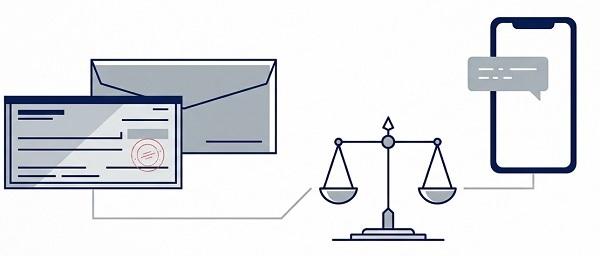
Two sets of provisions work together here.
Information Technology Act, 2000. Section 4 gives legal recognition to electronic records. Where a law requires something to be in writing, the requirement is met if the information is in electronic form and remains accessible for later reference. Section 13 deals with when an electronic record is treated as dispatched and received. Dependence will be on when the record is made in the computer resource of the recipient, although the rule varies depending on whether the recipient has selected a computer resource to receive those records.
Bharatiya Sakshya Adhiniyam, 2023. Section 61 provides that an electronic or digital record cannot be denied admissibility merely because it is electronic. Section 63 sets out the conditions for admitting an electronic record, including the certificate that must accompany it. In respect of dishonored cheques and notices issued from and after 1st July 2024, the certificate scheme under the BSA applies in place of Section 65B of the Indian Evidence Act, 1872. The earlier judgments referred to herein below have been rendered under Section 65B.
Judicial Position
Rajendra v. State of U.P. (Allahabad High Court). In an application under Section 482 CrPC (No. 45953 of 2023), Justice Arun Kumar Singh Deshwal held that a demand notice sent by email or WhatsApp can be a valid notice under Section 138, if it satisfies Section 13 of the IT Act. The Court reasoned that the proviso to Section 138 prescribes no particular mode of sending the notice, and that Section 4 of the IT Act treats electronic form as writing when it remains available for later reference. The court also made an order for the Magistrates in the state of Uttar Pradesh to ask the complainant to submit the postal report along with the case whenever registered post is used, to make the case of non-delivery difficult.
Two cautions are needed. First, this is a single-judge decision, so it binds courts in Uttar Pradesh and is persuasive elsewhere. Furthermore, there is no Supreme Court decision that clearly decides whether a WhatsApp message alone will constitute a valid statutory notice. The plaintiff that depends only on WhatsApp takes a litigation risk that would not be incurred through postal notice.
C.C. Alavi Haji v. Palapetty Muhammed, (2007) 6 SCC 555. The Supreme Court held that where a notice is sent by registered post to the correct address, the court may presume service in the ordinary course of business under Section 114 of the Evidence Act and Section 27 of the General Clauses Act. The drawer cannot be exempted from liability on the grounds that the notice was not received when it was correctly addressed and mailed. And this is why postal proof is still valid.
Sanjabij Tari v. Kishore S. Borcar (Supreme Court, Criminal Appeal No. 1755 of 2010, decided 25 September 2025). The Court dealt with the strength of the presumptions under Sections 118 and 139, and also gave directions to speed up Section 138 trials. Among them, it encouraged service of court summons through email and messaging platforms such as WhatsApp, with the complainant filing an affidavit giving the accused’s contact details. This has to do with summonses made out by the court, and is not a determination of the statutory demand letter. It does demonstrate that courts have come to consider electronic service as commonplace.
Practical Examples
Example 1: Email only
Example 1: Email only. A company emails a notice to the address printed on the cheque-related invoices and agreement. There is evidence of the date and time of sending, the recipient, and the attached file. In addition, the drawer argues that the email address was inactive at the time. The case of the complainant is well-grounded when the prior emails were sent through the same email address. Emails matter in other commercial disputes too, as explained in when emails are legally binding without a signed agreement.
Example 2: WhatsApp only
Example 2: WhatsApp only. The payee sends out a notice in PDF format from a number stored within the contact exchanges of the drawer himself. The drawer claims that the account in question belongs to one of his employees. It is now incumbent upon the complainant to demonstrate who used the particular number and also that the notice has been delivered. For a wider look at when chats are accepted in court, see whether a WhatsApp message is automatically admissible.
Example 3: Registered post plus email
Example 3: Registered post plus email. The complainant sends the notice by registered post and also emails it. If the post is returned as “refused” or “not available,” the email provides a second line of proof. This is the safest pattern.
Common Mistakes
1. Relying on WhatsApp alone when the drawer’s number or identity is open to dispute.
2. Sending the notice to an email address the drawer never used for business with the complainant.
3. Treating blue ticks as proof. A screenshot of ticks is weak without a certificate and the underlying device or account records. Courts are cautious here, as discussed in how Indian courts treat screenshots as evidence.
4. Forgetting that the 30-day window for the notice is strict. A late notice cannot be cured by good evidence of service.
5. Leaving the date and mode of service out of the complaint, which invites a non-service defence at the threshold.
6. Producing a printout of the email without the Section 63 certificate, or with a certificate that does not match the printout.
7. Not preserving the original message, headers, and attachments on the device or mail server.
Practical Steps
- Send the notice by registered post or speed post and by email to the drawer’s known business address. Add WhatsApp as a supplementary mode if you have a verified number.
- Keep the postal receipt and the tracking report. File the tracking report with the complaint.
- Save the original email with full headers, the attachment sent, and any delivery or read response.
- For WhatsApp, export the chat from the sending device and keep the device and account intact.
- Prepare the Section 63 BSA certificate for each electronic record you intend to rely on, and make sure its description matches the exhibit.
- State the date and mode of each service clearly in the complaint and in the affidavit of evidence.
- Count the 30-day notice period from the date you received the bank’s information, and calendar the 15-day payment period and the one-month complaint period separately.
Conclusion
The real issue here is not whether notice can be given through email or WhatsApp. The real question is whether you can prove to the satisfaction of the Magistrate that the drawer received notice on a specific day. While electronic forms of sending the notice are being accepted by the courts, the fact remains that proof will win or lose your case. Use electronic delivery as an added security layer, not the sole one.
*****
Disclaimer: This article has been written only for the purposes of information and awareness and is not to be treated as legal advice. The issues related to cheque dishonour depend upon many specific facts, circumstances and the laws that apply within the concerned jurisdiction.