
ITO Vs Sudarshan R. Kharbanda (ITAT Mumbai)
If the aforementioned judicial pronouncements and the facts available on record are kept in juxtaposition and analyzed with the assembling of parts done by the assessee, we find that the resultant end product is commercially known differently in the trading world, therefore, certainly it can be said that the activity of the assessee amounts to manufacture, consequently, entitled to deduction u/s 80IC of the Act, because, assembling of various parts in a specified manner and the net results into watches which are used by the public at large for different purposes and is commercially known differently, therefore, it amounts to manufacturing. The resultant end product is outcome of combination of efforts with the help of men and machine. The case of the assessee further find support from the decision in the case of Ramit Kumar Sharma vs DIT (IT) (2009) 309 ITR 344 (AAR-New Delhi) wherein the assessee intend to start a tractor manufacturing industry in the state of Himachal Pradesh, wherein, the primary job was to provide, milling, tooling and grinding of surface of rear cover etc, which are important part of tractor, it was held that the activities amounts to manufacture or production of an article difference from raw castings, thus, entitled to deduction u/s 80IC of the Act. So far as, assembling is concerned, the Ld. counsel for the assessee gave a live demonstration in the court room with respect to the process of assembling, wherein, only some screw were tightened up of already manufactured parts and the end product resulted into a watch. At this stage, the Ld. counsel for the assessee, stated that the assessee is merely screwing up some parts/components, used for manufacturing of the watches. So far as, consumption of electricity is concerned, it was explained that the electricity is used only for light purposes and it is not the case that some machinery used in the process rather broadly the screw drivers are used. The Ld. Counsel also explained that clearance is granted by the check post by the Excise and the VAT department for raw material as well as for finished watches/end product and the sales tax returns and excise returns filed by the assessee for every quarter has been accepted by the receptive Department. The Ld. counsel for the assessee, during hearing before us, also filed the photocopy of the wages register to demonstrate that employees were employed and due wages were paid, therefore, it cannot be said that the assessee is not dong manufacturing activity. Thus, we find no infirmity in the conclusion, of the Ld. Commissioner of Income Tax (Appeal). So far as, carrying forward losses of the unit eligible for 80IC deduction is concerned, the issue has been dealt with in para 2.3.7 of the impugned order in which also, we find no infirmity. Thus, the stand of the Ld. Commissioner of Income Tax (Appeal) is affirmed.
FULL TEXT OF THE ITAT JUDGMENT
The Revenue is aggrieved by the impugned order dated 29/01/2016 of the Ld. First Appellate Authority, Mumbai, allowing the claimed deduction to the tune of Rs.1,98,73,453/- under section 80IC of the Income Tax Act, 1961 (hereinafter the Act) without appreciating that the assessee fail to prove that actually 8,57,826 watches were manufactured in a year with just 13 employees, who are not professionally qualified and just with minimal electric consumption, thus, the assessee has not established that any manufacturing activity was done.
2. During hearing of this appeal, the counsel for the assessee, Shri Harsh Kothari, claimed that the assessee unit is situated at Parwanoo and the raw material, purchased by the assessee was simply assembled without use of sophisticated machinery. Our attention was invited to various pages of the paper book. It was claimed that wage register is also maintained. The Ld. counsel further asserted that manufacturing started on 27/03/2010 and the Ld. Assessing Officer has not disputed the books and purchase of raw materials. Plea was also raised that the assessee also filed sales tax and excise returns, which were accepted by the respective department.
2.1. On the other hand, the Ld. DR, Ms. N. Hemalatha, defended the addition made by the Ld. Assessing Officer by advancing arguments, which are identical to the ground raised. The crux of the argument is that actually no manufacturing activity was done by the assessee and merely the paper work has been done. Our attention was invited to the observation made in the assessment order.
2.2. We have considered the rival submissions and perused the material available on record. The facts, in brief, are that the assessee is an individual engaged in the business of manufacturing of watches at the manufacturing unit claim to be established at Parwanoo which is a notified industrial area for the purpose of section 80IC of the Act. The assessee declared nil income by claiming deduction under section 80IC of the Act amounting to Rs.2,03,62,738/-. The Ld. Assessing Officer rejected the claimed deduction on the plea that no manufacturing activity was actually done by the assessee and thus total income was computed at Rs.2,02,62,603/-.
2.3. On appeal before the Ld. Commissioner of Income Tax (Appeal), the factual matrix was considered and finally the assessee was held to be eligible for claimed deduction under section 80IC of the Act. The Revenue is aggrieved and is in appeal before this Tribunal. We find that the assessee sold 8,57,826 watches resulting into sales of Rs.13,30,03,065/-. The addition was made by the Ld. Assessing Officer that with the small use of electricity and with the help of only thirteen employees, the manufacturing/sale of a such magnitude is not possible., whereas, the Ld. Commissioner of Income Tax (Appeal) while coming to a particular conclusion observed that while making the addition, the Ld. Assessing Officer disregarded the entire manufacturing activity carried out by the assessee. It was further observed that the assessee is merely assembling the parts of the watches like cases, dials, movements and straps, etc., thus, no sophisticated machinery is used and merely the parts are assembled. Admittedly, the assessee is a manufacturer of quartz watches. The Ld. counsel for the assessee, before us, tried to demonstrate the manufacturing process and claimed that the sales tax and excise returns have been accepted by the respective department. The Ld. counsel invited our attention to the certificate of registration issued by the excise and taxation Department and various sample of purchases made with respect to raw material claimed to be used for manufacturing activity. Another reason for making the disallowance by the Ld. Assessing Officer is low consumption of electricity. Another reasoning of low consumption, adduced by the Ld. counsel for the assessee, the assessee works only for eight hours during the day, therefore, the less electricity is consumed. So far as, the audit report, which was brought to the notice of the Ld. counsel with respect to column number 25(f), it was claimed that auditor made a mistake in the audit report by mentioning that it was covered under section 80IC (2)(b)(ii), though it was covered under section 80IC(2)(a)(ii) of the Act. Before adverting further, we are reproducing hereunder the uncontroverted finding recorded by the Ld. Commissioner of Income Tax (Appeal) for ready reference and analysis:-
“2.3.2. The AO has stated that the Audit Report in Form No.CCB Col. No.25(f) has been stated. yes’, with regard to article or things specified, in 14th Schedule. The appellant has stated that its auditor has made a mistake in The Audit Report , that it was covered under section 80IC(2)(b)(ii), although it was covered under section 80IC(2)(a)(ii).Hence mere typographical error cannot be held responsible for denial of deduction. In fact the Hon’ble Bombay High Court in the case of Sanchit’Software and Solutions Pvt, Ltd vs. CIT (2012) ITR as held that the Income tax Department cannot take advantage of assessee’s mistakes in not claiming exemption in return and not giving him exemption. The entire object of administration of tax is to secure the revenue for the development of the country and not to charge assessee more tax than which is due and payable by the assessee. In the case of the appellant there has been a claim of deduction although under wrong sub section due to error of the auditor and in my view, the same cannot be held responsible for denial of deduction.
2.3.3 The appellant had during the course of appellate proceedings as well as during the course of assessment proceedings detailed the assembling of its quartz watches (page No.188 to 190 of paper book submitted to the AO on 30.12.2013). In the same the appellant has stated the components used for the manufacturing of watches. The production process had been detailed in 12 steps from opening the dials from ” butter paper” to testing and packing of the watches.
2.3.4 The appellant has further explained the confusion with regard to the . usage of electricity during the night and day stating the difference in units shown kVA and kWh.
2.3.5. As far as whether the appellant has manufactured/assembled 859 198 watches during the year, the Assessing Officer has stated that it is not possible considering the number of employees, amount of electricity used and the machinery employed. The appellant on the other hand has provided clearances obtained by it at the check post by the excise and VAT department for the raw materials and furnished its sales tax returns, the excise returns filed by it every quarter of the number. of watches manufactured and sold, the customers who placed the orders, register for raw materials etc.
2.3.6 Taking into account the manufacturing/assembling process, the reasons given by the AU to conclude that there had been no manufacturing and the evidence provided by the appellant during the course of appeal and assessment proceedings, _I am inclined in favour of the appellant. In my considered view, the documents and evidences provided by the appellant corroborate the fact that it had manufactured/assembled watches during the year. The appellant is hence eligible for deduction u/s.80IC.
2.3.7 It is however seen that the Appellant has carried forward losses from the’ unit eligiblejor 80I0 deduction in the immediately previous year ; when it . started its production; which it has not set off against the profit of the unit eligible for deduction under 80IC. The AO is hence directed to first adjust this carried forward loss with the profit available for 80 IC deduction. Moreover, the AO is also advised to keep in mind that this is the second year of the Unit in operation and hence the availability of the deduction should be calculated for the subsequent number of years taking this fact into account. Ground is partly allowed.”
2.4. If the observation made in the assessment order, leading to addition made to the total income, conclusion drawn in the impugned order, material available on record, assertions made by the ld. respective counsel, if kept in juxtaposition and analyzed, before adverting further, we are expected to analyze section 80IC of the Act, therefore, it is reproduced hereunder:-
”Where the gross total income of an assessee includes any profits and gains derived by an undertaking or an enterprise from any
business referred to in sub-section (2), there shall, in accordance with and subject to the provisions of this section, be allowed, in
computing the total income of the assessee, a deduction from such profits and gains, as specified in sub-section (3).
(2) This section applies to any undertaking or enterprise,—
(a) which has begun or begins to manufacture or produce any article or thing, not being any article or thing specified in the Thirteenth Schedule, or which manufactures or produces any article or thing, not being any article or thing specified in the Thirteenth Schedule and undertakes substantial expansion during the period beginning—
(i) on the 23rd day of December, 2002 and ending before the 1st day of April, 2007, in any Export Processing Zone or Integrated Infrastructure Development Centre or Industrial Growth Centre or Industrial Estate or Industrial Park or Software Technology Park or Industrial Area or Theme Park, as notified by the Board in accordance with the scheme framed and notified by the Central Government in this regard, in the State of Sikkim; or
(ii) on the 7th day of January, 2003 and ending before the 1st day of April, 2012, in any Export Processing Zone or Integrated Infrastructure Development Centre or Industrial Growth Centre or Industrial Estate or Industrial Park or Software Technology Park or Industrial Area or Theme Park, as notified by the Board in accordance with the scheme framed and notified by the Central Government in this regard, in the State of Himachal Pradesh or the State of Uttaranchal; or
(iii) on the 24th day of December, 1997 and ending before the 1st day of April, 2007, in any Export Processing Zone or Integrated Infrastructure Development Centre or Industrial Growth Centre or Industrial Estate or Industrial Park or Software Technology Park or Industrial Area or Theme Park, as notified by the Board in accordance with the scheme framed and notified by the Central Government in this regard, in any of the North-Eastern States;
(b) which has begun or begins to manufacture or produce any article or thing, specified in the Fourteenth Schedule or commences
any operation specified in that Schedule, or which manufactures or produces any article or thing, specified in the Fourteenth Schedule or commences any operation specified in that Schedule and undertakes substantial expansion during the period beginning—
(i) on the 23rd day of December, 2002 and ending before the 1st day of April, 2007, in the State of Sikkim; or
(ii) on the 7th day of January, 2003 and ending before the 1st day of April, 2012, in the State of Himachal Pradesh or the State of Uttaranchal; or
(iii) on the 24th day of December, 1997 and ending before the 1st day of April, 2007, in any of the North-Eastern States.
(3) The deduction referred to in sub-section (1) shall be—
(i) in the case of any undertaking or enterprise referred to in sub- clauses (i) and (iii) of clause (a) or sub-clauses (i) and (iii) of clause (b), of sub-section (2), one hundred per cent of such profits and gains for ten assessment years commencing with the initial
assessment year;
(ii) in the case of any undertaking or enterprise referred to in sub- clause (ii) of clause (a) or sub-clause (ii) of clause (b), of sub-section (2), one hundred per cent of such profits and gains for five assessment years commencing with the initial assessment year and thereafter, twenty-five per cent (or thirty per cent where the assessee is a company) of the profits and gains.
(4) This section applies to any undertaking or enterprise which fulfils all the following conditions, namely:—
(i) it is not formed by splitting up, or the reconstruction, of a business already in existence :
Provided that this condition shall not apply in respect of an undertaking which is formed as a result of the re-establishment, reconstruction or revival by the assessee of the business of any such undertaking as is referred to in section 33B, in the circumstances and within the period specified in that section;
(ii) it is not formed by the transfer to a new business of machinery or plant previously used for any purpose.
Explanation.—The provisions of Explanations 1 and 2 to sub-section (3) of section 80-IA shall apply for the purposes of clause
(ii) of this sub-section as they apply for the purposes of clause (ii) of that sub-section.
(5) Notwithstanding anything contained in any other provision of this Act, in computing the total income of the assessee, no deduction shall be allowed under any other section contained in Chapter VIA or in section 10A or section 10B, in relation to the profits and gains of the undertaking or enterprise.
(6) Notwithstanding anything contained in this Act, no deduction shall be allowed to any undertaking or enterprise under this section, where the total period of deduction inclusive of the period of deduction under this section, or under the second proviso to sub-section (4) of section 80-IB or under section 10C, as the case may be, exceeds ten assessment years.
(7) The provisions contained in sub-section (5) and sub-sections (7) to (12) of section 80-IA shall, so far as may be, apply to the eligible undertaking or enterprise under this section94.
(8) For the purposes of this section,—
(i) “Industrial Area” means such areas, which the Board, may, by notification in the Official Gazette, specify in accordance with the scheme framed and notified by the Central Government;
(ii) “Industrial Estate” means such estates, which the Board, may, by notification in the Official Gazette, specify in accordance with the scheme framed and notified by the Central Government;
(iii) “Industrial Growth Centre” means such centres, which the Board, may, by notification in the Official Gazette, specify in accordance with the scheme framed and notified by the Central Government;
(iv) “Industrial Park” means such parks, which the Board, may, by notification in the Official Gazette, specify in accordance with the scheme framed and notified by the Central Government;
(v) “Initial assessment year” means the assessment year relevant to the previous year in which the undertaking or the enterprise begins to manufacture or produce articles or things, or commences operation or completes substantial expansion;
(vi) “Integrated Infrastructure Development Centre” means such centres, which the Board, may, by notification in the Official Gazette, specify in accordance with the scheme framed and notified by the Central Government;
(vii) “North-Eastern States” means the States of Arunachal Pradesh, Assam, Manipur, Meghalaya, Mizoram, Nagaland and Tripura;
(viii) “Software Technology Park” means any park set up in accordance with the Software Technology Park Scheme notified by the Government of India in the Ministry of Commerce and Industry;
(ix) “Substantial expansion” means increase in the investment in the plant and machinery by at least fifty per cent of the book value of plant and machinery (before taking depreciation in any year), as on the first day of the previous year in which the substantial expansion is undertaken;
(x) “Theme Park” means such parks, which the Board, may, by notification in the Official Gazette, specify in accordance with the scheme framed and notified by the Central Government.”
2.5. If the provision of section 80IC of the Act is analyzed, it speaks about gross total income of the assessee, which includes any profit & gains “derived by”, an undertaking or an enterprises from “any business” referred to in sub-section (2)………… shall be allowed while computing the total income of the assessee. Sub-section (2) to section 80IC speaks about that any undertaking or enterprise (a) which has begun or begins to manufacture or produce any article or thing. The assessee unit was established in the area/backward area, wherein, specific concession was guaranteed and manufacturing is not in dispute, therefore, it is a beneficial section, therefore, the benefit cannot be denied to the assessee. So far as, whether assembling is a manufacturing or not is concerned, there are so many decisions, wherein, it has been held that assembling tantamount to manufacturing as the end product is commercially known differently. So far as, the expression “derived from” or “derived by” is concerned, it has been elaborated in various decisions including NOCI Ltd vs Collector Central Excise, (1997) 106 STC 467, 470 (Supreme Court), ratio laid down in Great Eastern Shipping Company Ltd. vs CIT 206 ITR 505 (Bom.), CIT vs UP State Agro Industrial Corporation 180 ITR 370 (All.). So far as, the general tests for manufacture/ production are concerned, we find that manufacturing and processing are not clearly demarcated field. The test of manufacture lies in the answer to the question whether what is processed or produced as end product is commercially known as a different product from the material out of which it was so produced. Therefore, if the product has a different name and identified by the buyers and seller as a different product and is sold as a different product from its raw material one can say that it is a manufactured product.The case of the assessee find support from the ratio laid down in the case of R.M. Chemicals Pvt. Ltd. (ITA No.111/Mum/2012) (Assessment Year 2003-04) order dated 11/05/2012 (wherein, one of us i.e., Judicial Member, is signatory to the order). The relevant portion from the aforesaid order is reproduced hereunder for ready reference:-
“ 3. We have considered the rival submissions and perused the material available on file. The facts, in brief, are that the assessee is engaged in manufacturing of detergent on job work basis for Hindustan Lever Limited (HLL in short hereinafter). The raw material was also claimed to be supplied by HLL and the 3 manufacturing process is done by the assessee. The assessee declared total income of Rs.15,49,230/-, after claiming deduction of Rs.6,63,956/- u/s 80IB of the Act in its return filed on 25.2.2004. The return was selected for scrutiny, therefore, pursuant to notice u/s 147 vide order dated 27.2.2010 the income was determined at Rs.2,91,61,870/- (including disallowance of deduction of Rs.6,63,956/-). However, under section 154 of the Act, necessary correction was made by the AO himself by restricting the disallowance to Rs. 6,63,956/- as claimed by the assessee. On appeal, the learned CIT(A) affirmed the disallowance which is under challenge before the Tribunal.
3.1 Before coming to any conclusion, we are reproducing hereunder the relevant portion from the impugned order :-
“2.3 I have carefully examined the issue in dispute. Soap is a product which has passed through evolution in many centuries. The process for making soap, has evolved with generations. Earlier it was prepared by mixing fatty acid with caustic soda and sodium silicate in a chemical process. After learning the process of synthesizing natural oil a new product called linear alkyl benzene (LAB) was developed which is used in making of modern day soap known as detergent soap. The chemical process for making soap has not gone through any metamorphic change. The soaps earlier were made by mixing chemicals like fatty acid, caustic soda, sodium silicate. The modern day detergent soaps are also made by mixing chemicals like LAB, sodium silicate and caustic soda. The only new material used in the detergent soap is LAB in place of fatty acid. This fact clearly show that the detergent soaps are one kind of soap. In the eleventh schedule the phrase mentioned is Soap. In substance, soaps made by using fatty acid or LAB are soap. In view of these facts, it is held that detergent soap manufactured by the appellant are covered by list of prohibited articles and things as given in the Eleventh Schedule hence the appellant is not entitled for deduction u/s 80IB. The disallowance of deduction u/s 80IB at Rs. 6,63,956/- is confirmed. This ground of appeal is dismissed.”
3.2. If the aforesaid conclusion drawn in the impugned order is analysed, one of the basis for such rejection is that the soaps are covered in the prohibited articles and things as provided in Eleventh Schedule, therefore, we are reproducing hereunder the list/things of negative list (as provided in Eleventh Schedule) :-
i. Beer, Wine and other alcoholic spirits
ii. …..
iii. ……
iv. Toothpaste, dental cream, tooth-powder and soap
v. …..
vi (11 – 21) omitted by the Finance Act, 1981 with effect from 1.4.1982
3.3 If the aforesaid list of articles are analysed, the legislature in its wisdom has used the article „Soap‟ and not detergent. Soaps are normally in the form of cake whereas the detergents are in the form of powder. Nothing prevented the legislature to specifically use the word “detergent powder” if it wanted to do so. The use of soap and detergent powder are always not the same and their chemical composition is also different, therefore, from this angle, we are not in agreement with the conclusion drawn in the impugned order.
3.4 The procedure for manufacturing soap and detergent which is as under:-
SOAP AND DETERGENT MANUFACTURE
Soaps and detergents are widely used in our society. Soaps are the product of the reaction between a fat and sodium hydroxide:
fat + 3NaOH glycerine + 3 soap
Soap is produced industrially in four basic steps. This article lists different steps because in the industrial processes described each of these is done over several process steps, but in principle it could be done in the three steps outlined here.
Step 1 – Saponification
A mixture of tallow (animal fat) and coconut oil is mixed with sodium hydroxide and heated. The soap produced is the salt of a long chain carboxylic acid.
Step 2 – Glycerine removal
Glycerine is more valuable than soap, so most of it is removed. Some is left in the soap to help make it soft and smooth. Soap is not very soluble in salt water, whereas glycerine is, so salt is added to the wet soap causing it to separate out into soap and glycerine in salt water.
Step 3 – Soap purification
Any remaining sodium hydroxide is neutralised with a weak acid such as citric acid and two thirds of’the remaining water removed.
Step 4 – Finishing Additives
such as preservatives, colour and perfume are added and mixed in with the soap and it is shaped into bars for sale. Detergents are similar in structure and function to soap, and for most uses they are more efficient than soap and so are more commonly used. In addition to the actual ‘detergent’ molecule, detergents usually incorporate a variety of other ingredients that act as water softeners, free-flowing agents etc.
INTRODUCTION
Soap is integral to our society today, and we find it hard to imagine a time when people were kept sweet-smelling by the action of perfume rather than soap. However, the current widespread use of soap is only a very recent occurrence, despite the fact that it has been made for more than 2500 years. The first recorded manufacture of soap was in 600BC, when Pliny the Elder described its manufacture by the Phonecians from goats tallow and ash, and it was known among the British Celts and throughout the Roman Empire. However, these people used their soap medicinally, and it was not until the second century AD that it was used for cleaning, and not until the nineteenth century that it began to be commonly used in the Western world.
Early this century the first synthetic detergents were manufactured, and these have now taken the place of soap for many applications. Their manufacture is covered briefly in the second part of this article.
I – Detergents-A -Soap-I
The Chemistry of Soap and Detergent Function
All soaps and detergents contain a surfactant’ as their active ingredient. This is an ionic species consisting of a long, linear, non-polar ‘tail’ with a cationic or anionic ‘head’ and a counter ion. The tail is water insoluble and the head is water soluble – a difference in solubility which has two important implications. Firstly, this makes the surfactant molecule a wetting agent: the tails migrate to align themselves with the solid:water interface, lowering the surface tension at that point so that it penetrates the fabric better. Secondly, it allows the oily dirt particles to form an emulsion with the water: the tails of many, surfactant molecules surround an oily dirt particle, forming a micelle with a drop of oil in the centre and the ionic heads of the surfactant molecules pointing outwards and hence keeping the micelle in the polar solution.
This reaction is exothermic, and progresses quickly and efficiently at around 12SoC inside an autoclave type reactor. The most common fats and oils used are tallow (beef or mutton/beef blend), coconut oil, and palm kernel oil (Table 1). Different oils produce soaps of varying hardness, odour and lathering, so the ratios of the oils used are closely monitored to produce a blend with the most desirable characteristics for the most reasonable cost.
However, pure soap is hard and easily oxidised, so various additives are added to correct this and to make a more aesthetically pleasing product. The first such “additive” is glycerine, which is produced in the saponification reaction. Glycerine makes the soap smoother and softer than pure soap. However, it is also much more valuable than soap itself, so only a minimum of glycerine is left in the soap and the remainder is extracted, purified and sold.
The glycerine is extracted from the soap with lye2 – a brine solution that is added to the soap at the saponification stage. Wet soap is soluble in weak brine, but separates out as the electrolyte concentration increases. Glycerine, on the other hand, is highly soluble in brine. Wet soap thus has quite a low electrolyte concentration and is about 30% water (which makes it easily pumpable at 70°C). To remove the glycerine, more electrolyte is added,
1 Surface active agent.
2 Pronounced “lee” in the UK and New Zealand and “lie” in the US.
XI· Detergents-A – Soap- 2
causing the wet soap to separate into two layers: crude soap and a brine/glycerine mixture known as spent lye, neutral lye or sweet waters. The soap still contains some salt, which itself functions as an additive, altering the viscosity and colour of the soap.
Once the spent lye has been removed the soap is dried, chipped, mixed with other additives such as perfumes and preservatives and then plodded (squeezed together), formed into tablets and packaged for sale. There are two different soap-making processes used in New Zealand, and these are both described below.
The Colgate-Palmolive Process
This is a continuous process (Figure 1) which uses a plant built by Binacchi & Co. The process is best understood in terms of two streams: soap flowing in the order given below against a counter-current of lye. Step 1 – Saponification The raw materials are continually fed into a reactor in fixed proportions. Assuming a production rate of 1000 kg wet soap per hour and a 80:20 tallow:coconut oil mix, the raw materials would be fed in at the following rates:
coconut oil 525.9 kghr-1
tallow 131.5 kghr-1
50% NaOH solution 3101 kghr-1
Although this is not the formula quantity. it gives a general indication to the process condition. The actual amount is affected by the caustic concentration in half – spent lye.
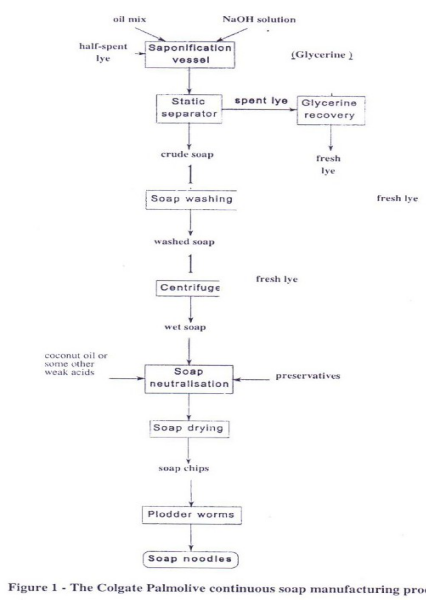
These ingredients alone would give a low water, high glycerine soap. Soap needs to be about 30% water to be easily pumpable, and even then needs to be held at around 70°C, so excess lye is added to hydrate the soap and dissolve “out some of the glycerine. The lye added is known as “half”spent lye” and is the lye discharged from the washing column (see below). This lye already contains some glycerine, but it is further enriched by that formed in the saponification reaction.
Step 2 – Lye separation The wet soap is pumped to a “static separator” – a settling vessel which does not use any mechanical action. The soap / lye mix is pumped into the tank where it separates out on the basis of weight. The spent lye settles to the bottom from where it is piped off to the glycerine recovery unit, while the soap rises to the top and is piped away for further processing.
Step 3 – Soap washing The soap still contains most of its glycerine at this stage, and this is removed with fresh lye in a washing column. The column has rings fixed on its inside surface. The soap solution is added near the bottom of the column and the lye near the top. As the lye flows down the column through the centre, a series of ‘rotating disks keeps the soap / lye mixture agitated between the rings. This creates enough turbulence to ensure good mixing between the two solutions.
The rate of glycerine production is calculated and the rate at which fresh lye is added to the washing column then set such that the spent lye is 25 – 35 % glycerine. Glycerine is almost infinitely soluble in brine, but at greater than 35% glycerine the lye no longer efficiently removes glycerine from the soap. The soap is allowed to overflow from the top of the column and the lye (“half spent lye”) is pumped away from the bottom at a controlled rate and added to the reactor.
Step 4 – Lye separation The lye is added at the top of the washing column, and the soap removed from the column as overflow. As the lye is added near the “overflow pipe the washed soap is about 20% fresh lye, giving the soap unacceptably high water and caustic levels. Separating off the lye lowersthe electrolyte levels to acceptable limits. The soap and lye are separated in a centrifuge, leaving a soap which is 0.5% NaCl and 0.3% NaOH, and about 31 % water. The lye removed is used as fresh lye.
Step 5 – Neutralisation Although the caustic levels are quite low, they are still unacceptably high for toilet and laundry soap. The NaOH is removed by reaction with a weak acid such as coconut oil (which contains significant levels of free fatty acids), coconut oil fatty acids, citric acid or phosphoric acid, with the choice of acid being made largely on economic grounds.
Some preservative is also added at this stage.
Step 6 – Drying Finally, the water levels must be reduced down to about 12%. This is done by heating the soap to about 125°C under pressure (to prevent the water from boiling off while the soap is still in the pipes) and then spraying it into an evacuated chamber at 40 mm Hg (5.3 kPa). The latent heat of evaporation lost as the water boils off reduces the soap temperature down to 45°C, at which temperature it solidifes onto the chamber walls.
11 XI – Detergents- A -Soap- 5
The soap chips are scraped off the walls and “plodded” (i.e. squeezed together) by screws known as “plodder worms” to form soap noodles. The soap is now known as base or neat soap chip, and can be converted into a variety of different soaps in the finishing stages.
The moisture evaporated off the wet soap is transported to a barometric condensor, which recondenses the vapour without the system losing vacuum. The moisture can contain soap dust (“Fines”) which is removed by cyclones and returned by augers to the: spray chamber, while the water is recycled.
Base soap can also be made by a batch process such as that used by Lever Rexona.
The Lever Rexona Process
This process is summarised in Figure 2.
Step 1 – Oil preparation The oils used most commonly are, as in the Colgate-Palmolive process, tallow and coconut oil. These are blended together and dried in a vacuum chamber. Once the oils are dry, bleaching earth is sucked by the vacuum into the chamber to remove any coloured impurities. The spent earth is landfilled and the oils stored ready for saponification.
Step 2 – Saponification The mixture of bleached oils is mixed with spent lye from the washing stage (see below) and a caustic soda solution. The mix is heated and then left to settle into two layers. The neutral lye (which is now rich in glycerine) is pumped off and the mixture of soap and unreacted oils which has risen to the top is left in the pan. More caustic liquor is added to this and the mix reheated to saponify the remaining free oils.
Step 3 – Washing The crude soap is then pumped to a divided pan unit (DPU) where it is washed by a counter-current of lye. This lye is a mixture of fresh brine solution and nigre lye (see below). The washed soap comes out the far end of the DPU and is sent to the fitting pans, while the lye comes out the near end and is pumped back into one of the saponification pans.
Step 4 – Fitting Here the remaining unwanted glycerine is removed from the soap by reboiling with water, NaCl and a small amount of NaOH solution. The electrolyte concentration in the water is such that the soap and water to separate out into two layers. The top layer is ‘neat’ wet soap, which is pumped off to be dried. The bottom layer is known as the ‘nigre’ layer, and consists of a solution of soap, glycerine and NaCI. This is left in the pan, reboiled with further salt and left to stand, forming a soap crust over a lower layer ofnigre lye (salt and glycerine). This soap is left in the pan and is mixed with the next intake of washed soap,
while the nigre lye is pumped back to the DPUs to wash the next batch of crude soap.
Step 5 – Drying Moisture is flashed off under vacuum in the same manner as was described above for the Colgate-Palmolive process.

Laundry or ‘hard’ soap manufacture The base soap is mixed with colour and preservatives and milled. Perfume is then added and the mixture plodded then extruded into a continuous bar. This, in turn, is cut into billets and stamped out into tablets ready for packaging.
Toilet soap manufacture
Toilet soap has less water and more fatty material (fatty acids and soap) than laundry soap. For this reason base soap intended for toilet soap manufacture usually has extra fatty acids added with the preservatives before it is vacuum dried. These ensure that there is no unreacted caustic left in the soap by the time it reaches the consumer, and also make the soap softer. Perfume, dye and opacifier are then added to the dried soap and the mixture milled to . ensure even mixing. It is then plodded and extruded out as a continuous bar, cut into billets and stamped ready for packaging and sale.
THE DETERGENT MANUFACTURING PROCESS
Detergents use a synthetic surfactant in place of the metal fatty acid salts used in soaps. They are made both in powder and liquid form, and sold as laundry powders, hard surface cleansers, dish washing liquids, fabric conditioners etc. Most detergents have soap in their mixture of ingredients, but it usually functions more as a foam depressant than as a surfactant.
Detergent powder manufacture Step 1 – Slurry making The solid and liquid raw ingredients (Table 2) are dropped into a large tank known as a slurry mixer. As the ingredients are added the mixture heats up as a result of two exothermic reactions: the hydration of sodium tripolyphosphate and the reaction between caustic soda and linear alkylbenzenesulphonic acid.” The mixture is then further
heated to 85°C and stirred until it forms a homogeneous slurry.
Step 2 – Spray drying The slurry is deaerated in a vacuum chamber and then separated by an atomiser into finely divided droplets. These are sprayed into a column of air at 425°C, where they dry instantaneously. The resultant powder is known as ‘base powder’, and its exact treatment from this point on depends on the product being made.
Step 3 – Post dosing Other ingredients are now added, and the air blown through the mixture in a fluidiser to mix them into a
homogeneous powder. Typical ingredients are listed in Table 3.
XI – Detergents- A – Soap-S
Table 2- The ingredients of detergent base powder



