In re P A S Exports (GST AAR Tamil Nadu)
The Tamil Nadu Authority for Advance Ruling (AAR) held that textile carry bags manufactured by P A S Exports from a blend of polyester, cotton and viscose are classifiable under HSN 4202 2990 as shopping bags and attract GST at 18%. The ruling, dated 23 October 2026, examined whether bags described by the applicant as eco-friendly recycled textile carry bags should be classified under Chapter 63, covering certain textile articles, or Chapter 42, which specifically includes shopping bags. The Authority concluded that the intended use and characteristics of the product justified classification under Chapter 42.
P A S Exports, based in Madurai, Tamil Nadu, manufactured textile carry bags supplied to textile shops, supermarkets, corporate customers and other businesses. The bags were intended for customers to carry purchased goods. The applicant claimed that its products were manufactured using waste cloth materials comprising polyester, cotton and viscose and sought an advance ruling on their appropriate HSN classification and applicable GST rate under Section 97(2) of the CGST Act, 2017.
The applicant submitted a test report issued by the Textile Testing and Development Centre, Kappalur, Madurai. The report established that the fabric contained 46% polyester, 39.5% cotton and 14.5% viscose. During the personal hearing held on 18 August 2026, the applicant’s authorised representative explained the manufacturing process and produced a sample bag. Although the product was described as recycled, the Authority recorded the applicant’s clarification that no actual recycling was involved and that the bags were manufactured using comparatively lower-grade cotton yarn.
The jurisdictional State GST authority reported that the applicant was classifying its products under Chapter 63. The AAR therefore examined Heading 6305, which covers sacks and bags of a kind used for packing goods. Referring to the HSN explanatory notes, the Authority observed that the heading concerns bags ordinarily used for packing goods for transportation, storage or sale, including bulk commodities and similar merchandise. The applicant’s bags, however, were designed for use by retail customers carrying purchases from shops and supermarkets.
The Authority distinguished ordinary packing sacks from reusable shopping bags. It observed that the bags manufactured by the applicant had handles and were supplied to retail establishments for onward distribution or sale to customers. Their essential function was to carry purchased articles rather than to pack loose or bulk goods. Consequently, the Authority rejected classification under Heading 6305.
Applying Rule 1 of the General Rules for the Interpretation of the Harmonised System, the AAR examined Heading 4202, which expressly covers shopping bags and other specified carrying articles. Although Chapter 42 principally concerns leather articles, the relevant headings also cover specified products manufactured from other materials. The Authority held that the textile carry bags were appropriately covered under Heading 4202 because of their nature, design and intended use.
The Authority further considered the material composition and exterior characteristics of the bags. It observed that the blended textile fabric combined properties of cotton, viscose and polyester. Since the bags were made from blended fabric and did not have an outer surface covering, the Authority classified them under the residual subheading 4202 2990 — Other, rather than the specific entries covering shopping bags made of cotton or jute.
On the applicable GST rate, the AAR referred to Notification No. 9/2025-Central Tax (Rate), dated 17 September 2025, which superseded the earlier goods-rate notification. Serial No. 145 of Schedule II covers goods falling under Heading 4202, subject to specified exclusions for cotton and jute shopping bags. Since the applicant’s blended-fabric shopping bags fell within the relevant entry, the Authority held that they attracted 9% CGST and 9% SGST, aggregating to 18% GST.
Accordingly, the AAR answered both questions in favour of classification under HSN 4202 2990 and application of 18% GST. The ruling demonstrates that GST classification of textile carry bags depends upon the product’s actual characteristics, construction and intended use rather than its commercial description as an eco-friendly or recycled product. It also distinguishes shopping bags from sacks and packing bags for the purposes of tariff classification.
No judicial precedents were cited or discussed in the supplied advance ruling. The Authority based its findings on the HSN classification framework, explanatory notes, product characteristics and applicable GST rate notifications.
-
Textile Carry Bags Made of Blended Fabric Attract 18% GST: Tamil Nadu AAR
-
HSN 4202 2990 Applicable to Reusable Textile Shopping Bags: GST AAR
-
Eco-Friendly Textile Carry Bags Not Classifiable Under HSN 6305: AAR
-
Polyester-Cotton-Viscose Shopping Bags Taxable at 18% GST: Tamil Nadu AAR
-
GST Classification of Textile Shopping Bags Under Chapter 42 Explained by AAR
FULL TEXT OF THE ORDER OF AUTHORITY FOR ADVANCE RULING, TAMILNADU
1. Any appeal against this Advance Ruling order shall lie before the Tamil Nadu State Appellate Authority for Advance Ruling, Chennai under Sub-Section (1) of Section 100 of CGST Act 2017/TNGST Act 2017, within 30 days from the date on which the ruling sought to be appealed is communicated.
2. In terms of Section 103(1) of the Act, Advance Ruling pronounced by the Authority under Chapter XVII of the Act shall be binding only—
(a) On the applicant who had sought it in respect of any matter referred to in sub-section (2) Section 97 for advance ruling.
(b) On the concerned officer or the Jurisdictional Officer in respect of the applicant.
3. In terms of Section 103(2) of the Act, this Advance Ruling shall be binding unless the law, facts or circumstances supporting the original advance ruling have changed.
4. Advance Ruling obtained by the applicant by fraud or suppression of material facts or misrepresentation of facts, shall render such ruling to be void ab initio in accordance with Section 104 of the Act.
5. The provisions of both the Central Goods and Services Tax Act and the Tamil Nadu Goods and Services Tax Act (herein referred to as the Act) are the same except for certain provisions. Therefore, unless a mention is specifically made to such dissimilar provisions, a reference to the Central Goods and Services Tax Act would also mean a reference to the same provisions under the Tamil Nadu Goods and Services Tax Act.
under the Goods and Service Tax Act, with GSTIN 33AADFP2208C1ZZ. They have filed an application for Advance Ruling under Sec.97 of the CGST Act, 2017 and the corresponding provision of the TNGST Act, 2017. The Applicant has made the payment of Rs.10,000/- towards application fees, under sub rule (1) of Rule 104 of CGST Rules, 2017 and TNGST Rules, 2017.
2. Statement of relevant facts having a bearing on the questions raised.
The Applicant states that they are engaged in the business of manufacturing recycled textile carry bags and supply to corporate and other local/other state customers for purpose of packing. The applicant stated that their products are made out of used/waste cloth bits of polyester, cotton & viscose and requested the correct HSN classification of their product and the rate of tax for the same. The applicant also submitted a test report from the Textile Testing and Development Centre, Kappalur, Madurai, which reported the materials used to manufacture their product.
3. The applicant has sought an Advance Ruling, under Sec.97(2)(a) and (b) of the CGST Act, 2017, on the following questions:
1. Classification for their product – Eco friendly recycled textile carry bags and HSN thereof;
2. Rate of tax for the Eco friendly recycled textile carry bags.
4. Applicant’s interpretation of law:
The Applicant has stated that their product, eco friendly textile carry bags are made out of waste cloth bits of polyester, cotton & viscose; that they procure yarn from various vendors and then send it to the job workers to convert to fabric. The fabric is further stitched and converted to textile carry bags that are sold to textile chain of stores, for packing goods. They also stated that their product was eco friendly.
5. The applicant is under the administrative control of State. The concerned authorities of the Centre and State were addressed to report if there are any pending proceedings against the applicant on the issues raised by the applicant in the ARA application and for comments on the issues raised. As per the report received from the State authority, the applicant is at present classifying their goods under Chapter 63 and that there are no pending proceedings against the applicant on the issues raised by the applicant in the Advance Ruling application.
6. Personal Hearing
The applicant was given an opportunity to be heard in person on 18.08.2026.
Shri S.Karunakar, Advocate, appeared for the personal hearing as the authorized representative (AR) of M/s. P A S Export. He submitted that the applicants are manufacturers of textile carry bags that are made out of waste cotton/bits of polyester/viscose and such bags are supplied to corporate/ local customers for the purpose of packing. He also submitted a test report from ‘Textile Testing and Development Centre’, which was a division of Madurai Spinners Association Trust, wherein the percentage of polyester/cotton/ viscose in their product was mentioned. He stated that they procure the raw material viz. waste cotton yarn from various mills and send the same for job work, for conversion to finished products. He submitted that their product was eco friendly carry bags and requested for the correct HSN code and the rate of tax for the same. He also produced a sample of the bag manufactured by them, illustrated below.
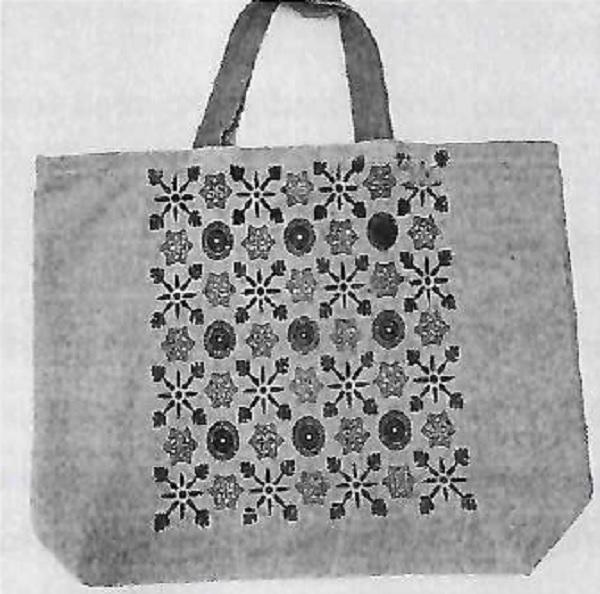
7. Discussions and Findings:
7.1 We have carefully examined the submissions made by the applicant in their advance ruling application and the submissions made during the personal hearing. We have also considered the issue involved, the relevant facts and the applicant’s submission / interpretation of law in respect of question on which the advance ruling is sought.
7.2 We find that the query is liable for admission as it gets covered under Section 97(2)(a) and Section 97(2)(b) of CGST/TNGST Act, 2017, under,
(a) classification of any goods or services or both;
(b) applicability of a notification issued under the provisions of the CGST/TNGST Act, respectively.
7.3 We find that the applicant, M/s PAS EXPORTS, are engaged in the business of manufacturing textile carry bags and they supply the same to corporate and other local/other state customers for the purpose of packing of goods and the customers are largely textile outlets and super markets. We see that their product- carry bags are made out of a blend of cotton/polyester/viscose fabric. They have addressed the Advance Ruling forum to give the correct HSN classification of their product and applicable rate of tax for the same. We find that they have submitted a test report issued by Textile Testing and Development Centre, Kappalur, Madurai, which is a division of Madurai Spinner Association Trust, a private organisation. It has been reported that the fabric sample is a blend of polyester (46%), cotton (39.5%) and viscose(14.5%). Even though the applicant has termed their product to be ‘recycled textile carry bag’, the applicant confirmed during the personal hearing that factually, there was no ‘recycling’ and as such, their product was made out of a slightly lower grade cotton yarn.
We now proceed to analyse the facts on hand with the provisions of law and answer the query of the applicant.
7.4 Question (1) Classification of the product – Eco friendly Textile carry bags and HSN thereof:
63.05 – Sacks and bags, of a kind used for the packing of goods (+).
6305.10 – Of jute or of other textile bast fibres of heading 53.03
6305.20 – Of cotton
\- Of man-made textile materials:
6305.32 – – Flexible intermediate bulk containers
6305.33 – – Other, of polyethylene or polypropylene strip or the like
6305.39 – – Other
6305.90 – Of other textile materials
This heading covers textile sacks and bags of a kind normally used for the packing of goods for transport, storage or sale.
These articles, which vary in size and shape, include in particular flexible intermediate bulk containers, coal, grain, flour, potato, coffee or similar sacks, mail bags, and small bags of the kind used for sending samples of merchandise by post. The heading also includes such articles as tea sachets.
It is seen that the jurisdictional State authority, has reported that the applicant is, at present filing returns by classifying their product under Chapter 63. Chapter heading 6305 covers Sacks and bags, of a kind used for the packing of goods.
On a plain reading of the above explanatory notes to Chapter 6305 , it is seen that the bags mentioned under this Chapter is evidently for packing of goods for transport, storage or sale and does not mean the carry bags, in question. The bags under this chapter are intended for transport of goods that are loose/bulk/ free flowing and requires to be packed in bags. However, in the instant case, as stated by the applicant, the impugned goods are carry bags, meant to carry goods/textiles etc. by customers, who purchase such from the textile stores or super markets that they visit and therefore we find that the CH 6305 is not the
appropriate classification for the impugned goods.
We shall now proceed to determine the correct HSN for the impugned product. We find from the facts presented to us that, the impugned product- ‘Textile carry bag’ with handles, are nothing but ‘shopping bags’ that are sold to the applicant’s clients, who are basically textile chain stores, super market outlets and other corporates, who in turn, sell or supply these bags to their customers to carry the goods so purchased from their textile showrooms/shops/super markets etc. As such, these shopping bags, are also reusable.
It is further seen from the facts presented by the applicant that, the impugned product- textile carry bag is made from a blend of various fabrics, viz. cotton, viscose and polyester. This blend ensures soft, breathable structure, is eco-friendly and eases cleaning from the cotton content, gets the smooth, silk-like finish and lightweight flexibility from viscose and increases the strength, durability and water resistance nature of the fabric, due to the polyester content.
As per Rule 1 of the General Rules for The interpretation of the Harmonized System, the titles of Sections, Chapters and sub-Chapters are provided for ease of reference only and for legal purposes, classification shall be determined according to the terms of the headings and any relative Section or Chapter Notes.
Accordingly, we find that, though the title of Chapter 42 of HSN is ‘Articles of leather; saddlery and harness, travel goods, handbags and similar containers; articles of animal gut (other than silkworm gut)’, as per the general notes to this Chapter, though Chapter 42 principally covers articles of leather or composition
leather, headings 4201 and 4202 also includes certain articles characteristically of the leather trade, but made from other materials. 42
GENERAL
This Chapter principally covers articles of leather or composition leather; however, headings 42.01 and 42.02 also include certain articles characteristically of the leather trade but made from other materials. It further covers certain articles of gut, goldbeater’s skin, bladders or tendons.
Accordingly, we find that the impugned goods viz. ‘Shopping bags/Carry bags’, can be appropriately fixed under the specific heading for Shopping bags under CSH 4202 (extracted below).
4202 — TRUNKS, SUIT-CASES, VANITY-CASES, EXECUTIVE-CASES, BRIEF-CASES, SCHOOL SATCHELS, SPECTACLE CASES, BINOCULAR CASES, CAMERA CASES, MUSICAL INSTRUMENT CASES, GUN CASES, HOLSTERS AND SIMILAR CONTAINERS; TRAVELLING-BAGS, INSULATED FOOD OR BEVERAGES BAGS, TOILET BAGS, RUCKSACKS, HANDBAGS, SHOPPING-BAGS, WALLETS, PURSES, MAP-CASES, CIGARETTE-CASES, TOBACCO-POUCHES, TOOL BAGS, SPORTS BAGS, BOTTLE CASES, JEWELLERY BOXES, POWDER-BOXES, CUTLERY CASES AND SIMILAR CONTAINERS, OF LEATHER OR OF COMPOSITION LEATHER, OF SHEETING OF PLASTICS, OF TEXTILE MATERIALS, OF VULCANISED FIBRE OR OF PAPERBOARD, OR WHOLLY OR MAINLY COVERED WITH SUCH MATERIALS OR WITH PAPER.
Further examination of CH 4202, reveals that sub headings 4202 21, 4202 22 and 4202 29 cover bags, irrespective of the presence of shoulder strap/handle and includes shopping bags, hand bags, vanity bags. It is also seen that the bags are differentiated by the material they are made of and the outer surface covering.
The impugned goods- ‘Shopping bags/Carry bags’ are made out of blended fabric and as such, do not have any outer surface covering and hence can be appropriately placed under “CSH 4202 2990 — Other” (extracted under)
| HSN | Description | Unit |
|---|---|---|
| Hand-bags, whether or not with shoulder strap, including those without handle: | ||
| 4202 21 | With outer surface of leather or of composition leather: | |
| 4202 21 10 | Hand-bags for ladies | NOS |
| 4202 21 20 | Vanity-bags | NOS |
| 4202 21 90 | Other | NOS |
| 4202 22 | With outer surface of sheeting of plastics or of textile materials: | |
| 4202 22 10 | Hand-bags and shopping bags, of artificial plastic material | NOS |
| 4202 22 20 | Hand-bags and shopping bags, of cotton | NOS |
| 4202 22 30 | Hand-bags and shopping bags, of jute | NOS |
| 4202 22 40 | Vanity-bags | NOS |
| 4202 22 90 | Other | NOS |
| 4202 29 | Other: | |
| 4202 29 10 | Hand bags of other materials excluding wicker-work or basket work | NOS |
| 4202 29 90 | Other | NOS |
Accordingly, we classify the impugned product — Textile carry bag’ under CSH ‘4202 2990- Other’ .
7.5 Question (2) Rate of tax for the product – Textile carry bags:
Based on the recommendations of the GST Council, Notification 9/2025- CT (R) dated 17.09.2025, was issued in supersession of the Rate notification 1/2017- CT(R), which notifies the rate of central tax on goods. Similarly, Notification II(2)/CTR/1016(b-1)/2025 vide G.O. (Ms) No.132 dated 17.09.2025, was issued by the State Government of Tamil Nadu, notifying the state tax on goods, under seven schedules, specifying CGST/SGST rates of 2.5%, 9%, 20%, 1.5%, 0.125%, 0.75% and 14%, respectively.
It is seen that S. No. 145 of Schedule II, covers within its scope, all goods under CSH 4202, except hand bags and shopping bags made of cotton or jute (extracted below).
| Sl. No. | Chapter/Heading | Description of goods |
|---|---|---|
| 145 | 4202 | Trunks, suit cases, vanity cases, executive cases, brief cases, school satchels, spectacle cases, binocular cases, camera cases, musical instrument cases, gun cases, holsters and similar containers; travelling bags, insulated food or beverages bags, toilet bags, rucksacks, handbags, shopping bags, wallets, purses, map-cases, cigarette cases, tobacco pouches, tool bags, sports bags, bottle cases, jewellery boxes, powder boxes, cutlery cases and similar containers, of leather, of sheeting of plastics, of textile materials, of vulcanised fibre or of paperboard, or wholly or mainly covered with such materials or with paper [other than handbags and shopping bags, of cotton or jute] |
The impugned product —‘Textile carry Bag’ classified under Chapter heading 4202 2990, is made from a fabric which is a blend of cotton, viscose and polyester, hence squarely covered by the entry at 145 of Schedule II of the above notification, attracting 9% CGST and 9% SGST. Accordingly we hold that the impugned goods, ‘Textile Carry bags’ classified under CSH 4202 2990, are subject to GST @ 18%, as per S. No. 145 of Schedule II of the notification 9/2025- CT (R) dated 17.09.2025.
8. In view of the above discussions, we rule as under:
RULING
(1) Classification of the product – Textile carry bags and HSN thereof : Ans. The applicant’s product — ‘Textile carry bags’ is classified under ‘4202 2990 – Other’.
(2) Rate of tax for the product – Textile carry bags:
Ans. The applicant’s product — Textile carry bags, classified under 4202 2990 attracts 18% GST, under S.No.145 of Schedule II of Notification 9/2025- CT (R) dated 17.09.2025.