D.K. Engineering & Construction Vs DCIT (ITAT Raipur)
CPC Cannot Disallow Section 80-IA Deduction Without Specific Prior Intimation: ITAT Deletes ₹37.22 Lakh Adjustment
Introduction
The ITAT, Raipur Bench, has deleted an adjustment of ₹37,22,491 made by the Centralised Processing Centre (CPC) towards disallowance of a deduction claimed under Section 80-IA. The Tribunal held that CPC could not make the adjustment without first issuing an intimation specifically proposing that disallowance.
Although CPC had issued a communication concerning PF and ESI contributions, it had not proposed denial of the Section 80-IA deduction. The Tribunal treated this omission as a failure to comply with the mandatory procedure under Section 143(1)(a) and allowed the assessee’s appeal.
Facts of the Case
The assessee, D.K. Engineering & Construction, was engaged in civil construction and power generation. It filed its income-tax return for Assessment Year 2024-25 on 15 November 2024, declaring income of ₹3,13,59,230, after claiming a deduction of ₹37,22,491 under Section 80-IA.
While processing the return under Section 143(1), CPC disallowed the entire deduction. The adjustment was reflected in the intimation dated 19 December 2025.
The assessee challenged the disallowance before the first appellate authority. However, instead of deleting the adjustment, the Additional/Joint Commissioner of Income Tax (Appeals) directed the jurisdictional Assessing Officer to examine the claim and verify whether the conditions for deduction were satisfied.
The first appellate authority treated the appeal as allowed for statistical purposes. Dissatisfied with the absence of substantive relief, the assessee approached the Tribunal.
Delay of 89 Days Condoned
The appeal before the Tribunal was delayed by 89 days. The assessee explained through an affidavit that serious medical difficulties involving the partners and their family members had prevented timely filing.
The circumstances included a severe heart ailment requiring surgery, the elderly partner’s health problems, and travel for specialist medical consultation.
Applying the principles of substantial justice, the Tribunal found no culpable negligence or mala fide intention. It accepted that sufficient and reasonable cause existed and condoned the delay, enabling adjudication on merits.
Assessee’s Main Objection
The assessee raised an additional ground highlighting that CPC’s proposed-adjustment communication dated 29 November 2024 concerned only ₹28,372 relating to PF/ESI contributions.
According to the assessee, no communication had proposed disallowance of the ₹37,22,491 Section 80-IA deduction. Introducing that adjustment directly in the final intimation deprived it of an opportunity to respond.
The assessee also submitted that the deduction had been disclosed in Schedule VI-A of the return and that the audit report in Form 10CCB had been filed online along with the return.
The Tribunal admitted the additional ground and identified the decisive issue as whether CPC could make an adjustment without first communicating that proposed adjustment.
Revenue’s Argument
The Revenue argued that Form 10CCB had been filed belatedly. It submitted that filing the report along with the return on 15 November 2024 did not satisfy the prescribed filing requirement.
On that basis, the Revenue contended that the assessee was not entitled to the deduction and that CPC was justified in disallowing it.
However, the Tribunal resolved the appeal on the mandatory prior-intimation requirement, rather than determining the substantive consequences of the alleged delay in filing the audit report.
Specific Prior Intimation Is Mandatory
The Tribunal examined the first proviso to Section 143(1)(a), which requires communication of the proposed adjustment to the assessee, either in writing or electronically, before making it.
It also reproduced the further proviso requiring consideration of the assessee’s response and providing a 30-day response period where no reply is received.
Emphasising the use of “shall”, the Tribunal held that prior intimation was mandatory. The procedural safeguard gives the assessee an opportunity to explain why a proposed adjustment should not be made.
On the facts, CPC had issued only one proposed-adjustment intimation, relating to PF and ESI under Section 36(1)(va). The Revenue produced no material showing that the proposed denial of the Section 80-IA deduction had separately been communicated.
A notice concerning one adjustment could therefore not support the different disallowance ultimately made.
Tribunal’s Decision
Following its earlier decision in Shikhar Enterprises, ITA No. 490/RPR/2026, the Tribunal held that CPC was not justified in making the ₹37,22,491 adjustment.
It set aside the impugned appellate order and deleted the adjustment made through the Section 143(1) intimation dated 19 December 2025. The assessee’s appeal was allowed.
Conclusion
The ruling reinforces that summary processing must comply with statutory procedural safeguards. CPC must communicate the particular adjustment it proposes and provide the prescribed opportunity to respond.
The relief granted rested on the absence of specific prior intimation. The order should accordingly be understood as a ruling on the validity of the adjustment procedure, without treating it as a determination that delayed filing of Form 10CCB is permissible in every case.
Cases Discussed
- HL Malhotra & Company Pvt. Ltd. Vs DCIT, Circle-12, New Delhi (Delhi High Court), 22.12.2020 — condonation of delay
- Collector, Land Acquisition, Anantnag & Anr. Vs Mst. Katiji and others (Supreme Court), (1987) 2 SCC 107 — substantial justice
- N. Balakrishnan Vs M. Krishnamurthy (Supreme Court), 1998 (7) SCC 123 — sufficient cause
- Arham Pumps, ITA No. 206/Ahd/2021 — relied upon by assessee
- Satishchandra Hiralal Berawala, ITA No. 940/Ahd/2024 — relied upon by assessee
- Shikhar Enterprises, ITA No. 490/RPR/2026 — followed by Tribunal
FULL TEXT OF THE ORDER OF ITAT RAIPUR
This appeal for Assessment Year (‘AY’) 2024-25 filed by the assessee is directed against the order dated 09.02.2026 of the Additional/Joint Commissioner of Income Tax, Appeals-1 [Addl/JCIT(A)], Noida passed under section 250 of the Income Tax Act, 1961 (‘Act’). 2. Following four effective grounds have been raised in this appeal:
“1.That the Ld. CIT(A) erred in law and on facts in not holding that the disallowance of the deduction claimed under section 80-IA, made by the CPC, Bengaluru while processing the return under section 143(1), was wholly beyond the scope of the prima facie/summary adjustments permissible under section 143(1)(a) of the Act, inasmuch as the claim was not an incorrect claim apparent from any information contained in the return, and the disallowance was made without pointing out any specific defect, inconsistency, or non-fulfilment of the conditions prescribed under section 80- IA, and without indicating the particular sub-clause of section 143(1)(a) under which the adjustment was purportedly made.
2. That the Ld. CIT(A) erred in law and on facts in not appreciating that all material necessary to adjudicate the Appellant’s claim of deduction of Rs.37,22,491/- under section 80-IA of the Act was already available on record before him, namely (i) the Audit Report in Form No. 10CCB filed along with the return of income as required under section 80-IA(7), (ii) disclosure of the claim in Schedule VI-A of the return of income, and (iii) reporting of the claim in Clause 33 of the Tax Audit Report in Form No. 3CD, and having recorded a categorical finding to this effect in para 5.1 of the impugned order, the Ld. CIT(A) ought to have allowed the claim in full instead of remanding the matter for verification of facts.
3. That the Learned Commissioner of Income Tax (Appeals) erred in law and on facts in failing to hold that the impugned adjustment made by the CPC under section 143(1)(a) was without jurisdiction, bad in law, and wholly unsustainable. Having failed to appreciate that the issue was not amendable to adjustment in a summary proceeding under section 143(1), the Learned CIT(A) further erred in merely directing a fresh examination instead of deleting the disallowance in its entirety. The impugned adjustment is also vitiated for violation of the principles of natural justice, as no effective and reasonable opportunity of being heard was afforded to the Appellant before making the adjustment.
4. That the Ld. CIT(A) erred in treating the appeal as ‘allowed for statistical purposes’ without granting any substantive relief to the Appellant, thereby causing avoidable hardship. delay, and multiplicity of proceedings, and exposing the Appellant to fresh litigation on an issue that was capable of being finally decided on the material already on record.”
2.1 The assessee has raised one additional ground as under:
“That the learned CIT(A), NFAC failed to appreciate that the CPC, Bengaluru erred in law while disallowing of ₹37,22,491/- towards deduction claimed under section-80IA, being profit derived from eligible undertaking, made in the intimation issued under section 143(1)(a) dtd.19/12/2025 as the prior intimation under section 143(1)(a) dtd.29/11/2024 of proposed adjustment was only in respect of disallowance of PF/ESIC contribution amounting to ₹28,372/-. Thus, the impugned adjustment of ₹37,22,491/- constitutes a fresh addition, introduced without affording any opportunity of hearing, in violation of the mandatory procedure prescribed under the proviso to section 143(1)(a) as well as the principles of natural justice. Consequently, the adjustment is illegal, void ab initio, and liable to be deleted.”
3. At the outset, Shri Sakshi Gopal Aggarwal, CA, Learned Authorized Representative (‘AR’) of the assessee submitted that this appeal was delayed by 89 days. For which, the delay condonation application had been duly filed by the assessee in the form of an affidavit. The relevant part of which reads as under:
“4. That the delay of 89 days in filing the said appeal was neither intentional nor deliberate, but was occasioned entirely due to circumstances beyond the effective control of the appellant, as detailed herein below.
5. That the appellant firm has two partners, namely, (i) Shri Ganesh Chand Jain, son of Late Nem Chand Jain, aged about 76 years; and (ii) myself, Shri Dhirendra Kumar Jain, son of Shri Ganesh Chand Jain, aged about 51 years. I am primarily responsible for looking after the day-to-day business operations of the firm, whereas the legal, statutory and documentation- related matters of the firm are generally looked after by my father, Shri Ganesh Chand Jain.
6. That during the relevant period, our family was facing serious medical difficulties. My mother, Smt. Shakuntala Jain, aged about 74 years, wife of Shri Ganesh Chand Jain, was suffering from a severe heart ailment and had to undergo open heart surgery recently. Her condition required considerable attention and care from the family members.
7. That at the same time, my father, Shri Ganesh Chand Jain, who is himself aged about 76 years and is also a heart patient, was facing medical difficulties relating to his eyes and subsequently underwent a cataract operation.
8. That in view of the serious medical condition of my mother and the health issues faced by my father, we, as partners of the firm, had to devote substantial time and attention towards medical treatment and family responsibilities, and had to travel to Mumbai for consultation and obtaining medical opinion from specialist doctors regarding the available course of treatment and remedy.”
4. The condonation petition for delay of 89 days’ in filing this appeal is on the record. The Ld. AR submitted that the delay was not due to any negligence or lack of due diligence on its part. The core reason admitted was medical problems faced by partners and their family members. On the other hand, the Ld. Sr. DR opposed the condonation of delay vehemently.
5. There is no dispute that under section 254 of the Act, the Tribunal may pass such order as it thinks fit. In case of HL Malhotra & Company Pvt. Ltd. Vs DCIT, Circle-12, New Delhi (ITA No. 211/2020 & CM Appeals 32045-32047/2020 dated 22nd December, 2020), the Hon’ble Delhi High Court has held that in absence of anything malafide or deliberate delay as a dilatory tactic, the Court should normally condone the delay as the intent is always to promote substantial justice following the Hon’ble Supreme Court decisions in the case of Collector, Land Acquisition, Anantnag & Anr. Vs Mst. Katiji and others (1987) 2 SCC 107 and N. Balakrishnan Vs M. Krishnamurthy 1998 (7) SCC 123.
6. The explanation of the assessee therefore, becomes relevant to determine whether the same reflects sufficient and reasonable cause on its part in not presenting this appeal within the prescribed time. In case of Collector, Land Acquisition vs MST Katiji (Supra), the Hon’ble Supreme Court has held that the expression ‘Sufficient Cause’ employed by the legislature is adequately elastic to enable the Courts to apply the law in a meaningful manner to sub-serves the ends of justice that being the life-purpose of the existence of the institution of Courts. It is further held by the Hon’ble Supreme Court that such liberal approach is adopted on one of the principles that refusing to condone delay can result in a meritorious matter being thrown out at the very threshold and cause of justice being defeated. As against this, when delay is condoned, the highest that can happen is that a cause would be decided on merits after hearing the parties. Another principle laid down by the Hon’ble Supreme Court is that when substantial justice and technical considerations are pitted against each other, the cause of substantial justice deserves to be preferred for and the other side cannot claim to have vested right in injustice being done because of a non-deliberate delay. It is also held by the Hon’ble Supreme Court is that there is no presumption that delay is occasioned deliberately, or on account of culpable negligence, or on account of malafides. A litigant does not stand to benefit by resorting to delay. In fact, he runs a serious risk.
7. In the instant case, applying the same principles, we find that there is no culpable negligence or malafide on the part of the assessee in delayed filing of this appeal as it does not stand to benefit by resorting to such delay. Therefore, in the factual matrix of the present case, we find that there exists sufficient and reasonable cause for condoning the delay in filing this appeal. In the interest of substantial justice, the delay in filing this appeal deserves to be condoned and the appeal be decided on merit. We do not see any prejudice which would be caused to the Revenue in deciding this appeal on merit. In light of aforesaid discussions, in exercise of powers under section 254 of the Act, we hereby condone the delay of 89 days in filing this appeal as we are satisfied that there is sufficient cause for not presenting this appeal within the prescribed time.
8. The relevant facts giving rise to this appeal are that the assessee is engaged in the business of civil construction and power generation. It filed its Income Tax Return (‘ITR’) of the relevant year on 15.11.2024 declaring income of Rs.3,13,59,230/- after claiming deduction of Rs.37,22,491/- under section 80IA of the Act. The ITR was processed by the CPC ITR-Bengaluru under section 143(1) of the Act disallowing the deduction of Rs.37,22,491/- claimed under section 80IA of the Act vide adjustment under section 143(1)(a) of the Act. Aggrieved, the assessee filed appeal before the first appellate authority. The first appellate authority remitted the matter back to the file of the Assessing Officer (‘AO’) for certain verification as per the following observations:
“5.2 In such a situation, I am of the view that this issue needs proper examination and consideration at the Jurisdictional AO level, because the kind of application of mind and examination of documents and claims of the assessee that is required in the present case to sort out this issue, is not possible at the computerized environment prevailing in the CPC. Furthermore, it is also not easy and efficient for this office to carry out such a check and verification of electronic and other records. In these circumstances, the Jurisdictional AO is directed to carry out necessary checks and verifications from return filed and other records and documents and if all the conditions for allowance of deduction u/s 80-IA are satisfied then accordingly allow the correct claim to the assessee as per the provisions of the Income Tax Act. During this process, the Jurisdictional AO will also grant proper opportunity of hearing to the appellant. With these directions, this appeal is treated as allowed for statistical purposes.”
9. We admit the additional ground. The sole issue here raised vide the above mentioned grounds and additional ground is that whether the CPC is justified in making the adjustment without sending an intimation to the assessee of such adjustment. 10. At the outset, the Ld. AR drew our attention to the show-cause notice issued under section 143(1)(a) of the Act to the assessee proposing the adjustment. The relevant part of the show-cause notice proposing adjustment is extracted below (page 78 of the paper book):
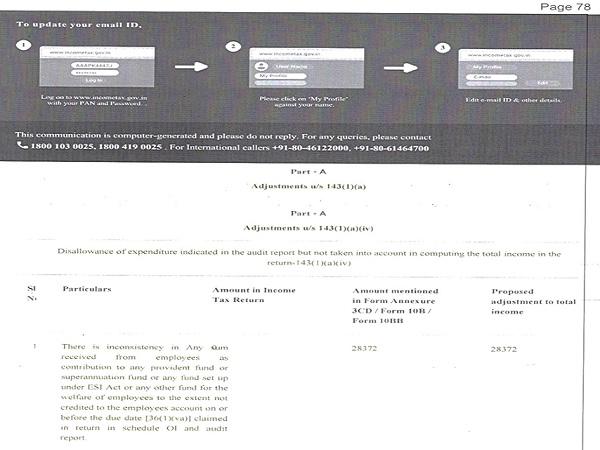
11. Further, The Ld. AR submitted that the CPC-ITR had not issued any show-cause notice proposing the disallowance of claim of deduction of Rs.37,22,491/- under section 80IA of the Act. Hence, no such disallowance while processing the ITR under section 143(1) of the Act, if not proposed vide show- cause notice, was permissible under the Act. He therefore, prayed for allowing the assessee’s appeal. 12. The Ld. AR further submitted that the assessee had filed its audit report online in Form No.10CCB of the Act along with ITR on 15.11.2024 wherein the claim of deduction of Rs.37,22,491/- under section 80IA of the Act was disclosed in Schedule VI-A of the ITR. However, the CPC-ITR disallowed the entire claim of deduction of Rs.37,22,491/- while processing the ITR under section 143(1) of the Act. The Ld. AR placed reliance on the decision of Tribunal in the cases of Arham Pumps in ITA No.206/Ahd/2021; Satishchandra Hiralal Berawala in ITA No.940/Ahd/2024 and Shikhar Enterprises in ITA No.490/RPR/2026. 13. The Ld. Sr. DR vehemently argued the case. He submitted that the audit report in Form 10CCB was filed along with the ITR on 15.11.2024 though it was required to be filed a month before the specified date under section 139(1) of the Act. Hence, the said audit report in Form 10CCB was belated; therefore, the assessee was not entitled for claim of deduction of Rs.37,22,491/- under section 80IA of the Act. Thus, the CPC was justified in disallowing the claim deduction of Rs.37,22,491/- under section 80IA of the Act. He supported the order of the First Appellate Authority and prayed for dismissal of the appeal of the assessee.
14. We have heard rival parties and have perused the material available on the record. We find merit in the submissions/contentions/arguments of the Ld. AR that the CPC cannot deny the claim of deduction of Rs.37,22,491/- under section 80IA of the Act without issuing the show-cause notice for the said adjustment. The principle of natural justice has to be followed. It is worth to reproduce relevant part of section 143(1) of the Act, which reads as under:
“143. (1) Where a return has been made under section 139, or in response to a notice under sub-section (1) of section 142, such return shall be processed in the following manner, namely:— (a) the total income or loss shall be computed after making the following adjustments, namely:—
(i) any arithmetical error in the return;
(ii) an incorrect claim, if such incorrect claim is apparent from any information in the return;
(iii) disallowance of loss claimed, if return of the previous year for which set off of loss is claimed was furnished beyond the due date specified under sub-section (1) of section 139;
(iv) disallowance of expenditure 68[or increase in income] indicated in the audit report but not taken into account in computing the total income in the return;
(v) disallowance of deduction claimed under 69[section 10AA or under any of the provisions of Chapter VI-A under the heading “C.— Deductions in respect of certain incomes”, if] the return is furnished beyond the due date specified under sub-section (1) of section 139; or
(vi) addition of income appearing in Form 26AS or Form 16A or Form 16 which has not been included in computing the total income in the return:
Provided that no such adjustments shall be made unless an intimation is given to the assessee of such adjustments either in writing or in electronic mode:
Provided further that the response received from the assessee, if any, shall be considered before making any adjustment, and in a case where no response is received within thirty days of the issue of such intimation, such adjustments shall be made:
Provided also that no adjustment shall be made under sub-clause (vi) in relation to a return furnished for the assessment year commencing on or after the 1st day of April, 2018;”
[Emphasis supplied]
15. From perusal of 1st proviso to section 143(1)(a) of the Act, it is evident that the CPC is mandatorily required to send an intimation proposing the adjustment before making any adjustment in accordance with the provisions of section 143(1)(a) of the Act. The word used in 1st proviso is “shall” and thus, it is clear that no adjustment shall be made while processing the ITR under section 143(1)(a) of the Act unless an intimation is given to the assessee of such adjustment. Here, the Ld. AR has admitted at Bar that the CPC has not sent any intimation proposing the adjustment on account of denial of the claim of deduction of Rs.37,22,491/- under section 80IA of the Act. The CPC has sent one and only one intimation proposing the adjustment of Rs.28,372/- with respect to PF and ESI under section 36(1)(va) of the Act.
16. The Revenue has not brought any material on the record to contradict the admission of the Ld. AR that the CPC has not sent any intimation proposing the adjustment on account of denial of the claim of deduction of Rs.37,22,491/- under section 80IA of the Act.
17. After thoughtful consideration, we are of opinion that the CPC has made the adjustment by denying the claim of deduction of Rs.37,22,491/- under section 80IA of the Act without sending any intimation to the assessee of such adjustment.
Further, we are of the considered view that the case at hand is squarely covered by the decision of this bench in the case of Shikhar Enterprises in ITA No.490/RPR/2026. We, therefore, following the decision of this bench in the case of Shikhar Enterprises (supra), hold that the CPC is not justified in making the adjustment of Rs.37,22,491/-. Accordingly, we set aside the impugned order and delete the adjustment of Rs.37,22,491/- made vide intimation, dated 19.12.2025, under section 143(1) of the Act.
18. In view of the above, the appeal of the assessee is allowed.
Order pronounced in the open court on 30/10/2026.