DCIT Vs Santosh Kumar Krishna Shastrula (ITAT Hyderabad)
Knowing an Accommodation Entry Is Not the Same as Earning From It – ₹3.48-Crore Commission Addition Deleted for Missing Money Trail
The Hyderabad Bench of the ITAT has held that an individual cannot be assessed for estimated commission income merely because he was associated with companies which allegedly provided accommodation entries and was aware that their transactions did not involve the physical movement of goods. The Revenue must establish through a money trail, seized material, third-party statement or other corroborative evidence that the commission was actually received by or accrued to the individual.
The assessee, Santosh Kumar Krishna Shastrula, was covered by a search u/s 132 on 23.12.2015 along with the Aster group. Consequent to the search, notice u/s 153A was issued for AY 2015-16. The assessee filed his return declaring a total income of ₹5,90,340.
During the assessment proceedings, the AO examined transactions entered into by two companies—Krishnadhatu Trading Pvt. Ltd. and Krishna Shastrula Trading Pvt. Ltd. These companies had originally been incorporated by the assessee.
The companies had recorded purchases and sales aggregating to approximately ₹214.82 crore during the relevant year. In the statement recorded during the search, the assessee acknowledged that there was no physical movement of goods in respect of these transactions and that they represented accommodation entries.
The AO referred to certain other cases in which accommodation-entry providers were stated to have earned commission ranging between 1.5% and 1.7% of the turnover. Applying an average rate of 1.62% to the turnover of ₹214.82 crore, the AO estimated commission income of ₹3,48,00,938 and assessed the entire amount in the assessee’s individual hands.
The assessment was completed u/s 143(3) r.w.s. 153A at a total income of ₹3,53,91,278.
The CIT(A) deleted the addition. The Revenue challenged that relief before the Tribunal.
The Department contended that incriminating evidence concerning the accommodation entries had been found from the assessee’s residence during the search. It argued that although the assessee was no longer formally a director during the relevant period, he continued to run the operations of the companies and had himself admitted the absence of physical movement of goods.
The Department further argued that the assessee had transferred his shares in the companies but had not received the consideration for that transfer. Since he had incorporated the entities and continued to look after their affairs, he should be regarded as the real beneficiary of the accommodation-entry business.
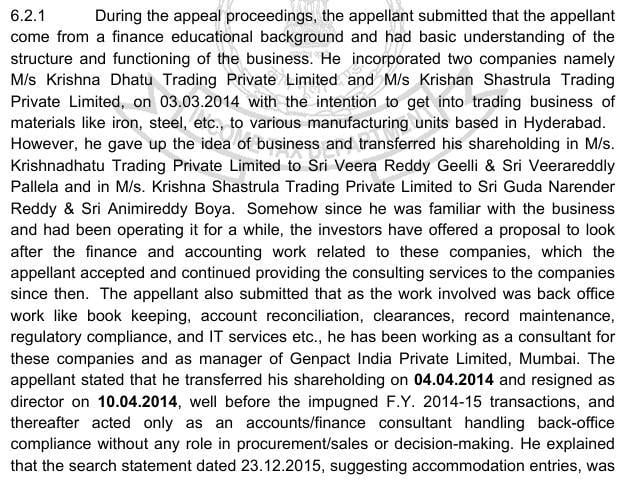
The assessee responded that he had transferred his shareholding on 04.04.2014 and resigned from the directorship of both companies on 10.04.2014. Thereafter, he was associated with them only as an employee or consultant handling accounting and finance-related functions.
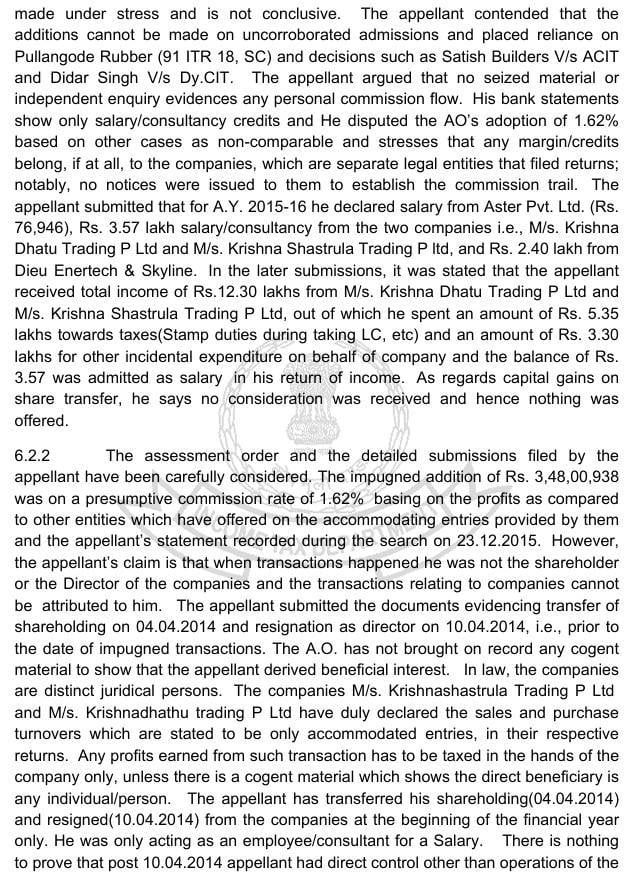
It was submitted that even if the transactions of the companies were treated as bogus, that fact did not establish that the assessee had personally earned commission. No part of the alleged commission was found in his bank accounts, and no cash, ledger, receipt or other seized document evidenced payment to him.
Further, no director, employee, counterparty or alleged beneficiary of the accommodation entries had stated that any commission had been paid or was payable to the assessee.
The Tribunal observed that the transactions were recorded in the books of the two companies and that the corresponding turnover belonged to those companies. The essential question was not merely whether the transactions were genuine, but whether the alleged commission income belonged to the assessee personally.
The CIT(A) had recorded a categorical factual finding that the assessee transferred his shareholding on 04.04.2014 and resigned as director on 10.04.2014. The Department failed to produce material contradicting these findings or demonstrating that the assessee continued as the beneficial owner of the companies.
The AO had not identified any actual receipt of commission. No amount was traced to the assessee’s bank account. No cash or document was seized showing payment to him. There was also no statement from any beneficiary alleging that the assessee had charged or received commission.
The Tribunal acknowledged that the material relied upon by the AO might demonstrate that the companies had undertaken non-genuine transactions. However, there remained a clear missing link between the companies’ transactions and the assessee’s alleged personal income.
The assessee’s statement acknowledging the nature of the transactions did not fill this evidentiary gap. Knowledge of, or involvement in, accounting and operational matters is different from proof that the resulting financial benefit accrued to the person concerned.
In the absence of evidence establishing the financial nexus, the AO could not apply a commission rate derived from other cases and tax ₹3.48 crore in the assessee’s hands. The CIT(A)’s order deleting the addition was upheld, and the Revenue’s appeal was dismissed.
Author’s Comments
The ruling makes an important distinction between three separate propositions: the transaction is bogus; the assessee knows it is bogus; and the assessee earned income from it. Proof of the first two does not automatically establish the third.
The assessee’s admission regarding the absence of physical movement of goods was undoubtedly incriminating as regards the companies’ transactions. But it was not an admission that he had received commission. An admission must be read for what it actually says and cannot be enlarged through inference.
The AO’s estimation at 1.62% suffered from two weaknesses. First, the rate was borrowed from other accommodation-entry cases without proving comparability. Second, and more fundamentally, the Revenue had not first established that any commission belonged to the assessee. Estimation can quantify income after its existence is proved; it cannot prove the existence of income.
Separate corporate personality was also relevant, though not conclusive. If evidence showed that the assessee remained the beneficial owner, controlled the bank accounts, received cash or appropriated the profits, the corporate structure would not protect him. In the present case, however, the recorded transfer of shares and resignation from directorship remained uncontroverted.
Search assessments frequently involve loose documents, statements and operational records. But even in a search case, attribution of income requires an assessee-specific nexus. The Department should trace the bank flow, identify beneficiaries, examine company personnel and establish who received the consideration for the entries.
The decision does not legitimise the accommodation transactions. It merely identifies the correct evidentiary burden before their presumed profit can be taxed in someone’s individual hands. Association creates suspicion; receipt or accrual creates taxable income.
FULL TEXT OF THE ORDER OF ITAT HYDERABAD
This appeal is filed by the Revenue, feeling aggrieved by the order passed by the Learned Commissioner of Income Tax (Appeals)-11, Hyderabad (“Ld. CIT(A)”) dated 24.09.2025 for the A.Y. 2015-16.
2. The Revenue has raised the following grounds of appeal:
“1) On the facts and in the circumstances of the case and in law, the Ld. CIT(A) erred in deleting the addition of Rs. 3,48,00,938/- without appreciating the fact that the incriminating material and evidences on the basis of which addition was made were unearthed at the residence of the assessee during the course of search u/s 132 of the Act.
2) The Ld. CIT(A) erred in not considering the fact that even though the assessee was not a director during the impugned period in the companies, he was running the entire operations of providing accommodation entries which the assessee himself admitted in the worn statement recorded on 23.12.2015.
3) The Ld. CIT(A) erred in holding that the companies and the assessee are separate legal entities and profits are taxable only in the hands of the companies, ignoring the fact that the income in respect of accommodation entries, the assessee is the real beneficiary.
4) Any other ground that may be urged at the time of hearing.
3. The brief facts of the case are that the assessee is an individual who was covered under search action under section 132 of the Income-tax Act, 1961 (“the Act”) on 23.12.2015 along with other group cases of M/s Aster (P) Ltd. Consequent to the search, notice under section 153A of the Act dated 21.11.2016 was issued to the assessee for the Assessment Year 2015-16. In response thereto, the assessee filed his return of income on 02.11.2017 declaring total income of Rs. 5,90,340/-. During the course of assessment proceedings, the Assessing Officer noticed that two companies, namely M/s Krishnadhatu Trading Private Limited and M/s Krishna Shastrula Trading Private Limited, which were originally incorporated by the assessee, had entered into transactions involving non-genuine purchases and sales aggregating to Rs. 214,82,06,059/- during the year under consideration. The Assessing Officer further observed that in the statement recorded during the course of search on 23.12.2015, the assessee had admitted that there was no physical movement of goods in respect of the transactions carried out through the aforesaid companies and that such transactions were in the nature of accommodation entries. Taking note of certain other cases wherein commission ranging between 1.5% and 1.7% was stated to have been earned for providing accommodation entries, the Assessing Officer estimated commission income attributable to the assessee at the rate of 1.62% of the alleged non-genuine turnover of Rs. 214.82 crores and accordingly made an addition of Rs. 3,48,00,938/- in the hands of the assessee. Accordingly, the assessment was completed by the Assessing Officer under section 143(3) read with section 153A of the Act on 22.12.2017 determining the total income of the assessee at Rs. 3,53,91,278/-.
4. Aggrieved by the assessment order, the assessee preferred an appeal before the Ld. CIT(A). After considering the submission of the assessee the Ld. CIT (A) deleted the entire addition of Rs. 3,48,00,938/- made by the Assessing Officer. Accordingly, the Ld. CIT (A) allowed the appeal of the assessee.
5. Aggrieved by the order of the Ld. CIT(A), the Revenue is in appeal before us. The Learned Departmental Representative (“Ld. DR”) reiterated the findings of the Assessing Officer and submitted that the assessee had himself admitted in the statement recorded during the course of search that the transactions undertaken by the aforesaid companies were merely accommodation entries without actual movement of goods. The Ld. DR also submitted that, although the assessee is contending that he has transferred his shares in the company, however, the assessee has not received the consideration for the said shares transferred. It was also submitted that the assessee was instrumental in incorporating the said companies and was looking after their affairs and, therefore, the Assessing Officer was justified in estimating the commission income attributable to the assessee. The Ld. DR accordingly prayed that the order of the Ld. CIT(A) be set aside and that of the Assessing Officer be restored.
6. Per contra, the Learned Authorized Representative (“Ld. AR”) relied upon the order of the Ld. CIT(A). The Ld. AR submitted that the assessee, in his statement recorded during the course of search, had categorically explained that he was working for the aforesaid companies as an employee/consultant and was looking after their accounting and finance-related work. It was submitted that merely because certain transactions undertaken by the companies were found to be bogus or accommodation entries, the same could not, by itself, lead to an inference that the assessee had earned commission therefrom. The Ld. AR further submitted that the Revenue had not brought on record any material showing that any part of the alleged commission had been received by or had accrued to the assessee. It was further submitted that no person connected with either of the companies or any alleged beneficiary of the accommodation entries had stated that the assessee was the beneficiary of the bogus transactions or had received commission in relation thereto. The Ld. AR accordingly submitted that the Ld. CIT(A) had rightly deleted the addition and prayed that the appeal filed by the Revenue be dismissed.
7. We have heard the rival submissions and perused the material available on record. The short controversy before us is whether the Ld. CIT(A) was justified in deleting the addition of Rs. 3,48,00,938/- made by the Assessing Officer by estimating commission income at the rate of 1.62% on the alleged non-genuine turnover of Rs. 214.82 crores undertaken through M/s Krishnadhatu Trading Private Limited and M/s Krishna Shastrula Trading Private Limited. It is not in dispute that the transactions in question were recorded in the books of the aforesaid two companies and the turnover pertaining thereto belonged to the said companies. The Assessing Officer has attributed commission income arising from such transactions to the assessee primarily on the basis that the assessee had initially incorporated the companies, had been associated with their affairs and had admitted during the course of search that the transactions were in the nature of accommodation entries. However, the crucial question is not merely whether the transactions undertaken by the companies were genuine or otherwise, but whether there was material on record establishing that the assessee had personally earned or received commission from such transactions. In this regard, we have gone through para nos. 6.2.1 to 6.2.4 of the order of the Ld. CIT (A) which is to the following effect:
*
*
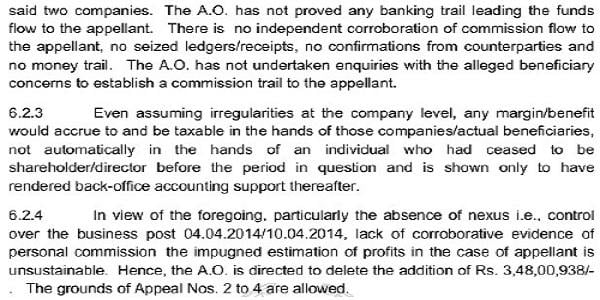
8. On perusal of the above, we find that the Ld. CIT(A) has recorded a categorical finding that the assessee had transferred his shareholding in the aforesaid companies on 04.04.2014 and resigned from their directorship on 10.04.2014. The Ld. CIT(A) has further recorded that thereafter the assessee was working only as an employee/consultant. Nothing has been brought before us by the Revenue to controvert these factual findings recorded by the Ld. CIT(A) or to demonstrate that, notwithstanding the transfer of shareholding and resignation from directorship, the assessee continued to be the beneficial owner of the companies or exercised such control over their business as would establish that the income arising from the alleged accommodation-entry activity belonged to him personally.
9. We further find that the Assessing Officer has not identified any receipt of commission by the assessee. No amount representing such commission has been found credited in his bank account nor has any cash, ledger, receipt or other seized material been brought on record showing payment of commission to the assessee. There is also no statement of any person connected with the two companies, or of any beneficiary of the alleged accommodation entries, stating that commission was paid or payable to the assessee. Thus, while the material relied upon by the Assessing Officer may indicate that the companies had undertaken non-genuine transactions, there is a clear missing link between such transactions and the alleged earning of commission by the assessee in his individual capacity.
10. The statement of the assessee acknowledging the nature of the transactions undertaken by the companies also does not, by itself, establish that the assessee was the recipient of commission arising therefrom. Knowledge of, or involvement in, the accounting or operational aspects of the transactions is distinct from establishing that the financial benefit arising from those transactions accrued to the assessee personally. In the absence of any material demonstrating such financial nexus, the entire estimated commission cannot be brought to tax in the hands of the assessee merely because he was associated with the companies or was aware of the nature of their transactions.
11. In view of the above facts and circumstances, we find that the Ld. CIT(A) has correctly appreciated the distinction between the alleged non-genuine transactions undertaken by the companies and the alleged commission income sought to be assessed in the hands of the assessee. The Revenue has not brought before us any material to controvert the finding of the Ld. CIT(A) that there was no money trail, seized material, confirmation from any counterparty or other corroborative evidence establishing that the assessee was the beneficiary of the alleged commission. Therefore, we find no infirmity in the order of the Ld. CIT(A) deleting the addition of Rs. 3,48,00,938/-. Accordingly, the order of the Ld. CIT(A) on this issue is upheld and the grounds raised by the Revenue are dismissed.
12. In the result, the appeal filed by the Revenue is dismissed.
Order pronounced in the Open Court on 11th September, 2026.