Summary: The article explains the Instant e-PAN facility and a practical Date of Birth (DOB)-related difficulty encountered during Aadhaar-based PAN generation. It states that the facility enables eligible individuals to obtain a digitally signed PAN electronically using Aadhaar, an Aadhaar-linked mobile number and DigiLocker. The article identifies complete DOB information as an important part of the electronic verification process and explains that where Aadhaar contains only the year of birth, the applicant is required to update the DOB in Aadhaar and retry the Instant e-PAN process. It also discusses the role of Instant e-PAN, DigiLocker-based DOB documentation, Aadhaar authentication, OTP verification and the alternative of applying through regular PAN application channels if the Instant e-PAN route remains unsuccessful. The article emphasises checking PAN status, Aadhaar validity, Aadhaar-linked mobile number, complete DOB, supporting DOB documentation and identity details before beginning the application.
- Brief
- Introduction
- Understanding the Instant e-PAN Process
- The Practical Case: A DOB-Related Problem
- Identifying the Actual Cause
- Corrective Action
- The Role of DigiLocker
- A Common Mistake: Assuming Aadhaar Alone Is Sufficient
- What Applicants Should Check Before Applying
- 1. PAN Status
- 2. Aadhaar Validity
- 3. Mobile Number
- 4. Complete Date of Birth
- 5. DOB Supporting Document
- 6. Name and Identity Details
- What If the e-PAN Request Fails?
- Lessons from the Case
- Conclusion
- References
Brief
The Instant e-PAN facility has made PAN allotment significantly easier for eligible individual taxpayers. By using Aadhaar, an Aadhaar-linked mobile number and DigiLocker, an eligible applicant can obtain a digitally signed PAN electronically without following the traditional paper-based application route. However, the convenience of an online process also means that the accuracy of underlying identity data becomes extremely important.
One of the practical issues that applicants may encounter relates to the Date of Birth (DOB). A mismatch, incomplete DOB information, or the absence of an acceptable DOB document in DigiLocker can prevent an applicant from completing the Instant e-PAN process.
This article discusses a practical case involving a DOB-related difficulty during an Instant e-PAN application. It explains how the issue was identified, why the application could not proceed, what corrective action was required and what taxpayers should verify before initiating an Instant e-PAN application.
Introduction
The Permanent Account Number (PAN) is an essential identifier for taxpayers in India and is required for various financial and tax-related transactions. Traditionally, obtaining PAN involved submitting an application with supporting documents through the prescribed channels. The Instant e-PAN facility introduced by the Income Tax Department has simplified this process for eligible individuals by allowing PAN generation through Aadhaar-based electronic verification.
The Instant e-PAN service is a free, pre-login facility available to eligible individuals who have not already been allotted a PAN. The current process requires a valid Aadhaar, an active mobile number linked with Aadhaar and access to DigiLocker. The service uses Aadhaar e-KYC details and DigiLocker-based Date of Birth proof as part of the PAN generation process.
While the process appears straightforward, applicants sometimes discover that the information available in their Aadhaar or supporting documents does not match the information required for PAN generation.
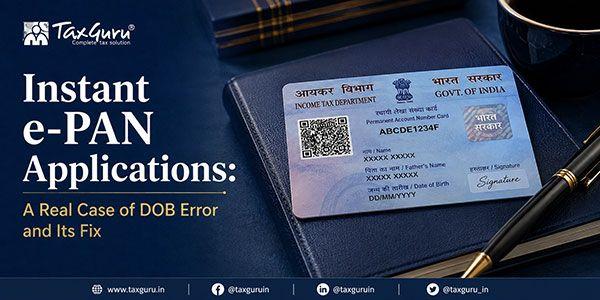
A Date of Birth issue may appear minor, but it can become a significant obstacle because identity information has to remain consistent across the electronic verification process.
A practical case illustrates how such an issue can arise and how it can be resolved systematically.
Understanding the Instant e-PAN Process
Under the Instant e-PAN facility, an eligible applicant begins the application from the Income Tax e-Filing portal by selecting the Instant e-PAN option and choosing “Get New e-PAN”.
The applicant provides consent for Aadhaar e-KYC and DigiLocker-based verification. The applicant is then redirected to DigiLocker for fetching the Date of Birth details and supporting proof.
The Income Tax Department currently identifies documents such as a Birth Certificate, Matriculation Certificate, Driving Licence, Matriculation Marksheet and Central Government Health Scheme (CGHS) Card as acceptable Date of Birth proof for this process.
Therefore, the success of the application is not dependent only on having an Aadhaar number. The information and supporting records connected with the applicant’s identity also matter.
The Practical Case: A DOB-Related Problem
In the case under discussion, the applicant attempted to obtain an Instant e-PAN through the Aadhaar-based process.
The applicant expected the process to be completed electronically because the Aadhaar details were already available and the mobile number was linked with Aadhaar.
However, during the application process, the Date of Birth information became the point of difficulty.
The applicant’s available identity records did not provide the complete Date of Birth information required for the Instant e-PAN process. In particular, the Aadhaar record contained only the year of birth rather than a complete Date of Birth.
As a result, the applicant was unable to successfully complete the Date of Birth stage of the e-PAN generation process.
This is an important practical lesson: an Aadhaar number being valid does not automatically mean that every Aadhaar-based service will be completed successfully. The information stored against the Aadhaar record must also satisfy the requirements of the particular service.
Identifying the Actual Cause
The first step in resolving the issue was not to repeatedly submit the e-PAN request.
Instead, the applicant’s Aadhaar details and available Date of Birth documents were reviewed.
The review showed that the problem was related to the availability of complete Date of Birth information.
The Income Tax Department’s own FAQ specifically addresses this situation. Where only the year of birth is available in Aadhaar, the applicant is required to update the Date of Birth in Aadhaar and then retry the Instant e-PAN process.
This distinction is important because repeatedly attempting the same application without correcting the underlying data is unlikely to solve the problem.
Corrective Action
The appropriate corrective step was to update the Date of Birth information in Aadhaar.
Once the Aadhaar information was corrected, the applicant could proceed with the Instant e-PAN process again.
The applicant also needed to ensure that an acceptable Date of Birth document was available through DigiLocker. The Income Tax Department states that the DOB proof used in the Instant e-PAN process is fetched through DigiLocker, and the applicant must provide consent for sharing the selected document with the Income Tax Department.
This makes DigiLocker an important part of the current Instant e-PAN workflow rather than merely an optional document-storage facility.
The Role of DigiLocker
DigiLocker has become an important component of the Instant e-PAN process because it enables the Income Tax Department to obtain supporting Date of Birth documentation electronically.
Applicants may select an eligible document available in DigiLocker as their Date of Birth proof. The document must be available from the relevant issuing authority or otherwise be available through the supported DigiLocker mechanism.
For example, an applicant may have a valid Class X marksheet or Birth Certificate, but if the required document is not available in DigiLocker in the manner required for the process, the Instant e-PAN application may not be completed through this route.
The Income Tax Department advises applicants to check whether the relevant issuing authority is available on DigiLocker and to fetch the document where possible. If an acceptable document cannot be obtained through the Instant e-PAN route, the applicant may need to consider the regular PAN application process.
A Common Mistake: Assuming Aadhaar Alone Is Sufficient
One of the most common misunderstandings surrounding Instant e-PAN is that possession of Aadhaar automatically guarantees PAN generation.
That is not necessarily the case.
The applicant must satisfy the eligibility conditions and successfully complete Aadhaar authentication and the required Date of Birth verification.
The current Income Tax Department guidance states that the applicant should not already have a PAN, should possess a valid Aadhaar linked with an active mobile number and should have access to DigiLocker. The applicant must also satisfy the other eligibility conditions applicable to the Instant e-PAN service.
Consequently, checking the underlying information before beginning the application can prevent unnecessary delays.
What Applicants Should Check Before Applying
Before starting an Instant e-PAN application, an applicant should ideally verify the following:
1. PAN Status
The applicant should confirm that a PAN has not already been allotted. The Instant e-PAN facility is intended for eligible individuals who do not already have a PAN.
2. Aadhaar Validity
The Aadhaar should be valid and the applicant should be able to complete Aadhaar authentication.
3. Mobile Number
The mobile number should be linked with Aadhaar because OTP-based verification forms part of the process.
4. Complete Date of Birth
The applicant should check whether the Aadhaar record contains the complete Date of Birth rather than only the year of birth.
5. DOB Supporting Document
An acceptable Date of Birth document should be available through DigiLocker.
6. Name and Identity Details
The applicant should also review identity information carefully before starting the application. Inconsistencies in core identity information can create verification difficulties.
What If the e-PAN Request Fails?
A failed Instant e-PAN request does not necessarily mean that the applicant cannot obtain a PAN.
The Income Tax Department’s current FAQ states that where the e-PAN allotment request fails, the applicant can apply for PAN through the regular channels, including Protean (formerly NSDL) or UTIITSL.
Therefore, applicants should distinguish between a technical or data-related failure in the Instant e-PAN route and the general eligibility to obtain a PAN.
If the underlying problem is a correctable Aadhaar or Date of Birth issue, correcting the data and retrying the process may be appropriate. If the Instant e-PAN route remains unsuccessful, the regular PAN application route provides an alternative.
Lessons from the Case
This practical case highlights a broader principle of digital compliance: the success of an online government service depends not only on the technology but also on the accuracy and consistency of the underlying records.
An applicant may have all the necessary documents physically but still face difficulty if the relevant electronic records are incomplete or inconsistent.
The case also demonstrates why applicants should understand the reason behind an application failure instead of repeatedly attempting the same process.
In the present situation, the problem was not solved by repeated attempts. It was addressed by identifying the missing or incomplete Date of Birth information, correcting the Aadhaar record and ensuring that appropriate supporting documentation was available for the electronic verification process.
This approach can save time and reduce unnecessary frustration for taxpayers.
Conclusion
The Instant e-PAN facility represents an important step towards simplifying taxpayer registration and reducing dependence on physical documentation. The process is free and can provide an electronic PAN through Aadhaar-based verification for eligible applicants. However, the simplicity of the application should not lead taxpayers to overlook the accuracy of their underlying identity information.
The Date of Birth issue discussed in this case demonstrates how a seemingly small data discrepancy can prevent an otherwise straightforward e-PAN application from being completed.
Applicants should therefore verify their Aadhaar information, ensure that their mobile number is linked with Aadhaar and confirm the availability of acceptable Date of Birth proof through DigiLocker before starting the application.
Where only the year of birth is available in Aadhaar, the Income Tax Department specifically advises updating the Date of Birth in Aadhaar and retrying the Instant e-PAN process.
The broader lesson is simple: before using a digital compliance service, verify the data that the system will use for authentication. Correct information at the beginning can prevent repeated failures and make the entire PAN application process considerably smoother.
References
1. Income Tax Department, Government of India – Instant e-PAN FAQ.
2. Income Tax Department, Government of India – Instant e-PAN User Manual.
3. Income Tax Department, Government of India – FAQ on e-PAN.
4. Income Tax e-Filing Portal – Instant e-PAN service guidance.