Summary: The Securities and Exchange Board of India (SEBI), through its Board Memorandum titled “FPI participation in Exchange Traded Commodity Derivatives (ETCDs)”, sought approval for expanding the participation of Foreign Portfolio Investors (FPIs) in India’s commodity derivatives market. The proposal covers two categories: non-agricultural index derivatives contracts irrespective of whether their underlying contracts are cash settled or physically settled, and non-cash settled non-agricultural commodity derivatives contracts. The initiative follows recommendations of the Commodity Derivatives Advisory Committee (CDAC), representations from market participants and a public consultation conducted in August 2026.
The proposed expansion seeks to improve institutional liquidity, strengthen price discovery, narrow bid-ask spreads and support effective hedging by domestic producers, refiners, importers and exporters. SEBI recognised that the existing restrictions on FPI participation in physically settled commodity derivatives, particularly bullion and base metals, could limit the development of Indian commodity markets as internationally relevant price-discovery centres. However, the framework also addresses the practical and regulatory difficulties arising from physical delivery obligations and GST registration requirements for FPIs.
The Memorandum proposes a safeguard mechanism under which FPIs would be prohibited from increasing their positions from T-3, where T represents the beginning of the tender period. FPIs would remain permitted to reduce, square off or roll over their existing positions until T-1. If an FPI fails to close or roll over its positions by the close of market hours on T-1, the outstanding positions would devolve upon its designated Trading Member or Trading-cum-Clearing Member at the exchange-declared closing or daily settlement price. Such transfer would be treated as a trade attracting applicable statutory levies.
Before participating in the relevant contracts, FPIs would be required to enter into appropriate tripartite or bipartite agreements with trading and clearing intermediaries. These agreements could provide for a Risk Absorption Charge to compensate the designated intermediary for assuming residual market, margin and position-limit risks. The Memorandum further examines suggestions concerning mandatory square-off by clearing corporations, additional margins, base-capital requirements, position limits, bank-owned brokers, bonded warehouses, liquidity thresholds and exceptional circumstances involving designated members.
SEBI received 93 public comments on the consultation paper, including 24 comments supporting the first proposal and 69 comments relating to the second proposal and its operational framework. Following the consultation, the Memorandum recommended retaining intermediary-level responsibility for risk management, advancing the restriction on incremental exposure from T-1 to T-3 and clarifying that positions devolved upon designated intermediaries under the regulatory safeguard would not constitute ordinary proprietary positions. The Board was requested to approve the proposals and authorise consequential operational changes. The subsequent SEBI Board meeting of September 24, 2026 approved wider FPI participation, as separately reported in the SEBI Board decisions.
Securities and Exchange Board of India
FPI participation in Exchange Traded Commodity Derivatives (ETCDs)
1. Objective:
1. Objective: This Board Memorandum seeks approval of the Board on a proposal to permit Foreign Portfolio Investors (FPIs) in:
1.1. Non-Agricultural Index Derivatives Contracts
1.2. Non-Cash Settled Non-Agricultural Commodity Derivatives Contracts
2. Background:
2.1. The CDAC in 2016, recommended that the commodity derivatives market should be opened up to institutional participation – both domestic as well as international in a phased manner. The tentative phased manner in which Government, SEBI, other Regulatory Bodies and exchanges could work together for permitting new participants on commodity derivatives exchanges, where in Phase 1, Category III Alternate Investment Fund (AIF), Portfolio Management Service (PMS), Mutual Funds and direct participation of foreign participants having exposure to commodities could be allowed. In phase 2, Banks, Insurance/reinsurance companies, Foreign Portfolio Investors and Pension Funds could be allowed.
2.2. Thereafter, a circular on Participation of Eligible Foreign Entities in the commodity derivatives market was issued in 2018. Foreign entities, having actual exposure to Indian commodity markets, in the commodity derivatives market were termed as “Eligible Foreign Entities” (EFEs).
2.3. Subsequently, in order to promote institutional participation in Exchange Traded Commodity Derivatives (ETCDs), SEBI had permitted Category III Alternative Investment Funds, Mutual Funds and Portfolio Management Services to participate in ETCDs vide Circular No SEBI/HO/CDMRD/DMP/CIR/P/2017/61 dated June 21, 2017, Circular No. SEBI/HO/IMD/DF2/CIR/P/2019/65 dated May 21, 2019 and Circular No. SEBI/HO/IMD/DF1/CIR/P/2019/066 dated May 22, 2019, respectively.
2.4. Thereafter, the proposal to allow FPIs to participate in ETCDs was placed before CDAC in its 12th meeting held on November 15, 2021. The CDAC had suggested that FPIs may be allowed to participate in Indian ETCDs with a graded approach.
2.5. The SEBI Board, during its meeting held on Jun 29, 2022, decided to allow foreign portfolio investors to participate in the exchange-traded commodity derivatives segment. Further, as per the decision taken in the board meeting, SEBI formed a Working Group comprising of representatives of Clearing Corporations, Custodians and SEBI to review and examine if any additional risk management measures including position limits need to be taken, for FPI participation in ETCDs.
2.6. The Working Group recommended that the current risk management framework in commodity derivatives market is adequate to take care of the anticipated participation by FPI. Hence, no additional risk management measures were proposed for FPI participation in ETCD markets. Further, the proposed Position Limit norms for FPI participation in ETCDs were adequate and no differential Position Limits may be needed. Hence, FPIs (other than individuals, family offices and corporate bodies) may be allowed position limit of a “client”. FPIs belonging to categories viz. individuals, family offices and corporates may be allowed position limit of 20 per cent of the “client level” position limit in a particular commodity derivatives contract.
2.7. Thereafter, SEBI vide Circular dated September 29, 2022 (now part of SEBI Master Circular SEBI/HO/MRD/MRD-PoD-1/P/CIR/2023/136 dated August 04, 2023), allowed participation of FPIs in cash settled non-agricultural commodity derivative contracts and indices comprising such non-agricultural commodities.
3. Need for Review:
3.1. Given passage of time, SEBI has been receiving representations from exchanges and market participants seeking to widen the scope of FPI participation in the Indian commodity derivatives market.
3.2. Major international commodity exchanges already permit diverse institutional participants, including foreign entities, in physically settled contracts. The continued exclusion of FPIs from India’s physically settled non-agri contracts increasingly stands out relative to global norms.
3.3. For contracts where India has meaningful production, consumption, or trade volume, credible price-setting status depends on institutional liquidity that the current restriction structurally limits.
3.4. Extending FPI participation to non-cash settled non-agricultural commodity derivatives is expected to deepen liquidity in India’s most actively traded and benchmark-setting contracts, i.e. bullion and base metals, which currently do not benefit from FPI-driven flow despite FPIs already being active in the cash-settled segment. Wider institutional participation is expected to narrow bid-ask spreads, improve depth across contract months, and strengthen price discovery by bringing a more diverse set of views, informed by global commodity flows and cross-market positioning, into the price formation process.
3.5. For domestic hedgers, producers, refiners, importers and exporters; deeper and more diverse institutional participation means greater capacity to execute hedges of meaningful size without adverse price movements, and a more dependable futures price to hedge against in the first place.
3.6. However, FPIs are not permitted to take or make delivery in physical markets due to the absence of a permanent establishment in India. Even if the FPI may delegate a Trading Member (TM) to take/make delivery of the goods on FPI’s behalf, the FPIs would still be required to mandatorily obtain GST registration to trade in commodities in India.
3.7. In international commodity markets, foreign investors are allowed to trade in physically settled commodity derivative contracts. Japan’s OSE and TOCOM attract active participation from foreign investors, who have been driving the surge in trading activity witnessed in some of the physically settled commodity derivative contracts. China, in its bid towards internationalization of its commodity markets, has permitted the Qualified Foreign Investors (QFIs) to trade in a wide range of commodity futures and options contracts (including physically settled contracts). In USA’s CME and Europe’s ICE, clearing members are required to assess whether clients possess the operational and financial capacity to fulfill delivery obligations and, where assurance is lacking, ensure that positions are liquidated prior to expiry. China and Japan manage delivery risk through VAT invoicing requirements and stringent position limits, while exchanges such as CME and ICE place oversight duties on clearing members to assess and manage delivery capabilities.
3.8. Drawing from international experience while taking into account the specific characteristics of the Indian market, it was felt that FPI participation in physically settled commodity derivatives contracts may be contingent upon ensuring that they exit the commodity derivatives contracts before the delivery obligation arises. Accordingly, a framework for FPI participation in physically settled commodity derivatives contracts relevant for domestic market has been designed.
3.9. The proposals to allow FPIs to participate in non-agri index derivatives contracts and non-cash settled non-agricultural commodity derivatives contracts were discussed in 19th and 20th meetings of CDAC held on February 26, 2026 and August 03, 2026 respectively. After due deliberation, the committee recommended that FPI participation may be permitted in aforementioned contracts.
3.10. Pursuant to discussions in the Committee, a Consultation Paper soliciting public comments on the proposal was issued by SEBI on August 11, 2026. Total 93 Comments have been received on the aforesaid consultation paper from members of the public including brokers, clearing members, custodians, financial markets consultants, law firms, industry associations and investors including FPIs.
4. Recommendations and Proposal to the Board:
4.1. Proposal I: FPI Participation in Non-Agricultural Index Derivatives Contracts
4.1.1. FPIs may be permitted to participate in non-agri index derivatives contracts where the underlying may be cash settled or settled by delivery.
4.1.2. CDAC Recommendation: The CDAC after due deliberation recommended the proposal placed at Para 4.1.1.
4.1.3. Analysis of Public Comments: 24 comments received on this subject, supported the proposal without any qualification. It has been argued by the commentators that FPI participation may deepen liquidity, improve price discovery and support efficient development of non-agricultural commodity indices.
Table-1: Analysis of comments received on Proposal 1
| Proposal No. | Proposal Description | No. of people/entities agreeing to the proposal (Strongly Agree + Agree + Partially Agree) | No. of people/entities disagreeing to the proposal (Strongly Disagree + Disagree) |
|---|---|---|---|
| 1 | Whether FPIs should be allowed to participate in Non-Agricultural Index Derivatives Contracts irrespective of whether the underlying is cash settled or not? | 24 | 0 |
4.1.4. Proposal I:
4.1.4.1. The nature of index derivatives is that they are always cash settled, irrespective of the underlying being cash-settled or not. Thus, FPIs participating in such contracts would not acquire a right or obligation to take or make delivery of the commodities forming the index.
4.1.4.2. In view of Para 4.1.1, CDAC recommendation and public comments, it is proposed that FPIs may be permitted to participate in non-agricultural index derivatives contracts.
4.2. Proposal II: FPI Participation in Non-Cash Settled Non-Agricultural Commodity Derivatives Contracts
4.2.1. FPI may be allowed to participate in Non-Cash Settled Non-Agricultural Commodity Derivatives Contracts at domestic exchanges. However, a safeguard mechanism is proposed to ensure that FPI exits its positions before entering the Tender Period, i.e. 3 days before the expiry of the contract, so that they exit before the possibility of delivery obligation arises. Further, as an additional safeguard, FPIs may not be permitted to increase its position on T-1 day.
4.2.2. The functioning of the safeguard mechanism is mentioned below:
4.2.2.1. Before enablement of FPI to trade in non-cash settled non-agricultural commodity derivative contracts, a tripartite agreement among the Professional Clearing Member (PCM), the Trading Member (TM) and the FPI, or a bipartite agreement between the Trading Cum Clearing Member (TCM) (or any other nomenclature used by the exchanges in this regard) and the FPI, as applicable to the membership structure through which the FPI operates, shall be executed. The TM/TCM who has entered into such agreement may be termed as designated TM/TCM.
4.2.2.2. The FPI may choose to enter into such onboarding agreement with a single TM/TCM, either across all exchanges and commodities, exchange-wise, or commodity/group-wise. However, this does not preclude the FPIs to trade with multiple trading members.
4.2.2.3. The agreement may incorporate a pre-agreed charge, to be named as the ‘Risk Absorption Charge’, payable by the FPI to the TM/TCM where the FPI’s open position may be devolved on account of the FPI’s failure to voluntarily square off or roll over such position by T-1. The Risk Absorption Charge is intended to compensate the TM/TCM for the risk, margin, and position-limit burden, it absorbs on account of the functions undertaken under the safeguard mechanism, and shall be over and above any service fee agreed between the parties.
4.2.2.4. The safeguard mechanism shall stand triggered only where an FPI has not voluntarily squared off or rolled over its open position by the close of market hours on T-3.
4.2.2.5. FPIs shall be free to square off or roll over their open position(s) at any time up to the close of market hours on the day preceding the start of the tender period (T-1). Only where such square-off or rollover has not been effected voluntarily by the close of market hours of T-1 day, the FPI positions shall be devolved on the designated TM/TCM. Under this arrangement, such devolvement of FPI positions shall be executed at the Closing Price/Daily Settlement Price, as declared by the Exchange on the day of devolvement of the position.
Figure 1: Time Period from T-3 day till Tender Period
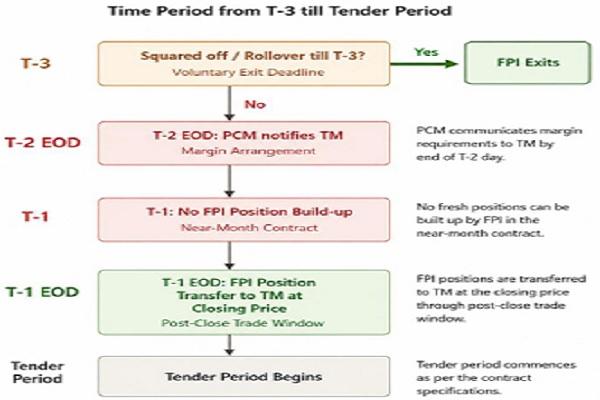
4.2.2.6. This devolvement of the open position from the FPI to the TM/TCM would be considered as a trade with applicable statutory levies.
4.2.3. CDAC Recommendation: The CDAC recommended the proposal placed at Para 4.2.1, to allow FPIs to participate in non-cash settled non-agricultural commodity derivatives contracts, subject to the safeguard mechanism to prevent obligation of delivery on FPIs.
4.2.4. Analysis of Public Comments: A total of 69 comments have been received with reference to the proposal. The commentators have agreed that FPIs should be allowed to participate in non-cash settled non-agricultural commodity derivatives. However, there have been certain suggestions with regard to the modalities of FPI participation in such contracts. In this regard, the received suggestions were also discussed with the exchange and market intermediaries in order to examine their relevance with reference to the proposed framework. Some of the suggestions received in the comments are discussed below:
Table-2: Analysis of comments received on Proposal 2
| Proposal No. | Proposal Description | No. of people/entities agreeing to the proposal (Strongly Agree + Agree + Partially Agree) | No. of people/entities disagreeing to the proposal (Strongly Disagree + Disagree) |
|---|---|---|---|
| 2A | Whether FPIs should be allowed to participate in Non-Cash Settled Non-Agricultural Commodity Derivatives Contracts? | 27 | 0 |
| 2B | Do you agree with the proposed framework for FPI participation in Non-Cash Settled Non-Agricultural Commodity Derivatives Contracts? | 22 | 2 |
| 2C | Draft Circular on FPI Participation in Exchange Traded Commodity Derivatives | 18 | 0 |
4.2.4.1. No Incremental exposure allowed for FPIs from T-3/T-4 instead of T-1:
4.2.4.1.1. The consultation paper had proposed that the FPIs should unwind their positions before start of the tender period, viz. three days before the expiry of the contract. To ensure that FPI positions do not enter into delivery period, it was proposed that the FPI may not be allowed any increase in exposure on T-1 day, where T is the beginning of the tender period.
4.2.4.1.2. However, three of the comments have suggested that FPIs should not be allowed to increase their exposure from T-3 day and one comment has suggested T-4 day as the cut off for no incremental exposure.
4.2.4.1.3. Our Comments & Proposal:
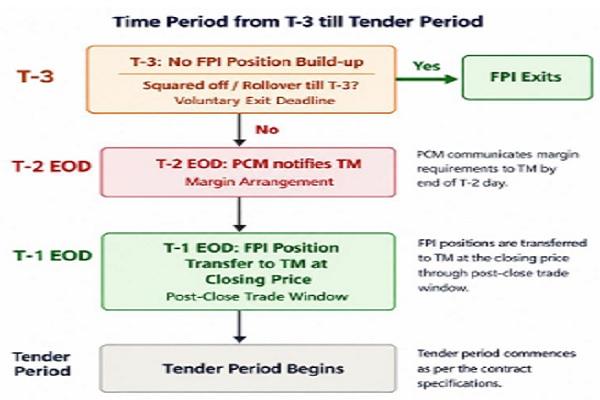
4.2.4.1.3.1. It is felt that restricting the FPI from taking incremental exposure from T-3 day instead of T-1 day may provide greater risk mitigation. However, FPIs shall be permitted to reduce, close or roll over their existing positions till T-1 day.
4.2.4.1.3.2. Based on the suggestions received, it is proposed that this deadline of limiting incremental exposure may be moved from T-1 day to T-3 day.
4.2.4.2. Mandated system driven square-off by Clearing Corporation (CC) for FPI positions before the start of the tender period:
4.2.4.2.1. Seven comments have suggested that, instead of post close position devolvement from FPI to TM/TCM at T-1 day, there should be system driven square off by CC of FPI positions either at T-4 or T-3 or T-2. Thus, implying that such responsibility of closeout of positions should be placed on Clearing Corporation. Only in cases where the positions could not be squared off due to suspension or halt of trade or any other reason; devolvement of such positions should be done on the designated TM/TCM. One comment has suggested to prepone the devolvement of FPI position on T-2 day from T-1 day.
4.2.4.2.2. One commentator has also suggested that PCM should not held liable for addition of open positions by the FPI on T-1 day since such additions would be beyond the control of the PCM for FPIs using auto confirmation. Most clients especially HFT or quant traders prefer to have auto confirmation of trades on account of high volumes. When the client trades are executed by TM, the CC will auto confirm the same based on reported margins. The CM or PCM will not have any control over what gets confirmed under auto confirmation. For clients under auto confirmation mode, the PCM gets the trade data only post execution and auto confirmation by the CC and hence the PCM has no control over such trades.
4.2.4.2.3. Our Comments & Proposal:
4.2.4.2.3.1. The Clearing Corporation is not the appropriate entity to undertake such square-off. Its primary role is to manage counterparty and settlement risk and ensure the integrity of the clearing and settlement process, rather than execute discretionary market transactions on behalf of participants.
4.2.4.2.3.2. The manner in which the positions of the FPI shall be handled, including the squaring off of the FPI positions or devolvement of such positions at the end of T-1 market hours, shall be governed as per the agreement between the FPI and the TM/TCM. Further, it may be noted that all confirmed trades have to be honoured by the clearing member.
4.2.4.2.3.3. The responsibility for monitoring client positions, margins, exposure and taking appropriate risk-mitigation measures appropriately rests with the broker/clearing member as part of its risk-management framework.
4.2.4.2.3.4. TM/TCMs shall incorporate appropriate provisions in their agreements with FPI clients governing position management and timely square-off of positions before commencement of the tender period.
4.2.4.2.3.5. Hence, the public comments with reference to system driven square off may not be accepted.
4.2.4.3. Imposition of additional margins by TM/TCMs from T-4 day till T-1 day and other margin related concerns:
4.2.4.3.1. Two comments have suggested that additional margins may be imposed on the FPI client from T-4/T-3 day as the positions of the FPI approaches close to the beginning of the Tender Period (T-day). One comment has suggested to prepone the margin call arrangement from T-2 day to T-3 day.
4.2.4.3.2. Our Comments & Proposal:
4.2.4.3.2.1. The decision regarding whether additional margins are warranted, and the quantum thereof, should appropriately remain within the risk-management discretion of the TM/TCM, based on the client’s financial capacity, trading behaviour, existing exposure, liquidity and the member’s assessment of the risks associated with the position. Further, the ability of a TM/TCM to onboard and service clients is itself subject to its client onboarding capacity, internal risk appetite, credit assessment and exposure limits. A member may accordingly choose to onboard only those clients for whom it is comfortable assuming the requisite risk and may impose higher client-level margins wherever necessary.
4.2.4.3.2.2. Further, the risk-management framework of the member may provide for appropriate changes to the client onboarding agreement to address the risks and obligations associated with FPI participation in commodity derivatives. The onboarding agreement may clearly specify the member’s rights to revise exposure limits, impose additional margins, restrict or close out positions, require reduction of positions within specified timelines, or take other appropriate risk-mitigation measures in response to changes in market conditions, liquidity, volatility or the client’s risk profile. This would enable the member to retain the necessary flexibility to manage client-level risks while ensuring that the relevant terms and conditions are transparently communicated and agreed with the client at the time of onboarding.
4.2.4.3.2.3. It is proposed that imposition of additional margins should remain a matter of TM/TCM-level risk management and client onboarding capacity rather than being mandated uniformly for all FPIs during the period from T-4 day to T-1 day.
4.2.4.3.2.4. Hence, the public comments with reference to mandatory imposition of additional margins and preponing of margin call may not be accepted.
4.2.4.4. Base Capital Criteria for TM/TCMs to become designated TM/TCM under safeguard mechanism:
4.2.4.4.1. One of the commentator has suggested that position absorption capacity should be defined for TM/TCMs as the residual risk falls upon them. Abrupt market moves may weaken the TM/TCMs financial position and may cause a scenario where the TM/TCM does not have funds to absorb the devolved FPI positions.
4.2.4.4.2. Our Comments & Proposal:
4.2.4.4.2.1. Position limits are already prescribed at the client level and member level, and members are required to ensure that their positions remain within the applicable regulatory limits. SEBI’s framework specifically provides for member-level position limits for commodity derivatives, including aggregation of client and proprietary positions. A member may assess the financial capacity and risk profile of its clients and accordingly determine the quantum of exposure it is willing to permit, including adopting more conservative internal limits than the regulatory position limits.
4.2.4.4.2.2. In the event of a default by a client, whether an FPI or any other client, the TM/CM remains responsible for managing and settling the resulting positions in accordance with the applicable framework. Accordingly, devolvement of the FPI’s positions to the TM/TCM before the start of the tender period would ensure that the physical market-related compliances and obligations, including applicable GST registration requirements, are fulfilled by the TM/TCM, without requiring the FPI to independently undertake such physical-market compliances.
4.2.4.4.2.3. Thus, prescribing an additional base-capital threshold specifically for designation under the safeguard mechanism could unnecessarily restrict the number of eligible members without a corresponding reduction in market risk, since the overall exposure is already constrained through client level and member level position limits and applicable margin requirements.
4.2.4.4.2.4. Hence, the public comments with reference to requirement of base capital criteria for TM/TCMs to become designated TM/TCM under safeguard mechanism may not be necessary.
4.2.4.5. Separate position limits for Category-1 and Category-2 FPIs and combined position limit for FPIs across Futures and Options:
4.2.4.5.1. One comment has suggested that separate position limits should be there for category-1 and category-2 FPIs. Another comment has suggested that there should be a combined FPI position limit across futures and options as the devolvement of options into futures may produce a position in excess of the futures limit.
4.2.4.5.2. Our Comments & Proposal:
4.2.4.5.2.1. The current SEBI prescribed guidelines on position limit for commodity derivatives provides different limits for Category-1 and Category-2 FPIs.
4.2.4.5.2.2. Further, in cases where devolvement of options into corresponding futures positions leads to open positions for clients/members exceeding their permissible position limits for future contracts; the stock exchanges may permit such clients/members maximum up to two trading days post option expiry day to reduce their futures positions to bring them within the permissible position limits.
4.2.4.5.2.3. Category-1 FPIs enjoy position limit at par with the domestic participants and Category-2 FPIs are allowed to hold positions upto 20 per cent of the client level position limit in a particular commodity derivative contract.
4.2.4.5.2.4. Hence, the concerns raised by the public comments are addressed by existing SEBI guidelines.
4.2.4.6. Disadvantages on bank brokers to participate in the proposed framework:
4.2.4.6.1. Two comments have suggested that the framework in current form puts bank brokers at disadvantage to participate as designated member for the safeguard mechanism. The proposed framework contemplates compulsory transfer/devolvement of FPI positions to the designated TM/TCM if the FPI fails to voluntarily square-off or rollover positions before commencement of the tender period. As per RBI Circular dated November 28, 2025, a bank subsidiary cannot undertake proprietary positions in the commodity derivatives segment. Thus, the proposed framework may create a direct regulatory inconsistency for bank-owned brokers who are prohibited from holding proprietary commodity derivative positions under RBI regulations.
4.2.4.6.2. Our Comments & Proposal:
4.2.4.6.2.1. The proposed mechanism is not a negotiated bilateral transfer but a regulatory backstop resulting from failure of the primary obligation to square-off. Thus, it is proposed that it may be explicitly clarified vide proposed circular that positions devolved upon the designated TM/TCM under the safeguard mechanism shall not be treated as proprietary positions initiated, acquired or maintained by the TM/TCM in the ordinary course of business, and shall be treated as positions arising solely pursuant to a regulatory risk management obligation, which needs to be appropriately managed by the entity.
4.2.4.6.2.2. It is proposed that the suggestion may be accepted.
4.2.4.7. Bonded zone delivery model and dual routes for FPI Participation:
4.2.4.7.1. Two suggestions have proposed a model similar to Chinese ecosystem wherein the exchange settles physical delivery into a network of customs bonded warehouses rather than routing delivery through a domestic intermediary. Goods sitting in bonded storage have not technically entered the domestic tax territory, so the contracts are quoted and settled net of VAT. Two of the commentators have proposed two modes of settlement mechanism (delivery capable and cash settled) for FPIs for the same contract.
4.2.4.7.2. Our Comments & Proposal:
4.2.4.7.2.1. The suggestion of bonded warehouses provides for a distinct framework from the one envisaged under the existing proposal and may therefore require separate consideration. While the proposed framework may have merit, it may be examined at a later stage as a supplementary model for FPI participation, based on market experience and the assessment of the effectiveness of the existing framework. Further, the suggestion to have two modes of settlement mechanism for the same contract may not be acceptable for the same contract.
4.2.4.7.2.2. It is proposed that the suggestions may not be considered at this point in time.
4.2.4.7.2.3. Hence, the public comments with reference to the same may not be considered.
4.2.4.8. Gradual opening of FPI participation in non-cash-settled non-agri derivatives contracts, linked to the liquidity of the underlying contract:
4.2.4.8.1. One suggestion has proposed FPI participation in non-cash-settled contracts may be introduced in a phased manner, with eligibility linked to objective liquidity parameters prescribed for the respective contracts. This would enable initial participation in contracts with adequate market depth while allowing access to additional contracts as they attain the prescribed liquidity thresholds.
4.2.4.8.2. Our Comments & Proposal:
4.2.4.8.2.1. The existing proposal provides a uniform and transparent framework for FPI participation, with appropriate safeguards governing position limits, risk management and exit from positions prior to the relevant settlement period. Introducing separate liquidity thresholds for determining FPI eligibility across contracts could result in differential access and additional operational complexity, as liquidity may vary over time and across contracts. It may also create uncertainty regarding the continued eligibility of a contract and require periodic reassessment of liquidity parameters.
4.2.4.8.2.2. Further, FPI participation is likely to improve liquidity and market depth in the derivatives contracts.
4.2.4.8.2.3. It is proposed to retain the existing proposal and allow market liquidity to develop organically under the prescribed safeguards, rather than making FPI participation contingent on additional liquidity-based eligibility criteria.
4.2.4.8.2.4. Hence, the public comments with reference to the same may not be considered.
4.2.4.9. Devolvement of FPI positions in the event of cancellation/withdrawal of the TM/TCM’s registration:
4.2.4.9.1. Two comments have sought clarity on applicability of the framework in case of exceptional circumstances, such as, cancellation of registration of the TM/CM. In this regard, the commentators have suggested to allow multiple designated TM/TCMs for the safeguard mechanism.
4.2.4.9.2. Our Comments & Proposal:
4.2.4.9.2.1. Such scenarios may be dealt with in the guidelines/SOPs formulated by the exchanges for handling and devolvement of outstanding FPI positions, including the manner and timeline for devolvement, close-out or migration of such positions.
4.2.4.9.2.2. The suggestion does not require any further regulatory prescription.
4.2.4.10. Standardisation of Risk Absorption Charge:
4.2.4.10.1. Two comments have suggested to standardise the proprietary risk absorption charge.
4.2.4.10.2. Our Comments & Proposal:
4.2.4.10.2.1. As per the proposed framework, the exchanges shall, in consultation with each other, standardise the format and material terms of the onboarding agreement, so as to ensure consistency in the safeguards and disclosures applicable to FPIs across exchanges.
4.2.4.10.2.2. The suggestion does not require any further regulatory prescription. Hence, the public comments with reference to the same may not be considered.
4.2.5. Proposal II:
4.2.5.1. Proposal in Para 4.2.1. and Para 4.2.2 may be accepted subject to changes as suggested in Para 4.2.4.1.3 and Para 4.2.4.6.2.
4.2.5.2. Thus, the revised timeline of the operation of safeguard mechanism is shown below:
Figure-2: Revised Time Period from T-3 day till Tender Period
4.3. The board is requested to consider and approve the proposals at Para 4.1.4 and Para 4.2.5 (viz. Para 4.2.5.1), set out in this Memorandum and to authorise the Chairperson to make consequential incidental and other operational changes and take necessary steps required to give effect to the decisions of the Board.