Agarwal Metcom Private Limited Vs ACIT/DCIT (ITAT Ranchi)
The Ranchi Bench of the Income Tax Appellate Tribunal allowed the appeal of Agarwal Metcom Private Limited for Assessment Year 2018-19 and quashed the revisionary order passed by the Principal Commissioner of Income Tax (Central), Patna at Ranchi, under Section 263 of the Income Tax Act, 1961, dated 31 March 2026. The Tribunal held that the foundational reassessment order dated 31 March 2024, passed under Section 147 read with Section 143(3), was itself invalid because the assessee had not been afforded the statutory minimum period of seven clear days to respond to a notice issued under Section 148A(b). Consequently, the subsequent revisionary proceedings founded upon that invalid assessment could not survive.
The controversy originated from a notice dated 22 March 2022 issued under Section 148A(b), requiring compliance on or before 29 March 2022. The assessee contended that the notice failed to provide seven clear days, as the date of issuance and the last date fixed for compliance had to be excluded. Relying on the Jharkhand High Court decision in Satish Kumar Vs PCIT, W.P.(T) No. 2640 of 2023, dated 28 August 2023, the assessee argued that the statutory requirement was mandatory and that its violation invalidated the reassessment proceedings. The submissions also referred to the Supreme Court decision in Pioneer Motors (Private) Ltd. Vs Municipal Council, Nagercoil, AIR 1967 SC 684, concerning computation of periods expressed as “not less than” a specified duration.
The reassessment proceedings concerned transactions with M/s Divine Alloys & Power Company Limited. According to the assessee’s written submissions, the Principal Commissioner invoked Section 263 alleging bogus purchases of Rs. 10,31,96,509 and bogus sales of Rs. 7,44,87,265 involving that party. The Assessing Officer had earlier completed the reassessment accepting the returned income of Rs. 66,96,880. The assessee maintained that the transactions had already been examined through notices, questionnaires and responses during reassessment and that the revisionary authority could not reopen the same issue merely because it preferred further verification or a different conclusion.
To support the objection to revision, the assessee relied upon several judicial precedents distinguishing lack of enquiry from inadequate enquiry. These included Himangshu Mahato Vanijya Pvt Ltd Vs PCIT, Shreeji Prints (P.) Ltd., CIT Vs Max India Ltd., CIT Vs Ashish Rajpal, CIT Vs Sunbeam Auto Ltd., Mahesh Reddy Vs PCIT and Kanin (India). The assessee argued that an assessment could not be characterised as erroneous and prejudicial to the interests of the Revenue merely because the Principal Commissioner was dissatisfied with enquiries already undertaken by the Assessing Officer.
The Revenue opposed the appeal, submitting that the transactions with Divine Alloys & Power Company Limited had not been examined in the proper perspective and that the assessment order was cryptic. It therefore supported the exercise of jurisdiction under Section 263.
The Tribunal decided the appeal on the preliminary jurisdictional issue. It found that the notice dated 22 March 2022 did not grant the requisite seven clear days for responding under Section 148A(b). Accordingly, the reassessment order dated 31 March 2024 was invalid. Since the Principal Commissioner had exercised revisionary jurisdiction over that very reassessment order, the consequential Section 263 proceedings were also invalid. The Tribunal quashed the revisionary order without examining the other issues raised by the assessee, including the merits of the alleged bogus transactions and the adequacy of enquiries undertaken during reassessment.
The appeal was allowed, and the Section 263 revisionary order was quashed. The ruling establishes, in the circumstances of this appeal, that a revisionary proceeding cannot be sustained on the foundation of a reassessment that is itself invalid for non-compliance with the statutory opportunity requirement under Section 148A(b).
Cases Discussed
- Satish Kumar Vs PCIT, W.P.(T) No. 2640 of 2023, Jharkhand High Court, dated 28.08.2023 – Relied upon for the requirement of seven clear days under Section 148A(b), excluding both terminal dates.
- National Thermal Power Co. Ltd. Vs CIT, 229 ITR 383 (SC) – Cited by the assessee in support of admission of additional legal grounds.
- Pioneer Motors (Private) Ltd. Vs Municipal Council, Nagercoil, AIR 1967 SC 684 – Cited within the reproduced High Court reasoning concerning computation of a statutory notice period.
- Himangshu Mahato Vanijya Pvt Ltd Vs PCIT, ITA No. 64/Ran/2024, ITAT Ranchi, order dated 20.02.2025 and corrigendum dated 24.02.2025 – Relied upon by the assessee concerning revision under Section 263 founded on an invalid assessment.
- Principal Commissioner of Income-tax, Surat-2 Vs Shreeji Prints (P.) Ltd., [2021] 130 taxmann.com 294 (SC) – Cited on the limits of revisionary jurisdiction where the Assessing Officer had made enquiries.
- CIT Vs Max India Ltd., (2007) 295 ITR 282 (SC) – Cited for the principle that an assessment adopting a permissible view is not erroneous merely because the Commissioner disagrees.
- CIT Vs Ashish Rajpal, (2009) 320 ITR 674 (Delhi High Court) – Cited concerning enquiries undertaken during assessment but not expressly discussed in the assessment order.
- CIT Vs Sunbeam Auto Ltd., 332 ITR 167 (Delhi High Court) – Cited to distinguish inadequate enquiry from lack of enquiry.
- Mahesh Reddy Vs PCIT, [2024] 167 taxmann.com 297 (ITAT Bangalore) – Cited concerning the need for the revisional authority to establish error and prejudice through appropriate verification.
- Pr. Commissioner of Income-tax (Central) Vs Kanin (India), [2022] 141 taxmann.com 83 (Punjab & Haryana High Court) – Cited regarding the requirement that revisionary jurisdiction be supported by identifiable error and prejudice.
FULL TEXT OF THE ORDER OF ITAT RANCHI
This is an appeal filed by the assessee against the order passed under Section 263 of the Income Tax Act, 1961 (in short, the Act) by the ld. PCIT(Central), Patna at Ranchi dated 31/03/2026 for the A.Y. 2018-19.
2. Shri Devesh Poddar, ld AR appeared for the assessee and H. Robindro Singh, ld. CIT-DR appeared for the revenue.
3. The ld. Authorised Representative has filed additional legal grounds of appeal which reads as follows:
“1) For that the initial assessment order passed U/s 147 dated 31/03/2024 is itself void and as such, the impugned order U/s 263 passed on such invalid order has no legs to stand.
2) For that the original assessment order passed U/s 147 dated 31/03/2024 is contended to be avoid to the extent that the 148 proceedings was initiated vide notice dated 22/03/2022 U/s 148A(b) compliance to which was sought for on or before 29/03/2022, whereas, as per the provisions of law, the clear period of not less than 7 days should be allowed in the show cause notice period. Reliance on this legal issue is placed upon the decision of Hon’ble Jurisdictional High Court in the case of Satish Kumar Vs PCIT in WP 2640/2023 dated 28/08/2023. As such, the notice issued U/s 148A(b) dated 22/03/2022 was bad in law and proceedings initiated thereby is fit to be quashed.
We humbly pray that the above grounds may kindly be admitted as fresh legal ground since the same goes to the very root of assessment proceedings and no fresh document or evidence is required to be called for. We pray that the ground be kindly admitted for adjudication as a fresh legal ground being raised before your honour in the light of decision of Hon’ble Apex Court in case of NTPC VS CIT 229 ITR 383 (SC).”
4. It was submitted by ld AR that the notice issued under Section 148A(b) of the Act is dated 22/03/2022 and the time given is 29/03/2022 which is less than 7 days. The notice issued under Section 148A(b) of the Act reads as follows:
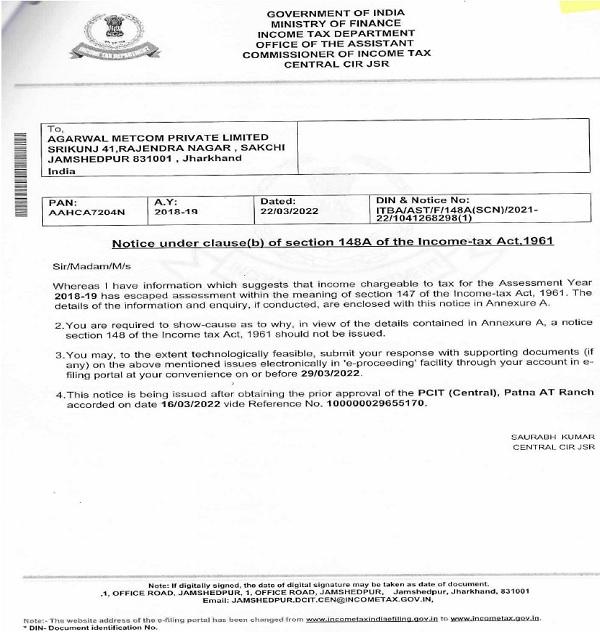
It was the prayer that in view of the decision of the Hon’ble Jurisdictional High Court in the case of Satish Kumar Vs Pr.CIT in WP(T) No. 2640 of 2023 dated 28/08/2023, notice issued under Section 148A(b) of the Act may be quashed and the consequential assessment order also may be quashed. The Hon’ble Jurisdictional High Court has held as follows:
“5. The entire periphery and ambit of the legal ground is confined to the interpretation of expression “being not less than 7 days…” That as demonstrated by the assessee the notice dated 12th March, 2022 u/s.148A of the Act states that the assessee shall submit the response with supporting documents on or before 18th March, 2022. Therefore, as per section 148A(b) of the Act, excluding these two das ie. Date of issuance of the notice and the date on when response is sought from the assessee, a clear 7 days time should have been provided to the assessee as has been held by the Hon’ble Jurisdictional High Court in the case of Satish Kumar vs Pr. CIT passed in W.P.(T) No.2640 of 2023 dated 28.8.2023. The relevant part of the judgment is extracted as follows:
7. To decide the lis involved in the instant application it is necessary to peruse the provisions of the Act which governs the issue in hand, which is quoted herein below:-
Section 148A(b) of the I.T. Act.
“148A (b) provide an opportunity of being heard to the assessee, by serving upon him a notice to show cause within such time, as may be specified in the notice, being not less than seven days and but not exceeding thirty days from the date on which such notice is issued, or such time, as may be extended by him on the basis of an application in this behalf, as to why a notice under section 148 should not be issued on the basis of information which suggests that income chargeable to tax has escaped assessment in his case for the relevant assessment year and results of enquiry conducted, if any, as per clause (a);”
From bare perusal of Section 148A(b) it appears that minimum 7 days is required to be given to the Assessee for filing reply. This 7 day is to be calculated by ignoring the date of issue and the last date of submission. In other words, minimum 7 clear days has to be provided to the Assessee for filing reply.
In this regard reference may be made to the case of Pioneer Motors (Private )Ltd. Vs Muncipal Council, Nagercoil reported in AIR 1967 sc 684, wherein at paragraph 8 & 9, the Hon’ble Apex Court has deliberated the issue with regard to counting of dates.
“8. The words “not being less than one month” do imply that clear one months’s notice was necessary to be given that is both the first day and the last day of the month had to be excluded.
“When……. ‘not less than’ so many days are to intervene, both the terminal days are excluded from the computation”.
9…………………. In every case the words have to be construed in the context taking into consideration the language used and the object to be achieved. As we have said above, the use of the words “not being less than one month” implies the giving of a clear month excluding both the first and the last day of the month……………………………………………………………… Emphasis supplied.
6. Considering the aforestated judgment as per the notice issued to the assessee u/s.148A of the Act, the assessee gets only five clear days for response i.e. excluding the date of issuance of the notice and the date on which the response is sought for. This is, therefore, violative of the mandate as prescribed in the Act and also as per the principles laid down by the Hon’ble High Court (supra). Therefore, on this score alone, the notice u/s.148A(b) of the Act is hereby quashed and set aside and all the subsequent proceedings becomes a nullity and nonest in the eyes of law.”
5. The ld. AR has filed written submissions which reads as follows:
“1. That this appeal is against the order dated 31/03/2026 passed U/s 263 by Ld. PCIT(Central) Patna wherein the order of assessment passed U/s 147/143(3) dated 31/03/2024 accepting the returned income of Rs. 66,96,880/- is held to be erroneous and prejudicial to the interest of revenue. A copy of the said order is attached herewith at Page 08-17.
2. That at the very outset we have challenged the validity of the assessment order itself since the notice issued U/s 148A(b) dated 22/03/2022 (copy of which is attached herewith at Page 13-15 seeking the date of compliance on or before 29/03/2022 was bad in law and as such, the assessment order itself was void. That being the case, there can be no proceedings U/s 263 against an void assessment order. We place reliance upon the decision of the coordinated bench in the case of M/s Himangshu Mahato Vanijya Pvt Ltd Vs PCIT in ITA No. 64/Ran/2024 order dated 20/02/2025 and corrigendum order dated 24/02/2025 wherein on identical facts, the proceedings undertaken U/s 263 was quashed. A copy of the said order is attached herewith at Page 2936.
3. That from the impugned order, it can be seen that the provisions of section 263 has been invoked specifically alleging that the assessee has entered into bogus purchases of Rs. 10,31,96,509/- and bogus sales of Rs. 7,44,87,265/-from the same party being M/s Divine Alloys & Power Company Limited.
4. That as seen from the original assessment itself and the documents on record, proceedings U/s 148 was initiated was this specific issue itself and the assessing officer after making all detailed enquiry and investigation has passed the order accepting the returned income.
5. That further the impugned order passed U/s 263 itself sates that questionnaire was issued to the assessee seeking an explanation of these transaction to which the assessee furnished its reply which was accepted. That for ready reference, we are attaching herewith the copy of the notice issued U/s 142(1) dated 11/02/2023 at page 16-21 along with acknowledgment of our replies filed on 15/02/2023 at Page 22-23 on 23/02/2024 at Page 25-26 and on 27/03/2024 at Page 27-28.
6. That thus from the above, it can be seen that it is not a case where no enquiry or verification has been made by the Ld AO or no application of mind has been done by the Ld AO. Apparently what can be opined is only that the Ld PCIT was not fully convinced with the enquiry and verification done by the Ld AO and as such, the powers vested U/s 263 has been invoked.
7. That the law is very clear to validate the difference between inadequate enquiry and lack of enquiry vis-a-vis applicability of provision U/s 263.
8. That with respect to the issue of inadequate or lack of enquiry and AO adopting to one of the possible views, on behalf of the appellant, we would like to rely upon the following case laws:-
-
- Principal Commissioner of Income-tax, Surat-2 vs. Shreeji Prints (P.) Ltd. [2021] 130 taxmann.com 294 (SC)[27-08-2021] Hon’ble Apex Court dismissing the SLP filed by the revenue department has upheld the order of the Hon’ble High Court of Gujarat holding that: (Copy of the order is attached herewith at Page 37-42
4. Being aggrieved by the order passed by the PCIT under section 263 of the Act, 1961, the assessee went before the Tribunal. The Tribunal, after considering the submissions made by the assessee and after considering the scope of power to be exercised by the PCIT under section 263 of the Act, 1961 came to be conclusion that the Assessing Officer has made inquiries in detail about two unsecured loans taken by the respondent assessee and observed as under:
15. The Pr.CIT had observed that Explanation 2 of section 263 of the Act is clearly applicable and it is clear that the Assessing Officer has passed the assessment order after making enquiries for verification which ought to have been made in this case. However. we find that the Pr. CIT has not mentioned in the show-cause notice issued under section 263 that he is going to invoke the Explanation 2 to 263 hence, invocation of Explanation in the order without confronting the assessee is not appropriate and sustainable in law in support of this contention, the Id. Counsel has placed reliance on the following decision.
17. We thus find merit in the plea of the assessee that the Revisional Commissioner is expected show that the view taken by the AO is wholly unsustainable in law before embarking upon exercise of revisionary powers. The revisional powers cannot be exercised for directing a fuller inquiry to merely find out if the earlier view taken is erroneous particularly when a view was already taken after inquiry. If such course of action as interpreted by the Revisional Commissioner in the light of the Explanation 2 is permitted, Revisional Commissioner can possibly find fault with each and every assessment order without himself making any inquiry or verification and without establishing that assessment order is not sustainable in law. This would inevitably mean that every order of the lower authority would thus become susceptible to section 263 of the Act and, in turn, will cause serious unintended hardship to the tax payer concerned for no fault on his part. Apparently, this is not intended by the Explanation. Howsoever wide the scope of Explanation 2(a) may be, its limits are implicit in it. It is only in a very gross case of inadequacy in inquiry or where inquiry is per se mandated on the basis of record available before the AO and such inquiry was not conducted, the revisional power so conferred can be exercised to invalidate the action of AO. The AO in the present case has not accepted the submissions of the assessee on various issues summarily but has shown appetite for inquiry and verifications. The AO has passed after making due enquiries issues involved impliedly after due application of mind. Therefore, the Explanation 2 to section 263 of the Act do not, in our view, thwart the assessment process in the facts and the context of the case. Consequently, we find that the foundation for exercise of revisional jurisdiction is sorely missing in the present case.
5. The Tribunal has found that in the order passed by the PCIT, Explanation 2 of section 263 of the Act, 1961 is made applicable. The Tribunal observed that the PCIT has not mentioned in the show cause notice to invoke the Explanation 2 of section 263 of the Act 1961. Therefore, by invocation of Explanation in the order without confronting the assessee and giving an opportunity of being heard to the assessee is not appropriate and sustainable in law.
-
- CIT V. Max India Ltd. (2007) 295 ITR 282/213 CTR 266/ (2008) 166 Taxman 188/204 Taxman 1 SC Hon’ble Apex Court observed that:-“The phrase “Prejudicial to the interest of revenue” section 263 has to be read in conjunction with the expression “erroneous”. When the Assessing Officer takes one of the two views permissible in law and which the Commissioner does not agree with and which results in a loss of revenue, it cannot be treated as erroneous order prejudicial to the interest of revenue, unless the view taken by the Assessing Officer is completely unsustainable in law.”
- CIT v. Ashish Rajpal (2009) 23 DTR 266/320 ITR 674/180 Taxman 623 (Delhi) (High Court) –
Where the assessing officer during the scrutiny assessment proceeding raised a query which was answered by the assessee to the satisfaction of the assessing officer but the same was not reflected in the assessment order by him, a conclusion cannot be drawn by the Commissioner that no proper enquiry with respect to the issue was made by the assessing officer, and enable him to assume jurisdiction under section 263 of the Act.
-
- CIT Vs Sunbeam Auto Ltd 332 ITR 167 (Delhi) – hether if while making assessment, Assessing Officer has made an inadequate enquiry that would not, by itself, give occasion to Commissioner to pass order under section 263, merely because he has different opinion in matter, it is only in cases of lack of inquiry’ that such a course of action would be open Held, yes Assessee-company was engaged in business of manufacturing and supplying auto parts assessment for relevant assessment year, it had been allowed deduction of expenditure incurred on tools and dyes as revenue expenditure Commissioner, however, set aside assessment order in exercise of his powers under section 263 on ground that Assessing Officer had allowed aforesaid expenditure without making proper enquiry He, accordingly, remitted matter back to Assessing Officer to re-examine issue – Whether when facts clearly showed that Assessing Officer had undertaken exercise of examining as to whether expenditure incurred by assessee in replacement of dyes and tools was to be treated as revenue expenditure or not and on being satisfied with assessee’s explanation, he accepted same, it could be said to be a case of lack of inquiry Held, no Whether further, on facts and law. view taken by Assessing Officer was one of possible views and, therefore, assessment order passed by Assessing Officer could not be held to be prejudicial to interest of revenue – Held, yes – Whether, therefore, Tribunal was justified in setting aside order of Commissioner – Held, yes
- Mahesh Reddy vs. PCIT [2024] 167 taxmann.com 297 (Bangalore – Trib.)[05-08-2024]- The Coordinated Bench of Bangalore Tribunal in its recent judgement has held that:-
Pr. Commissioner, in his revisionary jurisdiction, cannot say order with some enquiry done by Assessing Officer to be erroneous; he can hold non inquiry cases to be erroneous and for this he himself has to bring on record error and prejudice through independent verification and enquiry.
Revision of orders prejudicial to interest of revenue Assessment years 2017-18 and 2018-19 Whether Pr. Commissioner, in his revisionary jurisdiction, cannot say order with some enquiry done by Assessing Officer to be erroneous; he can hold non inquiry cases to be erroneous – Held, yes
Whether however he himself has to bring on record error and prejudice through independent verification and enquiry – Held, yes – Whether though Explanation (2) to section 263 gives some degree of discretion to Commissioner for exercise of his revisionary powers, same are not to be used arbitrarily and irrational manner – Held, yes.
9. That moreover Ld PCIT in a mechanical manner has simply invoked Explanation 2 (a) to section 263 to hold that the order of assessment is erroneous and prejudicial to the interest of revenue without himself doing any such enquiry or verification which the Ld AO ought to have done. The Ld PCIT is incorrect in stating that this is a case involving lack of inquiry on the selected issues. We would like to quote the decision of Pr. Commissioner of Income-tax (Central) vs. Kanin (India) [2022] 141 taxmann.com 83 (Punjab & Haryana) [21-04-2022] wherein the Hon’ble Court has held as under:-(Copy of the order is attached herewith at Page 43-46).
Section 263 of the Income-tax Act, 1961- Revision – Of orders prejudicial to interest of revenue (Explanation 2(a)) Assessment year 2013-14 Whether in order to attract section 263 Assessing Officer’s order must be erroneous and also prejudicial to interest of revenue – Held, yes – Whether before reaching conclusion that order of Assessing Officer is erroneous and prejudicial to interests of revenue, revisionary authority itself has to undertake some enquiries to establish that assessment order is erroneous and prejudicial to interests of revenue Held, yes Whether where order was passed by Principal Commissioner holding that assessment made by Assessing Officer was erroneous and prejudicial to interest of revenue as assessment order had been passed without making inquiries or verification, however, Principal Commissioner was not in a position to point out as to what inquiries or verification should have been made but had not been made by Assessing Officer so as to make present case fall within Explanation 2(a) to section 263, Tribunal rightly set aside order passed by Principal Commissioner – Held, yes [Paras 9 to 12] [In favour of assessee]
10. That as such, placing reliance upon the above facts and the case laws, we submit that the Ld PCIT Ranchi was not justified in invoking the jurisdiction U/s 263 to hold that the original order of assessment dated 31/03/2024 (though void itself) was erroneous & prejudicial to the interest of revenue.”
6. It was the prayer that the order passed under Section 263 of the Act is liable to be quashed. It was also the submission that the reopening of the original assessment itself had been done for the purpose to verify the transactions with M/s Divine Alloys & Power Company Limited. It was the submission that after verifying the same, the reassessment had been completed accepting the return of the assessee. It was the submission that 263 proceedings has been initiated for the exact the same purpose of verifying the transactions of the assessee with M/s Divine Alloys & Power Company Limited. It was the submission that this was not permissible in so far as the Assessing Officer has examined the issue in link and has already expressed his opinion. It was the submission that if there is change in the opinion of the ld. PCIT, the same cannot be done in the provisions of Section 263 of the Act and thus, cannot be invoked for the purpose of overriding the Assessing Officer’s opinion with that of the Ld. PCIT. It was the prayer that the order passed under Section 263 of the Act is liable to be quashed.
7. In reply, the ld. CIT-Departmental Representative submitted that the transactions of the assessee with M/s Divine Alloys & Power Company Limited had not been examined in the right perspective by the Assessing Officer and that the order passed by the Assessing Officer is a very cryptic order and no details were available. It was the submission that the ld. PCIT was right in invoking the provisions of Section 263 of the Act.
8. We have considered the rival submissions. A perusal of the facts in the present case clearly shows that the notice issued under Section 148A(b) of the Act dated 22/03/2022 in respect of the reassessment proceedings itself is invalid in so far as the requisite seven days time has not been granted to the assessee. This being so, the original reassessment order passed under Section 147 read with section 143(3) dated 31/03/2024 itself is found to be invalid. This is the order which has been treated as erroneous and prejudicial to the interest of revenue. As the said reassessment order dated 31/03/2024 is found to be invalid obviously the consequential revisionary proceedings initiated by the ld. PCIT on such invalid order would become invalid. This being so, on this ground, the order passed by the ld. PCIT under Section 263 of the Act is quashed as being invalid. As we have quashed the order passed under Section 263 of the Act on account of the invalidity of the reassessment order passed under Section 147 read with section 143(3) of the Act dated 31/03/2024, we are not going into the other issues raised by the assessee.
9. In the result, this appeal of the assessee is allowed.
Order announced in open court on 29/07/2026.