
Doulthabaji Rajender Vs ITO (ITAT Hyderabad)
The assessee had furnished a reply dated 3 February 2024 in response to the earlier notice dated 12 January 2024, along with bank statements, ledger accounts and supporting documents. These records established cash deposits of ₹6,50,000 in the savings bank account and ₹13,00,000 in the loan account, aggregating ₹19,50,000. Nevertheless, the Assessing Officer issued a show-cause notice under Section 148A(b) on 5 March 2024 and subsequently initiated reassessment proceedings by treating ₹1,33,22,500 as cash deposits. The Tribunal observed that the additional amount of ₹1,13,72,500 did not represent actual cash deposits and that the Assessing Officer had failed to properly verify the available banking records before proceeding with reassessment.
The Tribunal relied on its earlier decision in Adilakshmi Vangala Vs ITO, ITA No. 2222/Hyd/2025, decided on 17 April 2026, involving a similar issue of incorrect cash-deposit information being used to invoke the extended reassessment limitation period. It also considered the principles emerging from the Madras High Court decision in Krishna Reddy Venkatsan Vs ITO and the Bombay High Court decision in Naresh Balachandra Rao Shinde Vs ITO, concerning the necessity of examining supporting documents and determining the correct amount of alleged escaped income. The Tribunal held that incorrect or non-existent transactions could not be relied upon to extend the statutory limitation period. It further observed that the Revenue’s cited decisions did not assist its case on the particular facts.
Accordingly, the Tribunal held that where the actual cash deposits were only ₹19,50,000, the reassessment notice issued on 31 March 2024, beyond three years from the end of the relevant assessment year, could not be sustained by invoking the extended limitation applicable to cases involving alleged escaped income of ₹50 lakh or more. The Tribunal emphasised that an otherwise time-barred notice could not become valid merely because the Assessing Officer had relied upon inflated or incorrect transaction figures. Consequently, the notice under Section 148 and the reassessment order were set aside. Since the reassessment itself was invalid, the remaining grounds, including the objections relating to procedural irregularities and the addition under Section 68, became infructuous and were not separately adjudicated. The assessee’s appeal was allowed.
- Adilakshmi Vangala, Hyderabad v. ITO, Ward-6(1), Hyderabad, ITA No. 2222/Hyd/2025, decided 17 April 2026 (ITAT Hyderabad) — Followed on the limitation consequences of wrongly treating bank transactions as cash deposits.
- Girdhar Gopal Dalmia v. Union of India, [2022] 141 taxmann.com 251 (Calcutta High Court) — Cited by Revenue; distinguished on the facts.
- National Thermal Power Co. Ltd. v. CIT, [1998] 229 ITR 383 (Supreme Court) — Relied upon for admission of additional legal grounds.
- Home Finders Housing Ltd. v. ITO, [2018] 93 taxmann.com 371 (Madras High Court) — Cited by Revenue; held inapplicable to the present facts.
- CIT v. Vegetable Products Ltd., [1973] 88 ITR 192 (Supreme Court) — Cited in the reproduced Adilakshmi Vangala decision.
- ARB Hotels Resorts (P.) Ltd. v. Pr. CCIT (Allahabad High Court; full citation not supplied) — Discussed in the reproduced precedent in relation to reopening and writ jurisdiction.
- Krishna Reddy Venkatsan v. ITO, Tiruvallur (Madras High Court) — Reproduced for the need to examine bank statements before reopening.
- Naresh Balachandra Rao Shinde v. ITO (Bombay High Court) — Reproduced for quashing reopening where corrected amounts fell below ₹50 lakh.
FULL TEXT OF THE ORIGINAL JUDGMENT/ORDER
This appeal by the Assessee is directed against the Order dated 07.10.2025 of the learned CIT(A)-National Faceless Appeal Centre [in short “NFAC], Delhi, for the assessment year 2017-2018.
2. The assessee has raised the following grounds of appeal:
1. “The Order of the learned Commissioner of Income Tax (A), NFAC is not correct either on facts or in law and in both.
2. On the facts and circumstances of the case, the Ld. CIT(A) failed to appreciate that the notice issued under section 148A(b) allowed less than the mandatory seven days for response, resulting in denial of adequate opportunity and vitiating the order under section 148A(d) and the consequential notice under action 148.
3. Since the notice issued u/s 148 dated 31.03.2024 was issued by the Jurisdictional Assessing Officer, ITO Ward-1, Warangal, and not in a faceless manner as mandated, the notice is invalid and all consequential proceedings are bad in law.
4. The Learned CITIA), NFAC ignored that the assessment is based on wrong facts and incorrect figures mechanically adopted from the Insight Portal, as the AO neither verified the mismatch nor examined the data and documentary evidence submitted before him and still made an addition of Rs.1,33,22,500 u/s 68 without reconciling it with the assessee’s actual cash deposits of only Rs.19,50,000.
5. The Learned CITIAL, NFAC failed to appreciate that the Ld AO assumed cash deposits of Rs.133,27,500 though the assessee’s bank statements show actual cash deposits of only Rs.19,50,000 and the assessee had filed a detailed reply on 03.02.2024 in response to 148A(b) with documentary evidences but the AD ignored the reply without any enquiry and the objections were not disposed of hy a speaking order rendering the action invalid in law.
6. The Learned CITIA), SPAC failed to appreciate that the notice issued u/s 148 wan beyond 3 years and since the alleged escaped income was below Rs.50 lakhs the reopening seas clearly barred by limitation under section 149(1)(a) and the assessee’s bank statements establish actual rash deposits of only Rs.19,50,000 therefore the assumption of jurisdiction was invalid and the reassessment proceedings are liable to be quashed in law.
7. Without prejudice the Ld CITIA) failed to appreciate that the addition u/s 68 cannot be made when income is offered u/s.44AD and the assessee is not required to maintain books of accounts the AD did not bring any evidence to show that the cash deposits represented unexplained money rather than business receipts from turmeric procurement and the burden was wrongly shifted to the assessee.
8. The Learned CITIA), NFAC was not justified in granting only two short opportunities-notice dated 26.08.2025 for hearing on 02.09.2925 and notice dated 12,09.2005 for hearing on 19.09.2025 allowing merely 7 days each, which failed to provide a reasonable or effective opportunity of being heard.
9. The appellant craves leave to add, amend, modify, rescind, supplement or alter any or mote grounds of appeal stated herein above either before or at the time of hearing of this appeal.”
3. Ground nos.2, 3, 6 are additional grounds raised by the assessee vide application/petition for admission of the additional grounds under Rule-11 of ITAT, Rules, 1963 challenging the validity of the notice issued by the Assessing Officer u/sec.148A(b) and u/sec.148 of the Income Tax Act [in short “the Act”], 1961
4. We have heard the learned Authorised Representative of the Assessee as well as learned DR on admission of additional grounds and considered the relevant record. The additional grounds raised by the assessee are purely legal in nature challenging the validity of the notice issued by the Assessing Officer u/sec.148A(b) and u/sec.148 of the Act and can be adjudicated on the basis of the facts and material available on record. Thus, when no fresh material or facts are required to be verified for adjudication of the additional grounds which are purely legal in nature which go to the root of the mater then, in view of Judgment of Hon’ble Supreme Court in the case of National Thermal Power Co. Ltd., vs., CIT [1998] 229 ITR 383 (SC), we admit the additional grounds raised by the assessee for adjudication.
5. In ground no.6 the assessee challenged the validity of the notice issued by the Assessing Officer u/sec.148 of the Act being barred by limitation as issued after 03 years from the end of the assessment year under consideration whereas the alleged income escaped assessment on account of cash deposit in the bank account of the assessee is only Rs.19,50,000/- which is below Rs.50 lakhs.
6. The learned Authorised Representative of the Assessee has referred to the notice issued by the Assessing Officer u/sec.148A(b) of the Act dated 05.03.2024 and submitted that the Assessing Officer has issued the show cause notice for reopening of the assessment in respect of cash deposit in two bank accounts of the assessee with IDBI bank whereas the actual amount of cash deposit during the year under consideration is only Rs.19,50,000/- and the other transactions of Rs.1,13,72,500/- as referred by the Assessing Officer does not represent the cash deposit by the assessee in the bank account of the assessee. The learned Authorised Representative of the Assessee has further submitted that the assessee has filed reply to the notice issued by the Assessing Officer u/sec.148A(a) dated 12.01.2024 vide acknowledgment dated 03.02.2024 whereby the assessee has produced bank account statement of the assessee showing that the cash deposits in the bank account is only Rs.19,50,000/- and source of which was also explained by the assessee as its salary income as well as agriculture income from sale of agricultural produce from 45 acres 35 guntas cultivated by him. He has thus submitted that the relevant record was produced by the assessee to show that the actual transactions of cash deposit in the bank account was Rs.19,50,000/- only. However, the Assessing Officer while passing the Order u/sec.148A(d) has not even considered the bank account statements filed by the assessee along with the reply of the assessee to the notice u/sec.148A(a) of the Act. He has also referred to the assessment order in Para no.4.6.1 wherein the Assessing Officer has made the addition of Rs.1,33,22,500/- based on the wrong facts by treating the said amount as cash deposit in the bank account of the assessee whereas the amount of cash deposited is only Rs.19,50,000/-. Thus, the learned Authorised Representative of the Assessee has submitted that the notice issued by the Assessing Officer u/sec.148 of the Act is barred by limitation.
7. On the other hand, the learned DR has submitted that at the stage of issuing the show cause notice u/sec.148A(b) of the Act as well as passing the Order u/sec.148A(d) of the Act, the Assessing Officer is required to consider the information available with him which shows the deposit of cash of Rs.1,33,22,500/- in the bank account of the assessee and therefore, the period of limitation as per the provisions of sec.149(1) of the Act is 10 years and not 03 years from the end of the assessment year under consideration. The Assessing Officer has clearly mentioned the amount of income escaped assessment in the show cause notice issued u/sec.148A(b) as well as in the Order passed u/sec.148A(d) of the Act. Thus, the notice issued by the Assessing Officer u/sec.148 of the Act based on the information available with the Assessing Officer showing the cash deposit in the bank account of more than Rs.50 lakhs is well within the period of limitation i.e., 10 years from the end of the assessment year under consideration. In support of his contention, he has relied upon the Judgment of Hon’ble Madras High Court in the case of Home Finders Housing Ltd. v Income-tax Officer Ward 2(3), Chennai [2018] 93 taxmann.com 371 (Madras-HC) as well as Judgment of Hon’ble Calcutta High Court in the case of Girdhar Gopal Dalmia v. Union of India [2022] 141 taxmann.com 251 (Calcutta-HC).
8. We have considered the rival submissions as well as the relevant material on record. The Assessing Officer has issued show cause notice u/sec.148A(b) of the Act dated 05.03.2024 which reads as under:
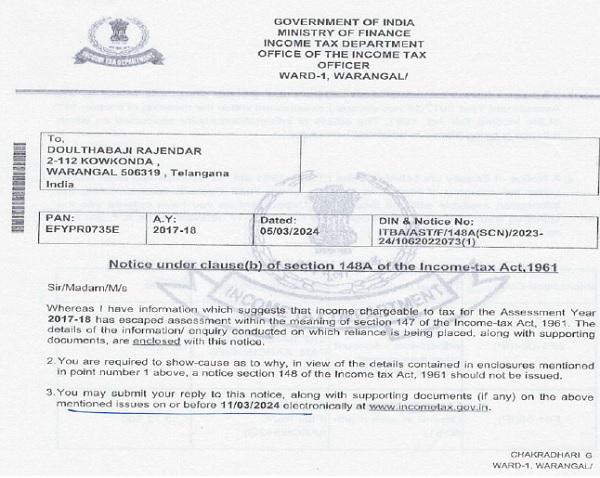
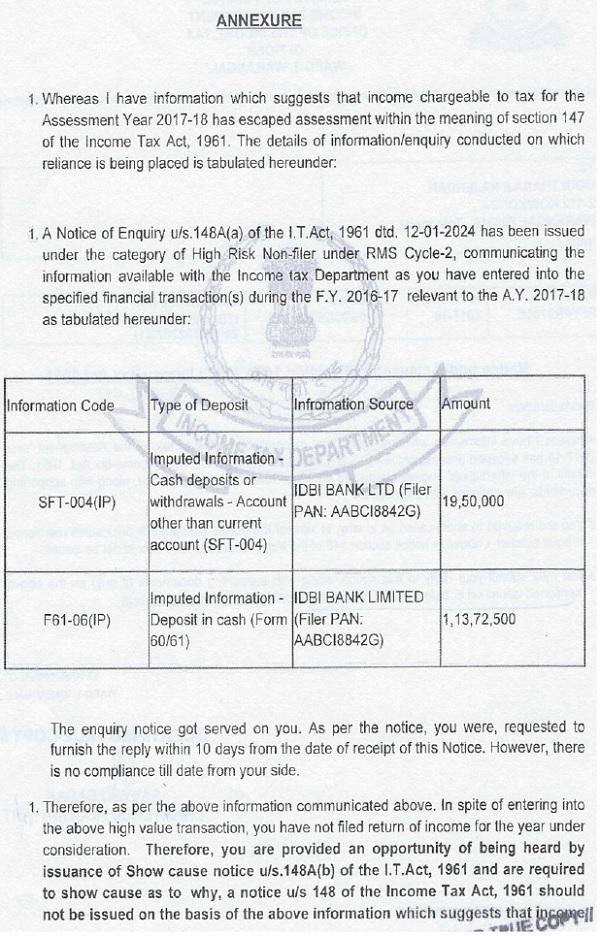
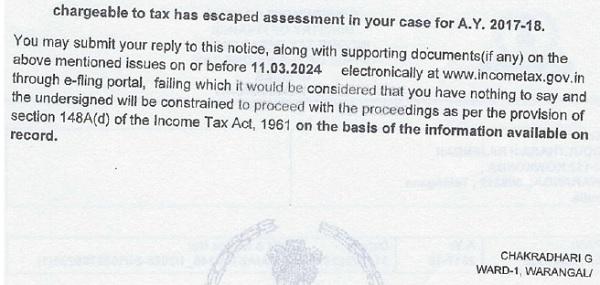
8.1. Thus the Assessing Officer has considered the income escaped assessment on account of cash deposit in the bank account with IDBI Bank total amounting to Rs.1,33,22,500/- comprising of cash deposit of Rs.19,50,000/- as well as Rs.1,13,72,500/-. It is pertinent to note that earlier the Assessing Officer has also issued notice u/sec.148A(a) of the Act dated 12.01.2024 calling the information from the assessee to verify the transaction of cash deposit in the bank account and in response to the said notice, the assessee filed reply dated 03.02.2024 along with ledger account, bank account statements etc. In the said reply, the assessee has explained that the assessee was having 02 bank accounts i.e., Savings Bank A/c as well as Loan A/c with IDBI Bank. In both the accounts the total cash deposit during the year was Rs.19,50,000/-. Copies of the bank account of the assessee are also placed at page nos.5 to 8 of the paper book as under:
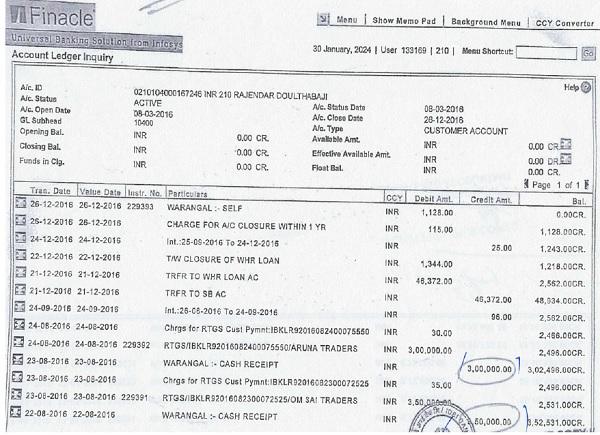
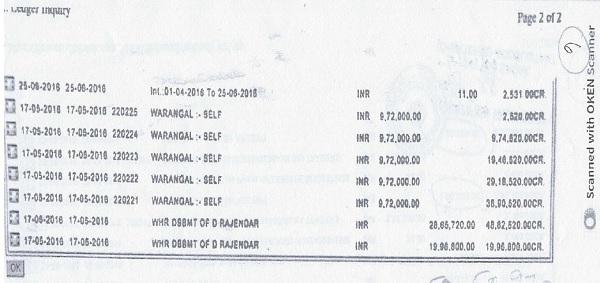
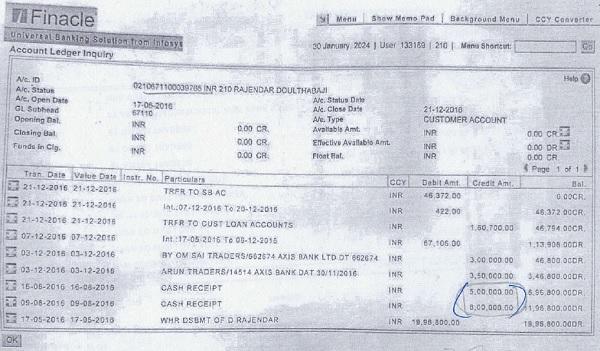
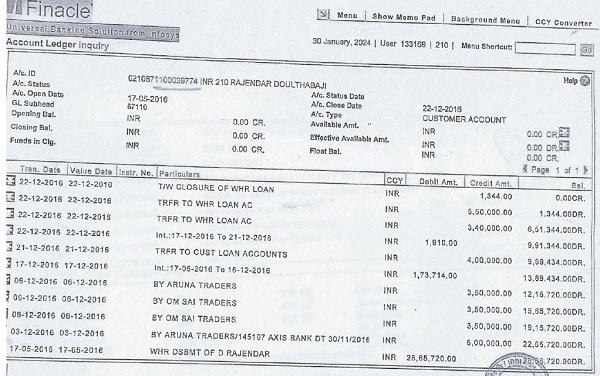
8.2. Thus, it is clear from the bank account statement of the assessee that there is a cash deposit of Rs.6,50,000/- in the Savings Bank A/c and Rs.13,00,000/- in the loan account both maintained with IDBI Bank total amounting to Rs.19,50,000/-. This fact of cash deposit is evident from the bank account statements of the assessee which were available with the Assessing Officer as filed by the assessee in response to the notice u/sec.148A(a) of the Act dated 12.01.2024. When the total cash deposit in the 02 bank accounts of the assessee was only Rs.19,50,000/- then, the notice issued by the Assessing Officer u/sec.148A(b) and the Order passed u/sec.148A(d) and notice issued u/sec.148 of the Act are based on incorrect and non-existing transactions. The Assessing Officer though initiated the re-assessment proceedings on the issue of cash deposit in the bank account however, to bring the notice u/sec.148 within the limitation period, the entire transaction of credit in the bank accounts of the assessee most of which are inter banking transfers are referred in the notice u/sec.148A(b), Order passed u/sec.148A(d) and notice issued u/sec.148 of the Act dated 31.03.2024. An identical issue has been considered by the ITAT, Hyderabad Bench, Hyderabad of this Tribunal in the case of Adilakshmi Vangala, Hyderabad vs. ITO, Ward-6(1), Hyderabad in ITA.No.2222/Hyd./2025 vide Order dated 17.04.2026 wherein one of us [Vice President] is party to the said Order and held in Para nos.6 to 6.6 as under:
“6. We have considered the rival submissions as well as relevant material on record. There is no dispute that the Assessing Officer issued show cause notice u/sec.148A(b) of the Act on 27.02.2023 which reads as under:
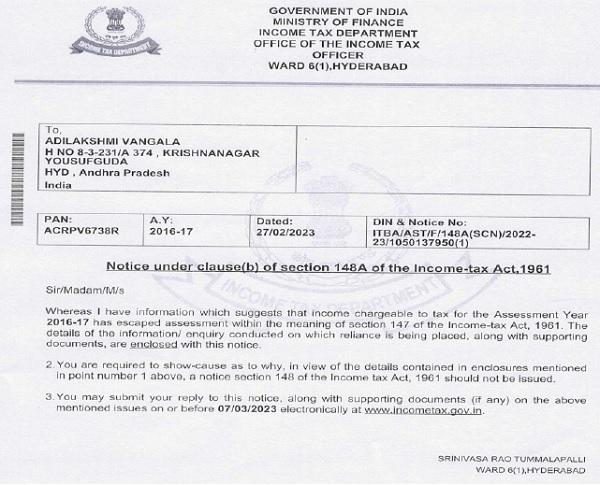
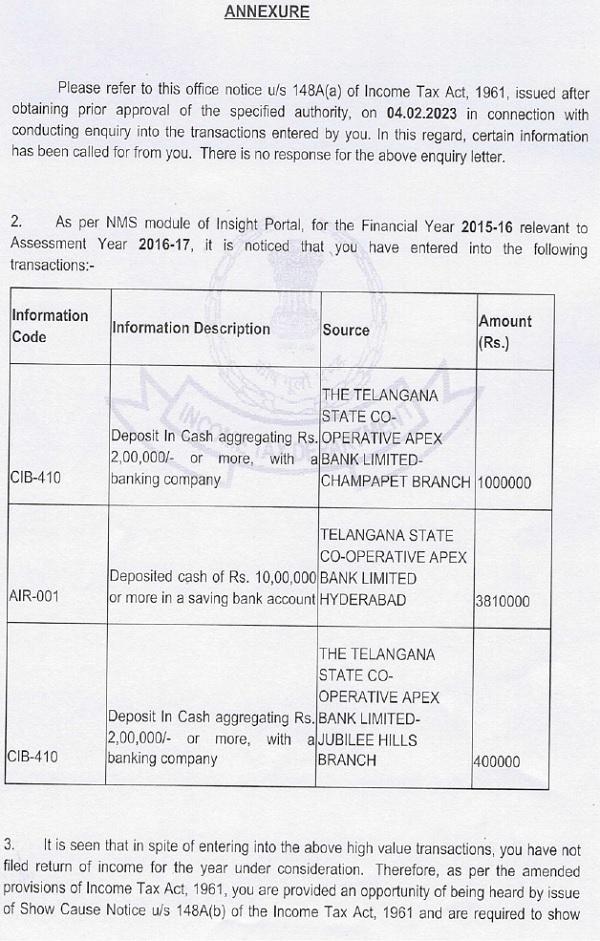
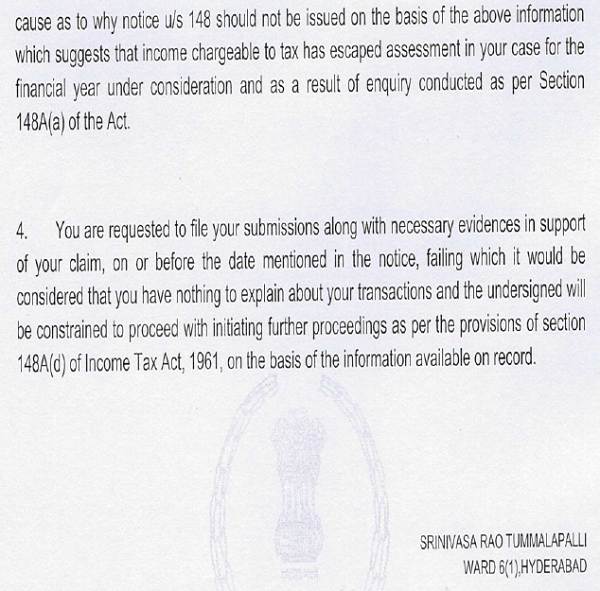
6.1. Thus, the Assessing Officer proceeded on the basis of the three transactions of cash deposit to reopen the assessment of the assessee. Thereafter, the Assessing Officer has passed an Order u/sec.148A(d) of the Act on 23.03.2023 and then issued notice u/sec.148 of the Act on 24.03.2023 reads as under:
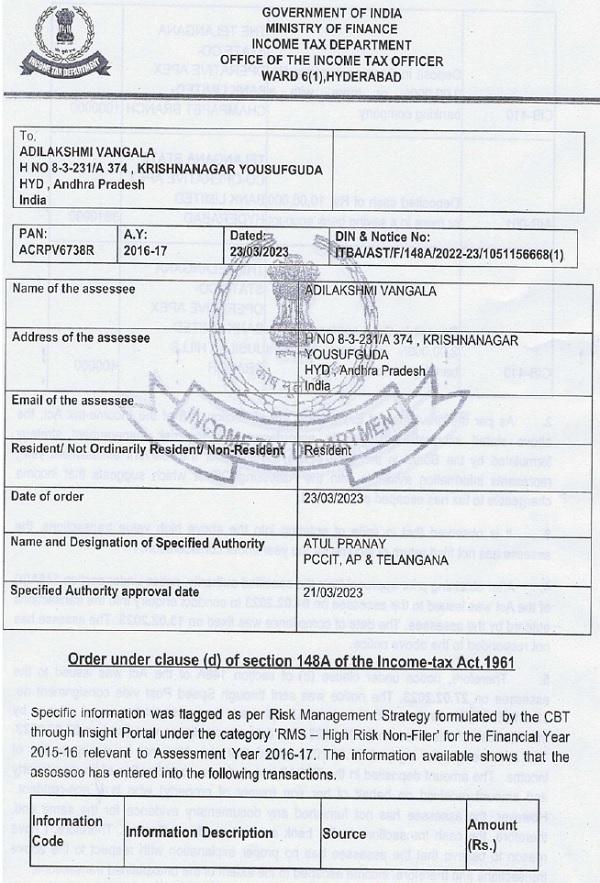
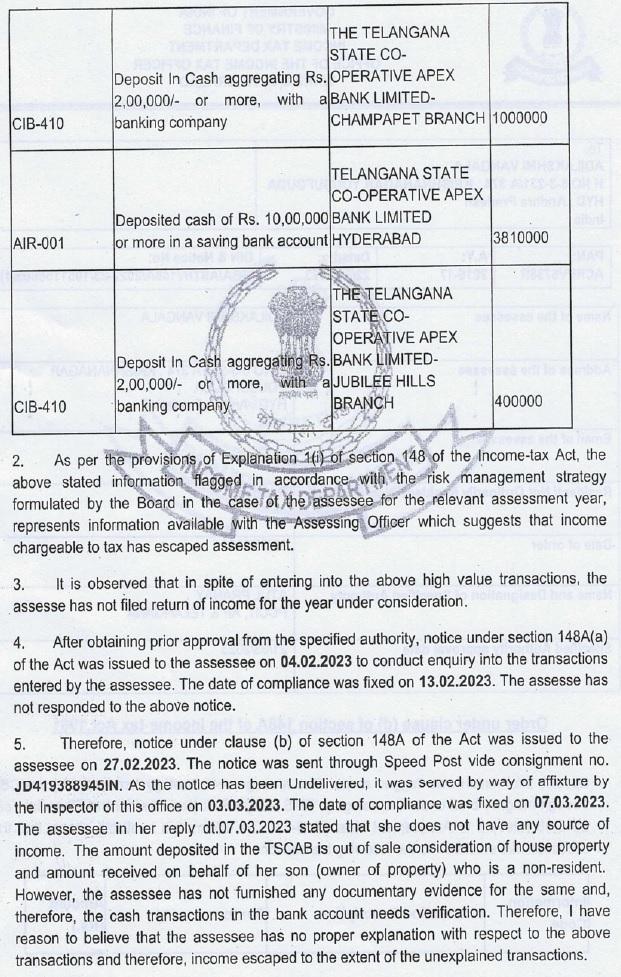
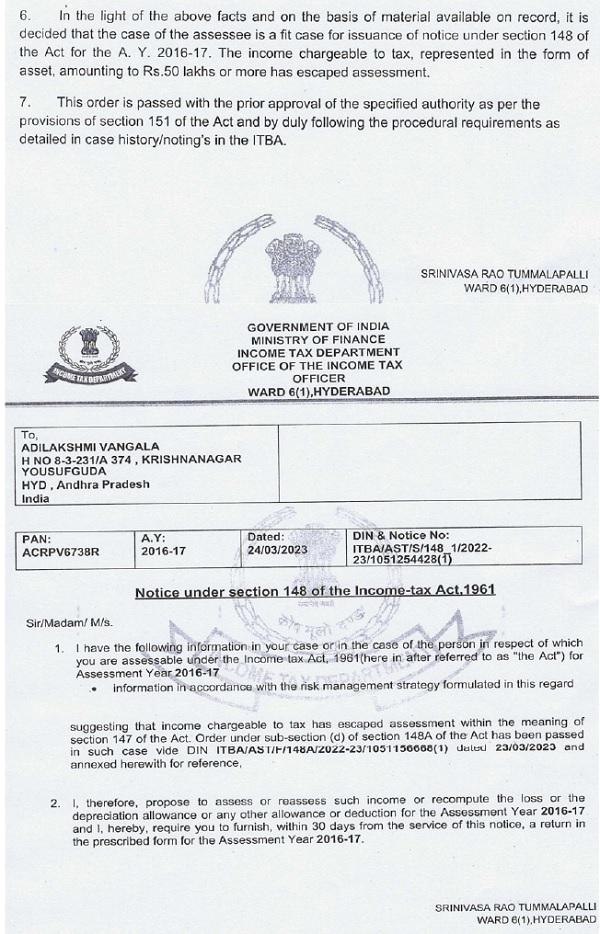
6.2. Thus, it is clear that even at the time of passing the Order u/sec.148A(d), the Assessing Officer has considered the same amount of cash deposits without even verifying the bank account statement of the assessee. In the assessment order the Assessing Officer finally held that the only transaction of cash deposit during the year is Rs.38,10,000/- which is added to the total income of the assessee as under:
“Finding of the case
Section 69A of the Act deals with money etc, owned by the assessee and found in possession including in the bank accounts of the assessee which remain unexplained. The said section is reproduced below for ready reference:
Section 69A-Unexplained Money
“Where in any financial year the assessee is found to be the owner of any money, bullion, jewellery or other valuable article and such money, bullion, jewellery or valuable article is not recorded in the books of account, if any, maintained by him for any source of income, and the assessee offers no explanation about the nature and source of acquisition of the money, bullion, jewellery or other valuable article, or the explanation offered by him is not, in the opinion of the Assessing Officer, satisfactory, the money and the value of the bullion, jewellery or other valuable article may be deemed to be the income of the assessee for such financial year.”
In the present case, the assessee has deposited cash in the bank account amounting to Rs. 38,10,000/- which is treated as unexplained money u/s 69A of the Act, since she has not offered an acceptable or cogent explanation regarding the source thereof. As discussed above, the explanation offered by the assessee are entirely by self-serving documents without third party evidence.”
6.3. Therefore, it is a case of wrong and incorrect facts or rather non-existing fact and transaction in the bank account of the assessee considered by the Assessing Officer at the time of issuing the show cause notice u/sec.148A(b); at the time of passing the Order u/sec.148A(d) as well as issuing notice u/sec.148 of the Act. Undisputedly, the actual transaction of deposit of cash is found to be only Rs.38,10,000/- and therefore, the case of the assessee falls in the category of ‘income escaped assessment less than Rs.50 lakhs’ and consequently, as per the provisions of sec.149(1)(b) of the Act, the limitation for issuing the notice u/sec.148A is only 03 years from the end of the relevant assessment year. There is no dispute that the notice u/sec.148 of the Act issued on 24.03.2023 is beyond 03 years and therefore, the same is time barred and invalid. It is pertinent to note that if a notice based on the correct and actual facts is invalid then, the same cannot be treated as valid by considering incorrect and non- existing facts and hence, the period of limitation provided u/sec.149(1)(b) of the Act cannot be enlarged or extended on the basis of incorrect facts or non-existing facts. It is a case of non- existing transaction of cash deposit which are considered by the Assessing Officer and not a case that the transaction of deposit is rightly considered by the Assessing Officer however, the assessee was able to explain the source during the assessment proceedings and finally the Assessing Officer after accepting the source of cash deposit made an addition which is less than Rs.50 lakhs. Therefore, there is no quarrel on the point that the addition finally made by the Assessing Officer in the assessment would not necessarily render the case of the assessee in the category of ‘income escaped assessment is less than or more than Rs.50 lakhs’ but the primary facts are relevant to consider whether the income escaped assessment is less than or more than Rs.50 lakhs. The Assessing Officer relied upon the Judgment of Hon’ble Allahabad High Court in the case of ARB Hotels Resorts (P.) Ltd., vs. Pr. CCIT (supra) however, the Hon’ble Allahabad High Court has made a specific observation in Para no.22 as under:
“22. Last, we may also note as a Court of equity, the writ Court may not be persuaded to drop the entire proceedings at the fag end on a purely technical submission. Yet, that submission is not being accepted in the present facts. On a general principle, once component of escapement exists, it has to be finally determined by the assessing authority. We therefore refrain ourselves from exercising the discretionary jurisdiction to quash the entire proceedings at this late stage. To that rule of equity and good conscience, we abide
(iii) Considering the facts of the case and decision of the Hon’ble High Court of Allahabad on similar issue, the contention of the assessee is not found to be acceptable and hence rejected.”
6.4. Therefore, the Hon’ble High Court has declined to accept the objection of the assessee which is purely technical in nature in the writ proceedings and therefore, challenging the validity of the notice u/sec.148 of the Act based on the factual finding given by the Assessing Officer in the assessment order would not render the notice u/sec.148 as time barred. The Hon’ble Madras High Court in the case of Krishna Reddy Venkatsan, Tiruvallur vs. ITO, Tiruvallur (supra), has considered this issue in Para nos.2 to 6 as under:
“2. Learned counsel for the petitioner invited my attention to the notice under Section 148A(b), the reply thereto and the impugned order. In spite of providing the bank statement for the relevant period, learned counsel submits that it is erroneously recorded therein that the details of the bank statement needs to be verified.
3. Mr. B. Ramana Kumar, learned senior standing counsel, submits in reply that the assessee is under an obligation to establish that the amount escaping assessment is less than Rs.50,00,000/-. He submits further that both the cash deposit and the time deposit qualify as assets and that the assessing officer was justified in adding the two to compute total income escaping assessment.
4. The operative paragraph of the impugned order reads as under:
“3. In response to the said notice u/s 148A(b), assessee replied on 28.03.2022. According to assessee “He deposited in cash Rs.25,90,000/- and the same has been deposited as fixed deposit. Hence, the amount of income escaped is less than 50 lakhs.” Assessee submitted bank statement also for the relevant financial year.
I have considered the reply of assessee and the same is not acceptable because of the following reasons: Though the assessee stated as the cash deposit again deposited as fixed deposit, the details of bank statement and others need to be verified.
Thus income in the form of asset has escaped assessment is not less than Rs.50 lakhs.”
5. It is evident from the above that the assessing officer failed to examine the bank statement so as to verify whether the cash deposits were used for purposes of creating the fixed deposit. In spite of the assessee providing the bank statement, this exercise was not undertaken. Without undertaking this exercise, it cannot be rationally determined as to whether income in the form of an asset of the value not less than Rs 50,00,000/- had escaped assessment during the relevant assessment year.
6. On perusal of the bank statement, it appears that the petitioner has an arguable case to contend that the cash deposits were used for purposes of creating the fixed deposit. Therefore, the matter warrants reconsideration. Consequently, the impugned order under Section 148A(d) and notice under Section 148 of the I-T Act are set aside and the matter is remanded to the assessing officer. After providing a reasonable opportunity to the petitioner, a fresh order shall be issued under Section 148A(d) of the I-T Act within two months from the date of receipt of a copy of this order.”
6.5. Thus, the Hon’ble Madras High Court has noted the fact that the Assessing Officer failed to examine the bank statement so as to verify correct and actual transactions of cash deposit and then set aside the notice issued u/sec.148 of the Act and the matter was remanded to the Assessing Officer for passing a fresh Order u/sec.148A(d) of the Act, after giving reasonable opportunity to the assessee. The Hon’ble Bombay High Court in the case of Naresh Balachandra Rao Shinde vs. ITO (supra), has also considered this issue in Para nos.6 to 9 as under:
“6. We have heard the learned counsel for the parties and we have perused the documents on record. To consider whether the writ petition could be entertained, it would be necessary to refer to certain undisputed facts. The notice under section 148 A(b) dated 23-3-2022 grants time to the petitioner to respond to the same by 29-3-2022. The period as granted is less than seven days as prescribed by section 148A(b) of the Act of 1961. Nevertheless, the petitioner has responded to the notice by his reply dated 29-3-2022.
Along with the reply, copy of the registered sale deed dated 3-2- 2015 indicating that it was his daughter who had purchased the immovable property therein was supplied. The petitioner’s daughter is separately assessed for tax. The name of the petitioner is mentioned as special power of attorney holder for his daughter. The registered sale deed clearly indicates that the petitioner is not the purchaser of the immovable property mentioned therein but it is his daughter, a separate assessee. The amount of consideration mentioned is Rs.40,00,000/- and it is stated that the purchaser had availed housing loan for the same. On a bare perusal of the registered sale deed, it becomes evident that the petitioner is not the purchaser of the said property as stated in the notice issued under section 14BA (b) of the Act of 1961. Despite supplying copy of the registered sale deed to the Assessing Officer, it has not been taken into consideration by him before passing the order under section 148A(d) of the Act of 1961. The same thus clearly indicates lack of application of judicious mind to the material on record. The amount of Rs.40,00,000/- as mentioned in the notice issued on 23-3-2022 under section 148A(b) thus deserves to be excluded from consideration.
7. As regards deposit of cash of Rs.16,20,000/- is concerned, the petitioner had sought disclosure of the material of the source of information on the basis of which such notice was issued. The petitioner denied having deposited the aforesaid amount in his bank account. The material/source of information was not supplied to the petitioner. Be that as it may, even if the amount of Rs.40,00,000/- as mentioned in the notice dated 23-3- 2022 is excluded from consideration for the reason that the petitioner is not the purchaser of the property in question, the amount remaining for consideration is Rs.20,71,500/- and Rs.16,20,000/- thus totaling Rs.36,91,500/-, In this regard, if the provisions of Section 149(1)(b) of the Act of 1961 are considered, it is seen that only if the amount in question that is likely to have escaped assessment is Rs.50,00,000/- or more, the time limit for issuing notice to re-open the assessment is three years but less than ten years. Thus if the income that is likely to escape assessment is only Rs.36,91,500/- after excluding the amount of Rs.40,00,000/-, it is clear that the proceedings are not liable to be re-opened as the amount involved is less than the one contemplated under section 149(1)(b) of the Act of 1961 and the same pertains to Assessment Year 2015-16. The notice under section 148(b) is dated 23-3-2022 which is beyond the permissible period of three years. On this count, a case for interference has been made out.
8. In the light of this undisputed position, it would be futile to require the petitioner to face proceedings under section 148 of the Act of 1961. The material on record that was placed before the Assessing Officer warranted consideration especially in the light of the fact that the document relied was a registered sale deed. If the amount of Rs.40,00,000/- mentioned therein is excluded from consideration, the notice as issued on 23-3-2022 falls foul of the provisions of section 149(1)(b) of the Act of 1961. Hence for this reason, we do not find that the petitioner should be required to further contest the proceedings under section 148 of the Act of 1961.
9. In that view of the matter, the order dated 31/3/2022 passed under section 145A(d) of the Income-tax Act, 1961 as well as notice dated 31-3-2022 issued under section 148 of the Act of 1961 are quashed and set aside. The respondents are free to take appropriate steps in accordance with law.”
6.6. Therefore, in view of the Judgment of the Hon’ble Supreme Court in the case of CIT vs. Vegetable Products Ltd. [1973] 88 ITR 192 (SC), we follow the Judgment of Hon’ble Madras High Court as well as Hon’ble Bombay High Court (supra) in deciding the issue in favour of the assessee. Accordingly, in the facts and circumstances of the case, when the actual transaction of cash deposit in the bank account of the assessee is only Rs.38,10,000/- then, the notice issued by the Assessing Officer after 03 years from the end of the assessment year under consideration is barred by limitation and liable to be set aside. We Order accordingly.”
8.3. Thus, the notice issued u/sec.148of the Act after 03 years from the end of the assessment year under consideration and the correct amount of cash deposit in the bank account is less than Rs.50 lakhs then, the same is barred by limitation. A notice issued u/sec.148 of the Act and the actual facts of transaction of cash deposit in the bank account are juxtaposed then, the period of limitation for issuing the notice u/sec.148 would be considered by considering the correct facts and not on the basis of the non- existing facts. Hence, an invalid notice issued u/sec.148 of the Act on account of barred by limitation cannot be converted to a valid notice by enlarging the limitation based on non-existing facts. Accordingly, in the facts and circumstances of the case, when the actual transaction of cash deposit is Rs.19,50,000/- only then, the notice issued u/sec.148 of the Act would be barred by limitation being issued beyond 03 years from the end of the assessment year under consideration. The decisions relied upon by the learned DR would not help the case of the Revenue in the facts of the present case. Since we have set aside the notice issued by the Assessing Officer u/sec.148 of the Act which also vitiates the re-assessment order passed by the Assessing Officer. Therefore, the other grounds including the additional ground raised by the assessee become infructuous and are not being taken up for adjudication.
9. In the result, appeal of the Assessee is allowed.
Order pronounced in the open Court on 23.04.2026.





