
Hanumantha Rao Annabattina Vs ITO (ITAT Hyderabad)
ITAT Hyderabad allowed the appeal of Hanumantha Rao Annabattina for Assessment Year 2018-19 and quashed the reassessment proceedings after holding that the notice issued under section 148 of the Income Tax Act, 1961 was issued without approval of the competent specified authority. The appeal before the Tribunal was delayed by 82 days. The assessee explained that he was engaged in poultry farming and his farm had been severely affected by an outbreak of Bird Flu (Avian Influenza), resulting in the death of approximately 5,000 birds, substantial financial losses and disruption of his livelihood. He also stated that he became seriously ill during the same period. Considering these circumstances, the Tribunal was satisfied that sufficient cause existed and condoned the 82-day delay.
The assessee raised additional grounds challenging the validity of the notice issued under section 148 for want of approval from the appropriate authority under section 151(ii). Since the issue was a jurisdictional legal issue going to the root of the matter and could be decided on the material already available on record without further factual investigation, the Tribunal, following National Thermal Power Co. Ltd. Vs CIT [1998] 229 ITR 383 (SC), admitted the additional ground.
On merits, the assessee submitted that the Assessing Officer had obtained approval from the Principal Commissioner of Income Tax while passing the order under section 148A(d) and issuing the section 148 notice in April 2022. According to the assessee, because more than three years had elapsed from the end of the relevant assessment year, the competent specified authority under section 151(ii), as it then stood, was the Principal Chief Commissioner, Principal Director General, Chief Commissioner or Director General and not the Principal Commissioner. The Revenue relied upon the proviso to section 151 and argued that the period referred to in the relevant provisos to section 149(1)(b) should be excluded while computing the three-year period.
The Tribunal noted that the notice under section 148 dated 09.04.2022 had been issued after expiry of three years from the end of Assessment Year 2018-19. Consequently, the competent authority for approval under section 151(ii), as existing on the date of issuance of the notice, was the CCIT/DGIT and not the Pr. CIT. The Tribunal relied upon the jurisdictional Telangana High Court judgment in Deloittee Consulting India Private Limited Vs Assessment Unit, Civil Writ Petition No. 4061 of 2024, dated 25.09.2025.
The Telangana High Court had held that where the section 148A(d) order and section 148 notice relating to AY 2018-19 were issued after more than three years from the end of the relevant assessment year, approval from the Principal Commissioner was insufficient. Approval was required from the authority specified in section 151(ii). It further rejected the Revenue’s attempt to apply retrospectively the proviso to section 151 inserted by the Finance Act, 2023 with effect from 01.04.2023. The High Court held that the later proviso could not retrospectively exclude the period allowed for replying to a section 148A(b) notice while determining the competent sanctioning authority for proceedings initiated in April 2022.
ITAT Hyderabad also followed its coordinate bench decision in Vijaya Malisetty, Khammam Vs ITO, Ward-1, Khammam, which had followed the same Telangana High Court ruling. Maintaining consistency with the jurisdictional High Court and the coordinate bench, the Tribunal held that the order under section 148A(d) and the section 148 notice dated 09.04.2022, having been issued on the basis of prior approval from the Pr. CIT instead of the competent authority under section 151(ii), were invalid and liable to be quashed.
Since the section 148 notice itself was quashed as invalid, the consequent reassessment order was also vitiated. The Tribunal therefore held that the remaining grounds raised by the assessee had become infructuous and did not adjudicate them. The assessee’s appeal was accordingly allowed. The order was pronounced in open court on 05.08.2026.
Cases Discussed
- National Thermal Power Co. Ltd. Vs CIT, [1998] 229 ITR 383 (SC) — Followed for admitting the assessee’s additional jurisdictional ground because it involved a legal issue going to the root of the matter and required no fresh investigation of facts.
- Deloittee Consulting India Private Limited Vs Assessment Unit, Civil Writ Petition No. 4061 of 2024, dated 25.09.2025 (Telangana High Court) — Followed as the jurisdictional High Court authority holding that, for AY 2018-19, a Section 148 notice issued after more than three years required approval from the authority specified under Section 151(ii), and that the proviso inserted by the Finance Act, 2023 could not operate retrospectively.
- Vijaya Malisetty, Khammam Vs ITO, Ward-1, Khammam (ITAT Hyderabad) — Coordinate Bench decision followed for the proposition that where more than three years had elapsed, approval under Section 151(ii) was required from the prescribed higher authority and approval by the Pr. CIT could not sustain the reassessment proceedings.
FULL TEXT OF THE ORDER OF ITAT HYDERABAD
This appeal by the Assessee is directed against the order dated 10.09.2025 of the Ld. CIT(A)-National Faceless Appeal Centre [in short “NFAC”], Delhi, for the Assessment Year 2018-2019.
2. At the outset, there is a delay of 82 days in filing the appeal before the Tribunal. The assessee has filed an application for condonation of delay which is supported by the affidavit of the assessee. The learned Authorised Representative of the Assessee has submitted that the assessee is engaged in the business of poultry farm and during the relevant period the poultry farm of the assessee was severely effected due to outbreak of Bird Flur [Avian Influenza], resulting the death of nearly 5,000 birds. Thus, the learned Authorised Representative of the Assessee has submitted that due to outbreak of the Bird Flu the assessee sustained substantial financial loss and his business was severely effected which is also effected the livelihood of the assessee therefore, the assessee has devoted his entire time in managing the crisis, disposing of the dead birds and taking necessary measures to contain the spread of the disease which has resulted in delay of 82 days in filing the present appeal before the Tribunal. He has thus pleaded that the delay in filing the appeal may be condoned and appeal of the assessee be admitted for hearing and adjudication on merits.
3. On the other hand, the learned DR has opposed the condonation of delay.
4. I have considered the rival submissions and carefully perused the reasons explained by the assessee in the affidavit in Para Nos.3 to 5 as under: “3. I am engaged in the business of poultry farming. During the relevant period, my poultry farm was severely affected by an outbreak of Bird Flu (Avian Influenza), resulting in the death of approximately 5,000 birds. The outbreak caused substantial financial loss, severely disrupted my poultry business and livelihood. Consequently, I had to devote my entire time to managing the crisis, disposing of the dead birds and taking necessary measures to contain the spread of the disease.
4. During the aforesaid period, following the outbreak of Bird Flu at my poultry farm, I also became seriously ill and suffered from high fever, severe body aches, persistent cough and extreme weakness, requiring medical treatment and complete rest. Simultaneously, I had to cope with the loss of approximately 5,000 birds in my poultry farm, resulting in severe financial hardship and mental stress. Owing to my illness and the exceptional circumstances arising from the outbreak, I was unable to attend to my tax matters or approach my tax consultant for filing the appeal within the prescribed period.
5. After the situation gradually improved, I contacted my tax consultant, who coordinated with the tax consultant at Hyderabad handling appeals before the Hon’ble Income Tax Appellate Tribunal. Upon furnishing the necessary documents, the appeal was filed before this Hon’ble Tribunal on 20.02.2026. The delay of 82 days was solely due to the exceptional and unavoidable circumstances stated above and was neither intentional nor attributable to any negligence on my part.”
4.1. Considering the reasons explained by the assessee, I am satisfied that the assessee was having ‘sufficient cause’ for delay of 82 days in filing the appeal before the Tribunal and accordingly, the delay of 82 days in filing the appeal before the Tribunal is condoned.
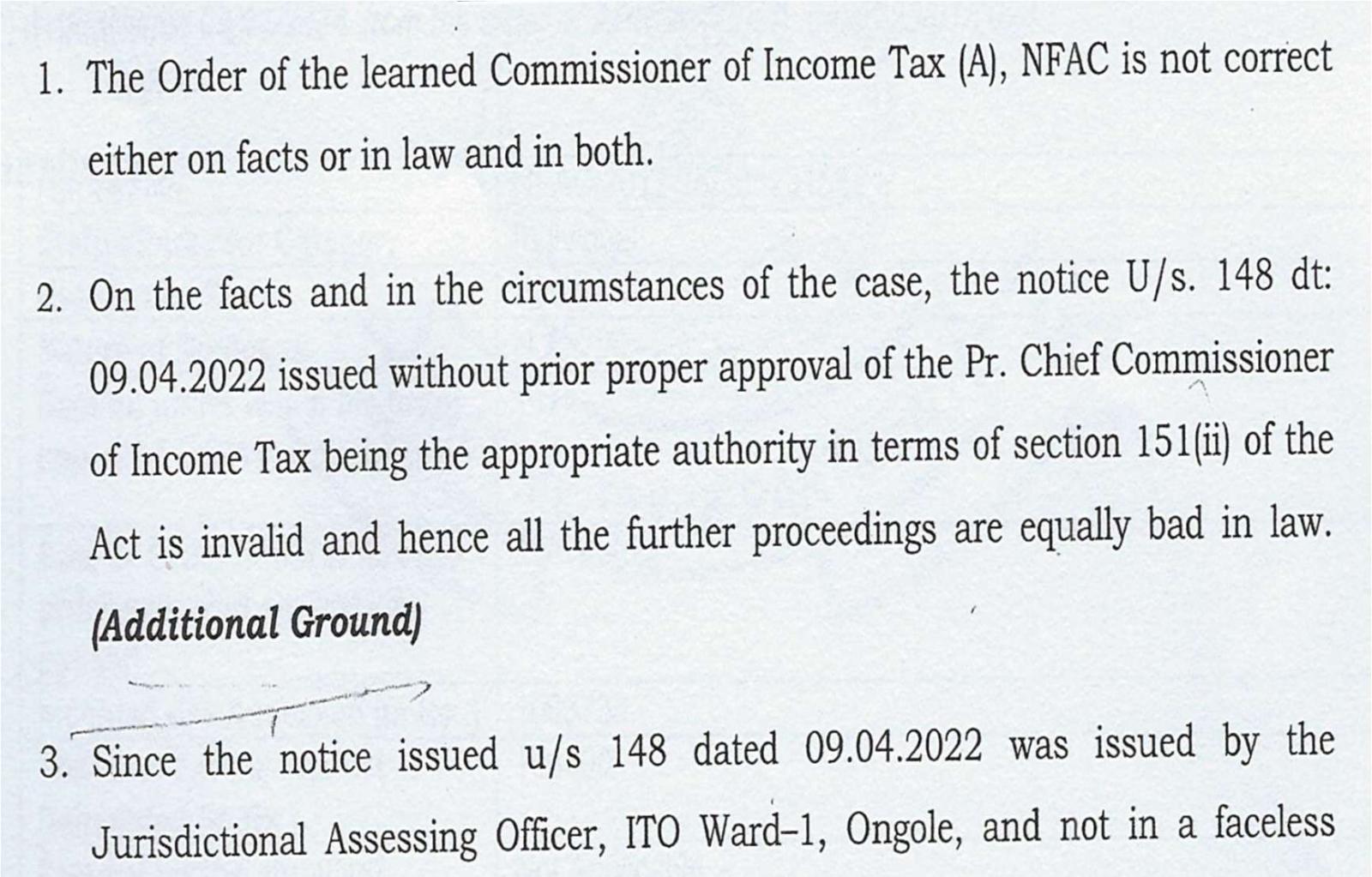
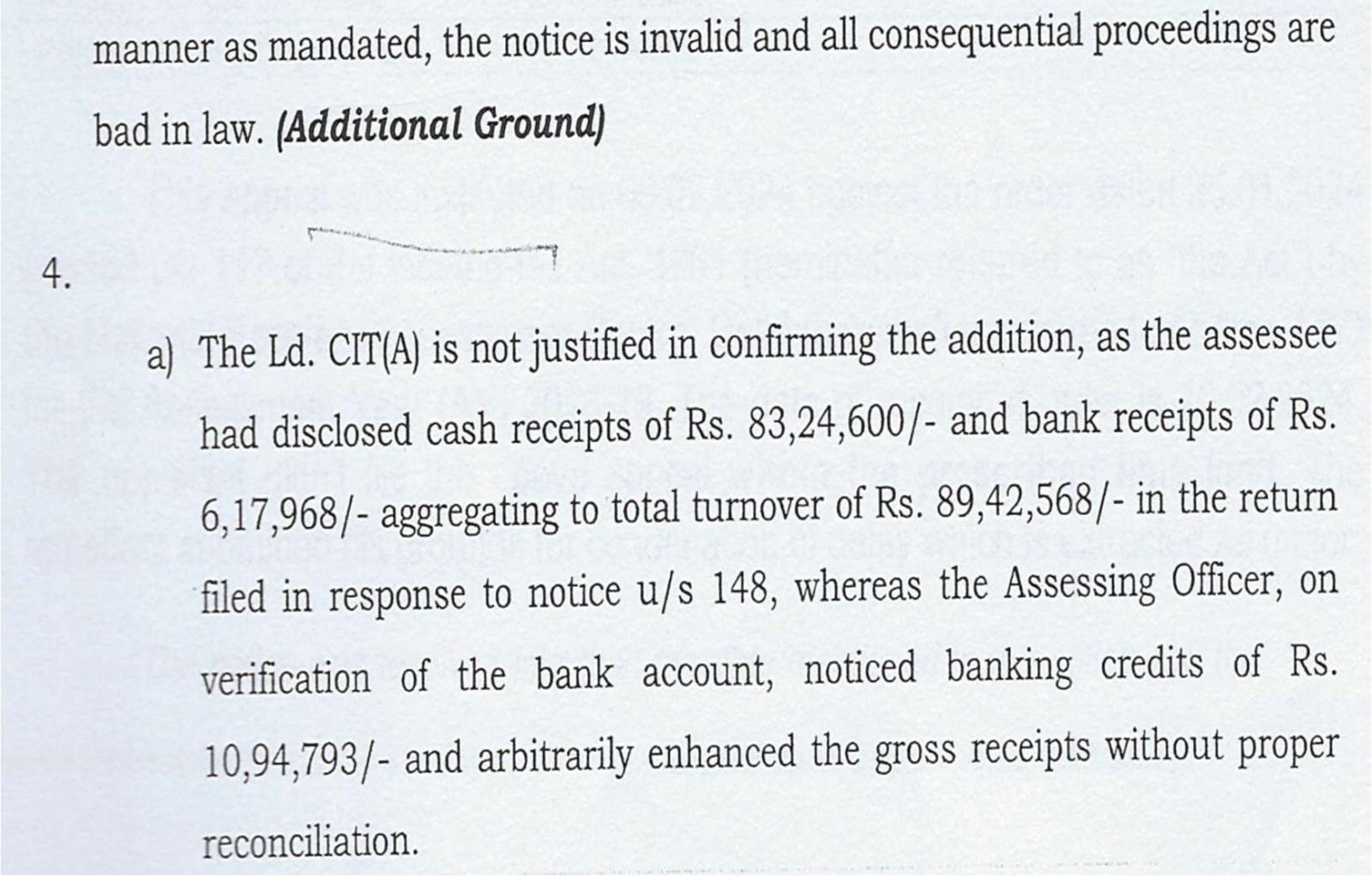
5. The assessee has raised the following grounds of appeal:
–
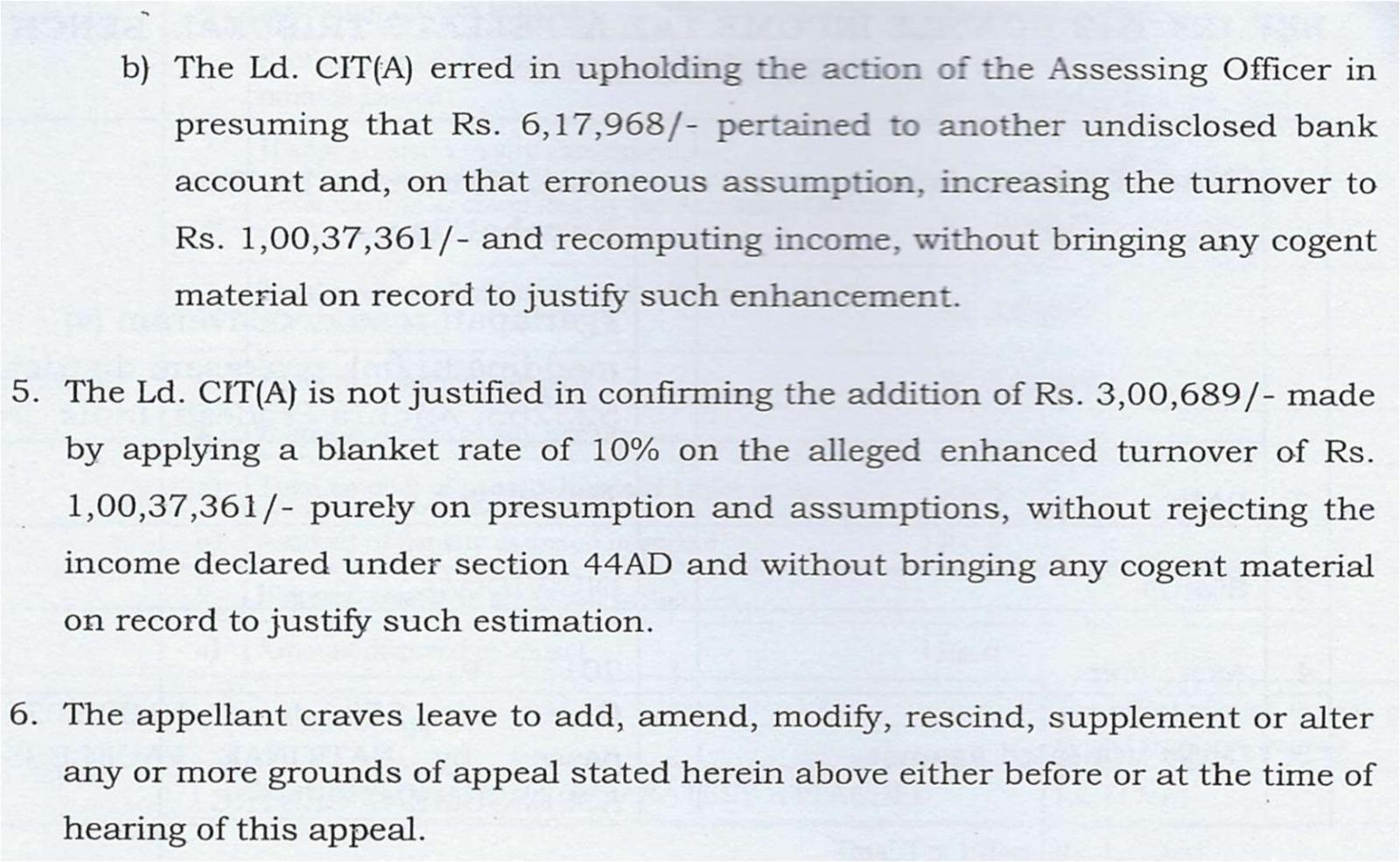
6. The assessee filed a petition for admission of the additional grounds raising ground nos.2 and 3 of the grounds of appeal.
7. I have heard the learned Authorised Representative of the Assessee and the learned DR on the admission of additional ground. The issue raised in the additional grounds challenging the validity of the notice issued u/sec.148 of the Income Tax Act [in short “the Act”], 1961 for want of approval of the Appropriate Authority u/sec.151(ii) of the Act which goes to the root of the matter. It is also pertinent to note that for adjudication of the above additional grounds, no fresh material or record or facts are required to be investigated, verified or considered, but, the same can be adjudicated on the basis of the material and facts already on record. Accordingly, by following the Judgment of Hon’ble Supreme Court in the case of National Thermal Power Co. Ltd., vs., CIT [1998] 229 ITR 383 (SC),I admit the additional ground raised by the assessee for hearing and adjudication.
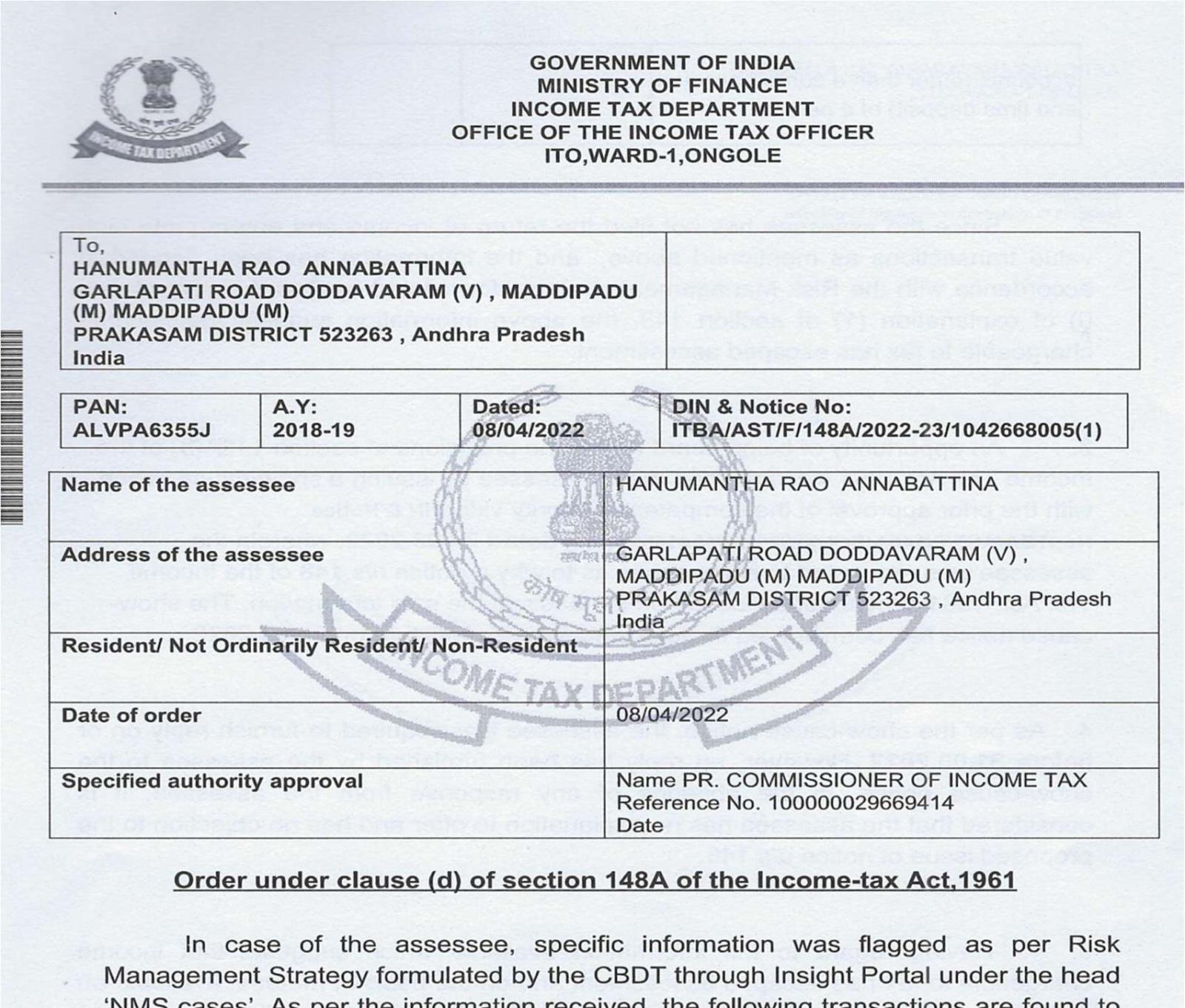
8. The learned Authorised Representative of the Assessee has submitted that the Assessing Officer has taken the approval from the Pr. CIT while passing the order u/sec.148A(d) as well as issuing notice u/sec.148 of the Act dated 08.04.2022 whereas as per the provisions of sec.151(ii) the notice issued u/sec.148 after three years from the end of the assessment year, the Specified Authority is Chief Commissioner/Director General of Income Tax and not the Pr. CIT. Thus, he has contended that the Order passed by the Assessing Officer u/sec.148A(d) of the Act and notice issued u/sec.148 of the Act are invalid and liable to be quashed.
9. On the other hand, the learned DR has submitted that as per the proviso to sec.151 of the Act the time given in fourth to sixth proviso to sec.149(1)(b) shall be excluded for the purpose of limitation of three years provided u/sec.151 of the Act. He has relied upon the Orders of the authorities below.
10. I have considered the rival submissions as well as relevant material on record. There is no dispute that the Assessing Officer has taken approval from Pr. CIT for passing the order u/sec.148A(d) dated 08.04.2022 as well as notice issued u/sec.148 of the Act. For ready reference, the order passed by the Assessing Officer u/sec.148A(d) is reproduced as under:
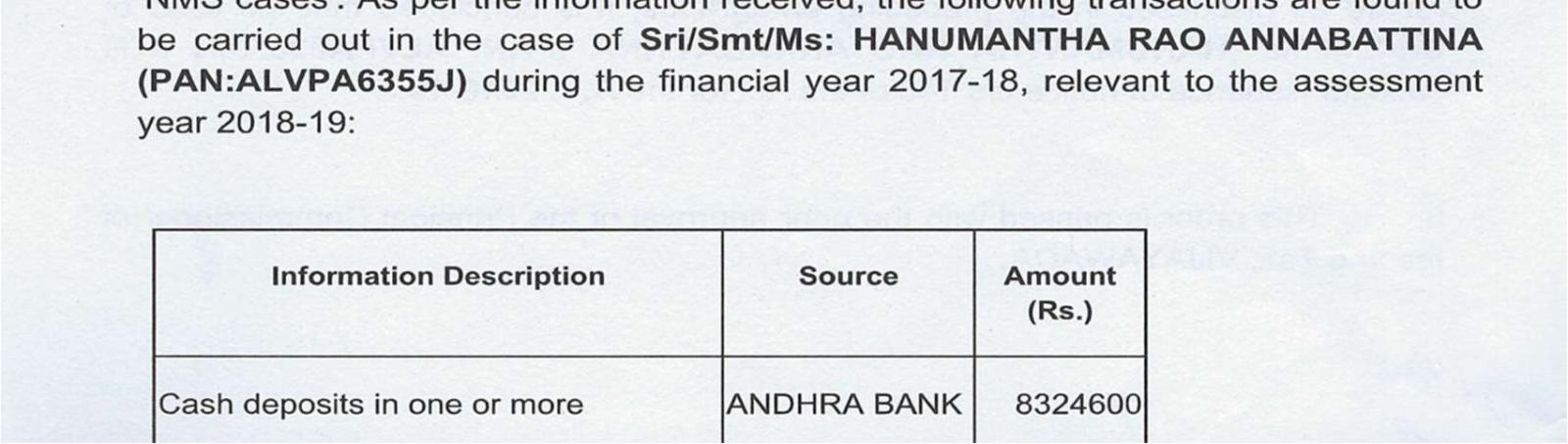
–
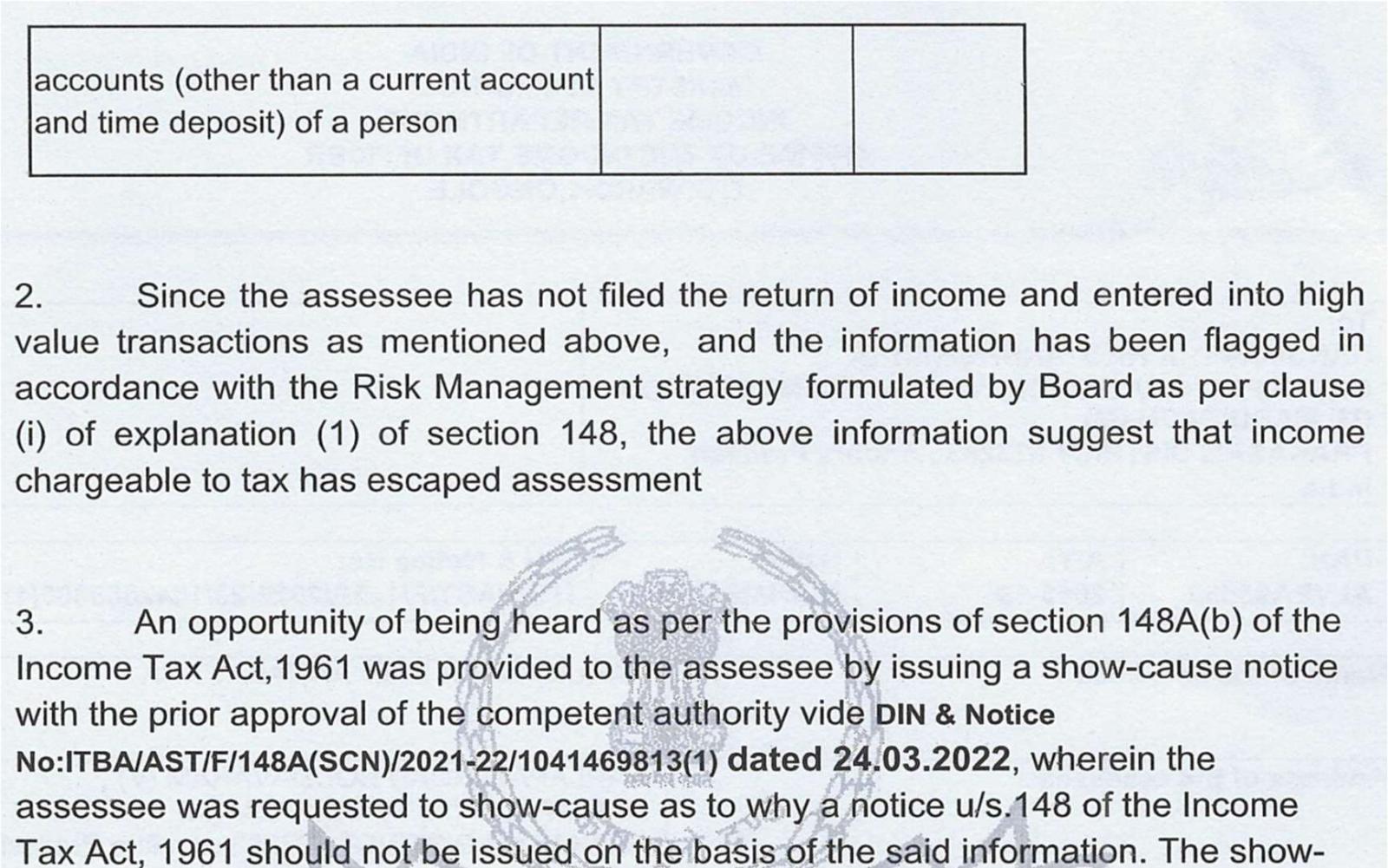
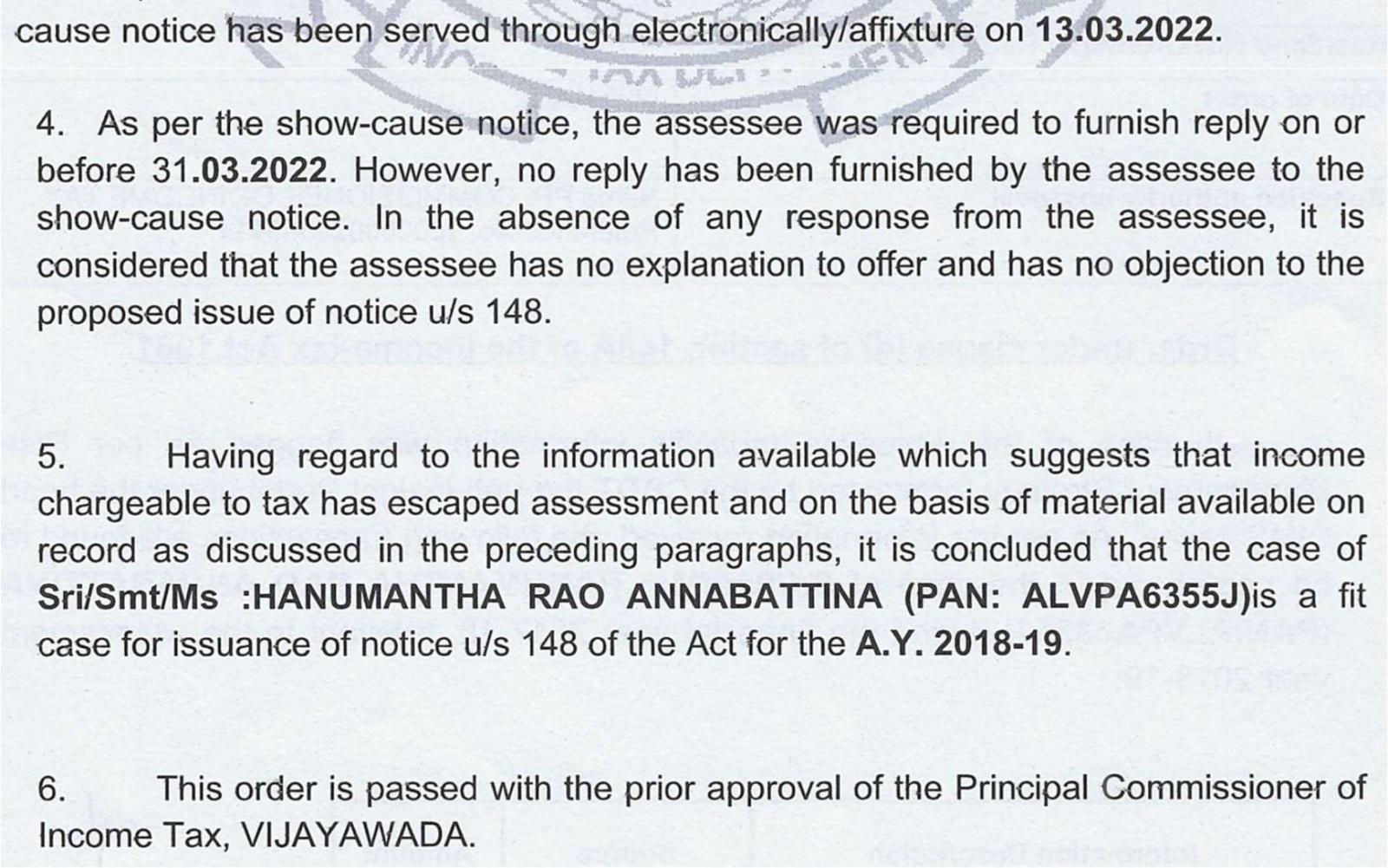

9.1. Since the notice u/sec.148 dated 09.04.2022 was issued after expiry of three years from the end of the assessment year under consideration therefore, the Competent Authority to grant approval for issuing notice u/sec.148 as per sec.151(ii) of the Act as exist at the relevant point of time i.e., the date of issuing the notice u/sec.148 is the CCIT/DGIT and not Pr. CIT. An identical issue has been considered by Hon’ble jurisdictional Telangana High Court in the case ofDeloittee Consulting India (P.) Ltd., vs. Assessment Unit Income Tax Department, National Faceless Assessment Centre, New Delhi(supra) in Para nos.48 to 50 as under: “48. The proviso to Section 151 has been introduced by the Finance Act, 2023 with effect from 01.04.2023. The relevant Section 151 with its proviso is applicable to the case of the petitioner is quoted here under:
“48. The proviso to Section 151 has been introduced by the Finance Act, 2023 with effect from 01.04.2023. The relevant Section 151 with its proviso is applicable to the case of the petitioner is quoted hereunder:
151. Sanction for issue of notice:- Specified authority for the purposes of Section 148 and Section 148A shall be,-
(i) Principal Commissioner or Principal Director or Commissioner or Director, if three years or less than three years have elapsed from the end of the relevant assessment year.
(ii) Principal Chief Commissioner or Principal Director General or Chief Commissioner or Director General, if more than three years have elapsed from the end of the relevant assessment year.
Provided that the period of three years for the purposes of clause (1) shall be computed after taking into account the period of limitation as excluded by the third or fourth or fifth provisos or extended by the sixth proviso to sub-section (1) of Section 149.
49. In the present case, the order under Section 148A(d) and notice under Section 148 have been issued on 07.04.2022 relatable to the relevant Assessment Year 201819 i.e., after more than three years from the end of the relevant assessment year. The approval before passing the order under Section 148A(d) of the Act and before issuing of notice under Section 148 of the Act has been taken from the Principal Commissioner of Income Tax by the respondent No.1, which is permissible only if three years or less than three years have lapsed from the end of the relevant assessment year. In the present case, the relevant three years lapsed on 31.03.2022. Therefore, the prior approval of the Principal Chief Commissioner or Principal Director General or the Chief Commissioner or the Director General was required to be obtained before passing of the order under Section 148A(d) or before issuance of the notice under Section 148 of the Act.
50. Learned counsel for the respondent has relied upon the proviso to Section 151 of the Act inserted by the Finance Act, 2023 with effect from 01.04.2023 quoted above to contend that the period of seven days furnished to the assessee to submit reply to the notice under Section 148A(b) issued on 23.03.2022 has to be excluded for counting the period of three years. It is submitted that the proviso is clarificatory in nature and as such, it would operate from the date when the amended Section 151 was brought into force i.e., 01.04.2021. However, such a contention is fit to be rejected since the proviso to Section 151 has been inserted by the Finance Act, 2023 only with effect from 01.04.2023. It, therefore, cannot be applied retrospectively to exclude the period of seven days in furnishing the reply to the notice under Section 148A(b) of the Act by the assessee. The Assessing Officer could not have assumed exclusion of such a period while passing the order under Section 148A(d) of the Act or issuing notice under Section 148 of the Act on 07.04.2022 that such a proviso excluding the period consumed in furnishing the reply is going to be brought into the statute book by amendment by the Finance Act, 2023 with effect from 01.04.2023. In taxing statutes, intendment cannot be assumed unless specifically expressed in the provision enacted by the legislature. Therefore, the reopening of assessment without sanction/approval of the specified authority in accordance with Section 151 of the Act was bad in law. Consequently, reassessment order dated 16.01.2024 also is bad in law.”
9.2. Thus, on identical facts the Hon’ble jurisdictional High Court has held that the notice issued u/sec.148 of the Act dated 07.04.2022 which is after three years from the end of the assessment year by taking the prior approval from the Pr. CIT is invalid and bad in law and consequently, the re- assessment order passed by the Assessing Officer is also bad in law. By following the above Judgment of Hon’ble jurisdictional High Court, the Coordinate Bench of ITAT, Hyderabad in the case of Vijaya Malisetty, Khammam vs. ITO, Ward-1, Khammam (supra) has held in Para nos.14 to 16 as under:
“14. At this stage, we may herein observe that our aforesaid view that in a case where a period of more than three years have elapsed from the end of the relevant assessment year, then, approval for issuing the notice under section 148 of the Act has to be taken from the Principal Chief Commissioner or Principal Director General or Chief Commissioner or Director General for issuing the notice under section 148 of the Act is supported by the recent judgment of the Hon’ble High Court of Telangana in Deloitte Consulting India Private Limited vs. The Assessment Unit, Income Tax Department, Civil Writ Petition No. 4061 of 2024, dated 25/09/2025. For the sake of clarity, we deem it apposite to cull out the observations of the Hon’ble jurisdictional High Court in the case of Deloitte Consulting India Private Limited vs. The Assessment Unit, Income Tax Department (supra), as under: “48. The proviso to Section 151 has been introduced by the Finance Act, 2023 with effect from 01.04.2023. The relevant Section 151 with its proviso is applicable to the case of the petitioner is quoted hereunder:
151. Sanction for issue of notice:- Specified authority for the purposes of Section 148 and Section 148A shall be,-
(i) Principal Commissioner or Principal Director or Commissioner or Director, if three years or less than three years have elapsed from the end of the relevant assessment year;
(ii) Principal Chief Commissioner or Principal Director General or Chief Commissioner or Director General, if more than three years have elapsed from the end of the relevant assessment year:
Provided that the period of three years for the purposes of clause (i) shall be computed after taking into account the period of limitation as excluded by the third or fourth or fifth provisos or extended by the sixth proviso to sub-section (1) of Section 149.
49. In the present case, the order under Section 148A(d) and notice under Section 148 have been issued on 07.04.2022 relatable to the relevant Assessment Year 2018- 19 i.e., after more than three years from the end of the relevant assessment year. The approval before passing the order under Section 148A(d) of the Act and before issuing of notice under Section 148 of the Act has been taken from the Principal Commissioner of Income Tax by the respondent No.1, which is permissible only if three years or less than three years have lapsed from the end of the relevant assessment year. In the present case, the relevant three years lapsed on 31.03.2022. Therefore, the prior approval of the Principal Chief Commissioner or Principal Director General or the Chief Commissioner or the Director General was required to be obtained before passing of the order under Section 148A(d) or before issuance of the notice under Section 148 of the Act.
50. Learned counsel for the respondent has relied upon the proviso to Section 151 of the Act inserted by the Finance Act, 2023 with effect from 01.04.2023 quoted above to contend that the period of seven days furnished to the assessee to submit reply to the notice under Section 148A(b) issued on 23.03.2022 has to be excluded for counting the period of three years. It is submitted that the proviso is clarificatory in nature and as such, it would operate from the date when the amended Section 151 was brought into force i.e., 01.04.2021. However, such a contention is fit to be rejected since the proviso to Section 151 has been inserted by the Finance Act, 2023 only with effect from 01.04.2023. It, therefore, cannot be applied retrospectively to exclude the period of seven days in furnishing the reply to the notice under Section 148A(b) of the Act by the assessee. The Assessing Officer could not have assumed exclusion of such a period while passing the order under Section 148A(d) of the Act or issuing notice under Section 148 of the Act on 07.04.2022 that such a proviso excluding the period consumed in furnishing the reply is going to be brought into the statute book by amendment by the Finance Act, 2023 with effect from 01.04.2023. In taxing statutes, intendment cannot be assumed unless specifically expressed in the provision enacted by the legislature. Therefore, the reopening of assessment without sanction/approval of the specified authority in accordance with Section 151 of the Act was bad in law. Consequently, reassessment order dated 16.01.2024 also is bad in law.”
(emphasis supplied by us)
15. We find that the Hon’ble High Court in its aforesaid order had not only observed that in the case of the assessee before them ie., for AY 2018-19, the specified authority for granting approval under section 151 of the Act was the Principal Chief Commissioner or Principal Director General or Chief Commissioner or Director General as a period of more than three years had lapsed from the end of the relevant Assessment Year, but had also rejected the claim of the revenue that the “proviso” to section 151 of the Act as had been made available on the statute vide the Finance Act, 2023 w.e.f. 01/04/2023 was to be given a retrospective effect.
16. We, thus, in terms of our aforesaid observation, concur with the Ld. AR that in the present case before us for A.Y. 2018-19, wherein notice under Section 148 of the Act was issued on 07.04.2022, i.e., beyond a period of three years from the end of the assessment year, the A.O. was statutorily obligated to have obtained the approval from either of the authorities specified u/s. 151(ii) of the law as was then available on the statute, viz. Principal Chief Commissioner or Principal Director General or where there is no Principal Chief Commissioner or Principal Director General, Chief Commissioner or Director General. However, as the A.O. had obtained the approval from the Pr. Commissioner of Income Tax, i.e. an authority who was not vested with any jurisdiction as per the mandate of Section 151 of the Act (as made available on the statute w.e.f 01.04.2021), therefore, the assessment so framed by him u/s.147 r.w.s. 144 r.w.s 144B of the Act, dated 13/02/2024, being devoid and bereft of any valid assumption of jurisdiction, is liable to be quashed. Accordingly, we quash the assessment framed by the A.O. under Section 147 r.w.s 144 r.w.s 144B of the Act, dated 13.02.2024, in terms of our aforesaid observations.”
9.3. Accordingly, by following the Judgment of Hon’ble jurisdictional High Court as well as the decision of Coordinate Bench of this Tribunal (supra) and to maintain the rule of consistency, I am of the considered opinion that the Order passed by the Assessing Officer u/sec.148A(d) as well as notice issued u/sec.148 of the Act dated 09.04.2022 by taking the prior approval of Pr. CIT is not valid and liable to be quashed. I order accordingly.
10. Since the notice issued u/sec.148 of the Act is quashed being invalid it vitiates the re-assessment order passed by the Assessing Officer therefore, the other grounds raised by the assessee become infructuous and not taken up for adjudication.
11. In the result, appeal of the Assessee is allowed.
Order pronounced in the open court on 05.08.2026




