Ashish Bhatt Vs ITO (ITAT Agra)
Gift from Mother-in-Law Out of Encashed FDs Cannot Be Brushed Aside on Suspicion—ITAT Deletes Section 69 Addition
Summary: The Agra Bench of the Income Tax Appellate Tribunal has held that where the assessee established the complete movement of funds through banking channels and demonstrated that the amount gifted by his mother-in-law originated from the encashment of her fixed deposits, the investment could not be treated as unexplained merely because the donor had a comparatively low returned income or because the funds were credited shortly before the gift was made.
The assessee had purchased an immovable property for ₹51,67,000 during the financial year relevant to A.Y. 2016-17. The payment consisted of ₹32 lakh financed through a housing loan from Axis Bank, ₹6.80 lakh paid from the assessee’s own funds, and ₹12.35 lakh contributed by his wife, Smt. Binatee Bhatt. The Assessing Officer accepted the housing loan and the assessee’s own contribution. However, out of the amount contributed by the wife, only ₹2 lakh was accepted as being sourced from her past savings. Consequently, the balance amount of ₹10.87 lakh was added as unexplained investment under section 69.
Before the CIT(A), the assessee explained that his wife had received a gift of ₹12 lakh from her mother, Smt. Kamla Ramesh Chhugani, who was a retired pensioner and a regular income-tax return filer. The gift was transferred through RTGS, and the assessee furnished the bank statements of the donor and the recipient, the donor’s confirmation, her return of income and other supporting evidence.
The CIT(A) admitted the additional evidence but nevertheless sustained the addition. According to the CIT(A), the donor had only a minimal balance in her bank account before certain credits were received, following which ₹12 lakh was transferred to her daughter. The CIT(A) also noticed that the donor had declared only a modest income and paid minimal self-assessment tax. The proximity between the credits received by the donor and the subsequent transfer to her daughter was considered sufficient to raise doubts regarding her creditworthiness and the source of the gift.
The Tribunal, however, found that the conclusion of the CIT(A) was not supported by the documentary evidence. The donor had expressly confirmed that she had gifted ₹12 lakh to her daughter for assisting her and her son-in-law in purchasing a residential flat at Noida. She had also explained that the money came from the liquidation of fixed deposits created out of funds received on her retirement from government service.
Significantly, the bank statement of the donor substantiated the encashment of the fixed deposits. The Tribunal further noticed that the RTGS credit of ₹12 lakh in the daughter’s bank account exactly corresponded with the debit of an identical amount on the same date in the donor’s bank account. Thus, the identity of the donor, the source in her hands, the fact of the gift and the actual movement of money were all supported by documentary evidence.
In these circumstances, the Tribunal held that the addition of ₹10.87 lakh under section 69 was not sustainable and directed its deletion. The decision makes it clear that the immediate transfer of money after encashment of fixed deposits cannot, by itself, be regarded as a suspicious circumstance. On the contrary, where the encashment and the subsequent transfer are reflected in the bank statements, the proximity between the two transactions actually supports the explanation regarding the source and utilisation of funds.
The assessee had also challenged the validity of the reopening notice dated 15.03.2023. The contention was that, for A.Y. 2016-17, the notice was beyond three years and the extended period under section 149(1)(b) could be invoked only when the income escaping assessment represented an asset and amounted to or was likely to amount to ₹50 lakh or more. Though the information referred to gross transactions of ₹71.35 lakh, the disputed unexplained amount was only ₹10.87 lakh. However, since the addition was deleted on merits, the Tribunal treated the jurisdictional ground as academic and expressly left it open.
The Tribunal also considered a separate addition of ₹24,840, which the Assessing Officer had treated as unexplained investment in equity shares. The assessee clarified that these were actually small monthly investments in mutual funds through SIPs, made in the name of his minor daughter. The amounts ranged from ₹1,000 to ₹3,000 and were invested on 14 different dates. The assessee was employed with Axis Bank and had regular salary income.
Although certain cash deposits were noticed in the relevant bank account before the investments, the Tribunal also found credits through clearing instruments. Considering the nominal amount of the SIP investments and their consistency with the assessee’s salary income and financial position, the explanation was accepted and the addition of ₹24,840 was also deleted.
Author’s Comments
The decision reiterates that suspicion, however strong, cannot substitute evidence. Once the assessee produces the donor’s confirmation, bank statements, proof of fixed-deposit encashment and the corresponding banking trail, the explanation cannot be rejected merely because the donor’s annual taxable income is modest. Creditworthiness must be examined with reference to the actual source of the gift and not merely the income disclosed for one particular year.
The order is also significant on reopening, although the issue was left undecided. For invoking the extended limitation under section 149(1)(b), the statutory threshold must relate to the income escaping assessment represented in the form of an asset, and not automatically to the gross value of the financial transaction. However, since the Tribunal left this question open, the order should not be cited as having conclusively decided the limitation issue.
FULL TEXT OF THE ORDER OF ITAT AGRA
This appeal is directed against the impugned order dated 25.11.2025 passed in appeal No NFAC/2015-16/10364012 by the NFAC (hereinafter referred to as the Commissioner of Income Tax), u/s. 250 of the Income Tax Act, 1961 (hereinafter referred to as the “Act”) for the A.Y. 2016-17, wherein ld. CIT (A) has dismissed assessee’s appeal.
2. Brief facts of the case: The AO noted on the basis on information that the assessee had entered into significant financial transactions amounting to Rs. 71,35,810/- including purchase of an immovable property valued at Rs. 51,67,000/-. Further the AO also noted that the assessee did not file his return of income for A.Y. 2016-17. Based on the above information, the case was reopened by the AO vide notice u/s 148 of the Act vide notice dated 15.03.2023.
2.1 In response to the said notice the assessee filed his return of income declaring to Rs. 7,08,770/-. As noted above the assessee had purchased unit shop no. O402 at Prateek Wisteria, Sector 77 and the AO noted the following details of sources submitted by the assessee for the investment in respect of the said property:
“Payment details are as under
| Period | Type of Payment | Payment by | Amount | Remarks |
|---|---|---|---|---|
| Oct 2015 | RTGS | Ashish Bhatt | 6,80,000 | Self Fund |
| Nov 2015 | RTGS | Axis Bank | 32,00,000 | Loan |
| Nov 2015 | Binatee (Wife of Ashish) | 12,35,330 | Self Fund | |
| TDS | 51,670 | |||
| Total | 51,67,000 |
2.2 The assessee submitted the details of source of the said property and the AO accepted the source of Rs. 40,80,000/- out of the total investment of Rs. 51,67,000/- and added the balance amount of Rs. 10,87,000/- u/s 69 of the Act. The AO accepted only a sum of Rs. 2,00,000/- out of the past savings of Smt. Binatee wife of the assessee (out of a claim of Rs. 12,35,330/-). In this regard, the relevant extracts of the order of the AO are reproduced as under:
“In his support, he has submitted the loan welcome letter of Axis Bank for the payment of Rs. 32,00,000/-The assesssee submitted that he has made payment through RTGS Rs. 6,80,000/- from self-fund and his wife Binatee made payment of Rs. 12,35,330/- out of self-fund. The amount of Rs. 6,80,000/- paid by Sri Ashish Bhatt has been accepted on the ground that he is working in Axis Bank since long but the payment of Rs. 2,00,000/-only has been considered on account of Binatee (wife) out of his past savings in absence of any supporting documents. Further the sale deed submitted by him is for 32,25,674/- instead of Rs.51,67,000/-Hence, out of the total amount of investment of Rs. 51,67,000/-an amount of Rs. 40,80,000/- (32,00,000/- + Rs.6,80,000/- + Rs.2,00,000/-) has been allowed and the difference amount of Rs.10,87,000/- has been added in the total income of the assesse as undisclosed investment u/s 69 of the Income Tax Act, 1961.”
3. Aggrieved with the said order the assessee filed an appeal before the Ld. CIT (A).
3.1 The Ld. CIT (A) dismissed appeal of the assessee. The Ld. CIT(A) did not accept the claim regarding source of funds amounting to Rs. 10,87,000/- on account of money received by the assessee from his wife Smt. Binatee who in turn claimed to have received an amount of Rs. 12,00,000/- as gift from his mother Mrs. Kamla Ramesh Chhugani. The Ld. CIT (A) did not accept the above explanation on the ground the assessee’s mother-in-law had in turn received several credits in a short duration in her bank account and finally an amount of Rs. 12,00,000/- was transferred to Binatee Bhatt’s account. The Ld. CIT (A) also noted that it was seen that Mrs. Kamla Ramesh Chhugani was having minimal amount in her bank account prior to the above transaction and the ITR filed by her was kept at total income with minimal tax of self-assessment tax. The Ld. CIT(A) also observed that the very nature of immediate credits prior to transfer of amount raised serious doubts about the source and the creditworthiness of the lender/payer. In this regard, the relevant findings of the Ld. CIT (A) are reproduced as under:
“Decision:. I have noted that the AO has given adequate opportunity to the appellant to explain the sources of investment. The AO was convinced about the majority of sources, except the amount of Rs. 10,87,000/-. Further, from perusal of details submitted by the appellant during the appellate proceeding in form of additional evidences, the admission of which have been allowed. But the same is being discussed to give the clear picture of the case. The appellant has submitted that an amount of Rs. 12,00,000/- has been gifted by his mother-in-law Kamla Chuggani to his wife Binatee Bhatt, and his wife has advanced the same to him, and corresponding bank statements of all the persons have been submitted. The said facts can be clearly seen appreciated. But, however, it is seen that his mother-in-law, has in turn received several credits in a short duration, and finally an amount of Rs. 12,00,000/- has been transferred to Binatee Bhatt’s account. It is seen that Kamla Chuggani is having minimal amount in her bank prior to the above transactions, and the ITR being filed by her is being kept at total income with minimal tax paid in form of SA tax. Hence, the very nature of immediate credits prior to transfer of amount raises serious doubt about the source and creditworthiness of the lender/payer.
The appellant has initially stated before the AO that the sum advanced by his wife pertained to her, but during the appellate proceeding, he submitted details claiming the same to be her mother-in-law’s money which has been given to his wife as gift. The appellant’s wife has no source of earning of her own, hence, it is improbable that the appellant wont be knowing from where this huge sum of more than Rs. 12 lakhs has come into her account.
In view of the above facts and discussion, I uphold the AO’s addition of Rs. 10,87,000/- made u/s. 69A, and thus the ground nos. 1, 2 & 4 raised by the appellant, are dismissed.”
4. Aggrieved with the said order, the assessee has filed an appeal before us on the following grounds of appeals:
“1. That the CIT(A) erred in law and fact in violation of principles of natural justice by ignoring the explanation and evidence submitted by the appellant regarding the source of funds for the property purchase.
2. That the learned CIT(A) has erred in law and on facts in confirming/making an addition of ₹10,87,000/- under Section 69 of the Income-tax Act, treating the same as unexplained income, without properly appreciating that the said amount was a part of the amount funded out of a genuine and lawful gift received by the appellant’s wife from her mother, Mrs. Kamla Chhugani, a retired pensioner, along with explained tax-paid savings. The learned CIT(A) failed to consider that the gift was received from the identifiable sources, and therefore, the impugned addition is arbitrary, unjustified, and liable to be deleted.
3. That the learned CIT(A) erred in law and on facts in upholding the validity of notice issued under section 148 dated 15.03.2023 for A.Y. 2016-17, which is barred by limitation under section 149(1)(a) of the Act, as the income alleged to have escaped assessment, even on admitted facts, does not exceed 50,00,000/-. The learned authorities erred in invoking the extended limitation under section 149(1)(b) by mechanically considering gross financial transactions of 71,35,810/-, ignoring the assessee’s reply under section 148A(b) and the admitted fact that *32,00,000/- represented a housing loan from Axis Bank and other amounts were already accepted as explained, leaving only 10,87,000/-in dispute. Consequently, the assumption of jurisdiction under section 148 is without authority of law, and the addition of ₹10,87,000/- is liable to be quashed.”
5. At the time of hearing, the Ld. AR in respect of the above findings of the Ld. CIT(A) submitted as under:
“It is respectfully submitted that the said amount formed part of the contribution made by the appellant’s wife towards the purchase of the property. The appellant had consistently explained that the amount contributed by his wife was sourced from a gift received from her mother, Mrs Kamla Chhugani, along with her own past savings. During the appellate proceedings, the appellant also furnished additional evidence, including the bank statements of the appellant’s wife and her mother, as well as the gift declaration confirming the transfer of funds. The learned CIT(A) himself admitted these evidences under Rule 46A, acknowledging that they were relevant to the issue under consideration.
From the documents placed on record, the identity of the donor, Mrs Kamla Chhugani, was clearly established. The transaction was carried out through banking channels, and the movement of funds was reflected in the respective bank statements. Thus, the genuineness of the transaction and the source of the funds were duly explained. It is further submitted that the contribution made by the assessee’s wife was also duly explained during the proceedings. The amount received by the wife from her mother was out of her savings and encashment of fixed deposits, which is duly reflected in the bank statements already furnished before the authorities below. The said fixed deposits were made by her out of the funds received at the time of retirement from her government Job. Therefore, the authorities erred in ignoring the evidence already available on record while mechanically treating the gross transaction amount as income escaping assessment.
However, the learned CIT(A), instead of objectively examining the evidence on record, sustained the addition primarily based on suspicion by observing that certain credits had appeared in the bank account of the donor prior to the transfer of funds. These credits are closure proceeds of FDRs of donor Mrs Kamla Chugani. It is respectfully submitted that such an observation cannot by itself justify treating the amount as unexplained in the hands of the appellant, particularly when the appellant had already discharged the initial onus by establishing the identity of the donor and the fact of the transaction through documentary evidence.
It is a settled principle that once the assessee furnishes prima facie evidence explaining the source of funds, the burden shifts to the department to bring material on record to prove that the explanation is false or not genuine. In the present case, no adverse material has been brought on record by the Assessing Officer or the learned CIT(A) to demonstrate that the gift transaction was not genuine.
Therefore, the addition sustained by the learned CIT(A) is based merely on conjectures and doubts rather than on any concrete evidence. In view of the facts and circumstances of the case, the impugned addition of ₹10,87,000/- under section 69 is unjustified and liable to be deleted.
A copy of the Purchase deed is attached as Annexure D.
A copy of the Agreement to sell is attached as Annexure E.
A copy of Bank statement and confirmation letter, along with the ITR of Mrs Kamla Ramesh Chhuganl, is attached as Annexure F.
A copy of CIT(A) Order is attached as Annexure G.”
5.1 Further, the Ld. AR also referred to a confirmation letter filed by Mrs. Kamla Ramesh Chhugani placed at Page at 60 which is reproduced as under:
“TO WHOSOEVER IT MAY CONCER
This is to certify and confirm that I, Kamla Ramesh Chhugani (PAN No ACOPC9344B), resident of C1-904, M I Rustle Court, Sector-6, Gomti Nagar Lucknow-226010 am the mother of Mrs Binatee Bhatt (PAN No AINPC1860F) wife of Ashish Bhatt (PAN No. AMRPB1889M) and I had gifted Rs 12,00,000/- (Twelve Lakhs only) to my daughter Mrs Binatee Bhatt in her ICICI Bank saving account no 629401531128 vide RTGS no ORBCR52015102000056356 dated 20/10/2015 from my Oriental Bank of Commerce saving account no 05512191037529. The purpose of the gift was to financially assist my daughter and son in law in purchase of a residential flat at Noida.
I further confirm that I am regular filer of Income Tax return and have pension and investment income as my source of income. I had given this amount after liquidating some of my investments in the form of FDR with Oriental Bank of Commerce.”
5.2 Further, the Ld. AR also referring to page no. 68 of the paper book stated that the source of Rs. 12,00,000/- was the closure proceeds of various FDR by Smt. Kamla Ramesh Chhugani which he stated that it was evident from the bank statement of Smt. Kamla Ramesh Chhugani placed at page no. 68 of the paper book. It was submitted by Ld. AR that in view of these facts the addition of Rs. 10,87,000/- was not justified and the same may be deleted.
6. On the other hand, the Ld. Sr. DR supported of the orders of the authorities below.
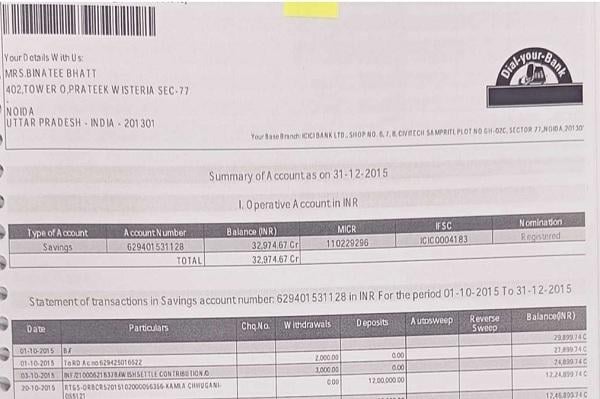
7. We have heard both the parties and perused the material available on record. As noted above, the disallowance of Rs. 10,87,000/- u/s 69 was made by the AO on the ground that the source of Rs. 10,87,000/- which was out of funds of Rs. 12,35,330/- claimed to have been received by the assessee from his wife Smt. Binatee Bhatt was not accepted by the AO. At the appellate stage it was submitted that the source of 12,35,330/- was out of a gift of Rs. 12,00,000/- received by Smt. Binatee Bhatt from her mother Smt. Kamla Ramesh Chhugani which was not accepted by the Ld. CIT(A) for the reasons as discussed above. In this regard we reproduce the bank statement filed by the assessee on page no. 58 and 68 of the paper book of Smt. Binatee Bhatt and Smt. Kamla Ramesh Chhugani respectively as under:
Page no. 58 of the paper book(bank statement of Smt. Binatee Bhatt.)
Page no. 60 of the paper book(bank statement of Smt. Kamla Ramesh Chhugani.)
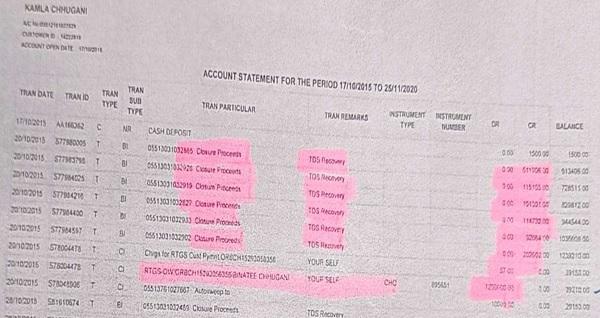
7.1 As noted above that Smt. Kamla Ramesh Chhugani in her declaration/ confirmation dated 22.04.2024 placed at page no. 60 of the paper book. stated that the source of Rs. 12,00,000/- was out of the closure proceeds of the FDRs which are supported by the bank statement of Smt. Kamla Ramesh Chhugani as reproduced above. Further, from the bank statement of Mrs. Binatee Bhatt as reproduced above it is noticed that the RTGS amount of Rs. 12,00,000/- credited in her bank account fully tallies with the debit of equivalent amount on the same date in the bank account of Smt. Kamla Ramesh Chhugani. Therefore, in the given facts of this case the disallowance of Rs. 10,87,000/- made by the AO u/s 69 of the Act is not sustainable and the same is deleted. Ground nos. 1 and 2 the appeal are allowed. In view of Ground no. 2 being allowed and Ground no. 3 becomes academic and is left open in this case.
8. Gound no. 4 of the appeal is in respect of addition of Rs. 24,840/- as unexplained income.
9. The AO had noted that the assessee had purchased equity shares amounting to Rs. 24,840/-. The AO noted that the assessee failed to provide the details of the source of the above purchases and accordingly added the same u/s 69 of the Act. The same was confirmed by the Ld. CIT (A) and the relevant finding of the Ld. CIT (A) are reproduced as under:
“8.4.2 Appellant’s Submission:
“The appellant had made investments in Mutual funds in the form of SIP of Rs 2000 per month with IDFC Mutual Fund scheme IDFC Flexi Cap Fund-Growth- (Regular Plan) from Aug 2015 and another SIP of Rs 1000/- per month with ICICI Prudential Mutual Fund from Aug 2015. This investment has been considered as unexplained investment u/s 69 by the AU. A copy of the mutual fund statement is attached herewith. It was explained vide reply dated 13th Feb, 2024 that the appellant had been employed since year 2007 and the investment of Rs 24840/- is out of past saving and current year salary income of the appellant. Also, the amount of investment is very small considering the salary income of the appellant. However, the AU ignored the reply of the appellant and instead made addition of Rs 24,840/- as unexplained investment u/s 69 of the Act.”.
8.4.3 Decision:. I note that the appellant has given a vague reply to substantiate the source of investment made in the mutual funds by stating that he has made out of his past saving since 2007. Onus is upon the appellant to prove the source of the investments made. Hence, I do not find any fault in the stand taken by the AO, and thus, this addition of Rs. 24,840/- u/s. 69 of the Act, is sustained. In view of this finding, the ground no. 6 raised by the appellant, is dismissed.”
10. Aggrieved with the said order, the assessee has filed an appeal before us on the following ground of appeal:
“4. That the CIT(A) is wrong in treating mutual fund investment of Rs. 24,840/- as unexplained income, ignoring that it was from the current year’s salary income and supported by evidence.”
11. At the time of hearing, the Ld. AR filed a written submission which is reproduced as under:
“Ground Number 4:
That the CIT(A) is wrong in treating mutual fund investment of Rs. 24,840/- as unexplained income, ignoring that it was from the current year’s salary income and supported by evidence.
The learned CIT(A) has erred both in law and on facts in sustaining the addition of 24,840/- by treating the mutual fund investment as unexplained under section 69 of the Act.
It is respectfully submitted that the appellant was employed with Axis Bank Ltd. during the relevant year and was earning regular salary income. The investment of ₹24,840/-represented small monthly investments in mutual funds through SIPs, and not equity shares, in the name of his minor daughter as she is a minor and PAN of the assessee was attached in the same.
The appellant had explained that the investment was made out of his current year salary income and past savings. The Investment was made through banking channels and the mutual fund statements were also furnished. Considering the salary income of the appellant during the year, such a small investment is clearly commensurate with his known sources of income. However, the learned authorities ignored these facts and treated the amount as unexplained merely on the ground that the explanation was not satisfactory.
It is submitted that when the appellant had regular salary Income and the amount involved is very small in comparison to the Income earned, there was no justification for treating the same as unexplained Investment. The addition has therefore been made merely on assumptions without any adverse material on record.
A copy of the bank statements of Ashish Bhatt and Yashvi Bhatt and the statement of mutual fund are attached as Annexure L.
Accordingly, the addition of 24,840/- sustained by the learned CIT(A) is unjustified and deserves to be deleted.”
12. On the other hand, the Sr. DR supported the order the authorities below.
13. We have heard both the parties and perused the material available on record. On perusal of the bank statement of Yashvi Bhatt U/G Ashish Bhatt with Axis Bank (placed at page no. 136 to 139 of the paper book) it is seen that the above investment is duly debited in the said bank account. However, we also notice that prior to the above investment there are cash deposits of Rs. 13,000/- and Rs. 10,000/- on 19.06.2015 and 01.07.2015 but we also notice that there was credit entries received through clearing instruments. Considering the very nominal investment varying between 1,000/- to maximum of 3,000 on 14 different dates between 03.08.2015 to 15.03.2016, the explanation of the assessee is acceptable. Therefore, the addition of Rs. 24,840/- is deleted. Ground no. 4 is allowed the appeal of the assessee.
14. Ground no. 5 of the appeal is reproduced as under:
“5. That on the facts and in the circumstances of the case and in law, the learned Assessing Officer, though correctly mentioning the taxable income in the body of the appeal effect order passed pursuant to the order of the learned Commissioner of Income-tax (Appeals), has erred in the computation of income by wrongly calculating the taxable income therein, resulting in an incorrect and excessive tax liability.”
14.1 The AO is directed to verify the above and take necessary action in accordance with law. Ground no. 5 of the appeal is allowed for statistical purposes.
15. in the result, the appeal of the assessee is partly allowed.
Order pronounced in the Open Court on- 18.09.2026