Summary: Residential Status is one of the important and primary aspect in computing your income-tax liability in India. The income being taxed in the hands of Non-Resident Indians (NRI) depends upon their residential status. By simply looking at whether a person has a job in overseas country, holds a permanent residency / foreign residence permit is not enough. Residential status has to be determined separately for each tax year by applying the conditions provided under section 6 of Income-tax Act, 2025 (ITA 2025) including the citizenship / Person of Indian Origin status, travel history of previous years. Common mistakes include relying only on passport stamps, incorrectly calculating the number of days spent in India, overlooking special rules applicable to Indian citizens and Persons of Indian Origin, ignoring Indian income, treating FEMA residential status as identical to income-tax residential status, overlooking Resident But Not Ordinarily Resident (RNOR) status, and failing to consider employment changes or foreign tax residency. Residential status also determines the scope of income taxable in India, including the treatment of foreign-source income for NR, RNOR and ROR individuals. The distinction between tax residency and FEMA residency is relevant for matters including NRO/NRE accounts, overseas investments, acquisition or transfer of assets and FEMA compliances. Complex cases involving multiple passports, frequent travel, substantial Indian income, foreign employment, multiple jurisdictions, split payrolls, tax equalisation, remote working, multiple tax residencies, foreign tax credits and DTAA implications may require professional review based on a fact-specific residential-status matrix.
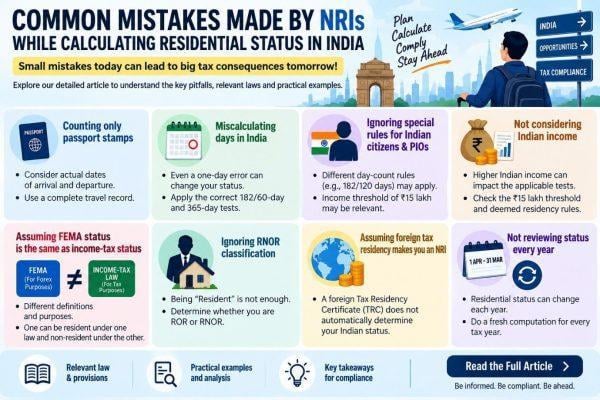
Below are the common mistakes made by NRIs while computing their Residential Status in India.
- 1. Counting only the passport stamps
- 2. Miscalculating the number of days spent in India
- 3. Ignoring special rules applicable to Indian citizens and Persons of Indian Origin
- 4. Not considering Indian income while determining residential status
- 5. Assuming FEMA residential status is the same as income-tax residential status
- 6. Ignoring the concept of Resident but Not Ordinarily Resident (RNOR)
- 7. Not considering employment changes during the year
- 8. Assuming foreign tax residency automatically makes an individual an NRI for Indian tax purposes
- 9. Ignoring the impact of residential status on global income
- 10. Not seeking professional advice in complex cases
1. Counting only the passport stamps
One of the most common mistakes is solely relying on the physical immigration stamps made by the Immigration Authorities on the passport. The residential status is determined through Actual physical presence in India (either work or non-work days) during the relevant tax year.
For example, an Individual may have:
a. multiple passports
b. electronic immigration records
c. visa or residence permit
d. frequent travel involving different passports
e. discrepancies between travel records and passport stamps
f. biometric entry and exits
g. automatic entry and exits (especially in Schengen Area)
h. Smart Gates (Australia)
i. Digital entry receipts over email (Singapore and Argentina)
j. e-Gates
Consequently, a residential status working should ideally be supported by a complete travel calendar for the tax year maintained in an excel file in the below format, rather than merely counting visible passport stamps.
| Date of Arrival in India | Place of Arrival in India | Date of Departure in India | Place of Departure in India | Stay in India |
|---|---|---|---|---|
Further, for an NRI with significant travel should maintain below documents:
a. Passport(s);
b. Immigration/entry-exit records, where available;
c. Flight tickets and boarding passes;
d. Visa/residence permit records;
e. Employer travel records;
f. Travel-calendar records; and
g. Any other evidence supporting the dates of presence in India.
2. Miscalculating the number of days spent in India
The second major mistake is incorrectly calculating the number of days spent in India (actual physical presence in India).
As per section 6(2) of ITA, 2025, an individual becomes resident of India if either:
Basic Test-1
He is in India for 182 days or more during the tax year; or
Basic Test-2
He is in India for:
a. 60 days or more during the relevant tax year, and
b. 365 days or more during the four preceding tax years.
Both conditions should be satisfied in order to qualify as Resident of India for the relevant tax year subject to certain exceptions.
Where an Individual is closed to the statutory threshold of 60 days, 182 days or 365 days and incorrectly calculated even a single day can potentially change the result.
Therefore, the computation of number of days in India should be done on actual basis rather than on estimated and assumption basis as it will have the impact on taxability of income in India.
3. Ignoring special rules applicable to Indian citizens and Persons of Indian Origin
a. The general 60 days rule contained Basic Test-2 does not apply to every Individual.
Section 6 contained the below exceptions:
i. Indian citizen leaves India as a member of the crew of Indian ship.
ii. Indian citizen leaves India for the purposes of employment outside India.
iii. Indian citizen or a person of Indian origin who being outside India comes on a visit to India in any tax year.
For an Indian citizen who leaves India as a member of the crew of Indian ship or for the purposes of employment outside India, the 60 days condition is replaced by 182 days condition.
Further, for an Indian citizen or a person of Indian origin who being outside India comes on a visit to India having :
- Income other than income from foreign sources is upto INR 15 lakhs, the 60 days condition is replaced by 182 days condition.
- Income other than income from foreign sources exceeding INR 15 lakhs, the 60 days condition is replaced by 120 days condition.
Therefore, an NRI coming to India for a visit must not simply applies the 60 days condition and must be aware of the visit provisions as well.
Further, an Indian citizen is not liable to tax in any other country or territory due to his domicile, residence, or similar criteria and has total income exceeding INR 15 lakhs during such tax year (other than the income from foreign sources) shall be deemed to be a Resident in India for a tax year. Here, Resident means Resident But Not Ordinarily Resident (RNOR).
4. Not considering Indian income while determining residential status
The Indian income is the important factor in determining in your residential status especially in the below cases:
a. You being an Indian citizen or Person of Indian Origin coming to India for the purpose of visit.
b. You being an Indian citizen not liable to tax in any other country or territory due to domicile, residence, or similar criteria.
Further, as per section 5 of ITA 2025, Indian income/ India sourced income includes all income from whatever source it is derived, which –
i. is received or deemed to be received in India in that year by or on behalf of such person; or
ii. accrues or arises, or is deemed to accrue or arise, to such person in India in that year.
5. Assuming FEMA residential status is the same as income-tax residential status
Definition of residential status is completely different under Income tax Act, 2025 and Foreign Exchange Management Act, 1999 (FEMA).
Under ITA 2025, residential status is determined basis the actual physical presence in India in the particular tax year for which residential status is determined. While under FEMA, residential status is determined basis the actual physical presence in India in the preceding financial year for which residential status is determined.
Under section 2(v) of FEMA, “Person Resident in India” means –
(i) a person residing in India for more than 182 days during the course of the preceding financial year but does not include–
(A) a person who has gone out of India or who stays outside India, in either case-
(a) for or on taking up employment outside India, or
(b) for carrying on outside India a business or vocation outside India, or
(c) for any other purpose, in such circumstances as would indicate his intention to stay outside India for an uncertain period
(B) a person who has come to or stays in India, in either case, otherwise than–
(a) for or on taking up employment in India, or
(b) for carrying on in India a business or vocation in India, or
(c) for any other purpose, in such circumstances as would indicate his intention to stay in India for an uncertain period
The distinction between residential status under ITA 1961 and FEMA is relevant for:
i. Non-Resident Ordinary (NRO) / Non-Resident External (NRE) accounts
ii. Overseas Investments
iii. Acquisition / Transfer of Assets
iv. FEMA compliances
v. Computation of Tax Liability
6. Ignoring the concept of Resident but Not Ordinarily Resident (RNOR)
Determining that an Individual is a Resident is not the end of the analysis.
Once an Individual qualifies as Resident of India under section 6 of ITA 2025, the next criteria to check whether such Individual qualifies as:
a. Resident and Ordinarily Resident (ROR); or
b. Resident But Not Ordinarily Resident (RNOR)
Under section 6(13) of ITA 2025, an individual will qualify as RNOR if he satisfies any of the following conditions:
i. He is a Non-Resident in Indian in 9 out of 10 tax years preceding the relevant year; or
ii. He is in India for 729 days or less in the preceding 7 tax years preceding the relevant year.
Further, as mentioned in point 3, an Indian citizen who is not liable to tax in any other country or territory due to his domicile, residence, or similar criteria and has total income excluding income from foreign sources exceeding INR 15 lakhs is deemed to be a Resident / RNOR of India.
Further, an Indian citizen or person of Indian origin who came to India for the purpose of visit having total income excluding income from foreign sources exceeding INR 15 lakhs and who has been in India for 120 days or more but less than 182 days during the tax year also qualifies as RNOR of India.
Further, in case of RNOR, following type of income from whatever source is taxable in India which :
a. is received or deemed to be received in India in that year by or on behalf of such person or
b. is accruing or arises, or is deemed to accrue or arise, to such person in India in that year or
c. is derived from a business controlled in or a profession set up in India
7. Not considering employment changes during the year
Changes in overseas employment can be relevant but it should be understood with reference to statutory provisions contained under ITA 2025.
Simply changing jobs does not automatically change the residential status. Whether the facts trigger the statutory conditions under section 6 is an important factor.
For example – an Individual leaves India for the purpose of employment including self-employment falls within the specific exception to the general 60 days rule contained under the Basic Test-2.
Therefore, following factors should be kept in mind while determining the residential status:
a. date of departure from India
b. date of overseas employment commenced
c. whether the individual actually left India for employment outside India
d. period of stay in India during the year
e. preceding four-year stay in India
f. citizenship
g. PIO status, where relevant
h. nature and location of employment; and
i. whether the individual returned to India during the year.
8. Assuming foreign tax residency automatically makes an individual an NRI for Indian tax purposes
Obtaining a foreign Tax Residency Certificate (TRC) or being treated as Tax Resident / Permanent Resident in another country does not automatically determine your residential status in India.
India tax residency needs to be determined for the period 1st April to 31st March based on the actual physical presence in India which is ultimately determined based on the conditions contained in section 6 of ITA 2025.
Thereafter, a separate question may arise to determine the residency under an applicable Double Taxation Avoidance Agreement (DTAA) if the individual is regarded as resident of both jurisdictions under their respective domestic laws. In such a situation, conditions relating to Tie-Breaker test needs to be applied to determine the tax residency under the applicable DTAA.
9. Ignoring the impact of residential status on global income
Residential status is important in determining the scope of income being taxable in India for the particular tax year.
For Individuals qualifying as Non-Resident (NR) of India, following income is taxable in India which:
a. is received or deemed to be received in India in that year by or on behalf of such person;
a. is accruing or arises, or is deemed to accrue or arise, to such person in India in that year; or
For Individuals qualifying as Resident But Not Ordinarily Resident (RNOR) of India, following income is taxable in India which:
a. is received or deemed to be received in India in that year by or on behalf of such person or
b. is accruing or arises, or is deemed to accrue or arise, to such person in India in that year or
c. is derived from a business controlled in or a profession set up in India
For Individuals qualifying as Resident and Ordinarily Resident (ROR) of India, following income is taxable in India which:
a. is received or deemed to be received in India in that year by or on behalf of such person or
b. is accruing or arises, or is deemed to accrue or arise, to such person in India in that year or
c. accrues or arises to such person outside India
Consequently, determining residential status is important factor for analysing the taxability and reporting of below types of income:
1. foreign salary
2. foreign interest
3. foreign dividends
4. foreign capital gains
5. foreign rental income
6. foreign business income
7. overseas investments and
8. other foreign-source income
However, residential status alone does not determine the final tax liability. The character, source, receipt/accrual, applicable exemptions, deductions, special tax provisions and treaty provisions also need to be examined.
10. Not seeking professional advice in complex cases
Certain residential-status cases cannot be correctly determined merely by counting the number of days.
Professional review/advice of a technical expert may be particularly relevant where the taxpayer has:
1. frequent India/overseas travel
2. multiple passports
3. Indian citizenship/PIO status
4. substantial Indian income
5. foreign-source income
6. foreign employment
7. employment in multiple jurisdictions
8. dual employment
9. split payroll arrangements
10. Tax equalised arrangements
11. remote-working arrangements
12. multiple tax residencies
13. foreign tax credits
14. DTAA implications or
15. possible deemed-residency implications.
In such cases, the analysis should ideally be performed using a fact-based residential-status matrix rather than a simple “NRI/Resident” declaration.
Conclusion – Determining residential status as per India Income tax Act is based on the actual physical presence in India which ultimately determine the type of income being taxed in India for the particular tax year. Proper documentation and advice from professional expert assist in determining the correct residential status. Further, the residential status under tax law and FEMA and the purpose for determining the status is completely different under both laws.
********
Author can be reach out for any queries at email ID – [email protected]
Disclaimer: This article serves an educational purpose and should not be considered as professional advice. Consultation with a qualified individual is recommended before making any decisions based on the content provided. The author bears no responsibility for any actions taken based on this article.