JCIT (OSD) Vs Rudra Buildwell Homes Pvt. Ltd. (ITAT Delhi)
Summary: The Delhi Bench of the Income Tax Appellate Tribunal dismissed the Revenue’s appeals arising from quantum assessment and penalty proceedings for AY 2018-19 in the case of a real estate developer executing the “Rudra Aqua Casa” project at Greater Noida (West). The assessment under section 143(3) had resulted in an addition of Rs.10,63,68,619/- for alleged suppressed turnover based on the difference between turnover reflected in service tax records and turnover reported in the income-tax return and Form 3CD. A disallowance of Rs.8,56,22,003/- under section 40(a)(ia) was also made. The CIT(A) deleted the turnover addition after accepting that the difference arose because the two statutes operated on different bases of recognition, and also granted relief in relation to the disallowance. The Revenue challenged, inter alia, the deletion of the turnover addition and acceptance of the Percentage of Completion Method (POCM).
The Tribunal held that returns filed under two different revenue statutes may report amounts differently because the statutes operate on different taxing events. Unless the Income Tax Act 1961 specifically permits income reported under another revenue statute to form the basis for computing income under the Act, a mismatch between returns filed under different statutes cannot, by itself, sustain an addition or disallowance. Under the erstwhile service tax regime, tax applied to advances received even before the service was rendered or possession handed over, whereas the assessee recognised revenue under POCM/mercantile accounting according to the stage of completion. The Tribunal noted that advances not recognised as revenue were carried in the balance sheet as liabilities and that revenue of Rs.5,10,47,004/- for FY 2017-18 was recognised in accordance with POCM. The audited books and Form 3CD had not been shown to suffer from discrepancies.
The CIT(A)’s reproduced findings showed that the addition was based solely on the mismatch between Service Tax Return turnover and income-tax turnover without independent inquiry, reconciliation or rejection of books under Section 145(3). The project had reached 38.70% completion based on project cost of Rs.6,02,29,00,000/- and cost incurred of Rs.2,33,08,16,514/-. Against expected sales realisation of Rs.2,10,37,96,149/-, cumulative revenue recognised under POCM was computed at Rs.81,41,53,117/-, leaving Rs.5,10,47,004/- to be recognised in FY 2017-18 after reducing revenue recognised in earlier years. The assessee’s project-wise workings formed part of the audited financial statements and audit report and were also available in the Paper Book. The CIT(A) further relied on CIT v. Excel Industries Ltd. (2013) 358 ITR 295 (SC) for the principle that income must be real and not hypothetical. Finding no reason to interfere with the CIT(A)’s findings, the Tribunal dismissed the Revenue’s quantum appeal and held that no substance survived in the appeal against penalty under section 270A.
FULL TEXT OF THE ORDER OF ITAT DELHI
These appeals preferred by the revenue against the differentorder of the Ld. Commissioner of Income Tax (Appeals)-3, Noida (hereinafter referred to as the First Appellate Authority or ‘the ld. FAA’ for short) in appeals filed before him against the orders of the ld. Assessing Officer (hereinafter referred to as the Ld. AO, for short) passed u/s 143(3)and u/s 270A of the Income-tax Act, 1961 (hereafter referred to as ‘the Act’). Further details of the orders of the lower authorities are as under: –
| ITA No. & AY | Ld. FAA who passed the appellate order | Appeal No. & Date of order of the Ld. FAA | AO who passed the assessment order & Date of order |
| 1847/D/26 2018-10 | CIT(A)-3 Noida | DIN & Order No: ITBA/APL/M/250/2025-26/1083598282(1) Dated 12.12.2025 | DCIT, NFAC New Delhi Dated 14.06.2021 |
| 1848/D/26 2018-19 | CIT(A)-3 Noida | DIN & Order No: ITBA/APL/M/250/2025-26/1083753877(1) Dated 16.12.2025 | DCIT, NFAC New Delhi Dated 30.03.2022 |
2. Heard and perused the record. Assessee company is engaged in the business of real estate development, executing a single project “Rudra Aqua Casa” at Greater Noida (West). The return for AY: 2018-19 was filed and assessment was completed u/s 143(3) of the Act determining income at Rs.20,14,73,350/- and returned income of Rs.94,82,730/- but on account of alleged suppressed turnover an addition of Rs.10,63,68,619/- was made on the basis of difference between turnover as per service tax record and turnover as per ITR and Form 3 CD. The same is deleted by ld. CIT(A) observing that difference arose from on account of difference of basis of recognition on income in two different statutes. Then disallowance u/s 40(a)(ia) of Rs.8,56,22,003/- was made on account of difference between inadmissible amount in Form 3CD and the amount disallowed and the same also stand deleted by the ld. CIT(A) holding that only 30% is disallowable as the remaining is disallowed by the assesse. Accordingly, department is in appeal and has raised following grounds:
1. Whether on the facts and circumstances of the case and in law, the Ld. CIT(A) has erred in deleting the addition of Rs.10,63,68,619/- made on account of difference in turnover reported in GST returns and turnover declared in the Income-tax Return, without appreciating the factual and legal position on record’
2 Whether on the facts and circumstancesofthecaseandin1aw,theLd.CIT(A) has erred in accepting the assessee’s claim of adoption of Percentage of Completion Method (POCM) without verifying the reconciliation of substantial variation between GST turnover and income offered to tax and without insisting upon cogent documentary evidences.
3. Whether on the facts and circumstancesofthecaseandinlaw,theLd.CIT(A) failed to appreciate that the assessee did not furnish project-wise reconciliation of receipts, stage of completion certificates, architect/engineer certification or any independent verification of percentage completion during the assessment proceedings, and therefore the acceptance of internal working furnished at the appellate stage is erroneous.
4. That the order of Ld. CIT(A)-3, Noida being erroneous in law and facts be set aside and order of the A.O be restored.
5. That the above grounds are without prejudice to each other and appellant craves leave to add, alter or amend any ground or grounds on or before the date of hearing of appeal.”
3. On hearing both sides as with regard to ground No. 1 to 3 we find that ld. DR has relied the impugned order of ld. AO but we find that additions rests on an alleged mismatch between two returns filed under two different revenues statutes. We are of the considered view that two different revenue statutes provide different reporting income for taxability on two different taxing events and unless the Income Tax Act 1961 specifically provides admissibility and consideration of income reported in another revenue statutes to be made basis for consideration of income under the Act too then on the basis of any mismatch between the returns filed under two different statutes, addition or a disallowance is not sustainable. In the case of assesse under the erstwhile services tax regime tax was deducted on advance received, even before service was rendered by position handed over i.e. on receipt/advance basis whereas under the Act revenue is recognized on percentage of completion method or mercantile basis only to the extent of stage of completion actually achieved as mandated by Section 145(1). Thus, advances not yet recognized as revenue under POCM were carried by assesse in the added balance sheet under advances from customers in the form of liability and duly disclosed the impugned assessment order nowhere costs any illegality in the manner of reporting income under the Act. In the revenue recognized of Financial Year 2017-18 correctly stood at Rs.5,10,47,004/- in line with POCM and accounting standards. The assessee’s audited books of accounts and audit report in Form 3CD have not been shown to be suffering from any discrepancy and the entire difference alleged in the form of mismatch is attributable to difference in accounting basis under the two different statute and ld. AO has not taken into consideration the said facts while ld. CIT(A) has duly considered these facts and circumstances and its findings in para 7 of the impugned order and the relevant para of the same is reproduced below:
7. Submission in respect of Ground No-1
| Ground No. 1 | The Ld. AO is not justified in facts and circumstances of 1 the case to make addition of Rs.10,63,68,619/- on account of difference in turnover in GST and ITR. |
7.1That the Assessing Officer (AO) has concluded that the assessee has concealed income to the extent of Rs. 10,63,68,619/- based solely on a mismatch between turnover figures reported in the Service Tax Return (Rs. 15,74,15,623/-) and the Income Tax Return and Tax Audit Report (Rs. 5,10,47,004/-), without conducting any independent inquiry or verification.
7.2 That the Ld. AO presumed that the entire difference between the two figures to preset unaccounted turnover and undisclosed income and added it to the total income of the assessee purely on a presumption, without seeking any reconciliation or clarification.
7.3 That the addition has been made without invoking or applying the provisions of Section 145(3) of the Income Tax Act, 1961, i.e., without rejection of books of accounts maintained by the assessee. The assessee was not issued any notice or opportunity to explain the nature of the difference, nor was any inquiry conducted into the assessee’s method of accounting or the basis of recognition of revenue.
7.4That the Ld. AO failed to analyze the nature of the receipts, the stage of completion of projects, or the revenue recognition method adopted by the assessee, which is critical in the case of real estate transactions. That the assessee is engaged in the business of real estate development and follows the Percentage of Completion Method (POCM) for recognizing revenue, as is appropriate and mandated for such businesses.
7.5That the assessee is engaged in the business of real estate development, which follows percentage of completion method. The details of Rs.15,63,58,844/- are as under:
| Particular | Amount |
|---|---|
| Amount received in April | 1096442 |
| Amount received in May | 4280688 |
| Amount received in June | 28528088 |
| Amount raised in June from Customer | 112585646 |
| Total | 156358844 |
7.6 That the sum of Rs. 15,63,58,844/- reported in the Service Tax Return comprises multiple components, including amounts received in April (Rs.1,09,64,422), May (Rs. 42,80,688), and June (Rs. 2,85,28,088), and demand raised in June (Rs.11,25,85,646).
7.7 That these amounts represent amount received and demands raised, and under mercantile system and POCM, such receipts do not constitute income until the relevant stage of construction or sale is achieved. The recognition of income under POCM requires matching of revenue with proportionate project costs incurred, which ensures income is recorded only when it is accrued and earned.
7.8 The calculation of turnover on the basis of percentage of completion method is as under:
| Computation | |
| Cost of the project | 6,02,29,00,000 |
| Cost incurred till date upto 31.03.2018 | 2,33,08,16,514 |
| % age completion | 38.70% |
| Saleable Area | 2143394 |
| Area sold till date | 703227 |
| Revenue to be recognised | |
| Expected Sales realization | 2103796149 |
| Revenue till now (38.70% of 2103796149) | 814153117 |
| Less: Revenue shown in F.Y.15-16 | 522787050 |
| Less: Revenue shown in F.Y. 16-17 | 240319063 |
| Revenue to be recognised in F.Y. 17-18 | 51047004 |
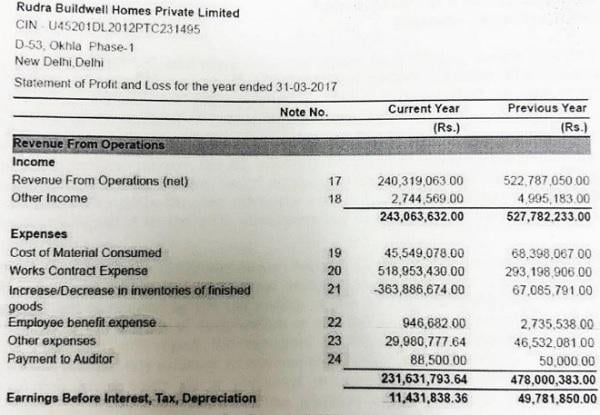
7.9 Based on POCM, the total cost of the project was Rs. 6,02,29,00,000, and cost incurred till date was Rs. 2,33,08,16,514, representing 38.70% completion. Total saleable area was 21,43,394 sq. ft., of which 7,03,227 sq. ft. was sold, with an expected sales realization of Rs. 2,10,37,96,149. Accordingly, revenue to be recognized till date was Rs. 81,41,53,117 (i.e., 38.70% of total expected realization), out of which Rs. 52,27,87,050 was recognized in FY 2015-16 and Rs. 24,03,19,063 in FY 2016-17.The screenshot of the revenue recognised is as under:
7.10 The revenue recognized for FY 2017-18, therefore, correctly stood at Rs. 5,10,47,004, fully in line with the PoCM and accounting standards. The assessee has maintained complete and audited books of accounts as per Section 44AB, and no discrepancies have been reported in the audit under Form 3CD.
7.11 The differential figure between STR and ITR arises purely due to difference in the basis of recognition-STR recognizes turnover on receipt basis for service tax applicability), while the books recognize income as per PoCM under the mercantile system.
7.12 Under the erstwhile Chapter V of the Finance Act, 1994, service tax was applicable on advances received, even if the service was yet to be rendered or possession not given, thereby inflating the STR turnover figure.Under the Income Tax Act, 1961, Section 145(1) permits computation of income in accordance with the method of accounting regularly followed by the assessee, which in this case POCM.
7.13 The ICAI’s Guidance Note on Accounting for Real Estate Transactions (Revised 2012) mandates that revenue must be recognized only when the conditions of revenue recognition are fulfilled, including substantial completion and transfer of significant risks and rewards.The AO failed to appreciate the applicable accounting standards, and made the addition without referring to the assessee’s accounting policy, disclosures in the financials, or supporting documents like customer ledgers and bank statements.
7.14 The entire difference is attributable to timing differences and accounting basis, and cannot be treated as unaccounted income unless it is proved to be bogus or unexplained.The AO failed to carry out any verification or inquiry to examine whether the receipts were indeed advances or whether they had culminated in revenue through completed sales.There is no finding or allegation of suppression, falsification, or manipulation of accounts, and no defect has been pointed out in the regularly followed accounting method.
7.15 It is a settled legal principle, as held by the Hon’ble Supreme Court in CIT v. Excel Industries Ltd. (2013) 358 ITR 295 (SC), that income must be realand not hypothetical, and mere advances cannot be treated as taxable income z. That the AO acted in a mechanical manner and treated the entire STR turnover as taxable income, without applying his mind to the nature of real estate business or the established accounting and taxation principles.
7.16 Even assuming without admitting that a portion of the advance might be attributable to income, the AO was duty-bound to determine what portion had actually accrued as income based on project status, which he failed to do.The assessee’s financials disclose advances received, and these figures match the amounts reported in the STR, demonstrating consistency and transparency in reporting.
7.17 The Tax Audit Report under Form 3CD clearly sets out the accounting policies followed, including revenue recognition method, which has not been questioned or rejected by the tax auditor or AO. In absence of rejection of books, absence of any finding of suppression or concealment, and full disclosure in the financials and audit report, the impugned addition is entirely unjustified. The AO has not brought any evidence or adverse material on record to justify the addition, and has acted solely on a perceived mismatch without understanding the underlying accounting treatment. The addition of Rs.10,63,68,619/- is thus contrary to law, factually incorrect, unsupported by evidence, and deserves to be deleted in full.
4. As far as ground no Ground 3 is alleging that no project-wise working or stage-wise completion details were furnished and that the learned CIT(A) merely relied upon the appellant’s internal working. However, ld. AR demonstrated that the appellant had duly furnished the complete project-wise working for the relevant assessment year, which forms part of the audited financial statements and audit report. The same is available at page 199 of the Paper Book, while the relevant extracts as relied by the CIT(A) are also placed at pages 113, 123 and 124 of the Paper Book. Thus, the finding that no project-wise working was furnished is demonstrably erroneous.
5. We find no reason to interfere the aforesaid findings and accordingly grounds No. 1 to 3 raised by revenue in quantum appeal are sustained and no substance is left in the appeal against the penalty levied u/s 270A of the Act. The appeals of revenue are accordingly dismissed.
Order pronounced in the open court on 31.08.2026