Samaj Sahyogi Sanstha Vs ITO (ITAT Jaipur)
A Blank Column, a ₹59,870 Demand: ITAT Restores Society’s Basic Exemption
Small Income, Substantial Tax Demand
The Jaipur Tribunal allowed the appeal of a registered society whose income of ₹1,71,260 had been taxed at the maximum marginal rate, despite its claim to the ₹3 lakh basic exemption limit under section 115BAC.
The Centralised Processing Centre accepted the returned income but denied the basic exemption, resulting in a demand of ₹59,870, including interest of ₹5,901.
The Tribunal found that neither the CPC nor the first appellate authority had explained why the society was ineligible for the claimed basic exemption. It directed the CPC to grant that benefit, holding that no tax was payable on the returned income in this case.
Society Files Return as an AOP
Samaj Sahyogi Sanstha was registered under the Rajasthan Societies Registration Act, 1958. Its stated objects included promoting education, providing relief to the poor, rendering medical aid, protecting the environment and assisting persons in need.
The society filed its return under the status of Association of Persons, declaring total income of ₹1,71,260. It claimed that this income fell below the ₹3 lakh basic exemption limit under the new tax regime.
While processing the return under section 143(1), the CPC accepted the income figure. The dispute therefore concerned the tax treatment of the accepted income, rather than any addition to it.
CIT(A) Treats Unfilled Fields as Indeterminate Shares
The first appellate authority upheld the CPC’s action on the ground that the society had not completed certain return fields relating to its members’ shares.
Specifically, the society had not selected “Yes” or “No” against the question asking whether the beneficiaries’ shares were determinate or known.
From this omission, the appellate authority concluded that the members’ shares were indeterminate or unknown. Referring to section 167B, it held that the income should consequently be taxed at the maximum marginal rate.
The society challenged this approach, contending that its status as an AOP did not, by itself, justify denying the basic exemption or applying the maximum marginal rate.
Its grounds also relied on CBDT Circular No. 320 dated 11 January 1982, concerning certain societies, associations and trusts whose members or trustees have no entitlement to a share in their income.
Identical Returns Receive Different Treatment
Before the Tribunal, the society produced copies of its returns for AYs 2023-24, 2024-25 and 2025-26.
It submitted that the relevant particulars had been filled in identically across these years. The members’ details were disclosed, while the field concerning whether their shares were determinate or known had been left unanswered.
Nevertheless, the CPC had granted the basic exemption in both the preceding and succeeding assessment years. Only AY 2024-25 had attracted taxation at the maximum marginal rate.
The Tribunal recorded that the society had established this factual position through the returns placed before it. The Departmental Representative could not controvert it. viewOrder-22-1
Eligibility for Exemption Was Left Unanswered
The Tribunal identified two questions requiring consideration: whether the society was entitled to the basic exemption under section 115BAC and, if that benefit was unavailable, whether its income should be taxed at the maximum marginal rate.
It found that the first appellate authority had not addressed the basic-exemption claim at all. Its reasoning dealt only with the tax rate, based on the unfilled return fields and section 167B.
The Tribunal also examined the CPC intimation reproduced in the appellate order. The return details expressly recorded that the society had not opted out of the new tax regime under section 115BAC(6). The reproduced CPC intimation on page 7 of the order also visually records the demand of ₹59,870 and the taxation option under the new tax regime. viewOrder-22-1
Thus, the CPC’s own processing record recognised the society’s position under the new regime, yet no reason had been given for denying its claimed basic exemption.
Tribunal Directs CPC to Grant Relief
The Tribunal held that denying the benefit for the disputed year, when it had been granted on identical facts in the surrounding years, without assigning any reason, was grossly unjustified.
It concluded that the denial of the basic exemption was incorrect and directed the CPC to allow it. viewOrder-22-1
Since the accepted income of ₹1,71,260 was below ₹3 lakh, no tax remained payable under the Tribunal’s conclusion. The society’s appeal was accordingly allowed. viewOrder-22-1
Author’s Comments
This decision highlights the importance of distinguishing an unanswered return field from a reasoned finding on the assessee’s tax entitlement. Here, the appellate authority moved from an unfilled field to maximum marginal taxation without examining the society’s specific claim under section 115BAC.
The surrounding years’ returns were particularly useful evidence. They demonstrated that the CPC had treated identical disclosures differently, and the Revenue offered no explanation for that difference.
The ruling should, however, be read within its factual setting. The Tribunal did not undertake a detailed examination of CBDT Circular No. 320 or comprehensively resolve the interaction between sections 167B and 115BAC. Its operative reasoning centred on the unexplained denial of the basic exemption, the recorded new-regime position and consistent treatment in the other years.
For practitioners, the useful lesson is to place the return particulars, processing intimation and comparable years’ treatment together before the appellate authority. In this case, that evidence secured complete relief from the disputed demand.
FULL TEXT OF THE ORDER OF ITAT JAIPUR
The present appeal has been filed by the assessee against the order passed by the Office of the Commissioner of Income Tax, Appeal Addl/JCIT(A), Kochi (hereinafter referred to as “Ld. CIT(A)”), dated 26.11.2025 u/s 250 of the Income Tax Act, 1961 (hereinafter referred to as “the Act”).
2. The grounds raised by the assessee read as under:-
1. The learned Commissioner of Income Tax (Appeals) CIT(A) / National Faceless Appeal Centre has erred in law and on facts in upholding the action of the CPC /Assessing Officer in invoking Section 167B of the Income-tax Act, 1961, denying the Rate (MMR), despite the Appellants total income being below the basic exemption Marginal limit of Rs 3,00,000 under Section 115BAC of the Act.
2. The learned CIT(A) has erred in holding that the Appellant, being an Association of Persons (AOP), is liable to be taxed at MMR, instead of at the rates ordinarily applicable to individuals, AOPs, or bodies of individuals, thereby wrongly denying the benefit of the basic exemption limit.
3.. The learned CIT(A) has further erred in not following the binding CBDT Circular No. 320 F. No. 131(31)/81-TP (Pt.) dated 11.01.1982, which clarifies that in the case of registered societies, trade/professional associations, social or sports clubs, charitable or religious trusts, where members or trustees are not entitled to any share in the income of the AOP, tax is payable at the rates ordinarily applicable to an AOP and not at MMR.
4. The learned CIT(A) has also erred in ignoring the legislative intent of the Income-tax Act, which requires a liberal and pragmatic interpretation of provisions so that technical or procedural errors do not deprive an assessee of a legitimate claim of deduction or exemption, particularly in light of CBDT Circular No. 14 (XL-35) dated 11.04.1955.
5. As a result of the above errors, the levy of tax and interest amounting to Rs 59,870 is illegal, arbitrary, and unsustainable in law, and the impugned order is liable to be set aside.
6. The Appellant reserves the right to add, amend, modify, or withdraw any of the above grounds at the time of hearing.
3. Brief facts relating to the case are that the assessee is a registered society and had filed its return of income declaring total income of Rs.1,71,260/- under the status of Association of Persons (AOP). The assessee had claimed the benefit of basic limit of income not chargeable to tax, as the total income was below Rs.3,00,000/- under the new tax regime in terms of Section 115BAC of the Act. The return was processed u/s 143(1) of the Act and intimation issued by CPC accepting the income of Rs.1,71,260/-. However, the CPC did not allow the claim of basic limit of income not chargeable to tax and computed the tax liability applying Maximum Marginal Rate (MMR), determining the tax liability of the assessee of Rs.59,870/- (including interest of Rs.5,901/-)
4. The assessee carried the matter in appeal before Ld. CIT(A) contending that being an AOP it was eligible for basic exemption and no tax was to be levied at MMR. The Ld. CIT(A) however rejected the contention of the assessee noting that in the return of income filed by the assessee it had failed to fill all relevant columns and therefore, he concluded, that the shares of members were indeterminate and unknown; that accordingly therefore tax was to be levied at MMR. He further noted that the assessee had not filled up “Yes” or “No” in the columns whether the shares of the members are indeterminate or unknown. Ld. CIT(A) referred to the provisions of Section 167B of the Act for holding that where shares of members are indeterminate the taxes to be levied at MMR.
5. Before me, Ld. Counsel for the assessee contended that the assessee was a society registered under The Rajasthan Societies Registration Act 1958 incorporated with main object of promoting education, providing relief to the poor and was rendering medical aid, protecting environment and providing assistance to persons in need. That it had filed its return of income for AY 2023-24 to 2025-26 selecting its status was AOP/BOI and sub-status as Society registered under Societies Registration Act 1860.
6. Ld. Counsel for the assessee contended that identically filed return of income of the assessee for AY 2023-24 and AY 2025-26 was processed by the CPC processed the return giving the benefit of basic exemption limit however for the impugned year AY 2024-25 the basic exemption limit was denied without giving any reasonand tax levied at the MMR.
7. He contended that in the return of income filed for those years, the columns were filed identically as in the present year listing the details of members of the assessee society AOP and without mentioning the share of beneficiaries as determinate or known, in point No. (E) of the return. He drew my attention to the said facts mentioned in the ITR filed by the assessee for AY 2023-24 at paper book page No.8, for AY 2024-25 at paper book page No.17 and for AY 2025-26 at paper book page No.26. He contended that the CPC in identical facts and circumstances had allowed assessee’s claim of basic exemption and had not levied any tax on its income leave alone applying MMR on the same.
8. He contended therefore that the Ld. CIT(A) had erred in confirming the intimation made by the CPC u/s 143(1) of the Act by denying the assessee basic exemption claimed as AOP and by levying tax at MMR on the assessee.
9. Ld. DR however, supported the order of the Ld. CIT(A).
10. I have heard the rival contention. The short issue for consideration before me is whether the CPC had rightly denied the assessee the benefit of basic exemption and thereafter levied tax at the MMR on its income. The assessee’s contention is that in identical facts and circumstances, the CPC has allowed the assessee the benefit of basic exemption and levied no tax on the assessee. Copies of return of income for the preceding and succeeding years were filed before me, and said facts duly established before me.
11. Ld. DR was unable to controvert the said fact.
12. The basic exemption has been claimed by the assessee u/s 115BAC of the Act which is a beneficial provision enhancing basic limit of income not liable to tax and prescribing different slab rates for taxation to assesses who fulfil conditions specified under sub section (2) of the said section 115BAC of the Act, of primarily not claiming any exemption or deduction while computing total income chargeable to tax. The purpose of introducing section 115BAC on the statute being to simply taxation by doing away with all exemption and deductions for computing total income and in turn subsidizing the levy of tax by prescribing separate slab rates of taxation, as opposed to those applicable to assesses not opting for returning income as per section 115BAC of the Act but as per the old regime of availing exemptions and deductions.
13. The contention of the Ld. Counsel for the assessee was that it had opted for paying taxes as per 115BAC of the Act and its income fell well within the limit specified under the said section for not paying any taxes.
14. The Ld. CIT(A)’s entire case for taxing assesses income at MMR rests on the fact that the assessee in the return of income did not fill the relevant columns revealing the fact whether the shares of the members were indeterminate and unknown or not and he has referred to the provisions of Section 167B of the Act for levying tax at the MMR.
His findings at para 6.3 of his order clearly reveal the aforesaid fact wherein he has categorically noted that while verifying the return of income filed by the assessee, he found that the assessee had failed to fill-in all the relevant columns in the return of income and the shares of members were indeterminate or unknown, and therefore the tax was to be levied at the MMR. He noted the assessee did not opt “Yes” or “No” in the column “whether shares of the beneficiary are determinate or known?” He has reproduced the relevant page of the return of income of the assessee at page 17 and thereafter, he reproduced the provisions of Section 167B of the Act for holding that where the shares of members of an AOP are indeterminate, the tax is to be charged at MMR.
15. I do not find any merit in the order of the Ld. CIT(A) for the reason that there were two issues for adjudication before him:-
- Whether the assessee was entitled to basic exemption in terms of Section 115BAC of the Act as pleaded by him.
- The other was that if the assessee was not entitled to basic exemption where tax was to be levied on his income at the MMR.
15.1 The Ld. CIT(A), Ihave noted has not dealt with the first issue at all. His findings are based only on the tax rate to be applicable on the assessee, which he has held to be a MMR applying Section 167B of the Act to the facts revealed / not revealed by the assessee in his return of income.
16. On going through the order of the Ld. CIT(A) itself, I have noted that at page 13 of his order, the Ld. CIT(A) has reproduced the intimation made on the assessee by the CPC u/s 143(1) of the Act wherein it is categorically mentioned in the Return Details regarding taxation option that the assessee has not opted out of the new tax regime as per Section 115BAC(6) of the Act. The relevant page of the Ld. CIT(A)s order recording the said fact is reproduced hereunder:-
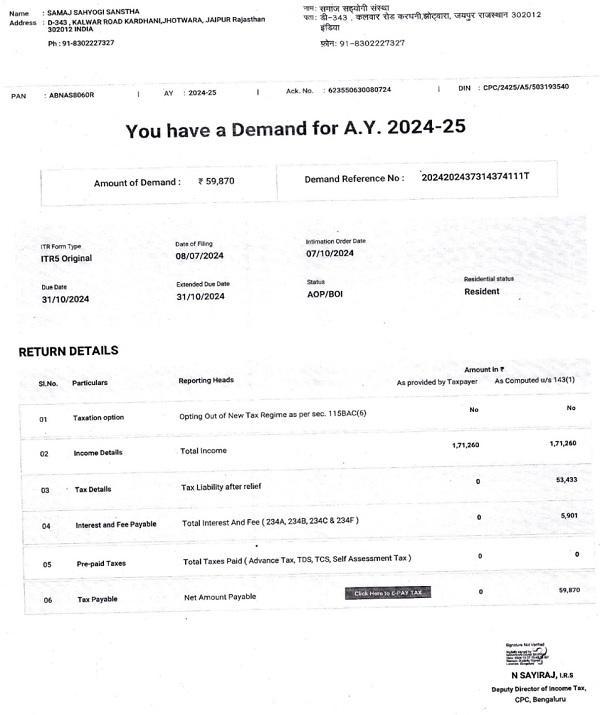
17. When the assessee had not opted out of the new tax regime as per the details fetched by the CPC itself from the return of income filed by the assessee, and no reason forthcoming from the department for denying the benefit of basic exemption to the assessee, I fail to understand why the assessee was denied the benefit of basic exemption to which it was allegedly eligible in terms of Section 115BAC of the Act. The Ld. CIT(A) has given no reasoning for the same.
18. Further admittedly this very benefit has been allowed to the assessee both in the preceding assessment year and the succeeding assessment year i.e. in AY 2023-24 and AY 2025-26, which fact was demonstrated by the Ld. Counsel for the assessee before us by filing copies of its return of income wherein details of 115BAC of the Act were identically filled by the assessee mentioning that it had not opted out of section 115BAC of the Act.
19. When in identical facts and circumstances the assessee has been granted benefit of basic exemption by the CPC, denying the said benefit in the impugned year, that too without assigning any reason, I hold, is grossly unjustified. The CPC clearly has erred in denying the benefit of basic exemption to the assessee in the impugned year. I accordingly hold that with no reason mentioned both by the AO and the Ld. CIT(A) for denying the assessee the benefit of basic exemption in terms of Section 115BAC of the Act the denial of the said benefit to the assessee was incorrect in law and I direct the CPC to allow the benefit to the assessee.
20. Having said so, there is no question of any tax being levied on the assessee since admittedly the assessee’s income was far below the exemption limit provided u/s 115BAC of the Act of Rs.3 lakhs, being Rs.1,71,260/-. Thus in fact, there is no taxable income for the assessee for the impugned year and therefore there was no question of tax being levied on the assessee.
21. In view of the same, I hold that the assessee is entitled to basic exemption limit u/s 115BAC of the Act as claimed in its return of income and direct the CPC to allow the same to the assessee.
22. In effect, appeal of the assessee is allowed.
Order pronounced in the open court on 06.10.2026.