Subhash Chand Vs ITO (ITAT Delhi)
The Income Tax Appellate Tribunal, Delhi, allowed the appeal filed by Subhash Chand against the order dated 18 November 2019 of the Commissioner of Income Tax (Appeals), Karnal, arising from the reassessment order dated 4 December 2018 under Sections 143(3)/147 of the Income Tax Act, 1961. The principal question was whether the Assessing Officer could initiate reassessment proceedings under Section 147 when rectification proceedings under Section 154 were already pending. The assessee also contended that the reassessment was based on a change of opinion.
During the hearing, the assessee challenged the reassessment through grounds 1 to 4 and raised an additional oral jurisdictional ground under Rule 27 of the ITAT Rules. Relying on Sanjay Sawhney Vs Pr. CIT, the Tribunal admitted the additional ground. The assessee relied upon the Supreme Court’s judgment in S.M. Overseas (P) Ltd. Vs CIT, in which reassessment proceedings initiated during the pendency of rectification proceedings were held impermissible in the circumstances of that case.
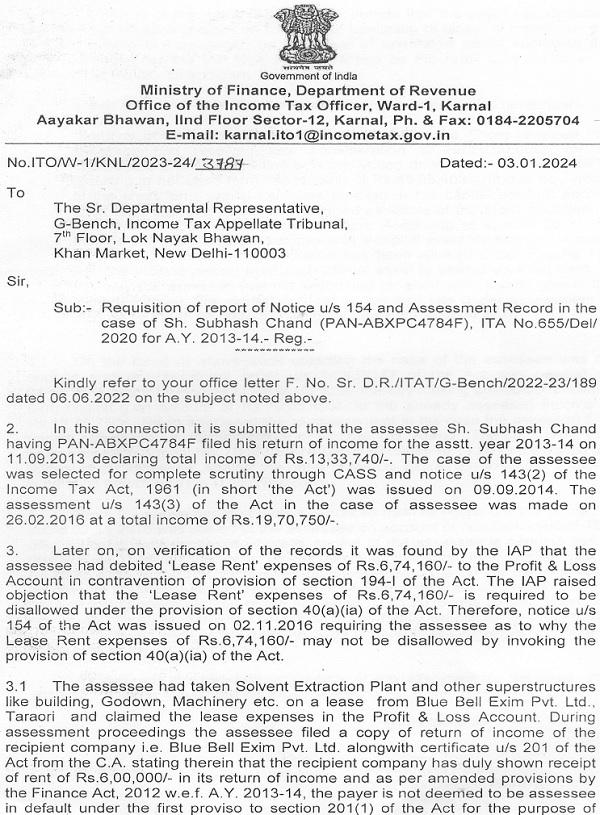
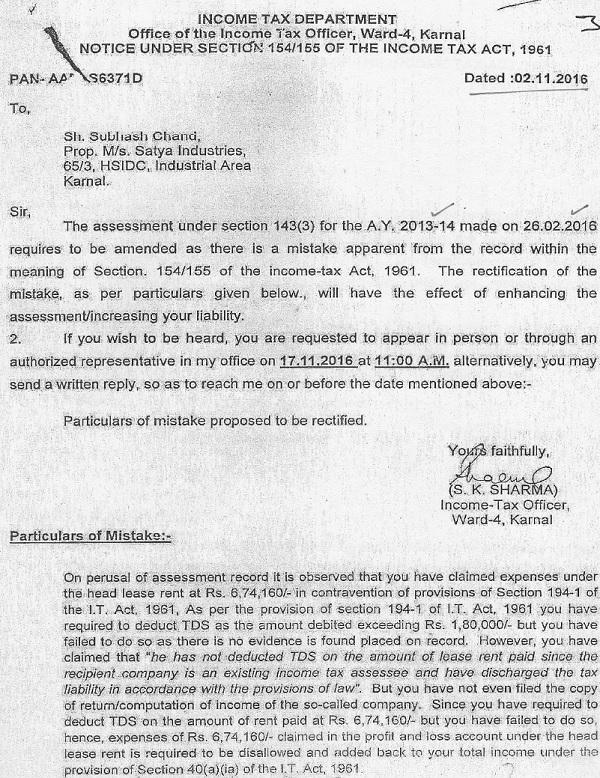
The Department argued that no rectification proceedings concerning the reopened issue remained pending. It relied on Section 154(8), contending that the time for passing a rectification order had expired. The Tribunal examined the notices dated 2 November 2016 and 12 January 2017 and observed that no corresponding disposal order was available on record. It rejected the Department’s reliance on Section 154(8), holding that the provision applied where an application had been moved by the assessee, which was not the situation in the present case.
The Tribunal further observed that the Assessing Officer was already aware of the disputed short-term capital gains transaction when the rectification notices were issued. Subsequent reopening on the same information amounted to reopening on stale material and a change of opinion. Accordingly, the Tribunal allowed grounds 1 to 4 and the additional ground, quashed the reassessment and allowed the assessee’s appeal. The order was pronounced on 18 June 2025.
Cases Discussed
- Sanjay Sawhney Vs Pr. CIT, ITA No. 834/2019, order dated 18.05.2020 (Delhi High Court) – Relied upon for admitting an oral additional ground under Rule 27 of the ITAT Rules.
- S.M. Overseas (P) Ltd. Vs CIT, (2022) 145 taxmann.com 375 (Supreme Court) – Followed regarding reassessment initiated during pending rectification proceedings under Section 154.
FULL TEXT OF THE ORDER OF ITAT DELHI
This appeal is preferred by the assessee against the order dated 18.11.2019 of the Ld. Commissioner of Income-tax (Appeals), Karnal
(hereinafter referred to as the Ld. First Appellate Authority or ‘the Ld. FAA’, for short) in Appeal No.IT/153/E/KNL/2018-19 arising out of the appeal before it against the order dated 04.12.2018 passed u/s 143(3)/147 of the Income Tax Act, 1961 (hereinafter referred as ‘the Act’) by the ITO, Ward-4, Karnal (hereinafter referred to as the Ld. AO).
2. At the time of hearing, the ld. counsel for the assessee has primarily argued on ground no. 1 to 4 raising legal question that the reassessment proceedings u/s 147 of the Act is bad as the same are based on change of opinion and also by way of an oral additional ground, by recourse to Rule 27 of the ITAT Rules, challenged the assumption of jurisdiction itself u/s 147 of the Act, as initiated during the pendency of rectification proceedings. Hon’ble Delhi High Court in the case of Sanjay Sawhney vs Pr. CIT vide ITA No.834/2019, order dated 18.05.2020 has held that the assessee can urge any ground by way of oral application under Rules 27 of the ITAT Rules. Accordingly same is admitted. Thus the issue in controversy primarily is that if at the time of reopening, the proceedings u/s 154 of the Act was pending, could the reopening have been done? The reliance has been placed by the ld. counsel on the judgement of the Hon’ble Supreme Court in the case of S.M. Overseas (P) Ltd. vs. CIT (2022) 145 taxmann.com 375 (SC) and we consider it relevant here to reproduce the said decision:-
“1. Feeling aggrieved and dissatisfied with the impugned judgment and orders dated 27.07.2010 passed by the High Court of Punjab and Haryana at Chandigarh in ITA No. 556 of 2009 as well as the subsequent order dated 29.09.2010 passed in Review Application No. 166-CII of 2010 dismissing the Review Application preferred by the assessee, the assessee has preferred the present Appeals.
2. The facts leading to the present Appeals in a nut shell are as under:-
3. The dispute is with respect to the A.Y. 1995-96. The Assessment Order came to be passed under Section 143(1) of the Income Tax Act (for short “the Act”). The assessee claimed the benefit under Section 80 HHC of the Act for the A.Y. 1995-96. However, in the subsequent A.Y., the assessee claimed the bad debt on the ground that, in the earlier year, the export was not materialized and therefore, the proceedings under Section 154 of the 23.01.2002. During the pendency of the said proceedings, the Department also initiated the proceedings under Section 147-148 of the Act and reopened the assessment for the A.Y. 1996-97. The Assessing Officer passed the Assessment Order. The same was carried before the ITAT. The ITAT quashed and set aside the assessment proceedings which were re- opened under Section 148 of the Act by holding that as the proceedings under Section 154 initiated against the assessee were pending, no re- opening proceedings under Section 147/148 of the Act could have been issued/initiated. Consequently, the ITAT quashed and set aside the Assessment Order for the A.Y. 1995-96. The order passed by the ITAT was the subject-matter of Appeal before the High Court. The High Court, by the impugned judgment and order, has allowed the said Appeal preferred by the Revenue and remanded the matter to the ITAT by observing that as the proceedings under Section 154 were beyond the period of limitation prescribed under Section 154(7) of the Act, the said notice was invalid and therefore, the re-opening proceedings under Section 147/148 would be maintainable. The review application preferred by the assessee has been dismissed. Hence the present Appeals.
4. Having heard learned counsel appearing on behalf of the respective parties and having gone through the impugned judgment and order passed by the High Court, we are of the opinion that the High Court has committed serious error in observing and holding that the notice under Section 154 was invalid as the same was beyond the period of limitation as prescribed/provided under Section 154(7) of the Act. It is required to be noted that the proceedings under Section 154 of the Act were not the subject-matter before the High Court. Nothing was on record that, in fact, the notice under Section 154 of the Act was withdrawn on the ground that the same was beyond the period of limitation prescribed under Section 154(7) of the Act. In the absence of any specific order of withdrawal of the proceedings under Section 154 of the Act, the proceedings initiated under Section 154 of the Act can be said to have been pending.
5. In that view of the matter, during the pendency of the proceedings under Section 154 of the Act, it was not permissible on the part of the Revenue to initiate the proceedings under Section 147/148 of the Act pending the proceedings under Section 154 of the Act. The High Court has erred in presuming and observing that the proceedings under Section 154 were invalid because the same were beyond the period of limitation.
6. In view of the above and for the reasons stated above, the impugned judgment and order passed by the High Court is unsustainable and the same deserves to be quashed and set aside. The impugned judgment and order passed by the High Court is hereby quashed and set aside. The order passed by the ITAT is hereby restored.
7. The present Appeals are accordingly allowed to the aforesaid extent. No costs.”
3. The ld. DR has not cited any law to the contrary and has relied a reportreceived from the AO and we considerit appropriate to reproduce the report contesting this point:-
–
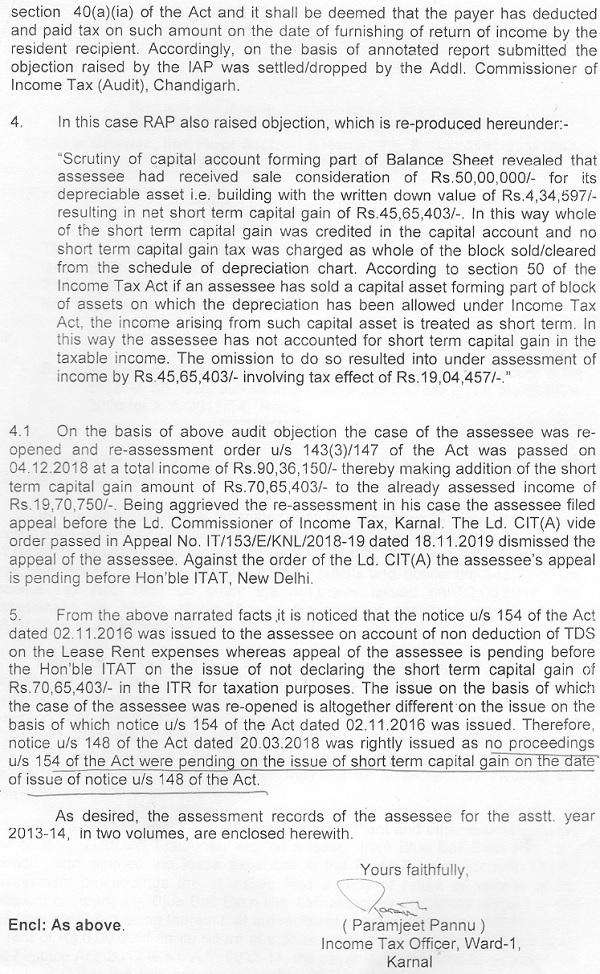
4. Thus, the case of the AO is that in regard to the issue which has been reopened, there was no rectification proceeding pending. The ld. DR has submitted that under the provisions of section 154(8) of the Act, the order u/s 154 of the Act was to be passed upto 31.07.2017 if the notice dated 12.01.2017 is considered to have been issued so it should be assumed no proceedings were otherwise pending. We find that earlier, by letter dated 04.06.2024, the AO had informed that notice dated 12.01.2017 is not found placed on record and, further, no order in response to notice u/s 154 dated 12.01.2017 is found on record.
5. The ld. counsel has placed in paper book copy of notice dated 02.11.2016 and 12.01.2017 issued by the AO u/s 154 of the Act at pages 33 and 34 of the paper book. In regard to the notice dated 02.11.2016, there is no dispute that the same was issued. However, in regard to notice dated 12.01.2017, copy of which is placed at page 34 of the paper book, there is no assertion of the AO as to if this notice was not issued at all.
6. At the same time there are two notices u/s 154 of the Act on record received by the assessee. As for convenience, we would like to reproduce both these notices dated 02.11.2016 and 12.01.2017:-
–
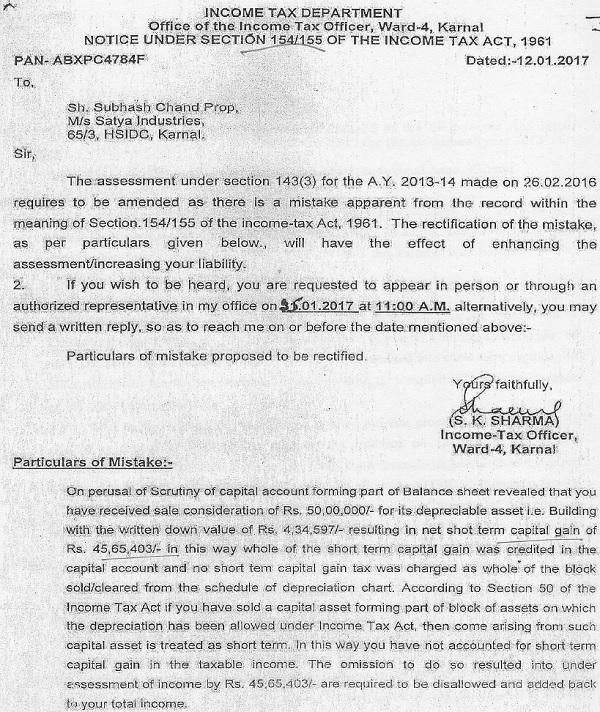
8. As far as application of provisions of section 154(8) of the Act is concerned, the same is applicable where the application is moved by an assessee which is not the case. Thus, the assertions of the ld. DR by relying provisions of section 154(8) of the Act do not come to the rescue.
9. In any case, when the material on record establish that AO was aware of the disputed transaction of short term capital gain for which notice was issued by way of rectification proceedings, and the proceedings are deemed to have been dropped then subsequent assumption of jurisdiction u/s 147 of the Act will certainly lead to reopening on stale information and just a change of opinion.
10. Thus we are inclined to allow the ground no. 1 to 4 and also the additional ground admitted by way of Rule 27 of ITAT Rules. The appeal of the assessee is allowed. The impugned reassessment is quashed.
Order pronounced in the open court on 18.06.2025.