
Grasim Industries Ltd. Vs ACIT (ITAT Mumbai)
Summary: The Income Tax Appellate Tribunal, Mumbai, considered four cross-appeals concerning Grasim Industries Ltd. and the Revenue for Assessment Years 2007-08 and 2008-09. The appeals arose from fringe benefit tax assessments and subsequent orders giving effect to earlier Tribunal decisions. The central dispute was the correct computation of interest on refunds under Section 244A of the Income-tax Act, 1961. The assessee challenged the manner in which refunds had been appropriated, while the Revenue disputed the entitlement to interest on self-assessment tax. The Tribunal pronounced its order on 11 November 2020.
The Tribunal noted that its earlier consolidated order dated 19 June 2013 had granted relief concerning the valuation of fringe benefits. However, while implementing that order for Assessment Years 2007-08 and 2008-09, the Assessing Officer had not granted the full period of interest claimed under Section 244A. The Commissioner (Appeals) subsequently directed that interest on advance tax should run from the first day of the relevant assessment year and interest on self-assessment tax from the date of payment, in each case up to the date of refund. The dispute nevertheless continued regarding the adjustment of refunds already issued.
The assessee argued that each refund must first be appropriated against the interest legally payable on the refund date, with the remaining amount adjusted against the tax principal. Where the refund was insufficient to discharge both components, the outstanding tax amount would continue to attract statutory interest. The Tribunal accepted this contention, following Union Bank of India v. ACIT, 162 ITD 142, and Bank of Baroda v. DCIT, ITA No. 646/Mum/2017. It clarified that this method did not amount to awarding interest on interest, because further interest would accrue only on the unpaid tax component.
The Tribunal accordingly directed the Assessing Officer to recompute interest due under Section 244A and adjust the refund first against that interest. Any remaining refund would then reduce the tax principal, and further statutory interest would be calculated on the outstanding tax amount until the relevant refund date. The assessee’s grounds were allowed for both assessment years. Since the principal argument succeeded, the Tribunal did not adjudicate the alternative argument advanced without prejudice.
In the Revenue’s appeals, the principal contention was that interest on self-assessment tax should not be allowed from the payment date because the assessee had allegedly failed to claim the refund in its original return. The Tribunal examined the notes accompanying the returns and observed that the assessee had disclosed that certain fringe benefit tax payments were made out of abundant caution. It therefore rejected the assertion that the delay was attributable to the assessee merely because the refund claim was not separately reflected in the manner suggested by the Revenue. The Tribunal found no basis to deny the statutory interest on that ground.
The Tribunal relied on the Bombay High Court decision in Stock Holding Corporation of India Ltd. v. CIT, 373 ITR 282, which recognised that excess self-assessment tax falls within Section 244A(1)(b) and attracts interest from the date of payment until the date of refund. It also followed the jurisdictional High Court’s decision in the assessee’s own case, Income Tax Appeal No. 1 of 2004, dated 13 June 2018. Applying these precedents, the Tribunal upheld the entitlement to interest on the refunded self-assessment tax and dismissed the Revenue’s substantive grounds.
The Tribunal further observed that the tax effect in the Revenue’s appeals for both assessment years was below the monetary limits prescribed by the CBDT for departmental appeals before the Tribunal. It therefore held that the Revenue’s appeals were liable to dismissal on that additional ground. In conclusion, both appeals filed by the assessee were allowed and both appeals filed by the Revenue were dismissed. The order establishes the treatment of partial tax refunds when interest is outstanding and reiterates the availability of Section 244A interest on excess self-assessment tax.
Cases Discussed
- Union Bank of India v. ACIT — 162 ITD 142, ITAT Mumbai, dated 11 August 2016.
- Bank of Baroda v. DCIT — ITA No. 646/Mum/2017, ITAT Mumbai, dated 20 December 2018.
- Stock Holding Corporation of India Ltd. v. CIT — 373 ITR 282, Bombay High Court.
- Grasim Industries Ltd. v. Income Tax Department — Income Tax Appeal No. 1 of 2004, Bombay High Court, dated 13 June 2018 (assessee’s own case, as cited in the order).
FULL TEXT OF THE ORDER OF ITAT MUMBAI
These cross appeals in ITA Nos.473/Mum/2016, 1121/Mum/2016, 474/Mum/2016 & 1120/Mum/2016 for A.Yrs.2008-09 & 2007-08 respectively arise out of the order by the ld. Commissioner of Income Tax (Appeals)-13 in appeal Nos. CIT(A)-13/ACIT-7(1)(1)/211/2015-16, CIT(A)-13/ACIT-7(1)(1)/212/2015-16, CIT(A)-12/ACIT-6(3)/28/2010-11 dated 11/12/2015 & 28/06/2011 respectively (ld. CIT(A) in short) against the order of assessment passed u/s.115 WE(3) r.w.s. 254 of the Income
Tax Act, 1961 & 115 WE(3) of the Act FBT (hereinafter referred to as Act) dated 02/12/2009 & 20/08/2010 respectively by the ld. Addl. Commissioner of Income Tax, Range-6(3), Mumbai (hereinafter referred to as ld. AO).
2. The only issue to be decided in the cross appeals for both the years is calculation of interest u/s.244A of the Act.
3. We have heard rival submissions and perused the materials available on record. We find that this Tribunal vide its common order for A.Yrs. 2006-07 and 2007-08 and 2008-09 dated 19/06/2013 had passed an order granting relief to the assessee with a direction to reduce certain items from the value of fringe benefits chargeable to tax. We find that subsequently the ld. AO on 14/08/2013 passed an order giving effect to the Tribunal’s order for A.Y.2006-07 wherein he correctly allowed interest on advance tax u/s.244A of the Act from the first day of the assessment year till the date of payment of refund as per law. Hence, there is absolutely no grievance left for the assessee for A.Y.2006-07 in this regard. However, the ld. AO on 16/09/2013 while passing order giving effect to the Tribunal’s order for A.Y.2007-08 and 2008-09, did not grant interest u/s.244A(1)(a) of the Act from first day of the assessment year till the date of receipt of the Tribunal order (i.e. 23/07/2013) and granted interest on advance tax only from the date of receipt of Tribunal order till passing of refund order. We find that the ld. AO in this order dated 06/09/2013 did not grant any interest on self-assessment tax paid by the assessee u/s.244A(1)(b) of the Act.
3.1. On appeal to the ld. CIT(A) for A.Ys.2007-08 and 2008-09, the ld. CIT(A) vide his order dated 11/12/2016 allowed interest u/s.244A of the Act on advance tax and self-assessment tax paid by the assessee from first day of assessment year and date of payment of self-assessment tax respectively for both the years till the date of grant of refund. However, we find that the ld. CIT(A) dismissed the assessee’s ground for allowing interest on the said amount for the period of delay on the alleged ground that it amounts to compensation by way of interest on interest.
4. Aggrieved by the aforesaid order of the ld. CIT(A), the assessee is in appeal before us seeking correct allowance of interest as per law u/s.244A of the Act and revenue is in appeal challenging the order of the ld. CIT(A) directing the ld. AO to grant interest on self-assessment tax u/s.244A(1)(b) of the Act.
5. It is pertinent to note that the revenue had not preferred any appeal before us challenging the direction of the ld. CIT(A) to grant interest on advance tax from first day of assessment year u/s.244A(1)(a) of the Act and hence, this matter has attained finality. For better appreciation of the facts on record, the following tabulation would be relevant:-
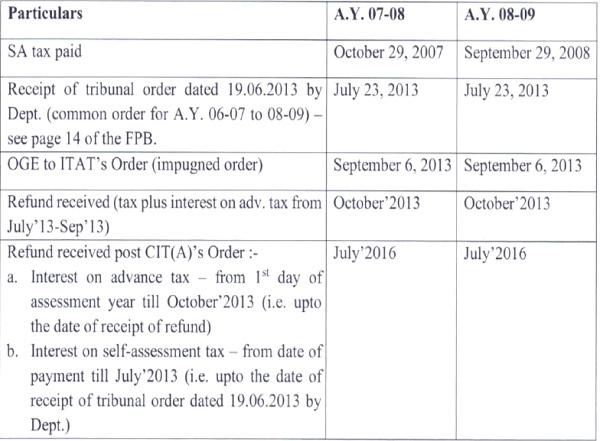
6. We find that assessee has raised ground before us stating that refund granted to the assessee is to be first adjusted against the correct amount of interest due on that date and thereafter, the left over portion should be a the instant case refund was granted to the assessee vide refund order in October 2013 and it was pleaded by the assessee that the said refund is to be adjusted against the correct amount of interest payable thereof to be computed as per the directions of the ld. CIT(A) and only the balance amount is to be adjusted against tax paid. Accordingly, unpaid amount is the tax component and therefore, the assessee would be entitled for claiming interest on the tax component remaining unpaid. In our considered opinion, the same would not tantamount to interest on interest as alleged by the ld. CIT(A) in para 4.2 on his order. Similarly, the refund granted to the assessee in July 2016 is to be adjusted against the correct interest payable on the tax amount remaining unpaid and balance towards tax component. We find that this issue is already settled in favour of the assessee by the following decisions of this Tribunal:-
a. Decision in the case of Union Bank of India vs. ACIT reported in 162 ITD 142 dated 11/08/2016
b. Decision in the case of Bank of Baroda vs. DCIT in ITA No.646/Mum/2017 dated 20/12/2018.
7. In view of our aforesaid decision in the facts and circumstnaces of the instant case and respectfully following the judicial precedents relied upon hereinabove, the alternative argument made by the ld. AR on without prejudice basis, need not be gone into and no opinion is given herein and they are left open.
8. Accordingly, we direct the ld. AO to compute the correct amount of interest allowable to the assessee as directed by the ld. CIT(A) as on the date of giving effect to the Tribunal’s order i.e.06/09/2013. We further hold that the refund granted on 06/09/2013 be first appropriated or adjusted against such correct amount of interest and consequently, the short fall of refund is to be regarded as shortfall of tax and that shortfall should then be considered for the purpose of computing further interest payable to the assessee u/s.244A of the Act till the date of grant of such refund. Accordingly, the grounds raised by the assessee in this regard are allowed for both the years.
9. As already stated, the revenue is in appeal only against the direction of the ld. CIT(A) to grant interest on self-assessment tax paid by the assessee u/s.244A(1)(b) of the Act. We find that the revenue had alleged that interest on self-assessment tax is not payable from the date of payment of tax till the date of receipt of refund as the delay is attributable to the assessee because assessee did not claim refund in the return of income. In this regard, we find that the ld. AR had submitted that delay is not at all attributable to the assessee and that the provisions of Section 244A(2) are not applicable as the assessee while filing its return for A.Yrs. 2007-08 and 2008-09 had indeed made a claim in the return of income by way of notes to the return of income and had also clarified in the said note that tax has been paid on certain fringe benefits only out of abundant caution. We find that this fact has even been noted by the ld. CIT(A) in para 3.3 of his order and also by the order of the Hon’ble Bombay High Court confirming the decision of this Tribunal in relation to fringe benefits wherein it has been mentioned at para 3(e), the assessee had filed such note. Hence, the notes forming part of the return should be read together with the return. Hence, it cannot be said that assessee never made such a claim of interest in the return of income for the respective years. Accordingly, no delay could be attributable on the part of the assessee in this regard. Hence, the grounds and the arguments advanced by the ld. AR in this regard deserves to be rejected.
10. We also find that the issue of assessee being entitled for interest on self-assessment tax from the date of payment of self-assessment tax till the date of actual payment of refund has been the subject matter of adjudication by the Hon’ble Jurisdictional High Court in the case of Stock Holding Corporation of India Ltd., vs. CIT reported in 373 ITR 282 wherein the head notes alone are reproduced hereunder:-
“Section 244A, read with sections 140A and 156, of the Income-tax Act, 1961 – Refunds -Interest on (Self assessment tax) – Assessment year 1994-95 – Whether tax paid on self assessment would fall under section 244A(1)(b), i.e. a residuary clause, covering refunds of amount not falling under section 244A(1) – Held, yes – Whether, therefore, interest is payable under section 244A(1)(b) on refund on excess amount paid on self assessment tax – Held, yes – Whether interest is payable from date of payment of tax on self assessment to date of refund of amount under section 244A – Held, yes [Paras 7, 8 and 12][In favour of assessee]”
11. Similar proposition was laid down by the Hon’ble Jurisdictional High Court in assessee’s own case in Income Tax Appeal No.1 of 2004 dated 13/06/2018.
12. Respectfully following the aforesaid decisions of Hon’ble Jurisdictional High Court, we hold that the grounds raised by the revenue are completely devoid on merits and are hereby dismissed.
13. We also find that the tax effect involved in the revenue appeals for A.Ys.2007-08 and 2008-09 are less than the monetary limits prescribed by CBDT for preferring appeals before this Tribunal by the revenue and hence, deserves to be dismissed on that ground also.
14. In the result, both the appeals of the assessee are allowed and both the appeals of the revenue are dismissed.
Order pronounced on 11/11/2020 by way of proper mentioning in the notice board.




