Sagarmal Mall Vs DCIT (ITAT Kolkata)
Assessment by DCIT Invalid Where Returned Income Placed the Case Within ITO’s Pecuniary Jurisdiction
Background
The assessee challenged a scrutiny assessment on the ground that it had been completed by an officer who lacked pecuniary jurisdiction under CBDT Instruction No. 1/2011 dated 31 January 2011.
The assessment order was passed by the DCIT, Circle-32, Kolkata. However, the assessee’s returned income for AY 2013-14 was ₹19,80,100, placing the case within the monetary limit assigned to an Income Tax Officer for non-corporate assessees in metropolitan charges.
Before examining the jurisdictional issue, the Tribunal condoned a 16-day delay in filing the appeal, after considering the assessee’s affidavit.
Incorrect Income Figure in the Assessment Order
The assessment order recorded that the assessee had filed a return on 9 October 2010, declaring income of ₹89,00,420. The assessee produced the acknowledgement for AY 2013-14 to demonstrate that the actual returned income was ₹19,80,100.
The Tribunal accepted the acknowledgement. It noted that the date and income recorded in the assessment order did not correspond with the assessment year under consideration and treated the recital as a mistake.
This factual correction was decisive because the jurisdictional allocation depended on the income declared in the relevant return, rather than the erroneous figure appearing in the assessment order.
CBDT’s Allocation of Pecuniary Jurisdiction
The Tribunal examined CBDT Instruction No. 1/2011, which allocated cases between ITOs and ACITs/DCITs according to returned income, the category of assessee and the location of the charge.
For non-corporate returns in metropolitan cities, including Kolkata, cases with declared income up to ₹20 lakh were assigned to ITOs. Cases above that limit were assigned to ACITs/DCITs.
Since the assessee’s returned income was ₹19,80,100, the Tribunal held that the DCIT did not possess jurisdiction to complete the assessment in the circumstances before it.
Although one paragraph of the order refers to “corporate returns”, the appellant is an individual, and the ₹20 lakh metropolitan threshold applicable to non-corporate returns corresponds with the instruction reproduced in the order.
Jurisdictional Ground Entertained Before the Tribunal
The Revenue objected that the assessee had not raised this issue before the lower authorities.
The Tribunal nevertheless took up the ground first because it was a legal challenge to the very jurisdiction of the officer passing the assessment order. The relevant returned-income figure was established through the return acknowledgement.
The decision therefore recognises that, in the circumstances considered, the absence of an earlier objection did not prevent examination of the alleged inherent jurisdictional defect.
Reliance on Coordinate Bench and High Court Decisions
The Tribunal relied on R A Realtors Pvt. Ltd. v. ITO, ITA No. 2275/Kol/2025, dated 19 January 2026, which had discussed the decision in Raghvendra Mohta v. ACIT, ITA No. 2416/KOL/2017.
In Raghvendra Mohta, the Tribunal held that an ACIT could not assume jurisdiction over a case assigned to an ITO under the CBDT’s monetary allocation merely because the ACIT was a higher-ranking officer.
The reasoning examined section 120, under which income-tax authorities exercise their powers according to the relevant directions and assignments. A higher rank does not automatically establish jurisdiction over every case allocated to a lower-ranking authority.
The present order also reproduced the Calcutta High Court’s dismissal of the Revenue’s appeal in Raghvendra Mohta, affirming the conclusion that the assessment suffered from lack of inherent jurisdiction.
Section 124 Objection Considered in the Precedent
The reproduced precedent addressed the Revenue’s argument concerning section 124(3) and the assessee’s failure to object within the prescribed period.
It distinguished the Supreme Court decision in DCIT v. Kalinga Institute of Industrial Technology on its facts and held that the pecuniary jurisdictional defect before it was not cured merely by the assessee’s participation in the proceedings.
The present Tribunal adopted that line of reasoning in allowing the jurisdictional challenge.
Decision
The Tribunal held that the assessment had been passed by the DCIT without jurisdiction under the applicable CBDT instruction. It accordingly set aside the assessment and allowed the appeal on the legal ground.
The substantive assessment issues were therefore not decided on their merits.
Author’s Comments
The first question in an assessment is whether the officer has authority to assess that particular case. This order illustrates how an incorrect recital of returned income can obscure a jurisdictional defect until the original return acknowledgement is examined.
The decision provides useful support for checking returned income, the applicable monetary allocation and the officer who issued the scrutiny notice and completed the assessment. A higher designation, by itself, does not answer a specific jurisdictional allocation.
At the same time, the conclusion must be applied to the governing directions and facts of the particular case, including any relevant assignment or concurrent-jurisdiction order. The ruling concerns the allocation applicable to this assessment; it should not be presented as a universal prohibition against a DCIT assessing an individual whose income is below ₹20 lakh.
Cases Discussed
- R A Realtors Pvt. Ltd. v. ITO, ITA No. 2275/Kol/2025, ITAT Kolkata, 19 January 2026 – followed for jurisdictional allocation.
- Rajroop Doshi v. ITO, ITA No. 1838/Kol/2025, ITAT Kolkata, 7 January 2026 – cited by assessee.
- Arjun Rishi v. ITO, [2025] 176 taxmann.com 720 (ITAT Delhi) – cited by assessee.
- PCIT v. Raghvendra Mohta, ITAT/51/2025 (Calcutta High Court) – affirmed the finding of inherent lack of jurisdiction.
- Rupasi Bangla Agro Industries Pvt. Ltd. v. ITO, ITA No. 909/Kol/2023, ITAT Kolkata, 14 December 2023 – followed in reproduced precedent.
- PCIT v. Shree Shoppers Ltd., ITAT/39/2023, Calcutta High Court – cited by assessee.
- Bhagyalaxmi Conclave (P) Ltd. v. DCIT, ITA No. 2517/Kol/2019, ITAT Kolkata, 3 February 2021 – relied upon in reproduced precedent.
- DCIT v. Kalinga Institute of Industrial Technology, (2023) 151 taxmann.com 434 (Supreme Court) – distinguished in reproduced precedent.
- ACIT v. Hotel Blue Moon, 321 ITR 362 (Supreme Court) – relied upon for a valid scrutiny notice.
- Raghvendra Mohta v. ACIT, ITA No. 2416/KOL/2017, ITAT Kolkata – followed; reasoning extensively reproduced.
FULL TEXT OF THE ORDER OF ITAT KOLKATA
This appeal filed by the assessee is directed against the order dated 16.10.2025 of the Office of the Commissioner of Income Tax, Appeal, Delhi passed under Section 143(3) of the Assessment Year 2013-14 of the Income- Tax Act, 1961 (hereinafter referred to as “the Act”).
2. At the very outset, it appears from the report of the Registry that the appeal has been filed by the assessee after a delay of 16 days. In support of the delay an affidavit has been filed by the assessee. Going over the contents of the affidavit delay is condoned.
3. At the time of the hearing the Ld. AR challenges the very impugned order by pressing his legal ground that the assessment order dated 29.02.2016 is bad in law in terms of instruction 1/11 as it has been passed by non-jurisdictional AO, DCIT 32(1) instead of ITO as the declared income is less than Rs. 20 lakhs. The Ld. AR filed the ITR acknowledgement of A.Y. 2013-14 in support of his declaration of total income as in the assessment order it has been wrongly mentioned amount at Rs. 89,00,420/-. He has also placed several decision of the Hon’ble Kolkata High Court?-
1. Pr. Commissioner of Income Tax-vs-Shree Shoppers Ltd. ITAT/39/2023; IT No. GA/1/2023 (Calcutta High Court)
2. R A Realtors Pvt. Ltd. –vs-ITO ITA No. 2275/Kol/2025 (Kolkata ITAT dated 19.01.2026)
3. Rajroop Doshi – vs- ITO ITA No. 1838/Kol/2025(Kolkata ITAT dated 07.01.2026)
4. Arjun Rishi –vs- Income-tax Officer [2025] 176 taxmann.com 720 (Delhi – Trib)
4. Contrary to that Ld. DR supports the impugned order by submitting that this issue has not been raised by the assessee before the lower authorities.
5. Since the assessee has raised legal issues challenges the very jurisdiction of the order passed by the DCIT we have taken this issue for adjudication first. Upon hearing the submission of the counsel of the respective parties and on perusal of the impugned order we find that assessment order has been passed by DCIT, Circle-32 Kolkata. The Ld. AR filed the ITR acknowledgement of 2013-14 which reflects the total income of the assessee atRs.19,80,100/- though assessment order reveals the total income of Rs. 89,00,420/-, apparently it is a mistake because the Assessing Officers in its assessment order has written thus:-“The assessee filed his return of income on 09.10.2010 showing total income of Rs. 89,00,420/-.” The present case relates to the Assessment Year 2013-14. So, we find substance in the arguments of the AR and also going over the ITR Acknowledgment that the total income of the assessee for the relevant A.Y. was Rs. 19,80,100/- i.e. below of Rs.20 lakhs.
5.1. We have gone through the CBDT Instruction No. 01/11 in which monitory limit to issuance of notice has been prescribed and the said instruction reads as under: –
5.2. On perusal of the above CBDT institution, we notice that in this case admittedly the assessee company had filed the return of income declaring
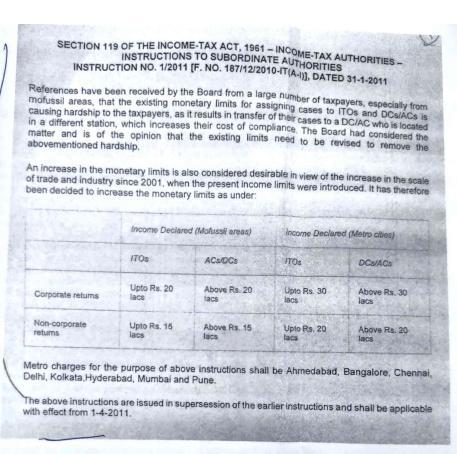
5.2 On perusal of the above CBDT institution, we notice that in this case admittedly the assessee company had filed the return of income declaring the total income of Rs. 19,80,100/- which is below the threshold limit of Rs. 20,00,000/-for the corporate returns.
5.3. We have gone through a decision passed by the Tribunal in the case R A Realtors Pvt. Ltd.(Supra) in which this issue has been elaborately dealt by following the order passed in Raghvendra Mohta which has been confirmed by the Hon’ble High court Kolkata. The relevant portion of the order passed in R A Realtors Pvt. Ltd is essential to reproduce here n below-
We have gone through the cited decision and find that order passed by the tribunalin the case of Raghvendra Mohta vs. ACIT in ITA No.2416/KOL/2017 defying the cited decision of Ld. DR passed in the case of M/s Kalinga Institute of Industrial Technology vs. DCIT (supra), and the decision of the Tribunal has further been confirmed by the Hon’ble Jurisdictional High Court Kolkata in ITAT/51/2025. It is important to reproduce the relevant portion of the order of the Tribunal and also the decision of the jurisdictional High Court which are as under:
5. We first take up the additional ground wherein it has been contended that Id. AO passing the assessment order did not have the jurisdiction over the case of the assessee and, therefore, both notice as well as the assessment order are bad in law. In this respect, Ld. Counsel for the assessee at the outset referred to para 1 of the impugned assessment order to point out the facts noted by the AO which are undisputed. Para 1 of the assessment order is reproduced for ease of reference. “1. The assessee, Shri Raghavendra Mohta, filed its return of income for the assessment year 2014-15 on 26.09.2014 disclosing a total income of Rs. Nil. The case has been selected for scrutiny assessment through “CASS’ and subsequently, notice u/s. 143(2) of the Act dated 31.08.2015 was issued and served upon the assessee on 10.09.2015. Thereafter, notice u/s. 142(1) of the Act dated 13.06.2016 along with questionnaire were issued and duly served upon the assessee.”
6. From the above, it is noted that return of income filed by the assessee is at Rs. Nil. Notice u/s. 143(2) has been issued and served on the assessee on 10.09.2015. Notice u/s. 142(1) dated 13.06.2016 along with questionnaire has also been issued and served on the assessee. The important fact Ld. Counsel asserted is that both, the notice as well as the assessment order has been issued by the Assistant Commissioner of Income Tax, Circle-36, Kolkata, who did not have jurisdiction over the assessee owing to the pecuniary jurisdiction mandated by CBDT in its Instruction No. 1/2011 (F. No. 187/12/2010-ITA-I) dated 31.01.2011. According to him, since the assessee has disclosed nil income, the jurisdiction for framing the assessment vide CBDT Instruction No. 1/2011 vests with the Income Tax Officer whereas the assessment order in question has been framed by the ACIT, therefore, assessment order is without jurisdiction and deserves to be quashed.
6.1. He further submitted that as per the settled proposition of law, issuing notice u/s. 143(2) by the concerned AO and competent authority is sine qua non to assume jurisdiction to frame assessment u/s. 143(3) of the Act. For this, he placed reliance on the decision of Hon’ble Supreme Court in the case of ACIT Vs. Hotel Bluemoon 321 ITR 362 (SC). In the present case of the assessee notice u/s 143(2) has been issued by Ld. ACIT who is not the AO having competent jurisdiction. Since the notice has been issued by a non- jurisdictional AO i.e. ACIT, the said notice issued by him does not have any legal sanctity.
7. Per contra, Ld. Sr. DR could not rebut the aforesaid legal proposition based on aforesaid factual aspect put forth by the Ld. Counsel for the assessee. The only assertion made by him was that the higher authority Le. ACIT had all the concurrent jurisdiction to exercise his powers which the Income Tax Officer has, who is an officer below the rank of ACIT. A written submission by the Ld. Sr. DR is also placed on record which deals with merit of the case only.
8. We have considered the rival contentions and gone through the records. Before proceeding further, it will be appropriate to refer to section 120 of the Act which, for the sake of ready reference, is reproduced as under:
“Jurisdiction of income-tax authorities
120.(1) Income tax authorities shall exercise all or any of the powers and perform all or any of the functions Conferred on, or, as the case may be, assigned to such authorities by or under this Act in accordance with such directions as the Board may issue for the exercise of the powers and performance of the functions by all or any of those authorities.
[Explanation.- For the removal of doubts, it is hereby declared that any income tax authority, being an authority higher in rank, may, if so directed by the Board, exercise the powers and perform the functions of the income-tax authority lower in rank and any such direction issued by the Board shall be deemed to be a direction issued under sub-section (1)].
(2) The directions of the Board under sub-section (1) may authorise any other income-tax authority to issue orders in writing for the exercise of the powers and performance of the functions by all or any of the other income tax authorities who are subordinate to it.
(3) In issuing the directions or orders referred to in sub- sections (1) and (2), the Board or other income tax authority authorised by it may have regard to any one or more of the following criteria, namely:-
(a) territorial area;
(b) persons or classes of persons;
(c) incomes or classes of income; and
(d) cases or classes of cases
8.1. A perusal of the aforesaid statutory provision would reveal that the jurisdiction of Income Tax Authorities may be fixed not only in respect of territorial area but also having regard to a person or classes of persons and income or classes of income. Therefore, CBDT having regard to the income as per return has fixed the jurisdiction of the Assessing Officers for class of cases with prescribed pecuniary limits based on income declared by the assessees.
8.2. The Id. Counsel in this respect has relied upon the CBDT Instruction No. 1/2011 (F.No. 187/12/2010-IT(A-I), for the sake of convenience is reproduced as under:
“Instruction No.1/2011 (F.No. 187/12/2010-IT(A-I), DATED 31-1-2011 References have been received by the Board from a large number of taxpayers, especially from mofussil areas, that the existing monetary limits for assigning cases to ITOs and DCs/ACs is causing hardship to the taxpayers, as it results in transfer of their cases to a DC/AC who is located in a different station, which increases their cost of compliance. The Board had considered the matter and is of the opinion that the existing limits need to be revised to remove the abovementioned hardship.
| Income Declared (Mofussil | areas) | Income declared (Metro cities) | ||
|---|---|---|---|---|
| ACs/DCs ITOs DCs/ACs | ||||
| Corporate returns | Upto Rs. 20 lcs | Above Rs. 20 lacs | Upto Rs. 30 lacs | Above Rs. 30 lacs |
| Non-corporate returns | Upto Rs. 15 lacs | Above Rs. 15 lacs | Upto Rs. 20 lacs | Above Rs. 20 lacs |
An increase in the monetary limits in also considered desirable in view of the increase in the scale of trade and industry since 2001, when the present income limits were introduced. It has therefore been decided to increase the monetary limits as under: Metro charges for the purpose of above instructions shall be Ahmedabad. Bangalore, Chennai, Delhi, Kolkata, Hyderabad Mumbai and Pune. The above instructions are issued in supersession of the earlier instructions and shall be applicable with effect from 1-4-2011.”
8.3. A perusal of the above provision of law along with the CBDT Instructions would show, in this case, the competent officer to proceed with the assessment byway of issue of notice u/ 143(2) of the Act was ITO, whereas, the notice u/s jurisdiction to issue the aforesaid notice. As has been held by the various courts 36. Kolkata who of the country including the Apex Court, the issuance of notice u/s 143/2) by the concerned Assessing Officer of a competent jurisdiction is mandatory to assume jurisdiction to proceed and frame assessment u/s 143(3) of the Act.
8.4. Identical issue came up for consideration before the Coordinate Bench of the Tribunal in the case of Bhagyalaxmi Conclave (P) Ltd. v. DCIT in IT Appeal No.2517/Kol/2019, dated 03-02-2021 wherein the Tribunal by further relying upon various other decisions of the Co-ordinate Benches of the Tribunal has decided the issue in favour of the assessee and held that when the notice u/s 143(2) was issued by an officer who did not have jurisdiction to proceed with the assessment and the assessment was framed by the other officer who did not issue the notice u/s 143(2) before proceeding to frame the assessment, then such an assessment order was bad in law.
9. On the above observations, the short issue which falls for consideration in the instant case is whether there is valid notice issued u/s. 143(2) of the Act in commencing the scrutiny assessment and thereafter framing the assessment order u/s. 143(3) of the Act. In this respect, it is not in dispute that on the date of selecting the case for scrutiny, the very basis for having jurisdiction over the assessee is the returned income which in the present case is less than the prescribed limit in CBDT Instruction no. 1/2011 and, therefore, the same lay with ITO. However, the notice u/s. 143(2) was issued by ACIT, Circle-36, Kolkata It is also a fact that subsequently the assessment has been framed by ACIT, Circle 36, Kolkata only. Since a valid notice u/s 143(2) has not been issued, the assessment proceeding carried thereafter can also not be held to be valid. We note that the assessment has been framed by the AO who is not having the prima facie jurisdiction to frame the impugned assessment, accordingly, the assessment is invalid. Case of the assessee finds support from the decision of Coordinate Bench of ITAT, Kolkata in the case of Rupasi Bangla Agro Industries Pvt. Ltd. Va ITO in ITA No. 909/Kol/2023 dated 14.12.2023.
10. Ld. DR has referred to the judgment of Hon’ble Supreme Court in the case of DCIT Vs. Kalinga Institute of Industrial Technology (2033) 151 taxmann.com 434 (SC) to contest that assessee did not raise objection in accordance with sec 124(3) within 30 days of issuance of service of notice u/s 143(2) and participated in the assessment proceedings. Therefore, he has no legal ground to challenge the assessment at this stage
10.1. On the contentions raised by the Id. Sr. DR on this aspect, we refer to section 124 of the Act which is extracted as under “Jurisdiction of Assessing Officers-
124. (1) Where by virtue of any direction or order issued under sub- section (1) or sub-section (2) of section 120, the Assessing Officer has been vested with jurisdiction over any area, within the limits of such area, he shall have jurisdiction-
(a) in respect of any person carrying on a business or profession, if the place at which he carries on his business or profession is situate within the area, or where his business or profession is carried on in more places than one, if the principal place of his business or profession is situate within the area, and
(b) in respect of any other person residing within the area.
(2) Where a question arises under this section as to whether an Assessing Officer has jurisdiction to assess any person, the question shall be determined by the Principal Director General or Director General or the (Principal Chief Commissioner or Chief Commissioner or the Principal Commissioner or Commissioner); or where the question is one relating to areas within the jurisdiction of different Principal Director General or Director General] or [Principal Chief Commissioner or Chief Commissioner/or Principal Commissioner or Commissioner), by the (Principal Director General or Director General) or (Principal Chief Commissioners or Chief Commissioners) or (Principal Commissioner or Commissioner concerned or, if they are not in agreement, by the Board or by such (Principal Director General or Director Generall or Principal Chief Commissioner or Chief Commissioner) or [Principal Commissioner or Commissioner) as the Board may, by notification in the Official Gazette, specify.
(3) No person shall be entitled to call in question the jurisdiction of an Assessing Officer-
(a) where he has made a return 1 [under sub-section (1) of section 115WD or under sub-section (1) of section 139), after the expiry of one month from the date on which he was served with a notice under sub-section (1) of section 142 or 2 (sub-section (2) of section 115WE or sub-section (2) of section 143) or after the completion of the assessment, whichever is earlier;
(b) where he has made no such return, after the expiry of the time allowed by the notice under 3 /sub-section (2) of section 115WD or sub-section (1) of section 142 or under sub-section (1) of section 115WH or under section 148 for the making of the return or by the notice under the first proviso to section 115WF or under the first proviso to section 144] to show cause why the assessment should not be completed to the best of the judgment of the Assessing Officer, whichever is earlier, 4 ((c) where an action has been taken under section 132 or section 132A, after the expiry of one month from the date on which he was served with a notice under sub-section (1) of section 153A or sub-section (2) of section 153C or after the completion of the assessment, whichever is earlier.)
(4) Subject to the provisions of sub-section (3), where an assessee calls in question the jurisdiction of an Assessing Officer, then the Assessing Officer shall, if not satisfied with the correctness of the claim, refer the matter for determination under sub-section (2) before the assessment is made.
(5) Notwithstanding anything contained in this section or in any direction or order issued under section 120, every Assessing Officer shall have all the powers conferred by or under this Act on an Assessing Officer in respect of the income accruing or arising or received within the area, if any, over which he has been vested with jurisdiction by virtue of the directions or orders issued under sub-section (1) or sub-section (2) of section 120.
11. From sub-section (1) of the aforesaid section, it is important to note that AO has to be vested with jurisdiction over any area as prescribed in clause (a) and (b) in sub-section (3), an assessee is not entitled to call for the jurisdiction of AO after the expiry of one month from the date on which it was served with a notice u/s. 143(2) Further, sub-section (5) states that every Assessing Officer shall have all the powers conferred by or under the Act on an Assessing Officer in respect of the income accruing or arising or received within the area over which he has been vested with jurisdiction by virtue of the directions or orders issued u/s. 120/1) and (2).
11.1. It is important to note that prima facie assumption of jurisdiction by the AO is to be first passed through the test prescribed in sub-section (1) In the case before us, the assessment has been framed u/s 143(3) by an AO whose jurisdiction is under challenge who at the threshold itself did not had the jurisdiction over the assessee for issuing notice u/s. 143(2) of the Act. In the present case, both the notice issued u/s. 143(2) and the assessment completed thereafter are by an officer who does not have jurisdiction in terms of CBDT Instruction no. 1/2011, owing to nil income return filed by the assessee.
12. It is noted by the Hon’ble Apex Court in the case of Kalinga Institute of Industrial Technology (supra) that jurisdiction changed after the returns were filed. Also, it noted that the High court had granted liberty to the concerned authority to issue appropriate notice. It further clarified that the Assessing Officer is free to complete the assessment if the assessment order is not issued.
12.1. On perusing the order of Hon’ble High court, it is noted that it did not express its opinion on the order of assessment and the demand u/s. 156. It dealt only with the issue of notice u/s. 143(2) for which also it was kept open for the competent authority to issue appropriate notice to the assessee as per law.
12.2. Facts in the case of Kalinga Institute of Industrial Technology (supra) are distinguishable from the facts of the present case as noted above.
13. Accordingly, we allow the additional ground raised by the assessee and hold that the assessment order framed in the case of the assessee is without jurisdiction and is a nullity. The impugned assessment order is hereby quashed since the AO Le. ACIT, Circle-36, Kolkata framed the said assessment did not have jurisdiction over the assessee as mandated by CBDT Instruction No. 1/2011. Since the additional ground has been allowed and the assessment order being quashed, the grounds on merits raised by the assessee in Form 36 are not adjudicated upon since they have been rendered academic in nature.
14. In the result, appeal of the assessee is allowed.
7.2 The Hon’ble Jurisdictional High Court has confirmed the above order observing as under on an appeal filed by the revenue:
We have heard Mr. Prithu Dudhoria, learned advocate for the appellant and Mr. Abhratosh Mazumder, learned senior counsel assisted by Mr. Aura Mazumder, learned advocate for the respondent.
The assessee preferred appeal before the learned Tribunal challenging the order passed by the Commissioner of Income Tax (Appeals)-10, Kolkata (CIT(A)] dated 26.9.2017. One of the grounds urged before the learned Tribunal was that the Assessing Officer, who passed the assessment order did not have jurisdiction over the case of the assessee and, therefore, the notice as well as the assessment order are bad in law. The learned Tribunal took note of the facts and circumstances of the case and found that the assessee filed its return of income declaring the income to be nil. Subsequently, notice under section 143(2) was issued on 10.9.2015 and notice under section 142(1) dated 13.6.2016 was issued along with the questionnaire. The assessee contended that the notices were without jurisdiction and relied upon section 120 of the Act. In this regard, the assessee referred to the notification issued by the CBDT in Instruction No.1 of 2011. The learned Tribunal took into consideration the facts of the case and found that the assessment has been framed by the Assessing Officer, who inherently lacks jurisdiction to do so.
The learned Tribunal took note of the decision of a Co-ordinate Bench of the learned Tribunal in the case of Bhagyalaxmi Conclave (P) Ltd. vs. DCIT dated 3.2.2021. Apart from other decisions and allowed the assessee’s appeal, the revenue had challenged the order passed in the case of Bhagyalaxmi Conclave (P) Ltd. before this court in ITAT/221/2022 etc. and by a judgment reported in 2022 (12) TMI 1514, the appeal filed by the department was dismissed wherein one of the questions framed is identical to the substantial questions of law suggested by the revenue in the instant case. Thus, we find that the learned Tribunal was right in allowing the assessee appeal and setting aside the order passed by the Assessing Officer on the ground of lack of inherent jurisdiction.
For the above reason, the appeal is dismissed and the substantial questions of law are answered against the revenue.
6. Admittedly in the present case, the total income of the assessee is at Rs. 19,80,100/-, assessment order was passed by the DCIT, Circle 32 Kolkata who have got no jurisdiction in view of the CBDT instructions as discussed above.
7. Keeping in view the discussion and considering the facts we do not have any hesitation to hold that the assessment order was passed by the officers who lacked jurisdiction accordingly set aside.
In the result, the appeal of the assessee has allowed on legal ground.
Kolkata, the 1st October, 2026.