Ibrahim Abdul Rashid Sheikh Vs Ward 42(1)(2) (ITAT Mumbai)
No Faceless Intimation, No Valid Assessment – Assessee’s Silence Cannot Cure the Department’s Procedural Default
Background
The assessee filed his return of income for Assessment Year 2018-19 declaring business and professional income of ₹4,75,422 and income from other sources of ₹2,64,070.
Based on information available with the Department, the Assessing Officer noticed that the assessee had purchased an immovable property at Borivali, Mumbai, for a consideration of ₹54 lakh, whereas its stamp-duty value was ₹73,95,277. The difference of ₹19,95,277 was proposed to be brought to tax.
As the assessee did not respond to the notices issued during the assessment proceedings, the Assessing Officer completed the assessment ex parte under section 144 read with section 144B and made an addition of ₹19,95,277, representing the difference between the stated purchase consideration and the stamp-duty value.
The assessee also failed to participate in the appellate proceedings. Consequently, the CIT(A) passed an ex parte order confirming the addition.
The assessee carried the matter before the Mumbai Tribunal.
Additional Legal Ground Before the Tribunal
Before the Tribunal, the assessee did not initially contest the merits of the addition. Instead, he raised an additional legal ground challenging the validity of the entire assessment.
It was contended that the National Faceless Assessment Centre had completed the assessment without issuing the mandatory intimation contemplated under the then applicable section 144B(1)(ii).
The provision required the National Faceless Assessment Centre to intimate the assessee that the assessment in his case would be completed in accordance with the procedure prescribed for faceless assessment.
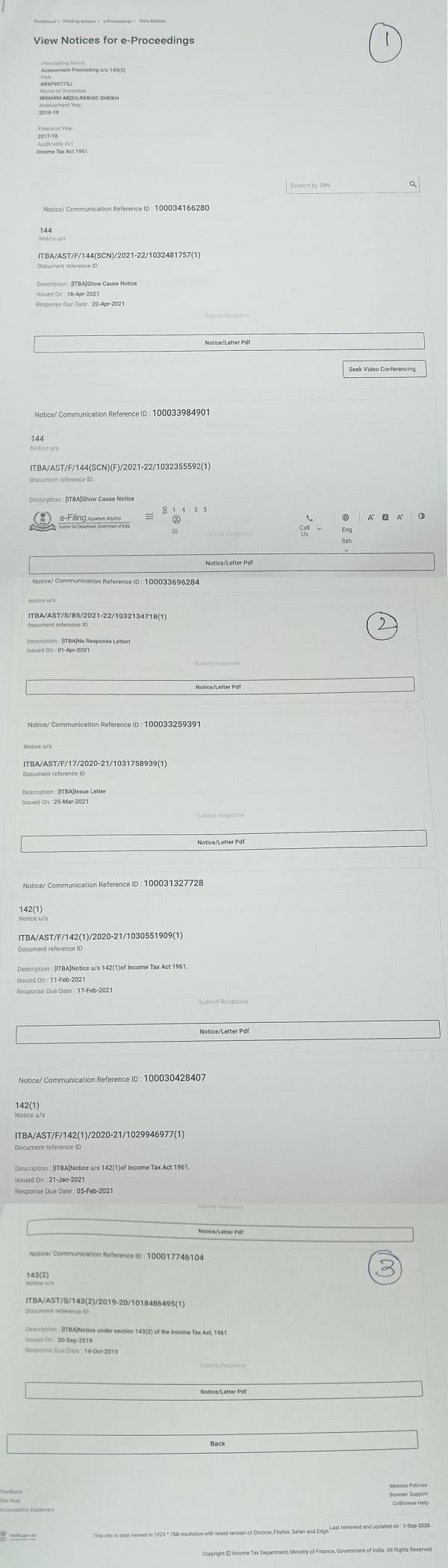
The assessee produced the chronology of the electronic proceedings downloaded from the Income-tax Department’s portal. According to him, the chronology did not disclose the issuance of any such intimation.
Since the additional ground involved a pure question of law going to the very validity of the assessment, the Tribunal admitted it for adjudication.
Revenue’s Contention
The Revenue contended that adequate opportunities had been provided to the assessee. Notices under section 142(1) were duly issued, but the assessee failed to comply with them.
It was also pointed out that the assessee remained non-compliant even before the CIT(A). Therefore, according to the Revenue, the assessee could not complain about violation of the prescribed procedure or the principles of natural justice.
The Revenue accordingly argued that the assessment and the addition deserved to be sustained.
Tribunal’s Findings
The Tribunal examined the chronology of electronic proceedings placed on record. It found that no intimation, as required under the then applicable section 144B(1)(ii), was discernible from the notices and communications appearing on the portal.
Even during the hearing, the Departmental Representative was unable to identify or produce any material establishing that the mandatory intimation had been issued to the assessee.
The Tribunal held that the assessee’s non-compliance with notices under section 142(1) could not cure the Department’s failure to comply with a mandatory step prescribed under the faceless assessment procedure.
The statutory obligation placed upon the National Faceless Assessment Centre was independent of the assessee’s obligation to respond to the notices. The assessee’s default could justify completion of a best-judgment assessment, but it could not authorise the Department to disregard the mandatory procedure laid down under section 144B.
Mandatory Procedure Cannot Be Bypassed
The Tribunal relied upon the decision of the Bombay High Court in Teerth Developers and Teerth Realties JV (AOP) v. ADIT, wherein it was held that the principles of natural justice are statutorily incorporated in section 144B. Non-compliance with its mandatory requirements renders the assessment illegal and unsustainable.
Reliance was also placed on Bekaert Mukand Wire Industries Private Limited v. ACIT, where the Bombay High Court held, with reference to the then prevailing section 144B(9), that an assessment not made in accordance with the prescribed faceless procedure would be non-est.
The Tribunal also referred to the Gujarat High Court’s decision in Gandhi Realty (India) Private Limited v. ACIT, which emphasised strict compliance with the statutory procedure governing electronic service and faceless assessments.
Following these decisions, the Tribunal held that, in the absence of proof of issuance of the mandatory intimation under section 144B(1)(ii), the assessment could not be sustained.
Assessment and Demand Quashed
The assessment order passed under section 144 read with section 144B was declared non-est and unsustainable in law.
Consequently, the order of the CIT(A), to the extent it sustained such assessment, was also set aside. The consequential demand arising out of the invalid assessment did not survive.
Since the entire assessment was annulled on the legal ground, the Tribunal did not adjudicate the merits of the addition of ₹19,95,277. Those grounds were treated as academic and kept open.
Authors’ Comments
This decision reinforces an important principle applicable to faceless assessments: the assessee’s procedural default does not excuse the Department’s statutory default.
An assessee’s failure to reply to notices may permit the Assessing Officer to proceed ex parte under section 144. However, an ex parte assessment must also be framed strictly in accordance with the procedure mandated by law. Section 144 cannot be used to bypass section 144B.
The Department’s argument that several opportunities had already been granted was therefore rightly rejected. Issuance of notices under section 142(1) and issuance of the specific intimation under section 144B(1)(ii) served different statutory purposes. Compliance with one requirement could not be treated as a substitute for compliance with the other.
The decision is particularly relevant to faceless assessments completed under the statutory framework then in force. However, its application must be examined with reference to the version of section 144B applicable on the date of the assessment order. The Tribunal’s conclusion rests upon the mandatory language of the then applicable provision and the legal consequences prescribed under the law prevailing at the relevant time.
The case also demonstrates the evidentiary importance of downloading and preserving the complete chronology of notices and communications from the income-tax portal. In a faceless assessment, the electronic trail is often the best evidence of whether the mandatory procedure was actually followed.
In short, an assessee may lose the opportunity to explain the merits by remaining absent, but the Revenue does not thereby acquire the liberty to disregard the statute.
Cases Discussed
- Teerth Developers and Teerth Realties JV (AOP) vs ADIT – Bombay High Court held that non-adherence to mandatory requirements of section 144B and principles of natural justice renders the assessment illegal.
- Bekaert Mukand Wire Industries Private Limited vs ACIT – Bombay High Court held that non-compliance with the then prevailing mandatory procedure under section 144B rendered the assessment non-est.
- Gandhi Realty (India) Private Limited versus ACIT – Gujarat High Court emphasised statutory compliance governing electronic service and faceless assessment.
FULL TEXT OF THE ORDER OF ITAT MUMBAI
The instant appeal of the assessee filed against the order of NFAC, Delhi [for brevity “Ld. CIT(A)”], order passed under Section 250 of the Income Tax Act, 1961 (for brevity ‘the Act’), for Assessment Year 2018-19, date of order 25.02.2025. The impugned order emanated from the order of the National e-Assessment Centre, Delhi (for brevity ‘Ld. AO’), order passed under Section 144 r.w.s. 144B of the Act, date of order 21.04.2021.
2. The brief facts of the case are that the assessee filed the return by declaring income from business and profession amounting to Rs. 4,75,422/- and income from other sources amounting to Rs. 2,64,070/-. As per the information received by the Ld. AO, the assessee had purchased an immovable property at Borivali Purva, Mumbai. The sale consideration paid by the assessee amounted to Rs. 54 lakhs, whereas the stamp duty value of the said immovable property was Rs. 73,95,277/-. The Ld. AO observed that the assessee had purchased the immovable property lesser than the stamp duty value, as a result the difference comes to Rs. 19,95,277/-. Accordingly, the Ld. AO passed an order exparte u/s. 144 of the Act and confirmed addition, the difference of agreement value and the stamp duty value amount to Rs. 19,95,277/-. The aggrieved assessee filed an appeal before the Ld. CIT(A). The Ld. CIT(A) upheld the addition and passed an ex-parte order. Being aggrieved, the assessee filed an appeal before us.
3. The Ld. AR argued on legal ground by challenging the jurisdiction of the Ld. AO for initiating the assessment without issuing notice u/s 144B(1)(ii) of the Act. The assessee filed an additional ground, which is reproduced as below:
“Additional Ground:
1. On the facts and circumstances of the case and in law, the assessment order passed by the Assessing Officer is grossly incorrect, invalid and bad in law, since, the same is passed by the Ld. AO (NFAC), without intimating the assessee that his case was to be completed under the Faceless Assessment Scheme. Thus, the order is passed without following the mandatory procedures laid down in said Faceless Assessment Scheme. Therefore, the order passed is grossly incorrect, invalid and bad in law.”
4. The Ld. AR conceded that both in appeal and in assessment proceedings the assessee had failed to comply the notices issued by the revenue authorities. But the Ld. AR had agitated only the legal issue related to the assessment order was passed without adhering to Section 144B(1)(ii) of the Act. The plain reading of the section 144B(1)(ii), as follows:
“144B. Faceless assessment
(1) xxxxxxxxxxx
(ii) The National Faceless Assessment Centre shall intimate the assessee that assessment in his case shall be completed in accordance with the procedure laid down under this Section.”
5. The Ld. AR submitted that the assessment proceedings under section 144B of the Act were initiated and the assessment order was passed by the Faceless Assessment Officer without duly intimating the assessee about the initiation of such proceedings. In support of this contention, the Ld. AR filed a chronology of the e-proceedings relating to the service of notices, as extracted from the Income Tax Department’s e-filing portal. The same is reproduced below:
6. The Ld. AR further argued that the Ld. AO did not recognize statutorily direction for the issuance of intimation to assessee in provision of Section 144B(1)(ii) of the Act. So non-adherence in the mandatory requirement of statutory provision and said principles as recognized by it would render the assessment order illegal and non-est. The Ld. AR respectfully relied on the order of Hon’ble Bombay High Court in case of Teerth Developers and Teerth Realties JV (AOP) vs ADIT reported in (2024) 169 Taxmann.com 94 (Bombay). The relevant paragraph number 15 to 18 is reproduced as below:
“15. We may also observe that the principles of natural justice are statutorily recognized in the provisions of Section 144B of the IT Act. Any non-adherenceto the mandatory requirement of the statutory provisions and such principles as recognized by it, would render assessment order patently illegal. The action of the respondents which is contrary to the mandate of the statutory provisions or in breach of the principlesof natural justice would be rendered illegal and invalid. It needs no elaboration that when an order under a statute is to be passed which would entail civil consequences, causing a prejudice to the person, against whom it is being passed, such order would be required to be passed in strict adherence to the principles of natural justice i.e. after issuance of a show cause notice and an opportunity of a hearing being granted. It is well settled that an order passed in breach of the principles of natural justice would be required to be held to be vitiated, non-est and a nullity. In the present case, the impugned assessment order is passed without issuance of a show cause notice and an opportunity of a hearing being granted to the petitioner. As noted above, Section 144B inheres the application of the principles of natural justice. For such reasons, the impugned order would be manifestly illegal and a nullity in the eyes of law.
16. In the light of the aforesaid discussion, in our opinion, this is a fit case, wherein the impugned order would deserve to be quashed and set aside, so that further appropriate procedure as recognized by law under the relevant provisions of the IT Act can now be followed and an appropriate assessment order in accordance with law passed.
17. The petition thus needs to be allowed. It is accordingly allowed in terms of prayer clauses (a) and (b).
18. Respondent no.1 shall take recourse to the procedure as mandated by law, to issue a show cause notice-cum-draft assessment order, to be served on the petitioner, and by following the due procedure under the provisions of the IT Act, pass an assessment order. All contentions of the parties in that regard are expressly kept open. Let this procedure be undertaken and completed within a period of three months from today.”
7. The Ld. AR further respectfully relied on the order of the Hon’ble Bombay High Court in the case of Bekaert Mukand Wire Industries Private Limited vs ACIT, Writ Petition No. 2153 of 2021, date of order 17.09.2021. The relevant para number 3 to 5 is reproduced as below:
“3. Mr. Pardiwala submitted that in the case of an eligible assessee the mandatory provisions provided under Clause (xxvii) to (xxxii) of sub-section (1) of Section 1448 of the said Act has to be strictly complied with. We agree with him. As held in SHL (India) Private Limited vs. Deputy Commissioner of Income Tax and others’ even provisions of Section 144C of the said Act are mandatory in nature. As we could understand from the affidavit-in-reply of one Bhushan Patil, DCIT, affirmed on 13th September, 2021, non compliance with these provisions have not been denied. What is stated is that the matter be remanded to the file of Assessing Officer for fresh adjudication.
4. Sub-section (9) of Section 144B provides that notwithstanding anything contained in any other provision of this Act, assessment made shall be non-est if such assessment is not made in accordance with the procedure laid down under Section 1448. It is an admitted position that the procedure laid down under Section 144B of the said Act has not been followed while passing the assessment order impugned in this Petition. Therefore, the assessment order dated 19th April, 2021 shall be non-est.
5. In the circumstances, the assessment order dated 19th April, 2021 impugned in this Petition is quashed and set aside. The consequential demand notice and penalty notice also dated 19th April, 2021 are also hereby quashed and set aside.”
8. The respectful reliance was also placed by the Ld. AR in the order of the Hon’ble Gujarat High Court in the case of Gandhi Realty (India) Private Limited versus ACIT reported in (2021) 133 taxmann.com 83 (Gujarat).The relevant paragraph number 13 to 20 is reproduced as below:
“13. It would be apt to refer to sub-sections (5) and (6) of section 144B, which provide that all communications among the assessment unit, review unit, verification unit or technical unit or with the assessee or any other person with respect to the information or documents or evidence or any other details, as may be necessary for the purposes of making a faceless assessment shall be through the National Faceless Assessment Centre and all communications between the National Faceless Assessment Centre and the assessee, or his authorised representative, or any other person shall be exchanged exclusively by electronic mode; and all internal communications between the National Faceless Assessment Centre, Regional Faceless Assessment Centres and various units shall be exchanged exclusively by electronic mode. The proviso would not be necessary to be discussed at this stage which concerns inquiry or verification conducted by the verification unit.
14. Sub-sections (7) of section 144B provides that for the purposes of faceless assessment an electronic record shall be authenticated by the National Faceless Assessment Centre by affixing its digital signature and by assessee or any other person, by affixing if required his digital signature if he is required under digital signature.
15. Sub-section (2) of section 114(B) says that every notice or order or any other electronic communication shall be delivered to the addressee, being the assessee, by way of placing an authenticated copy thereof in the assessee’s registered account; or by sending an authenticated copy thereof to the registered email address of the assessee or his authorised representative; or uploading an authenticated copy on the assessee’s Mobile App. Thus, there is specific requirement for service by electronic mode and in absence of placing before this Court any proof of virtual exchange or authenticated copy of service to the assessee, there is no reason for this Court to accept the version of the respondent about the service.
16. We are in total disagreement with the revenue that on account of issuance of notice u/s. 143(2) dated 22-9-2019 and opportunities provided earlier to the assessee, acceding to his request would be a mitigating circumstance so far as non-service of the Draft Assessment Order is concerned. The opportunity of furnishing the documents and hearing which has been given time and again and requests acceeded to by the authority to the assessee at that stage would not eventually culminate into furnishing of the final assessment order without service of prior notice along with draft assessment order, if any additions are made to the prejudice of the assessee.
17. It is a statutory requirement, as discussed hereinabove, more particularly when any assessment order is to be made which is likely to be prejudicial to the interest of the assessee. NFAC if would have served upon the assessee the draft assessment order, its presence on web portal would invariably there. In virtual regime, noticing of or presence or absence of trail of action is not a herculian task. Thus, in absence of any proof, the version of the respondent simply cannot be accepted. We could further notice from the documents which have been furnished by the petitioner that authenticated copy of notice/ order is not served to the petitioner when otherwise all other documents on the web portal of the income tax department are existing. We have sought assistance from the learned advocate of both the sides to point out to us due service of the draft assessment order, as has been claimed by the respondent, however, the said order dated 12-4-21 has been duly served to the petitioner, show cause notice which is claimed to have been issued along with the draft assessment order are surely missing. This being a simple case of statutory non-compliance of the provision, the same would amount to breach of not only principles of natural justice, but also, of the action in complete disregard to the statutory provision. And therefore, the order of the respondent passed without following the mandate given by the statute under section 144B of the Act deserves to be interfered with by quashing and setting aside the same.
18. In view of the foregoing reasons, we quash the impugned assessment order 20-4-2021 so also the notice of demand issued by the respondent authority and any other proceedings initiated pursuant to the said.
19. However, we direct that the respondent/revenue will be at liberty to proceed with the assessment process under the provisions of section 144B of the Act, as permissible under the law obviously after issuance of the prior notice-cum-draft assessment order and on availing an opportunity to the petitioner. The petitioner shall file response and the objection to the same. Opportunity of hearing if is sought for, the same shall be accorded including opportunity of personal hearing. Let the procedure under section 144B of the Act be followed by the revenue scruplously.
20. The petition is allowed and disposed of in above terms.”
9. The Ld. DR strongly relied upon the orders of the Revenue authorities and contended that sufficient opportunities had been afforded to the assessee during the assessment proceedings. The notice under section 142(1) of the Act was duly issued; however, the assessee failed to comply with the notices issued during the assessment proceedings. The Ld. DR further submitted that the assessee had also remained non-compliant during the appellate proceedings before the Ld. CIT(A). Accordingly, it was contended that the addition made by the Ld. AO and sustained by the Ld. CIT(A) deserved to be upheld.
10. We have heard the rival submissions and perused the material available on record. The assessment was completed ex parte under section 144 read with section 144B of the Act, resulting in an addition of Rs.19,95,277/-, being the difference between the consideration stated for purchase of the immovable property and its stamp duty value. The Ld. CIT(A) also passed an ex parte order sustaining the addition. The assessee, by way of an additional ground, has challenged the validity of the assessment on the specific plea that the mandatory intimation contemplated under the then applicable section 144B(1)(ii) of the Act was not issued before proceeding with the faceless assessment. The additional ground raises a pure legal issue going to the validity of the assessment proceedings and is, therefore, admitted for adjudication. The statutory provision, as reproduced in the record, required the National Faceless Assessment Centre to intimate the assessee that the assessment in his case would be completed in accordance with the procedure prescribed under section 144B.
11. We have also considered the chronology of e-proceedings placed on record by the Ld. AR, extracted from the Income Tax Department’s e-filing portal. On examination of the material placed before us, no intimation as contemplated under the then applicable section 144B(1)(ii) of the Act is discernible from the chronology of notices. The Ld. DR, though relying upon the assessee’s non-compliance with the notices issued under section 142(1), was unable to point out from the record any such statutory intimation issued to the assessee.
12. In this regard, the reliance placed by the Ld. AR on the judgment of the Hon’ble Bombay High Court in Teerth Developers and Teerth Realties JV (AOP) (supra) is relevant. The Hon’ble High Court observed that the principles of natural justice are statutorily recognised in section 144B and that non-adherence to the mandatory statutory requirements would vitiate the assessment. We further take note of Bekaert Mukand Wire Industries Private Limited (supra), wherein the Hon’ble Bombay High Court, while considering the then prevailing provisions of section 144B, held that non-compliance with the prescribed procedure rendered the assessment non-est. The decision of the Hon’ble Gujarat High Court in Gandhi Realty (India) Private Limited (supra), as reproduced in the record, similarly emphasises compliance with the statutory procedure governing electronic service and faceless assessment. The assessee’s failure to respond to other statutory notices cannot, by itself, cure the alleged non-compliance with a mandatory step prescribed for completion of a faceless assessment. In the absence of any material brought before us by the Revenue demonstrating issuance of the requisite intimation under the then applicable section 144B(1)(ii), the assessment cannot be sustained in the manner in which it has been framed.
13. Accordingly, following the aforesaid judicial precedents, the additional ground raised by the assessee is allowed and the assessment order passed under section 144 read with section 144B of the Act is held to be non-est and unsustainable in law. Consequently, the impugned order of the Ld. CIT(A), insofar as it sustains such assessment, cannot survive and is set aside. The consequential demand arising from the said assessment also does not survive. Since the assessment itself has been held to be non-est on the aforesaid legal ground, the remaining grounds relating to the merits of the addition have become academic and are, therefore, kept open.
14. In the result, the appeal of the assessee bearing ITA 7664/MUM/2026 is allowed.
Order pronounced in the open court on 17th day of September 2026.