Exide Industries Ltd. Vs Commissioner of Keralam State GST (GSTAT Ernakulam)
Mere Change of Route During Multiple Deliveries Cannot Justify GST Detention or Penalty Under Section 129: GSTAT Ernakulam
The Goods and Services Tax Appellate Tribunal, Ernakulam Bench, held that GST law prescribes no fixed route or delivery sequence when a vehicle carries consignments for several recipients. Where goods are covered by genuine tax invoices and valid, updated e-way bills and are proceeding to the declared destinations, a change of route by itself cannot justify detention or penalty under Section 129. The Tribunal also set aside the collection of CGST and SGST on the interstate consignments for which the invoices already charged IGST.
Facts of the Case
Exide Industries dispatched batteries from its Bengaluru branch under six tax invoices and corresponding e-way bills. Two invoices covered goods for its own warehouse in Kozhikode. The remaining four covered deliveries to customers in Wayanad and Sulthan Bathery. The consignments travelled together in a single vehicle, and the invoices charged IGST.
The vehicle crossed the Muthanga border on 20 October 2020. Owing to the late arrival and COVID-related labour constraints, the transporter proceeded first to Kozhikode. The warehouse consignment was delivered there, and the goods meant for the other recipients were temporarily unloaded. The following day, those goods were loaded into another vehicle. Exide updated Part B of the e-way bills with the new vehicle details before the onward journey. The e-way bills remained valid until 22 October 2020.
Why the Department Detained the Goods
The State GST officer intercepted the second vehicle at Lakkidi on 21 October 2020. The accompanying documents showed movement from Bengaluru to the declared destinations, while the vehicle was approaching Wayanad from Kozhikode. The officer relied on the earlier crossing at Muthanga and suspected multiple transactions using the same invoices and e-way bills. The physical verification in Form GST MOV-04, however, recorded no discrepancy.
The officer detained the goods and confirmed tax and equal penalty in two orders. Exide paid ₹98,728 and ₹1,49,720 under protest to secure release of the goods. The first appellate authority upheld the demands, taking the view that Exide had failed to establish that the goods carried from Kozhikode were the same consignments originally dispatched from Bengaluru.
The Transporter Can Decide the Delivery Sequence
The Tribunal examined all six invoices together. It found that the officer and the first appellate authority had overlooked the fact that the original vehicle was carrying goods for three destinations. Once the transporter chose to deliver the warehouse consignment first, the onward movement from Kozhikode towards Wayanad was consistent with the remaining deliveries. Lakkidi was on the road to Wayanad, and the vehicle was proceeding towards a destination declared in the e-way bills.
The Tribunal recognised that transporters ordinarily decide the order of deliveries based on practical factors such as labour availability, entry restrictions and delivery timings. It also found that Exide had correctly updated the vehicle particulars while the e-way bills were valid. The invoices, updated e-way bills and physical verification supported the continuity of the original movement. The officer’s suspicion of repeated use of the documents had no factual support.
High Court Decisions Relied Upon
In Kannangayathu Metals v. Assistant State Tax Officer, 2019 (11) TMI 473, the Kerala High Court held that taking an alternate road to the same destination could not, by itself, justify mechanical detention. The Tribunal also relied on Exide’s own case before the Allahabad High Court, reported in 2024 (7) TMI 1153, where the Court quashed action based on a route deviation when the accompanying documents were genuine.
The Karnataka High Court, in Joint Commissioner of Commercial Taxes (Appeals-3), Bengaluru v. Transways India Transport, 2024 (7) TMI 55, recognised the trader’s freedom to choose a route in the absence of a legal restriction, provided the destination remains the same. The Gujarat High Court, in Karnataka Traders v. State of Gujarat, 2022 (1) TMI 381, made clear that a route change could assume significance if the Department had cogent material indicating an attempt to dispose of the goods elsewhere.
Interstate Character and Consequential Relief
The Tribunal treated the Kozhikode-to-Wayanad leg as part of the original interstate movement from Karnataka. The temporary stop and vehicle change did not establish a separate intra-State transaction. It therefore set aside the CGST and SGST collection, quashed the detention and penalties, and allowed both appeals with consequential relief.
Author’s Comments
The ruling is particularly relevant to businesses that combine deliveries in one vehicle or use a warehouse for temporary unloading and transfer to another vehicle. An interception records where a vehicle is at a given moment. The invoices, e-way bills and vehicle updates show how that leg fits into the full journey. Here, those records explained both the direction of travel and the continued movement towards the declared consignees. The Department’s allegation of a fresh local transaction or reuse of documents required evidence beyond the route taken.
Cases Discussed
- Exide Industries Ltd Vs Additional Commissioner (Appeals), Mainpuri (Allahabad High Court); 2024 (7) TMI 1153; 09/07/2024 – Relied upon for the absence of a mandatory transport route where documents are genuine.
- Joint Commissioner of Commercial Taxes (Appeals-3), Bengaluru Vs Transways India Transport (Karnataka High Court); 2024 (7) TMI 55; WA No. 854 of 2022; 24/06/2024 – Relied upon for freedom to choose a route while retaining the declared destination.
- Karnataka Traders Vs State of Gujarat (Gujarat High Court); 2022 (1) TMI 381; 2022 SCC OnLine Guj 28 – Relied upon for requiring cogent evidence beyond a mere change of route.
FULL TEXT OF THE ORDER OF GSTAT ERNAKULAM
1.0 Mr Vivek Jalan, Ld Chartered Accountant appeared for the appellant and Mr Anil Gopinath, Ld Joint Commissioner appeared as AR for the respondent. The above two appeals nos APL/46/ERN/2026 & APL/47/ERN/2026 pertain to the transportation through same vehicles on same dates, but since there were two MOV-09 and DRC-07 passed for two separate set of tax invoices, but only having different destinations, two OIAs were passed, against which the present appeals are filed. Hence, we are taking up both the appeals together as all the facts are common to the case.
2.0 Ld CA, appearing for the appellant submits that M/s Exide Industries Ltd, a manufacturer and supplier of electric accumulators registered under GST in Kerala, dispatched battery consignments from its Karnataka branch under six valid tax invoices and corresponding e-way bills to its warehouse at Kozhikode and customers in Sulthan Bathery and Mananthavady, Wayanad. IGST was duly charged and all statutory documents accompanied the goods. The consignments were loaded on 19.10.2020 in vehicle KL57V0116. Owing to the late arrival of the vehicle at Sulthan Bathery, deliveries to Wayanad customers could not be completed. The vehicle proceeded to the appellant’s warehouse at Pathierankavu, Kozhikode, where the goods were unloaded. Due to COVID-related operational and labour constraints, the consignments meant for Wayanad could not be reloaded on the same day. On 21.10.2020, the goods were reloaded into vehicle KL57T6100 for onward delivery to the Wayanad customers. Before commencement of movement, Part B of the relevant e-way bills was updated with the new vehicle number and place of dispatch. During transit, the vehicle was intercepted at Lakkidi (in Keralam) by State GST authorities. Forms MOV-01, MOV-02, MOV-06 and MOV-07 were issued alleging that the goods had earlier crossed the Muthanga border (between Keralam and Karnataka) on 20.10.2020 and that the transportation had no nexus with the accompanying documents, suggesting multiple transactions using the same invoices and e-way bills. However, physical verification conducted through MOV-04 recorded nil discrepancy. The appellant explained that the goods had only been temporarily unloaded at its warehouse and were subsequently re-dispatched after updating the e-way bills, with no multiple supply or intent to evade tax. Nevertheless, The Appellant’s explanation and documents were disregarded. Tax and equal penalty were confirmed by MOV-09 bearing Reference Nos. OR/GST/58/SS/2020-21 and OR/GST/59/SS/2020-21, involving amounts of ₹98,728 and ₹1,49,720, respectively. The said amounts were paid under protest to secure release of the goods (MOV-05). The JC (Appeals) Appellate Authority dismissed vide OIA Nos. GSTA No. 56A/2022 dated 23-3-2022 and OIA/JCEKM/2021/GSTA-7A dated 12-6-2024, holding that (a) the movement did not correspond to the documents, (b) the Muthanga crossing indicated multiple use of the same documents, and (c) the Appellant had not proved that the goods were the same as those delivered to Kozhikode. The Appellant further submits that GST law does not prescribe any mandatory route or delivery sequence and expressly permits change of vehicle through updating of Part B of the e-way bill. The Appellant prays that the appeals may kindly be allowed in their favour.
3.0 Ld AR appearing for the respondent submitted that the Assistant State Tax Officer, Surveillance Squad, Wayanad intercepted vehicle No. KL57T6100 on 21.10.2020 at Lakkidi while transporting batteries covered by invoices and e-way bills. On verification, the officer observed that the goods were moving from Kozhikode towards Wayanad whereas the accompanying documents showed transportation from Bengaluru to Wayanad. It was further noted that the consignment had earlier crossed the Muthanga border on 20.10.2020. Based on these facts, the officer formed a view that the transportation had no nexus with the documents produced and suspected multiple transactions using the same invoices and e-way bills, alleging violation of Section 31 of the CGST/SGST Act read with Rules 46, 138 and 138A. Physical verification of the goods was conducted and no discrepancy in quantity was recorded.
However, the goods and conveyance were detained under Section 129 of the CGST/KGST Act and a notice in Form GST MOV-07 dated was issued proposing tax and penalty. The appellant thereafter paid the proposed amount for release of the goods and conveyance. He also made a written submission dated 6-10-2026. He submits that the tax and penalties are properly imposed, and the same may be upheld.
4.0 We have heard both sides.
4.1 We find that the issue to be decided in the present case is
“Whether GST Law prescribe any fixed or mandatory route for transportation from one place to another during multiple deliveries, and can a penalty be imposed under Section 129 (3) of CGST/KGST Act, 2017 for taking another convenient route during multiple deliveries in a common transport vehicle.”
4.2 We find that the facts of the case is that the appellant has a branch in Bengaluru, Karnataka State, and also a warehouse in Kozhikode. The Bengaluru Branch dispatched ‘Batteries’ under 6 tax invoices for delivery at three places in Kerala by charging appropriate IGST, and also carried valid e-way bills. The vehicle No was KL 57V 0116. The vehicle carrying the Batteries covered in six invoices left Bengaluru at 4.15PM on 19-10-2020. The three recipients were namely,
(1) Olapurakkal Agencies, Mysore Road, Sulthan Batheri – 673592
(2) Popular Electricals, Thalassery Road, Wayanad – 670645
(3) Exide Industries Limited – Calicut, , Poolenkara, Manakadavu Road, No.7/847-B, SAR Warehouse-Panthierankavu, Kozhikode
4.3 The APPEAL NO: APL/46/ERN/2026 pertains to the recipient of goods at Olapurakkal Agencies, Mysore Road, Sulthan Batheri.
| Recipient in Kerala | Invoice No | e-way Bill No | IGST (Rs) |
|---|---|---|---|
| Olapurakkal Agencies, Mysore Road, Sulthan Batheri | 1572125618 dated 15-10-2020 | 1212 6073 7115 dated 19-10-2020 | 15,545/- |
| 1572125687 dated 16-10-2020 | 1212 6071 8590 dated 19-10-2020 | 33,818/- | |
| Totals | 49,363/- |
4.4 The APPEAL NO: APL/ 47/ ERN/2026 pertains to the recipient of goods at Popular Electricals, Thalassery Road, Wayanad.
| Recipient in Kerala | Invoice No | e-way Bill No | IGST (Rs) |
|---|---|---|---|
| Popular Electricals, Thalassery Road, Wayanad | 1572125715 dated 16-10-2020 | 1012 6074 5662 dated 19-10-2020 | 68,971/- |
| 1572125716 dated 16-10-2020 | 1812 6074 3970 dated 19-10-2020 | 5,689/- | |
| Totals | 74,660/- |
4.5 We also find that the goods were accompanied by the tax invoice and also e-way bills. We also find that the e-way bills as mentioned above in both the cases have been updated by the appellant for delivery to the above recipients on 21-10-2020, while the e-way bills were still valid upto 22-10-2020.
4.6 The actual transport route from Bengaluru to Kozhikode is depicted as below:
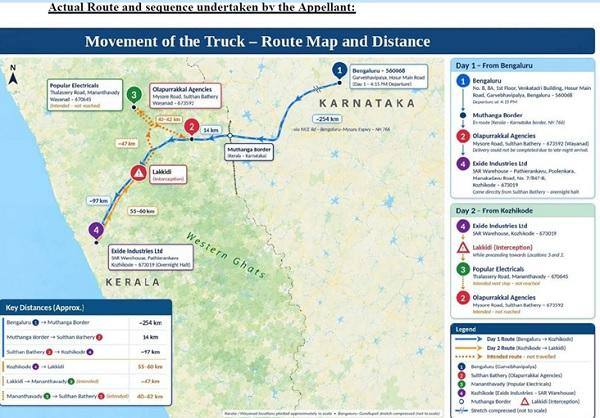
4.7 As seen in the pictorial map, the goods left Bengaluru on 19-10-2020, reached Muthanga border between Karnataka and Kerala, and since there was COVID restrictions and non availability of labour, as it was too late, the truck proceeded directly to Kozhikode where they delivered the goods pertaining to the appellant’s own warehouse covered by the two invoices addressed to them on 20-10-2020. Next day, on 21-10-2020, the goods pertaining to M/s. Popular Electricals, Wayanad, and M/s. Olapurakkal Agencies, Sulthan Batheri were loaded into another Truck No. KL 57T 6100 and the Part B of the e-way bills were updated, and the Truck left Kozhikode towards Wayanad, and were intercepted at Lakkidi, which falls enroute Wayanad.
4.8 We find that at the time of interception on 21-10-2020, the e-way bill was valid till 22-10-2020. The goods were properly declared, which is confirmed by the State
Tax officer in the MOV-07, and no discrepancy was found. The tax invoices pertaining to both the recipient of goods were shown, wherein IGST was charged. But the State Tax Officer who intercepted the vehicle had one query i.e. the vehicle was coming from opposite direction i.e. from Kozhikode to Wayanad, instead of Bengaluru to Wayanad or Kozhikode, and the place of interception is between Wayanad and Kozhikode.
4.9 We find that the three destinations for delivery with all the proper documents including tax invoice and e-way bills, were Sulthan Batheri, Wayanad and Kozhikode, the appellant’s transporter chose to deliver the goods first at Kozhikode, then it was going to Wayanad for second delivery and then intended to go to Sulthan Batheri. However, the goods were intercepted after first delivery at Kozhikode (at appellant’s own Warehouse). The only ground for detention of goods and imposing Tax (CGST and SGST) and penalty is only that the goods were originally consigned to Wayanad, Sulthan Bathri and Kozhikode, but the goods were intercepted when the goods were moving from Kozhikode to Wayanad. The reason for detention is not at all correct as the State Tax Officer detaining the goods, has failed to appreciate that in the same truck the transporter was making three deliveries, and first the goods pertaining to Kozhikode was delivered, and the second delivery was at Wayanad, and therefore the goods were moving from Kozhikode to Wayanad. There should not have been any problem. It is very common that the transporter carries goods of many consignees alongwith many tax invoices and makes deliveries one by one. It is for the transporter to decide which delivery to be made first and which one later depending upon the availability of labour, entry permits and time limits to enter particular municipalities. The transporter can decide the sequence of delivery while making multiple deliveries
in one truck. The State Tax Department cannot impose any such restrictions of a fixed route to be followed or a particular sequence in which deliveries to be made. We find that the appellant’s transporter has not made any mistake or omission, and has correctly followed the e-way bill rules, and has also updated the vehicle details when the goods were shifted to the new vehicle even when the e-way bill was still valid.
4.10 In the present case, the vehicle was intercepted at Lakkidi, on the road to Wayanad, and was proceeding towards the very destination shown in the e-way bills, for delivery to second consignee at Wayanad. Therefore, the detention of vehicle was only based on the assumption of the state tax officer, which is totally illegal and uncalled for.
4.11 GST Law focuses on the movement of goods being supported by the required documents, such as a valid e-way bill where applicable, and on whether the goods are moving to the declared destination, not on the exact road taken. The GST Council’s e-way bill guidance recognizes that consignments may need to be carried in a different conveyance or face transit exigencies. The transporter must update the conveyance details in Part-B of the e-way bill before further movement. For multiple deliveries, the important issue is whether each consignment has the correct invoice, delivery challan or e-way bill, and whether the goods are being diverted to an unauthorized destination or otherwise used to evade tax. A route change alone for transport convenience, traffic diversions, does not establish either. So, if the goods remain on the declared delivery route to their stated consignees and the paperwork is proper, a penalty cannot be imposed merely because the driver took a different or circuitous route during multiple deliveries.
5.0 We also find support in the following judgements:
5.1 In the judgement of Hon’ble Kerala High Court in the case of Kannangayathu Metals v. Assistant State Tax Officer cited in 2019 (11) TMI 473 (Kerala High Court). The Hon’ble High Court held that,
“The petitioner has approached this Court aggrieved by Ext.P2 detention notice issued to him detaining the goods and the vehicle at a place called Vazhayila. It is the case of the petitioner that the reason shown in Ext.P2 notice for detention is that the e-Way Bill in respect of the consignment showed that it was to cover a transportation from Pazhoor- Peppathi to Vettoor road- Kaniyapuram whereas the vehicle was detained at Vazhayila which was not on that route. It is the explanation of the learned counsel for the petitioner that, since the driver of the vehicle had taken an alternate route through MC Road, the vehicle had to reach Vazhayila before turning to Kaniyapuram and it was therefore that the vehicle was intercepted at Vazhayila by the respondents. The learned counsel for the petitioner would submit that there is no mandate under section 129 of the GST Act for detaining goods that were covered by a valid e-Way Bill merely because the driver of the vehicle took an alternate route to reach the same destination.
2. I have heard the learned counsel for the petitioner and the learned Government Pleader for the respondents.
3. On a consideration of the facts and circumstances of the case and the submissions made across the Bar, I find force in the contention of the learned counsel for the petitioner that there cannot be a mechanical detention of a consignment solely because the driver of the vehicle had opted for a different route, other than what is normally taken by other transporters of goods covered by similar e-Way bills. No doubt, if the vehicle is detained at a place that is located on an entirely different stretch of road and plying in a direction other than towards the destination shown in the e- Way bill, then a presumption could be drawn that there was an attempt at transportation contrary to the e-Way Bill. In the instant case, there is no such indication. I therefore allow this writ petition by directing the 1st respondent to forthwith release the goods and consignment to the petitioner on the petitioner producing a copy of this judgment before him.”
5.2 In the case of the appellant’s own case Exide Industries Ltd vs Additional Commissioner (Appeals), Mainpuri, cited in 2024 (7) TMI 1153 (Allahabad HC), the Hon’ble High Court has held that,
“12. The Court has perused the records.
13. Admittedly, the goods in question were sold by the the registered dealer along with genuine documents i.e. tax invoices and e-way bills. At the time of interception it is alleged that driver of the vehicle made statement that goods were to be unloaded at the place which is not mentioned in the tax invoice but at Auraiya and Etawah itself. But perusal of the statement of the truck driver, which is prepared and uploaded by the revenue authority in GST MOV-01, it appears that not a single word has been whispered in respect of the goods in question to be unloaded at the place which has not been shown in the tax invoice accompanying the goods.
14. Another issue raised that the goods along with truck was not on the route of its destination, therefore, there was intention to evade tax. Under the GST Act, there is no specific provision which bounds the selling dealer to disclose the route to be taken during transportation of goods or while goods are in transit however there was a provision under VAT Act to disclose the rout during transportation of goods to reach its final destination. Once the legislature itself in its wisdom has chosen to delete the said provision, this Court opined that the authorities were not correct in passing the seizure order even if the vehicle was not on regular route or on different route.
15. The power of detention as well as seizure can be exercised only when the goods were not accompanying with the genuine documents provided under the Act. The genuineness of the documents has not been disputed at any stage.
16. Observation/allegation has been made that at the time of interception / detention of the goods in question, the driver of the vehicle has only produced tax invoice and e-way bill dated 11.07.2023 and 13.07.2023, but none of the documents as prescribed under the Act has been referred or even brought on record before this Court in support of the said contention. Once the documents accompanying the goods were found to be genuine the goods ought not be have been seized.
17. Karnataka High Court in the case of M/s Karnataka Traders (supra) has held as under:-
“6. The respondent No.3 noticed two discrepancies in the impugned notice Form GST MOV – 10, which reads as under:
“(i) Vehicle was intercepted while it was travelling to the different direction than the direction of destination or way to the destination. So it is clear that the goods was not moving to the place destined for. Hence it appears that the goods is being transported with intention to evade tax.
(ii) The value of goods being transported is shown Rs. 286/- which is too low compared to its Real Market Value i.e. 330/-.”
13. On careful consideration of the facts and circumstances of the case and the submissions made by the respective advocates for the parties, we find the force in the contention of the learned advocate appearing for the petitioners that there cannot be any mechanical detention of a consignment in transit solely on the basis of the two reasons as stated by the respondent No.3 in the impugned notice. We find that merely the direction preferred by the petitioners for delivery of consignment to the place destined for, an inference cannot be drawn with regard to the intention of the petitioners to evade tax. So far as the second ground with regard to the goods being transported to be undervalue is concerned, no material has been placed on record. Even otherwise, as held by this Court as well as other High Courts, it is a settled legal position that undervaluation cannot be a ground for seizure of goods in transit by the inspecting authority. In the instant case, there is no such indication.”
18. Telangana High Court in the case of Vijay Metal (supra) has held as under :-
“19. We do not appreciate the stand taken by the 1st respondent for the reason that the quantity consigned to the petitioner at Hyderabad was admittedly 14.30 tonnes and the quantity which was consigned to M/s. Simi Steels, Adoni was only 2.01 tonnes. Naturally for operational convenience the transporter would load the lesser quantity last and the larger quantity first, i.e. the larger quantity would then be at the bottom of the goods vehicle and the smaller quantity would be on top of it; and it would be convenient for the transporter to offload the lesser quantity first and then the larger quantity next.”
19. In view of the facts as stated above as well as law laid down as aforesaid, the impugned order dated 06.03.2024 cannot be sustained in the eyes of law and is hereby quashed.
20. The writ petition is allowed.”
5.3 Hon’ble High Court of Gujarat, in the judgement cited in 2022 (1) TMI 381 (Gujarat High Court), in the case of M/s. Karnataka Traders Versus State of Gujarat, has held that,
13. On careful consideration of the facts and circumstances of the case and the submissions made by the respective advocates for the parties, we find the force in the contention of the learned advocate appearing for the petitioners that there cannot be any mechanical detention of a consignment in transit solely on the basis of the two reasons as stated by the respondent No.3 in the impugned notice. We find that merely the direction preferred by the petitioners for delivery of consignment to the place destined for, an inference cannot be drawn with regard to the intention of the petitioners to evade tax. So far as the second ground with regard to the goods being transported to be undervalue is concerned, no material has been placed on record. Even otherwise, as held by this Court as well as other High Courts, it is a settled legal position that undervaluation cannot be a ground for seizure of goods in transit by the inspecting authority. In the instant case, there is no such indication.
14. In the result, the present writ application succeeds and is hereby allowed. The confiscation proceedings initiated by the respondents are hereby quashed and set aside. The vehicle as well as the goods shall be released at the earliest and handed over to the writ applicants.
15. We clarify that we have quashed the entire confiscation proceedings keeping in mind two things: first, mere change of route without anything more would not necessarily be sufficient to draw an inference that the intention was to evade tax. Sometime, change of route may assume importance provided there is cogent material with the department to indicate that an attempt was sought to be made to dispose of the goods indirectly at a particular place. If such is the case, then probably, the authority may be justified in initiating appropriate proceedings, but mere change of route of the vehicle by itself is not sufficient. In the same manner, mere undervaluation of the goods also by itself is not sufficient to detain the goods and vehicle far from being liable to confiscation.
16. Rule is made absolute to the aforesaid extent. Direct service is permitted.
5.4 Hon’ble High Court of Karnataka, in the case of Joint Commissioner of Commercial Taxes (Appeals-3), Bengaluru Vs Transways India Transport cited in 2024 (7) TMI 55 (Karnataka High Court), has held that,
“5. Having heard the learned counsel for the parties and having perused the Appeal papers, we decline indulgence in the matter for the following reasons:
a) In shaping medieval English law in 1215 AD, the Magna Carta articulated travel rights for personal liberties and unfettered commerce in assuring “merchants are … safe and secure in … traveling in England.” Blackstone’s 1795 Commentaries on the Laws of England identified freedom of movement as a natural liberty inherent by birth. This personal liberty consists in the power of locomotion, of changing situation, or removing one’s person to whatsoever place one’s own inclination may direct, unless by due course of law.” He defined it as a “strictly natural” right. In 1770, Thomas Jefferson argued that freedom of movement is a personal liberty by birth. “Under the law of nature, all men are born free, everyone comes into the world with a right to his own person, which includes the liberty of moving and using it at his own will. This is what is called a personal liberty.” In 1871, Charles Darwin offered an explanation in his book ‘The Descent of Man’:
“…Hominids needed to walk on two legs to free up their hands… they were habitually used for locomotion…”
It is relevant to see what Erwan Le Corre, a French author opines:
“To the beings, movement is not a chore, not a temporary punishment for being physically lazy and out of shape, not an optional activity just for better looks”.
b) Right to movement whether by foot, cart, boat, aircraft or on a horseback, is constitutionally guaranteed to the citizens as a Fundamental Right under Article 19 (1) (d) and ordinarily that avails to the merchants too when they carry goods for trade. Production of goods but not distributing them would not serve interest of the community, is the underlying principle of Article 301 of the Constitution which reads as under:
“301. Freedom of trade, commerce and intercourse: Subject to the other provisions of this Part, trade, commerce and intercourse throughout the territory of India shall be free.” Even this freedom implies right to movement. Of course, the said guarantee in this regard is not absolute; law can regulate it & restrict too. Scope of right to movement is not the same always; it is variable depending upon the circumstances & conditions. For example, right to move becomes restrictive when a person moves with a firearm or when he uses vehicle for movement. It is because, the firearm & the vehicle are regulated by law in certain aspects and that affects the scope of right to movement otherwise vastly availing to citizens. That is how Article 19 (5) i.e., restriction by law is conceived. Thus, a trader cannot claim unfettered right of movement whilst carrying goods that are regulated by law. However, in the absence of such law being shown, fetter cannot be imposed.
c) This case involves also the fundamental right to trade & business guaranteed u/a 19
(1) (g) read with Article 301 of the Constitution. Therefore, it will have elements of right to movement, as well. It is open to a trader to take goods to the destination point
in whichever route he opts, unless the law otherwise requires, destination point being intact. Such a right needs to be recognized as of necessity to trade or business. Mr. Hamilton, a co-author of Federalist Papers (1787-88) says the following about importance of free movement to commerce:
“…An unrestrained intercourse between the States themselves will advance the trade of each by an interchange of their respective productions, not only for the supply of reciprocal wants at home, but for exportation to foreign markets. The veins of commerce in every part will be replenished, and will acquire additional motion and vigor from a free circulation of the commodities of every part. Commercial enterprise will have much greater scope, from the diversity in the productions of different States…”
d) The above being not an absolute right, can certainly be regulated by law as provided u/a 19(6), hardly needs to be stated. Despite vehement submission, learned AGA could not locate any rule or ruling that regulates the movement of conveyor of goods while choosing his route, in the State. It can be said without the risk of contradiction that as the law now stands in Karnataka, a merchant or his convoy is free to choose the route for the movement of goods from the point of origin to the point of destination and that he has specified a particular route in the consignment documents, would not come in the way of that route being altered, although destination cannot be. In the absence of law, he cannot be faltered if he chooses a circuitous route in preference to linear one in variance with the impression given to the authorities in the said documents as long as travel time and destination point remain intact. If that be so, the impugned orders of authorities that were structured on a contra premise could not stand the test of law. The judgement of the learned Single Judge therefore is inexplicable, despite the said reason not animating it.
e)*It is the vehement argument of learned AGA that the movement particulars in terms of lex mercatoria were furnished in writing by the consignor/conveyor of the goods specifically mentioning the point of origin, route & the destination points of the consignees; all that has been apparently breached unjustifiably inasmuch as the conveyor traveled astray qua the route map furnished and that amounted to carrying the goods without the requisite documents and therefore, the penal action taken by the authorities could not have been faltered. This contention is difficult to countenance: merchants as of course move with goods as vividly explained by noted novelist Dr. S L Bhyrappa in his famous work “Sartha” (2006), literally meaning a trading caravan; in ancient India, such caravans would travel to farthest lands for trade. In the instant case, driver of the conveyance left the usual track to venture in the other that had not found a place in the consignment documents, is undeniable. In fact, that was his admission and he gave his own reason for that which was not believed by the authorities as true. However, the question is whether law mandates conveyance in a particular route and prohibits alteration of travel route qua the one impressed in the consignment documents. We have not been shown any such law, rule or ruling.
[*Corrected vide chamber order dated 27.06.2024.]
(f) What is required by law is the furnishing of consignment documents and specified particulars of consignor, consignee, goods, route maps & destinations. Requirement of furnishing particulars of route map, etc., is one thing, compulsive adherence to the impressed route is another. There is law with regard to the former, is true; but latter is non liquet i.e., an area where there is no binding rule. When law does not require giving of reasons for changing the direction or route, whether the reason offered by the driver for opting another route is true or false, pales into insignificance. However, this does not mean a driver of conveyance can lie with impunity, the motto Satyameva Jayate
(Truth alone succeeds) having been inscribed in our national emblem i.e., Ashoka Sthamba. We are told at the Bar that even the requirement of furnishing travel & other particulars that obtained in law earlier has been now done away with in the new legal regime. That being the position, the orders of liability & penalty of the authorities that are quashed by the learned Single Judge cannot be revived by setting aside his Judgement.
g) It is relevant to advert to what a Division Bench of Hon’ble Gujarat High Court in a nearly comparable fact matrix observed in M/S. KARNATAKA TRADERS vs. STATE OF GUJARAT, 2022 SCC OnLine Guj 28. These observations occurring at paragraphs 6 & 13 run as under:
“6. Respondent No. 3 noticed two discrepancies in the impugned notice form GST MOV-10, which reads as under:
“(i) Vehicle was intercepted while it was travelling to the different direction than the direction of destination or way to the destination. So it is clear that the goods was not moving to the place destined for. Hence it appears that the goods is being transported with intention to evade tax.
(ii) The value of goods being transported is shown Rs. 286 which is to low compared to its real market value, i. e., Rs. 330.”
13. On careful consideration of the facts and circumstances of the case and the submissions made by the respective advocates for the parties, we find the force in the contention of the learned advocate appearing for the petitioners that there cannot be any mechanical detention of a consignment in transit solely on the basis of the two reasons as stated by respondent No. 3 in the impugned notice. We find that merely the direction preferred by the petitioners for delivery of consignment to the place destined for, an inference cannot be drawn with regard to the intention of the petitioners to evade tax. So far as the second ground with regard to the goods being transported to be undervalue is concerned, no material has been placed on record. Even otherwise, as held by this court as well as other High Courts, it is a settled legal position that undervaluation cannot be a ground for seizure of goods in transit by the inspecting authority. In the instant case, there is no such indication.”
6. What is stated above, in a measure, lends support to the case of respondent.
7. In the above circumstances, this Appeal being devoid of merits is liable to be and accordingly dismissed, costs having been made easy.
8. We place on record our appreciation for the research work done by Chamber Intern Mr. Arjun Vivekananda Harihar.
6.0 We also find that the JC (Appeals) in his order at the last para writes that,
“The E-way Bill and invoices accompanying showed the movement of goods from Banagalore to Wayanad where as the actual movement of goods were from Kozhikode to Wayanad. Appellant has not produced before me any documents to show that the goods consigned back are one and the same.”
7.0 We find that the JC (Appeals) has not applied his mind and has passed such order without properly verifying the facts of the case. He has also not appreciated the fact that the truck carried six invoices, out of which two invoices pertained to Kozhikode, which was delivered first, and then the vehicle was changed and truck no was updated in the e-way bill, and the vehicle was going for second delivery at Wayanad. That is the reason why the vehicle was moving from Kozhikode to Wayanad. We find that it is on record that all the tax invoices and updated e-way bills were produced before the intercepting officer, and also before the JC (Appeals). But no one has made any effort to understand the issue, and howsoever, booked the case against the appellant.
8.0 We find that the detention of goods was made without proper reason and without the authority of law. The goods and the transporter was holding proper documents i.e. Tax Invoices, valid and updated e-way bills, which is sufficient to demonstrate the genuine nature of transportation of goods.
9.0 In view of the above we find that that the detention of goods, imposition of penalty and demand of tax in CGST and SGST when the transaction is inter-state and IGST is charged in the tax invoice, are totally illegal and unlawful. The detention order of the goods is qashed and set aside. The order in appeal, is also passed without verifying the facts and without application of mind, is also liable to be set aside.
10.0 To answer our issue raised at Para No. 4.1, we find that GST Law does not prescribe any fixed or mandatory route for transportation from one place to another during multiple deliveries, and a penalty cannot be imposed under Section 129 (3) of CGST/KGST Act, 2017 for taking another convenient route during multiple deliveries in a common transport vehicle.
11.0 In view of the above, we conclude that there is no intention to evade taxes, and the goods were being transported with proper tax invoices and e-way bills, and also updated Part – B of the e-way bills whenever the vehicle was changed. Only because the appellant’s transporter chose a different route, cannot be the only ground for imposing penalties under Section 129 (3) of the CGST/KGST Act, 2017. Hence, the penalties thus imposed are liable to be set aside.
12.0 As regards, the tax collected in CGST and SGST, we find that the tax invoices already show that IGST is charged in the supply invoices. The tax collected once again as CGST and SGST alleging that the transaction is intra-state, is set aside.
13.0 We would also appreciate the efforts of Mr Anil Gopinath, Ld Joint Commissioner of State Tax in bringing out the correct facts before this Tribunal.
14.0 Accordingly, we pass the following order:
The Order in Appeals is set aside and the appeal nos. APL/ 46/ ERN/2026 & APL/ 47/ ERN/2026 are allowed with consequential relief.
(order pronounced in open court)