Rameshwar Gupta Vs Commissioner SGST (GSTAT Lucknow)
Summary: GSTAT Lucknow allowed by way of remand the appeal of Rameshwar Gupta, proprietor of M/s Shakti Iron Stores, concerning disputed input tax credit for FY 2017-18. The first appellate proceedings had ended in rejection following the appellant’s non-appearance, which he attributed to medical difficulties. The order refers to a disputed amount of Rs. 13,12,968 and separately records an ITC demand of Rs. 5,78,400 arising from supplies by M/s Day & Co. and M/s Muskan Steel. The appellant relied on purchase invoices, books of account, payment records, reconciliation statements and a CA certificate dated 14.07.2026. The Revenue opposed relief, maintaining that sufficient hearing opportunities had been provided and objecting to the certificate being issued after the appeal was filed.
The Tribunal accepted the medical explanation in the circumstances of the case and found that non-appearance could not justify concluding the proceedings without examining the substantive ITC dispute. It held that a difference between GSTR-3B and GSTR-2A/GSTR-2B requires examination but cannot, by itself, conclusively establish wrongful availment of ITC. Eligibility under Section 16 of the CGST Act, 2017 must be determined from the underlying invoices, books, supplier particulars, payment records and other transaction evidence. For FY 2017-18, the verification mechanism under CBIC Circular No. 183/15/2022-GST dated 27.12.2022 was relevant wherever applicable. The Bench also recorded that the Department had undertaken verification but could not upload its results owing to portal difficulties, and held that the proceedings could not remain pending indefinitely on that account.
The Tribunal held that the subsequent date of the CA certificate did not, by itself, make it inadmissible where the certified matters could be correlated with contemporaneous records. The certificate was to be considered as corroborative material, and the circular applied to pending proceedings, including appeals. The Tribunal set aside the original and appellate orders to the extent challenged, together with the consequential demand of tax, interest and penalty arising from the disputed ITC. It directed the Proper Officer to consider the CA certificate, invoices, ledger account and return mismatch for determination of tax, with consequential relief in accordance with law. The disposal was a remand for verification and fresh determination.
Cases Discussed
- M/s Felicity Adobe LLP v. Assistant Commissioner of Central Tax, decided on 16.04.2026 (Karnataka High Court) — Cited by the appellant for factual reconciliation and an opportunity to establish a claim through documentary material.
- Sanjeet Kumar Bhagat v. Commissioner of State Tax, decided on 06.10.2025 (Jharkhand High Court) — Included among the precedents cited by the appellant; the supplied order does not separately explain its reasoning.
- Masany Construction Equipment Pvt. Ltd. v. State Tax Officer, WP(C) No. 33646 of 2024, decided on 11.03.2025 (Kerala High Court) — Cited by the appellant among the authorities supporting its challenge to the orders.
- Mukesh Kumar Singh v. Commissioner, Jharkhand Goods and Service Tax, decided on 24.01.2025 (Jharkhand High Court) — Cited by the appellant in support of its challenge concerning ITC and procedural fairness.
- Karmaxx Infotech v. Assistant Commissioner (ST), W.P. No. 18311 of 2023, decided on 20.06.2023 (Madras High Court) — Cited in the reproduced first appellate order concerning failure to participate in proceedings. The Tribunal nevertheless accepted the medical explanation in the present case.
- Raj Kumar Agrawal v. Suresh Chandra Jain, Writ-A No. 54978 of 2014, decided on 10.04.2015 (Allahabad High Court) — The appellant referred to this decision in its submissions concerning sufficient cause on the material date of non-appearance.
- G.P. Srivastava v. R.K. Raizada & Ors., (2000) 3 SCC 54 (Supreme Court) — Relied upon by the Tribunal when considering the explanation for non-appearance; sufficient cause was considered in the context in which the party was proceeded against.
FULL TEXT OF THE ORDER OF GSTAT LUCKNOW
Brief Facts of the Case
1. The present appeal has been filed by the Appellant, Shri Rameshwar Gupta, proprietor of M/s Shakti Iron Stores, a registered taxpayer under the GST law bearing GSTIN 09AFOPG6846H1ZZ, against Order No. ZD090525119927X dated 14.05.2025 passed by the Additional Commissioner Grade-II (Appeal), whereby the appeal preferred against Demand Order No. ZD091225328365D dated 26.12.2023 of disputed tax amounting Rs. 13,12,968, was disposed of as rejected because the appellant did not appear before the First Appellate Authority due to Medical Issues. The Appellant aggrieved by the said order and submitted before this Bench that his claim of Input Tax Credit deserves to be allowed on the basis of the invoices, books of account, reconciliation
The entire ITC demand of Rs. 5,78,400.00 arises from supplies received from two identified suppliers:
Supplier |
GSTIN |
Aggregate Taxable Value (Rs.) |
CGST (Rs.) |
SGST (Rs.) |
Total ITC in Dispute (Rs.) |
|---|---|---|---|---|---|
M/s Day & Co. |
09ABBPK9377N1ZV |
30,10,000.00 |
2,70,900.00 |
2,70,900.00 |
5,41,800.00 |
M/s Muskan Steel |
09ABLNPM1316G1Z3 |
2,03,311.50 |
18,298.04 |
18,298.04 |
36,596.08 |
Total |
32,13,311.50 |
2,89,198.04 |
2,89,198.04 |
5,78,400.00 |
statements and other supporting documents, in accordance to the CBIC Circular No. 183/15/2022-GST dated 27.12.2022. The appellant stated in the present appeal the total ITC in dispute is as below-
2. GROUNDS OF APPEAL
2.1 The appellant submitted that the First Appellate Authority had erred in dismissing the appeal on procedural grounds without examining the substantive merits of the case, thereby causing prejudice to the appellant and violating the principles of natural justice.
2.2 The appellant submitted that the Order-in-Original dated 26.12.2023 had been passed ex-parte without providing an effective opportunity to explain the alleged mismatch between GSTR-3B and GSTR-2A and to produce the relevant supporting documents.
2.3 The appellant contended that the Proper Officer had not independently verified the fulfillment of the conditions prescribed under Section 16(2) of the CGST Act, 2017, including possession of valid tax invoices, receipt of goods or services, payment to suppliers, and payment of tax by the suppliers.
2.4 The appellant further contended that the alleged mismatch between GSTR-3B and GSTR-2A, by itself, had not established that the ITC was wrongly availed, particularly for FY 2017-18, when such discrepancies could have arisen due to suppliers’ reporting errors, delayed filing, incorrect GSTINs, or other bona fide reasons.
2.5 It was submitted that the Proper Officer had failed to consider and follow the procedure prescribed under CBIC Circular No. 183/15/2022-GST dated 27.12.2022 for verification of ITC mismatches pertaining to FY 2017-18 and had not called for the relevant supporting documents or prescribed certificates.
2.6 The appellant submitted that the First Appellate Authority had failed to properly consider the appellant’s contentions and had dismissed the appeal mainly on account of non-appearance and non-production of documents, without adequately examining the validity of the ITC claim or the reasons for the alleged mismatch.
2.7 It was further submitted that the Order-in-Appeal dated 17.04.2025 had not adequately dealt with the issues raised by the appellant and had not contained sufficient reasons for rejecting the appeal, thereby failing to constitute a proper and reasoned order.
2.8 The appellant submitted that the relevant purchase invoices, payment proofs, ledger extracts, books of account, reconciliation statements, and other supporting documents had been available with the appellant and could have been produced if an effective opportunity had been granted.
2.9 It was submitted that the authorities had failed to identify the specific reasons for the difference between GSTR-3B and GSTR-2A and had not examined whether the discrepancy had arisen due to any default on the part of the appellant or due to errors or omissions attributable to the suppliers.
2.10 The appellant submitted that the appellant had consistently maintained that the ITC had been claimed against genuine business transactions supported by valid tax invoices and other relevant records, and that the claim was required to be examined on the basis of documentary evidence and proper reconciliation.
2.11 It was further submitted that the appellant had been willing to furnish a detailed reconciliation of the ITC claimed in GSTR-3B, reflected in GSTR-2A, and recorded in the books of account, along with supplier/CA/CMA certificates, wherever applicable, for proper verification of the claim. The appellant relied upon the various judicial precedents, which are reproduced below-
I. G.P. Srivastava v. R.K. Raizada & Ors., (2000) 3 SCC 54 -Hon’ble Supreme Court of India.
II. Raj Kumar Agrawal v. Suresh Chandra Jain, Writ-A No. 54978 of 2014 -Hon’ble Allahabad High Court.
III. M/s Felicity Adobe LLP v. Assistant Commissioner of Central Tax, decided on 16.04.2026 -Hon’ble Karnataka High Court.
IV. Sanjeet Kumar Bhagat v. Commissioner of State Tax, decided on 06.10.2025 -Hon’ble Jharkhand High Court.
V. Mukesh Kumar Singh v. Commissioner, Jharkhand Goods and Service Tax, decided on 24.01.2025 -Hon’ble Jharkhand High Court.
VI. Masany Construction Equipment Pvt. Ltd. v. State Tax Officer, decided on 11.03.2025 -Hon’ble Kerala High Court.
2.12 In view of the above, the appellant submitted that the Order-in-Appeal dated 17.04.2025 and the Order-in-Original dated 26.12.2023 are liable to be set aside.
3. Submissions of the Appellant.
3.1 Shri Swayambhu Manu, Advocate, appeared on behalf of the Appellant and represented the case before the Bench. He is hereinafter referred to as the “Ld. Appellant.”
3.2 The appellant submitted that the objection regarding the CA Certificate dated 14.07.2026 is based only on the date of its issuance and not on the nature of the facts certified therein. The certificate relates to transactions of FY 2017-18 and merely certifies pre-existing facts relating to supplies, invoices and payment of tax by the concerned suppliers. The subsequent date of certification does not alter the date or nature of the underlying transactions.
3.3 Circular No. 183/15/2022-GST dated 27.12.2022 specifically provides a mechanism for verification of ITC discrepancies for FY 2017-18 and FY 2018-19 and expressly states that the instructions apply to cases where adjudication or appeal proceedings are still pending. The Circular does not prescribe that the CA/CMA certificate must necessarily be issued before filing of the appeal.
3.4 The appellant further submitted that Rule 112 of the CGST Rules permits production of additional evidence before the appellate forum in appropriate circumstances, including where the appellant was prevented by sufficient cause from producing such evidence earlier. In the present case, the appellant has explained the circumstances relating to medical difficulties and GSTN-related issues which prevented effective participation before the First Appellate Authority.
3.5 The CA Certificate is also capable of independent verification from invoices, supplier GSTR-3B/GSTR-1, GSTN records and the reconciliation statement. Taking the certificate on record would therefore cause no prejudice to the Revenue.
3.6 The Hon’ble Karnataka High Court in M/s Felicity Adobe LLP v. Assistant Commissioner of Central Tax, decided on 16.04.2026, has emphasised the need to examine factual reconciliation and afford an opportunity to demonstrate the case where the dispute is capable of verification from documentary material.
3.7 Accordingly, the appellant submitted that the CA Certificate dated 14.07.2026 may kindly be taken on record and considered along with the supporting documents.
3.8 The objection that the medical documents do not correspond date-to-date with every hearing fixed before the First Appellate Authority is not, by itself, sufficient to reject the appellant’s explanation.
3.9 In G.P. Srivastava v. R.K. Raizada, (2000) 3 SCC 54, the Hon’ble Supreme Court held that sufficient cause for non-appearance has to be considered with reference to the date on which ex parte action was taken. Earlier defaults, which had already been overlooked, cannot by themselves defeat relief where sufficient cause is established for the material date.
3.10 The said principle has also been recognised by the Hon’ble Allahabad High Court in Raj Kumar Agrawal v. Suresh Chandra Jain. Thus, the relevant consideration is whether sufficient cause existed on the material/final date on which the First Appellate Authority proceeded to dispose of the appeal, and not whether the medical certificate reproduces every earlier hearing date.
3.11 A medical certificate is issued to record the patient’s medical condition and treatment; it cannot reasonably be expected to mirror the administrative hearing calendar of the tax authority. The medical documents should therefore be considered along with the nature and period of illness and the surrounding circumstances.
3.12 The appellant therefore prayed that the impugned order in Appeal and Order in Original to be set aside and the appeal to be allowed with the consequential relief as per law.
4. Respondent’s Contention
4.1 Shri Rakesh Kumar Singh, Learned Deputy Commissioner, appeared on behalf of the Respondent and represented the case before the Bench. He is hereinafter referred to as the “Ld. Respondent.”
4.2 The Ld. Respondent submitted that the contention of the Appellant that no effective opportunity of hearing was provided is factually incorrect. The Proper Officer as well as the First Appellate Authority provided sufficient opportunities to the Appellant to appear, present the relevant facts and submit the necessary documents in support of, his case. However, the Appellant failed to avail the opportunities so provided and did not appear before either of the authorities.
4.3 The Ld. Respondent further submitted that the Chartered Accountant’s Certificate relied upon by the Appellant cannot be taken on record at this stage, as the same was issued subsequent to the filing of the appeal. Its admission would, therefore, require consideration of the delay and the justification furnished by the Appellant for producing the said document belatedly.
4.4 The Ld. Respondent submitted that the medical reports relied upon by the Appellant correspond only to the last date of hearing fixed before the First Appellate Authority. The said documents, therefore, do not explain the Appellant’s failure to avail the earlier opportunities granted during the proceedings.
4.5 The Ld. Respondent, therefore, submitted that the Proper Officer as well as the First Appellate Authority passed the respective orders in accordance with law after providing due and sufficient opportunities to the Appellant. Accordingly, the present appeal, being devoid of merit, deserves to be dismissed.
5. Question of law –
(i) Whether the Order-in-Appeal dated 14.05.2025 is sustainable when it was passed without proper verification of the conditions prescribed under Section 16 of the CGST Act, 2017?
(ii) Whether the alleged ITC mismatch for FY 2017-18 was required to be examined in accordance with the verification procedure prescribed under CBIC Circular No. 183/15/2022-GST dated 27.12.2022?
Since the Question of law involved in the matter, therefore the case to be heard by this Double Bench.
6. Heard both the parties and perused the records.
7. FINDINGS
Issue no. 1.
7.1 This Bench has carefully considered, the Order-in-Original dated 26.12.2023, the Order-in-Appeal dated 17.04.2025, the grounds of appeal, the submissions of the Ld. Appellant and the Ld. Respondent, and the documents placed on record. The controversy primarily concerns the admissibility of ITC claimed by the appellant for FY 2017-18 and the basis on which the same came to be disputed.
7.2 At the outset, this Bench finds that the appellant’s non-appearance before the adjudicating/ appellate authority cannot, in the peculiar facts of the present case, be treated as sufficient to conclude the proceedings against it without consideration of the substantive dispute. The appellant has placed an explanation for its inability to appear, including the medical circumstances relied upon. The principle laid down by the Hon’ble Supreme Court in G.P. Srivastava v. R.K. Raizada, (2000) 3 SCC 54, that sufficient cause is required to be considered in the context in which the party was proceeded against, is relevant for such determination.
7.3 This Bench also finds that the Order-in-Appeal dated 17.04.2025 does not adequately address issue. The appellate authority was required to determine the substantive issue arising from the alleged ITC discrepancy and record reasons on the material having a bearing on the tax liability. The order of the first appellate authority is reproduced below-
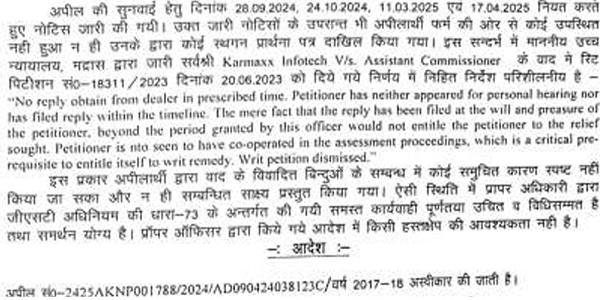
This impugned order does not reveal that details of the case were examined on merit. It is submitted that due to medical difficulties the appellant could not appear before the First Appellate Authority to pursue his case. the medical certificate was produced in support of his arguments. In the light of judgements cited by the appellant the medical certificate of the appellant is accepted and the case is decided on its merit and the facts presented before this Bench.
Issue no. 2
7.4 During the course of hearing the Respondent was directed to verify the details furnished by the appellant. From the submissions made by the Ld. Representative of the Respondent, it is evident that the Department had examined the GSTR-3B and GSTR-2B position. But such verification could not be uploaded onto the GSTAT portal owing to technical difficulties. Thus, the issue before this Bench is not one of complete absence of departmental verification, but of the effect of a technical inability to upload the result of verification already undertaken. The Bench commenced hearings on 15th July 2026. In the present case, hearings were held on 15.07.2026, 07.08.2026, 18.08.2026, 14.09.2026 & 29.09.2026. Time and again the respondent was advised to get their id mapping process completed on the portal and also upload, among other required documents, the authorisation issued by competent authority to appear before GSTAT. Registry was advised to communicate the same to the respondent and a letter vide C. No. IV/01/02/Court Proceedings/2026 dated 10.08.2026 was issued to The Commissioner, State Tax (SGST), Lucknow, Uttar Pradesh. However, till the date of pronouncing the judgement i.e. 06.10.2026, there appears status quo and the respondent says that they are unable to access the portal and upload credentials. The Registry confirm that they have not received a response from the Respondent.
The matter cannot be allowed to linger indefinitely for want of a proactive and responsive approach of the Respondent and a decision needs to be taken based on the merits of the case.
8. As regards the alleged difference between GSTR-3B and GSTR-2B/GSTR-2A, such difference is undoubtedly a matter requiring examination; however, it cannot, in isolation, constitute conclusive proof that the ITC was wrongly availed. The difference has to be appreciated in the context of the relevant invoices, books of account, supplier particulars, payment records and other material forming part of the transaction.
8.1 The statutory conditions prescribed for availment of ITC under Section 16 of the CGST Act, 2017 remain applicable. However, the fulfilment of such conditions is a question to be determined on the basis of the evidence relating to the actual transactions. In the present case, the Department’s own verification of the GSTR-3B and GSTR-2B position assumes significance while determining whether the alleged discrepancy could legitimately sustain the proposed denial of credit.
8.2 Since the dispute pertains to FY 2017-18, the verification approach contemplated under CBIC Circular No. 183/15/2022-GST dated 27.12.2022 is also relevant, wherever applicable. The said mechanism is intended to facilitate examination of discrepancies by reference to the underlying transaction and supplier-side records rather than by treating the numerical difference alone as determinative. The Circular is reproduced below for ready reference-
Circular No. 183/15/2022-GST
F. No. CBIC-20001/2/2022 – GST
Government of India
Ministry of Finance
Department of Revenue
Central Board of Indirect Taxes and Customs
GST Policy Wing
New Delhi, Dated the 27ᵗʰ December, 2022
To,
The Principal Chief Commissioners/ Chief Commissioners/ Principal Commissioners/
Commissioners of Central Tax (All)/
The Principal Directors General/ Directors General (All)
Madam/Sir,
Subject: Clarification to deal with difference in Input Tax Credit (ITC) availed in FORM GSTR-3B as compared to that detailed in FORM GSTR-2A for FY 2017-18 and 2018-19 – reg.
It is worthy to note that this circular requires the CA certificate in case where the disputed tax amount is more than 5 lakhs and it is applicable to the cases, which are pending at any stage.
4. The proper officer shall first seek the details from the registered person regarding all the invoices on which ITC has been availed by the registered person in his FORM GSTR 3B but which are not reflecting in his FORM GSTR 2A. He shall then ascertain fulfillment of the following conditions of Section 16 of CGST Act in respect of the input tax credit availed on such invoices by the said registered person:
i) that he is in possession of a tax invoice or debit note issued by the supplier or such other tax paying documents;
ii) that he has received the goods or services or both;
iii) that he has made payment for the amount towards the value of supply, along with tax payable thereon, to the supplier.
Besides, the proper officer shall also check whether any reversal of input tax credit is required to be made in accordance with section 17 or section 18 of CGST Act and also whether the said input tax credit has been availed within the time period specified under sub-section (4) of section 16 of CGST Act.
4.1 In order to verify the condition of clause (c) of sub-section (2) of Section 16 of CGST Act that tax on the said supply has been paid by the supplier, the following action may be taken by the proper officer:
4.1.1 In case, where difference between the ITC claimed in FORM GSTR-3B and that available in FORM GSTR 2A of the registered person in respect of a supplier for the said financial year exceeds Rs 5 lakh, the proper officer shall ask the registered person to produce a certificate for the concerned supplier from the Chartered Accountant (CA) or the Cost Accountant (CMA), certifying that supplies in respect of the said invoices of supplier have actually been made by the supplier to the said registered person and the tax on such supplies has been paid by the said supplier in his return in FORM GSTR 3B. Certificate issued by CA or CMA shall contain UDIN. UDIN of the certificate issued by CAs can be verified from ICAI website https://udin.icai.org/search-udin and that issued by CMAs can be verified from ICMAI website https://eicmai.in/udin/VerifyUDIN.aspx.
4.1.2 In cases, where difference between the ITC claimed in FORM GSTR-3B and that available in FORM GSTR 2A of the registered person in respect of a supplier for the said financial year is upto Rs. 5 lakh, the proper officer shall ask the claimant to produce a certificate from the concerned supplier to the effect that said supplies have actually been made by him to the said registered person and the tax on said supplies has been paid by the said supplier in his return in FORM GSTR 3B.
4.2 However, it may be noted that for the period FY 2017-18, as per proviso to section 16(4) of CGST Act, the aforesaid relaxations shall not be applicable to the claim of ITC made in the FORM GSTR-3B return filed after the due date of furnishing return for the month of September, 2018 till the due date of furnishing return for March, 2019, if supplier had not furnished details of the said supply in his FORM GSTR 1 till the due date of furnishing FORM GSTR 1 for the month of March, 2019.
5. It may also be noted that the clarifications given hereunder are case specific and are applicable to the bonafide errors committed in reporting during FY 2017-18 and 2018-19. Further, these guidelines are clarificatory in nature and may be applied as per the actual facts and circumstances of each case and shall not be used in the interpretation of the provisions of law.
6. These instructions will apply only to the ongoing proceedings in scrutiny/audit/investigation, etc. for FY 2017-18 and 2018-19 and not to the completed proceedings. However, these instructions will apply in those cases for FY 2017-18 and 2018-19 where any adjudication or appeal proceedings are still pending.
7. Difficulty, if any, in the implementation of the above instructions may please be brought to the notice of the Board. Hindi version would follow.
Sanjay Mangal
Principal Commissioner (GST)
8.3 This Bench holds that the arguments made by the Ld. Counsel for the appellant that the Chartered Accountant/CA-CMA certificate dated 14.07.2026, has been taken into consideration. Its subsequent date does not, by itself, render it inadmissible, particularly when the matters certified are capable of correlation with the books, invoices, returns and other contemporaneous records. The certificate is, therefore, to be appreciated as corroborative material and not discarded merely on the ground of the date on which it was issued. The CA certificate can be produced for consideration at the appellate stage because of CBIC Circular No. 183/15/2022-GST dated 27.12.2022 is applicable to the pending cases.
9. ORDER
(i) The appeal is allowed by way of remand.
(ii) The Order-in-Original dated 26.12.2023 and the Order-in-Appeal dated 17.04.2025 are set aside to the extent challenged in the present appeal.
(iii) The consequential demand of tax, interest and penalty arising from the disputed ITC is set aside.
(iv) The appellant shall be entitled to consequential relief, if any, in accordance with law. The Proper Officer is directed to take into consideration the CA Certificate produced before this Tribunal by the appellant, the invoices, the ledger account and the mismatch of GSTR 3B and 2A etc., for the determination of tax amount.
The Order is pronounced in Open Court.