DGAP, DG Anti-Profiteering, Director General of Anti-Profiteering Vs Praxis Home Retail Ltd. (GSTAT Delhi)
Summary: The GST Appellate Tribunal, Delhi, upheld the Directorate General of Anti-Profiteering’s determination of ₹3,67,88,027 against Praxis Home Retail Ltd. for failing to pass on GST rate-reduction benefits to customers during 15 November 2017 to 30 September 2019. The proceedings began with a modular-kitchen complaint after the GST rate on relevant goods fell from 28% to 18%. The respondent argued that its GST registration began after the rate reduction, that the earlier business belonged to Future Retail Ltd., and that customised products and negotiated lump-sum prices could not be compared reliably. The Tribunal examined the NCLT-approved demerger, invoice-wise calculations, disputed product entries and the scope of the investigation. It held that the registration date and customised nature of supplies did not, by themselves, defeat the statutory obligation under Section 171 of the CGST Act. It also held that the DGAP could examine other affected goods beyond the original complaint and that withdrawal of the complaint did not terminate statutory proceedings.
The Tribunal accepted the DGAP’s computation after considering an error in the Gujarat State-wise figure, corrected from ₹1,98,043 to ₹19,48,043, and disregarded a residual ₹2 difference as insignificant. It held that proof of intentional profiteering was unnecessary where the tax benefit was not passed on, while genuine commercial cost increases required cogent supporting evidence. The Tribunal also rejected the objection to the approximately 22-month investigation period. The confirmed amount includes ₹21,200 relating to the complainant. No penalty under Section 171(3A) was imposed because the relevant period ended before that provision took effect on 1 January 2020.
Cases Discussed
- Reckitt Benckiser India Pvt. Ltd. v. Union of India, 2024 (82) G.S.T.L. 344 (Delhi High Court)
- Excel Crop Care Ltd. v. Competition Commission of India, (2017) 8 SCC 47 (Supreme Court)
- Cadila Healthcare Ltd. v. CCI, (2018) SCC OnLine Del 11229 (Delhi High Court)
- LICHFL Care Homes Ltd. v. DGAP, W.P.(C) 13665/2026 (Delhi High Court)
- Commissioner of Central Excise and Customs v. Larsen and Toubro Ltd., (2016) 1 SCC 170 (Supreme Court)
- CIT v. B.C. Srinivasa Shetty, (1981) 2 SCC 460 (Supreme Court)
- Reliance Infratel Ltd., 2016 (42) S.T.R. 452 (CESTAT Mumbai)
- DGAP v. Urban Essence (Subway Franchisee), [2025] 177 com 376 (GSTAT New Delhi)
FULL TEXT OF THE JUDGMENT/ORDER OF GSTAT
The present proceedings arise out of an investigation undertaken under Section 171 of the Central Goods and Services Tax Act, 2017 (hereinafter referred to as the “CGST Act, 2017”) in respect of the benefit arising from reduction in the rate of tax on the goods supplied by M/s Praxis Home Retail Ltd. (hereinafter referred to as the “Respondent”). The Director General of Anti-Profiteering (hereinafter referred to as the “DGAP”) initially submitted its Investigation Report dated 27.11.2020 under Rule 129(6) of the Central Goods and Services Tax Rules, 2017 (hereinafter referred to as the “CGST Rules, 2017”). The said Report was thereafter examined by the erstwhile National Anti-Profiteering Authority (hereinafter referred to as the “NAA”) which, vide Order No. 24/2022 dated 30.09.2022, directed reinvestigation on specified issues and consequential re-computation of the profiteering amount. Pursuant thereto, the DGAP submitted its further Investigation Report dated 29.03.2023, which is the report presently under consideration.
2. The proceedings originated from an application filed by Shri K.G.M. Bhushan, alleging profiteering in respect of the supply of “Modular Kitchen components (HSN Code 9403)” by the Respondent. It was alleged that the Respondent had issued a quotation dated 03.11.2017 for installation of a Modular Kitchen, wherein the price was finalised at Rs. 2,50,000/-, inclusive of GST at the then applicable rate of 28%, against which an advance of Rs. 1,25,000/- was stated to have been paid. The Complainant further alleged that, notwithstanding the reduction in the rate of GST on the impugned goods from 28% to 18% with effect from 15.11.2017, the Respondent, vide invoice dated 20.11.2017 increased the base prices of the impugned products such that the total price charged remained at Rs. 2,50,000/-, inclusive of GST at the reduced rate of 18%. According to the Complainant, the Respondent had thereby not passed on the benefit arising from the reduction in the rate of GST by way of commensurate reduction in prices and the Complainant sought refund of the alleged excess amount paid.
3. The said Investigation Report dated 27.11.2020 was thereafter considered by the NAA. Upon examination of the Report, its annexures and calculations, the submissions of the Respondent and the material available on record, the NAA identified certain discrepancies in the data and computation forming the basis of the Report dated 27.11.2020.
4. Upon identifying the aforesaid discrepancies, the NAA, vide Order No. 24/2022 dated 30.09.2022, directed the DGAP, under Rule 133(4) of the CGST Rules, 2017, to undertake re-investigation and to re-examine and wherever necessary, re-compute the amount of profiteering. The NAA, inter alia, directed re-examination of the following issues:
i. inclusion of certain transactions involving goods subjected to GST rates of 12% and 5% in the profiteering computation;
ii. apparent discrepancies in the base-price calculations of certain products;
iii. a mismatch between the total profiteering amount reflected in the State-wise computation and the aggregate amount stated in the Report; and
iv. the Respondent’s contention regarding its status as a separate legal entity following the demerger of the business of Future Retail Ltd. and the consequent applicability of Section 171 to the transactions under consideration.
5. Pursuant to the aforesaid directions, the DGAP undertook reinvestigation and submitted its Investigation Report dated 29.03.2023. The Report records examination of the relevant transactions and material pertaining to the period from 01.07.2017 to 30.09.2019. The period for which profiteering was ultimately computed, however, was from 15.11.2017, being the effective date of the relevant reduction in the rate of GST, to 30.09.2019.
6. The findings of the DGAP in its original Investigation Report dated 27.11.2020, which were subsequently considered during the reinvestigation are summarised as under:
6.1. The DGAP had initially submitted its Investigation Report dated 27.11.2020 under Rule 129(6) of the CGST Rules, 2017. The said Report proceeded on the allegation that the Respondent had increased the base prices of the subject goods consequent upon the reduction in the GST rate from 28% to 18% with effect from 15.11.2017, thereby not passing on the benefit of such reduction to the recipients by way of commensurate reduction in prices. For determining the benefit required to be passed on, the DGAP compared the channel-wise average base prices of the impacted goods during the period from 01.11.2017 to 14.11.2017 with the actual invoice-wise base prices of the corresponding goods sold from 15.11.2017 onwards.
6.2. In the original investigation, the DGAP illustrated its methodology through Table-A, relating to the product “Slide on Hinge” sold through the “Normal Sales Modular Kitchens – Customised” channel. The calculation proceeded by determining the average base price during the pre-rate-reduction period and thereafter determining the commensurate selling price after applying the reduced rate of GST. The relevant calculation, as contained in the original Report, is reproduced below:
Table- A
| Sr. No. |
Description | Factors | Pre Rate Reduction (From 01.11.2017 to 14.11.2017) |
Post Rate Reduction (From 15.11.2017 onwards) |
|---|---|---|---|---|
| 1 . | Product Description | A | Slide On Hinge – Normal Sales Modular Kitchens – Customised | |
| 2 . | Notification No. | B | Notification No. 41/2017-Central Tax (Rate) dated 14.11.2017 | |
| 3 . | Total quantity of item sold | C | 194 | |
| 4 . | Total taxable value | D | Rs. 5,387.27 | |
| 5 . | Average base price (without GST) | E=D/C | Rs. 27.77 | |
| 6 . | GST Rate | F | 28% | 18% |
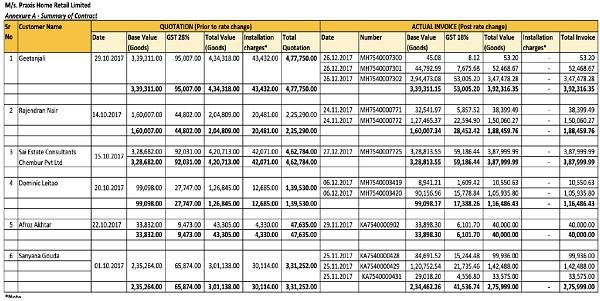
| 7 . | Average selling price (pre rate reduction with GST) | G=E*1.28 | Rs. 35.54 | |
| 8 . | Commensurate Selling price (post Rate reduction-with GST) | H=E*1.18 | Rs. 32.77 | |
| 9 . | Invoice No. | I | WB7540044565 | |
| 10 . | Invoice Date | J | 17.11.2018 | |
| 11 . | Total Billed quantity (above invoice) | K | 5 | |
| 12 . | Transaction Value in the invoice | L | Rs. 305 | |
| 13 . | Actual Selling price per | M=L/K | Rs. 61 | |
| 14 . | Post rate reduction with GST) Excess amount charged or profiteering | N=M-H | Rs. 28.23 | |
| 15 . | Total Profiteering | O=N*K | 141.15 | |
6.3. On the basis of the aforesaid illustration, the DGAP observed that the actual selling price exceeded the commensurate selling price arrived at after giving effect to the reduction in the GST rate and accordingly, an amount of Rs. 141.15/- was computed as profiteering in respect of the said invoice.
6.4. The DGAP similarly illustrated the computation in respect of two other products through Table-B and Table-C as reproduced below:
Table- B
| Description | Factors | Pre Rate Reduction (From 01.11.2017 to 14.11.2017) |
Post Rate Reduction (From 15.11.2017 onwards) |
|---|---|---|---|
| Product Description | A | WalTile 303X450 KCH-3127 Normal Sales – Non-Customised | |
| Notification No. | B | Notification No. 41/2017-Central Tax (Rate) dated 14.11.2017 | |
| Total quantity of item sold | C | 224 | |
| Total taxable value | D | Rs. 19,249.88 | |
| Average base price (without GST) |
E=D/C | Rs. 85.93 | |
| GST Rate | F | 28% | 18% |
| Average selling price (pre rate reduction with GST) | G=E*1.28 | Rs. 109.99 | |
| Commensurate Selling price (post Rate reduction-with GST) | H=E*1.18 | Rs. 101.39 | |
| Invoice No. | I | UP7540002689 | |
| Invoice Date | J | 28.12.2017 | |
| Total Billed quantity (above invoice) |
K | 130 | |
| Transaction Value in the invoice | L | Rs. 15,340 | |
| Actual Selling price per | M=L/K | Rs. 118 | |
| Post rate reduction with GST) Excess amount charged or profiteering | N=M-H | Rs. 16.61 | |
| Total Profiteering | O=N*K | Rs. 2,159.30 | |
Table- C
| Sr. No. |
Description | Factors | Pre Rate Reduction (From 01.11.2017 to 14.11.2017) | Post Rate Reduction (From 15.11.2017 onwards) |
|---|---|---|---|---|
| 1 . | Product Description | A | Top mark Wenge Executive Table – Normal Sales – Non-Customized | |
| 2 . | Notification No. | B | Notification No. 41/2017-Central Tax (Rate) dated 14.11.2017 | |
| 3 . | Total quantity of item sold | C | 1 | |
| 4 . | Total taxable value | D | Rs. 46,796.88 | |
| 5 . | Average base price (without GST) | E=D/C | Rs. 46,796.88 | |
| 6 . | GST Rate | F | 28% | 18% |
| 7 . | Average selling price (pre rate reduction with GST) | G=E*1.28 | Rs. 59,900 | |
| 8 . | Commensurate Selling price (post Rate reduction-with GST) | H=E*1.18 | Rs. 55,220.31 | |
| 9 . | Invoice No. | I | MH7540000470 | |
| 10 . | Invoice Date | J | 23.11.2017 | |
| 11 . | Total Billed quantity (above invoice) | K | 2 | |
| 12 . | Transaction Value in the invoice | L | Rs. 1,45,800 | |
| 13 . | Actual Selling price per Post rate reduction with GST) | M=L/K | Rs. 72,899.99 | |
| 14 . | Excess amount charged or profiteering | N=M-H | Rs. 17,679.68 | |
| 15 . | Total Profiteering | O=N*K | Rs. 35,359.36 | |
6.5. These illustrations formed the basis of the DGAP’s broader invoice-wise computation in respect of the goods impacted by the reduction in GST rate.
6.6. In the original Report, the DGAP ultimately determined the total profiteered amount at Rs. 3,67,88,027/- for the period from 15.11.2017 to 30.09.2019. The Report stated that this amount included Rs. 21,200/- as the profiteering amount collected by the Respondent from the Complaint. The DGAP further stated that the computation was made by comparing the channel-wise average base prices of the impacted goods during the pre-rate-reduction period with the actual invoice-wise base prices during the post-rate-reduction period.
6.7. The original Report also contained a State-wise break-up of the profiteering amount in Table-D which is reproduced as below:
| S. No. | State Code | State | Profiteered Amount (Rs.) |
|---|---|---|---|
| 1 | 01 | Jammu & Kashmir | 0 |
| 2 | 02 | Himachal Pradesh | 1422 |
| 3 | 03 | Punjab | 11599 |
| 4 | 04 | Chandigarh | 427 |
| 5 | 05 | Uttarakhand | 3558 |
| 6 | 06 | Haryana | 1001674 |
| 7 | 07 | Delhi | 646151 |
| 8 | 08 | Rajasthan | 18032 |
| 9 | 09 | Uttar Pradesh | 2849079 |
| 10 | 10 | Bihar | 29827 |
| 11 | 11 | Sikkim | 59487 |
| 12 | 12 | Arunachal Pradesh | 38912 |
| 13 | 13 | Nagaland | 31882 |
| 14 | 14 | Manipur | 3268 |
| 15 | 15 | Mizoram | 0 |
| 16 | 16 | Tripura | 10294 |
| 17 | 17 | Meghalaya | 95375 |
| 18 | 18 | Assam | 1440273 |
| 19 | 19 | West Bengal | 6824656 |
| 20 | 20 | Jharkhand | 803844 |
| 21 | 21 | Orissa | 67992 |
| 22 | 22 | Chhattisgarh | 623994 |
| 23 | 23 | Madhya Pradesh | 226151 |
| 24 | 24 | Gujarat | 198043 |
| 25 | 27 | Maharashtra | 8500621 |
| 26 | 29 | Karnataka | 4900367 |
| 27 | 30 | Goa | 10444 |
| 28 | 31 | Lakshwadeep | 13728 |
| 29 | 32 | Kerala | 427569 |
| 30 | 33 | Tamil Nadu | 371900 |
| 31 | 34 | Pondicherry | 477 |
| 32 | 35 | Andaman & Nicobar Islands | 8144 |
| 33 | 36 | Telangana | 4450097 |
| 34 | 37 | Andhra Pradesh (New) | 1368742 |
| Grand Total | 36788027 |
7. The aforesaid Investigation Report was thereafter examined by the NAA. Upon examination of the DGAP’s Report, the Respondent’s submissions and the material available on record, the NAA identified the following issues requiring re-examination:
7.1. Although the investigation had proceeded on the basis that the rate of GST on the subject goods was reduced from 28% to 18%, the calculation sheet in Annexure-19 contained certain entries where the goods had been taxed at 12% and 5%, respectively and profiteering had also been computed in respect of such entries.
7.2. There were substantial variations between the pre-GST and post-GST base prices of certain products. In particular, for “Screw On front connector 2Pcs” (Serial No. 91), the base price was shown as Rs. 7.27/- in the pre-GST period as against Rs. 0.85/- in the post-GST period, while for “SS16 LUMOS METALLIC BASE LAMP ASRTD” (Serial No. 994), the corresponding prices were shown as Rs. 934.38/- and Rs. 3.47/-. Further, in respect of Serial No. 111, the base price appeared as a negative figure.
7.3. There was a discrepancy in the State-wise computation of profiteering. While the total profiteering reported by the DGAP was Rs. 3,67,88,027/-, the aggregate of the figures appearing in Table-D was Rs. 3,50,38,029/-, resulting in a difference of Rs. 17,49,998/-.
7.4. The Respondent contended that it had obtained GST registration only in November, 2017 and that the transactions undertaken prior to the rate reduction were by Future Retail Ltd. According to the Respondent, it was a separate legal entity holding a different GST registration and consequently, the prices of transactions undertaken by Future Retail Ltd. could not be compared with those of the Respondent for determining profiteering.
8. The DGAP examined the material submitted by the Respondent during the re-investigation and specifically addressed each of the four issues identified by the NAA in the Report dated 29.03.2023.
8.1. In respect of the first issue, concerning the goods taxed at 12% and 5%, the DGAP found that the earlier investigation had covered all three categories of goods affected byNotification No. 41/2017-Central Tax (Rate) dated 14.11.2017, namely: (a) goods where GST was reduced from 28% to 18%; (b) goods where GST was reduced from 18% to 12%; and (c) goods where GST was reduced from 12% to 5%. On scrutiny of the invoice-wise details, the DGAP found that Serial No. 69694 related to a Bedsheet, while Serial No. 71039 related to a Vase, with different HSN classifications and GST rates. The DGAP accordingly maintained that the profiteering computed on these entries was attributable to goods actually impacted by the relevant rate reductions.
| S. No. | Ref. | Date | Description | HSN | GST Rate | Price (incl.GST) |
|---|---|---|---|---|---|---|
| 1 . | 69964 | 28.12.2017 | AW 17/Essentials-A/E- 2/PEACH/SBQ2995 | 94042190 | 12% | Rs. 2,995 |
| 2 . | 71039 | 17.12.2017 | AW17/EZRA RIBBED BTTL VASE 23C ORNG | 69149000 | 5% | Rs. 125 |
8.2. In respect of the second issue, concerning the substantial variation in the prices reflected at Serial Nos. 91 and 994 and the negative value appearing at Serial No. 111, the Respondent reiterated that the modular kitchen business involved customised and made-to-order supplies for which consideration was negotiated on a lump-sum basis and subsequently allocated among individual items for billing purposes. In respect of Serial No. 994, the Respondent stated that the goods had been scrapped and sold at a nominal value and that the notation “DAD” in its internal records denoted “Damaged and Defective”. In respect of Serial No. 111, it was stated that the negative value represented a credit note.
8.3. The DGAP, however, observed that the Respondent had not provided a separate classification of the “DAD” invoices either in the sales classification column or in the invoice-number column and therefore, the distinction between scrap and non-scrap items and the alleged anomaly could not be independently verified on the basis of the information furnished. As regards Serial No. 111, the DGAP noted that the transaction represented a credit note and that no profiteering had been computed in respect thereof. Accordingly, the said entry did not result in any alteration to the profiteering computation:
| Serial No. | Product | Pre-GST base price |
Post-GST base price |
|---|---|---|---|
| 91 | Screw On front connector 2Pcs |
Rs. 7.27/- | Rs. 0.85/- |
| 994 | SS16 LUMOS METALLIC BASE LAMP ASRTD | Rs. 934.38/- | Rs. 3.47/- |
| 111 | Screw On front connector 2Pcs |
Negative | – |
8.4. In respect of the third issue, namely, the discrepancy in Table-D, the DGAP accepted that the State-wise table contained an inadvertent error in the figure relating to Gujarat and stated that the figure required correction. However, as noticed above, the difference between Rs. 1,98,043/- and Rs. 19,48,043/- is Rs. 17,50,000/-, whereas the difference between the State-wise aggregate of Rs. 3,50,38,029/- and the aggregate amount of Rs. 3,67,88,027/- is Rs. 17,49,998/-. Accordingly, the correction stated by the DGAP does not, by itself, reconcile the two totals. The correctness of the final aggregate amount must, therefore, be determined with reference to the underlying invoice-wise calculation and not merely on the basis of the corrected Gujarat figure stated in the Report.
8.5. As regards the Respondent’s contention that it was a separate legal entity and that the pre-rate-reduction transactions were undertaken by Future Retail Ltd. (FRL), the DGAP relied upon the demerger of the Home Retail Business Undertaking of FRL into the Respondent. The DGAP referred, inter alia, to the quotation dated 03.11.2017 issued by FRL, the subsequent tax invoice dated 20.11.2017 stated to have been issued by the Respondent, and the NCLT Order dated 10.11.2017 governing the demerger. The DGAP treated these documents as evidencing continuity of the Home Retail Business Undertaking. The evidentiary and legal effect of these documents including the significance of the Respondent’s GST registration date, requires independent consideration.
8.6. The DGAP also considered the NCLT Order dated 10.11.2017, particularly paragraph 13.1.2 thereof, and relied upon the provision treating the profits, income, expenditure, losses and taxes relating to the Home Retail Business Undertaking of Future Retail Ltd. as those of Praxis Home Retail Ltd. for the purposes specified therein. On that basis, the DGAP concluded that the change in legal entity consequent upon the demerger did not in its view, extinguish the requirement to pass on the benefit arising from the reduction in the rate of tax under Section 171 of the CGST Act, 2017.
8.7. In its final conclusion, the DGAP stated that in its view, the directions issued by the NAA vide Order No. 24/2022 dated 30.09.2022 had been complied with and that the computation contained in the earlier Report remained sustainable subject to the clarifications recorded during the re-investigation.
8.8. The DGAP accordingly concluded that the Respondent had contravened Section 171(1) of the CGST Act, 2017 by not passing on the benefit arising from the reduction in the rate of tax by way of commensurate reduction in prices.
9. Thereafter, the investigation Report dated 29.03.2023 was received in the Competition Commission of India on 31.03.2023 for adjudication under Section 171 of the CGST Act, 2017. . A notice dated 31.07.2023 was issued to the Respondent directing it to file written submissions on the DGAP Report.
10. The Respondent vide submissions dated 05.01.2026 and 09.07.2026 contended against the Report stating as under:
10.1. The Respondent submitted that it was engaged in providing customized solutions to its customers, particularly in relation to modular kitchens and other retail products. It was submitted that the prices of such products depended upon several factors, including customer requirements, size, quality and material used, location, seasonality and other commercial considerations. Accordingly, two supplies could not be treated as comparable merely on the basis of a similar product description. It was further submitted that the DGAP had compared the pre-rate-reduction estimate with the post-rate-reduction tax invoice without taking into consideration the differences in the products and deliverables. According to the Respondent, such comparison could not constitute a proper basis for determination of profiteering. Reliance was also placed on the earlier findings of the NAA to contend that factors such as demand and supply, input costs, taxes and other business considerations are relevant while examining price variations.
10.2. The Respondent further submitted that it obtained GST registration only with effect from 21.11.2017 and therefore, had not made any sales prior to the reduction in the GST rate. It was contended that there was consequently no pre-rate-reduction sale by the Respondent which could be compared with its subsequent sales. The Respondent submitted that in the absence of such a pre-rate-reduction transaction, the basic basis for comparison of prices before and after the rate reduction was itself unavailable.
10.3. The Respondent further submitted that Section 171 of the CGST Act, 2017 could not be invoked where no supplies had been made by it prior to the rate reduction. It was contended that the statutory requirement of passing on the benefit arising from reduction in the rate of tax by way of commensurate reduction in price necessarily presupposes a proper basis for comparison of the relevant supplies. Since, according to the Respondent it had not made any supplies before the rate reduction, there was no basis to determine whether any benefit had been retained by it.
10.4. The Respondent further submitted that Section 171(1)could not be applied in the present case in the absence of any transitional supply contract. It was contended that the transactions under consideration were not contracts entered into before the rate reduction and completed thereafter, but were customised transactions undertaken on a lump-sum basis in accordance with the commercial terms agreed with the customers. It was further submitted that prices agreed for such transactions could not subsequently be examined merely on account of a change in the GST rate. According to the Respondent, such an approach would restrict its right to revise prices in the ordinary course of business and would effect the controlling of prices, contrary to Article 19(1)(g) of the Constitution.
10.5. The Respondent challenged the adoption of approximately 22 months as the period of investigation. It was submitted that the complaint related to an invoice dated 30.11.2017, whereas the DGAP had examined transactions over a period of nearly two years. The Respondent submitted that prices in its business could change from time to time on account of factors such as increase in input costs, market conditions, demand and supply, changes in labour and staff costs, marketing strategies and other commercial considerations. It was therefore, contended that prices prevailing over such an extended period could not be directly compared. It was further submitted that such an extended investigation effectively restricted the Respondent’s freedom to revise prices and thereby amounted to an indirect form of price control.
10.6. The Respondent submitted that there was no evidence of profiteering and that the customer had subsequently withdrawn the complaint. It was contended that the complaint was based on a comparison between an estimate issued before the rate change and a tax invoice issued thereafter, without taking into consideration the differences in the deliverables. The Respondent further submitted that it had explained the position to the State Level Screening Committee and that the customer had acknowledged that he had been misled and expressed his willingness to withdraw the complaint. However, according to the Respondent, the withdrawal could not be completed for procedural reasons. It was submitted that the customer’s declaration regarding withdrawal was subsequently placed on record.
10.7. The Respondent submitted that the CGST Act, 2017 and the Rules do not prescribe any specific methodology for determination of profiteering. It was contended that the DGAP had adopted its own methodology without adequately explaining the basis on which the alleged profiteering was computed, thereby depriving the Respondent of a proper opportunity to defend its case. Reliance was placed on Rule 126 of the CGST Rules, 2017, and it was submitted that the power to determine the methodology and procedure for determining profiteering vested in the NAA and not in the DGAP. The Respondent also relied upon the decisions in Commissioner of Central Excise and Customs Kerala v. Larsen and Toubro Limited. (2016) 1 SCC 170 and Commissioner of Income Tax, Bangalore v. B.C. Srinivasa Shetty (1981) 2 SCC 460 to contend that, in the absence of a proper machinery for computation, the demand could not be sustained.
10.8. The Respondent submitted that mere earning of profit could not by itself, amount to profiteering. It was contended that Section 171 could apply only where it was established that the benefit arising from reduction in the rate of tax or increase in ITC had been wilfully retained and not passed on to the customer. It was further submitted that profit earned through lawful business activities could not, by itself, be treated as profiteering. The Respondent submitted that its business involved customised products and dynamic pricing and that prices could increase or decrease for several legitimate business reasons. Therefore, an increase in price could not automatically be treated as profiteering. It was also contended that the DGAP had not established that the Respondent had increased its prices with the intention of retaining the benefit arising from the GST rate reduction.
10.9. The Respondent submitted that the NCLT Order dated 10.11.2017 fixed 01.07.2017 as the appointed date and that pursuant to the said Order, certain transactions undertaken by Future Retail Ltd. (FRL) during the relevant period were recognised in the Respondent’s books for accounting purposes. It was submitted that the transactions were actually undertaken by FRL and that the availment of Input Tax Credit (hereinafter referred to as “ITC”) and payment of the corresponding outward tax liability were also undertaken by FRL. The Respondent therefore, contended that merely because such transactions were recognised as income in its books pursuant to the NCLT-approved arrangement, it could not be treated as the person who had actually undertaken those transactions. Reliance was placed on Reliance Infratel Limited [2016 (42) S.T.R. 452 (Tri. – Mumbai)] to contend that an accounting entry, by itself, could not determine the taxability of a transaction unless the requirements of the relevant tax law were satisfied. It was therefore, submitted that the accounting treatment arising from the NCLT-approved arrangement could not, by itself, determine the Respondent’s liability underSection 171 of the CGST Act, 2017. .
10.10. The Respondent submitted that the DGAP had travelled beyond the scope of the complaint and had exceeded its jurisdiction. It was contended that the complaint related to Modular Kitchen Components, i.e. the subject goods, and that the reference made to the DGAP was also in respect of those goods. According to the Respondent, the DGAP, however, expanded the investigation to other goods and services supplied by the Respondent without any direction from the Standing Committee or the Authority. Reliance was placed on Rules 129(1) and 129(3) of the CGST Rules, 2017, particularly the requirement that the goods or services forming the subject matter of the proceedings should be specified. The Respondent further relied upon the subsequent insertion of Rule 129(5) by Notification No. 31/2019-Central Tax dated 28.06.2019 to contend that the power to expand the scope of investigation was specifically conferred upon the Authority and not upon the DGAP. It was, therefore, submitted that the DGAP could not have suo motu enlarged the scope of the investigation.
11. Per contra, the DGAP, vide its clarifications dated 02.01.2026 and 30.01.2026, and further clarification dated 14.08.2026, addressed the submissions and objections raised by the Respondent:
11.1. As regards the contention that the Respondent was engaged exclusively in customised solutions and therefore, there were no comparable products for undertaking a pre- and post-rate reduction comparison, the DGAP submitted that this contention had already been examined during the investigation. The DGAP referred to the earlier Investigation Report dated 27.11.2020, wherein illustrations of customised as well as non-customised products supplied by the Respondent had been considered. It was submitted that the Respondent had itself furnished the relevant pre and post-rate data for examination. The DGAP accordingly did not accept the contention that the customised nature of the products, by itself, rendered comparison impossible.
11.2. On the contention that customised contracts executed on a lump-sum basis were not amenable to profiteering analysis, the DGAP submitted that the consideration for each customised transaction was separately negotiated as the products, including modular kitchens, were made to order according to the requirements of individual customers. The DGAP further clarified that although the total consideration was agreed on a lump-sum basis, the invoices contained per-item prices for billing purposes. It was accordingly submitted that the lump-sum nature of the contractual arrangement did not render the transactions incapable of examination for the purposes of determining profiteering.
11.3. With regard to the Respondent’s contention that it obtained GST registration only with effect from 21.11.2017 and, therefore, had not undertaken supplies prior to the reduction in the rate of tax, the DGAP submitted that the Respondent itself had furnished documents and data relating to the period preceding Notification No. 41/2017-Central Tax (Rate) dated 14.11.2017. According to the DGAP, those documents demonstrated business activity and pricing data relating to the pre-rate-reduction period. The DGAP, therefore, contended that the date of GST registration, by itself, could not be treated as conclusive of the absence of any relevant pre-rate-reduction transaction or pricing evidence.
11.4. In relation to the contention that Section 171 could not be invoked in the absence of a pre-rate-reduction supply by the Respondent, the DGAP submitted that the relevant reduction in the rate of tax was effected by Notification No. 41/2017-Central Tax (Rate) dated 14.11.2017 with effect from 15.11.2017. The DGAP contended that the Respondent’s date of GST registration could not, by itself, determine whether the transactions forming part of the transferred business were liable to examination under Section 171. According to the DGAP, the relevant issue was whether the benefit of the reduction in the rate of tax was passed on in respect of the supplies forming part of the business under examination.
11.5. As regards the contention that Section 171 could not be applied in the absence of a transitional supply contract, the DGAP relied upon the quotation dated 03.11.2017 issued by FRL, the subsequent tax invoice dated 20.11.2017 stated to have been issued by the Respondent and the NCLT Order dated 10.11.2017. The DGAP submitted that these documents, read with the demerger of the Home Retail Business Undertaking, established continuity of the relevant business. The DGAP further relied upon paragraph 13.1.2 of the NCLT Order, while contending that the profits, income, expenditure, losses and taxes relating to the Home Retail Business Undertaking were, for the purposes specified in the said Order, to be treated as those of the Respondent. The DGAP accordingly submitted that the Respondent could not rely solely upon the date of its GST registration to contend that the benefit arising from the reduction in the rate of tax was outside the scope of Section 171.
11.6. On the Respondent’s objection to the period of investigation of approximately 22 months, the DGAP submitted that the period of investigation was neither prescribed under the CGST Act, 2017 nor under the corresponding Rules or Notifications. It was stated that the Standing Committee on Anti-Profiteering had referred the matter to the DGAP on 09.10.2019 and accordingly, the period from 15.11.2017 up to 30.09.2019 was taken for investigation. The DGAP further submitted that the same practice had been uniformly adopted in investigations to cover the period up to the last date of the month preceding the month in which the reference was received. The DGAP, therefore, rejected the contention that adoption of the said period was impermissible or constituted an exercise of price control.
11.7. With regard to the contention that there was no evidence of profiteering since the complaint had subsequently been withdrawn by the customer, the DGAP submitted that the investigation had been undertaken pursuant to a reference received from the Standing Committee on Anti-Profiteering under Rule 129 of the CGST Rules, 2017. It was further submitted that the reference had been forwarded to the DGAP for detailed investigation and that neither the CGST Act, 2017 nor the Rules relating to anti-profiteering contained any provision stipulating that an investigation would cease merely because the complainant subsequently withdrew the complaint. The DGAP accordingly rejected the contention that such withdrawal affected the continuation of the investigation.
11.8. In relation to the Respondent’s contention that the anti-profiteering provisions could be invoked only where an unlawful manner of business or profiteering was established, the DGAP submitted that Section 171 of the CGST Act, 2017 expressly requires every reduction in the rate of tax on a supply of goods or services, or the benefit of input tax credit, to be passed on to the recipient by way of commensurate reduction in prices. The DGAP accordingly submitted that the statutory obligation under Section 171 was attracted upon the reduction in the rate of tax and did not depend upon establishing any separate unlawful manner of conducting business.
11.9. With regard to the Respondent’s reliance on the accounting treatment arising from the demerger, the DGAP reiterated that the quotation dated 03.11.2017, the tax invoice dated 20.11.2017 and paragraph 13.1.2 of the NCLT Order dated 10.11.2017, when read together, supported its position that the Respondent could not avoid the statutory obligation under Section 171 merely on the basis of its accounting treatment or the date of its GST registration.
11.10. Finally, in response to the contention that the DGAP had exceeded its jurisdiction by examining products beyond the contours of the complaint, the DGAP submitted that Section 171 of the CGST Act, 2017 required the benefit arising from reduction in the rate of tax on any supply of goods or services to be passed on to the recipient by way of commensurate reduction in prices. The DGAP further submitted that the determination of profiteering was required to be undertaken with reference to the individual supplies and the benefit attributable thereto, and that the scope of the statutory mechanism was not confined merely to the particular product or transaction mentioned in the original complaint. The DGAP accordingly rejected the Respondent’s contention that the investigation was without jurisdiction.
12. Heard Shri Ajay Tehlan, Additional Assistant Director, appearing on behalf of the Directorate General of Anti-Profiteering and Shri Gopal Mundhra, learned Advocate, appearing on behalf of the Respondent.
13. During the hearings, the Respondent, through its oral submissions, reiterated the submissions already made in writing.
Observations on the issues raised by the NAA
14. We have examined the four issues identified by the erstwhile NAA in its Order No. 24/2022 dated 30.09.2022, the responses furnished by the DGAP pursuant to the directions for re-investigation, and the material available on record. The findings of the Tribunal on the said issues are recorded hereunder:
a) Entries taxed at 12% and 5%: The NAA had noticed that, although the investigation was stated to concern the reduction in the rate of GST from 28% to 18%, certain entries in Annexure-19 reflected supplies attracting GST at 12% and 5%. The DGAP explained that apart from modular kitchens attracting GST at 18%, certain other items were either used in the customisation of modular kitchens or were sold separately by the Respondent and were subject to the corresponding rate reductions from 18% to 12% and from 12% to 5%. We find that the said entries were not outside the scope of the rate reductions examined by the DGAP and were included in the computation with reference to the applicable rate of tax and the corresponding base prices. Accordingly, the inclusion of such transactions does not, by itself, warrant any exclusion from the profiteering computation
b. Variations in pre- and post- GST base prices: The NAA had also noticed substantial variations in the pre- and post-GST base prices in certain instances, including Serial No. 91 and Serial No. 994, as well as a negative value at Serial No. 111. The DGAP clarified that Serial No. 111 represented a credit note, in respect of which no profiteering had been computed. In respect of Serial No. 994, the Respondent had stated that the goods were damaged/defective and had been sold as scrap; however, the material furnished on record did not independently establish that the transaction was wholly unrelated to the supplies covered by the investigation or that it was required to be excluded from the computation. We have examined the methodology adopted by the DGAP and find that the mere existence of variations in individual transactions does not, in the absence of cogent evidence demonstrating that the transactions were unrelated or that the methodology had been wrongly applied, justify their wholesale exclusion from the computation.
c. Discrepancy between Table-D and the reported aggregate profiteering amount: The NAA had noticed that the State-wise figures in Table-D aggregated to Rs. 3,50,38,029/-, whereas the aggregate profiteering amount reported by the DGAP was Rs. 3,67,88,027/-. The DGAP subsequently clarified that the figure pertaining to Gujarat had inadvertently been stated as Rs. 1,98,043/- instead of Rs. 19,48,043/-. We have taken note of the said correction and also examined the resulting arithmetic difference between the corrected State-wise aggregation and the aggregate amount determined by the DGAP. The discrepancy is therefore treated as a matter arising from the presentation of the State-wise figures and is considered in the context of the underlying computation, rather than as establishing any additional amount of profiteering over and above Rs. 3,67,88,027/-.
d) Respondent’s objection regarding the legal entity: The NAA had also directed examination of the Respondent’s contention that it was registered under GST only with effect from 21.11.2017, whereas the pre-rate-reduction transaction relied upon by the DGAP was associated with Future Retail Ltd. We have examined the quotation dated 03.11.2017, the tax invoice dated 20.11.2017, the NCLT order dated 10.11.2017 and in particular, Clause 13.1.2 thereof. The material on record shows the continuity of the Home Retail Business Undertaking in the context of the demerger and the subsequent transaction undertaken by the Respondent. The Respondent’s GST registration date therefore, cannot be examined in isolation from the underlying business transfer and transaction sequence. Accordingly, the objection regarding the legal identity of the supplier does not, by itself, invalidate the pre-rate-reduction reference data or render the comparison adopted by the DGAP impermissible.
15. In view of the foregoing discussions, we find that the four discrepancies identified by the NAA have been examined in the reinvestigation and have also been independently considered by us. None of the aforesaid issues, either individually or cumulatively, warrants exclusion of the relevant transactions or rejection of the methodology adopted by the DGAP. We accordingly proceed to examine the Respondent’s remaining contentions and the ultimate profiteering determination on the basis of the material available on record.
Issues for determination
16. Upon consideration of the submissions of the Respondent, the clarifications furnished by the DGAP, and the material available on record, in our opinion, following issues arise for our determination:
i. Whether in view of the Respondent having obtained GST registration with effect from 21.11.2017 and the demerger of the business of Future Retail Ltd. pursuant to the NCLT Order dated 10.11.2017, the transactions under consideration could be examined under Section 171 of the CGST Act, 2017, and whether the absence of any pre-rate-reduction supply by the Respondent affects such determination?
ii. Whether the DGAP exceeded the scope of its jurisdiction by examining goods and services beyond the subject matter of the complaint?
iii. Whether the customised and composite nature of the modular kitchen supplies, coupled with the lump-sum contractual arrangement and the manner in which the pre- and post-rate-reduction prices are evidenced, affects the comparability of the transactions for determining the commensurate reduction in prices under Section 171(1)of the CGST Act, 2017, and whether the methodology adopted by the DGAP for such determination is sustainable?
iv. Whether the subsequent withdrawal of the complaint affects the continuation or validity of the proceedings under Section 171 of the CGST Act, 2017?
v. Whether the Respondent failed to pass on the benefit arising from the reduction in the rate of tax by way of commensurate reduction in prices, in contravention of Section 171(1)of the CGST Act, 2017, and whether the determination of profiteering can be sustained in the absence of proof of wilful retention of such benefit?
vi. Whether the period for which profiteering was determined by the DGAP, i.e. 15.11.2017 to 30.09.2019, is appropriate for determining the benefit arising from the reduction in the rate of tax?
Determination of issue (i)
Whether in view of the Respondent having obtained GST registration with effect from 21.11.2017 and the demerger of the business of Future Retail Ltd. pursuant to the NCLT Order dated 10.11.2017, the transactions under consideration could be examined under Section 171 of the CGST Act, 2017, and whether the absence of any pre-rate-reduction supply by the Respondent affects such determination?
17. We have considered the submissions of the Respondent, the clarification furnished by the DGAP and the material available on record. The Respondent has primarily contended that it obtained GST registration only with effect from 21.11.2017 and that the transactions prior thereto were undertaken by Future Retail Ltd. It has further been submitted that, pursuant to the NCLT Order dated 10.11.2017, the revenue relating to the Home Retail Business Undertaking was recognised in the books of the Respondent with effect from 01.07.2017 for accounting and compliance purposes and that such accounting treatment could not, by itself, determine the person liable under the GST law.
18. The Respondent has also relied upon the demerger of the Home Retail Business Undertaking of FRL and has sought to distinguish the accounting treatment pursuant to the said arrangement from the actual incidence of supply under the GST law.
19. The aforesaid contention has to be examined in the context of the terms of the NCLT Order dated 10.11.2017 governing the demerger of the Home Retail Business Undertaking. Clause 13.1.2 of the said Order provides as under:
“13.1.2 All the profits or incomes accruing or arising and all expenditure or losses arising or incurred (including all taxes, if any, paid or accruing in respect of any profits and income) by FRL in relation to the Home Retail Business Undertaking shall, for all purposes, be treated and be deemed to be and accrue as the profits or incomes, or as the profits or incomes, or as the case may be, expenditure or losses (including taxes) of PHRL.”
20. The aforesaid clause is relevant for determining the consequences of the demerger between the transferor and transferee undertakings. It cannot, however, be read in isolation as conclusively determining the identity of the supplier for every individual transaction under the CGST Act, 2017. For that purpose, the relevant invoices, GST registration particulars, contractual documents and other contemporaneous evidence must also be examined.
21. The fact that PHRL obtained GST registration with effect from 21.11.2017 is therefore a relevant circumstance, but it is not by itself determinative of the applicability of Section 171. The question has to be examined with reference to the particular transactions forming the subject matter of the investigation and the documentary evidence establishing continuity, pricing and the identity of the supplier in those transactions.
22. At the same time, the Respondent has contended that the relevant transactions were actually undertaken by FRL and that the corresponding availment of ITC and discharge of outward tax liability were also undertaken by FRL. This contention cannot be rejected merely on the basis of the accounting treatment under the demerger scheme. At the same time, the accounting treatment under the scheme is a relevant piece of evidence concerning the transfer and continuity of the Home Retail Business Undertaking. The question must therefore be determined on the cumulative effect of the NCLT-approved arrangement, the contractual and pricing documents, the invoices, the GST registration particulars and the other material on record.
23. The record contains the quotation dated 03.11.2017 issued by FRL and a subsequent tax invoice dated 20.11.2017 stated to have been issued by PHRL. These documents are relevant to the question whether the post-rate-reduction transaction represented the continuation or completion of the same commercial transaction initiated before the rate reduction. However, the evidentiary connection between the quotation and the subsequent invoice, including the identity of the customer, description and quantity of goods, consideration and other material particulars, must be established from the record before treating them as documents relating to the same transaction.
24. The absence of a pre-rate-reduction tax invoice in the name of PHRL cannot, by itself, be treated as conclusive against the applicability of Section 171. Similarly, the existence of a pre-rate-reduction quotation issued by FRL cannot, by itself, establish the price against which the post-rate-reduction transaction is required to be compared. The decisive question is whether the material on record establishes a sufficient nexus between the pre-rate-reduction pricing evidence and the post-rate-reduction supplies and whether on the methodology lawfully adopted, the benefit arising from the reduction in the rate of tax was passed on to the recipients.
25. The contention that Section 171 can be invoked only in respect of a “transitional contract” cannot be accepted as an absolute proposition. Section 171(1) requires the benefit arising from a reduction in the rate of tax on a supply to be passed on by way of commensurate reduction in prices. The absence of a contract entered into before the rate reduction is not, by itself, determinative of whether the statutory benefit was passed on. At the same time, where the alleged pre-rate-reduction price is derived from a quotation rather than an actual completed supply, the evidentiary reliability of that quotation and its comparability with the subsequent transaction must be independently examined.
26. Accordingly, the Respondent’s objection that the transactions could not be examined under Section 171 merely because PHRL obtained GST registration with effect from 21.11.2017 cannot be accepted in the absolute terms in which it has been urged. The date of registration is a relevant factual circumstance but is not, by itself, conclusive of the applicability or otherwise of Section 171. The applicability of the provision must be determined with reference to the nature of the transactions, the demerger arrangement and the documentary evidence establishing the relevant pre- and post-rate-reduction pricing. Issue No. (i) is accordingly decided against the Respondent, subject to the findings recorded on the evidentiary and computational aspects considered hereinafter.
Determination of Issue (ii)
Whether the DGAP exceeded the scope of its jurisdiction by examining goods and services beyond the subject matter of the complaint?
27. We have considered the submissions of the Respondent, the clarification furnished by the DGAP and the material available on record. The Respondent has contended that the DGAP exceeded the scope of its jurisdiction by examining goods and services beyond the specific subject matter of the complaint. According to the Respondent, the investigation ought to have remained confined to the goods or services in respect of which the original complaint was made. The issue, therefore, is whether the scope of the DGAP’s investigation was restricted to the specific goods or services identified in the complaint.
28. In this regard, Rule 129(2) of the CGST Rules, 2017 empowers the DGAP to conduct investigation and collect evidence necessary to determine whether the benefit of reduction in the rate of tax on any supply of goods or services or the benefit of ITC has been passed on to the recipient by way of commensurate reduction in prices.
29. The aforesaid position has been expressly considered by the Hon’ble Delhi High Court in Reckitt Benckiser India Pvt. Ltd. v. Union of India, 2024 (82) G.S.T.L. 344 (Del.). The Hon’ble Court, while considering the scope of Section 171 of the CGST Act, 2017 and Rule 129 of the CGST Rules, 2017, held that Section 171 is widely worded and does not limit the scope of examination only to the goods or services in respect of which a complaint is received. The Hon’ble Court further considered the expression “any supply of goods or services” occurring in Rule 129(2) and observed as under:
159. Section 171 of the Act, 2017 is widely worded and does not limit the scope of examination to only goods and services in respect of which a complaint is received. The scope of powers of the DGAP is provided for in Rule 129 of the Rules, 2017. From a reading of the said Rule especially the expression ‘any supply of goods or services ‘used in sub-rule (2) of Rule 129, it is apparent that the scope of the DGAP’s powers is very wide and is not limited to the goods or services in relation to which a Complaint is received. The word ‘any ’includes within its scope ‘some ’as well as ‘all’.
161. In the context of similar powers of investigation exercised by the Director General under the Competition Act, 2002, the Supreme Court in Excel Crop Care Ltd. v. Competition Commission of India (2017) 8 SCC 47/[2017] 81 taxmann.com 173, has held that the Director General would be well within its powers to investigate and report on matters not covered by the complaint or the reference order of the Commission, and an interpretation to the contrary would render the entire purpose of investigation nugatory. The High Court of Delhi in Cadila Healthcare Ltd. v. CCI (2018) SCC Online Del 11229/[2018] 97 taxmann.com 237, relying on the judgment of the Supreme Court in Excel Crop Care Ltd. (supra) has clarified in express terms that the scope of investigation by the Director General is not restricted to the matter stated in the Complaint and includes other allied as well as unenumerated matters. Consequently, the expansion of investigation or proceedings beyond the scope of the complaint is not ultra vires the statute.
30. Applying the aforesaid principle to the present case, the mere fact that the investigation extended to goods or services beyond those specifically identified in the complaint cannot, by itself, render the investigation without jurisdiction. The Respondent has also not demonstrated that, while examining such additional supplies, the DGAP travelled outside the statutory purpose of determining whether the benefit contemplated under Section 171 had been passed on.
31. The Respondent has not demonstrated that the DGAP, while examining the additional goods or services, travelled outside the statutory purpose of determining whether the benefit arising from reduction in the rate of tax or the benefit of ITC had been passed on by way of commensurate reduction in prices. The subsequent insertion of Rule 129(5) also does not, by itself, alter the scope of the investigative power conferred under Rule 129(2), particularly when the latter provision expressly refers to “any supply of goods or services.”
32. We are, therefore, of the considered view that the DGAP’s investigative jurisdiction was not confined strictly to the particular goods or services identified in the original complaint. The Respondent’s objection that the DGAP suo motu enlarged the scope of the investigation and thereby acted without jurisdiction is accordingly, not sustainable. Issue No. (ii) is accordingly decided in favour of the DGAP and against the Respondent.
Determination of issue (iii)
Whether the customised and composite nature of the modular kitchen supplies, coupled with the lump-sum contractual arrangement and the manner in which the pre- and post-rate-reduction prices are evidenced, affects the comparability of the transactions for determining the commensurate reduction in prices under Section 171(1) of the CGST Act, 2017, and whether the methodology adopted by the DGAP for such determination is sustainable?
33. We have considered the submissions of the Respondent, the clarification furnished by the DGAP and the material available on record. At the outset, it would be appropriate to refer to the relevant statutory provision. Section 171(1) of the CGST Act, 2017 provides as under:
(1) Any reduction in rate of tax on any supply of goods or services or the benefit of input tax credit shall be passed on to the recipient by way of commensurate reduction in prices.
(2) The Central Government may, on recommendations of the Council, by notification, constitute an Authority, or empower an existing Authority constituted under any law for the time being in force, to examine whether input tax credits availed by any registered person or the reduction in the tax rate have actually resulted in a commensurate reduction in the price of the goods or services or both supplied by him.
Thus, the statutory enquiry is not confined merely to ascertaining whether there has been a reduction in the rate of tax. It extends to examining whether the benefit arising therefrom has been passed on to the recipient by way of commensurate reduction in prices.
34. The main contention of the Respondent is that the comparison undertaken by the DGAP is not reliable, as the Respondent was engaged in supplying customised modular kitchens and other products according to the specific requirements of individual customers. It has been submitted that the consideration for such transactions was agreed on a lump-sum basis and that the individual components reflected in the tax invoices could not be treated as separately negotiated supplies. It was further submitted that the component-wise break-up was maintained for purposes such as inventory management and billing and did not represent the actual contractual arrangement with the customer. The Respondent has therefore, contended that comparison of individual component prices appearing in different transactions would amount to comparison of unlike transactions and would not provide a reliable basis for determination of profiteering.
35. The DGAP on the other hand, submitted that the consideration for the customised transactions was separately negotiated and that the products, including modular kitchens, were made to order according to the requirements of individual customers. It was further submitted that the prices of individual items reflected in the invoices were available for examination and that the profit element was already included in the item prices. The DGAP accordingly, did not accept the contention that the lump-sum nature of the contractual arrangement rendered the transactions incapable of examination under Section 171 of the CGST Act, 2017.
36. During the course of hearing, the Respondent was specifically directed vide our order dated 14.05.2026 to submit invoices issued prior to and after the relevant GST rate notification. The relevant direction contained in the said Order reads as follows:
“6. The Respondent is directed to submit few invoices issued prior to and after the GST notification and submit a short synopsis of their argument within two weeks.”
37. Pursuant to the aforesaid direction, the Respondent furnished a document titled “Annexure A”, containing, inter alia, particulars of quotations stated to relate to the period preceding the rate change and invoices relating to the subsequent period as reproduced below:
38. We find that the material furnished by the Respondent does not place before us corresponding actual tax invoices evidencing the prices at which the relevant goods were supplied immediately prior to the rate reduction. A quotation records the price offered or proposed by the supplier and does not, without supporting evidence of acceptance and actual supply establish the price at which the supply was ultimately made. However, for calculation of the Profiteering amount the DGAP has compared the tax invoices issued before and after the rate reduction. Hence the Respondent’s submissions with respect to quotations supplied to various customers is not taken into account.
39. The quotation dated 03.11.2017 and the invoices dated 30.11.2017 and 07.12.2017 furnished in relation to the original complaint are therefore relevant primarily for examining the specific allegation made by the Complaint. They cannot, by themselves, be treated as conclusive proof of the entire pre-rate-reduction pricing base used for the broader profiteering computation. The sustainability of the latter must be determined with reference to the underlying transaction data and the methodology adopted by the DGAP.
40. The next question which arises for consideration is whether the absence of a fixed or uniform mathematical formula renders the methodology adopted for determination of profiteering unsustainable. Rule 126 of the CGST Rules, 2017 empowers the Authority to determine the methodology and procedure for determining whether the reduction in the rate of tax or the benefit of ITC has been passed on by way of commensurate reduction in prices. In this regard, the Hon’ble Delhi High Court in Reckitt Benckiser India Pvt. Ltd. (supra), in Para 124, has observed as under:
“124. This Court is of the view that no fixed/uniform method or mathematical formula can be laid down for determining profiteering as the facts of each case and each industry may be different. The determination of the profiteered amount has to be computed by taking into account the relevant and peculiar facts of each case. There is ‘no one size that fits all ’formula or method that can be prescribed in the present batch of matters. Consequently, NAA has to determine the appropriate methodology on a case to case basis keeping in view the peculiar facts and circumstances of each case.
41. Furthermore, the aforesaid principle has also been reiterated by the Hon’ble Delhi High Court in LICHFL Care Homes Ltd. v. Director General of Anti-Profiteering, Central Board of Indirect Taxes & Customs, W.P.(C) 13665/2026, decided on 28.09.2026, wherein, while considering the methodology for determination of profiteering, the Court observed that the methodology adopted by the authorities is required to be “fair, reasonable and responsive to the peculiarities of the particular project”.
“52. The Court is conscious that Paragraph No.124 of Reckitt Benckiser (supra) holds that no fixed or uniform mathematical formula can be prescribed for determination of profiteering and that the methodology must take into account the peculiar facts of each case. This principle, however, does not mean that every methodology adopted by the authorities is impermissible merely because it involves a mathematical computation. What is required is that the methodology be fair, reasonable and responsive to the peculiarities of the particular project.”
42. The said principle is relevant in the present case, where the supplies included customised modular kitchen products and the consideration was stated to have been agreed on a lump-sum basis. The customised nature of the supplies does not, by itself, exclude them from the scope of Section 171. It is nevertheless necessary that the methodology used for determining the commensurate price should reasonably account for the nature of the transactions and should be founded upon sufficiently reliable pre- and post-rate-reduction data.
43. The absence of a prescribed mathematical formula therefore does not dispense with the requirement of a rational and evidence-based determination. In particular, where substantial variations are disclosed in the base prices of the same or apparently similar products, such variations require examination to determine whether they arise from genuine differences in the goods supplied, damage or defective goods, credit notes, quantity differences or other identifiable commercial factors, or whether they affect the reliability of the comparison itself.
44. The relevant question is, therefore, whether the methodology adopted by the DGAP, when applied to the underlying data and after taking into account the anomalies identified by the NAA, provides a sufficiently reliable basis for determining the commensurate reduction in price. The fact that the transactions were customised or involved lump-sum consideration is relevant to this enquiry, but is not by itself determinative.
45. The Respondent has also contended that the DGAP had itself prescribed a methodology contrary to Rule 126 of the CGST Rules, 2017. We find no merit in this contention. Rule 126 empowers the Authority to determine the methodology and procedure, while Rule 129 provides for investigation by the DGAP. The DGAP was accordingly required to apply the applicable methodology to the material relevant to the investigation.
46. The calculation sheet forming part of the DGAP’s Report records, transaction-wise, the relevant product description, the pre-rate-reduction average base price, the post-rate-reduction base price, the applicable GST rates and the consequential computation of the amount alleged to have been retained. The computation proceeds by comparing the relevant base price, exclusive of GST, with the price actually charged after the rate reduction and by applying the reduced rate of GST to determine the commensurate price. We have examined the said calculation methodology together with the issues specifically identified by the NAA.
Sr No |
Stare Name/ Name of Customer |
Invoke Date |
Goods /Service Description |
Total Taxable Amount |
65T Rate |
65T ATOM. |
Invoice Value |
Average pre-Base Price |
Actual Base Price charged in Post Rate reduction period (in Rs.) |
Profitering per unit (inRs.j |
Amount of GST on Profiteering (In Rs.) |
Profiteeri me inclusive of GS, (inRs.) |
Final Profiteering (in rs.) |
A |
a |
E |
II |
L |
FA |
FA |
0 |
T |
U |
V=U-T |
W=VAR. |
X=VAW |
)1°X.K. |
HT-THANE-MANPADA-R MALL |
25-11-2017 |
AW16 IRF60.3195A COMBIPACK – BIG |
1525.42 |
18 |
274.58 |
1800 |
1406.24 |
1525.42 |
119.18 |
21.45 |
140.63 |
140.63 |
|
2 |
HT-VADODRA-WADIWADI (CUT IN CENTRAL |
30-11-2017 |
YOGAMAT61/(173/(0.5 BROWN 695 |
588.98 |
18 |
10E02 |
695 |
542.96 |
588.98 |
46.02 |
13.28 |
54.30 |
54.30 |
HT-HYDERABAD-INORBIT MALL |
26-11-2017 |
YOGAMAT 61)(173%0.5 BROWN 695 |
1177.96 |
18 |
212.04 |
1390 |
542.96 |
588.98 |
46.02 |
8.28 |
54.30 |
108.61 |
|
0 |
HT -KOLKATA-HOMELAND-BHAVANIPUR |
22-11-2017 |
YOGAMLAT 61X173X0.5 BROWN 695 |
588.98 |
18 |
106.02 |
695 |
542.96 |
588.98 |
4E02 |
11.20 |
54.30 |
54.30 |
5 |
HT-MUMBALI-VIKHROLI |
21-11-2017 |
YOGAMLAT61X173X0.5 BROWN 695 |
412.72 |
18 |
74.28 |
987 |
542.96 |
412.72 |
0.00 |
0.00 |
MOO |
0.00 |
6 |
HT-KOLKATA-RALARHAT |
22-11-2017 |
AV/15 YOGA MAT Blue 80x 200 x0.5cm 1150 |
1949.16 |
18 |
350.04 |
2300 |
/398.44 |
914.58 |
7E14 |
13.71 |
89.85 |
179.69 |
7 |
HT-BEN GALURU-VANSHREE TOWER |
30-11-20175516 |
REV YOGA MAT RED BLUE 995 |
777.34 |
28 |
217.66 |
995 |
777.34 |
777.34 |
0.00 |
0.00 |
0.00 |
0.00 |
8 |
HT-BEN GALURU-VANSHREE TOWER |
32-11-20175516 |
REV YOGA MAT RED BLUE 995 |
777.34 |
28 |
217.66 |
995 |
777.34 |
777.34 |
0.00 |
MOO |
0.00 |
0.00 |
9 |
HT-HYDERABAD-GACHIBOWLI |
30-11-2017 |
HAPPINESS ROUND COASTER- Mod Assrt |
127.12 |
18 |
22.08 |
150 |
39.06 |
42.37 |
3.31 |
0.60 |
3.91 |
11.72 |
10 |
HT-THANE-THANE-R MALL |
30-11-2017 |
HAPPINESS ROUND COASTER- Mod Assrt |
84.74 |
18 |
15.26 |
100 |
39.06 |
42.37 |
3.31 |
0.60 |
3.90 |
7.81 |
11 |
HT-PUNE-MARKET CITY |
30-11-2017 |
HAPPINESS ROUND COASTER- Mod Assrt |
42.38 |
18 |
7.62 |
50 |
39.06 |
42.38 |
3.32 |
0.60 |
392 |
3.92 |
12 |
HT-CT-BENGALURU-.1.P.NAGAR |
30-11-2017 |
HAPPINESS ROUND COASTER- Mod Assrt |
92.38 |
18 |
7.62 |
50 |
39.06 |
42.30 |
3.32 |
0.60 |
392 |
3.92 |
13 |
HT-AHMEDABAD-ACROPOLIS MALL |
29-11-2017 |
HAPPINESS ROUND COASTER-Mod Assrt |
67.8 |
18 |
12.2 |
BO |
39.06 |
33.90 |
000 |
0.00 |
0.00 |
MOO |
14 |
HT-HYDERABAD-PUNIAGUTTA |
28-11-2017 |
HAPPINESS ROUND COASTER- Mod ASSrt |
84.79 |
18 |
15.26 |
100 |
39.06 |
42.37 |
3.31 |
0.60 |
330 |
7.81 |
15 |
HT-VADODRA-WADIWADI (CUT IN CENTRAL |
29-11-2017 |
HAPPINESS ROUND COASTER-Mod ASSrt |
508.48 |
18 |
91.52 |
600 |
39.06 |
42.37 |
331 |
0.60 |
331 |
46.89 |
16 |
HT-KOLKATA-RAIARHAT |
27-11-2017 |
HAPPINESS ROUND COASTER-Mod ASSrt |
127.12 |
18 |
22.88 |
150 |
39.06 |
42.37 |
331 |
0.60 |
331 |
11.72 |
17 |
HT-MUMBAI-MATUNGA-ERA HOUSE |
27-11-2017 |
HAPPINESS ROUND COASTER-Mod Assrt |
254.24 |
18 |
45.76 |
300 |
39.06 |
42.37 |
331 |
010 |
331 |
23.44 |
18 |
HT-VISHAKAPATNAM-CIOR CENTRAL MALL |
27-11-2017 |
HAPPINESS ROUND COASTER-Mod Assrt |
127.12 |
18 |
22.88 |
150 |
39.06 |
42.37 |
3.31 |
010 |
331 |
11.72 |
19 |
HT-KOLKATA-RAJARHAT |
26-11-2017 |
HAPPINESS ROUND COASTER- Mod Assrt |
966.1 |
18 |
83.9 |
550 |
39.06 |
42.37 |
3.31 |
0.60 |
391 |
4237 |
20 |
HT-MUMBALI-VIKHROLI |
26-11-2017 |
HAPPINESS ROUND COASTER-Mod Assrt |
92.38 |
18 |
7.62 |
50 |
39.06 |
42.38 |
3.32 |
0.60 |
392 |
3.92 |
21 |
HT-THANE-MANPADA-R MALL |
26-11-2017 |
HAPPINESS ROUND COASTER- Mod ASSrt |
92.38 |
18 |
7.62 |
50 |
39.06 |
42.38 |
3.32 |
0E0 |
392 |
3.92 |
22 |
HT-VASH-CENTER ONE |
26-11-2017 |
HAPPINESS ROUND COASTER- Mod Assrt |
508.48 |
18 |
91.52 |
600 |
39.06 |
42.37 |
3.31 |
0.60 |
3.91 |
46.89 |
23 |
HT-GURGAON-AMBIENCE MALL |
26-11-2017 |
HAPPINESS ROUND COASTER- Mod Assrt |
254.24 |
18 |
45.76 |
300 |
39.06 |
42.37 |
3.31 |
0.60 |
3.91 |
23.44 |
24 |
HT-VISHAKAPATNAM-CIOR CENTRAL MALL |
26-11-2017 |
HAPPINESS ROUND COASTER- Mod Assrt |
127.12 |
18 |
22.88 |
150 |
39.06 |
42.37 |
3.31 |
0.60 |
391 |
11.72 |
25 |
HT-KOLKATA-RAJARHAT |
25-11-2017 |
HAPPINESS ROUND COASTER- Mod Assrt |
92.38 |
18 |
7.62 |
50 |
39.06 |
42.38 |
3.32 |
060 |
332 |
392 |
26 |
HT EXP-RAPUR-DEVE NORA NAGAR |
26-11-2017 |
HAPPINESS ROUND COASTER-Mod Assrt |
338.98 |
18 |
61.02 |
400 |
39.06 |
42.37 |
3.31 |
0.60 |
3.91 |
31.25 |
27 |
HT-HYDERABAD-INORBIT MALL |
25-11-2017 |
HAPPINESS ROUND COASTER-Mod Assrt |
84.79 |
18 |
15.26 |
100 |
39.06 |
42.37 |
3.31 |
0.60 |
330 |
7.81 |
28 |
HT-HYDERABAD-GACHIBOWLI |
25-11-2017 |
HAPPINESS ROUND COASTER- Mod ASSrt |
254.24 |
18 |
45.76 |
300 |
39.06 |
42.37 |
3.31 |
010 |
3.91 |
23.44 |
29 |
HT-MUMBALI-VIKHROLI |
25-11-2017 |
HAPPINESS ROUND COASTER- Mod Assrt |
127.12 |
18 |
22.08 |
150 |
39.06 |
42.37 |
331 |
010 |
3.91 |
11.72 |
30 |
HT-MUMBAI-MATUNGA-ERA HOUSE |
25-11-2017 |
HAPPINESS ROUND COASTER- Mod Assn |
211.86 |
18 |
33.14 |
250 |
39.06 |
42.37 |
331 |
0.60 |
3.91 |
19.53 |
31 |
HT-BENGALURU-INANTRI MALI. |
25-11-2017 |
HAPPINESS ROUND COASTER- Mod Assn |
92.38 |
18 |
7.62 |
50 |
39.06 |
42.38 |
3.32 |
010 |
332 |
392 |
32 |
HT-KOLKATA-RAIARHAT |
24-11-2017 |
HAPPINESS ROUND COASTER-Mod Assn |
127.12 |
18 |
22.88 |
150 |
39.06 |
42.37 |
3.31 |
010 |
3.91 |
11.72 |
33 |
HT-HYDERABAD-PUNIAGUTTA |
24-11-2017 |
HAPPINESS ROUND COASTER- Mod Assn |
508.48 |
18 |
91.52 |
600 |
39.06 |
42.37 |
3.31 |
0.60 |
391 |
46.59 |
34 |
HT-MUMBALI-VIKHROLI |
24-11-2017 |
HAPPINESS ROUND COASTER-Mod ASSrt |
92.38 |
18 |
7.62 |
50 |
39.06 |
42.38 |
3.32 |
0.60 |
392 |
3.92 |
35 |
HT-VISHAKAPATNAM-CIOR CENTRAL MALL |
24-11-2017 |
HAPPINESS ROUND COASTER-Mod Assrt |
127.12 |
18 |
22.88 |
150 |
39.06 |
42.37 |
3.31 |
0.60 |
3.91 |
11.72 |
36 |
HT EXP-RAPUR-DEVE NORA NAGAR |
24-11-2017 |
HAPPINESS ROUND COASTER- Mod Assrt |
84.79 |
18 |
15.26 |
100 |
39.06 |
42.37 |
3.31 |
0.60 |
390 |
7.81 |
37 |
HT-VASH-CENTER ONE |
23-11-2017 |
HAPPINESS ROUND COASTER- Mod Assrt |
92.38 |
18 |
7.62 |
50 |
39.06 |
42.38 |
3.32 |
0.60 |
392 |
3.92 |
38 |
HT-VISHAKAPATNAM-CIOR CENTRAL MALL |
23-11-2017 |
HAPPINESS ROUND COASTER- Mod Assrt |
84.79 |
18 |
15.26 |
100 |
39.06 |
42.37 |
3.31 |
060 |
390 |
7.81 |
39 |
HT-KOLKATA-RAIARHAT |
22-11-2017 |
HAPPINESS ROUND COASTER- Mod Assrt |
211.86 |
18 |
38.14 |
250 |
39.06 |
42.37 |
3.31 |
0.60 |
3.91 |
19.53 |
40 |
HT-HYDERABAD-GACHIBOWLI |
22-11-2017 |
HAPPINESS ROUND COASTER- Mod ASSrt |
127.12 |
18 |
22.88 |
150 |
39.06 |
42.37 |
3.31 |
0.60 |
391 |
11.72 |
41 |
HT-CT-BENGALURU-I.P.NAGAR |
22-11-2017 |
HAPPINESS ROUND COASTER- Mod Assrt |
92.38 |
18 |
7.62 |
50 |
39.06 |
42.38 |
3.32 |
0.60 |
332 |
3.92 |
42 |
HT EXP-RAPUR-DEVE NORA NAGAR |
22-11-2017 |
HAPPINESS ROUND COASTER- Mod Asset |
296.62 |
18 |
53.38 |
350 |
39.06 |
42.37 |
3.31 |
010 |
3.91 |
27.35 |
43 |
HT-HYDERABAD-PUNIAGUTTA |
21-11-2017 |
HAPPINESS ROUND COASTER- Mod Asset |
508.48 |
18 |
91.52 |
600 |
39.06 |
42.37 |
331 |
OSA |
3.91 |
46.89 |
44 |
HT-PUNE-MARKET CITY |
21-11-2017 |
HAPPINESS ROUND COASTER- Mod Assrt |
84.79 |
18 |
15.26 |
100 |
39.06 |
42.37 |
331 |
0.60 |
330 |
7.81 |
47. The calculation sheet demonstrates the manner in which the DGAP quantified the amount allegedly not passed on. Where the post-rate-reduction base price, after taking into account the reduced rate of GST, resulted in an amount in excess of the commensurate price, the difference was treated as the amount of profiteering. The computation was undertaken with reference to the relevant quantities and transactions and was thereafter aggregated. However, the aggregate amount must be reconciled with the State-wise computation and the corrections directed by the NAA.
48. The calculation sheet further demonstrates that the DGAP did not merely compare gross invoice values inclusive of GST. The computation proceeded with reference to the base price and the applicable rate of tax in the pre- and post-rate-reduction periods. We have also examined the entries specifically identified by the NAA, including the entries relating to goods taxed at 12% and 5%, the substantial price variations and the negative entry.
49. In respect of Serial No. 111, the DGAP treated the negative amount as relating to a credit note and did not include any profiteering in respect thereof. As regards Serial No. 994, the Respondent attributed the substantially lower post-rate-reduction price to damaged and defective goods sold at a nominal value. The DGAP stated that the Respondent had not furnished a sufficiently distinct classification enabling independent verification of the “DAD” transactions. In the absence of adequate supporting evidence establishing that the anomalous entries were wholly unrelated to the normal sales used for the comparison, the entries cannot be treated as conclusively establishing that the entire methodology was invalid. At the same time, their treatment must be reflected consistently in the underlying computation.
50. On an overall examination of the methodology adopted by the DGAP, the material relied upon, and the clarifications furnished during the reinvestigation, we find that the customised and composite nature of the supplies does not, by itself, render the methodology adopted by the DGAP impermissible. The methodology is, therefore, found to be a permissible basis for determining the benefit required to be passed on under Section 171(1) of the CGST Act, 2017. However, the amount of profiteering determined by the DGAP must be considered in light of the State-wise figures, the specific corrections directed by the NAA, and the explanation furnished for the residual difference of Rs. 2/-between the corrected State-wise aggregation and the aggregate amount reported by the DGAP. As discussed hereinafter, the said difference of Rs. 2/- has been found to be insignificant and has accordingly been ignored. Subject to the aforesaid, Issue No. (iii) is answered accordingly.
Determination of issue (iv)
Whether the subsequent withdrawal of the complaint affects the continuation or validity of the proceedings under Section 171 of the CGST Act, 2017?
51. We have considered the submissions of the Respondent, the material available on record and the statutory scheme governing anti-profiteering proceedings. The Respondent has contended that the complainant subsequently withdrew the complaint and therefore, no surviving grievance remained against the Respondent. It has accordingly been submitted that the proceedings under Section 171 could not validly continue thereafter. We are unable to accept this contention. Once the matter was taken up under the statutory mechanism and referred for investigation in accordance with Rule 129, the proceedings were required to be examined in accordance with the provisions of the CGST Act and the Rules. Rule 129 contemplates a detailed investigation by the DGAP to determine whether the benefit arising from reduction in the rate of tax or the benefit of ITC has been passed on to the recipient by way of commensurate reduction in prices.
52. Proceedings under Section 171 cannot, therefore, be treated as a purely private dispute whose continuation depends upon the complainant’s continued grievance. The obligation to pass on the benefit is statutory and its compliance is determined by the competent authorities in accordance with the prescribed procedure. The Hon’ble Delhi High Court in Reckitt Benckiser (supra) has recognised the anti-profiteering provisions as a consumer-welfare measure and has emphasised the statutory mechanism through which such proceedings are investigated and determined.
53. In the present case, the complaint had already resulted in initiation of proceedings and investigation by the DGAP. Its subsequent withdrawal cannot retrospectively invalidate the proceedings already undertaken or, by itself, extinguish the statutory obligation under Section 171. Accordingly, the withdrawal does not bring the proceedings to an end or render the investigation invalid. Therefore, the issue No. (iv) is decided in favour of the DGAP and against the Respondent.
Determination of issue number (v)
Whether the Respondent failed to pass on the benefit arising from the reduction in the rate of tax by way of commensurate reduction in prices, in contravention of Section 171(1)of the CGST Act, 2017, and whether the determination of profiteering can be sustained in the absence of proof of wilful retention of such benefit?
54. We have considered the submissions of the Respondent, the clarifications furnished by the DGAP and the material available on record. The Respondent has contended that mere earning of profit or an increase in selling price cannot, by itself, constitute profiteering and that the DGAP has not established any intention or wilful conduct on its part.
55. Section 171(1)of the CGST Act, 2017 casts a statutory obligation to pass on the benefit arising from reduction in the rate of tax by way of commensurate reduction in prices. The statutory enquiry is therefore directed to the existence and extent of the benefit and whether that benefit was passed on. A separate finding of intention or wilful retention is not, under Section 171(1)a condition precedent to determining the benefit not passed on. At the same time, a mere increase in selling price or the earning of profit, without establishing the quantum of benefit and its non-passing on, cannot by itself constitute profiteering.
56. In the present case, the DGAP examined invoice-wise data and determined the amount allegedly not passed on by reference to the pre-rate-reduction base prices and the post-rate-reduction prices. The question before us is whether that determination, after taking into account the issues identified by the NAA and the material produced by the Respondent, establishes the amount of benefit not passed on.
57. The Respondent has referred to changes in input costs, market conditions, demand and supply, labour costs and other commercial factors. Such factors may be relevant to the determination of actual prices were supported by contemporaneous and transaction-specific evidence. The Respondent, however, has not demonstrated, with reference to the transactions included in the calculation, the extent to which such factors accounted for the increase in the relevant base prices or offset the benefit arising from the reduction in the rate of GST. The mere assertion of general commercial factors is therefore insufficient to displace the invoice-wise computation, subject to the reconciliation of the aggregate amount discussed above.
58. In this regard, the Tribunal in DGAP v. Urban Essence (Subway Franchisee), [2025] 177 com 376 (GSTAT–New Delhi) has recognised that factors other than the reduction in the rate of tax may be relevant in examining an increase in prices, but such factors are required to be established by cogent, clear and unequivocal evidence or material. In the present case as noticed above, the Respondent has not placed sufficient transaction-specific or contemporaneous material to establish the extent to which the stated commercial factors accounted for the increase in the relevant base prices or offset the benefit arising from the reduction in the rate of GST. The relevant extracts of the said judgment are reproduced below:
“26. In Paragraph 119, the High Court of Delhi express that in agreement with the submission of learned Amicus Curiae that if there is any variation on account of other factors, such as any costs necessitating the setting off of such reduction of price, the same needs to be justified by the supplier. The inherent presumption that these must necessarily be a reduction in prices of the goods and services is a rebuttable presumption. It is clarified that if the supplier is to assert reasons for offsetting the reduction, it must establish the same on cogent basis and must not use it merely as a device to circumvent the statutory obligation of reducing the prices in a commensurate manner contemplated under Section 171 of the Act.
27. Thus, it is clear as per the provision 171 if there is a reduction in the rate of tax as it is the case here it must be passed on end user or consumer by commensurate reduction in price. However, in cases where there has been any increase in the base price of the product or any other market forces have pushed up the price of the base product then that has to be considered. There is a presumption, though it is a rebuttable one, that once there is a reduction in rate of GST then it must pass on to the consumers but such presumption can be rebutted by cogent, clear and unequivocal evidences or materials. In this case, the Respondent has not produced any documents or any evidence to rebut such a presumption, either before the investigating agency or before this Tribunal or the Erstwhile NAA. The Respondent did not produce any document to show that the price of the base price of the product had increased after 14.11.2017. So, there is no rebuttal of the presumption that arises in favour of the DGAP’s Report.”
(emphasis supplied)
59. We therefore find that as per Section 171(1) the benefit of rate reduction has to be passed onto the consumers. It is the Respondent’s obligation to do so and also to provide reasonable evidence as to whether the benefit arising from the reduction in the rate of tax was passed on by way of commensurate reduction in prices and, if not, the quantum thereof. This issue is accordingly answered in affirmative.
Determination of Issue (vi)
Whether the period for which profiteering was determined by the DGAP, i.e. 15.11.2017 to 30.09.2019, is appropriate for determining the benefit arising from the reduction in the rate of tax?
60. We have considered the submissions of the Respondent, the clarifications furnished by the DGAP and the material available on record. The Respondent has objected to the period from 15.11.2017 to 30.09.2019 on the ground that it extends over approximately 22 months and that prices of customised goods may change during such period because of changes in input costs, customer-specific requirements and other commercial factors.
61. In this regard, it would be appropriate to refer to the decision of the Hon’ble Delhi High Court in Reckitt Benckiser India Pvt. Ltd.(supra). The Hon’ble High Court, while considering the scheme of Section 171 of the CGST Act, 2017, specifically dealt with the question of the period for which the benefit arising from reduction in the rate of tax is required to be reflected in prices. In paragraph 135, the Hon’ble High Court observed as under:
“135. This Court is in agreement with the submissions of the respondents and the learned Amicus Curiae that bearing in mind the very nature of the Act, 2017, it is not proper or feasible to contemplate any specific period of time for application of the reduced price, as the same has to take effect so long as the direct relation between the reduction of tax rate or the benefit of Input Tax Credits exists and there is no other factor effecting/countering the same. If, conceptually, the reduction of tax rate has taken place on a specified date and there are no justified variations in the cost price or other factors for offsetting such reduction in the prices for a particular period of time, clearly for that period a reduced price must govern the transaction. This Court is of the view that providing for a particular period of time for operation of the provisions would be not in conformity with the scheme and intent of the Act, 2017 itself.”
62. The aforesaid principle indicates that Section 171 does not prescribe a fixed number of months for which the benefit must be examined. This, however, does not mean that the period selected for computation is immune from scrutiny. The period must bear a reasonable nexus with the rate reduction and the transactions to which the benefit relates.
63. The relevant enquiry is therefore whether the period adopted for the computation reasonably captures the transactions affected by the reduction in the rate of tax and whether the Respondent has produced material demonstrating that identifiable changes in costs or other relevant factors materially affected the prices during that period.
64. In the present case, the DGAP determined profiteering for the period from 15.11.2017 to 30.09.2019. The commencement date corresponds to the date from which the relevant reduction in the rate of GST became effective. The end date corresponds to the end of the month preceding the month in which the reference was stated to have been received by the DGAP. The adoption of this period therefore has a discernible nexus with the rate reduction and the reference.
65. The mere length of the period cannot, by itself, invalidate the determination. In a continuing business, the statutory benefit arising from a rate reduction is not confined to the first transaction after the reduction. The relevant question remains whether the benefit continued to be reflected in the prices during the period for which the transactions were examined.
66. The commercial factors relied upon by the Respondent may be relevant where they are supported by cogent evidence and demonstrate a corresponding change in the cost or other determinants of price. Their general assertion without transaction-specific or contemporaneous supporting material, does not by itself establish that the increase in the base prices was attributable to such factors rather than the non-passing on of the tax benefit.
67. On examination of the material placed on record, the Respondent has not established, with reference to the transactions included in the computation, that identifiable increases in input or other relevant costs were of such magnitude and timing as to offset the benefit arising from the reduction in the rate of GST.
68. We therefore find that the period from 15.11.2017 to 30.09.2019 cannot be rejected merely because it extends over approximately 22 months. The period has a reasonable nexus with the effective date of the rate reduction and the reference received by the DGAP. The Respondent has also not established, on the basis of specific supporting evidence, that changes during this period rendered the methodology incapable of determining the benefit attributable to the rate reduction.
69. The objection of the Respondent regarding the length of the period is therefore rejected, subject to the final reconciliation of the computation referred to hereinabove. Issue No. (vi) is accordingly answered against the Respondent.
Conclusion
70. In view of the foregoing discussion, we hold that the Respondent failed to pass on to the customers the benefit arising from the reduction in the rate of tax by way of commensurate reduction in prices, in contravention of Section 171(1) of the CGST Act, 2017. We have also examined the discrepancy in the State-wise aggregation identified during the re-investigation. The DGAP has clarified that the discrepancy arose on account of the inadvertent omission of the numeral 4 in the Gujarat figure, which was accordingly corrected from Rs. 1,98,043/- to Rs. 19,48,043/-. The correction resulted in an increase of Rs. 17,50,000/- in the Gujarat figure, whereas the difference between the original State-wise aggregate of ₹3,50,38,029/- and the aggregate profiteering amount of Rs. 3,67,88,027/- is Rs. 17,49,998/-. Thus, a residual difference of Rs. 2/- remains between the two amounts. Having regard to the explanation furnished by the DGAP regarding the correction of the Gujarat figure, and subject to the foregoing reconciliation, the residual difference of Rs. 2/- is considered insignificant and is ignored.
71. Accordingly, the profiteering amount determined by the DGAP is accepted at Rs. 3,67,88,027/- for the period from 15.11.2017 to 30.09.2019. This amount includes Rs. 21,200/- relating to the Complainant, which forms part of the total profiteered amount. Consequently, the DGAP report dated 29.03.2023 is accepted.
72. As regards imposition of penalty, Section 171(3A) of the CGST Act, 2017 was inserted with effect from 01.01.2020. The profiteering determined in the present proceedings relates to the period from 15.11.2017 to 30.09.2019. Since the period in respect of which the contravention has been determined predates the coming into force of Section 171(3A), no penalty under the said provision is imposable in the present proceedings.
ORDER
73. The DGAP report dated 29.03.2023 is accepted.
74. Accordingly, in terms of Section 171 of the CGST Act, 2017 read with Rule 133(3)(b) and Rule 133(3)(c) of the CGST Rules, 2017, the Respondent is directed to pass on/ deposit the profiteered amount of Rs. 3,67,88,027/-. Out of the said total amount, an amount of Rs. 21,200/-, being the amount of profiteering attributable to the Complainant, who is an identifiable recipient, shall be passed on to the Complainant along with interest at the rate of 18% in terms of Rule 133(3)(b) from the date of collection of the higher amount from the Complainant till the date of actual passing on of the corresponding benefit. The remaining amount, pertaining to recipients who are not identifiable in terms of Rule 133(3)(c) along with interest at the rate of 18%, shall be deposited in the respective Consumer Welfare Funds in accordance with the said Rule. The amount of Rs. 21,200/- attributable to the Complainant shall be excluded from the amount to be deposited in the Central/ State Consumer Welfare Funds of Karnataka and shall not be deposited therein.
75. A copy of this Order be supplied to the DGAP, the Respondent and the Jurisdictional Commissioner(s) for information and necessary action.
Order pronounced in the open court in the presence of the Leaned Advocate, Shri Gopal Mundhra appearing on behalf of the Respondent and Shri Ajay Kumar Tehlan, Additional Assistant Director, appearing on behalf of the DGAP.