Swastik Stockists And Traders Pvt. Ltd. Vs Commissioner of Customs (Port), Kolkata (CESTAT Kolkata)
Summary: The Customs, Excise and Service Tax Appellate Tribunal (CESTAT), Kolkata, comprising Judicial Member R. Muralidhar and Technical Member K. Anpazhakan, set aside an order confirming differential customs duty, confiscation, redemption fine and penalties against M/s Swastik Stockists And Traders Pvt. Ltd. The dispute concerned imports of carpets, multimedia speakers and blankets from overseas suppliers during the period from 23 February 2011 to 1 July 2014. The Department alleged deliberate undervaluation and incorrect classification of imported speakers, relying principally on statements recorded from the company’s director, proforma invoices recovered during investigation and purported information obtained from foreign customs authorities. The Tribunal found that these materials failed to establish undervaluation or justify rejection of the declared transaction values under the Customs Valuation Rules. It further held that multimedia speakers with additional ancillary features were correctly classifiable under Customs Tariff Heading 8518 rather than the classification adopted by the Department.
The Directorate of Revenue Intelligence (DRI), Kolkata, had searched the office and residential premises of the then director, Suresh Agarwal, on 8 February 2012 and recorded several statements. The investigation also referred to two proforma invoices relating to Indonesian carpets and alleged communications from customs authorities in Indonesia and China. A show-cause notice dated 1 September 2014, followed by an addendum dated 8 March 2016, proposed reassessment of the imported goods, recovery of differential duty, confiscation and penalties under the Customs Act, 1962. The Commissioner confirmed differential duty of ₹1,16,50,256 on carpets, ₹46,64,532 on speakers and ₹1,66,372 on blankets, together with interest. The order also imposed redemption fine and penalties, including a penalty against the company and a separate personal penalty on its director.
The appellant contended that the director’s statements were vague, general and incapable of establishing undervaluation of any identified consignment. The statements did not disclose specific Bills of Entry, relevant periods, goods, quantities or alleged differential prices. The director had also subsequently alleged that statements were obtained under coercion. Referring to Commissioner of Customs (Imports), Mumbai Vs Ganpati Overseas, the appellant argued that unsupported statements and unverified foreign records could not displace declared transaction values. The appellant further relied on Section 138B of the Customs Act, 1962 and judicial precedents concerning admissibility of statements recorded during investigation. It maintained that no statement had been examined and admitted through the statutory procedure required for reliance in adjudication.
On the alleged undervaluation of carpets, the Tribunal examined the two proforma invoices attributed to an Indonesian supplier. These invoices concerned transactions between an Indonesian supplier and a purchaser in Hong Kong, not the appellant’s imports into India. The documents also related to different varieties of carpets at different prices, without demonstrating comparability with the appellant’s actual consignments. The Tribunal applied the principle recognised in Oswal Metal Works Vs Commissioner of Customs that a proforma invoice ordinarily represents a quotation or offer rather than proof of an actual transaction price. It also observed that the Department had adopted an arbitrary carpet value of USD 3 per square metre without establishing a defensible connection between that figure, the proforma invoices and comparable imports.
The Tribunal further found that the purported information from overseas customs authorities was not adequately authenticated or linked to the particular consignments under investigation. The alleged Chinese customs data consisted of unauthenticated tabulations without proper covering communication. Documents allegedly received from Indonesia did not establish a reliable correlation with the appellant’s Bills of Entry. The Tribunal also noted the absence of disclosed contemporaneous Bills of Entry proving imports of identical or similar goods at higher values. Relying on the principle recognised in Commissioner of Customs, Calcutta Vs South India Television (P) Ltd., 2007 (214) E.L.T. 3 (S.C.), the Tribunal held that the burden of proving undervaluation rested upon the Department. The absence of comparable transaction evidence and the deficiencies in the relied-upon records rendered enhancement of the carpet values unsustainable.
Regarding multimedia speakers, the Tribunal examined whether additional features such as USB, SD-card, MMC playback or FM radio changed the essential classification of the goods. Following decisions concerning the classification of multimedia speakers, including Logic India Trading Company Vs Commissioner of Customs and Jupiter International Limited Vs Commissioner of Customs (Port), Kolkata, it held that such additional functions did not alter the principal character of the products as speakers. Accordingly, classification under CTH 8518 was upheld, while the Department’s proposed classification under CTH 8527/85279100 and the corresponding demand based on MRP-linked valuation were rejected. The Tribunal similarly set aside the differential duty on blankets, finding no consignment-specific corroboration of the allegation of undervaluation or reliable evidence of contemporaneous imports at higher prices.
Having rejected the allegations of undervaluation and misclassification, the Tribunal held that the goods were not liable to confiscation and that the redemption fine and penalties could not survive. It also found no basis for invoking the extended period under Section 28 of the Customs Act, 1962, as fraud, wilful misstatement or suppression with intent to evade duty had not been established. In the connected appeal filed by Suresh Agarwal against the personal penalty of ₹10 lakh under Section 114AA, the Tribunal recorded that he had died, as evidenced by a death certificate issued on 5 March 2019. Consequently, that appeal stood abated and the demand against him did not survive. By Final Order Nos. 77325–77326/2025 dated 18 August 2025, the Tribunal allowed the company’s appeal with consequential relief, while recording the abatement of the director’s appeal.
Cases Discussed
- Commissioner of Customs, Chennai Vs Sahara Enterprises (CESTAT Chennai); 2006 (206) E.L.T. 548 (Tri.-Chennai) — Relied upon through Oswal Metal Works for the proposition that a proforma invoice is an offer or quotation and does not, by itself, establish the price actually paid for imported goods.
- Commissioner of Customs, Calcutta Vs South India Television (P) Ltd. (Supreme Court); 2007 (214) E.L.T. 3 (S.C.) — Applied on the need for reliable contemporaneous import evidence and the Department’s burden to establish grounds for rejecting the declared transaction value.
- Commissioner of Customs Vs Bussa Overseas Properties Ltd. (Supreme Court); 2007 (216) E.L.T. 659 (S.C.) — Cited concerning the evidentiary value of overseas records and statutory presumptions relating to documents.
- Commissioner of Customs Vs J.D. Orgochem Ltd. (Supreme Court); 2008 (226) E.L.T. 9 (S.C.) — Cited by the appellant on the burden of establishing customs undervaluation.
- Basudev Garg Vs Commissioner of Customs (Delhi High Court); 2013 (294) E.L.T. 353 (Del.) — Cited concerning the right to cross-examine witnesses whose statements are relied upon in adjudication.
- Commissioner of Customs Vs Truwoods Pvt. Ltd. (Supreme Court); 2016 (331) E.L.T. 15 (S.C.) — Cited concerning the evidentiary foundation required to sustain enhancement of customs values.
- Logic India Trading Company Vs Commissioner of Customs (CESTAT Bangalore); 2016 (337) E.L.T. 65 (Tri.-Bang.), maintained in 2016 (342) E.L.T. A34 (S.C.) — Followed on classification of multimedia speakers with ancillary features under CTH 8518.
- Hi Tech Abrasives Ltd. Vs Commissioner of Central Excise & Customs (Chhattisgarh High Court); 2018 (362) E.L.T. 961 (Chhattisgarh) — Extensively quoted concerning the mandatory evidentiary procedure under Section 9D of the Central Excise Act, corresponding to Section 138B of the Customs Act.
- Onkyo Sight & Sound India Pvt. Ltd. Vs Commissioner of Customs, Chennai (CESTAT Chennai); 2019 (368) E.L.T. 683 (Tri.-Chennai) — Cited regarding classification of audio products and multimedia speakers under CTH 8518.
- Commissioner of Central Excise & Service Tax, Noida Vs Sanjivani Non-Ferrous Trading Pvt. Ltd. (Supreme Court); 2019 (365) E.L.T. 3 (S.C.) — Cited on rejection of declared transaction value and the Department’s obligation to establish undervaluation.
- Commissioner of Customs (Imports), Mumbai Vs Ganpati Overseas (Supreme Court); (2023) 11 Centax 101 (SC) — Cited regarding the inadequacy of unproved overseas information and statements for enhancement of customs values.
- Gobinda Das Vs Commissioner of Customs (Preventive) (CESTAT Kolkata); (2023) 7 Centax 201 (T-Cal.) — Followed on the admissibility of statements recorded during customs investigations.
- Commissioner of Customs Vs Jeen Bhavani International (Supreme Court); (2023) 6 Centax 14 (SC) — Cited concerning admissibility of computer-generated evidence and the requirements of Section 138C.
- Commissioner of Customs Vs Junaid Kudia (Supreme Court); (2024) 16 Centax 504 (SC) — Cited regarding statutory requirements for computer-generated records and admissibility of evidence.
- Oswal Metal Works Vs Commissioner of Customs, Chennai-III (CESTAT Chennai); 2024 (10) TMI 408 — Followed for the principle that a proforma invoice cannot independently justify enhancement of the transaction value of imported goods.
- Sunny Sales & Ors. Vs Commissioner of Customs (Port), Kolkata (CESTAT Kolkata); 2024 (10) TMI 514 — Followed regarding absence of reliable contemporaneous Bills of Entry and the evidentiary conditions for rejecting import transaction values.
- Jupiter International Limited Vs Commissioner of Customs (Port), Kolkata (CESTAT Kolkata); 2025 (2) TMI 430 — Followed on multimedia-speaker classification under CTH 8518 despite ancillary features.
- Jupiter International Limited Vs Commissioner of Customs (Port), Kolkata (CESTAT Kolkata); Final Order Nos. 75404–75405/2025; 05/02/2025; Customs Appeal Nos. 75580 & 75581 of 2020 — Further relied upon concerning classification of multimedia speakers under CTH 8518 instead of CTH 8527 or CTH 8519.
FULL TEXT OF THE JUDGMENT/ORDER OF CESTAT KOLKATA
Brief facts of the case are that during the period from 23.02.2011 to 01.07.2014, M/s. Swastik Stockists and Traders Private Limited, Kolkata (hereinafter referred to as the “appellant”) imported multiple consignments of carpets, speakers, and blankets from overseas suppliers in Indonesia and Hong Kong, China. The said goods were imported against proper shipping documents, including commercial invoices, and Bills of Entry drawn in terms of the Customs Act, 1962 (“the Act”).
2.1. All the subject consignments, save for one consignment of speakers imported against Bill of Entry 6987461 dated 1.6.2012, that was intercepted by the DRI post-commencement of the investigation against the appellant, were imported and cleared following assessment and inspection by the customs authorities, without any objection being raised at the time in respect of the declarations made by the appellant as to description, classification, quantity or value.
2.2. On 08.02.2012, the officers of Directorate of Revenue Intelligence (DRI), Kolkata Zonal Unit, undertook a search of the office and residential premises of the late Director of the appellant, Suresh Agarwal (Ghoriwala). During the course of such search, and in the period thereafter, several statements of the said Director were recorded by the DRI, which were purported to be confessional in nature, inasmuch as the Director allegedly admitted to undervaluing some imports. In addition to obtaining statements of the said Director, the officers of DRI allegedly also recovered two Proforma Invoices from the appellant’s residence, purportedly obtained information from overseas customs authorities of Indonesia and China, during the course of the subject investigation. Four months after the stated search, the DRI examined the said consignment of speakers sought to be imported under the stated Bill of Entry 6987461 dated 1.6.2012 and detained the same apprehending that the same had been misclassified by the appellant. The said consignment of speakers was subsequently released provisionally against PD Bond No. S37(VB)-35/2012A (PD) and Bank Guarantee (BG) No. S37(VB)-03/2012A (BG) both dated 02.11.2012.
2.3. On completion of the Investigation, a Show Cause Notice dated 01.09.2014 was issued to the appellant, followed by an addendum thereto issued on 08.03.2016. In the Notice, it was alleged that during the said period the appellant had imported the said goods by deliberately undervaluing them with intent to evade payment of customs duty, and in the case of multi-media speakers, by also misclassifying them to suppress CVD liability on the retail sale price basis. The SCN proposed rejection of the declared assessable transaction values under the Customs Valuation (Determination of Value of Imported Goods) Rules, 2007, redetermination of value, and recovery of differential duty with interest under sections 28 and 28AA of the Act, along with confiscation of the goods under section 111(m) and imposition of penalties under sections 114A and 114AA of the Customs Act, 1962.
2.4. On adjudication, the Ld. Commissioner of Customs (Port), Kolkata proceeded to pass the said impugned order, rejecting the declared values for the said goods, confirming the re-determined assessable values and corresponding duty demands as set out in the Show Cause Notice, upholding the proposals for reclassification of speakers, confiscation of the said goods, and imposition of penalties, while accepting the declared values in respect of other minor goods such as glassware, bags, trolleys, toys and keychain for want of corroborative evidence.
2.5. By the subject impugned Order No. KOL/CUS/COMMISSIONER/PORT/33/2017 dated 18.09.2017, the Commissioner of Customs (Port) has confirmed the following demands:
(i) Duty differential demand of Rs. 1,16,50,256 against 87 consignments of carpets particularised in Annexures A and E of the Show Cause Notice dated 01.09.2014, with interest thereon under Sections 28 and 28AA/AB of the Customs Act, 1962.
(ii) Duty differential demand of Rs. 46,64,532 against consignments of speakers particularised in Annexures D and F of the Show Cause Notice dated 01.09.2014 with interest thereon under Sections 28 and 28AA/AB of the Act;
(iii) Duty differential demand of Rs. 1,66,372 against consignments of blankets particularised in Annexure G of the Show Cause Notice dated 01.09.2014 (with interest thereon under Sections 28 and 28AA/AB of the Act;
(iv) Confiscations of the carpets, speakers and blankets (henceforth collectively referred to as the “said goods”) under Section 111(m) of the Act subject to redemption against a fine of Rs. 1,00,000/-
(v) Imposition of penalty under Section 112 of the Act of Rs. 1,00,000/- and under Section 114A of the Act of Rs. 1,76,87,038
Other demands based on Annexure B and C of the Show Cause Notice dated 01.09.2014 on miscellaneous items including glassware, were dropped and the value declared by the appellant during their importation was accepted by the Commissioner.
2.6. Aggrieved against the confirmation of the demands of duty along with interest and penalties confirmed in the impugned order, the appellant has filed this appeal.
3. The Ld. Senior Counsel appearing on behalf of the appellant submits that the said impugned order is patently erroneous, contrary to the facts and materials on record, based on assumptions and presumptions unsupported by materials on record and/or incorrect conclusion arrived at by misconstruing records. It is his submission that the findings arrived at in the said impugned order are misconceived, arbitrary and violative of the principles laid down by Courts and Tribunals on the issues involved including the principles of natural justice; that the purported demand of duty is even otherwise barred by limitation.
3.1. It is also submitted by the appellant that the allegations against them are entirely based on statements of the then-Director, Suresh Agarwal (Ghoriwala), now deceased, purported to be of a confessional nature; that in the first statement of Mr. Agarwal (Ghoriwala) dated 08.02.2012, he claimed to be the Director of the appellant, and the authorised signatory of a different proprietary concern namely, M/s Glass Style International; that he expressly denied any undervaluation in course of importing glassware. However, it is submitted by the Ld. Sr. Counsel for the appellant that regarding “other items” imported by “both the above firms”, the director stated that “there might be chance of undervaluation the value and the amount of which I cannot exactly remember; in this statement, there is no reference to any period, consignment, bills of entry, invoice, or even a product description of the goods he thought may have been undervalued.
3.2. He further points out that in the next statement dated 11.02.2012, the Director had stated that post importation, items were mixed up and separate distinction between the stocks of the appellant and the other concern, M/s. Glass Style International belonging to another proprietor, Vikas Agarwal, was not maintained; he claimed to have undervalued blankets from USD 3.00 per kg to USD 2.25 per kg. Further, he submits that as regards carpets, the Director stated that “carpets had not been imported recently though we sell imported carpets by taking the same from other importers”; thus, save for “blankets”, there was no specific reference to any good to which his purported confession of undervaluation pertained. It is also stated that the Director also said that the goods once imported were mixed together with those of the other firm, M/s Glass Style International in the godowns where the imported goods were kept; there was no reference to any period during which undervaluation took place, and there was also no reference to any bill of entry, or any specific consignment to which such purported confession of undervaluation pertained. It is also his submission that it was also not clear from the statement if he was referring to goods imported by M/s Glass Style International that were undervalued or those of the appellant, be it blankets or otherwise.
3.3. The appellant further submits that during the course of providing his statement dated 11.02.2012, the Director was also shown 2 pro forma invoices showing sale of carpets from a supplier of Indonesia, which was allegedly recovered from his premises; on seeing them, the Director stated “I do not know whether the sale actually took place or not.” He said further, “I am not anywhere related to the said transaction but I might have kept copies of those documents as a part of the original unit price of carpets which might be useful for my export business”; that the Director clarified that “Those documents were sent to me for handing over to some other person like forwarding agent/clearing agent/indenting agent at Kolkata.” The appellant thus contends that therefore it is evident from this statement, that the pro forma invoices were not related in any manner to the imports made by the appellant and that the Director retained them to remember the price of the specific type of carpets described in the invoices; he did not admit to any undervaluation of the carpets and never claimed that the pro forma invoice values represented the actual value of the carpets that the appellant had imported; there is also no confession of any sort that the type of carpets described in the pro forma invoices matched with those imported by the appellant; rather, the Director asserted that these invoices were not related to the imports “in any manner”.
3.4. It is further mentioned by the Ld. Sr. Counsel for the appellant that in the following statement dated 23.07.2014, the Director stated in Answer to Question No. 60, that “earlier these carpets were imported at 2 dollars per square meter FOB, now it is being imported at 2.20 dollars FOB. We generally import only one quality of carpet but sizes and colours differs”; that as regards importation of speakers, the Director stated in answer to Question No. 8, that “We generally import 2.0, 2.1, 4.1 & 5.1 Channel Multimedia Speakers but without any brand name. If the MMS were imported under any brand it was of suppliers and wo don have any brand as such.”; in answer to Question No. 11, the Director stated further that “the utility of MMS is to get good quality sound when attached to other multimedia devices”. Whereas in answer to Question No. 27, the Director stated that USB/SD/FM Radio are “optional features” of the speakers imported. Hence, the appellant stresses that there is absolutely no confession of any sort to any undervaluation or misclassification in the said statement dated 23.07.2014, and a clear clarification was provided that the USB playback feature on the speakers were “optional” negating thereby any presumption that all speakers imported necessarily or mandatorily carried that feature.
3.5. It is also pointed out that the Director subsequently claimed in his reply dated 15.03.2016 to the Show Cause Notice that the statements were obtained at the dictates of the authority recording the same, and that they had been obtained under threat and/or coercion. Relying upon the decision of the Hon’ble Supreme Court in Commissioner of Customs (Imports), Mum v. Ganpati Overseas [(2023) 11 Centax 101 (SC)], the appellant contends that such a statement cannot be used against the person making the statement.
3.6. In view of the aforesaid submissions, the appellant submits that regardless of whether the Director had belatedly disclosed the fact of duress or coercion in course of the obtainment of the statements, there is absolutely no consignment-specific admission or confession to valuation; that there is also no period-specific confession to undervaluation and also no undervaluation admitted in respect of carpets or speakers, both forming the bulk of the demand. As regards blankets, it is submitted that there was an overarching, general statement of undervaluation given by the Director, but there is no reference to any consignment or period in relation to which such undervaluation was purported admitted by the Director. As regards the pro forma invoices, the appellant’s submission is that the Director himself claimed the same to be unrelated to the imports, and there was no indication that the values specified therein had any relevance to the carpets imported. In the case of the subject speakers imported by the appellant, it is mentioned that the dispute is purely based on how they were classified, the matter being one of pure interpretation of the tariff chapter heads; there is also no admission or confession of any deliberate misclassification by the appellant or the Director either.
3.7. It is the further submission of the appellant that the statements are uncorroborated; that in particular, the Department seeks to place reliance on information purportedly obtained from overseas customs authorities to justify the revaluation of the carpets and blankets. In this regard, the appellant contends that the said impugned order and the Show Cause Notice have purported to rely on a letter dated June 2012 of the Directorate General of Customs and Excise, Indonesia, addressed to the First Secretary (Commerce), High Commission of India in Singapore, written in response to the letter of the First Secretary, dated 04.04.2012; the said letter dated June 2012 provides references to 2 containers containing “Carpets” bearing Container Nos. AMFU8872831 and BSIU9152315. It is also their submission in this regard that there is no reference to any bill of lading, or the dates of despatch of the containers, or any invoice reference, but there is a reference to the receiver, International Enterprises, Hong Kong; that this letter indicates that the container was in relation to a shipment from Indonesia to Hong Kong, and not from Indonesia to India. They submit that the subject imports in the present case were made from Indonesia directly to India and therefore, it is clear that the consignment to which the container pertained could not have under any circumstances pertained to the imports in the present case, and given the absence of any consignment details provided in the said letter dated June, 2012, there is no means of determining what connection if any, the same could have with the said goods imported by the appellant. Further, the appellant submits that the purported letter of the First Secretary, High Commission of India in Singapore, dated 04.04.2012 has also not been disclosed by the respondent authorities, be it with the Show Cause Notice or during the adjudication and period thereafter; the said letter dated June, 2012 also contains no description of the carpets, and what size or number of carpets, or variety or characteristic thereof that were being exported, and from which the unit price thereof could have been determined; there are no accompanying shipping documents or any bill of entry, even the one alleged in paragraph 19.4 of the said impugned order (i.e. B/E 2833582 dated 23.02.2011), enclosed with the said letter dated June, 2012 and none have been incorporated as part of the relied upon documents. The appellant therefore submits that it is apparent that the letter dated June 2012 in isolation offers absolutely no information regarding the subject imports, and bears no relevance to the present case, and cannot in any manner serve to corroborate the statements of the Director or support any theory or allegation of undervaluation pertaining to carpets.
3.8. The appellant draws attention to the fact that there are innumerable varieties of carpets whose prices widely vary depending on design, commission, size and other factors, even in respect of the same category and quality of carpets. In the facts and circumstances, they contend that there is no basis to allege undervaluation of the subject consignments of carpets.
3.9. As regards information purported obtained from China Customs authorities, it is the appellant’s contention that the same contain all but a tabulation with import particulars of two entities, being the appellant and the said proprietary concern, M/s Glass Style International (prop. Vikas Agarwal); there is no authentication of any sort by any customs authority of China, and there is no covering letter of any customs authority indicating that such tabulation forms part of a communication involving the customs authorities in China; apart from a mere averment on the part of the respondent authorities, there is absolutely no indication that such tabulation represents any real transaction or evidences any communication with or by the customs authorities in China; the stated tabulation averred to be containing details allegedly provided by the customs authorities in China. Thus, from the above, the appellant submits that the price available in the said proforma Invoices should be disregarded altogether and no relevancy may be accorded to the same to the present case.
3.10. It is also their contention that it is trite law that sole uncorroborated statements, confessional or otherwise, cannot be relied upon for establishing undervaluation of goods by the relevant assessee, particularly where the same is vague, inconsistent and contradictory; they argue that the Commissioner ought to have appreciated that the statements sought to be relied upon in the said order, by themselves, are not sufficient for establishing any undervaluation of the said goods. Further, referring to various judgements of Hon’ble Courts, it is submitted that such statements are relevant and admissible only when examined by the adjudicating authority under Section 138B of the Act. In this connection reliance is placed by the appellant, inter alia, upon the following decisions:
(i) Hi Tech Abrasives Ltd. Vs. Commissioner of C.Ex&Cus [2018 (362) ELT 961 (Chhattisgarh)]
(ii) Basudev Garg Vs. Commissioner of Customs [2013 (294) ELT 353 (Del)]
(iii) Gobinda Das Vs. Commissioner of Customs(Prev.) [(2023) 7 Centax 201(T-Cal)]
3.11. Insofar as the alleged overseas information purportedly obtained from customs authorities in China, the appellant submits that they are unsigned and unattested tabulations without any covering letter indicating their source or authenticity; that it is settled law that no presumption can be raised under Section 139 of the Act in respect of such unsigned and unauthenticated documents; they are inadmissible. Based on such documents, it is their contention that the transaction value of the said goods cannot be enhanced. The appellant places reliance in this regard on the following decisions:
(i) Commissioner of Customs Vs. Bussa Overseas Properties Ltd. [2007 (216) ELT 659 (SC)]
(ii) Commissioner of Customs Vs. TruwoodsPvt. Ltd. [2016 (331) ELT 15 (SC)]
3.12. With regard to the four computer printout invoices copies relied upon in the impugned order, the appellant submits that none of them satisfy the requirements of Section 138C(2) of the Act for being treated as a document which is admissible in any proceedings as per Section 138C(1) of the Act. Thus, they contend in this regard that the said printouts are inadmissible evidence and no demand can be raised or confirmed against the appellant on the basis thereof. In support of this contention, the appellant relies on the following decisions:
(i) Commissioner of Customs Vs. Junaid Kudia [(2024) 16 Centax 504 (SC)]– affirming Juniad Kudia Vs. CC [(2024) 16 Centax 503(T)]
(ii) Commissioner of Customs Vs. Jeen Bhavani International, (2023) 6 Centax 14 (SC)– affirming Jeen Bhavani International Vs. Commissioner of Customs [(2023) 6 Centax 11(T)]
3.13. It is the appellant’s further submission that the respondent authorities have also sought to rely on a Bill of Entry No. 5951708 dated February 8, 2012 drawn by another importer, one M/s S. Krishna & Co., whereby carpets were imported from M/s Pt Universal Carpet & Rugs, Indonesia, being the same supplier from whom they had imported their carpets; however, no copy of such Bill of Entry is included in the relied upon documents accompanying the Show Cause Notice; that in the said Bill of Entry, M/s S. Krishna & Co, being a completely unrelated party, had allegedly imported the said carpets at the rate of USD 2.00 per sq.m. It has been alleged in the said impugned order and the Show Cause Notice however, that though M/s S. Krishna & Co. had declared the valuation of the said carpets to the Indian Customs Authorities at $2.00 per sq.m, its actual value, as purportedly obtained from the Indonesian Customs Authorities was $3.3 per sq.m. Such notice of undervaluation was purportedly provided to the concerned authorities by the Acting Director, DGCE, Ministry of Finance, Indonesia by his letter dated April 30, 2013. However, the appellant has submitted that no copy of such letter dated 30.4.2013 has been disclosed with the Show Cause Notice and the said impugned order acknowledges its absence in para 19.4 of the impugned order. Thus, the appellant stressed that said letter cannot be relied upon as evidence to reject the transaction value declared by them.
3.14. Likewise, the appellant also contends that the details and particulars of carpets purportedly imported by M/s S. Krishna under Bills of Entry No. 2986679 dated March 17, 2011, and No. 3725162 dated June 7, 2011 at the alleged unit price of 3.4 per sq.m, has not been provided in the Show Cause Notice or at any stage during or post-adjudication; none of the copies of the said Bills of Entry dated 17.3.2011 and 7.6.2011 have been disclosed either.
3.15. Accordingly, it is the appellant’s submission that the documents referenced in the impugned order, cannot be accorded any evidentiary value whatsoever for purposes of rejecting the transaction value and re-determining the assessable value for the purpose of charging customs duty.
3.16. As regards the importation of blankets, the appellant puts forth the contention that apart from a general statements by the Director regarding their undervaluation, which was not specific to any consignment or bill of entry or any exporting or importing party for that matter, there was no corroborative evidence of any sort put forward by the respondents in this regard; that the appellant by its reply to the Show Cause Notice, submitted a copy of a Bill of Entry No. 7256218 dated 03.11.2014 against which it had during the course of adjudication imported blankets with a declared unit value of USD 2.2 per kg, but this contemporaneous evidence has been rejected by the adjudicating authority on the purported basis that the same is not contemporaneous even though the Show Cause Notice dated 01.09.2014 had only been issued only 2 months prior to the presentation of such Bill of Entry dated 03.11.2014. It is their plea that the said impugned order has proceeded solely on the basis of the statement of the Director dated 11.02.2012 and not produced any evidence of contemporaneous imports with higher value.
3.17. Inasmuch as the imported speakers are concerned, it is reiterated by the appellant that there was no case for undervaluation, but misclassification, and hence, the dispute was purely of an interpretational nature; there was no confession of any sort by any witness against the appellant, be it of the Director or otherwise, that would indicate any misclassification, or any intent to evade payment of duty on the same.
3.18. Moreover, the appellant argues that it is a settled principle of law that the burden of proof that there has been undervaluation lies on the Department and not on the importer; in this respect it is obligatory on the part of the Customs authorities to disclose contemporaneous evidence to establish that there has been undervaluation of each of the category of subject goods imported by the appellant during the said period; that there has been no such discharge of onus cast upon the Customs authorities in the instant case and not a single piece of material has been disclosed which evidences that at or about the same time when the respective goods were imported by the appellant, goods of similar description, quantity and volume had been imported through any port of the country at a price more than that declared by the appellant. It is submitted that in such cases the purported conclusion of undervaluation sought to be drawn in the show cause notice and the misconceived demands of short paid/short levied duty made therein are not based on legal principles settled by, inter alia, the Apex Court and, hence, untenable and unsustainable. In this respect reliance is placed upon, inter alia, the following decisions:
(i) Commissioner of Customs Vs. J.D. Orgochem Ltd. [2008 (226) ELT 9 (SC)]
(ii) CCE & ST, Noida v. Sanjivani Non-Ferrous Trading Pvt. Ltd. [2019 (365) ELT 3 (SC)]
(iii) Commissioner of Customs, Calcutta Vs. South India Television (P) Ltd. [2007 (214) ELT 3 (SC)]
(iv) Commissioner of Customs (Imports), Mum v. Ganpati Overseas [(2023) 11 Centax 101 (SC)]
3.19. Regarding classification of Multi Media Speakers, the appellant submits that the issue is no longer res integra, as this Tribunal has decided the classification of the said speakers under Chapter Head 8518 and hence, contend that the demand confirmed in the impugned order on account of reclassification of the goods under the CTH 85279100, is not sustainable.
3.20. The appellant contends that they have not suppressed any information from the Department; as there is no misdeclaration or undervaluation of the imported goods is established, it is submitted that there is no basis for invocation of Sections 14, 28, 28AA/AB or for confiscating goods under Section 111(m) of the Act or for imposing redemption fine and penalty under Sections 125, 112, and 114A of the Act.
3.21. In view of the above submissions, the Ld. Sr. Counsel for the appellant has prayed for setting aside the impugned order and allowing their appeal.
4. The Ld. Authorized Representative (A.R.) of the Revenue reiterated the findings in the impugned order. Regarding rejection of the transaction value, the Ld. A.R. of the Revenue submits that investigation conducted by the officers has established that the appellant undervalued the carpets imported by them; that the undervaluation is supported by the Proforma Invoices showing higher value for the same goods retrieved from the appellant. Accordingly, he supported the demands confirmed in the impugned order.
5. Heard both sides and perused the appeal records.
6. We observe that the appellant has imported multiple consignments of carpets, speakers, and blankets from overseas suppliers in Indonesia and Hong Kong, China. All the subject consignments, except the one consignment of speakers imported against Bill of Entry 6987461 dated 1.6.2012 intercepted by the DRI, were cleared following assessment and inspection by the customs authorities, without any objection being raised at the time in respect of the declarations made by the appellant as to description, classification, quantity or value. The investigation conducted by DRI resulted in issue of the Notice demanding differential customs duties on account of undervaluation and misclassification, which ultimately resulted in confirmation of the said duties in the impugned order.
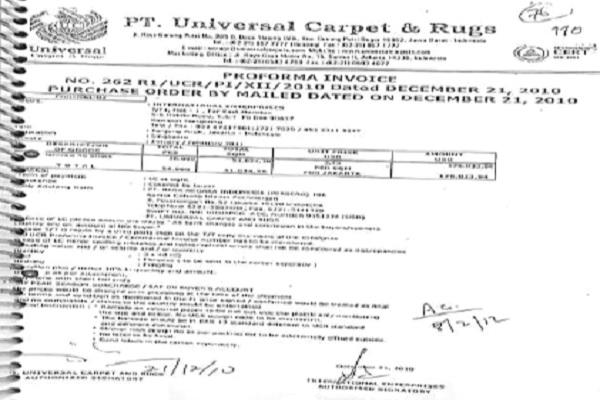
6.1. Regarding the differential demand of Rs. 1,16,50,256/- confirmed in respect of 87 consignments of carpets, we observe that the ld. adjudicating authority, in the impugned order, has relied upon the statements from the Director. The allegation of the Revenue is that two proforma Invoices showing higher value of carpets have been recovered from the house of the Director. For ready reference, the copies of the said proforma Invoices are extracted below:
–
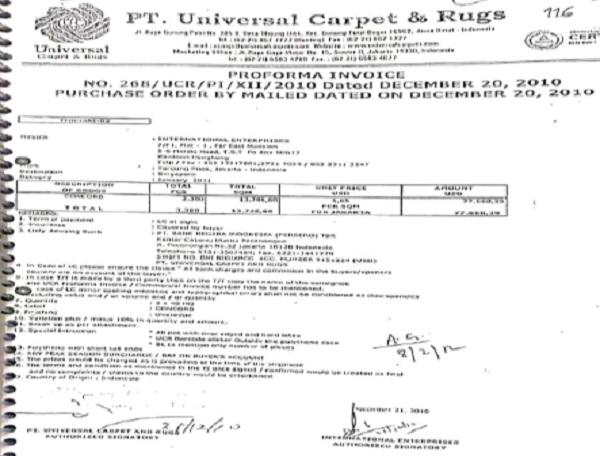
6.2. From the Pro Forma Purchase Invoices extracted above, we find that the said Proforma Invoices were issued by M/s Pt Universal Carpet & Rugs, Indonesia to M/s International Enterprise, Hong Kong. In the pro forma invoice bearing no. 262 R1/UCR/PI/XII/2010 dated December 21, 2010 issued by M/s Pt Universal Carpet & Rugs, ‘Florence’ carpets are shown priced at $3.45 per sq.m, However, in the said pro forma invoice bearing no. 268/UCR/PI/XII/2010 dated December 21, 2012, ‘Concord’ carpets were valued at $5.65 per sq.m., which is much less than the per unit value [lesser by $2.20 per sq.m] of the said Florence carpets sold by M/s Pt Universal Carpet & Rugs. In other words, it is evident that the carpets of different kinds were being sold by M/s Pt Universal Carpet & Rugs at vastly different rates. Moreover, presuming that the transactions particularised in the said pro forma invoices did in fact take place, it does not necessarily follow that the type of carpets sold thereunder were identical or similar to the ones imported by the appellant during the said period. Further, we observe that the proforma invoice was related to a transaction of carpets between the seller from Indonesia and buyer from Hong Kong. It cannot be said that the value at which goods are traded between Hong Kong and Indonesia will be identical or entirely consistent with the value at which goods are traded between India and Indonesia. It is also pertinent to note that the quantity of goods traded during the course of a transaction is also a determining factor of their price/value. In the instant case, we find that no proper comparisons can be drawn with the goods described in the said pro forma invoices and the carpets imported by the appellant. Thus, we are of the view that the value available in the proforma Invoice cannot be relied upon for purposes of rejecting the transaction value declared by the appellant and to re-determine the assessable value of the carpets for the purpose of charging customs duty.
6.2.1. In this regard, we find it relevant to refer to the decision rendered by the Tribunal at Chennai in the case of Oswal Metal Works v. Commissioner of Customs, Chennai-III [2024 (10) TMI 408 – CESTAT, Chennai] wherein it has been observed that a proforma invoice is in the nature of a quotation or offer and hence does not constitute valid basis for enhancement of value of imported goods. The relevant observations of the Tribunal in the aforesaid decision are reproduced below: –
“7. We find that it has been held by a Division Bench of this Tribunal in Commissioner of Customs, Chennai Vs Sahara Enterprises [2006 (206) E.L.T. 548 (Tri.-Chennai)] that a proforma invoice is in the nature of a quotation or offer and hence does not constitute valid basis for enhancement of value of the imported goods. It held as under;
“3. After careful consideration of the submissions, we find that, admittedly, value of the goods was enhanced by the original authority on the basis of proforma invoice issued in December 2001 by the supplier of the goods, to another party. The subject import was made in July 2002. There is a gap of more than six months between the two. Even otherwise, as rightly noted by the Commissioner (Appeals), a proforma invoice is in the nature of a quotation or offer and hence does not constitute valid basis for enhancement of value of the imported goods. This finding of the lower appellate authority is squarely supported by the Tribunal’s decision in the case of Mahavir Spinning Mills Ltd. reported in 1996 (84) ELT A147 and the Hon’ble Supreme Court’s judgment in Civil appeal No. 5263/92 in the case of M/s Sai Impex (S.C.). In the circumstances, we do not think that it is necessary to look into the issue whether it was open to the lower appellate authority to admit additional evidence. Valuation done by the original authority on the basis of quotation was not on any legally sustainable basis. Learned Commissioner (Appeals) has set things right. The impugned order does not call for interference. The appeal stands dismissed.”
(emphasis added)
6.3. We also find that the investigation cited the evidence of the value available in the proforma invoice to reject the value declared by the appellant, but has not applied the value of either USD 3.45 per sq.m. or USD 5.65 per sq.m. derived from the said pro forma invoices to re-determine the assessable value of the carpets. An arbitrary rate of USD 3 per Sq Mtr has been taken to quantify the demand. Thus, we observe that the proforma invoices recovered by the investigation has no relevance to the facts and circumstances of the instant case for rejecting the transaction value declared by the appellant and to re-determine the assessable value of the carpets.
6.4. As regards information obtained from China Customs authorities, it is observed that the same contains tabulation with import particulars of two entities, being the appellant and the said proprietary concern, M/s Glass Style International (prop. Vikas Agarwal). There is no authentication of any sort by any customs authority of China, and there is no covering letter of any customs authority indicating that such tabulation forms part of a communication involving the customs authorities in China. Apart from a mere averment on the part of the respondent authorities, there is absolutely no indication that such tabulation represents any real transaction or evidences any communication with or by the customs authorities in China. Thus, we are of the view that that the price available in the said Tabulation Sheet should be disregarded altogether and no relevancy can be accorded to the same in the present case.
6.5. The other evidence relied upon by the investigation to allege undervaluation is the various statements recorded from its Director. We find that the investigation alleges that the Director in his statements accepted the undervaluation of the carpets imported by them. We have perused the various statements recorded from the Director. From the answers given by the Director, we find that he has not given any confessional statement agreeing undervaluation. For ready reference the answers given by the Director to the questions relevant to the issue are analysed below.
6.6. The Director was shown 2 pro forma invoices showing sale of carpets from a supplier of Indonesia to allegedly recovered from his premises. On seeing them, the Director stated “I do not know whether the sale actually took place or not.” He said further, “I am not anywhere related to the said transaction but I might have kept copies of those documents as a part of the original unit price of carpets which might be useful for my export business”. The Director clarified that “Those documents were sent to me for handing over to some other person like forwarding agent/clearing agent/indenting agent at Kolkata.” In the statement dated 23.07.2014, the Director stated in Answer to Question No. 60, that “earlier these carpets were imported at 2 dollars per square meter FOB, now it is being imported at 2.20 dollars FOB”. It is therefore evident from this statement, that the pro forma invoices were not related in any manner to the imports made by the appellant. The Director’s submission is that he has retained them to remember the price of the specific type of carpets described in the invoices. He did not admit to any undervaluation of the carpets and never claimed that the pro forma invoice values represented the actual value of the carpets that the appellant had imported. There is also no confession of any sort that the type of carpets described in the pro forma invoices matched with those imported by the appellant. Rather, the Director asserted that these invoices were not related to the imports “in any manner”.
6.7. In this regard, we also take note of the fact that the investigation has not brought in any evidence to corroborate the allegation other than the statements. We agree with the submission of the appellant that uncorroborated statements, confessional or otherwise, cannot be relied upon for establishing undervaluation of goods by the importer, particularly where the same is vague, inconsistent and contradictory. The Commissioner ought to have appreciated that the statements sought to be relied upon in the said order, by themselves, are not sufficient for establishing any undervaluation of the said goods.
6.8. Further, as held by the Hon’ble Courts, such statements are relevant and admissible only when examined by the adjudicating authority under Section 138B of the Act, which has not been done in this case. In this connection, we place our reliance upon the decision in the case of Hi Tech Abrasives Ltd. Vs. Commissioner of C.Ex & Cus [2018 (362) ELT 961 (Chhattisgarh)], wherein it has been observed as under:-
“9. Findings on Substantial Questions of Law (i) & (ii) :
We shall decide the first two substantial questions of law as they are overlapping. The submission of counsel for the appellant has been that firstly, the Director’s statement was not admissible and secondly it cannot be treated as admission because in reply to Show Cause Notice, the said statement was stated to have been obtained under duress. We shall first examine the legal position with regard to the admissibility of the statement of Director which admittedly was taken during search operations by the investigation officers.
9.1 At the outset, it needs to be clarified that during the course of argument, Learned Counsel for the parties agreed that second substantial question of law is with regard to legality of procedure adopted by the adjudicating authority and not the Tribunal as such because the Tribunal has only exercised appellate jurisdiction. This is quite obvious from orders passed by the Tribunal, the appellate authority and pleadings/ground in the appeal. There is no dispute that the adjudicating authority did not record the statement of the Director Mr. Narayan Prasad Tekriwal and the basis of the finding recorded by the adjudicating authority as well as Customs, Excise and Service Tax Appellate Tribunal, has been the statement of the Director as recorded by the investigation officer during investigation. Section 9D of the Central Excise Act of 1944 reads as under :
Section 9D – Relevancy of statements under certain circumstances. — (1) A statement made and signed by a person before any Central Excise Officer of a gazetted rank during the course of any inquiry or proceeding under this Act shall be relevant, for the purpose of proving, in any prosecution for an offence under this Act, the truth of the facts which it contains, –
(a) When the person who made the statement is dead or cannot be found, or is incapable of giving evidence, or is kept out of the way by amount of delay or expense which, under the circumstances of the case, the Court considers unreasonable; or
(b) when the person who made the statement is examined as a witness in the case before the Court and the Court is of the opinion that having regard to the circumstances of the case, the statement should be admitted in evidence in the interest of justice.
(2) The provisions of sub-section (1) shall, so far as may be, apply in relation to any proceeding under this Act, other than a proceeding before a Court, as they apply in relation to a proceeding before the Court.
On scanning the anatomy of the said provision, we find that the statement made and signed by a person before any Central Excise Officer of a gazetted rank during the course of inquiry or proceeding under the Act shall be relevant for the purposes of proving truth of the facts which it contains only when it fulfills the conditions prescribed in clause (a) or as the case may be, under clause (b). While clause (a) deals with certain contingencies enumerated therein, clause (b) provides that statement made and signed would be relevant for the purposes of proving the truth of the facts contained in that statement only when the person whom made the statement is examined as witness before the Court. (her, the adjudicating authority).
9.2 At this juncture, we need to notice the provision contained in Section 9D which provides that sub-section (1) shall, as far as may be, applied in relation to the proceedings under the Act, other than the proceeding before the court, as they apply in relation to proceeding before the Court. This provision when read in juxtaposition, the small clauses (a) and (b) under sub-section (1), requirement of law of recording of examination as witness would be in relation to the proceedings before the adjudicating authority.
9.3 A conjoint reading of the provisions therefore reveals that a statement made and signed by a person before the Investigation Officer during the course of any inquiry or proceedings under the Act shall be relevant for the purposes of proving the truth of the facts which it contains in case other than those covered in clause (a), only when the person who made the statement is examined as witness in the case before the court (in the present case, Adjudicating Authority) and the court (Adjudicating Authority) forms an opinion that having regard to the circumstances of the case, the statement should be admitted in the evidence, in the interest of justice.
9.4 The legislative scheme, therefore, is to ensure that the statement of any person which has been recorded during search and seizure operations would become relevant only when such person is examined by the adjudicating authority followed by the opinion of the adjudicating authority then the statement should be admitted. The said provision in the statute book seems to have been made to serve the statutory purpose of ensuring that the assessee are not subjected to demand, penalty interest on the basis of certain admissions recorded during investigation which may have been obtained under the police power of the Investigating authorities by coercion or undue influence.
9.5 Undoubtedly, the proceedings are quasi criminal in nature because it results in imposition of not only of duty but also of penalty and in many cases, it may also lead to prosecution. The provisions contained in Section 9D, therefore, has to be construed strictly and held as mandatory and not mere directory. Therefore, unless the substantive provisions contained in Section 9D are complied with, the statement recorded during search and seizure operation by the Investigation Officers cannot be treated to be relevant piece of evidence on which a finding could be based by the adjudicating authority. A rational, logical and fair interpretation of procedure clearly spells out that before the statement is treated relevant and admissible under the law, the person is not only required to be present in the proceedings before the adjudicating authority but the adjudicating authority is obliged under the law to examine him and form an opinion that having regard to the circumstances of the case, the statement should be admitted in evidence in the interest of justice. Therefore, we would say that even mere recording of statement is not enough but it has to be fully conscious application of mind by the adjudicating authority that the statement is required to be admitted in the interest of justice. The rigor of this provision, therefore, could not be done away with by the adjudicating authority, if at all, it was inclined to take into consideration the statement recorded earlier during investigation by the Investigation officers. Indeed, without examination of the person as required under Section 9D and opinion formed as mandated under the law, the statement recorded by the Investigation Officer would not constitute the relevant and admissible evidence/material at all and has to be ignored. We have no hesitation to hold that the adjudicating officer as well as Customs, Excise and Service Tax Appellate Tribunal committed illegality in placing reliance upon the statement of Director Narayan Prasad Tekriwal which was recorded during investigation when his examination before the adjudicating authority in the proceedings instituted upon show cause notice was not recorded nor formation of an opinion that it requires to be admitted in the interest of justice. In taking this view, we find support from the decision in the case of Ambica International v. UOI rendered by the High Court of Punjab and Haryana.
Reliance has been placed by the Counsel for the Revenue on the decision in the matter of Commissioner of Central Excise v. Kalvert Foods India Private Limited (Laws (SC) 2011 838) = 2011 (270) E.L.T. 643 (S.C.). That decision turned on its own facts. In para 19 of the judgment, it was concluded as below :
“19. We are of the considered opinion that it is established from the record that the aforesaid statements were given by the concerned persons out of their own volition and there is no allegation of threat, force, coercion, duress or pressure being utilized by the officers to extract the statements which corroborated each other. Besides the Managing director of the Company of his own volition deposition the amount of Rs. 11 lakhs towards excise duty and therefore in the facts and circumstances of the present case, the aforesaid statement of the Counsel for the Respondents cannot be accepted. This fact clearly proves the conclusion that the statements of the concerned persons were of their volition and not outcome of any duress.”
Accordingly, on the first and second question of law, we hold that the statement of the Director could not be treated as relevant piece of evidence nor could be relied upon without compliance of Section 9D of the Act. The two questions of law accordingly, stand answered in that manner.”
6.9. The same view has been expressed by this Tribunal in the case of Gobinda Das Vs. Commissioner of Customs (Prev.), (2023)7 Centax 201(T-Cal).
6.10. Thus, by relying on the decisions cited supra, we hold that the statements relied upon in this case cannot be relied upon to reject the transaction value declared by the appellant and to re-determine the assessable value of the carpets.
6.11. We also observe that the Ld. adjudicating authority has relied upon some Bills of Entry of similar imports made by other importers. However, we find that the authorities have not provided any of the copies of the said Bills of Entry dated 17.3.2011 and 7.6.2011. No evidence has also been brought on record by the respondent-authorities to substantiate that the goods imported vide the said bills of entry are comparable goods or not. In the absence of the copies of the said bills of entry, it is not possible to ascertain whether the goods imported therein are comparable or not. A similar view has been taken by this Tribunal in the case of Sunny Sales & ors. v. Commissioner of Customs (Port), Kolkata [2024 (10) TMI 514 – CESTAT, Kolkata] wherein it has been held that:
“6.5. We observe that in the impugned order the transaction value declared by the appellant was rejected on the basis of some contemporaneous imports. In our view, the rejection of transaction value can be done only on the basis of cogent and comparable material and when there is no case of contemporaneous bill of entry or contemporaneous import available on record, the transaction value cannot be rejected on the basis of materials which are not admissible into evidence. For rejection of transaction value, contemporaneous import of identical and/or similar import is essential. This view has been crystallized by the Hon’ble Supreme Court in the case of Commissioner of Customs, Calcutta Vs- South India Television Pvt. Ltd. reported in 214 ELT page 3 SC. The relevant part of the said decision is reproduced below: “7. Applying the above tests to the facts of the present case, we find that there is no evidence from the side of the Department showing contemporaneous imports at higher price. On the contrary, the respondent importer has relied upon contemporaneous imports from the same supplier, namely, M/s. Pearl Industrial Company, Hong Kong, which indicates comparable prices of like goods during the same period of importation. This evidence has not been rebutted by the Department. Further, in the present case, the Department has relied upon export declaration made by the foreign supplier in Hong Kong. In this connection, we find that letters were addressed by the Department to the Indian Commission which, in turn, requested detailed investigations to be carried out by Hong Kong Customs Department. The Indian Commission has forwarded the export declarations in original to the Customs Department in India. One such letter is dated 19-9-1996. In the present case, the importer has alleged that the original declarations were with the Department. That certain portions of the originals were not shown to the importer despite the importer calling upon the adjudicating authority to do so. Further, by way of Interlocutory Application No. 4 in the present civil appeal, an application was moved by the importer calling upon the Department to produce the original declaration in the Court. No reply has been filed to the said I.A. till date. In the circumstances, we are of the view that the Department had erred in rejecting the invoice submitted by the importer herein as incorrect. Further, the Department received from the Hong Kong supplier a Fax message dated 22-7-1996. That was produced before the Commissioner. In that message, he had explained that the manufacturer of the impugned goods was getting export rebates and, therefore, it is possible that the manufacturer had over-invoiced the price in order to claim more rebate. The goods were of Chinese origin. In the Fax message it is further stated by the foreign supplier that he was required to show the export value on the higher side in order to claim the incentives given by his Government. This explanation of the foreign supplier, in the present case, had been accepted by the Commissioner. In his order, the Commissioner has not ruled out over-invoicing of the export value by the foreign supplier in order to obtain incentives from his Government. For the aforestated reasons, we find no infirmity in the impugned judgment of the Tribunal.” 6.6. From the impugned order, we observe that not a single bill of entry of identical imports at higher value has been cited. On the contrary, we observe that the appellant has cited several imports mentioned in the chart at page 231 Volume II and enclosed invoices and bill of entry from pages 232 to 476 which are identical and of near same value. However, no findings have been given by the ld. adjudicating authority on these averments made by the appellant. In the Show Cause Notice, we observe that the appellant has submitted some evidence of identical imports at lower value, which has been admitted in paragraph 14.3 and paragraph 14.4 of the notice. The relevant paragraph 14.3 of the Show Cause Notice is set out hereinbelow; “ …The import value data base of the contemporaneous period, therefore contains in abundance data of import of comparable goods at such misdeclared low value , which themselves have either been already subjected to or may be subjected to the scanner under the ongoing process of investigation relating to import made by other importers”
6.7. Thus, we observe that the ld. adjudicating authority has not taken into account the evidences submitted by the appellant on contemporaneous imports with lower value. Also, he has not furnished the details of the Bills of Entry where higher value has been adopted.
6.8. We observe that the ld. adjudicating authority has also not followed the valuation rules in a systemic mannerto redetermine the Assessable value, by stating that it will be in conflict with the intelligence about the rampant under-invoicing as alleged in paragraph 14.4 of the notice. In the impugned order, it has been admitted that none of the Rules from Valuation Rule 4 to Rule 8 are applicable and valuation has been done under Rule 9 of the valuation rules. We observe that in the impugned order, valuation was disputed in the manner and the procedure adopted to re-determine the value is unknown to law. We observe that the machine with only head were compared with certain imports where head was not imported, but some other parts were imported, and by application of Rule 9, the prices were sought to be adjusted even when there is no comparability of the goods in part , model, valuation, etc. Thus, we hold that the transaction value in this case could not have been rejected under Rule 12 of the Valuation Rules.”
6.11.1. Accordingly, we hold that the evidence of contemporaneous imports brought in by the investigation cannot be relied upon to reject the value declared by the appellant. Thus, we hold that the documents referenced in the impugned order, cannot be accorded any evidentiary value whatsoever for purposes of rejecting the transaction value and re-determining the assessable value for the purpose of charging customs duty.
6.12. In view of the above findings, we reject the value re-determined by the adjudicating authority and hold that the transaction value declared by the appellant should be accepted. Accordingly, we hold that the demand of differential customs duty of Rs.1,16,50,256/- confirmed in the impugned order in respect of 87 consignments of carpets is not sustainable and hence, we set aside the same.
7. Regarding the differential customs duty demand of Rs.46,64,532/- in respect of Multi Media speakers, we observe that the differential duty has been confirmed mainly on the allegation of misclassifying them to suppress CVD liability on the retail sale price basis. In this regard, it is seen that the issue of classification of Multi Media Speakers is no longer res integra, as this Tribunal has decided the classification of the said speakers under Chapter Head 8518 in a catena of decisions. In support of this view, we refer to the decision of this Tribunal in the case of M/s. Jupiter Green Energy Pvt. Ltd. v. Commissioner of Customs (Port), Kolkata [Final Order No. 76550 of 2025 dated 11.06.2025 in Customs Appeal No. 76843 of 2018 – CESTAT, Kolkata], wherein in it has been held as under: –
“11. With regard to the first issue, we find that an identical issue had come up before this Tribunal in the appellant’s own cases. In M/s. Jupiter International Limited vs Commissioner of Customs (Port), Kolkata [2025 (2) TMI 430 – CESTAT Kolkata], under similar facts and circumstances, it has been observed as under: –
“The appellant, Jupiter International Ltd imported a consignment of Two models of Multimedia Speakers having additional function such as Blue tooth/SD/MMC/USB/FM/AUX with remote wireless Microphone and some electronic spare parts of speakers. They have filed a Bill of Entry No. 7866965 dated 01.09.2018 self assessing the Multimedia Speakers under heading no.85182200. They imported another consignment of various models of Multimedia Speakers comprising of three categories of speakers i.e. (i) Multimedia Speakers with additional function of Bluetooth and FM radio, (ii) Multimedia Speakers with additional function of USB and (ii) samples of Multimedia Speakers without any additional function…..
…
8. We find that this issue was before the Banglore Tribunal in the case of Logic India Trading Co-v-C.C-2016(337) ELT 65(Tri-Bang). The Tribunal has held as under:
…
9. We find that the same issue was dealt by this Bench in the case of B.C. (Port), Kolkata -v- M/s Santosh Radio Products (order no. F/O 76070/2018 dated 04.05.2018-(Tribunal-Kol)], wherein it has been held as under:
…
10. After going through the factual matrix, we find that the case laws cited above are squarely applicable. Hence, applying the cited case laws, we set aside the impugned order and allow the appeal.”
11.1. Further, in the appellant’s own case in M/s. Jupiter International Limited vs Commissioner of Customs (Port), Kolkata vide Final Order Nos. 75404-75405 of 2025 dated 05.02.2025 in Customs Appeal Nos. 75580 & 75581 of 2020 (CESTAT, Kolkata), this Tribunal has held as under: –
“1. The appellant has imported Multimedia Speakers/Computer Speakers on 11.01.2018 classifying the said goods under CTH 85182200. The department proposed classification of the product under CTH 8519/8527 attracting CVD on retail sale price basis. The Adjudicating authority vide O-I-O dated 13.02.2018 determined the classification of the imported goods under 85279100. Being aggrieved the appellant filed their appeal before Commissioner (Appeals), which come to be dismissed. Hence, the appellant is before the Tribunal.
2. We find that the aforesaid, question of classification of the said products has been examined in extenso and the rival entries discussed threadbare. The subject issue is no more res integra. There are a catena of decisions holding the classification of the impugned goods under heading under CTH-8518. In the case of Logic India Trading Company US Commissioner of Customs, Cochin (2016(337)ELT 65(Tr-Bang.), as maintained by the Hon’ble Apex Court, reported in 2016(342)ELT A-34(SC), while dealing with similar set of facts, the courts have held the classification of the said goods under CTH 8518. Relevant paras of the said decision are referred to hereunder below:
….
6. The detailed analysis of the classification of all such Audio-Visual Receivers was also undertaken independently by this Tribunal in the case of ONKYO SIGHT & SOUND INDIA PVT.LTD. vs Commissioner of Customs, Chennai (2019(368) ELT 683(Tri- Chen.), wherein too the Southern Regional Bench of the Tribunal did not agree with the department’s stance for classification of the said products under CTH 8527 and had retained the CTH 8518 claiming the goods as Audio Frequency Amplifier along with Home Theatre Systems as multiple loudspeakers mounted in the same enclosure.
7. In view of said matter having been examined ad nauseam as referred supra, we find no merit in the order of the lower authority which is therefore set aside.
8. The appeal filed by the appellant is hereby allowed with consequential relief, if any, as per law.”
11.2. Thus, we find that the issue is no longer res integra as the same has already been dealt with by this Tribunal in the above cited cases. Therefore, following the above judicial precedents, we hold that the appellant has rightly classified the multimedia speakers with added ancillary features of USB/SD card/ MMC Playback and/ or FM radio under CTH 8518. Accordingly, the demands confirmed against the appellant by reclassifying the said goods under CTH 8527/CTH 8519 are not sustainable and therefore, we set aside the same.”
7.1. By following the ratio of the decision cited above, we hold that the appellant has rightly classified the Multi Media Speakers imported by them under Chapter Head 8518, where MRP based price is not applicable. Thus, we hold that the demand confirmed in the impugned order on account of reclassification of the goods under the CTH 85279100, is not sustainable and hence, we set aside the same.
8. Regarding the differential duty demand of Rs.1,66,372/- confirmed in respect of the consignments of blankets, it is observed that apart from a general statement by the Director regarding their undervaluation, which was not specific to any consignment or bill of entry or any exporting or importing party for that matter, there is no corroborative evidence of any sort put forward by the respondents. The appellant by its reply to the Show Cause Notice, submitted a copy of a Bill of Entry No. 7256218 dated 03.11.2014 submitted value of contemporaneous goods of imported blankets with a declared unit value of USD 2.2 per kg. This contemporaneous evidence has been rejected by the adjudicating authority on the purported basis that the same is not contemporaneous even though the Show Cause Notice dated 01.09.2014 had only been issued only 2 months prior to the presentation of such Bill of Entry dated 03.11.2014. We observe that the said impugned order has proceeded solely on the basis of the statement of the Director dated 11.02.2012 and not produced any evidence of contemporaneous imports with higher value. Considering the above, we hold that the declared value of the blankets by the appellant in the bills of entry cannot be rejected. Accordingly, we hold the demand confirmed in the impugned order on the blankets imported by the appellant is not sustainable and hence we set aside the same.
9. Regarding confiscation of the goods in question and imposition of redemption fine, as we have already observed that the allegations of undervaluation and mis-classification cannot be sustained, we hold that the goods are not liable for confiscation. Hence, we set aside the order confiscation of goods and imposition of redemption fine in lieu of confiscation imposed in the impugned order.
10. We have also examined the contentions raised by the appellant as to there being no basis for invocation of the extended period or imposition of penalties in this case on the ground that no information has been suppressed from the Department and no misdeclaration or undervaluation of the imported goods has been established.
10.1. In this regard, it is observed that the appellant has not acted in contravention of the provisions of the Act during the said period, as aforesaid, and hence there can be no basis to the allegation of fraud or wilful misstatement on their part with intent to evade payment of duty. Under such circumstances, we are of the considered view that the extended period of limitation cannot be invoked in terms of Section 28 of the Act, as the conditions precedent for such invocation have not been satisfied in the present case.
10.1.1. The ingredients for imposing penalties under Section 112 or Section 114A of the Customs Act being identical to those required for invoking the extended period, and the same not being satisfied in the instant case, in view of our above discussions, we hold that no penalty is imposable on the appellant under Section 112 or Section 114A ibid. Accordingly, the same are set aside.
11. Customs Appeal No. 77103 of 2017 has been filed by Shri Suresh Agarwal against the penalty of Rs.10,00,000/- (Rupees Ten Lakh only) imposed on him under Section 114AA of the Customs Act, 1962. In this regard, it is seen from the records that Shri Suresh Agarwal has expired, as evidenced by the Death Certificate issued on 05.03.2019 which has been produced by the Ld. Counsel for the appellant. As Shri Suresh Agarwal has already expired, the demand against him in the impugned order does not survive. Accordingly, the appeal filed by him stands abated.
12. In view of the above discussions, we set aside the impugned order and allow the Customs Appeal No. 77102 of 2017, filed by the appellant-company, with consequential relief, if any, as per law. Customs Appeal No. 77103 of 2017 filed by Shri Suresh Agarwal, stands abated and hence the demand against him does not survive.
13. The appeals filed by the appellants are disposed on the above terms.
(Order Pronounced in Open court on 18.08.2025)