In re Ganesh International (CAAR Delhi)
The Customs Authority for Advance Ruling (CAAR), Delhi, in In re Ganesh International, examined the classification of various decorative plastic products such as PVC Wall Panels, PS Mouldings, PS Sheets, PU Wall Panels, and PVC Sheets under the Customs Tariff Act, 1975. The central issue was whether these goods should fall under Heading 3921 (Other Plates, Sheets, Film, Foil and Strip, of Plastics) or 3925 (Builders’ Ware of Plastics, Not Elsewhere Specified or Included).
Background and Product Description
The applicant imported plastic products like PVC and PS wall panels, sheets, and mouldings used mainly for interior decoration in residential and commercial buildings. The products were typically rectangular sheets or panels, some embossed, printed, UV-coated, or designed with interlocking edges for installation. The applicant asserted that the products were decorative coverings, not structural components of buildings.
Legal Framework
The Authority relied on the General Rules for Interpretation (GRI) of the Import Tariff, particularly Rule 1, which requires classification based on the terms of the headings and relevant Section or Chapter Notes. The competing tariff headings, 3921 and 3925, and related Chapter Notes 10 and 11 of Chapter 39 were analyzed in detail.
-
Heading 3921 covers plates, sheets, films, foils, and strips of plastics, including laminated and cellular forms, provided they are not “further worked” beyond basic surface treatments.
-
Heading 3925, on the other hand, covers specific “builders’ ware” items like structural elements, doors, shutters, gutters, ornamental architectural features, and other fittings intended for permanent installation in or on buildings.
Arguments Presented
The applicant argued that:
-
Their products are decorative panels used temporarily and not permanently fixed to walls.
-
The panels retain a rectangular sheet form even after installation.
-
The interlocking edges serve only aesthetic purposes and do not alter the essential character of the goods.
-
The panels lack structural strength and are used as substitutes for paint or wallpaper rather than as structural materials.
Conversely, the jurisdictional Commissionerate contended that:
-
The panels have interlocking profiles enabling permanent installation in walls or ceilings, taking them beyond the scope of simple sheets under Heading 3921.
-
Such panels function as constructional articles qualifying as “builders’ ware” under Heading 3925.
-
The manufacturing process involving profiling and hollow-core construction amounts to further working, disqualifying them from Heading 3921.
Findings and Analysis
The Authority found that the goods fall into two distinct categories:
-
Plain plastic sheets/panels (like PVC and PS sheets with UV or printed surfaces) — clearly classifiable under Heading 3921, as they retain the essential character of plastic sheets.
-
Profiled wall panels and mouldings with interlocking edges — required closer examination.
CAAR rejected the department’s contention that these panels were permanently installed or structurally integral. It observed:
-
Installation is temporary and reversible, usually using screws or adhesive.
-
The panels maintain their rectangular geometry and are not “further worked” in the sense envisaged by Chapter Note 10.
-
The interlocking features are formed during extrusion and do not constitute post-manufacturing modification.
-
The products lack structural function and are used purely for aesthetic wall covering.
CAAR relied on the precedent set in Bakelite Hylam Ltd. v. CCE, Hyderabad [1997 (91) E.L.T. 165 (Tri.-Mad)], where plastic tiles in rectangular or square shape were classified under Heading 3921, supporting the applicant’s claim.
Conclusion
CAAR Delhi ruled that the subject goods are classifiable under Heading 3921 of the Customs Tariff. Specifically:
-
39211100 – Polymers of styrene
-
39211200 – Polymers of vinyl chloride
-
39211390 – Polyurethanes (other)
-
39219029 – Other plastics
The classification is subject to verification of the actual composition and structure of each imported consignment.
The ruling clarifies that decorative plastic panels and sheets, not intended for permanent installation or structural use, fall under Heading 3921, not under builders’ ware Heading 3925.
FULL TEXT OF THE ORDER OF CUSTOMS AUTHORITY OF ADVANCE RULING, DELHI
M/s Shri Ganesh International, Near Railway Phatak, Ubhawal Road, Sangrur (PB)-148001 (herein refered to as “applicant”) is having IEC No. CFGPK3936L and PAN-CFGPK3936L. The applicant has filed an application dated 05.06.2025, seeking advance ruling under section 28-H of the Customs Act, 1962, before the Customs Authority for Advance Rulings, New Delhi (CAAR, New Delhi in short). The application was accordingly registered under Serial No. 99/2025 dated 05.06.2025.
1.1 The applicant, vide the aforesaid application seeks an advance ruling on the classification and applicable duty rates for the imported products i.e “PVC Wall Panels”, “PS Moulding”, “PS Sheet”, “PS Wall Panel”, “PS Wall Panel Sheet”, “PU Wall Panel”, “PVS Panel (Foam)”, “PVC Sheet”, “PVC Sheet (UV)” in accordance with the provisions set forth in the Customs Act, 1962, and related regulations.
1.2 The applicant has further stated that it is anticipated that the Product will be classified under Chapter heading 3921 of the Customs Tariff Act, 1985, as amended from time to time. For the purpose of trading of the aforementioned Product, the applicant intends to import the same from multiple countries such as China.
1.3 The Subject Goods constitute pvc sheets/panels exhibiting cellular structure, produced primarily for decorative applications in interior spaces. These products manifest the following defining characteristics:
a. They are of uniform sizes and are either ready to use or not further worked upon.
b. They are reinforced or combined with other materials that enhance their strength or functionality.
c. They have a cellular structure making them lightweight and suitable for various decorative applications.
d. When cut, these sheets remain ready to use in their original form as sheets/panels.
e. They are primarily used for interior decoration purposes such as wall coverings and ceiling decoration to enhance the aesthetic appeal of domestic or commercial spaces.
f. They cannot, under any stretch of imagination, be classified as “builder’s ware” as they do not serve any structural or construction purpose but are merely decorative overlays.
g) It is an established fact that these modern era decorative PVC sheets with additional aesthetic advantage and being time savers have replaced usage of paints used conventionally.
1.4 It is pertinent to emphasize that the “Subject Goods” fundamentally differ from construction materials or “builder’s ware” with respect to their intrinsic purpose, application methodology, and essential characteristics. The Subject Goods do not constitute structural elements within buildings but rather function as decorative finishes applied to preexisting structural corn ponents.
LEGAL FRAMEWORK AND CLASSIFICATION ANALYSIS
1.5 Proper Classification Under CTH 3921
1.5.1 The Customs Tariff heading 3921 encompasses “OTHER PLATES, SHEETS, FILM, FOIL AND STRIP, OF PLASTICS.” The Applicant submits that the Subject Goods are properly classifiable under the following specific subheadings:
a. 39211200 — Of polymers of vinyl chloride (for PVC Wall Panels/PVC Wall Panel Sheets)
b. 39219029 — Other (for specific types of reinforced panels)
c. 39211390 — Other (for PU Wall Panel)
1.5.2 This classification derives its legal foundation from Note 10 to Chapter 39, which explicitly defines the expression “plates, sheets, film, foil and strip” as applicable to:
“plates, sheets, film, foil and strip and to blocks of regular geometric shape, whether or not printed or otherwise surface worked (for example, polished, embossed, coloured, merely curved or corrugated), uncut or cut into rectangles (including squares) but not further worked (even if when so cut, they become articles ready for use).”
1.5.3 The Subject Goods conform precisely to this statutory definition, as they:
a. Constitute plates/sheets of regular geometric configuration;
b. May incorporate surface treatments such as printing, embossing, coloring, or corrugation;
c. Are presented either uncut or cut into rectangular/square formats without further processing;
1.5.4 Furthermore, heading 3921 explicitly encompasses plates, sheets, film, foil and strip of plastics that exhibit cellular structure or have undergone reinforcement, lamination, or combination with other materials. The explanatory notes to this heading unequivocally state:
“plates, sheets, film, foil and strip, of plastics… It therefore covers only cellular products or those which have been reinforced, laminated, supported or similarly combined with other materials.”
1.5.5 The Subject Goods matches with this description exactly, as they:
a. Have a cellular structure (making them lightweight and suitable for decorative applications)
b. Are reinforced or combined with other materials for enhanced aesthetic properties
c. Are marketed, sold, and used exclusively as decorative sheets/panels
d. Maintain their essential character as “sheets” even after application
Inapplicability of Classification Under CTH 3925
1.6 The Applicant respectfully submits that classification of the Subject Goods under heading 3925 (“Builders’ ware of plastics, not elsewhere specified or included”) would constitute a fundamental misapplication of the Harmonized System nomenclature for the following determinative reasons:
Scope and Limitation of Heading 3925
1.6.1 Heading 3925 encompasses “Builders’ ware of plastics, not elsewhere specified or included.” An analysis of its subordinate subheadings reveals that this heading targets specific construction components possessing defined structural or functional roles:
a. 39251000: Reservoirs, tanks, vats and similar containers, of a capacity exceeding 300 liters
b. 39252000: Doors, windows and their frames and thresholds for doors
c. 39253000: Shutters, blinds (including Venetian blinds) and similar articles and parts thereof
d. 39259010: Of PVC-U (Unplasticized Poly Vinyl Chloride)
e. 39259090: Other
1.6.2 These subheadings unambiguously establish that heading 3925 applies to discrete construction products fulfilling specific structural or functional roles within buildings, roles fundamentally distinct from the exclusively decorative function of the Subject Goods.
1.6.3 The Subject Goods do not provide enclosure, support, storage, or any other building function but serve solely to enhance aesthetic appeal. The CBIC tariff has consistently classified decorative sheets under heading 3921, recognizing their essential character as sheets rather than “builder’s ware.”
Application of General Rule for Interpretation (GRI) 3(a)
1.7 General Rule for Interpretation 3(a) establishes that:
“The heading which provides the most specific description shall be preferred to headings providing a more general description.”
1.7.1 In the instant case, heading 3921 provides the most specific description for the Subject Goods as “sheets of plastics, cellular or reinforced/combined with other materials,” whereas heading 3925 constitutes a residual classification limited to “builders’ ware not elsewhere specified or included.”
Not Elsewhere Specified or Included” Limitation of Heading 3925
1.8 The phrase “not elsewhere specified or included” in heading 3925 represents a statutory recognition that goods specifically covered under alternative headings cannot be classified under heading 3925. It is apparent from The Harmonized System Explanatory Notes that residual headings with the phrase “not elsewhere specified or included” have a lower classification priority than specific headings that precisely encompass the goods in question.
1.8.1 Since the Subject Goods are specifically and comprehensively covered under heading 3921 as “sheets of plastics” with explicitly enumerated characteristics, they cannot be diverted to the residual heading 3925. The mere application of these decorative sheets to walls does not supersede their essential character as “sheets” specifically provided for under heading 3921.
1.8.2 It represents a fundamental principle of customs classification that when a product receives specific description in a particular heading, it cannot be classified under a general heading, notwithstanding that the general heading might superficially appear to encompass the product by virtue of its broad terminology.
Refutation of “Structural Elements” Characterization
1.9 Any reliance upon point 11(b) of the general explanatory notes to Chapter 39, which references “structural elements used, for example, in floors, walls or partitions, ceilings or roof,” would be fundamentally misplaced for the following reasons:
a. Contextual Interpretation Requirement: Point 1 1(b) must be interpreted within its proper context and in conjunction with Note 10 to Chapter 39, which specifically addresses classification of “plates, sheets, film, foil and strip.” The specific provisions of Note 10 cannot be superseded by general explanatory notes.
b. Absence of Structural Function: The term “structural elements” in point 11(b) designates components providing structural support or fulfilling construction functions. The Subject Goods manifestly provide no structural support and fulfill no construction function whatsoever, they function exclusively as decorative overlays applied to existing structures.
c. Essential Character Test: Pursuant to established customs classification principles, goods must be classified according to their essential character. The essential character of the Subject Goods remains that of decorative sheets/panels, not construction elements. Just as paint enhances aesthetic appeal of walls and ceilings without triggering classification as “builder’s ware,” the Subject Goods serve identical decorative purposes. If we accept the department’s logic that our PVC sheets provide structural stability (which they do not), then paint should also be classified as “builder’s ware” – an interpretation that is clearly incorrect. Both paint and our decorative panels are applied to existing structures for purely aesthetic purposes.
d. Product Design and Limitations: The Subject Goods are specifically designed and marketed exclusively for decorative purposes. They lack requisite structural properties, thickness, and engineering specifications necessary for any construction or “builder’s ware” application.
1.9.1 The Subject Goods cannot function as structural elements in the following applications:
a. Floors: The Subject Goods lack necessary durability, thickness, and load-bearing capacity required for flooring applications. They are neither designed for, marketed for, nor utilized on floors.
b. Walls and Partitions: Classifying the subject goods wall or partition elements wrongly mixes up decorative wall coverings with actual structural wall parts. The Subject Goods are applied to preexisting walls exclusively for decorative purposes; they do not themselves create walls or partitions. Partitions cannot be constructed using the Subject Goods, as they merely constitute decorative overlays applied to structural elements already in place—functionally equivalent to paint or wallpaper.
c. Ceilings and Roofs: The Subject Goods are too lightweight and lack requisite structural integrity to function as ceiling or roof elements. They may be applied to existing ceilings exclusively for decorative purposes, analogous to paint or wallpaper application.
1.9.2 The mere fact that a sheet/panel can be affixed to walls does not automatically make it “builders’ ware” under 3925 if it maintains its essential character as a “sheet/panel” covered under 3921 by this logic, any decorative item placed on a wall (including posters, paintings, or fabric) would become “builder’s ware”- an interpretation that defies commercial reality and classification principles.
1.9.3 The Subject Goods maintain their essential character as decorative sheets/panels even when applied to walls and do not transform into specific builders’ ware such as doors, windows, or other construction elements covered under heading 3925. They cannot, under any reasonable interpretation, be characterized as structural elements providing stability or reinforcement to buildings.
JUDICIAL PRECEDENTS SUPPORTING CLASSIFICATION UNDER CTI-1 3921
1.10 The classification under CTH 3921 is supported by the following judicial precedents:
CTH 3921 has already been adopted by the department in the case of BAKELITE HYLAM LTD. Versus COMMISSIONER OF C. EX., HYDERABAD Order No. 1665/96, dated 3-10-1996 in Appeal No. E/2235/91 and 2283/91-C where, the goods are classified under HSN 3925 and department was claiming it under HSN 3921. In para 7 and 8 it was held as under :-
1.11 For proper understanding of the scope of the headings, we have to refer to the scope of various entries which answer to the same description by way ofform under Chapter 39. It is seen that heading 39.18 covers floor and ceiling coverings and by virtue of Chapter Note 9 the scope of the coverage of the item is restricted to materials in running length of specified width. Heading 39.19 covers self adhesive plates and sheets films, foils etc., whether or not in rolls. The remaining varieties of plates, sheets, films, foils etc are covered under tariff heading 3920 and 3921. Heading 3920 covers the non-cellular varieties. Both the tariff entries 3920 and 3921 are covered by Chapter note 10 of Chapter 39. In our view going by the scheme of the tariff and chapter notes the scope of tariff entries 3920 and 3921 has to be read together and if that be done the goods manufactured by the appellants are squarely covered under tariff heading 3921. We are supported in this view by the scheme of the tariff in the HSN on which Central Excise tariff is based. The goods in question as per the HSN note fall under tariff heading 39.21 which corresponds to Central tariff entry 3921. The explanatory note under this heading in HSN read as under:
1.12 This heading covers plates, sheets, film, foil and strip, of plastics, other than those of heading 39.18, 39.19 or 39.20 or of Chapter 54. It therefore covers only cellular products or those which have been reinforced, laminated, supported or similarly combined with other materials. (For the classification of plates etc, combined with other materials, see the General Explanatory Note). ‘
1.13 According to Note 10 to this Chapter, the expression “plates, sheets, foil and strip” applies only to plates, sheets, film, foil and strip and to blocks of regular geometric shape, whether or not printed or otherwise surface worked (for example, polished, embossed, coloured merely curved or corrugated), uncut or cut into rectangles (including squares) but not further worked (even if when so cut, they become articles for ready for use).
1.14 The Ld. Advocate in this context has urged that reliance could not be placed on the HSN notes for interpreting Central Excise tariff entries. We observe that Hon ‘ble Supreme Court in the case of Wood Craft Products Ltd. 1995 (77) E.L.T. 23 has held under para 18: We are of the view that the Tribunal as well as the High Court fell into the error of overlooking the fact that the structure of the Central Excise Tariff is based on the internationally accepted nomenclature found in the HSN and, therefore, any dispute relating to tariff classification must, as far as possible, be resolved with reference to the nomenclature indicated by the HSN unless there be an express different intention indicated by the Central Excise Tariff Act, 1985 itself. The definition of a term in the ISI Glossary, which has a different purpose, cannot in case of a conflict, override the clear indication of the, meaning of an identical expression in the same context in the HSN. In the HSN, block board is included within the meaning of the expression “similar laminated wood” in the same context of classification of block board. Since the Central Excise Tari.ff Act, 1985 is enacted on the basis and pattern of the HSN, the same expression used in the Act must, as far as practicable, be construed to have the meaning which is expressely given to it in the HSN when there is no indication in the Indian Tariff of a different intention.’
1.15 In view of the above we hold that the goods namely tiles in square and rectangular shape have been correctly held to be classifiable under tariff heading 3921. Since no pleas in respect of any other aspect have been adduced we upheld the orders of the Id. lower authority and dismiss the appeals.
1.16 In the light of above, it is requested that any attempt to classify PVC sheet under a chapter heading other than 3921 would be contrary to the provisions of Rule 3(a) of the general Rules of Interpretation as well to the statutory context of heading 3921 as well as will draw a wrong precedent being matter already decided long tome back in the favour of the department.
1.17 In the case of COMMR. OF C. EX, NEW DELHI Versus CONNAUGHT PLAZA RESTAURANT (P) LTD, The Hon’ble Supreme Court has emphasized the principle that a specific entry shall prevail over a general entry. Following this principle, heading 3921 provides a more specific description of our goods than the general category of “builders’ ware” under 3925,
1.18 Based upon comprehensive analysis of the Subject Goods’ physical characteristics, relevant legal provisions, explanatory notes, and established classification principles, the Applicant respectfully submits that proper classification of “PVC Wall Panels, PVC Wall Panel Sheets, PU Wall Panels, and PVC Panel Strips” falls under the appropriate subheadings of heading 3921 of the Customs Tariff Act.
1.19 Commercial understanding, industry practice, technical specifications, and established interpretative principles uniformly confirm the essential character of the Subject Goods as decorative sheets falling squarely within heading 3921. This classification maintains consistency with international customs practices and ensures regulatory harmonization in classification of such decorative products.
STATEMENT CONTAINING THE APPLICANT’S INTERPRETATION OF LAW AND/OR FACTS, AS THE CASE MAY BE, IN RESPECT OF THE AFORESAID QUESTIONS) (I.E. APPLICANTS VIEW POINT AND SUBMISSIONS ON ISSUES ON WHICH THE ADVANCE RULING IS SOUGHT).
1.20 In the light of aforementioned, the Applicant seeks to enter the following questions for Advance Ruling and its interpretation of the question will be as under: –
i) Whether the classification of the goods mentioned in the table is correct.
| S.NO | ITEM/DESCRIPTION | CTI-I |
| 1 | PVC Wall Panels | 39211100 |
| 2 | PS Moulding | 3921 1100 |
| 3 | PS Sheet | 39211100 |
| 4 | PS Wall Panel | 39211100 |
| 5 | PS Wall Panel Sheet | 39211100 |
| 6 | PU Wall Panel | 39211100 |
| 7 | PVS Panel (Foam) | 39211100 |
| 8 | PVC Sheet | 39211100 |
| 9 | PVC Sheet (UV) | 39211100 |
2. Comments of The Port Commissioncrate:
2.1 As per the provision of CAAR Regulation, 2021, the complete application of the applicant was provided to the concerned Custom Port, and requested to furnish the requisite comments in the instant matter. The port authority vide letter dated 21.08.2025 furnished its comments, as follows: –
2.2 The applicant is seeking advance ruling from CAAR, New Delhi on the questions of classification of imported goods namely, ” PVC Panel/Sheet/Mouldings under the I-IS Code 39211100. M/s Shri Ganesh International (hereinafter referred to as “the Applicant”) are engaged in the import and trade of PVC Wall Panels, PS Moulding, PS Sheet, PS Wall Panel, PS Wall Panel Sheet, PU Wall Panel, PVS Panel (Foam), PVC Sheet, PVC Sheet (UV) (hereinafter referred to as “the goods”). The AppliCant intends to classify them under Chapter heading 3921.
2.3 The Applicant seeks an advance ruling on the classification and applicable duty rates for the product, PVC Wall Panels, PS Moulding, PS Sheet, PS Wall Panel, PS Wall Panel Sheet, PU Wall Panel, PVS Panel (Foam), PVC Sheet, PVC Sheet (UV).
2.4 In light of the points raised by the applicant in Annexure-1 of their application, the following observations and comments are made. The claims made by the applicant are devoid of substantive evidence and are legally untenable on the following grounds: –
2.4.1 Polyvinyl chloride (PVC) is a type of high-strength plastic that can be used in any number of applications. The extrusion of PVC wall panels involves forcing molten PVC compound through a die shaped to create the panel’s three-dimensional, hollow-core profile with interlocking features. Further, post-extrusion processing involves refining joints and cutting into non-rectangular shapes further shape the panels. These panels are three-dimensional, hollow-core construction elements with an engineered profile, featuring tongue-and-groove or similar interlocking systems for secure and continuous installation. It has been observed that the PVC wall panels are used in construction as decorative and functional coverings for walls and ceilings, providing protection, insulation, and moisture resistance. These panels are not semi-finished materials but finished articles designed for permanent installation.
2.4.2 The explanatory notes to heading 3921, are re-produced as under:
“This heading [3921] covers plates, sheets, film, foil and strip, of plastics, other than those of heading 39.18, 39.19 or 39.20 or of Chapter 54. It therefore covers only cellular products or those which have been reinforced, laminated, supported or similarly combined with other materials. (For the classification of plates, etc. combined with other materials, see the General Explanatory Note.)
2.4.3 According to Note 10 to this Chapter, the expression “plates, sheets, film, foil and strip ” applies only to plates, sheets, film, foil and strip and to blocks of regular geometric shape, whether or not printed or otherwise surface-worked (for example, polished, embossed, coloured, merely curved or corrugated), uncut or cut into rectangles (including squares) but not further worked (even if when so cut they become articles ready for use).
2.4.4 Plates, sheets, etc., whether or not surface-worked (including squares and other rectangles cut therefrom), with ground edges, drilled, milled, hemmed, twisted, framed or otherwise worked or cut into shapes other than rectangular (including square) are generally classified as articles of headings 39.18, 39.19 or 39.22 to 39.26.”
2.4.5 As per the above explanatory note, the heading 3921 excludes plates, sheets, etc., that are “drilled, milled, hemmed, twisted, framed or otherwise worked or cut into shapes other than rectangular (including square). This heading applies only to unworked or merely surface-worked plates, sheets, film, foil, and strip, or blocks of regular geometric shape, uncut or cut into rectangles (including squares). Further, PVC wall panels have worked edges in such a way that they fit with other PVC Panels directly.
2.4.6 Further, the engineered interlocking system of PVC wall panels, which is integral to their function as wall coverings, represents a level of processing beyond simple cutting. This specialized shaping to enable secure and continuous installation distinguishes them from basic rectangular cuts of a flat sheet, which appear to place them outside the scope of CTH 3921. Further, the engineered interlocking system of PVC wall panels, formed through extrusion and further refining, represents further working beyond surface-working. This engineered shaping, enables secure installation as wall or ceiling coverings, and thus appear to be classified under CTH 3925 (specifically 392590, “Other builders’ ware”), rather CTI 39211200.
2.4.7 The explanatory notes to heading 3925, are reproduced as under: “Heading 3925 applies only to the following articles, not being products covered by any of the earlier heading of sub-Chapter II:
a. Reservoirs, tanks (including septic tanks), vats and similar containers, of a capacity exceeding 3001;
b. Structural elements used, for example, in floors, walls or partitions, ceilings or roofs:
c. Gutters and fittings thereof:
d. Doors, windows and their frames and thresholds for doors;
e. Balconies, balustrades, fencing, gates and similar barriers;
f. Shutters, blinds (including Venetian blinds) and similar articles and parts and fittings thereof:
g. Large-scale shelving for assembly and permanent installation, for example, in shops, workshops, warehouses;
h. Ornamental architectural features, for example, flutings, cupolas, dovecotes; and
i. Fittings and mountings intended for permanent installation in or on doors, windows, staircases walls or other parts of builders, for example, knobs, handles hooks, brackets, towel rails, switch-plates and other protective plates.”
2.5 Further, the goods classified under CTl-1 39211100 attracts BCD @ I0% SWS@IO% and IGST@18%, however, CTI-1 3925 attracts BCD@ I5%, SWS@IO% and IGST@18%. Thus, by seeking classification under a different heading, the applicant appears to be attempting to evade Customs duty/1GST. Based on a comprehensive analysis of the I-IS structure, legal notes and interpretative rules, the most appropriate classification for the products, PVC Wall Panels, PS Moulding, PS Sheet, PS Wall Panel, PS Wall Panel Sheet, PU Wall Panel, PVS Panel (Foam), PVC Sheet, PVC Sheet (UV) is under CTI-I 3925 and specifically under CTH 39259090 as “Other builders’ ware”.
2.6 As per the above explanatory note, the heading 3925 covers structural elements used in walls. PVC wall panels designed for permanent installation as functional and decorative coverings, providing protection, insulation, and moisture resistance, appears to qualify as such structural elements. Thus, the subject projects, appears to be classifiable under CTI-I 3925, not under CT1 39211200 as intended by the applicant. At this port these products are being imported under heading 3925.
3. Record of Personal hearing:
Personal hearing in the matter was conducted through physical mode on 12.09.2025 wherein the authorized representative of the applicant i.e Shri Rishabh Jain attended the same and reiterated the same which were already submitted with the application of the applicant. Sh. Nay Gupta, authorized representative of the Department also attended the hearing in virtual mode and reiterated their written submission already made in the port comments. Sh. Ajay Gupta was asked whether they want to quote any case laws in their support, for which they declined. They have nothing more to add,
4. Additional Submission:
In response to the port comments, the applicant vide their letter dated 10.09.2025 submitted the following.
4.1. Response to para 2:
The contents of this paragraph are a matter of record and hence need no reply.
4.2. Response to para 3:
That point wise reply to this paragraph is as follows:
4.3. Response to para 3.1:
The departmental observation regarding manufacturing process is not based on any expert opinion and based on assumptions or content available on open source. PVC wall panels being characterized as “construction elements” is fundamentally self-contradictory and legally untenable. The department itself acknowledges that these panels serve as a finished article used as “decorative and functional coverings,” yet simultaneously attempts to classify them as construction materials under CTH 3925. Construction and decorative functions are entirely different in nature and purpose. PVC panels lack the structural strength necessary for construction applications that would provide building stability or support. These products serve as substitutes for paint and wallpaper, designed exclusively for aesthetic enhancement rather than structural construction. The department’s assertion regarding “permanent installation” is factually incorrect and contradicts the actual method of application. These panels are not permanently installed but are temporarily attached to walls through pasting or screwing methods. The installation is so temporary that panels can be removed by hand without damage to the underlying wall structure. The panels of size 8 feet by 4 feet are supplied without interlocking features and primarily provide the aesthetic appearance of stone, while panels measuring 10 feet by 12 inches and 9.5 feet by 6 inches feature interlocking systems that provide no structural stability whatsoever. The temporary nature of attachment, combined with the ease of removal, clearly distinguishes these products from permanent construction elements and reinforces their character as decorative wall coverings.
4.4. Response to para 3.2:
Our panels fundamentally maintain their essential rectangular geometric shape throughout the manufacturing and installation process, with the geometric integrity preserved regardless of size variations required for specific applications. When installation demands necessitate dimensional adjustments, sheets are simply cut along straight lines to produce smaller rectangular panels that accommodate particular wall dimensions, without any alteration to their basic geometric character or structural properties, particularly in the case of last panel, where full penal cannot be fit. The cutting process involves no complex shaping or specialized working beyond standard dimensional reduction, ensuring that the essential rectangular nature remains unchanged. The interlocking edges incorporated into certain panel varieties serve exclusively aesthetic purposes, specifically designed to create groove appearances that enhance visual appeal and ensure seamless visual continuity between adjacent panels during installation and too minimize the usage of small mini size screws. The departmental understanding that PVC wall Panels are engineered products is not based on correct understanding as all one piece of PVC wall Panel is extruded in a single manufacturing process and cannot be worked upon to add features like interlocking as the extrusion process is done in a manner that PVC wall panels where ever inter locking is required is done in a single extrusion process. This clearly demonstrates as a qualifying criterion to classify PVC Wall Panel under HSN 3921. All allegations of further working or refining etc on such PVC Panel to exclude it from HSN 3921 are not based on any facts and not possible keeping in view the chemical/physical properties of PVC which can be put to a shape by controlled temperature extrusion alone rather than from any engineering method as assumed by the department.
4.5 Response To Para 3.3:
Further, the department’s assertion that the subject PVC wall panels appears to be classifiable under 3925 ” Other Builder’ Ware” is highly inconceivable as our imported goods are totally different line of goods than goods covered under CTH 3925 as Builder Ware in Explanatory Notes. Also , department’s suggested classification of PVC Wall Panel imported by us as “other category” of CTH 3925 without adducing any specific category from Explanatory clearly of heading 3925 shows that they are unable to find any appropriate heading for PVC wall panels imported by us in categories (a) to (ij) of Explanatory Notes CTH 3925. Importantly, the Explanatory Notes for heading 3925 itself declares that ”
“Heading 3925 applies only to the following articles, not being products covered by any of the earlier heading of sub-Chapter II:
a. Reservoirs, tanks (including septic tanks), vats and similar containers, of a capacity exceeding 3001;
b. Structural elements used, for example, in floors, walls or partitions, ceilings or roofs;
c. Gutters and fittings thereof
d. Doors, windows and their frames and thresholds for doors;
e. Balconies, balustrades, fencing, gates and similar barriers; 7) Shutters, blinds (including Venetian blinds) and similar articles and parts and fittings thereof,’
f. Large-scale shelving for assembly and permanent installation, ,for example, in shops, workshops, warehouses;
g. Ornamental architectural features, for example, flutings, cupolas, dovecotes; and
(j) Fillings and mountings intended for permanent installation in or on doors, windows, staircases, walls or other parts of builders, for example, knobs, handles, hooks, brackets, towel rails, switch plates and other protective plates.”
4.6. From the above, it is evident that there is no scope for PVC wall panels to get a classification slot under an “Others” which is already “Other Builder Ware.” Further, Customs Tariff is reproduced below: –
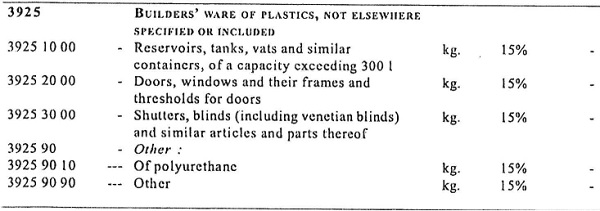
4.7. CTI-I 3925 is applicable to Builder Ware which are specifically mentioned in the Explanatory Notes from (a) to (ij), therefore, PVC Wall Panels imported by us cannot be classified under other category of 3925, as it pertains to listed Builder Ware Items only but made up of any other Plastic material i.e. other than of Plastics and Polyurethane.
4.8. The departmental attempt to classify our goods under CTEI 3925 fails comprehensively when examined against each specific category enumerated in the explanatory notes:
a. Reservoirs, tanks, vats and similar containers: Our panels are flat decorative sheets, not containers of any description.
b. Structural elements used in floors, walls or partitions, ceilings or roofs: This category specifically contemplates load-bearing or structurally integral components. Our panels serve purely decorative functions and lack structural integrity. They are applied over existing walls, not incorporated into the wall’s structural framework.
c. Gutters and fittings thereof: Entirely inapplicable to flat decorative panels.
d. Doors, windows and their frames and thresholds: Our products are neither used for such access mechanisms nor their associated hardware.
e. Balconies, balustrades, fencing, gates and similar barriers: These are protective or demarcating structures, wholly distinct from decorative wall coverings.
f. Shutters, blinds and similar articles: These are moveable coverings for windows, unrelated to permanent wall decoration.
g. Large-scale shelving for assembly and permanent installation: Our panels provide no storage functionality.
h. Ornamental architectural features: This category specifically references “flutings, cupolas, dovecotes” — specialized architectural elements with defined geometric patterns and structural purposes. Our imported PVC panels are simply rectangular sheets without any such architectural complexity. To illustrate, architectural features would be required for creating miniature monuments such as a model of the Taj Mahal with specific design patterns and architectural structural elements. Our panels possess no such architectural characteristics, being merely geometric rectangular shapes for wall covering.
i. Fittings and mountings for permanent installation: These are hardware items, not decorative surface materials.
4.9. The department’s reliance on category (b) regarding “structural elements used in walls” fundamentally mischaracterizes our products, which are decorative overlays applied to walls rather than structural components of walls themselves.
4.10. Response to para 3.4:
The departmental suggestion that seeking classification under a “different heading” with lower duty rates constitutes attempted duty evasion is both legally unfounded and factually incorrect. The rate of duty applicable to different headings is entirely irrelevant to the classification determination, as classification must be based on the goods’ inherent characteristics rather than fiscal considerations. The department’s claim that “these products are being imported under heading 3925” at their port merely indicates inconsistent administrative practice and cannot override statutory classification requirements, as port practice has no bearing on correct legal classifcation. The department’s finding regarding duty evasion intent is entirely erroneous and represents a fundamental misunderstanding of classification principles, as the mere fact that a product attracts a lower rate of duty under its correct classification cannot constitute evidence of improper classification. This reasoning would essentially penalize importers for seeking accurate classification and undermine the entire tariff structure by suggesting that goods should be classified based on duty rates rather than their essential characteristics.
4.11. Response to para 4:
That the contents of this paragraph are wrong and hence vehemently denied in light of the submissions made above.
4.12. Conclusion:
The departmental comments fundamentally mischaracterize both the nature of our imported goods and the applicable legal framework governing their classification. Our PVC panels remain essentially decorative sheets designed for aesthetic wall covering as a substitute of paint & wall papers, temporarily in nature and easily removable, lacking structural function, architectural complexity, or permanent integration into building frameworks. The correct classification under CTH 39211100 reflects both the goods’ essential character as plastic sheets and their commercial understanding as decorative wall coverings. Also, departments classification seems to be based on higher tax rate and liable to shift again if tax rate of 3921 is increased by Government as compared to 3925.
5. Findings, Discussion & Conclusion:
5.1 Having examined the CAAR-1 application, the comments received from the jurisdictional Customs Commissionerate, the record of personal hearing held on 12.09.2025, additional written response of the applicant dated 10.09.2025 and the applicable legal framework, I find the application to be valid in terms of the Customs Act, 1962 and the CAAR Regulations, 2021. I therefore allow the application and proceed to determine the classification of the proposed imports on the basis of the information on record.
Product description:
5.2 The question before me in this case relates to the classification of the goods proposed to be imported, namely “PVC Wall Panels, PS Moulding, PS Sheet, PS Wall Panel, PS Wall Panel Sheet, PU Wall Panel, PVS Panel (Foam), PVC Sheet and PVC Sheet (UV)” as detailed in para 1.1 to 1.4 of this ruling.
Issue of Classification:
5.3. I note that the applicant seeks an advance ruling in respect of classification of a range of goods such as PVC wall panels, PS Mouldings, PS sheets, PU wall panels, PVS sheets and related plastic articles etc. I observe that the goods, as per the applicant submission, articles made of polymers of plastics, presented generally in sheet or panel form, and intended to be used for interior decoration and allied applications. I note that the applicant has placed on record detailed specifications and claimed that the subject goods are marketed primarily as interior decorative materials rather than as structural components of a building. The product literature placed on record describes these goods as manufactured from polymers such as polyvinyl chloride, polystyrene and polyurethane, presented generally in the form of rectangular sheets or panels of standard sizes. While certain items are plain sheets with surface treatment such as embossing, printing or UV coating, others are moulded or provided with profiled, interlocking edges for installation on walls or ceilings. The intended use of all these products, as highlighted by the applicant, is for interior decorative purposes in residential and commercial buildings.
5.4. It is settled principle of law that the classification of any good under Customs Tariff Act, 1975 is governed by the General Rules for the Interpretation of the Import Tariff. Further, Rule 1 of GRI stipulates that “classification shall be determined according to the terms of the headings and any relative Section or Chapter Notes.” It is only when the headings and notes do not require otherwise then one may proceed to the subsequent rules.
5.5. Therefore, the starting point is an analysis of the terms of the competing headings, 3921 and 3925, read with the relevant Section/Chapter/Explanatory notes. For the purpose of determining the correct classification of the impugned goods, it is imperative to examine Tariff Headings 3921 and 3925 in the proper context and statutory framework. The said tariff headings under the First Schedule to the Customs Tariff Act, 1975, reads as under:
| 3921 |
|
OTHER PLATES, SHEETS, FILM, FOIL AND STRIP, OF PLASTICS |
| – | Cellular: | |
| 3921 1100 | — | Of polymers of styrene |
| 3921 12 00 | — | Of polymers of vinyl chloride |
| 3921 13 | — | Of polyurethanes: |
| 3921 13 10 | — | Flexible |
| 3921 13 90 | — | Other |
| 3921 14 00 | — | Of regenerated cellulose |
| 3921 19 00 | — | Of other plastics |
| 3921 90 | – | Other: |
| 3921 90 10 | — | Thermocol |
| — | Of polymers of vinyl chloride: | |
| 3921 90 2I | —- | Rigid, lacquered |
| 3921 90 22 | —- | Flexible, lacquered |
| 3921 90 23 | —- | Rigid, metallised |
| 3921 90 24 | —- | Flexible, metallised |
| 3921 90 25 | —- | Rigid, laminated |
| 3921 90 26 | —- | Flexible, laminated |
| 3921 90 29 | —- | Other |
| —- | Of regenerated cellulose: | |
| 3921 90 31 | —- | Rigid, lacquered |
| 392 I 90 32 | —- | Flexible, lacquered |
| 3921 90 33 | —- | Rigid, metallised |
| 3921 90 34 | —- | Flexible, metallised |
| 3921 90 35 | —- | Rigid, laminated |
| 3921 90 36 | —- | Flexible, laminated |
| 3921 90 39 | —- | Other |
| — | Other: | |
| 3921 90 91 | —- | Rigid, lacquered |
| 3921 90 92 | —- | Flexible, lacquered |
| 3921 90 93 | —- | Rigid, metallised |
| 3921 90 94 | —- | Flexible, metallised |
| 3921 90 95 | —- | Rigid, laminated |
| 3921 90 96 | —- | Flexible, laminated |
| 392190 99 | —- | Other |
| 3925 | BUILDERS’ WARE OF PLASTICS, NOT ELSEWHERE SPECIFIED OR INCLUDED | |
| 3925 10 00 | – | Reservoirs, tanks, vats and similar containers, of a capacity exceeding 300 1 |
| 3925 20 00 | – | Doors, windows and their frames and thresholds for doors |
| 3925 3000 | – | Shutters, blinds (including venetian blinds) and similar articles and parts thereof |
| 3925 90 | – | Other: |
| 3925 9010 | — | Of polyurethane |
| 39259090 | — | Other |
5.5.1. The relevant chapter note which explains the scope of these headings read as under:
The Chapter Note 10 of Chapter 39 provides that “in headings 39.20 and 39.21, the expression ‘plates, sheets, film, foil and strip” applies only to plates, sheets, film, foil and strip (other than those of Chapter 54) and to blocks of regular geometric shape, whether or not printed or otherwise surface-worked, uncut or cut into rectangles (including squares) but not further worked (even if when so cut they become articles ready for use).”
5.5.2. The explanatory note to Tariff Heading 3921 are reproduced below:
“This heading covers plates, sheets, film, foil and strip, of plastics, other than those of heading 39.18, 39.19 or 39.20 or of Chapter 54. It therefore covers only cellular products or those which have been reinforced, laminated, supported or similarly combined with other materials. (For the classification of plates, etc. combined with other materials, see the General Explanatory Note.)
According to Note 10 to this Chapter, the expression “plates, sheets, film, foil and strrp” applies only to plates, sheets, film, foil and strip and to blocks of regular geometric shape, whether or not printed or otherwise surface-worked (for example, polished, embossed, coloured, merely curved or corrugated), uncut or cut into rectangles (including squares) but not further worked (even ifwhen so cut they become articles ready for use).
Plates, sheets, etc., whether or not surface-worked (including squares and other rectangles cut therefrom), with ground edges, drilled, milled, hemmed, twisted, framed or otherwise worked or cut into shapes other than rectangular (including square) are generally classified as articles of headings 39.18, 39.19 or 39.22 to 39.26.”
5.5.3. The explanatory note to Tariff Heading 3925 are reproduced below:
3925 Builders’ ware of plastics, not elsewhere specified or included
3925.10 – Reservoirs, tanks, vats and similar containers, of a capacity exceeding 300 1
3925.20 – Doors, windows and their frames and thresholds for doors
3925.30 – Shutters, blinds (including Venetian blinds) and similar articles and parts thereof
3925.90 – Other
This heading applies only to the articles mentioned in Note 11 to this Chapter.
5.5.4. The chapter notes to Tariff Heading 3925 is reproduced below:-
(11)”Heading 3925 applies only to the following articles, not being products covered by any of the earlier heading of sub-Chapter II:
a. Reservoirs, tanks (including septic tanks), vats and similar containers, of a capacity exceeding 3001;
b. Structural elements used, for example, in floors, walls or partitions, ceilings or roofs:
c. Gutters and fittings thereof:
d. Doors, windows and their frames and thresholds for doors;
e. Balconies, balustrades, fencing, gates and similar barriers;
f. Shutters, blinds (including Venetian blinds) and similar articles and parts and fittingTs thereof
g. Large-scale shelving for assembly and permanent installation, for example, in shops, workshops, warehouses;
h. Ornamental architectural features, for example, flutings, cupolas, dovecotes; and
i. Fittings and mountings intended for permanent installation in or on doors, windows, staircases walls or other parts of builders, for example, knobs, handles hooks, brackets, towel rails, switch plates and other protective plates,”
5.6. After due examination of Tariff heading and chapter notes, I note that the principal contention of the applicant is that the goods, notwithstanding certain surface finishing such as UV coating, printing or embossing, retain their essential character as plates or sheets of plastics of regular rectangular shape. The applicant has stressed that in terms of Chapter Note 10 to Chapter 39 and submitted that such plates or sheets remain classifiable under heading 3921, even if, when so cut, they become articles ready for use. The applicant has therefore asserted that classification under heading 3925, which covers builders’ ware of plastics, is not appropriate for their products.
5.7. On the other hand, the jurisdictional Commissionerate, in their comments, has opposed classification under heading 3921 mainly on three grounds. The Commissionerate has highlighted that (i) certain product lines described in the application are provided with profiled or interlocking edges which enable permanent installation in buildings. The panels as three-dimensional hollow-core construction elements, with tongue-and-groove profiles engineered for permanent installation as wall/ceiling coverings providing protection, insulation and moisture resistance, (ii) The engineered interlocking system of PVC wall panels, which is integral to their function as wall coverings, represents a level of processing beyond simple cutting. This specialized shaping to enable secure and continuous installation distinguishes them from basic rectangular cuts of a flat sheet, which appear to place them outside the scope of CTI-I 3921. Further, the engineered interlocking system of PVC wall panels, formed through extrusion and further refining, represents further working beyond surface-working, (iii) the heading 3925 covers structural elements used in walls. PVC wall panels designed for permanent installation as functional and decorative coverings, providing protection, insulation, and moisture resistance, appears to qualify as such structural elements. Accordingly, the department has suggested classification under CTI-1 3925.
5.8. I have examined the submissions from both sides in light of Tariff entry and chapter notes. On a careful perusal of the product brochures and technical literature on record, I observe that there are in fact two categories of products are listed in this application. The first category comprises plain PVC sheets, PS sheets and similar goods supplied in large rectangular form, sometimes with a UV coating or surface printing. There is no doubt that these products are having character as plastic sheets in terms of Chapter Note 10. The second category, which comprises mouldings, profiled wall panels and goods with interlocking tongue-and-groove edges, designed to be fitted continuously to create a wall or ceiling surface. These products in view of the department exhibit characteristics of builders’ ware and their classification require to be examined in further detail.
5.9. I have observed that the Commissionerate concern relates particularly to the above second category. Their argument is that once a sheet is profiled in such a manner as to interlock and form part of the building structure, its essential character changes from a mere sheet to a constructional article.
5.10.However, on careful examination and after examining submission of the applicant in response to the Commissionerate’s comments, I find that (i) the department’s assertion regarding “permanent installation” is untenable and contradicts the actual method of application. These panels are not permanently installed but are temporarily attached to walls through pasting or screwing methods. The installation is so temporary that panels can be removed by hand without damage to the underlying wall structure. The temporary nature of attachment, combined with the ease of removal, clearly distinguishes these products from permanent construction elements and reinforces their character as decorative wall coverings, (ii) these panels fundamentally maintain their essential rectangular geometric shape throughout the manufacturing and installation process, with the geometric integrity preserved regardless of size variations required for specific applications. When installation demands necessitate dimensional adjustments, sheets are simply cut along straight lines to produce smaller rectangular panels that accommodate particular wall dimensions, without any alteration to their basic geometric character or structural properties, particularly in the case of last panel, where full penal cannot be fit. The cutting process involves no complex shaping or specialized working beyond standard dimensional reduction, ensuring that the essential rectangular nature remains unchanged, (iii) the interlocking edges incorporated into certain panel varieties serve exclusively aesthetic purposes, specifically designed to create groove appearances that enhance visual appeal and ensure seamless visual continuity between adjacent panels during installation and too minimize the usage of small mini size screws. The departmental understanding that PVC wall panels are engineered products is not based on correct understanding as all one piece of PVC wall panel is extruded in a single manufacturing process and cannot be worked upon to add features like interlocking as the extrusion process is done in a manner that PVC wall panels where ever inter locking is required is done in a single extrusion process. This clearly demonstrates as a qualifying criterion to classify PVC Wall Panel under HSN 3921, (iv) PVC panels lack the structural strength necessary for construction applications that would provide building stability or support. These products serve as substitutes for paint and wallpaper, designed exclusively for aesthetic enhancement rather than structural construction and are in the nature of decorative overlays applied to walls rather than structural components of walls themselves.
5.11. Further, heading 3925 reads “Builders’ ware of plastics, not elsewhere specified or included.” As per Chapter Note (11) of this chapter, it “applies only” to the listed classes of articles such as reservoirs/tanks of capacity exceeding 300 L; structural elements used in floors, walls or partitions, ceilings or roofs; gutters and fittings; doors, windows and frames; balconies/balustrades/fencing/gates; shutters/blinds and parts; large-scale shelving for permanent installation; ornamental architectural features (e.g., flutings, cupolas, dovecotes); and fittings and mountings intended for permanent installation on parts of buildings (knobs, handles, hooks, brackets, towel rails, switch-plates and protective plates). The phrase “not elsewhere specified or included” textually subordinates heading 3925 to any more specific provision. I find these PVC panels remain essentially decorative sheets designed for aesthetic wall covering as a substitute of paint & wall papers, temporarily in nature and easily removable, lacking structural function, architectural complexity, or permanent integration into building frameworks. The correct classification under CTH 3921 reflects both the goods’ essential character as plastic sheets and their commercial understanding as decorative wall coverings.
5.12. Moreover, I find that the products retain the essential form of plates/sheets of plastics within the meaning of Note 10 to Chapter 39. The longitudinal interlocking/tongue-and-groove at the edges is an in-line extrusion profile and, on these facts, does not amount to “further working” of the type exemplified in the Chapter and explanatory notes (e.g., drilling, milling, framing, twisting, cutting into non-rectangular shapes). The HSN EN to 3921 explicitly embraces cellular and reinforced/laminated/supported sheet products that remain plates/sheets and are not covered by 3918/3919/3920 or Chapter 54. The subject panels fit that description.
5.13. I have also examined case law on the issue and find that in case of Bakelite Hylam Ltd.CCE, Hyderabad [1997 (91) E.L.T. 165 (Tri.- Mad)] wherein plastic tiles in square and rectangular shape were held classifiable under 3921. The ratio of the above case law supports the case of the applicant.
6. In view of above discussion and findings, I hold that the following goods mentioned in application are classifiable under heading 3921 of the Customs Tariff; goods of polymers of styrene in the sheet/panel form fall under 39211100; goods of polymers of vinyl chloride in the sheet/panel form fall under 39211200; goods of polyurethanes in the sheet/panel form fall under 39211390; and other plastics or sheets retaining the character of plates/sheets fall under 39219029, subject to verification of the actual composition, structure (cellular/ non-cellular; reinforced/ laminated/ supported) by the field formation for every import consignments in this regard.
7. I, rule accordingly.