Swa-Griha CHS Ltd. Vs State of Maharashtra and Ors. (Bombay High Court)
Summary: The Bombay High Court held that where a cooperative housing society is already registered in respect of a building, residents or flat purchasers seeking a separate society cannot directly obtain registration of another society under Section 9 of the Maharashtra Co-operative Societies Act, 1960 (“MCS Act”).
Their remedy lies in statutory bifurcation under Sections 17 or 18. Swa-Griha CHS Ltd., originally registered in 1968, undertook redevelopment involving its land and adjoining MHADA lands. The redeveloped project comprised Wings A, B, C and D, and agreements contemplated purchasers becoming members of the existing society. Nevertheless, 71 purchasers from Wings A and B sought registration of Atharva CHS Ltd. The Deputy Registrar granted registration on 20 February 2025, and the Joint Registrar and Minister subsequently rejected Swa-Griha’s challenge.
The High Court found that the Deputy Registrar proceeded without properly appreciating that an existing society already covered the building and that 72 purchasers in Wings A and B had already become its members. The Court held that Sections 17 and 18 prescribe comprehensive mechanisms for division of an existing society, including consideration of property rights, liabilities, amenities and objections.
Permitting a second society under Section 9 without following that process would bypass statutory safeguards and create overlapping rights over the same building and property. Relying inter alia on Sarita Cooperative Housing Society Ltd., the Court reiterated that Section 9 cannot indirectly fragment an existing society. The Court additionally found that the four wings formed an integrated structure with common amenities, including an underground water tank, access, recreational ground, utilities, terrace and a separate common ten-floor parking block, making independent management problematic. It also noted contractual provisions in the Development Agreement and Agreements for Sale requiring purchasers to become members of Swa-Griha and prohibiting formation of a new independent society.
The Circular dated 30 July 2004 concerning wing-wise societies could not override the statutory bifurcation mechanism and, in any event, its guidelines did not support separation on the facts. The High Court therefore set aside the orders of the Deputy Registrar, Joint Registrar and Minister and cancelled registration of Atharva CHS Ltd. The writ petition was allowed without costs. After pronouncement, operation of the judgment was stayed for six weeks at the request of Respondent No.4-Society.
Cases Discussed
- Kritika Jewels Coop. Housing Society Vs State of Maharashtra and Ors. Writ Petition No.12234 of 2024, decided on 19 November 2025— Contractual commitments in registered agreements concerning formation of one common cooperative society cannot be disregarded while considering registration of a separate society.
- Cosmopolitan III Co-operative Housing Society Limited Vs Hon’ble Minister Cooperation, Marketing Govt. of Maharashtra and Ors. (2025) 2 High Court Cases (Bom) 363— Bifurcation under Section 18 requires a comprehensive process addressing constitution, property rights, liabilities, obligations and common amenities; ordinary management disputes are not by themselves sufficient justification.
- Sadguru Universal CHS Ltd. Vs State of Maharashtra through Govt. Pleader 2025 SCC OnLine Bom 4382— Identified structural design, access, utilities, maintenance responsibility, parking, use pattern, ownership documents and impact on members’ rights as relevant considerations for separate societies.
- Sarita Cooperative Housing Society Ltd. Vs Minister for Cooperation & Textile Department & Ors. — Registration under Section 9 cannot be used to fragment an existing registered cooperative society without statutory division under Sections 17 or 18.
- Madhur Naina Co-operative Housing Society Limited Vs State of Maharashtra and Ors. Writ Petition No.850 of 2026, decided on 22 July 2026— Mere disputes between members relating to management or redevelopment do not by themselves justify bifurcation under Section 18.
FULL TEXT OF THE JUDGMENT/ORDER OF BOMBAY HIGH COURT
1. Rule. Rule is made returnable forthwith. Since pleadings in the Petition are complete, the same is taken up for final hearing with the consent of the learned counsel appearing for parties.
2. Petitioner is a cooperative housing society and is aggrieved by registration of a separate society (Atharva CHS Ltd.) by flat purchasers of Wings- A and B of its building. The Petitioner has accordingly challenged registration order dated 20 February 2025 passed by the Deputy Registrar, Cooperative Societies, Mumbai (Deputy Registrar), order dated 8 July 2025 passed by the Joint Registrar, Co-operative Societies, Slum Rehabilitation Authority, Mumbai (Joint Registrar) dismissing its Appeal and Order dated 18 February 2025(2026) passed by the Hon’ble Minister, Cooperation, dismissing its Revision Application.
3. The Maharashtra Housing and Area Development Authority (MHADA) is the owner of land admeasuring 1125.84 sq. yards equivalent to 941.31 sq. mtrs situated at City Survey No.1330 of old Parel Division, Mumbai (Land-1). MHADA constructed a building of ground + three upper floors on Land-1 and allotted the tenements therein to various persons, who formed Petitioner-Society, which was registered on 10 January 1968. By Indenture of Lease dated 22 November 1980 MHADA granted lease of 99 years in respect of the Land-1 in favour of the Petitioner-Society. Thereafter by Deed of Sale dated 22 November 1982, MHADA sold right, title and interest in respect of Land-1 to the Petitioner-Society. There were total 32 members in the Petitioner-Society occupying 32 flats each admeasuring about 322 sq.ft. carpet area.
4. Petitioner-Society resolved to undertake the exercise of redevelopment of its building. MHADA granted approval for joint redevelopment of the land of the Society alongwith adjoining lands belonging to MHADA. Accordingly, adjoining land admeasuring 2100 sq. mtrs. (Land-2) and tit-bit area of 388.99 sq.mtrs. (Land-3) were included in the redevelopement process of the Petitioner-Society. MHADA granted approval for joint redevelopment of the land of the Society alongwith adjoining Land Nos. 2 and 3 belonging to MHADA. Accordingly, adjoining lands were also undertaken for redevelopment. Development Agreement dated 5 August 2020 was executed between the Petitioner and Respondent No.6-Developer for redeveloping the land admeasuring 3430.30 sq.mtrs. Commencement Certificate was issued on 2 December 2020. A Tripartite Agreement was executed between MHADA, Respondent No.6 and the Petitioner-Society on 2 December 2021, under which it was agreed to provide 75 flats to MHADA alongwith obligations on the Petitioner-Society to admit the allottees as its members.
5. Respondent No.6 commenced construction of the building comprising of wings- A, B, C and D and executed Agreements with flat purchasers. According to the Petitioner-Society, the Agreements for Sale executed with the flat purchasers contained covenants for flat purchasers becoming member of the Petitioner-Society. On 12 January 2024, the building was certified to be fit for occupancy. On 12 February 2024, MHADA executed Supplementary Lease Deed in respect of the remaining land admeasuring 2488.99 sq.mtrs. (RG Plot area admeasuring 330 sq.mtrs +Tit-Bit Plot area admeasuring about 55.99 sq.mtrs. and MHADA’s own plot admeasuring about 2100 sq.mtrs.) in favour of the Petitioner-Society.
6. Respondent No.6-Developer forwarded a list of flat purchasers to the Petitioner. Full Occupancy Certificate dated 14 March 2024 in respect of the building was issued. It appears that several flat purchasers were enrolled as members of the Petitioner-Society. However, Respondent No.5-Chief Promoter of Atharva CHS Ltd. submitted a proposal to the Deputy Registrar for registration of a new society in respect of Wings-A and B and the proposal was signed by 71 flat purchasers of Wings-A and B. The Petitioner-Society opposed the Application. However, by order dated 20 February 2025, the Deputy Registrar allowed the Application and granted registration in respect of Atharva Co-operative Housing Society Ltd. (Respondent No.4) in respect of wings-A and B of the building.
7 The Petitioner-Society filed appeal before the Joint Registrar, which is rejected by order dated 8 July 2025. The Petitioner-Society filed revision before the Hon’ble Minister-Cooperation, which is rejected by order dated 18 February 2025(2026). Aggrieved by the order passed by the Deputy Registrar, Joint Registrar and Hon’ble Minister, Co-operation, the Petitioner-Society has filed the present Petition.
8. Mr. Khandeparkar, the learned counsel appearing for the Petitioner-Society submits that the Deputy Registrar has grossly erred in granting registration to Respondent No.4-Society. He submits that once the Petitioner-Society is already in existence, it is impermissible to entertain an application for registration of a new Society. That the only remedy is to file an application for bifurcation of the existing society under Sections 17 and 18 of the Maharashtra Co-operative Societies Act, 1960 (MCS Act). That the impugned order of the Deputy Registrar therefore suffers from serious jurisdictional error. He submits that there are 240 flats in four wings of the Society, out of which 165 flat owners are members of the Petitioner-Society. That even in respect of Wings A and B, 72 flats purchasers are members of the Petitioner-Society. He submits that there is contractual obligation on the flat purchasers to become members of the Petitioner-Society. That the contractual obligation is both in the Development Agreement as well as in Agreement for Sale executed with the flat purchasers.
9. Mr. Khandeparkar further submits that it is otherwise impermissible to form a separate society in respect of Wings A and B as there are common amenities in the building in respect of the four wings, which share a common podium parking consisting of 10 floors, which is adjacent to Wings C and D. That water meter of all the wings is common and electricity connection is also common. That generator, ring well, water disposal management system is also common for all Wings. There is also one entry where vehicles would enter into the compound, which is located near C wing. That gymnasium, which is an amenity for all the four wings, is located on 27th Floor of A and B wings. That the common passage and the recreational ground is also common. He therefore submits that it is impermissible to form a separate society in respect of a building which has amenities, making it impossible to divide them.
10. Mr. Khandeparkar further submits that the entire development itself is undertaken by the Petitioner-Society. That IOD, Commencement Certificate, sanctioned plans, Occupancy Certificate, etc., are also issued in the name of the Petitioner-Society. That the Petitioner-Society had developed the entire building with a condition that the flat purchasers shall become its members. That therefore formation of a separate society in respect of the building constructed by the Petitioner-Society is clearly impermissible.
11) Mr. Khandeparkar further submits that a contractual undertaking cannot be disregarded and in support, he relies on judgment of this Court in Kritika Jewels Coop. Housing Society V/s. State of Maharashtra and Ors.1. He further submits that mere difficulties in managing or disputes relating to management of the society cannot be a ground for formation of a separate society and in support, he relies on judgment of this Court in Cosmopolitan III Co-operative Housing Society Limited V/s. Hon’ble Minister Cooperation, Marketing Govt. of Maharashtra and Ors. 2 He submits that formation of a separate Society affects ownership of land as it is impossible to subdivide the land. He submits that formation of two societies reduces rights of owners in common areas. In support, he relies on judgment of this Court in Sadguru Universal CHS Ltd. V/s. State of Maharashtra through Govt. Pleader 3 . In support of his contention that registration under Section 9 of the MCS Act cannot be used to indirectly fragment an existing society, he has relied on judgment of this Court in Sarita Cooperative Housing Society Ltd. V/s. The Minister for Cooperation & Textile Department and Ors. 4 . Mr. Khandeparkar would accordingly pray for setting aside the impugned orders passed by the Deputy Registrar, Joint Registrar and Hon’ble Minister, Cooperation.
12. The Petition is opposed by Mr. Sakhare, the learned Senior Advocate appearing for Respondent No.4-Society. He submits that the three authorities have concurrently ruled against the Petitioner-Society. That the three authorities have recorded detailed findings of formation of a separate society qua Wings A and B. That formation of separate society is needed on account of existence of several disputes about the manner in which affairs of the Society were being conducted by the Managing Committee of the Petitioner-Society. He submits that the building of Wings A and B is independently constructed on Land No. 2 admeasuring 2100 sq. m. having no connection with other parts of the land. That all the three parts are always treated as separate and independent. That the building is also separately constructed in respect of A and B wings and completely separate from C and D wings. That A and B wings are separated by a gap and two buildings are connected with each other. That therefore there is absolutely no reason why there needs to be a common housing society in respect of large number of flats forming part of two distinct structures.
13. Relying on provisions of Section 9 of the MCS Act, Mr. Sakhare submits that there is no prohibition / limitation on formation of multiple housing societies under the scheme of the MCS Act. He submits that under Section 154B-2, it is permissible to form and register a society the moment the conditions stipulated therein are satisfied. That the plain reading of provisions of Sections 9 and 154B-2 of the MCS Act clearly permits formation of a separate housing society and that there is no compulsion that there has to be one society in respect of the building in the layout. That, interpreting prohibition for formation of multiple society would cause violence to the provisions of the MCS Act. That the Court cannot read into Sections 9 and 154B-2 of the MCS Act something which is consciously not provided for. That when law permits formation and registration of Respondent No.4-Society, any contractual stipulation or practical difficulty cannot come in the way of right of the flat purchasers of the A and B Wings to form and register a new society. Mr. Sakhare further submits that there are otherwise completely different, distinct and separated amenities in respect of Wings A and B. That there are separate electricity meters for common passage lights and other utilities. That there are separate water tanks installed for each wings. With installation of separate pumps for lifting waters, separate water meters can always be installed. That Respondent No.4-Society is willing to take care of the underground tank, which can also be segregated by the two societies. That fire suppression and detection systems installed for each wings are also separate and independent. That terrace area can always be notionally divided into two distinct sections. That offices of the Societies are also different. That the two societies also have two gymnasiums. That Respondent No.4 is willing to bear all costs and expenses for maintenance of recreational ground area. That Respondent No.4-Society is prepared to engage its own independent security personnel. That the parking building is also separate and separate floors are allotted to members of Respondent No.4-Society for parking their vehicles. On above broad submissions, Mr. Sakhare would pray for dismissal of the Petition.
14) In rejoinder, Mr. Khandeparkar submits that the Legislature has retained application of provisions of Sections 17 and 18 of the MCS Act to co-operative housing societies and that therefore there needs to be harmonious reading of provisions of Sections 9 and 154B-2 with Sections 17 and 18 of the MCS Act. That therefore new society can be registered only after bifurcation of the existing society. He submits that the provisions of Section 154B-2 are otherwise violated in the present case as registration of new society requires minimum 5% of total number of flats sanctioned. That there are 240 flats in the building and therefore proposal by minimum 120 flat purchasers is necessary whereas only 71 persons had signed the proposal. That the proposal itself was faulty and could not have been otherwise granted.
15. Rival contentions urged on behalf of the parties now fall for my consideration.
16. The Petitioner is a society formed in respect of the entire building which comprises of Wings A, B, C and D. The Petitioner-Society was in fact the original owner of part of the land admeasuring 941.31 sq. mtrs and the entire redevelopment process has been implemented at the instance of and in the name of the Petitioner-Society. Since purchasers of flats in sale component wings have formed a separate society, the Petitioner-Society is aggrieved by grant of registration to the said Society. It believes that it alone can manage the affairs of the building and formation of multiple societies is impermissible in respect of the same building.
17. On the other hand, it is the contention of Respondent No.4-Society that Wings A and B of the building are distinct and separate from Wings C and D. The flat purchasers of sale component wings possibly do not desire to dwell together with the flat occupiers who were part of old building as well as with MHADA allottees and want to manage affairs of their own Wings separately.
18) The first issue that arises for consideration is whether the Deputy Registrar could have entertained and decided the application for registration of a new society in the light of existence of the Petitioner-Society. Perusal of the order dated 20 February 2025 passed by the Deputy Registrar indicates that he was apparently not even made aware of existence of Petitioner-Society in respect of the building. The chief promoter of Respondent No.4-Society (Respondent No.5) filed a proposal complaining that the developer had not cooperated for formation of the society. It was contended by the chief promoter that an application was submitted to the developer for securing Form-Z. However, no cooperation was received from the developer. This is how the application for registration of Respondent No.4-Society was pitched by Respondent No.5-chief promoter. The Petitioner-Society was not impleaded in the proceedings filed before the Deputy Registrar. The notice was apparently issued only to the developer. The Deputy Registrar apparently felt that what was filed by the chief promoter was a proposal for registration of a new society in respect of the building without being aware of the position that the Petitioner-Society already existed in respect of the buildings. The Deputy Registrar formed an opinion that despite requesting the developer to form a society, he had not cooperated and accordingly, the Deputy Registrar proceeded to pass order dated 20 February 2025. This is clear from the following findings recorded by the Deputy Registrar in order dated 20 February 2025:
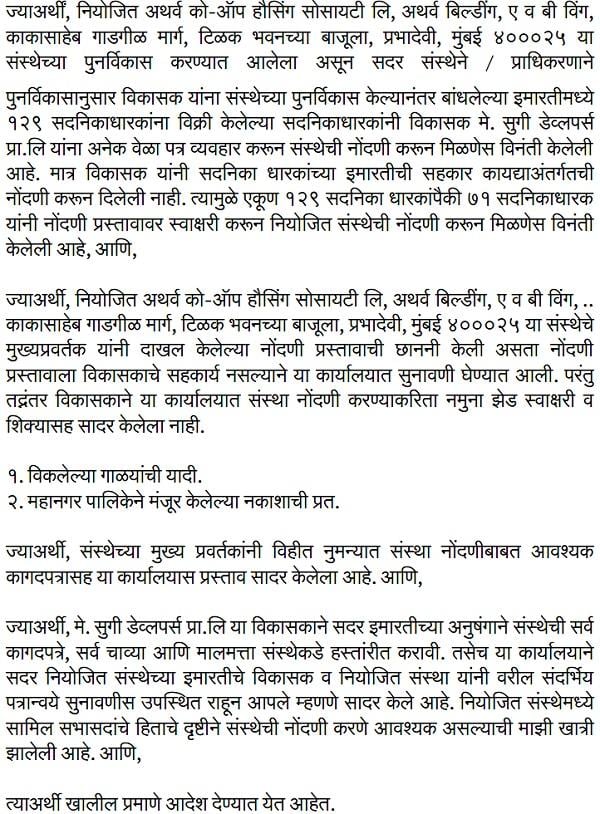
19. Thus, the Deputy Registrar was not even aware of the position that a new society was sought to be registered by separating from the existing society. As a matter of fact, 72 flat purchasers of Wings A and B were already made members of the Petitioner-Society. Thus, at the time of passing of order dated 20 February 2025 by the Deputy Registrar, 72 flat purchasers of Wings A and B were already members of another Society and by suppressing this position, the registration of Respondent No.4 Society was sought.
20. Though Respondent No.5-Chief Promoter did not implead the Petitioner as party to the proceedings before the Deputy Registrar, it appears that the Petitioner-Society got wind of proposal submitted by Respondent No.5 and it filed its objections vide letter dated 6 February 2025. However, the impugned order dated 20 February 2025 indicates that the Deputy Registrar did not take cognizance of objections raised by the Petitioner-Society. Thus, the impugned order dated 20 February 2025 suffers from twin vices viz., (i) it is passed in ignorance of the fact that the Petitioner-Society is already formed in respect of the building and (ii) it ignores the objection raised by the Petitioner-Society vide letter submitted on 6 February 2025.
21. The Joint Registrar failed to appreciate this position where the Deputy Registrar had decided the proposal for registration in ignorance of existence of Petitioner-Society. Ordinarily therefore, the Joint Registrar ought to have set aside order of the Deputy Registrar and ought to have remanded the proceedings for fresh adjudication. However, the Joint Registrar as well as the Hon’ble Minister have failed to appreciate this position and have erroneously dismissed the appeal and revision preferred by the Petitioner-Society.
22. Coming back to the core issue of permissibility to form and register a separate society under Section 9 of the MCS Act in the light of existence of another society in respect of a building, in my view, the scheme of the MCS Act does not permit formation of a new society independently when another society is already formed in respect of the building. The MCS Act provides for a remedy for formation of a new society under the provisions of Sections 17 and 18 of the MCS Act. Both Sections 17 and 18 of the MCS Act provide for remedy of division of the existing society. Under Section 17, members of the Society can pass a resolution by two-third’s majority and decide to divide itself into two or more societies. Thus, under Section 17, members of the society can themselves decide to divide the society into two societies. Section 17 of the MCS Act provides thus:-
17. Amalgamation, transfer, division or conversion of societies. (1)A society may, with the previous approval of the Registrar, by resolution passed by two-thirds majority of the members present and voting at a special general meeting held for the purpose, decide-
(a)to amalgamate with another society;
(b)to transfer its assets and liabilities, in whole or in part, to any other society;
(c)to divide itself into two or more societies; or (d)to convert itself into another class of society:
Provided that, when such amalgamation, transfer, division or conversion, aforesaid, involves a transfer of the liabilities of a society to any other society, no order on the resolution shall be passed by the Registrar, unless he is satisfied that-
(i)the society, after passing such resolution, has given notice thereof in such manner as may be prescribed to all its members, creditors and other persons, whose interests are likely to be affected (hereinafter in this section referred to as “other interested persons”), giving them the option, to be exercised within one month from the date of such notice, of becoming members of any of the new societies, or continuing their membership in the amalgamated or converted society, or demanding payment of their share or interest or dues, as the case may be,
(ii)all the members and creditors and other interested persons, have assented to the decision, or deemed to have assented thereto by virtue of any member or creditor or any other interested person failing to exercise his option within the period specified in clause (i) aforesaid, and
(iii)all claims of members and creditors and other interested persons, who exercise the opinion within the period specified, have been met in full or otherwise satisfied
Provided further that, in case of societies doing the business of banking, no such amalgamation, transfer, division or conversion shall be initiated without the prior approval of the Reserve Bank of India.
(2)Notwithstanding anything contained in the Transfer of Property Act, 1982, or the Indian Registration Act, 1908, in the event of division or conversion, the registration of the new societies or, as the case may be, of the converted society, and in the event of amalgamation, on the amalgamation the resolution of the societies concerned with amalgamation, shall in each case be sufficient conveyance to vest the assets and liabilities of the original society or amalgamating societies in the new societies or converted or amalgamated society, as the case may be.
(3)The amalgamation of societies, or division or conversion of a society shall not affect any rights or obligation of the societies so amalgamated, or society so divided or converted, or render defective any legal proceedings which might have been continued or commenced by or against the societies which have been amalgamated, or divided or converted; and accordingly, such legal proceedings may be continued or commenced by or against the amalgamated society, or, as the case may be, the converted society, or the new societies.
(4)Where two or more societies have been amalgamated, or a society has been divided or converted, the registration of such societies or society shall be cancelled on the date of registration of the amalgamated society, or the converted society, or the new societies between which the society may have been divided.
23) Under Section 18 of the MCS Act, power is conferred on the Registrar to inter-alia order sub-division of society into two or more societies, if he is satisfied that it is essential to do so in public interest or in the interest of the members of the society or in the interest of cooperative movement or for the purpose of securing proper management of any society. Power under Section 18 of the MCS Act can be exercised by the Registrar either suo-motu or even on an application made by members of the Society, who do not form two-third majority. Section 18 of the MCS Act provides thus:
18. Power to direct amalgamation, division and reorganisation in the public interest or in the interest of members, etc.
(1)Where the Registrar is satisfied that it is essential in the public interest or in the interest of members of such societies or in the interest of the co-operative movement, or for the purpose of securing the proper management of any society, that two or more societies should amalgamate or any society should be divided to form two or more societies or should be reorganised then notwithstanding anything contained in the last preceding section but subject to the provisions of this section, the Registrar may, after consulting such federal society as may be notified by the State Government by order notified in the Official Gazette, provide for the amalgamation, division or reorganisation, of those societies into a single society, or into societies with such constitution, property rights, interests and authorities, and such liabilities, duties and obligations, as may be specified in the order.
Provided that, such notified federal society shall communicate its opinion to the Registrar within a period of forty-five days from the date of receipt of communication, failing which it shall be presumed that such federal society has no objection to the amalgamation, division or reorganisation and the Registrar shall be at liberty to proceed further to take action accordingly.
(2)No order shall be made under this section, unless-
(a)a copy of the proposed order has been sent in draft to the society or each of the societies concerned.
(b)the Registrar has considered and made such modifications in the draft order as may seem to him desirable in the light of any suggestions and objections which may be received by him within such period (not being less than two months from the date on which the copy of the order as aforesaid was received by the society) as the Registrar may fix in that behalf, either from the society or from any member or class of members thereof, or from any creditor or class of creditors.
(3)The order referred to in sub-section (1) may contain such incidental, consequential and supplemental provisions as may, in the opinion of the Registrar, be necessary to give effect to the amalgamation, the division or reorganisation.
(4)Every member or creditor of or other person inserted in each of the societies to be amalgamated, divided or reorganised who has objected to the scheme of amalgamation, division or reorganisation, within the period specified, shall be entitled to receive, on the issue of the order of amalgamation, division or reorganisation his share or interest if he be a member and the amount in satisfaction of his dues if he be a creditor.
(5)On the issue of an order under sub-section (1), the provisions in subsections (2), (3) and (4) of section 17 shall apply to the societies so amalgamated, divided or reorganised as if they were amalgamated, divided or reorganised under that section, and to the society amalgamated, divided or reorganised.
(6) Nothing contained in this section shall apply for the amalgamation of two or more co-operative banks or two or more primary agricultural credit societies.
24. Thus, members of the existing society or even a person who is not interested in becoming member of the existing society can apply to the Registrar for the purpose of bifurcation of the existing society into two societies. Upon recording satisfaction about existence of one out of the four enumerated grounds under Section 18(1), the Registrar can process the proposal, prepare a draft order, consult the federal society and make an order of bifurcation.
25. Therefore, when a cooperative housing society is already formed in respect of a building and residents (members or otherwise) are desirous of separation from existing society and formation of a new society, the only course of action open to them is to pass a resolution for bifurcation under Section 17 or to apply to the Registrar for bifurcation under Section 18 of the MCS Act. It is wholly impermissible to directly approach the Deputy Registrar by filing application under Section 9 of the MCS Act for registration of a new society.
26. If power of the Registrar to directly entertain an application for registration of a new society in respect of a building for which there already exists another housing society is recognised, the same would lead to an anomalous situation. Once a housing society is registered in respect of a building, it becomes entitled to manage the entire land and the building. The Society is entitled to seek conveyance as well as control the structure of the building as well as the amenities situated in the land. Therefore, bifurcation of an existing housing society often involves complicated questions. Therefore, detailed and comprehensive procedures are prescribed under Sections 17 and 18 of the MCS Act before making the order of bifurcation of the existing society. The procedure under Section 18 is as under:
i. Upon receipt of application for bifurcation, the Registrar needs to first consult the federal society in respect of proposal for bifurcation, if, in his opinion, there is need for entertaining the bifurcation proposal.
ii. The Registrar thereafter needs to prepare a draft order by making a provision for constitution, property rights, interest and authorities as well as by determining the liabilities, duties and obligations of the two societies.
iii. The draft order needs to be sent to the existing society for inviting its suggestions and objections.
iv. Registrar needs to take into consideration the suggestions and objections and thereafter make modification in the draft order as may be necessary.
v. The Registrar can thereafter make an order of bifurcation of existing society into two societies.
27) Thus, the statutory scheme of Sections 17 and 18 of the MCS Act indicates that bifurcation of existing society is not a simple process and cannot be casually ordered. Federal society (Mumbai District Cooperative Housing Federation Ltd.) needs to be consulted, which very often visits the building and verifies whether it is possible to easily bifurcate the properties, amenities, utilities, etc. The Registrar is guided by the opinion of the federal society. The Registrar also needs to take into consideration the objections, which may be received from existing society or its members to the bifurcation proposal. He is required to conduct hearings. While preparing draft of the order as well as while sanctioning the same, the Registrar needs to make detailed provisions for division of the land, superstructure, facilities, amenities, finances, fund, etc. of existing society into two societies. This is the reason I have held that bifurcation of existing society is not a casual exercise to be undertaken by Deputy Registrar, but there is a comprehensive procedure as bifurcation results into vesting of property allocated to each of the societies. In this connection provisions of sub-section (2) of Section 17 of the MCS Act are of significance, which provides that in the event of division of existing society, the registration of new society itself constitutes a conveyance for vesting of assets and liabilities of original society in the new society.
28) In view of the detailed procedure contemplated for division of the existing society under Sections 17 and 18 of the MCS Act, it is difficult to accept a proposition that residents of a building for which a housing society is already formed, can apply under Section 9 of the MCS Act for registration of a new society. The statutory scheme under Sections 17 and 18 of the MCS Act is such that once a housing society is already registered qua a building, application for registration of a new society in respect of that building cannot even be entertained by the Registrar. The Registrar needs to reject such application and the remedy open to the aggrieved member is to pass a resolution for bifurcation under Section 17 or apply to the Registrar for bifurcation under Section 18 of the MCS Act. In Cosmopolitan III Co-operative Housing Society Ltd. (supra) the coordinate Bench of this Court has held that a statutory scheme of Section 18 read with Rule 17 of the MCS Act necessitates bifurcation order to be a comprehensive process. In paragraphs 15 and 16 it is held as under:-
15. The statutory scheme of Section 18 read with Rule 17 necessitates the bifurcation order to be a comprehensive order providing for constitution, property rights, interests and authorities, liabilities, duties and obligations and to contain such incidental, consequential and supplemental provisions as are necessary to give effect to the division. Before ordering bifurcation, the Registrar is required to consult the Federal Society on the draft scheme and after considering its suggestions, if any, and where there are no remarks offered within 45 days, the draft of the proposed order is to be sent to the Society inviting suggestions and objections and thereafter the final order is to be issued.
16. Considering the statutory provision, the use of the expression “interest of members of such societies”, or “in interest of the cooperative movement” or “for the purpose of securing proper management of the society” cannot be construed in a narrow sense of personal interest of the members and has to be understood in the context of the statutory scheme of Section 18. While adjudicating an application for bifurcation, there has to be holistic consideration of the consequences ensuing from the bifurcation and whether the bifurcation order is capable of providing a clear cut division of the constitution of the societies, the property rights and interests, separation of common amenities, etc. which are necessary for the smooth functioning of the bifurcated societies. To achieve that end, the property rights and interests and common amenities should not be intertwined in such a manner so as to be inseparable. The intent behind the preparation of the draft scheme in respect of the bifurcation is to ensure that the scheme makes necessary arrangement for separation of property rights and common amenities.
29) Chapter XIII- B has been inserted in the MCS Act for making special provisions relating to housing societies. No doubt, under Section 154B-1, the provisions of Section 9 of the MCS Act continue to apply mutatis mutandis even to thehousing societies. Therefore, registration of a housing society can be processed under Section 9 of the MCS Act. The only difference is that registration needs to be done by keeping in mind the eligibility prescribed under Section 154B-2 of the MCS Act. However, what bears mention is the fact that provisions of Sections 17 and 18 of the MCS Act are also made applicable to housing societies after incorporation of Chapter XIII-B. Therefore, provisions of Sections 9, 17 and 18 of the MCS Act need to be harmoniously construed to mean that proposal for registration of a new society can be entertained by the Registrar under Section 9 only when there is no housing society already formed in respect of the concerned building. In every case where there already exists a housing society formed by flat purchasers/residents of a building, it would be impermissible to entertain a proposal for registration of a new society under Section 9 of the MCS Act. The only remedy available to the members of existing society or residents of the building, who are desirous of formation of a new society is to go for bifurcation by adopting resolution under Section 17 or by applying for bifurcation under Section 18 of the MCS Act. Thus, the provisions of Section 9 on one hand and Sections 17 and 18 of the MCS Act on the other, can harmoniously co-exist if interpreted in the above manner. They operate in distinct situations and can co-exist harmoniously.
30) I am therefore not inclined to accept the contention raised by Mr. Sakhare that the Legislature has not imposed any restriction or embargo on power of the Registrar to register a new society under Section 9 of the MCS Act in respect of a building where there already exists another housing society. If such contention is accepted, the same would lead absurdity, confusion and anomalous situation. If new society is allowed to be registered without bifurcating the existing society, there would be utter chaos as multiple societies would get registered in respect of the same building. This is not the legislative object and in fact goes against the very spirit of the cooperative movement.
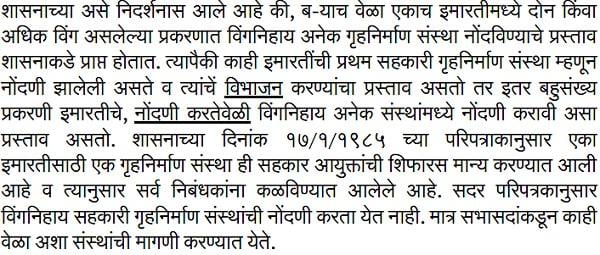
31. Even going by the Circular dated 30 July 2004, on which heavy reliance is placed by the Joint Registrar and Hon’ble Minister, it is seen that the guidelines prescribed therein apply only for the purpose of (i) bifurcation of existing societies or (ii) registration of multiple wingwise societies at the stage of formation. The Circular dated 30 July 2004 consciously does not take into consideration the eventuality of registration of a new society in respect of a building in which there is already existing society (except where bifurcation is contemplated). The Circular providing for wing-wise formation of societies apply only at the inception when organisations are to be formed by the flat purchasers of buildings having multiple wings or where bifurcation of a society into wing-wise multiple societies is proposed. This is clear from opening part of Circular dated 30 July 2004.
(emphasis and undelrling added)
Thus the Circular dated 30 July 2004 cannot be used for assuming power in Registrar to sub-divide the existing society into wing-wise multiple societies without undertaking the process of bifurcation.
32. In Sarita Cooperative Housing Society Ltd. (supra) this Court has held that in absence of statutory division of existing society, the Registrar cannot permit registration of another society in respect of the premises which already formed part of duly registered cooperative society. This Court held in paragraphs 10 and 11 as under:
10. The core question is not whether the shops can be physically demarcated from the residential flats. Physical separability by itself does not determine the legal position. Such an inquiry may become relevant where the competent authority exercises statutory power of division or bifurcation under Sections 17 and 18 of the MCS Act, after following due procedure and recording reasons. In the present case, there is no order of bifurcation. The original society continues to subsist. In the absence of a statutory division of the existing society, the authorities could not have permitted registration of another society in respect of premises which already form part of a duly registered cooperative society. Registration under Section 9 cannot be used as a means to indirectly fragment an existing society. If such a course is permitted, it would defeat the scheme of the Act and create overlapping jurisdictions over the same property. The statute contemplates orderly formation, alteration, and division of societies through defined procedures. Those safeguards cannot be bypassed.
11. In my considered view, the authorities have failed to appreciate the legal effect of the prior registration of the petitioner society and the absence of any order under Sections 17 or 18. By treating a portion of the same building as an independent structure without a lawful process of bifurcation, the authorities have misdirected themselves in law. The result is that two societies now claim authority over different parts of one integrated building, which the statute does not contemplate without proper division. This approach amounts to a misapplication of the provisions of the MCS Act and has led to an erroneous exercise of jurisdiction. The impugned orders, therefore, cannot be allowed to stand.
(Emphasis supplied)
33) In my view therefore, the impugned order passed by the Deputy Registrar on 20 February 2025 suffers from serious jurisdictional error as the Deputy Registrar could not have entertained application under Section 9 of the MCS Act for registration of a new society in respect of a building for which Petitioner-Society already existed.
34) Even otherwise, formation and registration of multiple societies in respect of the building in the present case is not warranted. From the plans as well as photographs, it clearly appears that the building in respect of which Petitioner-Society is formed is a part of one common structure. Though the building is divided into four wings, all the wings are connected together by a common terrace. There is a common underground water tank in respect of the four wings. The water supply lines, electricity meter, water pumps, etc. are all common. There is a common entrance to the building from which vehicles can enter. The other entry is only through a small gate from which vehicles cannot pass. Therefore, for vehicular entry, all the four Wings depend on common entrance from the road. From the other gate as well as from the narrow gap, vehicles cannot pass. There is a common recreational ground for all four wings. The Gymnasium for the four wings is provided on 22nd floor of A and B wings building. Even though there might be small gap on account of ‘L’ shape of the building between Wings B and C, the entire structure ultimately forms part of one common block. From the common terrace of all wings on the top, which is joined together, one can easily pass from one Wing to the other. In these circumstances, it prima facie becomes difficult to believe that it is easy for two distinct societies to manage affairs of the building separately, independently and without causing any friction. In fact, Mr. Sakhare has placed on record copy of letter dated 3 August 2026 signed by Secretary of Respondent No.4-Society in which Respondent No.4-Society has undertaken to maintain various common facilities on its own for all Wings. Respondent No.4-Society has agreed to assume full liability for all expenses relating to house-keeping, electricity, CCTV surveillance system. This willingness on the part of Respondent No.4-Society to look after the expenditure required for some of the common amenities on behalf of four wings itself makes it abundantly clear that it is impossible to sub-divide the amenities, facilities and utilities in respect of the building.
35. Most importantly, all the four Wings have independent and common parking comprising of 10 floors. Wings A, B, C and D do not have parking facility in those wings and developer has constructed separate parking block of 10 floors in which all the cars of the residents of the four Wings get parked. There can be no dispute to the position that it is impossible to sub-divide parking building for Wings A, B and C, D.
36. In my view therefore, formation of two societies in respect of the building would create difficulties in the areas of land and property ownership as well as it would adversely affect the rights and convenience of the members. In Sadguru Universal CHS Ltd. (supra) this Court has laid down the parameters to be examined by the Registrar while deciding whether two societies can exist. In paragraphs 18 and 19 this Court held as under:-
18. For deciding whether two societies can exist, the first authority must examine the following compulsory parameters:
(i) Structural design and layout:
The design of the building is the starting point. If the commercial portion and the residential portion are physically separated by walls, lobbies, or different levels and if there are independent entrances, separate staircases, and separate lift systems for each portion, then the building reflects separation by design. For example, if the commercial units on the lower floors have their own entrance from the main road and residents use a different lobby and lift, then separate functioning is possible. But if both the commercial and residential occupants use the same main gate, lobby, staircase, or lift, then the building is one integrated structure. In such a case, separate societies cannot be justified.
ii. Access and entry points:
Separate entry and exit points are a practical sign of independence. If customers and visitors to shops can enter and exit without passing through residential areas, and residents can access their homes without passing through or depending on commercial units, it supports independent functioning. Shared access means shared control and responsibility. The authority must check if both portions have separate entrances and exits. If customers, visitors and delivery vehicles for commercial units use the same access used by residents, then the building functions as one unit.
iii. Utilities and amenities:
Separate utilities show independent functioning. If the commercial units and residential units have different water supply lines, drainage systems, electricity connections, lift banks, and fire safety systems, then they can manage their affairs separately. But if both units use the same water tank, the same drainage system, the same firefighting equipment, or the same security staff, then they are dependent on each other. Such common use means that decisions about maintenance will affect both groups. The authority must verify if water supply, drainage, lifts, electric cabin, firefighting system and other utilities are common. If the same utilities are used, separation cannot be permitted. If utilities are independent, separation may be justified.
iv. Maintenance and financial responsibility:
The authority must consider who will pay for common repairs and facilities. If commercial and residential users have independent systems and bear their own expenses, separate societies may work. But if maintenance involves common lifts, compound walls, external painting, or structural repairs, then separation will cause conflict. When responsibility is common, the law requires one society. The authority must determine who shares the cost of maintenance. If common expenses are shared and cannot be fairly separated, then one society should manage the building. If separate expenses exist and can be accounted independently, separate societies may be examined.
19. In addition to the above, the authority must also examine the following parameters, where substantial compliance is required:
(a) Parking and circulation area:
Parking arrangements speak about dependence. If the commercial units have their own parking areas and their vehicle movement does not affect residential movement, it shows independence. But if customers of the commercial units use the same parking spaces, internal roads, or compound as the residents, there is no separation. Who uses parking and internal movement areas, and whether circulation of commercial visitors affects residential comfort. If separate parking cannot be created due to municipal design, but records clearly earmark certain slots for residents and others for commercial units, it satisfies substantial compliance.
b. Use pattern and occupancy:
How the premises are used on a daily basis also indicates whether separation exists. Commercial units operate during business hours. Residential units operate round the clock. If activities of commercial units interfere with residential life, such as crowding, noise, or customers using residential passages, then both are linked. In such circumstances, separation into two societies will only lead to disputes. Whether commercial activity disturbs residential use or whether timings and movement of commercial traffic interfere with residents’ rights. Perfect segregation in use is not required. What matters is whether activities in one part disturb or interfere with the other. If each portion functions independently without affecting the other, the test stands met.
c. Legal and ownership documents:
The authority must examine sanctioned plans and approvals. If the plan clearly shows separate commercial block and separate residential block, then the promoter may justify two societies. But if the plan shows one single building with mixed use, then one society is the rule. The promoter cannot, after selling units, artificially divide the building. Whether the sanctioned plan, occupation certificate and sale documents support separation. There may be cases where the sanctioned plan is composite but the actual construction has resulted in clear separation. In such cases, the authority can rely on actual construction along with correspondence or undertakings from the promoter or owners.
d. Impact on members’ rights and convenience:
The Registrar must ensure that forming two societies does not take away any member’s rights. No member should be denied access to common areas, terraces, passages, or utilities. If forming two societies will result in restrictions or disputes, one society must be formed. Whether separation affects the right of any member to use common areas or results in inconvenience or discrimination. If forming two societies will not reduce rights of any owner in common areas and convenience will improve, it is considered sufficient compliance.
(Emphasis supplied)
37. The Joint Registrar and Hon’ble Minister have led stress on Circular dated 30 July 2004 for holding that same permits formation of societies in respect of each wing of a building. However, in Sadguru Universal CHS Ltd.(supra) this Court has held that said Circular is not issued under any provisions of the MCS Act and cannot be treated as law. It is held to be merely administrative instructions not creating any enforceable rights. This Court held in paragraph 33 of the judgment as under:
33. Therefore, the Circular dated 30 July 2004, not issued under any provision of the MCS Act and not authenticated in accordance with Article 166, cannot be treated as “law” within the meaning of Article 13. At best, it is an administrative instruction. It does not create enforceable rights. It cannot be relied upon to defeat rights flowing from the MCS Act or from the Maharashtra Ownership Flats Act. In conclusion, such a circular has no statutory force and cannot be treated as law under Article 13 of the Constitution.
(Emphasis supplied)
38. In my view, by Circular dated 30 July 2004 the State Government has suggested guidelines for processing applications for registration of separate societies for each wing in a building. The guidelines stipulated in Circular dated 30 July 2004, though may not create any enforceable rights, can be kept in mind by the Registrar while deciding application for registration of wing wise societies. The said Circular also provides for guidelines while deciding proposal for bifurcation and formation of new wing wise societies. Since Sections 17 and 18 of the MCS Act do not lay down detail parameters for deciding the application for bifurcation particularly for housing societies, which has building with multiple wings, the Registrar can make use of guideline stipulated in the Circular dated 30 July 2004.
39. In the present case, even if the guidelines in Circular dated 30 July 2004 are considered, it is difficult to hold that formation of two societies in respect of the building would be appropriate. The most important parameter stipulated in the Circular dated 30 July 2004 is that Planning Authority ought to have sanctioned layout by subdividing things such as electricity connections, water meter, etc. In respect of building comprising of multiple wings, which share common underground tank, formation of multiple societies would be not advisable. In the present case, it is an admitted position that there is common underground tank for all the four wings. Therefore, even if guidelines stipulated in Circular dated 30 July 2004 are applied in the present case, it is difficult to hold that two separate societies can be formed in respect of the building.
40. Mr. Sakhare has strenuously highlighted the difference of opinion in relation to management of Wings A and B and Wings C and D of the building. It appears that in Wings A and B, sale component flats are situated, which are purchased by outsiders. Sale component flats are apparently larger in size possibly indicating a different economic and social class purchasing flats therein. On the other hand, the flats in Wings C and D apparently accommodate the original members of the Petitioner-Society, who were residents of the old building (32 in number). Additionally, there was an obligation to accommodate 75 flats in Wings C and D for being allotted to MHADA as per the Tripartite Agreement dated 2 December 2021. Since the original plot of Petitioner-Society was itself owned by MHADA and since MHADA permitted amalgamation of adjoining lands owned by it, there was an obligation to provide 75 flats to allottees of MHADA, who are also residing in Wings C and D. It appears that residents of Wings A and B are finding it difficult to come on same page with residents of Wings C and D. However, as rightly pointed out by Mr. Khandeparkar the flat purchasers of Wings A and B were fully aware of the position that they had contractually agreed to become members of the Petitioner-Society and that they will have to become part of common decision making and management process with residents of Wings C and D. The flat purchasers of Wings A and B have thus purchased the flats with their eyes wide open to the fact that they will be required to reside in a particular socio-economic class. Now they cannot turn around and complain that there are social or economic differences between the two sets of residents. This is particularly because all the four Wings are so commonly fused that formation of two societies would result in more chaos than solving the one that may exist today. Also the flat purchasers of wings A and B are apparently majority in number. Therefore, the case does not involve a situation where the residents of old building are imposing their decision on residents of sale component flats.
41) This Court has held that mere existence of disputes for management cannot be a reason for undertaking the exercise of bifurcation. In Madhur Naina Co-operative Housing Society Limited V/s. State of Maharashtra and Ors. 5 this Court has held that mere existence of disputes between members relating to redevelopment process cannot be a reason for invoking Section 18 of the MCS Act. This Court has held in paragraph 18 as under:-
18. Acting on the proposal dated 6 August 2024, the Deputy Registrar decided to exercise powers under Section 18(1) of the MCS Act which empowers the Registrar to direct amalgamation, division or reorganization of Societies. Section 18 of the MCS Act provides thus:
18. Power to direct amalgamation, division and reorganisation in the public interest of members, etc.—
(1) Where the Registrar is satisfied that it is essential in the public interest or in the interest of members of such societies, or in the interest of the co-operative movement, or for the purpose of securing the proper management of any society, that two or more societies should amalgamate or any society should be divided to form two or more societies or should be reorganised then notwithstanding anything contained in the last preceding section but subject to the provisions of this section, the Registrar may, after consulting such federal society as may be notified by the State Government by order notified in the Official Gazette, provide for the amalgamation, division or reorganisation of those societies into a single society, or into societies with such constitution, property, rights, interests and authorities, and such liabilities, duties and obligations, as may be specified in the order :
Provided that, such notified federal society shall communicate its opinion to the Registrar within a period of forty-five days from the date of receipt of communication, failing which it shall be presumed that such federal society has no objection to the amalgamation, division or reorganisation and the Registrar shall be at liberty to proceed further to take action accordingly.
(2) No order shall be made under this section, unless—
a. a copy of the proposed order has been sent in draft to the society or each of the societies concerned ;
b. the Registrar has considered and made such modifications in the draft order as may seem to him desirable in the light of any suggestions and objections which may be received by him within such period (not being less than two months from the date on which the copy of the order as aforesaid was received by the society) as the Registrar may fix in that behalf, either from the society or from any member or class of members thereof, or from any creditor or class of creditors.
(3) The order referred to in sub-section (1) may contain such incidental, consequential and supplemental provisions as may, in the opinion of the Registrar, be necessary to give effect to the amalgamation, the division or reorganisation.
(4) Every member or creditor of, or other person interested in, each of the societies to be amalgamated, divided or reorganised, who has objected to the scheme of amalgamation, division or reorganisation, within the period specified, shall be entitled to receive, on the issue of the order of amalgamation, division or reorganisation his share or interest, if he be a member, and the amount in satisfaction of his dues if he be a creditor.
5. On the issue of an order under sub-section (1), the provisions in sub- sections (2), (3) and (4) of section 17 shall apply to the societies so amalgamated, divided or reorganised as if they were amalgamated, divided or reorganised under that section, and to the society amalgamated, divided or reorganised.
6. Nothing contained in this section shall apply for the amalgamation of two or more co-operative banks or two or more primary agricultural credit societies.
42) In Cosmopolitan III Co-operative Housing Society Ltd. (supra) this Court has held that the disputes between the society members, allegations of misappropriation, non-holding of elections, etc. are all capable of being redressed by adopting remedies under the provisions of the MCS Act and that bifurcation of the Societies is not the remedy. This Court has held in paragraphs 21 and 22 of the judgment as under:
21. The bifurcation order also cannot be sustained as there is no reasoned finding in the order as to why the bifurcation is necessary. The Joint Registrar failed to notice that the mechanism provided under the MCS Act were sufficient for resolving the disputes sought to be put forth as ground for bifurcation as the allegations appear to be qua the concerned Managing Committee members.
22. The allegation of misappropriation of Society funds, non-holding of elections, irregular manner in passing of resolutions, maintenance, etc. are all issues which are capable of being redressed by adopting the necessary remedy under the provisions of MCS Act. The enquiry which ought to have been conducted is whether the disputes have the effect of disrupting the effective management of Society. In addition, it was also necessary to consider whether the legislative intent of effective management can be achieved in the facts of present case where there is practical impossibility of division of land in proportion to the built-up area.
43) In my view, therefore, mere existence of disputes between residents of Wings A and B and residents of Wings C and D cannot be a reason for formation of a new Society in respect of the same building when such formation is otherwise impermissible.
44. In the present case, there is yet another reason why a separate society in respect of Wings A and B cannot be formed or registered. The building has been constructed at the instance of the Petitioner-Society. In that sense, the Petitioner is the real promoter. The IOD, CC, OC, etc. are all issued in the name of the Petitioner-Society. In the Development Agreement dated 5 August 2020, following stipulations are incorporated in clauses 6(h) and 6(n):
6. Covenants and Undertakings of the Society:
xxx
h. The Developer shall nominate all prospective purchasers as new members of the Society being the purchasers of the Developer’s Allocation as per applicable laws, rules and regulation. Such prospective purchasers shall be enrolled as members of the Society. In case of the Developer falling to nominate such prospective Purchasers, the Society shall enroll Developer as a nominal member of the Society for such flats comprised of Developer’s Allocation and the Developer shall pay maintenance charges and all other outgoings for such unsold units till they are sold.
Xxx
n. The Society shall cause and the Existing Members shall obtain no objection certificate from their financial Institutions regarding any lien/mortgage created by the Existing Members with respect to their respective Existing Premises before execution of Permanent Alternate Accommodation Agreement. The society shall record the charge/lien of the banks/financial institutions with respect to the flats of members in the New Building who have taken loan from banks /financial institutions in the New Building.
45. Thus, it was specifically agreed in the Development Agreement itself that developer was required to nominate all prospective purchasers as new members of the Petitioner-Society and the Petitioner was to enroll them as its members. Even in Tripartite Agreement with MHADA executed on 2 December 2021, there was contractual stipulation for admission of 75 tenement allottees of MHADA to be admitted as members of the Petitioner-Society. More importantly, in Agreement executed under Section 4 of the Maharashtra Ownership Flats (Regulation of the Promotion of Construction, Sale, Management and Transfer) Act, 1963, by Respondent No.6-developer with flat purchasers of A and B wings, there are specific contractual stipulations in recital (H) and clause 17 as under:-
H. The Developer/Promoter proposes to construct on the Project Land, a multi-storied building (“Said New Building”) comprised of 4 Wings l.e. Wing-A, Wing-B, Wing-C and Wing-D, all four wings having common Ground floor for stilt car parking + 1 to 23rd upper residential floors and proposed separate car parking low rise building comprising of ground floor to upper podium floor for car parking. The Developer/Promoter will carry out the Redevelopment of the said Property as per said offer Letter and approvals as may be sanctioned by the Concerned Authorities (hereinafter referred to as the “Project”). The said New Building is comprised of 32 units/flats of the existing members of the said Old Building and 75 units/flats to be handed over to MHADA towards MHADA Share and saleable units/flats.
xxx
17.1 Since, the Society i.e. The Swa-Griha Co-operative Housing Society Limited is already in place, the Developer/Promoter shall not be under any obligation to form and register a new separate and Independent society of flat purchasers/allottees as envisaged under the provisions of the relevant Act. The Allottee/s along with other Allottees In the said New Building shall become the member of the Society and for this purpose also from time to time sign and execute application for registration and/or membership and the other papers and documents necessary for becoming a member, including the bye-laws of the Society and duly fill in, sign and return to the Developer/Promoter within Seven days of the same being forwarded by the Developer/Promoter to the Allottee/s.
17.2 The Developer/Promoter may become a member of the Society to the extent of all unsold and/or unallotted flat(s)/premises/units, areas and spaces in the said New Building.
17.3 The Developer/Promoter shall within the time limit stipulated under the said Act and rules made thereunder, handover all necessary permissions, certificates, plans and title documents etc.to the Society. The Society Including the Allottee/s herein shall serve and maintain all documents, plans received from the Deloper/Promoter and subsequently carry out necessary repairs, structural audit, fire audit at regular Interval and also present periodical structural audit reports and repair history as per the requirements of the Chief Fire Officer through the authorised agency of the concerned authorities.
46) Thus, in all the Agreements for Sale executed with flat purchasers, (who have now formed new society) there was specific prohibition on formation or registration of new, separate or independent society and on the other hand, there was obligation to become member of the Petitioner-Society. The residents of Wings A and B cannot violate the above contractual stipulations and go for registration of new Society. In Kritika Jewels Coop. Housing Society (supra), this Court has dealt with a case where the Registrar, while registering the society, had reserved right of the promoter to form a society of commercial shops on first floor above the stilt parking. This Court took note of contractual stipulations for formation of one society and held that it was impermissible to violate the same and to form multiple societies. This Court has held in paragraphs 11, 12, 14 and 17 as under:
11. The agreements executed with the flat purchasers form a reliable and binding record of what the promoter promised at the time of sale. These agreements are not casual statements. They are registered documents. They reflect the understanding between the promoter and every purchaser. When the promoter has undertaken in these agreements to form one common cooperative society for both residential and commercial units, that promise carries legal weight.
12. Such a commitment cannot be ignored while deciding the nature of the society to be registered. The agreements show thatthe promoter treated the entire building, including the commercial shops, as one single project meant to be managed through one common society. This is credible evidence of the promoter’s intention at the time of construction and sale.
xxx
14. In these circumstances, the contractual undertaking binds the promoter. It is a strong piece of evidence that the entire building was meant to be governed by one common society. The Registrar could not overlook this commitment while deciding the registration application.
xxx
17. The judgments relied upon by the promoter, including the decisions in Sadguru Universal and in Haresh Bhatia, recognise that more than one cooperative society can exist within the same building. In the present case, the promoter has given a clear contractual undertaking to form one common society for both residential and commercial units. This undertaking forms part of the registered agreements with the purchasers. There is no such undertaking in the cases cited by the promoter. In fact, the Courts in those cases proceeded on a different factual foundation where no promise of a single combined society existed. A contractual undertaking cannot be disregarded unless the promoter places material to show that circumstances have changed or the sanctioned plan has been modified. No such evidence has been brought on record. The cited judgments cannot override a binding contractual promise. They also cannot be applied where the physical structure itself does not support separation. For these reasons, the decisions in Sadguru Universal and Haresh Bhatia do not assist the promoter and cannot justify the reservation made by the Registrar in the present case.
47. Thus, there is estoppel by contract under which Respondent No.4-Society cannot be registered by flat purchasers of Wings A and B.
48. The conspectus of the above discussion is that orders of the Deputy Registrar, Joint Registrar and Hon’ble Minister-Cooperation suffer from multiple illegalities as discussed above. Impugned orders are thus indefensible and liable to be set aside.
49) The Petition accordingly succeeds and I proceed to pass the following order:
i. Order dated 20 February 2025 passed by the Deputy Registrar, directing registration of Respondent No.4-Society is set aside.
ii. Order dated 8 July 2025 passed by the Joint Registrar dismissing the Appeal and Order dated 18 February 2025(2026) passed by the Hon’ble Minister dismissing the Revision Application are also set aside.
iii. Consequently, registration granted in favour of Respondent No.4-Society stands cancelled.
50) Writ Petition is allowed in above terms. Rule is made absolute Considering the facts and circumstances of the case, there shall be no order as to costs.
[SANDEEP V. MARNE, J.]
51) After the Judgment is pronounced, the learned counsel appearing for Respondent No.4-Society seeks stay of the Judgment for a period of six weeks. The request is opposed by the learned counsel appearing for the Petitioner. Considering the fact that Respondent No.4-Society has been registered in the year 2024, there shall be stay to the operation of the judgment for a period of six weeks.
1 Writ Petition No.12234 of 2024, decided on 19 November 2025.
2 (2025) 2 High Court Cases (Bom) 363
3 2025 SCC OnLine Bom 4382
4 Writ Petition No.3541 of 2025, decided on 12 February 2026.
5 Writ Petition No.850 of 2026, decided on 22 July 2026