Central Bank of India Vs Simplex Infrastructures Limited (NCLT Kolkata)
Summary: The National Company Law Tribunal, Kolkata Bench (Court-II), in Central Bank of India Vs Simplex Infrastructures Limited, allowed an interlocutory application filed by the corporate debtor and dismissed the insolvency petition instituted by Central Bank of India under Section 7 of the Insolvency and Bankruptcy Code, 2016. The Financial Creditor had claimed a default of ₹105,10,20,392, comprising principal of ₹91,31,06,821.34 and interest of ₹13,79,13,570.66 as at 30 June 2021. The corporate debtor contended that it was a functioning engineering, procurement and construction (EPC) company experiencing a temporary mismatch between contractual receivables and payment obligations, rather than an enterprise whose business model had failed. Relying upon Vidarbha Industries Power Limited Vs Axis Bank Limited, the NCLT examined whether the existence of substantial pending arbitration awards and the company’s operating circumstances justified refusing admission of the insolvency application.
The corporate debtor explained that its principal commercial assets were technical expertise, trained manpower, ongoing construction contracts and amounts recoverable under arbitral awards, rather than substantial physical assets. It submitted details of awards and claims against government agencies, infrastructure companies and other counterparties. According to the schedule placed before the Tribunal, the aggregate awards amounted to ₹484.03 crore, increasing to ₹554.17 crore inclusive of interest as at 31 March 2022. The Tribunal also noted that awards described as having survived appellate scrutiny amounted to only ₹3.38 crore. Several awards remained subject to challenges under Sections 34 and 37 of the Arbitration and Conciliation Act, 1996, and their actual realisation was uncertain. The corporate debtor additionally placed reliance on its positive net worth and stated that it had settled claims involving 152 creditors.
The Central Bank of India opposed application of the Vidarbha Industries precedent. It argued that the default had persisted for approximately three years and was therefore materially different from a temporary inability to pay. The Bank also maintained that the corporate debtor’s outstanding arbitration awards had not attained the same degree of finality as the electricity tariff award considered by the Supreme Court in Vidarbha Industries. According to the Bank, the pending challenges made actual recovery uncertain, and the existence of contingent or disputed receivables could not justify refusing admission of a Section 7 petition based on debt and default.
After examining the rival submissions, the NCLT considered the company’s financial structure, the aggregate arbitration awards, its asset-light EPC business model and the practical consequences of replacing the existing management through corporate insolvency resolution proceedings. The Tribunal distinguished between financial failure, involving a persistent mismatch between incoming payments and outgoing obligations, and business failure, involving inability of the enterprise’s business model to generate sufficient revenue. Referring to the Bankruptcy Law Reforms Committee Report, 2015, it viewed the company’s difficulties as a financial failure rather than a failure of the underlying EPC business model. The Tribunal reasoned that appointment of a new management would not necessarily accelerate recovery of disputed arbitration awards, which represented a substantial portion of the company’s expected realisations.
Considering the objectives of promoting entrepreneurship, credit availability and maximisation of enterprise value, the NCLT concluded that admitting the corporate debtor into CIRP could cause greater harm without necessarily improving creditor recoveries. It exercised the discretion which it understood to arise under Section 7(5)(a) in the context of the Supreme Court’s *Vidarbha Industries* ruling and allowed IA (IB) 1297/KB/2022. Consequently, C.P. (IB) No. 186/KB/2021 and its associated interlocutory applications were dismissed by order pronounced on 4 May 2023.
Subsequent legal position: The Supreme Court subsequently clarified the scope of Vidarbha Industries, observing that its conclusions were made in the particular factual setting of that case and should not be read as overriding the established principles in Innoventive Industries and E.S. Krishnamurthy. The NCLT’s decision in the present case must therefore be read in its historical and judicial context, rather than as establishing a general rule that an otherwise complete Section 7 application can be rejected solely because the corporate debtor has a positive net worth or substantial receivables.
Cases Discussed
1. Vidarbha Industries Power Limited Vs Axis Bank Limited (Supreme Court); Civil Appeal No. 4633 of 2021; 12/07/2022; (2022) 8 SCC 352 — Applied by the NCLT while examining whether the financial position, arbitration awards and viability of the corporate debtor warranted exercising discretion under Section 7(5)(a) instead of admitting the insolvency petition. The order quotes paragraphs 86 and 88 of the Supreme Court judgment.
FULL TEXT OF THE ORDER OF NCLT KOLKATA
1. The Court is convened by hybrid mode.
2. This application has been filed under section 60 (5) read with Rule 11 of the NCLT Rules, 2016 for disposal of CP (IB) No. 186/KB/2021. The application has been filed by Simplex Infrastructures Limited (‘Applicant’) against the Central Bank of India (‘Respondent’).
3. It has been contended by the applicant that the application is not maintainable and deserves to be rejected as the present case is squarely covered by Vidarbha Industries Power Ltd. Judgement, wherein discretionary power of this Adjudicating Authority has been stressed upon.
4. C.P (IB) No.186/KB/2021
4.1 The Respondent in the IA (IB) 1297/KB/2022 had filed a Company Petition under section 7 of the Insolvency and Bankruptcy Code, 2016 (‘the Code’) read with Rule 4 of the Insolvency and Bankruptcy (Application to Adjudicating Authority) Rules, 2016 through Mr. Dashrath Pandurang Sadayeto, lawful attorney, Central Bank of India, duly authorised vide Power of Attorney dated 12 July, 20141 for initiation of Corporate Insolvency Resolution Process (“CIRP”) against the Applicant in the IA (IB) 1297/KB/2022 .
4.2 The Petition was filed on 15 July, 2021 before this Adjudicating Authority on the ground that the Corporate Debtor has defaulted in the payment of sum of Rs.105,10,20,392/- [Principal – Rs.91,31,06,821.34/- and Interest – Rs.13,79,13,570.66/-] including both realized and unrealized interest calculated till 30 June, 2021.
4.3 It is submitted in the Petition, Part – II that the authorised share capital of the Corporate Debtor is Rs. 75,00,00,000/- (Rupees Seventy Five Crore only) with paid up Capital as Rs. 11,42,85,640/- (Rupees Eleven Crore Forty Two Lakh Eighty Five Thousand Six Hundred Forty only).
5. Submissions by Ld. Sr. Advocate Mr. Joy Saha appearing for the Corporate Debtor i.e., the Applicant in the IA (IB) 1297/KB/2022
5.1 Ld. Sr. Advocate Mr. Joy Saha appearing for the Corporate Debtor brought out that the Corporate Debtor is an EPC company and is in the business of putting up the projects for the clients and works as per the contracts entered into with various principals as well as with some other main work contractors. Considering the fact that the company does not have significant assets of its own, its strength is its know-how as well as the skilled manpower by virtue of which it carries on the work with the payments coming in from various contracts. He further stated that the company is undergoing only a transient shortage of funds and can in no manner be termed as an insolvent company
5.2 Ld. Sr. Counsel appearing for the Corporate Debtor i.e. Simplex Infrastructures Limited led us through the Paragraphs 81, 84, 88 of the Vidarbha Judgement to support his contention. In this context, paragraph 88 of the judgement is extracted below:-
“The Adjudicating Authority (NCLT) has to consider the grounds made out by the Corporate Debtor against admission, on its own merits. For example when admission is opposed on the ground of existence of an award or a decree in favour of the Corporate Debtor, and the Awarded/decretal amount exceeds the amount of the debt, the Adjudicating Authority would have to exercise its discretion under Section 7(5)(a) of the IBC to keep the admission of the application of the Financial Creditor in abeyance, unless there is good reason not to do so. The Adjudicating Authority may, for example, admit the application of the Financial Creditor, notwithstanding any award or decree, if the Award/Decreetal amount is incapable of realization. The example is only illustrative”.
5.3 Further taking recourse to paragraph 90 of the said judgment, the Ld. Sr. Counsel submitted that unlike Section 9 of the IBC, 2016, wherein it is obligatory for the Adjudicating Authority to admit the application mechanically subject to fulfillment of the laid down requirements of debt default and pre-exiting dispute in Section 9 of IBC, 2016, where under Section 9(5) it is clearly stipulated that the Adjudicating Authority shall within Fourteen days the receipt of the application (shall admit the application), whereas there is a discretionary power given to the Adjudicating under section 7 (5) thereof.
5.4 Section 7(5) of the IBC underscores this discretion by using the word ‘where the Adjudicating Authority is satisfied’. Citing these two terms extracted from IBC, 2016, he submitted that the Adjudicating Authority’s satisfaction is paramount in deciding whether the Corporate Debtor is to be admitted to CIRP and simply the ticking the check boxes of the debt and default are not good enough for sending the Corporate Debtor to the CIRP, particularly when the balance sheets of the Corporate Debtor shows the networth to be positive.
6. Submissions by the Ld. Counsel appearing for the Financial Creditor i.e., the Respondent in the IA (IB) 1297/KB/2022
6.1 Ld. Counsel appearing for the Respondent Central Bank (in this IA) which is essential a demurrer to the main CP (IB) 186/KB/2021, was directed to file reply vide order dated 04 November, 2022.
6.2 However, when this matter was taken up, he stated that he wanted to distinguish the contentions of the Corporate Debtor on the Vidharbha Industries Power Ltd. judgment only orally as the matter is purely a point of law. Advancing his arguments, further, he sought to distinguished the Paragraph 82 to 88 of the judgement to say that the said judgment very clearly outlines that the Adjudicating Authority ‘may’, for example, admit the application of the Financial Creditor. Notwithstanding any award or decree, if the Award/Decretal amount is incapable of realization. He submitted that the various awards cited by the Corporate Debtor to be pending in his favour are the awards which have been challenged in various courts but have not yet been adjudicated and have yet not travelled to Hon’ble Supreme Court as has been the case of the Vidharbha Industries Power Ltd. Therefore, the fate of these Awards being uncertain, this Adjudicating Authority cannot allow the matter to be even compared with the Vidharbha case.
6.3 Three points were made viz.(1) In the cited case, the situation that it sought to be addressed is a temporary default and in the present case the default is continuing for three years; (2)The use of words “Realisable” in the said judgment as against the uncertainty of realization in the present case (3) In Vidarbha the award was already crystallized and the matter has already travelled to the Hon’ble Supreme Court of India and, therefore, the matter was not as uncertain as the present .
Analysis and findings;
6. We have heard the both Ld. Counsels on both sides at length and perused the application. We are mindful of the fact that the Vidarbha judgment which inter-alia notes as follows:
“86. Even though Section 7 (5)(a) of the IBC may confer discretionary power on the Adjudicating Authority, such discretionary power cannot be exercised arbitrarily or capriciously. If the facts and circumstances warrant exercise of discretion in a particular manner, discretion would have to be exercised in that manner.”
7. In light of the above it is essential to see:
(i) Whether the facts of the present case are similar to those of the Vidarbha Judgement, making it appropriate to apply the same in the present case.
(ii) Whether the Corporate Debtor is actually a Solvent company and the present quasi-insolvency situation is a transient one.
(i) Comparison of facts :
It is a true that the Corporate Debtor has secured many Arbitration Awards in his favour, even though the same are challenged under section 34 and 37 of the Arbitration and Reconciliation Act, 1996 (as amended). In Vidarbha’s case also the award for increased tariff was passed by APTEL , which is infact an Appellate authority for the respective regulatory commission which adjudicates the tariff disputes. As such in that case also the first authority to rule over the tariff matters had given an award which was challenged and was upheld/modified by the next appellate authority before travelling to Supreme Court. In the present case also there are some awards passed by the Arbitral Tribunals under the A&C and challenged and upheld by the Appellate court viz. the High court/Commercial court. The following table gives the details of the award as presented by the Corporate Debtor in their pleadings:
| Sl No. | Name of the Respondent /Defendant | Total Awards amount including pendent lite interest & others | Challenged (u/s 34 or 37) | Challenged by | Pending before which forum |
|---|---|---|---|---|---|
| 1. | NHPC | 11.25 | u/s 37 | NHPC & Patel | Single Bench of Chandigarh High Court |
| 2. | NHPC | 44.57 | u/s 37 | Patel | Division bench of Chandigarh High Court |
| 3. | NHPC | 2.60 | u/s 34 | NHPC & Patel | District Court Faridabad |
| 4. | NHPC | 54.82 | u/s 34 | NHPC | Appealed by NHPC u/s 34, dismissed in January, 2022 by District Court, faridabad |
| 5. | NHPC | 77.63 | u/s 34 | NHPC | District Court Faridabad |
| 6. | NHPC | 44.55 | u/s 34 | NHPC | District Court Faridabad |
| 7. | Bangalore Metro Rail Corporation Limited (BMRCL) | 8.79 | u/s 34 | BMRCL | Commercial Court, Bangalore |
| 8. | Bangalore Metro Rail Corporation Limited (BMRCL) | 6.13 | u/s 34 | BMRCL | Commercial Court, Bangalore |
| 9. | Bhushan Steel & Strips Limited | 0.49 | u/s 34/ NCLT | Bhushan | Single Bench of Delhi High Court, IRP appointed |
| 10. | Delhi Development Authority (DDA), Project – Moolchand Flyover | 7.57 | u/s 34 | DDA | Delhi High Court |
| 11. | Delhi Development Authority (DDA), Project – Pankha Flyover | 5.01 | u/s 34 | DDA | Delhi High Court |
| 12. | DMRC – Hospital Vasant Kunj | 0.40 | u/s 34 | DMRC | Delhi High Court |
| 13. | DMRC – Delhi Metro Rail Corporation – Shahstri Park | 0.57 | SLP | SIL | Supreme Court of India |
| 14. | Fernas Construction India Private Limited | 3.53 | Recovery proceedings are being pursued | ||
| 15. | Hyderabad Metro Development Authority | 65.65 | u/s 34 | HMDA | Comm. Court, City Civil Court, Hyderabad |
| 16. | IIITM-K, Kerala | 16.49 | u/s 34 | IIITM | District Commercial Court, Thiruvananthapuram, Vanchiyoor |
| 17. | Kerala Minerals and Metals Limited (KMML) | 0.92 | Execution Petition | SIL | District Court, Kollam |
| 18. | Kolkata Metro Rail Corporation Limited (KMRCL) | 5.96 | u/s 34 | KMRCL | Calcutta High Court |
| 19. | Kolkata Metro Rail Corporation Limited (KMRCL) | 5.29 | u/s 34 | KMRCL | Calcutta High Court |
| 20. | Maharashtra State Road Development Corporation Limited, Mumbai (MSRDCL) | 17.80 | u/s 34 | MSRDCL | Bombay High Court |
| 21. | Metropolitan Transport Project – Southern Railway (MRTS) | 2.22 | Sec. 34 dismissed on 26.08.2021 | MTRS | Filing of execution petition is under process |
| 22. | Municipal Corporation of Greater Mumbai (MCGM) | 0.98 | u/s 34 | MCGM | Bombay High Court |
| Municipal Corporation of Greater Mumbai (MCGM) | 8.37 | u/s 34 | MCGM | Single Bench of Bombay High Court | |
| 23. | NHAI – SJEPL | 48.32 | u/s 37 | SJEPL (SIL) | Delhi High Court |
| 24. | NHAI – Bihar (Labour Cess) Ref No.4 | 3.71 | u/s 34 | NHAI | Delhi High Court |
| 25. | NHAI – Bihar (Extra Lead) | 8.62 | u/s 34 | NHAI | Delhi High Court |
| 26. | NHAI Bihar – (Dispute relating to payment of final bill) | 6.32 | u/s 34 | NHAI | Delhi High Court |
| 27. | Nicco Corporation Limited | 0.58 | NCLT & RP | ||
| 28. | Public Works Department, (PWD-Vikaspuri) – Union of India | 1.81 | u/s 34 | PWD | Rohini Court, North Delhi |
| 29. | Public Works Department, (PWD-Vikaspuri) – NCT of Delhi | 0.31 | u/s 34 | PWD | Rohini Court, North Delhi |
| 30. | RVNL Joka Station Building | 1.16 | u/s 34 | RVNL | Sec. 34 dismissed on 29.09.2021 by Delhi High Court |
| 31. | RITES Limited (IIT Kharagpur) | 0.90 | u/s 37 | SIL | Delhi High Court |
| 32. | Tamil Nadu Maritime Board (TNMB) | 0.55 | u/s 37 Execution Petition | TNMB/SIL | Single Bench of Madras High Court |
| 33. | Vijay Tanks and Vessels Limited | 0.69 | u/s 37 Execution Petition | Vijay/SIL | Single/ Division Bench of Madras High Court |
| 34. | Mahendra Investment Advisors Private Limited | 10.84 | Recovery proceedings are being pursued | ||
| 35. | Utkal Steel Limited (Supplier / Sub-Con.) | 2.05 | Utkal | 8th M.M, Calcutta | |
| 36. | Aban Lloyd Chiles Offshore Limited. Aban Energies Limited, Chennai. | 6.58 | Madras High Court | ||
| Total | 484.03 | ||||
| Sum inclusive of interest as on 31.03.2022 | 554.17 | ||||
It is seen that while the total amount of the Arbitration awards that have gone in the favour of the Corporate Debtor is Rs.554.17 Crores (including interest), while the ones passed the muster of an appellate court is of Rs.3.38 Crores.
However, in the present case, none of the cases has yet reached the Apex court, albeit in some of them the challenges to the awards have been overruled by the High courts in terms of the Arbitration and Conciliation act have been held to be correct.
(iii) An exhaustive list has been placed at page 60 and 61 of the application totaling to an amount of Rs.5,54.17 Crores on the strength to trade receivables. The Balance sheets of the Corporate Debtor do not show a negative net worth and as such cannot be termed as insolvent. However, in this in any way cannot be construed to be the acceptance of the fact that the Corporate Debtor be left in lurch for an uncertain period. This uncertainty is undoubtedly, a situation where as the company though not being able to pay its debt cannot be termed as insolvent, as it has a much large amount of claims waiting to be released in his favour.
(iv) We also note the fact that the Corporate Debtor is essentially an EPC & a contracting Company and does not have many tangible assets as brought from the balance sheet of the company and the only prominent assets of the company are the works in hand which may lead to a reasonable profit margin and its trained main power and the skill of the people.
(v) The Corporate Debtor has also led us through a list of number of cases which have been settled by the Corporate Debtor in favour of various Operational Creditors, which further supports his contention that it is an inherent part of the business of the corporate debtor that some of his payments would get realized over a protracted period of time due to disagreements on the interpretation of certain clauses of the contract as also due to delay in the finalization of the rates of the extra work which is asked to be done by the clients in terms of contract. The only gap that creates such a condition is that whereas the work is asked to be done in a timebound manner and is delivered too, it takes an excruciatingly large time to approve the rates for such works and the resultant payments are received much later. It was directed that the Corporate Debtor file a supplementary affidavit in amount that has been settled, so as to have an idea about the intrinsic financial strength of the company. A list thereof is annexed to the IA (IB) 1297/KB/2022 and marked as Annexure F at pages 2901 to 2905, where it reflects that the Applicant has already settled the matter with 152 of its creditors.
(vi) The crux of the Vidarbha judgement lies in the deduction that the purpose of any legislation should not be lost sight of in the process of implementation of the law itself so to say that the means should not become the ends. In the instant case the purpose of this legislation as enshrined in the preamble is as below:
“An Act to consolidate and amend the laws relating to reorganisation and insolvency resolution of corporate persons, partnership firms and individuals in a time bound manner for maximization of value of assets of such persons, to promote entrepreneurship, availability of credit and balance the interests of all the stakeholders including alteration in the order of priority of payment of Government dues and to establish an Insolvency and Bankruptcy Board of India, and for matters connected therewith or incidental thereto.”
(vii) It is clear that one of the precepts of the legislation is to promote entrepreneurship and availability of credit. These two components of the benefits of intiation of CIRP against the Corporate Debtor have been examined in the ensuing text.
(viii) Further the BLRC in its 2015 report in clause 3.2 has defined the insolvency of two types:
• Financial failure – a persistent mismatch between payments by the enterprise and receivables into the enterprise, even though the business model is generating revenues, or
• Business failure – which is a breakdown in the business model of the enterprise, and it is unable to generate sufficient revenues to meet payments.
In the present case , it is a financial failure while the business model is sound in keeping with the general industry practice. Having said that it is not likely that any new management would be in a position to do something better which the current management is not able to do.
As the BLRC report observes:
Conflicts in creditor-debtor negotiation:
Conflicts tend to be exacerbated when there are multiple levels and types of liabilities in an enterprise. In addition to the conflict between creditor and debtor, there can be conflict between different types of creditors as well. Enterprises have financial creditors by way of loan and debt contracts as well as operational creditors such as employees, rental obligations, utilities payments and trade credit. When the debtor contracts these liabilities, there is an understanding about a priority structure of payout to the claims. While this will not be disputed when the debtor is solvent, multiple claims will give rise to conflict during insolvency.
Considering the number of cases filed against this corporate debtor by a number of operational creditors, with whom he is going on settling the claims on a transient basis (as soon as some payments are received into the enterprise, it is paid to the creditors, mostly operational creditors and small time financial creditors ), there is a strong possibility that such a conflict as brought out in the BLRC report shall remain and as such there is a grave danger that the insolvency may not get resolved. Such a situation has been experienced in the EMC case, where after failure of the SRA to deposit the amount of money in the CIRP account, the entire process was reset in a bid to resolve the insolvency. However EMC also being an EPC company , like the corporate debtor, does not have sizeable physical assets and as such in the second round of the rebooted CIRP, there do not appear to be any takers.
(ix) Be that as it may, the key to resolution in such cases would be a faster recovery of the dues of the corporate debtor, which are stuck in various arbitration cases, apart from carrying on with the existing contracts. Now it is highly unlikely that the prospective Resolution applicant would be in any better position to liquidate the awards given in favor of the corporate debtor, considering the gaps in the documentation and ground situation which is quite pronounced in such cases. Furthermore the working ethos of the EPC companies is going to remain the same, what with deficient contracts and poor implementation thereof by both the parties to these contracts.
(x) According to a report by the Indian Ministry of Law and Justice, the construction sector has consistently been the top contributor to the number of arbitration cases filed in India between 2016-2020. The construction industry has also accounted for the highest value of disputes referred to arbitration in India. As per a report by the International Chamber of Commerce (ICC), construction disputes in India were worth over USD 8 billion in 2019. Delay in project completion is the most common reason for arbitration cases in the construction industry in India, followed by disputes related to payment, quality, and design issues.
(xi) As such these issues are certainly going to stay and dog the working of any new contender. Thus, even though we would have followed the law in its letter, the spirit may be eluding us.
(xii) Since there are insignificant tangible assets with the corporate debtor, the financial assets of the Corporate Debtor which would be available to the new incumbent is again in the shape of the arbitration awards only. It is thus not certain that by what innovative thinking by the new incumbent, these awards can be decided in an early timespan. Till that time the value has to remain locked and the money that is stuck is not going to be released into the credit market any time soon than the prevailing trend of resolution of such arbitration cases.
(xiii) A snapshot of general statistics on Indian arbitration scenario released by an International firm viz. Statista is reproduced below:
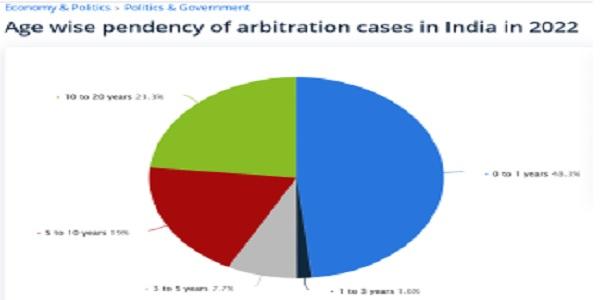
| Age of arbitration cases | Percentage |
|---|---|
| 0 to 1 years | 48.3% |
| 1 to 3 years | 1.6% |
| 3 to 5 years | 7.7% |
| 5 to 10 years | 19% |
| 10 to 20 years | 23.3% |
(xiv) In light of the above, it is seen that the Corporate debtor is undergoing a transient insolvency due to a financial failure and it is a matter of time that it is able to liquidate these awards and payoff the creditors in good time which is in any case not going to be short, even if the management of the enterprise is changed, the business model of the Corporate Debtor being prudent.
(xv) Furthermore since the business model of the Corporate Debtor is not a faltered one- it works as a construction company on EPC and other form of contracts – the larger issue of the quality of the tender documents, the competition in the sector, the delay in the execution of the works due to various hinderances – both attributable to the owner and attributable to the Corporate Debtor and also various permutations thereof – remains unchanged even after the change of management through the resolution process.
(xvi) As such we are not satisfied in terms of Section 7 (5)(a) that this application needs to be admitted for if that was done it might create a larger harm to the Corporate Debtor. Hence, IA (IB) 1297/KB/2022 is allowed, resultantly, CP (IB) No.186/KB/2021 stands dismissed in above terms, along with all associated IAs.
(xvii) Urgent copies of this order be issued by the registry following due process.
1 Pages 22 – 33 of C.P (IB) No.186/KB/2021. ↩