In re JioMart (Reliance Retail Pvt. Ltd.) (Central Consumer Protection Authority)
In matter of JioMart (Reliance Retail Pvt. Ltd.) (Sale of Agro-Chemical Product, namely “Cyclosinone Herbicide”)
Summary: The Central Consumer Protection Authority (CCPA) held JioMart (Reliance Retail Pvt. Ltd.) responsible for misleading advertisement and unfair trade practice arising from the listing, advertisement and sale of an unregistered agro-chemical product described as “Cyclosinone Herbicide” on its e-commerce platform. The proceedings originated from a complaint forwarded by the Department of Agriculture and Farmers Welfare concerning sale and advertisement of the product through e-commerce and digital platforms. The Ministry stated that “Cyclosinone” was not included in the Schedule to the Insecticides Act, 1968 and that pesticides permitted for domestic sale are subject to registration and licensing requirements.
The CCPA’s preliminary inquiry found that the product was advertised on JioMart with claims including “5% Active Formula”, “Safe Weed Control for Lawns, Gardens & Farmlands” and “Granular Application for Home & Commercial Use”, without disclosure of its active ingredient, precise chemical identity or verifiable licence particulars. JioMart contended that it was merely an intermediary facilitating transactions between third-party sellers and relied upon Shreya Singhal v. Union of India and Section 79 of the Information Technology Act, 2000. It stated that sellers were contractually responsible for statutory compliance, that the product had been deliberately mis-categorised by the seller, and that only two listings by one seller had resulted in approximately 137 units being sold through 150 orders with aggregate sale value of ₹39,593. The CCPA rejected the contention that marketplace or intermediary status provided blanket immunity. It held that JioMart had independent statutory obligations as a marketplace e-commerce entity and was required to exercise appropriate due diligence, particularly where products were expressly represented as herbicides and were subject to licensing and regulatory controls.
The Authority referred to the Consumer Protection (E-Commerce) Rules, 2020, the Insecticides (Second Amendment) Rules, 2022 and the Information Technology (Intermediary Guidelines and Digital Media Ethics Code) Rules, 2021. It distinguished the “actual knowledge” principle considered in Shreya Singhal from independent due-diligence obligations imposed on digital platforms. The CCPA also considered Dr. Zaheer Ahmed v. Union of India & Ors. concerning online sale of regulated substances, Christian Louboutin SAS v. Nakul Bajaj & Ors. concerning active participation by an online marketplace, and M.C. Mehta v. Union of India concerning heightened responsibility associated with hazardous substances. The Authority held that contractual allocation of responsibility to sellers could not dilute statutory consumer-protection obligations and that post-facto removal of listings did not erase the underlying lapse. It concluded that the impugned conduct constituted misleading advertisement and unfair trade practice under the Consumer Protection Act, 2019. Taking a lenient view because the occurrence was confined to two listings by a single seller over a short period, the CCPA directed immediate discontinuance of false and misleading advertisements and sale of unregistered agro-chemical products, ordered JioMart to conduct a self-audit of its platform, imposed a penalty of ₹5,00,000 and required a compliance report within 15 days.
Cases Discussed
- Shreya Singhal v. Union of India, (2015) 5 SCC 1 — considered and distinguished on the scope of intermediary safe harbour under Section 79 of the Information Technology Act, 2000 and the “actual knowledge” standard; CCPA held that the decision did not create a blanket exemption from independent due-diligence obligations applicable to digital platforms.
- Dr. Zaheer Ahmed v. Union of India & Ors., W.P. (C) 11711/2018, interim order dated 12.12.2018 (Delhi High Court) — referred to concerning restrictions on online sale of regulated substances without a valid licence and the importance of licensing and verification safeguards.
- Christian Louboutin SAS v. Nakul Bajaj & Ors., 2018 SCC OnLine Del 12215 (Delhi High Court) — relied upon on the distinction between a passive intermediary and an online marketplace taking an active role through services extending beyond mere hosting in the context of Section 79 safe-harbour protection.
- M.C. Mehta v. Union of India, (1987) 1 SCC 395 (Supreme Court) — referred to for the principle of heightened responsibility associated with hazardous or inherently dangerous activities and substances.
FULL TEXT OF THE ORDER OF CENTRAL CONSUMER PROTECTION AUTHORITY
1. The Central Consumer Protection Authority (hereinafter referred to as CCPA) has been established under section 10 of the Consumer Protection Act 2019 to regulate matters relating to violation of rights of consumer, unfair trade practices, false and misleading advertisement which are prejudicial to the interest of public and consumers and to promote, protect and enforce the rights of consumer as a class.
2. The CCPA, in exercise of its statutory mandate under Section 18(1) of the Consumer Protection Act, 2019 (hereinafter referred to as Act), is entrusted with the function of preventing unfair trade practices and ensuring that no false or misleading advertisement is made in respect of any goods or services, and further to ensure that no advertisement of goods or services is issued in contravention of the provisions of the said Act or the rules and regulations framed thereunder.
3. It came to the notice of the CCPA vide letter dated 18.02.2026 received from the Department of Agriculture and Farmer Welfare (Plant Protection Division), Ministry of Agriculture and Farmers Welfare, Government of India, wherein it had forwarded a complaint dated 22.01.2026 submitted by the Crop Care Federation of India (CCFI) regarding the sale and advertisement of an unregistered herbicide, namely “Cyclosinone Herbicide” through e-commerce platforms and digital media platforms.
3.1. The aforesaid letter further stated that the unregistered herbicide, namely “Cyclosinone Herbicide” (impugned product hereinafter referred to as unregistered herbicide) is not included in the Schedule of Insecticides Act, 1968. Additionally, the letter stated that only those pesticides (insecticides, fungicides, herbicides, and rodenticide) which are duly registered with Central Insecticides Board and Registration Committee (CIB&RC) under the Insecticides Act, 1968 for the use in the country are allowed to be sold in the domestic market through authorized license holder only. Thus, the sale of such unregistered and illegally imported pesticides, pose serious risk to farmers, consumers and the environment.
4. Inter-alia, the complaint of Crop Care Federation of India (CCFI) further alleged that:
4.1. The sale of unregistered herbicide cyclosinone was available for sale though e-commerce platforms.
4.2. The retail package carries no information whatsoever about the product whether in compliance with the Rules of Insecticides Act, 1968.
4.3. The label claimed product as low-toxicity which is a self-certified claim. The e-commerce platform sell this pesticide as an eco-friendly pesticide.
4.4. That there is no herbicide / chemical registered officially anywhere in the world under the nomenclature “Cyclosinone”.
5. Accordingly, on the basis of contents of the aforesaid Letter, the CCPA took cognizance of the matter and initiated a preliminary inquiry. CCPA examined various e-commerce platforms including that of the JioMart (Reliance Retail Pvt. Ltd.) (Herein after referred as Opposite Party and, upon such analysis, found prima facie that the Opposite Party was advertising, listing, offering for sale, and selling the unregistered impugned product under the brand name “Cyclosinone Herbicide.” The findings of the said preliminary inquiry indicated that:
5.1. The objective of the Insecticides Act, 1968 is to regulate the import, manufacture, sale, transport, distribution and use of insecticides with a view to prevent risk to human beings or animals, and for matters connected therewith.
Accordingly Section 13 (1) of the Insecticides Act, 1968 stipulates that:
Any person desiring to manufacture or to sell, stock or exhibit for sale or distribute any insecticide [or to undertake commercial pest control operations with the use of any insecticide], may make an application to the licensing officer for the grant of a license.
Moreover, Section 17 (1) states that:
No person shall, himself or by any person on his behalf, import or manufacture:
(a) any misbranded insecticide;
(b) any insecticide the sale, distribution or use of which is for the time being prohibited under section 27.
5.2. The Insecticides (Second Amendment) Rules, 2022 clearly stipulates under Rule 10(E) for Sale of Insecticides through e-commerce entity that:
A licensee, during the currency of license, may undertake sale of any insecticide through e-commerce entity for supply of insecticides to the door step of the farmers and the licensee shall comply with the provisions of the Act and the rules made there under for the time being in force:
Provided that the operators of e-commerce entity before engaging the licensee for sale of insecticide through online portal, shall verify the validity of the licence issued by the concerned Licensing Officer of the State.
Provided further that the operators of e-commerce entity and licensee shall comply with the provisions of the Consumer Protection (E-commerce) Rules, 2020 notified in the Gazette of India vide G.S.R No. 462(E) dated 23rd July, 2020 and further subsequent amendments (if any).”
5.3. Rule 5 (2) of Consumer Protection (E-Commerce) Rules 2020 stipulates liabilities of marketplace e-commerce platforms that:
Every marketplace e-commerce entity shall require sellers through an undertaking to ensure that descriptions, images, and other content pertaining to goods or services on their platform is accurate and corresponds directly with the appearance, nature, quality, purpose and other general features of such good or service.
5.4. Further it was observed that the label of the unregistered impugned product clearly claimed 5% formulation granules and low toxicity. Additionally, the Opposite Party made the following claims: (Annexure: A)
i. 5% Active Formula,
ii. Safe Weed Control for Lawns, Gardens & Farmlands,
iii. Granular Application for Home & Commercial Use.
From the perusal of the Preliminary Inquiry Report it was clear that the said unregistered impugned product was being offered for sale without disclosing active ingredient, its precise chemical identity, any verifiable license number with its validity and mandatory disclosures regarding it hazardous or the basis of above claims such as “Safe Weed Control for Lawns, Gardens & Farmlands” etc. and if any Principal Authorization Certificate is obtained for sale or not.
Thus, it appeared that the misleading claims made by the Opposite Party could deceive consumers into believing that the impugned product is in compliance with the laws made for the time being in force, however, which was not the case.
6. Considering the above findings of the preliminary inquiry report, a Notice dated 30.03.2026 was issued to the Opposite Party to submit response within 15 days along with necessary supporting documents regarding the date of initial listing and duration of the unregistered impugned product, total number of listings both active and inactive listings along with total number of units sold, along with the corresponding sale value from January 2024 till date, complete details of all sellers who had listed it and whether the Opposite Party has verified the statutory compliance of the said product with respect to disclosure of the active ingredient and its precise chemical identity in the advertisements and product listings, as required under applicable laws and regulatory standards. Whether the Opposite Party has any mechanism in place to scrutinize and prevent listing, advertisement and sale of impugned product in the absence of statutory compliance without ensuring the seller’s requisite license / authorization. Further, whether the requisite due diligence under the Consumer Protection Act, 2019 and the Consumer Protection (E-Commerce) Rules, 2020 were duly undertaken and implemented.
7. In response to the above Notice, the Opposite Party vide email dated 15.04.2026 submitted that:
7.1. The Opposite Party acts as an intermediary, as defined under the Information Technology Act, 2000, facilitating the sale between buyers and sellers of the Subject Products on its e-commerce platform. The Impugned Products listed on the platform of Opposite Party are sold by third-party sellers, and Reliance does not own the title to any such products. All product liabilities, responsibilities, and product-related compliances rest with the sellers themselves.
7.2. The Hon’ble Supreme Court’s judgement in Shreya Singhal vs Union Of India (AIR 2015 SC 1523) wherein the Hon’ble Court has clarified and significantly limited the due diligence obligations of internet intermediaries under law. The Hon’ble Court held that intermediaries are only required to remove allegedly unlawful content when they receive a takedown order from a competent court or a government authority, not merely upon subjective assessments. Further, the Hon’ble Supreme Court specifically rejected the notion that intermediaries should be required to proactively monitor and filter content.
7.3. The Opposite Party maintains comprehensive Seller Policies and specific contractual agreements with all sellers operating on the Platform. These JioMart Seller Services Agreement expressly mandate that sellers comply with all applicable laws, rules, and regulations, which would include those relating to product safety, information disclosure, labelling, and licensing requirements.
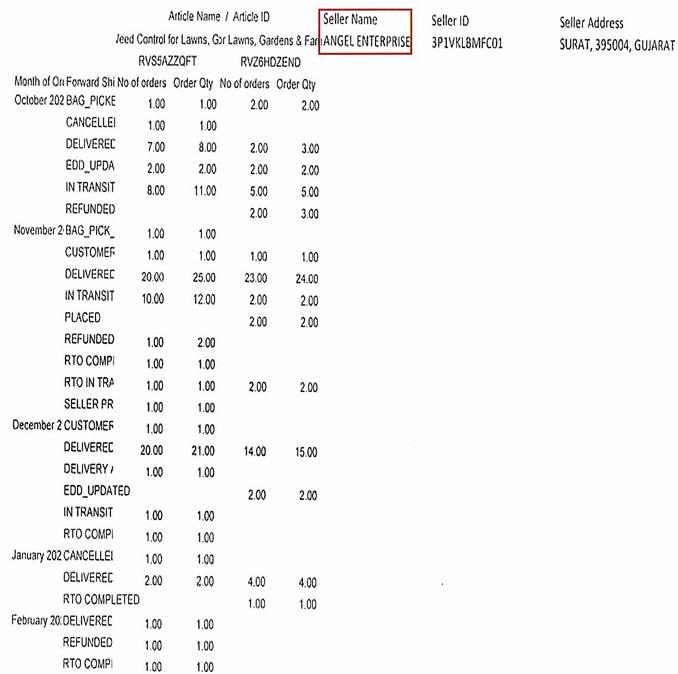
7.4. That from January 2024 till date a total of 2 listings of the Subject Products were listed on the Platform between October 2025 and February 2026 (5 months). It was clarify that this occurred solely due to the seller fraudulently misclassifying the products by listing them under the category of “Bathing Bars & Soaps”, rather than any failure or negligence on the part of the Platform. The details of the listing of the Subject Product as well as the seller details and units sold from January 2024 till date have been marked and annexed as:
7.5. Given the nature of the misclassification, wherein the impugned products were erroneously categorized under an unrelated product category, the listings did not trigger the compliance verification protocols that would ordinarily apply to agro-chemical products. Further, the annexure to the Notice (titled Annexure 2) containing the screenshot of the listing page on JioMart, attached to the Notice sent by your good office, clearly confirms that the Subject Products are shown as “unavailable at your location”.
8. The reply submitted by the Opposite Party was examined by the CCPA and based on it CCPA was satisfied that there exists a prima-facie case of violation of consumer rights, misleading advertisement and unfair trade practice which lead to the necessity of further scrutiny.
9. Thereafter, CCPA, vide letter dated 13.05.2026 forwarded the matter to DG (Investigation) for detailed investigation.
10. The Opposite Party vide letter dated 27.05.2026 submitted following to the DG Investigation wing:
10.1. The Hon’ble Supreme Court’s judgement in Shreya Singhal vs Union of India (AIR 2015 SC 1523) wherein the Hon’ble Court has clarified and significantly limited the due diligence obligations of internet intermediaries under law.
10.2. The product attribute designated as “Product Type” the Subject Product has been expressly and unambiguously classified as “Soaps / Bathing Bars & Soaps.” This categorization unequivocally demonstrates that the seller, at the time of listing the Subject Product on the Platform, deliberately and misleadingly assigned it to a product category that does not accurately represent the true nature or regulatory classification of the product.
10.3. The occurrence was limited to a mere two (2) listings over a span of five (5) months, which, when viewed in the Context of the millions of active listings hosted on the Platform at any given time, demonstrates the isolated and exceptional nature of this incident.
10.4. The Platform maintains robust and continuously evolving technology-driven mechanisms, including automated keyword-based filters, category-specific compliance checks, and periodic manual audits, to identify, flag, and remove non-compliant or prohibited listings. However, instances of deliberate and sophisticated misclassification by sellers, executed with malafide intent, may occasionally evade detection in real time despite the exercise of reasonable due diligence.
11. The investigation report dated 28.07.2026 was received from DG (Investigation) wherein the following were submitted:
11.1. It was observed that the Opposite Party continued to host and facilitate the sale of impugned product on its platform up to March 2026 without ensuring compliance with mandatory regulatory safeguards applicable to the sale of such regulated substance. The impugned listings neither disclose its active ingredient, nor its precise chemical identity, any verifiable license number with its validity and mandatory disclosures regarding it hazardous or the basis of above claims and if any Principal Authorization Certificate is obtained or not.
11.2. The omission to disclose aforesaid material information specifically regarding statutory licensing requirements, its active ingredient and its precise chemical identity deprive consumers of essential information required to make informed purchasing decisions and exposes them to legal and safety risks.
11.3. It was further observed that, at present, there are no active listings of the impugned product on the platform. However, this does not absolve it of its liability for the period during which the product was available for sale.
11.4. During the investigation, comments were sought from the “Department of Agriculture & Farmers Welfare, Plant Protection Division, Ministry of Agriculture & Farmers Welfare” regarding the legal status of the impugned product marketed as “Cyclosinone Herbicide.” The department, inter alia, vide letter dated 02.06.2026 stated as follows:
i. Insecticides/pesticides are inherently toxic in nature as they are designed to develop to kill or combat the insects, diseases and weeds hence its import, manufacture, sale, transport, distribution and use are regulated under the Insecticide acts, 1968 and Insecticides Rules 1971 with a view to prevent risk to human being or animals and matters connected therewith.
ii. There is no chemical as “Cyclosinone” included in the Schedule to the Insecticides Act, 1968. However, the product “Cyclosinone” claimed to be “Herbicide” is being sold through e-portals without disclosing the chemical name of its active ingredient and composition.
iii. The statement of the Opposite Party that “Cyclosinone” does not exist as a registered compound is legally untenable. The product “Cyclosinone” is being actively marketed and sold via e-portals platform with explicit claims of being an “Herbicide” falls squarely within this functional clarification. Hence, it is currently being marketed illegally because it bypasses the mandatory safety, bio-efficacy, quality and legal checks required under the Insecticides Act, 1968.
11.5. Opposite Party does not undertake any independent verification to ascertain whether sellers are complying with the mandatory legal requirements, such as the need for any licenses or other regulatory approvals, wherever applicable. Instead, the company relies primarily upon the information furnished by sellers under the “Jiomart’s Policies and Contractual Agreements”. However, sellers may submit false or incomplete declarations in order to list their products. Therefore, relying only on self-declaration is inadequate. It reflects gross negligence and deficiencies in the Opposite Party’s seller onboarding procedures, product verification and content moderation mechanisms.
11.6. The investigation further revealed that in consideration of permitting sellers to list and sell products on the Application, Opposite Party charges the sellers various kinds of fees, including logistics charges, Jiomart Fullfillment Specific Fee, commission fee and fixed fee as a marketplace facilitator. These contractual terms indicate that the company derives commercial revenue from facilitating the sale of products, including the impugned product, albeit indirectly through service-related charges rather than by directly selling the product. In such circumstances, the company cannot completely shift entire responsibility onto the sellers by solely relying on the Opposite Party’s Polices and contractual agreements” clause that places liability for non-compliance on the sellers. Permitting products to be listed without adequate scrutiny while simultaneously generating revenue from listing-related services raises serious concerns regarding compliance and accountability.
11.7. The company’s reliance on its status as an intermediary is not sufficient to avoid responsibility. As a marketplace e-commerce entity facilitating transactions between buyers and sellers, the company is required to exercise reasonable due diligence and oversight over listings hosted on its platform.
11.8. The company’s contention that “the products annexed in the SCN were displayed as ‘unavailable at your location’ which corroborates the fact that it was not available for sale on its platform prior to the issuance of the Notice” is untenable and devoid of merit. The mere fact that a product was unavailable at a particular location does not establish that it was not available for sale on the platform as a whole. On the contrary, the documentary evidence furnished by the company itself, including details of the number of units sold, unequivocally demonstrates that the impugned products were, in fact, listed and sold through the platform during the relevant period.
11.9. Additionally, it was observed that the details of the Grievance Officer is not provided under “Contact Us” section where customers would look for assistance, thus requiring consumers to dig through multiple layers to access it. Further, the contact details of the Grievance Officer are not mentioned anywhere on the platform.
11.10. Henceforth, a case relating to the violation of consumer rights and misleading advertisement under the Consumer Protection Act, 2019 is established.
12. In view of the findings in the DG (Investigation) Report, the CCPA vide letter dated 31.07.2026 shared the investigation report with the Opposite Party to furnish their comments, if any. However, no comments were received. Thereafter, a hearing was scheduled on 18.08.2026.
13. During the hearing held on 17.08.2026, Shri Yuvraj Patil, Shri Adithya Jairaj and Ku. Aprajita Tripathi appeared on behalf of the Opposite Party and submitted the following:
13.1. In the present case, the Seller deliberately mis-categorized the product, thereby circumventing and defeating the checks, safeguards, and control measures implemented by the Platform.
13.2. It was emphasised that only 2 listings of the subject product uploaded by 1 Seller were found to have existed on the platform, pursuant to which approximately 137 units were sold vide to 150 orders, amounting to aggregate sale value of ₹39,593/-.
13.3. That the Insecticides Rules do not, in express terms, impose an absolute prohibition or embargo upon the sale of herbicides; rather, the Rules cast a statutory obligation of due diligence upon the seller to ensure that the products are sold only through, or in engagement with, a duly licensed person, in accordance with the requirements prescribed under Rule 10(E) of the Insecticides Rules.
13.4. It has actively commenced engagement with the business team to implement such further measures and safeguards as may be necessary to prevent the occurrence of similar listings in the future.
13.5. A request was made by the Opposite Party during the hearing to submit the additional comments on the DG (Investigation) Report within a period of 7 days which was duly granted to the Opposite Party.
14. The Opposite Party vide letter dated 24.08.2026 submitted its following comments:
14.1. The fact that the impugned listings stand deactivated and that there are no active listings of the Subject Product presently on the Platform is a directly relevant and material circumstance, going not merely to present compliance but also to the promptness and good faith of Reliance’s remedial response upon the matter being brought to its notice.
14.2. A product bearing a name that does not correspond to any scheduled or registered active ingredient, and which was in any event mislabelled by the seller under an unrelated product category, would consequently not be identifiable by existing filters as falling within the regulated class of insecticides / pesticides.
14.3. Finding regarding “Gross Negligence” does not take into account the multi-layered due-diligence framework actually maintained by Reliance, which includes: (i) mandatory seller declarations and category-specific documentation requirements at the time of onboarding and listing; and (ii) periodic manual audits of listings across categories.
14.4. The commission fee, fixed fee, shipping fee, and JioMart Fulfilment Specific Fee referred to in the Investigation Report are standard, uniformly applicable, and non-discriminatory charges levied on all sellers and products across the Platform, without reference to the specific identity, nature, or attributes of any individual product. These charges are consideration for logistics, fulfilment, packing, storage, and platform-usage services rendered to sellers generally, and not consideration referable to, or contingent upon, the sale of the Subject Product in particular.
14.5. The contractual requirement that sellers comply with applicable law is one component of a layered compliance framework that also includes restriction of certain categories of products, filters and manual audits described above. It does not operate in substitution of, but in addition to, such measures.
14.6. The designated officer (Mr. Chandeep Gupta), the dedicated e-mail address, and a two-tier escalation matrix comprising customer support (Level 1) and the Grievance Officer (Level 2), are duly published on the Platform’s Terms of Use page, which is a mandatorily disclosed document accessible from every page of the Platform through the website footer.
14.7. That two isolated, fraudulently mis-categorised listings by a single seller, that were promptly removed upon detection, do not establish a failure on the part of Reliance to protect consumers as a class within the meaning of Section 2(9).
14.8. The finding of a misleading advertisement is more appropriately attributable to the seller who authored the impugned content, with Reliance’s role being confined to that of a hosting intermediary entitled to safe-harbour protection.
14.9. The representations forming the basis of the alleged unfair trade practice were made by the seller in its capacity as the “trader,” and not by Reliance, which did not itself adopt, promote, or actively endorse the impugned claims.
14.10. The standard contemplated is one of reasonable diligence and not of guaranteed, error-free accuracy in every instance, particularly where a seller has engaged in deliberate concealment and mis-categorisation calculated to defeat such diligence.
15. The CCPA, after careful consideration of the relevant provisions observes that —
15.1. In terms of Section 3(e) of the Insecticides Act, 1968, the expression “insecticide” includes:
(i) any substance specified in the Schedule to the Act;
(ii) such other substances, including fungicides and weedicides, as the Central Government may, after consultation with the Central Insecticides Board, by notification in the Official Gazette, include in the Schedule from time to time; and
(iii) any preparation containing one or more of such substances.
15.2. Section 27(1) of the Insecticides Act, 1968 stipulates for Prohibition of sale, etc., of insecticides for reasons of public safety —
(1) If, on receipt of a report under section 26 or otherwise, the Central Government or the State Government is of opinion for reasons to be recorded in writing, that the use of any insecticide specified in clause (e) of section 3 or any specific batch thereof is likely to involve such risk to human beings or animals as to render it expedient or necessary to take immediate action……
15.3. Section 18 of the Insecticides Act, 1968 stipulates Prohibition of sale, etc., of certain insecticides:
(1) No person shall, himself or by any person on his behalf, sell, stock or exhibit for sale, distribute, transport, use, or cause to be used by any worker:
(a) any insecticide which is not registered under this Act;
(b) any insecticide, the sale, distribution or use of which is for the time being prohibited under section 27;
(c) any insecticide in contravention of any other provision of this Act or of any rule made thereunder.
(2) No person shall, himself or by any person on his behalf, sell, stock or exhibit for sale or distribute for use for commercial pest control operations any insecticide except under, and in accordance with the conditions of, a licence issued for such purpose under this Act.
15.4. The Insecticides (Second Amendment) Rules, 2022 clearly stipulates under Rule 10(E) for Sale of Insecticides through e-commerce entity that:
A licensee, during the currency of license, may undertake sale of any insecticide through e-commerce entity for supply of insecticides to the door step of the farmers and the licensee shall comply with the provisions of the Act and the rules made there under for the time being in force:
Provided that the operators of e-commerce entity before engaging the licensee for sale of insecticide through online portal, shall verify the validity of the licence issued by the concerned Licensing Officer of the State.
Provided further that the operators of e-commerce entity and licensee shall comply with the provisions of the Consumer Protection (E-commerce) Rules, 2020 notified in the Gazette of India vide G.S.R No. 462(E) dated 23rd July, 2020 and further subsequent amendments (if any).
15.5. Section 2(1) of the Consumer protection Act, 2019 defines:
(1) “advertisement” means any audio or visual publicity, representation, endorsement or pronouncement made by means of light, sound, smoke, gas, print, electronic media, internet or website and includes any notice, circular, label, wrapper, invoice or such other documents.
15.6. Section 2(28) of the Consumer protection Act, 2019 defines “misleading advertisement” in relation to any product or service to mean an advertisement:
i) falsely describes such product or service; or
ii) gives a false guarantee to, or is likely to mislead the consumers as to the nature, substance, quantity or quality of such product or service; or
iii) conveys an express or implied representation which, if made by the manufacturer or seller thereof, would constitute an unfair trade practice; or
iv) deliberately conceals important information.
15.7. Section 2 (47) of the Act defines ‘unfair trade practice’ as to the practice when for the objective of promoting the use or supply of any service, any person, adopts unfair or deceptive practice inter-alia any statement, whether orally or in writing or by visible representation including by means of electronic record which falsely represents that the goods are of a particular standard, quality, quantity, grade, composition, style or model [(Section 2(47) (b)] or represents that the goods or services have sponsorship, approval, performance, characteristics, accessories, uses or benefits which such goods or services do not have [(Section 2(47) (d)].
15.8. Inter alia, the Guidelines for Prevention of Misleading Advertisement and Endorsement of Misleading Advertisement, 2022 stipulates under para 12 (d) that an advertisement shall not contain statements or visual presentations which directly, or by implication, or by omission, or by ambiguity, or by exaggeration are likely to mislead consumers about the product advertised, or the advertiser, or about any other product or advertiser.
16. From a bare reading of the above provisions of the Act, it is clear that any advertisement should:
16.1. contain truthful & honest representation of facts and shall not falsely describe products,
16.2. An advertisement shall be considered to be valid and not misleading, if it does not mislead consumers by exaggerating the accuracy, scientific validity or practical usefulness or capability or performance or service of the goods or product.
16.3. The definition of advertisement under the Consumer Protection Act, 2019 is wide and technology-neutral and expressly extends to publicity or representation made through “electronic media, internet or website,” without confining the term to conventional print or broadcast media.
16.4. Rule 10E of the Insecticides (Second Amendment) Rules, 2022 published vide notification number G.S.R. 670 (E), came into effect from the 24.11.2022 specifically to regulate the online sale of insecticides and requires the e-commerce entity to verify the validity of the licence of the concerned licensee. Where a product is expressly represented and marketed as a herbicide, the platform cannot adopt a wholly passive approach and disclaim responsibility on the ground that the product was not independently identified by it as falling within the Schedule.
17. Based on the written and oral submissions made by the Opposite Party, CCPA noted that:
17.1. The Opposite Party’s attempt to distance itself from the Impugned Product by describing itself as a mere marketplace intermediary is untenable. Since it owns, manages, and operates the Online Marketplace through which it facilitated listing, hosting, advertising and selling of that unregistered impugned product. The Opposite Party cannot disclaim responsibility for unlawful or misleading products made available to consumers on its platform. The fact that the actual seller is a third party does not, by itself, absolve the platform of its statutory consumer-protection mandate. A platform cannot profit from the transaction while simultaneously disclaiming every corresponding responsibility.
17.2. The present proceedings concern the Opposite Party’s independent obligations in its capacity as an Online Marketplace, and not obligations attaching to it as a manufacturer. Once the platform facilitates the advertising, listing, offering for sale, and selling the unregistered impugned product represented as a herbicide, the statutory duties applicable to the platform cannot be avoided.
17.3. The Opposite Party’s reliance on the intermediary liability exemption under Section 79 of the Information Technology Act, 2000, on Shreya Singhal v. Union of India, (2015) 5 SCC 1 and on the comparative absence of a provision similar to Rule 10E of the Insecticides Rules, 1971, is misplaced as the judgment in Shreya Singhal was rendered in the context of remove or disable access to unlawful content with regard to far-reaching questions relatable primarily to the fundamental right of free speech and expression guaranteed by Article 19(1)(a) of the Constitution of India.
i. The safe harbour under Section 79 is conditional upon compliance with the due diligence obligations prescribed under Section 79(2), including the general due-diligence obligation under Section 79(2)(c) and Rule 3(1)(b) of the Information Technology (Intermediary Guidelines and Digital Media Ethics Code) Rules, 2021, which independently obligates every intermediary to exercise due diligence to ensure that unlawful information, including the listing of goods whose sale is restricted or prohibited under applicable law, is not advertised, listed, offered for sale on its platform.
ii. The proposition regarding ‘actual knowledge’ standard in Shreya Singhal governs an intermediary’s obligation to take down specific content upon notification; it can neither be read as prohibiting all forms of due diligence, compliance measures, or reasonable regulatory obligations upon digital platforms. Nor the judgment created a blanket exemption from obligations imposed by valid legislation enacted to protect consumers and prevent unfair or deceptive commercial practices.
iii. Inter-alia, it cannot be read as a legislative intention to exempt e-commerce platforms dealing in unregistered substances from the general due-diligence obligations that independently arise under Rule 3(1)(b) of the IT Rules, 2021 and Rules 4(3) and 5 of the Consumer Protection (E-Commerce) Rules, 2020, and other validly notified and gazetted law, such as Insecticides (Second Amendment) Rules, 2022 published vide notification number G.S.R. 670 (E), is presumed to be known to all persons governed by it and the opposite party’s own admission, at the hearing, that it undertakes no verification whatsoever of a seller’s licence leaving this entirely to the seller and buyer demonstrates that no meaningful due diligence was, in fact, applied to listings of these substances at any stage prior to the Notice.
17.4. The issue is not whether the Opposite Party was required to determine the chemical classification of the product, but whether a product expressly marketed, listed, advertised and offered for sale as a “herbicide” in the absence of its active ingredients, chemical identity could be placed before consumers without the requisite regulatory scrutiny. The Opposite Party could have carried due diligence before allowing the advertising, listing, offering for sale, and selling any unregistered impugned product claiming it to be a herbicide. The relevant question is not who authored the description, but whether the platform which had adequate mechanisms to identify products represented as herbicide, ensured safeguards for the consumers as required under the Insecticides (Second Amendment) Rules, 2022 and Consumer Protection Act, 2019.
17.5. The Opposite Party has nowhere disputed that the unregistered impugned product was not a herbicide and, therefore, did not require to be regulated. Thus, where the impugned product was being advertised, listed, hosted and sold as a “Herbicide”, it was incumbent upon the Opposite Party to have put due diligence and to ensure compliance with the mandatory requirements prescribed under Section 10(E) of the Insecticides (Second Amendment) Rules, 2022.
17.6. The CCPA during the hearing dated 18.08.2026, displayed and read the following relevant provisions of law as mentioned in para 5 and 15 above so as to remove the interpretative ambiguity. Based on which the statutory intent was clarified that, where the prescribed statutory conditions are satisfied with respect to the likelihood of risk arising from the use of any insecticide or any specific batch thereof, the law contemplates the taking of immediate action where such action is considered expedient or necessary.
17.7. The import, manufacture, sale, transport, distribution and use of insecticides is regulated with the view to prevent risk to human beings or animals and insecticides includes fungicides & weedicides i.e. herbicides. The impugned product which was labelled as “Cyclosinone Herbicide”, “5% Active Formula”, and claimed as “Safe Weed Control for Lawns, Gardens & Farmlands,” “Granular Application for Home & Commercial Use”, was listed without disclosing chemical name of its active ingredients and composition. The claim of the Opposite Party that the seller’s conduct in coining an unregistered trade name, compounded by its mis-categorization under “Bathing Bars and Soaps” was to circumvent the category-specific compliance filter that otherwise would have triggered had the product been correctly classified as agro-chemical / pesticide product, is untenable as the picture of the product along with description very prominently disclosed it as “Cyclosinone Herbicide”. Thus, as per the Insecticides (Second Amendment) Rules, 2022 the operator of e-commerce entity before engaging the sale of insecticides through online portal, should have verified the validity of the license issued by the concerned Licensing Officer of the State.
17.8. The underlying object of consumer protection law is to ensure that consumers by ensuring access to complete, accurate, and truthful information, thereby enabling them to make informed choices. In furtherance of this objective, with the enactment of the Consumer Protection Act, 2019, the traditional doctrine of caveat emptor has undergone a marked transformation, giving rise to the principle of caveat venditor.
18. It is imperative to mention that statutory provisions mandate due diligence to be carried out for offering sale of goods and services and violating the same, amounts to misleading advertisement and unfair trade practice. In the present matter after consideration of the submissions made by the Opposite Party and findings recorded in the DG Investigation Report, the CCPA finds that:
18.1. The impugned product was advertised, listed and offered for sale on the Online Marketplace as a “Herbicide”, with claims like “5% Active Formula”, “Safe Weed Control for Lawns, Gardens & Farmlands,” “Granular Application for Home & Commercial Use” product, but without disclosure of its active ingredient, precise chemical identity, requisite regulatory credentials, license particulars, or other material information necessary for consumers to assess its legality, scientific validity, and safety.
18.2. The above claims made in the impugned listings, were material claims capable of influencing a consumer’s purchasing decision. In the absence of adequate substantiation and disclosure of the composition and regulatory status of the unregistered impugned product, such representations misled consumers as to the nature, characteristics, safety, quality and efficacy of the product and, therefore, constitute a misleading advertisement within the meaning of Section 2(28) of the Consumer Protection Act, 2019.
18.3. The submissions of Opposite party further established that 137 units of the impugned product were sold through the Online Marketplace pursuant to 150 orders, having an aggregate sale value of ₹39,593/-, and that the Opposite Party did not undertake adequate independent verification of the regulatory credentials of the impugned product or of the sellers. It further demonstrates the scale of the listings requiring the necessity of CCPA from exercising its statutory jurisdiction under the Consumer Protection Act, 2019.
18.4. The Opposite Party’s platform cannot, by any stretch of interpretation, be characterized as being operated “for any public good” or in the nature of a public utility. On the contrary, the platform is operated as a commercial enterprise for the direct and substantial pecuniary benefit of the Opposite Party, which derives revenue from the engagement, participation, listings, and related activities facilitated through the platform. This commercial character is further unequivocally borne out by the information available on the Opposite Party’s own website concerning its fee structure. (Annexure: B)
18.5. The Ministry of Agriculture and Farmers Welfare has categorically stated that no chemical under the nomenclature “Cyclosinone” is included in the Schedule to the Insecticides Act, 1968. The insecticides / pesticides are inherently toxic in nature as they are designed to combat the insects, diseases and weeds, hence its manufacturing, sale, transport, distribution and use are regulated under the law with a view to prevent risk to human beings and animals. Further, prior to giving registration to any insecticides for use in the country, various attributes are verified in detail relating to its chemistry, toxicity, bio-efficacy, and packaging claims. The unregistered impugned product was being marketed via e-commerce platforms including that of the Opposite party which explicitly claimed being a “Herbicide” and was sold illegally because it bypasses the mandatory safety, bio efficacy, quality, legal checks required under the insecticides Act, 1968.
18.6. The Registration Committee (R.C.) constituted under Section 5 of the Insecticides Act, 1968, clearly states that R.C. registers insecticides after scrutinizing formula, verify claims of efficacy and safety to human beings and animals, specifying the precautions against poisoning and performing any functions incidental to these matters. Therefore, the Opposite Party permitted and facilitated the listing, advertisement, and sale of hazardous substances with misleading claims that are subject to mandatory registration, licensing, verification, and other regulatory requirements. Indeed, Section 2(9) recognises, inter alia, the consumer’s right to be protected against the marketing of goods, products or services which are hazardous to life and property. Hence, by enabling access to such sensitive and potentially hazardous materials without ensuring adequate regulatory disclosures, authentication, verification, and consumers safeguards, the Opposite Party materially violated Section 2(1) of the Consumer Protection Act, 2019 and facilitated access to regulated substances in circumstances giving rise to serious and foreseeable risks to the safety of consumers as a class.
18.7. The CCPA has clarified that enforcement, licensing, and penal consequences under the Insecticides Act, 1968 and the rules framed thereunder fall within the jurisdiction of the competent statutory authorities, and that the present proceedings do not adjudicate or determine criminal liability under the said enactment. However, the said statutory framework read conjointly and in their proper context with the Consumer Protection Act, 2019 and the rules framed thereunder is directly germane to the present proceedings, as it establishes the Opposite Party has falsely described unregistered impugned product such as “Safe Weed Control for Lawns, Gardens & Farmlands,” “Granular Application for Home & Commercial Use” etc. and while, at the same time, deliberately concealed important information including its active ingredients, chemical identity and registration and license particulars. Thus, squarely falls within the ambit of Section 2(1), Section 2(9), Section 2(28), Section 2(47) of the Consumer Protection Act, 2019, read with Rules 4(3) and 5 of the Consumer Protection (E-Commerce) Rules, 2020.
18.8. Insecticides, including herbicides, may lawfully be offered for sale only by a person or entity holding a valid license as required under the applicable law. Accordingly, e-commerce entities, prior to listing, advertising, facilitating, or otherwise offering for sale any hazardous chemical products purportedly represented as “herbicides,” including products described as “Safe Weed Control for Lawns, Gardens & Farmlands” etc. ought to have undertaken due diligence to verify the validity, authenticity of the requisite license of the seller including the active ingredient, precise chemical identity, requisite regulatory credentials of the impugned products. Such due diligence is necessary to safeguard consumers from potentially hazardous products.
18.9. Courts have, in analogous contexts, taken a strict view of the online availability of substances whose sale is subject to licensing or regulatory control, where adequate verification safeguards are absent. The Delhi High Court, in Dr. Zaheer Ahmed v. Union of India & Ors., W.P. (C) 11711/2018, by an interim order dated 12th December, 2018 (Division Bench of Chief Justice Rajendra Menon and Justice V. Kameswar Rao), restrained the sale of drugs online without a valid licence, taking note of the risk posed by unregulated and unverified access to substances requiring licensed sale. While those proceedings concerned pharmaceutical products, the underlying rationale that the mere convenience of online access cannot be permitted to dilute the licensing and verification safeguards that apply to the sale of a regulated substance in the physical marketplace applies with equal, if not greater, force to insecticides substances such as unregistered impugned product, having regard to the gravity and more immediate risk to soil, human beings and animals.
18.10. The fact that the Opposite Party operates as a marketplace-based e-commerce model does not confer upon it any blanket immunity from the obligations expressly cast upon a “marketplace e-commerce entity” under the Consumer Protection (E-Commerce) Rules, 2020 (“E-Commerce Rules”). The very definition of a “marketplace e-commerce entity” under Rule 3(g) contemplates an entity which provides an information technology platform to facilitate transactions between buyers and sellers. The Rules thereafter specifically prescribe independent duties and liabilities of such marketplace entities. The statutory scheme therefore makes a clear distinction between the role of the seller as the person offering the goods for sale and the independent obligations imposed upon the marketplace through which such transaction is facilitated.
18.11. The Opposite Party cannot simultaneously invoke its status as a marketplace e-commerce entity for the purposes of conducting its business and disown the corresponding statutory obligations imposed upon such entities for the protection of consumers. The proceedings before the CCPA, concern the Opposite Party’s conduct and obligations as an e-commerce entity facilitating the advertisement and sale of the impugned product to consumers, and not any liability arising from its manufacture of the product. The defence of “mere intermediary” cannot be permitted to operate as a jurisdictional shield against an express statutory regime enacted specifically to regulate e-commerce entities and prevent unfair trade practices on digital marketplaces. Therefore, the Opposite Party failed to exercise adequate due diligence and safeguards commensurate with the nature of the unregistered impugned product represented to consumers as an herbicide.
18.12. The Delhi High Court, in Christian Louboutin SAS v. Nakul Bajaj & Ors., 2018 SCC OnLine Del 12215, examining the liability of an e-commerce platform claiming intermediary status, held that an online marketplace ceases to be a passive intermediary and becomes an active participant where it renders services beyond mere hosting including charging of fees, actively promoting sellers’ listings and offering verification or authentication services that lend credibility to a seller in the eyes of a buyer and that such active participation disentitles the platform to safe-harbour protection under Section 79 of the Information Technology Act, 2000. This principle applies with full force to the facts of the present case and was accordingly examined in the present matter.
18.13. The submission that the Opposite Party merely displays information entered by sellers and therefore bears no responsibility for such information ignores the express language of the E-Commerce Rules. Rule 5(2) which clearly states that the marketplace to obtain an undertaking regarding the accuracy of descriptions, images and other content relating to goods or services displayed on its platform. The statutory architecture is therefore not premised upon the proposition that a marketplace may simply reproduce whatever information is uploaded by a seller, even if it fraudulently listed “Cyclosinone Herbicide” under an unrelated and unregistered category (soap) and thereafter disclaim all responsibility. The Opposite Party did not share any details about the action taken against the fraudulent seller i.e. Angel Enterprise for its fraud.
18.14. Reliance placed upon the JioMart Seller Services Agreement is misplaced. A contractual arrangement between the Opposite Party and third-party sellers cannot dilute, transfer, or contract out of statutory obligations imposed for the protection of consumers. The existence of contractual assurances from sellers merely demonstrates that the Opposite Party was aware of the need for legal compliance, it does not establish that the Opposite Party actually exercised effective diligence to prevent non-compliant unregistered impugned products from being sold to consumers through its platform.
18.15. A contractual arrangement between a marketplace and its sellers cannot override, dilute or contract out of statutory obligations imposed by Parliament or delegated legislation for protection of consumers. The statutory requirement of obtaining a seller undertaking itself demonstrates that the marketplace has a compliance obligation; it is not sufficient for the marketplace to merely assert that responsibility rests contractually upon the seller. Moreover, Rule 4(3) of the E-Commerce Rules expressly provides that no e-commerce entity shall adopt any unfair trade practice, whether in the course of business or otherwise.
18.16. The subsequent deactivation of the listings are remedial steps, but they do not erase the underlying lapse. The Opposite Party’s own decision to implement enhanced detection mechanisms demonstrates that its existing safeguards were not necessarily sufficient to prevent the impugned listing. Post-facto corrective measures may mitigate continuing consumer harm, but cannot be invoked as a defense against statutory accountability. Inter-alia, the opposite party’s own submissions establish that it possesses full technical and administrative control over the content hosted on its platform including the ability to review, restrict and remove listings, disable seller accounts and implement keyword-level blocking and it cannot, in the same breath, contend that responsibility for regulatory compliance rests exclusively with third-party sellers.
18.17. The heightened responsibility attaching to any person or entity facilitating access to inherently hazardous substances finds support in the well-settled principle enunciated by the Hon’ble Supreme Court in M.C. Mehta v. Union of India, (1987) 1 SCC 395 (the Oleum Gas Leak case), where the Court held that an enterprise engaged in a hazardous or inherently dangerous activity owes an absolute and non-delegable duty to the community to ensure that no harm results on account of such activity and that this obligation cannot be diluted merely because the enterprise claims to have exercised reasonable care. While that case arose in the context of tortious liability for industrial hazards, the underlying principle that those who deal in, or facilitate access to, inherently dangerous substances bear a heightened, non-delegable duty of care commensurate with the risk involved is instructive in assessing the standard of due diligence expected of the opposite party in permitting the listing of unregistered impugned product.
18.18. Accordingly, the CCPA holds that the conduct complained of resulted in violation of consumer rights and constituted a misleading advertisement and unfair trade practice within the meaning of the Consumer Protection Act, 2019. Additionally, for the sake of clarity it is emphasized the Rule 10E of the Insecticides (Amendment) Rules, 2022, is itself vocal that the operators of e-commerce entity and licensee shall comply with the provisions of the Consumer Protection (E-commerce) Rules, 2020. It may be emphasized that the regulatory purpose of the Act would be defeated if intervention were permissible only after actual injury had materialised.
19. For the foregoing reasons, CCPA is of the considered view that the legislative object of the CCPA is expressly class-based. Section 18 empowers the Authority to protect, promote and enforce consumer rights “as a class” and to prevent unfair trade practices. The statutory framework therefore does not require the CCPA to await individual instances of physical injury or financial loss before exercising jurisdiction.
19.1. The Opposite Party was required to exercise appropriate due diligence commensurate with the regulatory sensitivity of such product. Rule 6 of the Consumer Protection (E-Commerce) Rules, 2020, read with the applicable regulatory framework governing online sale of insecticides, including herbicides cannot be construed as permitting an e-commerce entity to discharge its statutory obligations merely by obtaining contractual declarations or self-certifications from third-party sellers.
19.2. In particular, the sale of unregistered impugned product, listed, hosted, and advertised by explicitly claiming to being an “Herbicide” bypassed the mandatory safety, bio efficacy, quality, legal checks required under the Insecticides Act, 1968. Further, where the applicable regulatory regime requires verification of the validity of the license of a licensee before facilitating online sale, such requirement necessarily contemplates an effective verification mechanism, disclosure of ingredients, precise chemical identity for safeguarding consumers from risky and hazardous substances.
19.3. Section 2(9) of the Act protects against the marketing of goods hazardous to life and property and is not confined in its application to household consumer goods. The opposite party cannot absolve itself of responsibility merely on the ground that the impugned listings were uploaded by independent third-party sellers or on the ground that it functions as a mere marketplace ecommerce entity with no knowledge of requirements of extant laws.
19.4. It is a settled principle in consumer protection jurisprudence that representations must be assessed from the perspective of a reasonable consumer of average intelligence, and not through a technical interpretation by the advertiser. The Opposite Party’s attempt to conflate inherently subjective taglines with an absolute claim is therefore unsustainable and misleading.
19.5. Accordingly, the CCPA concludes that the impugned claims constitute misleading advertisements and unfair trade practice within the meaning of the Consumer Protection Act, 2019 which affects consumers as a class. CCPA is of the opinion that it is also necessary to levy a penalty for falsely representing the product. However, looking at the limited nature of occurrence, confined to only two listings by a single seller, over a short window, CCPA is ready to take a lenient view.
20. The CCPA is empowered under Section-21 of the Consumer Protection Act, 2019 to issue directions to the advertiser of false or misleading advertisement to discontinue or modify the advertisement and if necessary, it may, by order, impose a penalty which may extend to ten lakh rupees and for every subsequent contravention may extend to fifty lakh rupees. Further, Section 21 (7) of the above Act prescribes that following may be regarded while determining the penalty against false or misleading advertisement:-
a. the population and the area impacted or affected by such offence,
b. the frequency and duration of such offence,
c. the vulnerability of the class of persons likely to be adversely affected by such offence.
d. the gross revenue from the sales effected by virtue of such offence
21. In view of the above, the CCPA hereby issues the following directions to the Opposite party:
i. To discontinue false and misleading advertisement, sale of unregistered agro-chemical products on its platform with immediate effect from its platform.
ii. The Opposite Party shall further ensure that, it shall conduct self-audit of its platform to prevent listings of products which are in contravention of the law for the time being in force or which are hazardous to life and safety of the consumers.
iii. The opposite shall pay a penalty of ₹ 5,00,000/- prescribed under the Consumer Protection Act, 2019 for first violation of indulging in misleading advertisement and unfair trade practice.
iv. The Opposite Party shall submit a compliance report to CCPA on the above directions within 15 days from the date of this Order.
22. The above order and directions are passed in exercise of the powers conferred upon CCPA under section 10, 18, 20, 21 of the Consumer Protection Act 2019.