Embee Software Pvt. Ltd. Vs National Commodities Management Services Limited (NCLT Mumbai)
Case Title: Payment Acknowledgments Defeat Reconciliation-Based Dispute Defence: NCLT Mumbai Admits CIRP
Summary: The National Company Law Tribunal, Mumbai Bench-VI, admitted Embee Software Pvt. Ltd.’s petition under Section 9 of the Insolvency and Bankruptcy Code, 2016 against National Commodities Management Services Limited concerning unpaid Microsoft Azure service invoices. Embee, an authorised Microsoft reseller, claimed ₹1,74,11,647, comprising principal dues of ₹1,38,49,664 and interest of ₹35,61,983 calculated at the claimed rate of 24% per annum up to 9 December 2024. The claim arose from 16 invoices issued between 19 September 2022 and 8 November 2024. The corporate debtor asserted a pre-existing dispute involving excessive billing, failure to reconcile accounts, discontinued resources, expiry of a one-year purchase order and invoices raised after migration from Azure.
Applying Mobilox Innovations Pvt. Ltd. v. Kirusa Software Pvt. Ltd., the Tribunal examined the substance of the reconciliation correspondence alongside subsequent conduct. It found that requests for consumption details and resource optimisation were followed by payment proposals, requests for time, acknowledgment of approximately ₹1 crore in outstanding dues and actual part-payments. On these facts, the correspondence did not establish a plausible pre-existing dispute. Expiry of the purchase order did not, by itself, terminate the broader three-year Enterprise Enrollment Agreement or extinguish liability for subsequent services. Production of Microsoft’s upstream invoices was also not a condition precedent to maintaining the petition in the circumstances.
The Tribunal treated the NeSL Record of Default as corroborative evidence rather than as something capable of automatically overriding a genuine dispute. It also rejected the contention that non-booking of invoices conclusively established a dispute. The statutory auditor’s certificate verified extraction of accounting and ITC particulars; it did not certify that the invoices were fabricated, services were absent or liability did not exist. The Tribunal expressly clarified that ITC availment alone is not conclusive proof of operational debt, while reversal after commencement of proceedings cannot retrospectively establish a pre-existing dispute. An alleged payment of ₹9,50,124 was unsupported by banking evidence. The replies to the demand notice were on record and considered, and the Tribunal found no necessity to return a finding of suppression or perjury.
Finding the petition within limitation, the debt above the ₹1 crore threshold, the demand notice duly served and the statutory requirements fulfilled, the Tribunal admitted CIRP and declared a moratorium under Section 14. It appointed Mr. Devang Sampat as Interim Resolution Professional and directed Embee to deposit ₹3 lakh towards initial CIRP expenses. Precise verification of interest and adjustments was left to the CIRP process in accordance with law.
Cases Discussed
- Korea Trade Insurance Corporation (Ksure) v. Amrit Polychem Pvt. Ltd., NCLAT Delhi, Company Appeal (AT) (Insolvency) No. 1383 of 2023, decided on 15.10.2025 — cited by the corporate debtor on the bar against admitting a Section 9 application where a genuine pre-existing dispute exists.
- Rajendra Bisht v. Satkar Logistics (P) Ltd., NCLAT Delhi, Company Appeal (AT) (Insolvency) No. 285 of 2022, decided on 11.03.2025 — distinguished because the reconciliation issue there formed part of a substantive and subsisting dispute, unlike the subsequent acknowledgments and payment conduct in the present matter.
- East India Udyog Ltd. v. SPML Infra Ltd., NCLAT Delhi, Company Appeal (AT) (Insolvency) No. 256 of 2023, decided on 23.03.2023 — distinguished on the factual nature of the reconciliation dispute; a reference to reconciliation cannot mechanically defeat every Section 9 application.
- Sabarmati Gas Ltd. v. Shah Alloys Ltd., (2023) 3 SCC 229, Supreme Court of India — relied upon by the corporate debtor and distinguished because the present correspondence was followed by acknowledgments, payment proposals and part-payments.
- S.S. Engineers v. Hindustan Petroleum Corporation Limited, Supreme Court of India, Civil Appeal No. 4583 of 2022 — the principle that IBC is not a debt-recovery mechanism was accepted, but held not to assist the corporate debtor on the documentary record in this case.
- Consolidated Construction Consortium Limited v. Hitro Energy Solutions Private Limited, (2022) 7 SCC 164, Supreme Court of India — cited by the operational creditor; referred to in the order as “Hitro Energy Solutions”.
- Honest Machinery Pvt. Ltd. v. VSM Venture Control Systems Pvt. Ltd., NCLT New Delhi, Company Petition No. IB24(ND)/2020, decided on 24.12.2020, as cited in paragraph 8.2 of the order — included among the authorities relied upon by the operational creditor.
- Jagmeet Singh Sabharwal v. Rubber Products Ltd., 2019 SCC OnLine NCLAT 277, NCLAT — included among the authorities relied upon by the operational creditor.
- Swiss Ribbons Pvt. Ltd. v. Union of India, (2019) 4 SCC 17, Supreme Court of India — cited by the operational creditor in support of its petition.
- Mobilox Innovations Pvt. Ltd. v. Kirusa Software Pvt. Ltd., (2018) 1 SCC 353, Supreme Court of India, Civil Appeal No. 9405 of 2017, decided on 21.09.2017 — applied to determine whether the defence disclosed a plausible, genuine pre-existing dispute rather than a spurious or unsupported assertion.
FULL TEXT OF THE NCLAT JUDGMENT/ORDER
1. BACKGROUND
1.1 This is an Application bearing C.P. (IB) No.433/MB/2025 filed on 06.03.2025 by EMBEE SOFTWARE PVT. LTD., the Applicant (Operational Creditor) under Section 9 of the Insolvency and Bankruptcy Code, 2016 (hereinafter referred to as “the Code”) read with Rule 6 of the Insolvency and Bankruptcy (Application to Adjudicating Authority) Rules, 2016 (hereinafter referred to as “the AAA Rules”) by Mr. Romit Dalal, authorised representative vide Board Resoluation dated 03.03.2025 for initiating Corporate Insolvency Resolution Process (hereinafter referred to as “CIRP”) in respect of NATIONAL COMMODITIES MANAGEMENT SERVICES LIMITED , the Corporate Debtor.
1.2 The Corporate Debtor is National Commodities Management Services Limited (CIN: U74140MH2004PLC148859) having its Registered Office at D-164, TTC Industrial Area, Nerul MIDC, Mumbai City, Navi Mumbai, Maharashtra, India, 400706.
1.3 The Applicant has not proposed the name of an IRP and has requested this Tribunal to appoint an IRP.
2. AVERMENTS OF THE APPLICANT
2.1 As per Part-IV of Form 5, the total operational debt claimed by the Operational Creditor is Rs. 1,74,11,647/-, comprising Rs. 1,38,49,664/- towards principal outstanding under the invoices and Rs. 35,61,983/- towards interest calculated at 24% per annum upto 09.12.2024, calculated from the respective due date of the invoices annexed as Annexure II (8).
2.2 The date of default is mentioned as 08.12.2024.
2.3 It is stated that the relationship between the Operational Creditor, the Corporate Debtor and Microsoft Corporation (India) Pvt. Ltd. (“Microsoft”), originated from the Enterprise Enrollment Agreement executed on 28.01.2016 under the Azure Server and Cloud Enrollment Program. The Operational Creditor acted as the “Authorized Reseller” for Microsoft. This agreement was renewed in 2019 and further extended through the 2022 Enrollment Agreement (EA 2022) bearing no. 60248394 executed on 01.02.2022 for a further period of three years.
2.4 Under these Agreements, Microsoft invoiced the Operational Creditor for the services consumed by the Corporate Debtor. The Operational Creditor, in turn, invoiced the Corporate Debtor based on actual usage and over charge. The Microsoft product terms, integral to the Agreements, inter-alia outlines invoicing provision. Clause 3 under the “Payment and Fees” section of the product terms specifically details this invoicing arrangement.
2.5 It is stated that the services provided under EA 2022 are global standardized products, and the Operational Creditor is merely the Authorized Reseller of those services provided by Microsoft. Hence, the Operational Creditor has no control over the services. The entire model is based on consumption, and the Corporate Debtor has been invoiced based on the actual consumption by the Corporate Debtor. For instance, the services provided by Microsoft are akin to using electricity, which is charged as per actual consumption. The Corporate Debtor availed itself of these services of Microsoft through the Operational Creditor, without raising a single dispute over the Invoices and without, at any point, denying its obligation to pay the amounts due under the Invoices. This is evident from the correspondence exchanged between the Parties, which are annexed as Annexure II (9).
2.6 Despite the Operational Creditor’s obligation to pay Microsoft irrespective of the Corporate Debtor’s payments, the latter consistently delayed payments. As of now, the claim is based on 16 unsettled invoices [Annexure II (6a to 6p)], all of which were acknowledged by the Corporate Debtor without dispute, bearing its seal.
2.7 It is stated that the Corporate Debtor did not ever terminate the services of the Operational Creditor, despite being entitled to do so under the Agreements. This unequivocally demonstrates that there were no disputes pertaining to the services rendered and the Invoices raised by the Operational Creditor for the services used by the Corporate Debtor. In fact, by its email dated 08.11.2023 [Annexure II(9n)], the Corporate Debtor proposed a payment plan to settle several outstanding invoices, including those marked as Annexures 6(c) to 6(f). Further, vide its email dated 15.02.2024 [Annexure II (9ff)], the Corporate Debtor categorically acknowledged the significant outstanding dues of the Operational Creditor, estimating the amount to be approximately Rs.1,00,00,000/- (Rupees One Crore only) and expressed its inability to pay such outstanding amount. The detailed correspondence exchanged between the Parties in this regard is annexed hereto as Annexure II (9).
2.8 Despite the first default on 19.10.2022, the Corporate Debtor continued to default on subsequent invoices, leading to a cumulative outstanding amount of the Operational Debt. The Corporate Debtor’s persistent failure to clear the dues, despite repeated reminders and partial payments, demonstrates a continuous pattern of default. Thus, despite repeated reminder emails and calls, the Corporate Debtor has continued to avail the licensed software, programs, and licenses without settling the outstanding debt.
2.9 It is contented that, a statement detailing the calculation of the interest due and Corporate Debtor’s Ledger Account as maintained by Operational Creditor for the relevant period 19.09.2022 to 08.12.2024 as on 09.12.2024 is annexed as Annexure II (8) and Annexure II (7) respectively. Consequently, the total amount of Rs. 1,74,11,647/- remains unpaid by the Corporate Debtor, as detailed in the “Calculation of Total Amount of Debt Payable by NCML as on 09.12.2024” [Annexure II (8)].
2.10 The Operational Creditor has relied upon the following documents:
1. Copy of the Demand Notice dated 18.12.2024.
2. Copies of a letter dated 31.12.2024, 13.01.2025 and 01.03.2025 addressed by the Advocates of the Corporate Debtor to the Advocates of the Operational Creditor.
3. Copy of a letter dated 18.01.2025 addressed by the Corporate Debtor to the Operational Creditor.
4. Certified copy of the extract from the minutes of the Board of Directors meeting of the Operational Creditor.
5. Copy of an email dated 17.12.2024 authorizing Ms. Aditi Halan to serve the Demand Notice upon the Corporate Debtor.
6. Copies of Microsoft Server and Cloud Enrollment Agreement dated 28.01.2016, 01.02.2019 and 01.02.2022.
7. Copy of Purchase Order dated 27.01.2022.
8. Copies of Invoices raised by Operational Creditor on Corporate Debtor from time to time, which include the following 16 outstanding Invoices.
9. Copies of Corporate Debtor’s Ledger Account as maintained by Operational Creditor for the relevant period 19.09.2022, 08.12.2024 and 09.12.2024.
10. Copy of Statement for calculation of interest amount due as on 09.12.2024.
11. Copies of e-mails between the Operational Creditor and the Corporate Debtor.
12. Affidavit u/s 9(3)(b) No Dispute.
13. Copy of Form for serving copy of application for initiation of CIRP to the IBBI.
3. CONTENTIONS OF CORPORATE DEBTOR
3.1 The Corporate Debtor filed Affidavit-in-Reply dated 30.04.2025 affirmed by Mr. Nand Kishore, authorised representative of the Corporate Debtor vide Authority Letter dated 08.04.2025.
3.2 It is stated that the Operational Creditor has deliberately misrepresented facts in order to create an impression that there is no pending dispute between parties with respect to the claim for purported outstanding sums. The Operational Creditor has filed an incorrect and false Affidavit of no dispute despite having received a reply dated 31.12,2024 and 13.01.2025 (annexed to the Petition) wherein with express reference to past emails it has been pointed out that the so-called claims have been in dispute and were not admitted in any manner. The Operational Creditor has filed the present Petition merely to use these proceedings as a recovery proceeding to create undue pressure on the Corporate Debtor to settle invoices which have been challenged contemporaneously and have nonetheless been continued to be issued in respect of services that were expressly communicated as not being used. Petitioner deliberately ignored the issue in order to overcharge and cause invoices to be issued to create false liability. All attempts to seek reconciliation were ignored. It is, therefore, submitted that the present petition is liable to be dismissed with costs.
3.3 It is contacted that the present Petition suffers from suppressio veri and suggetio falsi. Therefore, it is necessary for the Respondent to put the true and correct facts on record as under:
i. The Corporate Debtor is a Company incorporated under the provisions of the Companies Act. 1956 and is primarily engaged in providing risk management services for commodities and inventories which inter alia includes warehousing arrangements, inspection, valuation, quality testing, gradation, assessment, monitoring services and other services related to the commodity markets. The Respondent was earlier known as National Collateral Management Services Limited.
ii. The Operational Creditor is a Cloud Solution provider providing customized technology consultancy and integration solution to its clients. Based on the representation by the Operational Creditor the Corporate Debtor had opted to avail services of the Petitioner under the Azure Server and Cloud Enrolment Program.
iii. As per the practice, the Respondent procured services of the Operational Creditor by issuance of Purchase Orders which specified amongst other particulars the period for which the same was valid and subsisting. Admittedly the last Purchase Order under which the Corporate Debtor procured services from the Operational Creditor was dated 27.01.2022 (hereinafter referred to as “the said Purchase Order”) and was valid for a period of One year. The said Purchase Order was for an aggregate amount of Rs. 81,61,280/- (Rupees Eighty-One Lakhs Sixty-One Thousand Two Hundred and Eighty Only), (basic amount +GST). Copy of the said Purchase Order is annexed as Annexure “B”, it is pertinent to note that the Purchase Order amount used to be determined on the basis of representations regarding the expected cost given the services being used by the Corporate Debtor.
iv. Unfortunately, despite representation of expected cost and no change in services being utilized, the billing on month to month over various periods varied substantially. Various attempts to understand the reason for the same was ignored by making equivocal statements. The costs, however. continued to mount without any discernable increase in usage or addition of any new services. All attempts to seek redressal of this opaque billing with unsustainable mounting costs were unsuccessful. After the PO expired. Respondent pushed the issue substantially and attempted to compel Petitioner to reconcile the invoices. Petitioner was therefore expressly informed that certain services were stopped being used and still invoices continued to be issued at the same high level without any clarity. However, inspite of the above and even after repeated follow-ups the expected lowering of usage costs was not reflected in the invoices raised by the Operational Creditor. The Respondent thereafter addressed an email dated 26.05.2023 to the Operational Creditor, requesting for ‘Microsoft Azure Billing Breakups’ for the year 2022-23 so as to ascertain on what basis and on what services was the Operational Creditor billing the Corporate Debtor at such high cost. As the Operational Creditor failed to provide the requested details even after repeated oral requests and reminders, the Respondent was constrained to seek Reconciliation of Accounts vide emails dated 28.09.2023 and 29.09.2023. Copies of emails dated 26.05.2023, 28.09.2023 and 29.09.2023 are annexed as Annexure “C-1 to C-3” respectively.
v. To the Corporate Debtor shock and surprise, the Operational Creditor vide its Email dated 10.10.2023 instead of agreeing to the Reconciliation and address the issue in a transparent manner sought to threaten the Respondent with termination and potential loss of all the Company’s internal data stored on Cloud. Copy of the Email dated 10.10.2023 is annexed as Annexure “D”.
vi. The Corporate Debtor thereafter vide their emails dated 30.10.2023 and 02.11.2023 once again sought Consumption Breakup Reports intending to know the details breakup of billings raised by the Operational Creditor visa-vis the actual subscriptions utilized by the Corporate Debtor. However, in response the Operational Creditor replied vide email dated 03.11.2023 informing that the invoices in question will not be supported by Azure Consumption Report possibly implying that the reason being the said invoices were for the period after the expiry of the said Purchase Order. The Operational Creditor thus, seemed to have closed all avenues of reconciliation while keeping the issues raised by the Corporate Debtor unresolved. Evidently, the Operational Creditor was misusing its position with Corporate Debtor data being stored on the Azure cloud and a migration not being easy, by seeking assurance byway of a payment plan notwithstanding the billing data not being made available. In light of the same a payment plan had to be communicated while continuing the efforts for reconciliation and seeking explanation for the basis of billing. Copies of emails dated 30.10.2023, 02.11.2023 and 03.11.2023 are annexed as Annexure “E-1 to E3” respectively.
vii. The Corporate Debtor thereafter left with no option, once again vide email dated 29.11.2023 reiterated that the utilization of Azure Resources has been reduced and therefore the invoices should be raised accordingly. Thereafter, emails dated 15.01.2024, 07.02.2024 and 12.02.2024 were also addressed to the Operational Creditor on similar grounds emphasizing that the Corporate Debtor had optimized the use of Azure services and further provided a list of Azure Services that were no longer in use by the Corporate Debtor and thereby requested to exclude those resources from the bills and raise the invoices excluding the extra charges levied for the services that are no longer in use. The Corporate Debtor had also addressed an Email dated 31.01.2024 to the Operational Creditor and informed that the Corporate Debtor had optimized several resources but the same has not impacted the billings. The Corporate Debtor also addressed an email dated 12.02.2024 enlisting all the RI subscriptions that the Corporate Debtor had stopped utilizing and further requested the Operational Creditor to remove all those RI Subscriptions thereby intending to seek corrections in the amounts of invoices. Regardless of informing the Operational Creditor about removing specific resources from the billing cycle, the same did not reflect in the invoices being raised and the Operational Creditor continued to over-charge the Corporate Debtor. The Petitioner was charging the Corporate Debtor for the resources that the Corporate Debtor had discontinued and had also informed of to the Operational Creditor. The copies of the E-mails dated 29.11.2023, 15.01.2024, 31.01.2024, 07.02.2024 and 12.02.2024 are hereto annexed as Annexure “F-1 to F5” respectively.
viii. In light of the irrational billing and complete refusal to reconcile accounts or explain the basis for such high billing, Corporate Debtor had decided to migrate out of Azure platform as it understood that Operational Creditor was trying to overcharge the Corporate Debtor as having used the said platform since 2016. migration was a time consuming and costly exercise. Corporate Debtor began the process sometime in late 2023 and completed the migration by March 2024. The Corporate Debtor by the month of March, 2024 had stopped utilizing all the subscriptions provided by the Operational Creditor and had informed the Operational Creditor of the same. However, even then the Operational Creditor continued to raise invoices for consumption in subsequent months of April, May, June, July and November, 2024.
3.4 It is stated that in view of the aforesaid, it is both disputed and denied that the Corporate Debtor of the Operational Creditor or that the Corporate Debtor owes any ‘Operational Debt’ to the Operational Creditor or that an unpaid amount of the alleged Operational Debt of Rs. 1,74,11,647/- (Rupees One Crores Seventy-Four Lacs Eleven Thousand Six Hundred and Forty-Seven) (hereinafter referred to as “the alleged operational debt”) alongwith interest, as alleged or at all is payable to the Operational Creditor. It is submitted that the Operational Creditor has maliciously filed the present proceedings against the Corporate Debtor, knowing fully well that the Operational Creditor has overly charged the Corporate Debtor even when it was formally communicated vide email dated 07.02.2024 to remove the specific subscriptions from the billing cycle that had been discontinued by the Corporate Debtor. The Corporate Debtor upon realizing that it is being charged for services that are no longer utilized, had addressed emails dated 28.09.2023 and 29.09.2023 thereby proposing reconciliation of accounts to determine the actual charges for Microsoft Azure services. The Operational Creditor being reluctant to initial reconciliation on one hand continued to issue fresh invoices without addressing the issues raised by the Respondent including the disputed amount claimed by the Petitioner vide its various invoices.
3.5 It is reiterated that the Corporate Debtor had proposed for Reconciliation of Accounts so that it could be brought to the Operational Creditor’s knowledge that there are several subscriptions that the Corporate Debtor had stopped using and therefore should be charged only for the services utilized. It was intended that during the process of Reconciliation of Accounts the Operational Creditor could demonstrate how it has been charging the Corporate Debtor at a high rate when the Corporate Debtor had stopped using several subscriptions. Under the present Petition, the Operational Creditor is abusing the process of this Tribunal and the same is akin to playing fraud upon this Hon’ble Tribunal. Therefore, it is most humbly stated and submitted that such extortionate litigations are required to be dealt strictly by imposing exemplary costs.
3.6 It is further contacted that without prejudice to the aforesaid and assuming without admitting that there is even a semblance of truth in the Operational Creditor allegations, it is manifestly apparent from a bare perusal of the captioned Petition that the alleged claim of the Operational Creditor is clearly disputed on various occasions by the Corporate Debtor and inspite of the same that the Operational Creditor intends to exploit insolvency proceedings as recovery mechanism by filing the present Petition. It is stated that the Operational Creditor with a fraudulent intent and to somehow wrongfully enrich itself has filed the present petition. Notwithstanding the falsity and fraudulent nature of the present Petition, it is clear there are several disputed questions not only of facts but also in respect of the alleged claim amount raised by the Corporate Debtor from time to time. Therefore, there are clear pre-existing disputes between the parties and the present Petition is liable to be dismissed with costs.
3.7 The Corporate Debtor has further dealt with the averments contained in part -IV the captioned petition paragraph wise, as under:
i. The Corporate Debtor has categorically denied the contents of paragraph (1), including the allegation that an operational debt of Rs. 1,74,11,647/- (Rupees One Crore Seventy-Four Lakh Eleven Thousand Six Hundred and Forty-Seven only), or any other sum or amount whatsoever, is due and payable by the Corporate Debtor to the Operational Creditor towards the invoices raised by the Operational Creditor, along with interest thereon, as alleged or at all.
ii. In regards the contents of paragraphs 1(b) (i) and 1(b) (ii), the contents therein are denied to the extent that the same is contrary to the stated position of the Corporate Debtor and the Operational Creditor is put to the strict proof thereof. Further, the Corporate Debtor craves leave to refer to and rely upon the true and correct interpretation of the Enterprise Enrolment Agreement and the Clauses/Provisions therein as and when produced. It is pertinent to note that the Operational Creditor has not produced any purported invoice or proof of payment to Microsoft by it and in light of the contents of the said paragraph, no liability can be contended to have arised on the Corporate Debtor without the Operational Creditor providing details of such billing by Microsoft and payment by it. It is also pertinent to note that in light of its own submissions, the present claim cannot be pursued by the Operational Creditor, as the contract is a contract with Microsoft which is not a party herein and there is an attempt to represent a tripartite contractual dispute falsely as an admitted debt.
iii. In regards the contents of Paragraphs 1(b) (iii), 1 (b) (v) & 1(b) (vi), the contents therein are denied to the extent that the same is contrary to the stated position of the Corporate Debtor and the Operational Creditor is put to the strict proof thereof. It is specifically denied that the Corporate Debtor had not raised any dispute over the invoices or at any time denied its obligation to pay as alleged. The correspondence relied upon by the Operational Creditor and the interpretation thereof are self-serving as can be established from the facts as set out hereinabove and the email communications referred to and exhibited by the Corporate Debtor. Further, the Operational Creditor with the sole intention to somehow legitimize its false claims intentionally chose not to annex emails dated 26.05.2023, 28.09.2023 and 29.09.2023 (Exhibits C1 to C3 supra) which establishes that the Corporate Debtor have disputed the invoices and the claims of the Operational Creditor as also the fact that the Operational Creditor has not come to this Tribunal with clean hands.
iv. In regards the contents of Paragraphs 1(b) (iv), 1(b) (vii) and 1(b) (viii), the contents therein are denied to the extent that the same is contrary to the stated position of the Corporate Debtor and the Operational Creditor is put to the strict proof thereof. It is specifically denied that the Corporate Debtor had acknowledged and not raised any dispute in respect of the invoices as alleged. The correspondence exchanged between the parties clearly establishes that the Corporate Debtor had disputed the invoices as they were being overcharged through opaque billing and refusal to engage in any discussion to understand the same. Further, it is an admitted position that post the expiry of the tenure of the said Purchase Order, the Corporate Debtor continued to seek billing breakup and raised disputes with regards to the invoices being issued as the same were inflated and erroneous. In view of the said position and the correspondence exchange between the parties in that regards, it cannot be staled that there was any continuous pattern of default by the Corporate Debtor as alleged. The submissions by the Operational Creditor therefore arc false and incorrect even to their own knowledge.
v. In regards the contents of Paragraphs (1) (ix) and 1 (b) (x), it is denied that an alleged Operational Debt of Rs. 1,74,11,647/- (Rupees One Crores Seventy Four Lacs Eleven Thousand Six Hundred and Forty Seven) or any other sum / amount whatsoever alleged is payable by the Corporate Debtor to the Operational Creditor towards the invoices raised alongwith interest, as alleged or at all.
vi. In regards the contents of Paragraphs 1 (c) (i), (ii) and (iii) the contents therein are denied to the extent that the same is contrary to the stated position of the Respondent and the Petitioner is put to the strict proof thereof It is specifically denied that the amount as claimed under the invoices referred to in the paragraph under reply are due and payable and that there has been any default in payment as alleged and also denied paragraphs 2(a) and 2(b), that an alleged Operational Debt of Rs. 1,74,11,647/- (Rupees One Crores eventy Four Lacs Eleven Thousand Six Hundred and Forty-Seven) or any other sum / amount whatsoever alleged is payable by the Respondent to the Petitioner towards the invoices raised along with interest, as alleged or at all. The rest of the allegations though not specifically dealt with are denied in toto and the Petitioner is put to strict proof thereof.
3.8 It is stated that, it is clear from record that right from the time the invoices were raised, during the demands being pursued and events leading upto termination there has been clear dispute raised by Corporate Debtor at each stage. This was also highlighted in response to the demand notice by Respondent’s advocate and yet the Petitioner has filed this Petition merely to avoid reconciliation and adjudication of criteria of billing and create undue pressure on Respondent to make payment by using the present proceedings as a recovery proceeding, which is legally impermissible.
4. REJOINDER
4.1 The Rejoinder was filed by the Applicant on 08.05.2025.
4.2 It is stated that the present Company Petition has been filed under Section 9 of the Insolvency and Bankruptcy Code, 2016 (“IBC”) for initiation of Corporate Insolvency Resolution Process against the Respondent for its willful failure to discharge its liability towards an Operational Debt of Rs.1,74,11,647/- comprising the principal amount and interest as agreed between the parties. It is contented that the said operational debt has arisen from 16 unpaid invoices raised between 19.09.2022 and 08.11.2024 for Microsoft Azure cloud services consumed by the Corporate Debtor. These services were provided by Microsoft Corporation (India) Pvt. Ltd. and availed by the Corporate Debtor through the Operational Creditor, who was acting as an Authorized Reseller under the Microsoft Server and Cloud Enrolment Program.
4.3 The Operational Creditor stated that no genuine dispute ever existed prior to the issuance of the demand notice, and it is only upon initiation of these proceedings that the Respondent has attempted to manufacture a defense. Until such time, there was never any denial of the outstanding amount, nor any communication whatsoever indicating dissatisfaction with the services rendered. As regards the contractual relationship, the Operational Creditor states that the transaction between the parties was governed by the Enterprise Enrollment Agreement dated 28.01.2016, its renewal dated 01.02.2019, and thereafter the 2022 Enrollment Agreement dated 01.02.2022 bearing No. 60248394, which was valid for a period of three years. According to the Operational Creditor, the Purchase Order dated 27.01.2022 for ₹81,61,280/- operated within the broader framework of the 2022 Enterprise Enrollment Agreement and said purchase order was merely an operative instrument and not exhaustive of the contractual relationship between the parties.
4.4 It is contacted that the billing under the 2022 EA was governed by the Microsoft Product Terms, annexed as Annexure II(3d) to the Petition, which formed an integral part of the contractual framework between the parties. As per Clause 3 under the “Payment and Fees” section of the said Product Terms, invoicing was to be based on actual usage and overages, in accordance with a consumption-based mode Acting in its capacity as an Authorized Reseller, the Operational Creditor raised invoice on the Corporate Debtor strictly in accordance with the said term. The 16 unpaid invoices issued under this model are annexed to the petition as Annexure II(6a) to II (6p), all of which were duly received and acknowledged by the Respondent without any protest or dispute. It is further stated that the cloud services provided under the 2022 EA operated within a standardized, global, consumption-based model akin to utility services such as electricity, where charges accrue solely on the basis of actual usage. The Petitioner, acting merely as an intermediary and Authorized Reseller, had neither discretion nor control to alter or manipulate the service metrics or pricing, which were system-generated and directly governed by Microsoft. The Respondent continued to avail and consume the said services without demur, raised no contemporaneous objection or dispute, and on multiple occasions acknowledged its liability by proposing payment plans and making part-payments towards the outstanding invoices. In this context reliance can be placed on email correspondence dated 08.11.2023 [Annexure II(9n) Pg.397], 23.01.2024 [Annexure II(9y) Pg.414], 15.02.2024 [Annexure (9ff) Pg.427], 19.02.2024 [Annexure II(9hh) Pg.429], 04.03.2024 [Annexure (9kk) Pg.432] respectively annexed to the Petition.
4.5 The Operational Creditor stated that the Corporate Debtor has made a belated and dishonest attempt to manufacture a dispute that never existed. This becomes evident from the following non-exhaustive indicators:
a. The Corporate Debtor’s email dated 08.11.2023 [Annexure II(9n) Pg.397 to the Petition] proposing a payment plan for certain invoices including those forming part of the 16 unsettled invoices underpinning the Operational Creditor’s claim;
b. The Corporate Debtor’s email dated 15.02.2024 expressly admitting outstanding dues of approximately Rs. 1 Crore [Annexure II 9(9ff)pg. 427 to the Petition];
c. The Corporate Debtor’s email dated 04.03.2024 expressly admitting that they would make on-account payment of Rs.40,00,000/- (Rupees Forty Lakhs only) in that week [Annexure II(9kk) Pg.432 to the Petition];
d. Repeated payments and part-payments were made by the Corporate Debtor against the outstanding invoices, as more particularly set out in the Operational Creditor’s Rejoinder Letter dated 01.03.2025 [Annexure 1(5) to the Petition, Pg.146] and evidenced by the payment records annexed as Annexures II(Sa) to II(Se) to the Petition. These payments were made well after the expiry of the Purchase Order and, therefore, unequivocally demonstrate the Respondent’s continued acknowledgment of its liability under the 2022 Enterprise Agreement, notwithstanding the formal term of the Purchase Order.
4.6 The Operational Creditor states that there is a complete absence of any contemporaneous written communication from the Respondent raising objections or disputing:
a. The validity of the 16 unpaid invoices forming the operational debt;
b. The quality or continuity of Azure services provided under the 2022 EA;
c. Any specific charges, billing methodology or calculation errors.
4.7 It is stated that the Corporate Debtor’s reliance on internal emails (Annexures C1-C3, F1-F5 to the Reply) concerning resource optimization or consumption reports does not amount to a dispute within the meaning of Section 8(2) (a) of the IBC. The said emails are not objections but rather operational correspondences. It is further stated that the Corporate Debtor never exercised its contractual right to terminate services or raise a formal billing dispute contemporaneously.
4.8 The Operational Creditor further contends that the Corporate Debtor conduct, including usage of services, delayed payment, email acknowledgment, and absence of contemporaneous objections, is wholly inconsistent with the stand now taken in the Reply and clearly evidence the absence of any genuine dispute. The belated allegations are an afterthought aimed solely at obstructing the legitimate invocation of Section 9. Further, it is stated that the entire defense raised by the Respondent is illusory, lacks substance, and is designed solely to frustrate the insolvency process envisaged under the IBC. It is settled law that a dispute under Section 9 must be genuine, real, and pre-existing as on the date of issuance of the demand notice under Section 8. In the present case, no such dispute was ever raised by the Respondent prior to the issuance of the demand notice dated 18.12.2024 [ Annexure I (1) to the Petition]. It is further contented that even in the Corporate Debtor subsequent letters dated 31.12.2024 and 13.01.2025 purporting to be responses to the said demand notice no real or specific dispute was disclosed. These letters are annexed to the Petition as Annexures I (2) and I (3) respectively. It is stated that the said responses merely refer to internal email communications which have been misrepresented by the Corporate Debtor as evidence of a pre-existing dispute. However, a bare reading of those emails reveals that they are nothing but routine operational exchanges relating to resource optimization, technical clarifications, and service adjustments-none of which raise any objection to the validity of the 16 unpaid invoices or the billing methodology itself. These communications, which occurred in the ordinary course of business, were never contemporaneously framed as disputes and cannot now be retroactively relied upon to fabricate one. The Corporate Debtor’s conduct clearly reflects an afterthought and contrived effort to manufacture a defense post-facto in order to evade its admitted payment obligation.
4.9 In view of the foregoing, the Respondent’s Reply deserves to be rejected in its entirety as it fails to establish any bona fide pre-existing dispute regarding either:
(a) The quality or nature of services provided; or
(b) The validity of the 16 unpaid invoices forming the operational debt.
4.10 Without prejudice to the submissions made hereinabove, the Operational Creditor responds to the Reply on a paragraph-wise basis, as set out hereunder:
a. In respect of para 5 to 7 of the reply, the contents are categorically denied as a desperate attempt to evade liability through bald assertions and misrepresentations. The Corporate Debtors sweeping claims of “malicious proceedings” and “pre-existing disputes” are contradicted by its own conduct: (1) explicit admission of debt in its 15th February 2024 email [ Annexure II(9ff) to the Petition]; (2) partial payments [Annexure II(5a-5e) to the Petition]; and (3) failure to terminate services or dispute specific invoices contemporaneously. The purported “disputes” raised are nothing but operational queries about resource optimization, not challenges the validity of the 16 unpaid invoices that forms the basis of claim/operational debt. The Respondent’s attempt to recast routine communications as disputes is a transparent ploy to evade its admitted liabilities under the 2022 EA. Its allegations of overcharging are belied by the consumption-based billing model [Annexure II(3d) to the Petition] and its own payment plan proposal [Email dated 08.11.2023 Annexure II(9n) to the Petition]. The Petition relies on 16 undisputed unpaid invoices [ Annexure II(6a-6p) to the Petition] and the Corporate Debtor written acknowledgments, leaving no room for bona fide dispute. The Corporate Debtor’s generic denials, unsupported by evidence, fail to meet the threshold under Section 8(2) of the IBC.
b. In respect of para 8(A) to 8(B) and 8(E) to 8(G) of the Reply, the Operational Creditor reiterates the averment contained in paragraphs I, I (b) (i), I (b) (ii), l(b) (ix-x), l(c) (i to iii) and 2(a-b) of the Petition, as also para 4 to 7 of the Rejoinder, and denies the contrary assertions made by the Corporate Debtor. The Operational Creditor denies that there is any requirement under the contract or in law to produce Microsoft invoices for the operational debt to become due or payable. Without prejudice thereto, the Petitioner craves leave to refer to and rely upon the documents evidencing such payments made by it to Microsoft, as and when produced. The existence of a valid and binding 2022 EA, and the operational debt of Rs.1,74,11,647/- (Rupees One Crore Seventy-Four Lakh Eleven Thousand Six Hundred and Forty-Seven Only) arising thereunder, comprising the principal amount and interest as agreed, has been consistently admitted and acted upon by the Respondent, including through part-payments made till as late as 2024 without protest. The challenge now raised is a belated, sham and untenable excuse, lacking any basis in fact or law, and is plainly designed to evade payment of a clearly admitted and legally enforceable debt.
c. In respect of para 8(C) and 8(D) of the Reply, the Operational Creditor reiterates all that is stated in paragraphs l(b)(iii), l(b)(iv), l(b)(v), l(b)(vi), l(b)(vii) and l(b )(viii) of the Petition and paragraphs 4 to 7 hereinabove and deny all that is contrary thereto and/or inconsistent therewith. The Operational Creditor denies that there was ever any genuine dispute raised by the Respondent in respect of the invoices or that any of the emails now relied upon, support such a claim. The Respondent has on multiple occasions acknowledged the liability and never disputed the issuance, validity or enforceability of the 16 unpaid invoices [Annexures 6(a) to 6(p) to the Petition] contemporaneously. The allegations of “overcharging” or “opaque billing” are afterthoughts, raised only in the present proceedings as a device to manufacture a defense and escape liability. The Operational Creditor has acted with utmost transparency and good faith and denies the allegation of suppression or lack of clean hands. With respect to the averments pertaining to the emails at Annexures ‘C-1’ to ‘C-3 ‘, the Operational Creditor reiterates that the purported emails annexed at Annexures ‘C-1’ to ‘C-3’ to the Reply are not admitted since they appear to be forwarded emails, not printed out from either the sender or recipient’s id, and as such, are capable of being edited, being in the edit text format. Without prejudice thereto, as set out above, the said emails in no way support the Corporate Debtor’s contentions.
d. In respect of the contents of paragraphs 9 and 10 of the Reply, the Operational Creditor categorically denies the Corporate Debtor’s allegations that this Petition constitutes an abuse of process or an impermissible recovery action. The record unequivocally demonstrates that (i) no genuine pre-existing dispute was raised prior to the statutory demand notice [ Annexure I(1) to the Petition], as evidenced by the Corporate Debtor’s repeated acknowledgments of debt, including emails dated 08.11.2023 [Annexure II(9n) Pg.397], 23.01.2024 [Annexure II(9y) Pg.414], 15.02.2024 [Annexure (9ff) Pg.427], 19.02.2024 [Annexure II(9hh) Pg.429], 04.03.2024 [Annexure (9kk) Pg.432] respectively to the Petition and partial payments [Annexures II (Se) to the Petition]; (ii) all mandatory pre-litigation steps under Section 8 of the IBC were duly complied with; and (iii) the Petition is founded on a crystallized operational debt of Rs. 1,74,11,647/- supported by 16 undisputed unpaid invoices and governing contractual documents [Annexures II(3a) to (3d) to the Petition]. The Corporate Debtor’s belated attempt to characterize routine operational correspondence as “disputes” is a transparent ploy to evade its admitted liabilities.
4.11 The Operational Creditor stated that the Corporate Debtor has failed to show any real or pre-existing dispute as required under Section 9 of the IBC. The Reply is an afterthought and deserves no credence. The present Rejoinder is also being filed in furtherance of the undertaking given by the Learned Counsel for the Operational Creditor before this Tribunal on 02.04.2025, whereby the Operational Creditor undertook to file an affidavit placing on record the Form C and Form D obtained from the National e-Govemance Services Limited (“NeSL”), along with the Master Data of the Corporate Debtor.
4.12 It is stated that, in compliance with the said undertaking, the Operational Creditor places on record the following documents:
a. Form C certificate issued by NeSL dated 20.03.2025 along with the acknowledgments of fee payment on document submission pertaining to the Operational Debt as more particularly set out Petition/Form V in the above Company Petition. The same is annexed as Annexure IV(a).
b. The Operational Creditor has already followed up with NeSL vide email dated 21.04.2025 requesting issuance of Form D, as more than 32 days have lapsed since generation of Form C. A copy of the email dated 21.04.2025 is annexed as “Annexure IV(b)”. The Operational Creditor undertakes to file the Form D certificate before this Tribunal as and when the same is issued by NeSL.
c. The Master Data of the Corporate Debtor as obtained from the official website of the Ministry of Corporate Affairs. The same is annexed as “Annexure IV(c)”. The Operational Creditor respectfully prays that this Tribunal be pleased to take on record the above documents and proceed in accordance with law
4.13 In view of the foregoing submissions and the material placed on record, it is respectfully submitted that the Corporate Debtor has committed a clear default in payment of an operational debt that is duly acknowledged, evidenced by contemporaneous documentation, and remains unpaid despite repeated demands. The alleged disputes raised in the Reply are afterthoughts and devoid of merit, and do not qualify as a “pre-existing dispute” under the IBC. The Operational Creditor, having complied with all procedural requirements and having established the debt beyond reasonable doubt, prays chat this Hon’ble Tribunal be pleased to admit the present Petition under Section 9 of the Insolvency and Bankruptcy Code, 2016 and initiate the Corporate Insolvency Resolution Process (CIRP) against the Corporate Debtor.
5. ADD. DOCUMENT FILED BY THE APPLICANT
5.1 In compliance of the order dated 01.05.2025, Applicant has filed additional affidavit on 27.05.2025.
5.2 The present Affidavit is being filed to place on record the Form D Certificate dated 14.05.2025 issued by the Information Utility he National eGovernance Services Limited (“NeSL”), in respect of the Operational Debt claimed by the Operational Creditor in the above Company Petition, pursuant to Regulation 21(4) of the Insolvency and Bankruptcy Board of India (Information Utilities) Regulations, 2017, read with Section 215(3) of the Insolvency and Bankruptcy Code, 2016, which mandates the issuance of a Record of Default (Form D) upon authentication or deemed authentication of the debt. A copy of the From D certificate dated 14.05.2025 is annexed as Annexure IV(d) of the add. Affidavit.
5.3 The Operational Creditor has previously undertaken before this Tribunal to take place the said Form D Certificate on record as and when received. The authentication period of the debt was completed on 21.04.2025, and despite multiple reminders from the NeSL system sent to the Respondent/Corporate Debtor, the Corporate Debtor failed to act upon or respond to the authentication requests within the prescribed period.
5.4 It is further stated that the process for issuance of the said Form D Certificate was consequently delayed due to the inaction on the Corporate Debtor and the time taken by the Ne SL Department in processing the same. Notably, the Advocates for the Operational Creditor addressed follow-up communications to NeSL, including an email dated 21.04.2025, seeking urgent issuance of the Form D Certificate and clarifying the Corporate Debtor’s change of name from National Collateral Management Services Limited to National Commodity Management Services Limited, while pointing out that the PAN of the Corporate Debtor (AACCN0054C) remained unchanged. In response, the NeSL Department, vide its email dated 14.05.2025, sought formal confirmation regarding the name discrepancy. The Operational Creditor, through its Advocates email, promptly replied on the same day, i.e., 14.05.2025, confirming the continuity of legal identity and requesting issuance of the certificate in the former name. Pursuant thereto, NeSL issued the Form D Certificate under Regulation 21 of the Insolvency and Bankruptcy Board of India (Information Utilities) Regulations, 2017. The printouts of the email correspondences dated 21.04.2025 and two emails dated 14.05.2025 are annexed as Annexure “IV(e)”, “IV(f)”, and “IV(g)” respectively.
5.5 It is contented that the said Form D Certificate authenticates the Operational Debt under the category of “Deemed Authentication” as per the applicable Regulations, in light of the Respondent’s failure to respond within the prescribed time limit. It is further submitted that though the Respondent has changed its name, it continues under the same legal entity with the same PAN. Moreover, in its Affidavit in Reply dated 25th April 2025, the Respondent itself has admitted that its previous name was National Collateral Management Services Limited. Accordingly, the issuance of Form D in the said name does not affect the authenticity or evidentiary value of the Form D certificate [Annexure IV(d) hereto].
5.6 The Operational Creditor humbly prays that this Tribunal be pleased to take on record the documents [ Annexures IV (d) to IV (g)] and proceed further in the above matter in accordance with Law.
6. ADD. DOCUMENT FILED BY THE CORPORATE DEBTOR
6.1 The Corporate Debtor has filed additional affidavit on 28.01.2026.
6.2 The Corporate Debtor stated that, vide order dated 25.09.2025, this Tribunal had directed it to produce the GST returns pertaining to the period of the invoices have been claimed by the Operational Creditor, together with a certificate from its Statutory Auditor confirming whether Input Tax Credit (ITC) had been availed in respect of the invoices which are on page no. 374 of the Application.
6.3 Pursuant thereto, the Corporate Debtor approached its Statutory Auditors, M/s Walker Chandiok & Co. LLP, for issuance of the requisite certificate. According to the Corporate Debtor, the order dated 25.09.2025 was uploaded on 09.10.2025, where after the Statutory Auditors were required to examine voluminous documents and records, resulting in some delay in issuance and filing of the certificate. The Corporate Debtor had also applied for GST Reversal for the alleged invoices for the month of July 2024 & November 2024, as the same were not booked in their books of accounts and the Respondent had claimed ITC for the same inadvertently. Therefore, the GST Reversal Certificate GSTR-3B for the month July 2024 & November 2024 are also being filed along with the GST Returns and the Statutory Auditors Certificate.
6.4 In compliance with the aforesaid direction, the Corporate Debtor has placed on record its GSTR-3B Returns for the months of September 2022; April to October 2023; January, February and March 2024; and June, July and November 2024, together with the certificate issued by its Statutory Auditor. The copies GST-3B Returns for the aforementioned months annexed as Exhibit A1 to A14. A copy of the said Certificate issued by the Statutory Auditors is annexed as Exhibit ‘B’. A copy of the GST reversal Form ‘GSTR-3B’ for the alleged invoices for the month of July 2024 and November 2024 is annexed as Exhibit ‘C’.
7. AFFIDAVIT-IN-REPLY FILED ON BEHALF OF THE OPERATIONAL CREDITOR
7.1 The Operational Creditor has filed Affidavit-in-Reply on dated 16.02.2026.
7.2 It is stated that the present Affidavit is filed in reply to the Additional Affidavit dated 28.01.2026 filed by the Corporate Debtor, pursuant to the order dated 25.09.2025 and 21.01.2026. The Operational Creditor reiterate all that has been stated in the pleadings in the Company Petition, Affidavit in Rejoinder dated 08.05.2025 and Written Submissions dated 28.05.2025 and deny all that is contrary thereto and! or inconsistent therewith. Nothing contained in the Additional Affidavit should be deemed admitted for want of a specific denial.
7.3 With respect to Invoice No. 31727 dated 19.09.2022 for a sum of Rs. 9,51,886/-, it is an admitted and incontrovertible position that (i) the said Invoice was duly booked in the accounts of the Corporate Debtor (ii) the input tax credit (lTC) pertaining thereto was consciously availed by the Corporate Debtor; and (iii) the said Invoice remains unpaid till date. The booking of the invoice and availing of ITC constitutes a clear acknowledgment and admission of liability. The said invoice therefore represents a crystallised, undisputed operational debt, which is due, payable and outstanding as on date. In its Notes on Pg.50 of the Additional Affidavit, at Sr. No.3, the Corporate Debtor itself admits its liability in respect of Invoice No.31727 dated 19.09.2022. Accordingly, the said Invoice along with interest thereon is due and payable.
7.4 Similarly, Invoice No. 30058 dated 17.04.2023 for a sum of Rs. 9,50,1241- was duly accounted for by the Corporate Debtor coupled with the availment of ITC and never disputed at any contemporaneous stage. The Corporate Debtor’s assertion in its Notes on Pg.50 of the Additional Affidavit (Sr.No.4), that an amount equivalent to this invoice was allegedly paid on 31.03.2025 (after the filing of the captioned Company Petition) is false, misleading and unsupported by any proof. No such payment has been received by the Operational Creditor, as alleged, as is evident from the running ledger between the parties. No bank proof or payment confirmation has been annexed. The said invoice thus continues to remain due, unpaid and outstanding, and the Respondent’s plea is a bald afterthought raised post-filing of the Petition and for the first time vide this Additional Affidavit.
7.5 As regards Invoice No. 30961 dated 18.07.2024 and Invoice No. 32601 dated 08.11.2024, it is admitted from the Respondent’s own documents that ITC was availed on both invoices despite non-payment and the alleged reversal of ITC through Form GSTR-3B was undertaken only on 17.10.2025, as reflected by the ARN. Pertinently, the said reversal was carried out after the order dated 25.09.2025 passed by this Tribunal and months after filing of the present Petition. Any purported reversal or claim of non-booking is therefore a subsequent, self-serving act, undertaken solely to create a defence and defeat the insolvency proceedings. The timing itself conclusively establishes that these invoices were treated as payable debts by the Corporate Debtor.
7.6 It is stated that the Corporate Debtor’s contention that invoices at Sr. Nos. 3 to 16 were allegedly “not booked” is wholly irrelevant in law for determining the existence of an operational debt under Section 9 of the Insolvency and Bankruptcy Code, 2016. The Statutory Auditor’s certificate relied upon by the Respondent Corporate Debtor merely reflects the status of ITC in GST returns, does not certify that the invoices are incorrect, fabricated or disputed, does not deny rendition or consumption of services; and does not negate liability to pay the Petitioner. Internal accounting treatment or subsequent GST adjustments cannot override contractual liability, admitted consumption of services, or statutory default under the IBC. The operational debt claimed by the Operational Creditor remains due, payable and in continuing default. The Additional Affidavit filed by the Corporate Debtor is a desperate attempt to create a sham defence, and does not in any manner dislodge the Operational Creditor’s case for admission of the present Petition.
8. WRITTEN-SUBMISSIONS OF THE OPERATIONAL CREDITOR
8.1 The Operational Creditor has also filed brief synopsis/ written statements of its arguments on 28.05.2025 and 10.03.2026, both of which have been duly considered in the passing of this order.
8.2 The Operational Creditor has relied on the following judgments:
i. Swiss Ribbons Pvt. Ltd. v. Union of India, (2019) 4 SCC 17;
ii. Jagmeet Singh Sabharwal v. Rubber Products Ltd., 2019 SCC OnLine NCLAT 277;
iii. Hitro Energy Solutions, (2022) 7 SCC 164;
iv. Mobilox Innovations Pvt. Ltd. v. Kirusa Software, (2018) 1 SCC 353;
v. Honest Machinery Pvt. Ltd. v. VSM Venture Control Systems Pvt. Ltd., Company Petition No. IB24(ND)/2020 decided on 24.12.2020.
9. WRITTEN-SUBMISSIONS OF THE CD
9.1 The Corporate Debtor has also filed brief synopsis/ written statements of its arguments on 12.06.2025 and 26.02.2026, both of which have been duly considered in the passing this order.
9.2 The Corporate Debtor has relied on the following judgments:
i. Mobilox Innovations (P) Ltd. v. Kirusa Software (P) Ltd.,
ii. Sabarmati Gas Ltd. V. Shah Alloys Ltd. (2023) 3 SCC 229.
iii. Rajendra Bisht v. Satkar Logistics (P) Ltd.
iv. Korea Trade Insurance Corporation (Ksure) v. Amrit Polychem Pvt. Ltd.
v. East India Udyog Ltd. v. SPML Infra Ltd.
10. ANALYSIS AND FINDINGS
10.1 We have heard the Ld. Counsels for the Operational Creditor and the Corporate Debtor and have perused the records as placed before us. Our findings in the matter are as under: –
10.2 The present application was affirmed on 03.03.2025.
10.3 The present Petition has been filed by Embee Software Private Limited, the Operational Creditor, under Section 9 of the Insolvency and Bankruptcy Code, 2016 (“Code”) seeking initiation of Corporate Insolvency Resolution Process (“CIRP”) against National Commodities Management Services Limited, the Corporate Debtor, on account of alleged default in payment of operational debt arising from Microsoft Azure services supplied through the Operational Creditor.
10.4 The commercial relationship between the parties is not in dispute. The Operational Creditor acted as an authorised reseller of Microsoft Corporation (India) Pvt. Ltd. and the Corporate Debtor availed Microsoft Azure services. The Operational Creditor relies upon the Enterprise Enrollment arrangement commencing from 2016, renewed in 2019 and thereafter through the 2022 Enterprise Enrollment Agreement dated 01.02.2022 bearing No. 60248394, stated to be valid for three years. The services thereunder were governed by Microsoft Product Terms providing for consumption-based Azure billing. The Corporate Debtor, however, principally relies upon the Purchase Order dated 27.01.2022, having a value of Rs. 81,61,280/- inclusive of GST, which according to it was valid for one year and stood paid in full. The defence of the Corporate Debtor is that invoices raised thereafter were excessive and required reconciliation.
10.5 The Operational Creditor has based the present Petition upon 16 invoices raised between 19.09.2022 and 08.11.2024. The aggregate invoice value is stated to be Rs.1,41,45,632/-, against which payment/adjustment of Rs.2,95,968/- has been given credit for the purpose of arriving at the principal outstanding amount of Rs.1,38,49,664/-. Interest of Rs.35,61,983/-, calculated at the claimed rate of 24% per annum up to 09.12.2024, has also been claimed, thereby taking the total claim to Rs.1,74,11,647/-.
10.6 The invoice-wise particulars relevant for the present Petition are as follows:
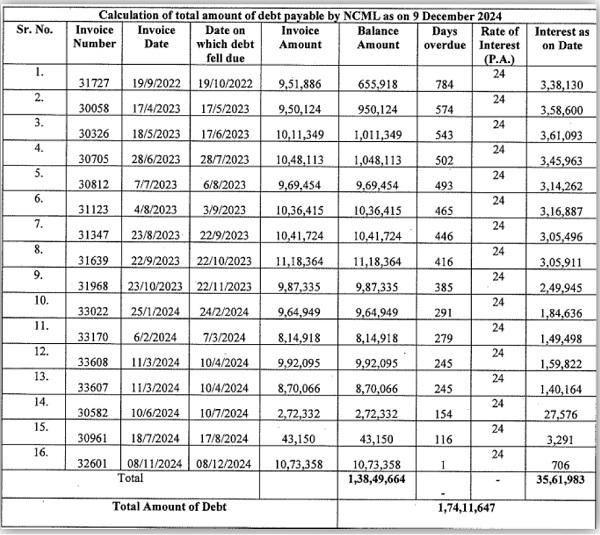
The invoice values are also reflected in the statement produced with the Corporate Debtor’s own Additional Affidavit, whereas the petition records the corresponding invoice-wise dates of default.
10.7 The first default therefore occurred on 19.10.2022, while the last invoice fell due on 08.12.2024. The Petition having been instituted in the year 2025 is within the period of limitation. The claim also substantially exceeds the minimum threshold prescribed under Section 4 of the Code. The Operational Creditor issued the statutory Demand Notice in Form 3 dated 18.12.2024. The material on record shows service through email on 18.12.2024 and delivery through Speed Post on 20.12.2024. The Corporate Debtor thereafter addressed a holding reply dated 31.12.2024 and a detailed reply dated 13.01.2025.
10.8 The principal defence raised by the Corporate Debtor is that there existed a pre-existing dispute concerning consumption-based billing, alleged excessive invoices, non-reconciliation of accounts and billing for discontinued Azure resources.
10.9 It is well settled by the Hon’ble Supreme Court in Civil Appeal No. 9405 OF 2017 Mobilox Innovations Private Limited v. Kirusa Software Private Limited that the Adjudicating Authority is required to see whether there is a plausible contention requiring further investigation and whether the defence is not a patently feeble legal argument or an assertion unsupported by evidence. At the same time, a mere assertion of dispute or an ingenious defence raised to avoid payment cannot defeat an otherwise complete application under Section 9. The relevant para 40 the said order is reproduced below:
“40 …… Therefore, all that the adjudicating authority is to see at this stage is whether there is a plausible contention which requires further investigation and that the “dispute” is not a patently feeble legal argument or an assertion of fact unsupported by evidence. It is important to separate the grain from the chaff and to reject a spurious defence which is mere bluster……”
(Emphasis Supplied)
10.10 As such, in the above judgement the Hon’ble Supreme Court in (Civil Appeal No. 9405 OF 2017 Mobilox Innovations Private Limited v. Kirusa Software Private Limited) while explaining the scope of enquiry under Sections 8 and 9 of the Code, held that the Adjudicating Authority is required to ascertain whether the defence raised by the Corporate Debtor constitutes a plausible contention requiring further investigation and whether the alleged dispute is not a patently feeble legal argument or an assertion unsupported by evidence. The Hon’ble Supreme Court further clarified that a spurious defence which is mere bluster is required to be rejected and that the dispute relied upon must truly exist in fact and cannot be spurious, hypothetical or illusory.
10.11 Therefore, the emails relied upon by the Corporate Debtor have to be examined not merely by their existence but by their substance and in conjunction with the subsequent conduct of the Corporate Debtor.
10.12 The Corporate Debtor relies upon emails dated 26.05.2023, 28.09.2023 and 29.09.2023, whereby it sought consumption reports, billing break-ups and reconciliation of accounts. It also relies upon subsequent communications dated 30.10.2023, 02.11.2023, 03.11.2023, 29.11.2023, 15.01.2024, 31.01.2024, 07.02.2024 and 12.02.2024.
10.13 We have carefully examined the nature of this correspondence. The same does demonstrate that the Corporate Debtor sought consumption details, reconciliation and optimisation of Azure resources. However, such communications do not disclose a clear and unequivocal repudiation of the outstanding liability under the invoices. Rather, they appear to form part of continuing operational and commercial discussions between the parties while the services continued and payments remained outstanding. This distinction assumes importance because the Corporate Debtor’s conduct subsequent to these emails is inconsistent with its present assertion that the underlying debt itself stood disputed.
10.14 The Operational Creditor has placed on record various subsequent communications from the Corporate Debtor, including emails dated 08.11.2023, 23.01.2024, 15.02.2024, 19.02.2024 and 04.03.2024. According to the record, the email dated 08.11.2023 proposed a payment plan; the email dated 23.01.2024 sought one week’s time for clearing outstanding dues; the email dated 15.02.2024 referred to outstanding dues of approximately Rs.1 Crore; and the subsequent emails contained payment commitments. Of particular significance is that these communications were exchanged after several of the reconciliation emails relied upon by the Corporate Debtor were issued. Thus, notwithstanding the earlier requests for billing clarification/reconciliation, the Corporate Debtor subsequently continued to treat substantial dues as outstanding and sought time/payment arrangements. The email dated 23.01.2024 specifically records a request of one week’s time to settle the outstanding dues, while the Operational Creditor’s communication dated 24.01.2024 records continued consumption of services despite non-payment for December 2023 and January 2024. The relavant correspondence dated 23.01.2024 and 24.01.2024 exchanged between the OC and the CD is reproduced herein below:
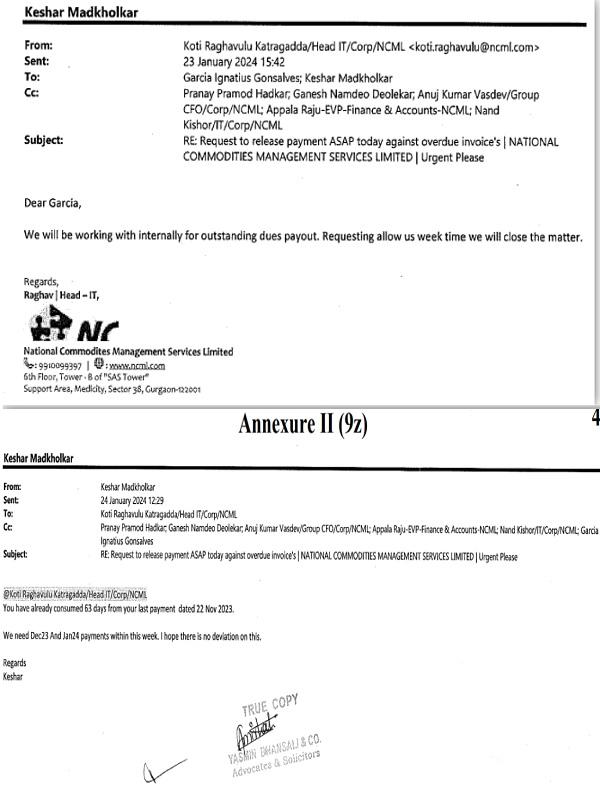
10.15 When the aforesaid correspondence is read as a whole, we are unable to accept the contention that the communications seeking reconciliation constituted a categorical dispute as to the existence of the operational debt. A request for reconciliation or resource optimisation, followed by payment proposals and acknowledgments of substantial outstanding dues, is qualitatively different from a genuine and consistent repudiation of liability. The record further shows that payments continued to be made even after the alleged dispute. The Petition contains bank records evidencing, inter alia, a payment of Rs. 10,31,432.61/- on 11.03.2024, adjusted against Invoice No. 33302, and a further payment of Rs. 4,35,884/- on 19.05.2024, adjusted against Invoice No. 31727. The Operational Creditor has further relied upon a series of part-payments over the course of the commercial relationship. Such continued payments are another material circumstance which cannot be ignored while examining whether the Corporate Debtor had genuinely repudiated the liability.
10.16 The Corporate Debtor contends that the Purchase Order dated 27.01.2022 was valid only for one year and stood fully paid and, therefore, invoices raised thereafter are disputed.
10.17 We find that this contention overlooks the broader contractual arrangement placed on record. The 2022 Enterprise Enrollment Agreement dated 01.02.2022 bearing No. 60248394 was stated to be valid for three years, and the Microsoft Product Terms contemplated invoicing based on actual Azure consumption. More importantly, the conduct of the Corporate Debtor demonstrates continued utilisation of services, correspondence and payments after the alleged expiry of the Purchase Order. No material has been shown to us demonstrating that the entire contractual relationship stood automatically terminated upon expiry of the Purchase Order. We therefore find no merit in the contention that expiry of the Purchase Order, by itself, extinguished the underlying commercial relationship or rendered all subsequent invoices incapable of constituting operational debt.
10.18 The Corporate Debtor has further contended that the Operational Creditor has not produced corresponding invoices raised by Microsoft upon it or proof of the amounts paid to Microsoft, and that the transaction is in the nature of a tripartite arrangement involving Microsoft.
10.19 We are unable to accept that production of Microsoft’s invoices to the Operational Creditor is a condition precedent for maintaining the present Petition. The Corporate Debtor admittedly availed Azure services through the Operational Creditor, and the claim in the present Petition arises from invoices raised by the Operational Creditor upon the Corporate Debtor under the subsisting commercial arrangement. The liability of the Corporate Debtor has therefore to be examined on the basis of its own contractual and commercial dealings with the Operational Creditor. The absence of upstream invoices from Microsoft does not, in the facts of the present case, negate the operational character of the debt.
10.20 The Corporate Debtor alleges that consumption reports were not furnished and that the billing was opaque. The Operational Creditor has disputed this allegation and stated that the Corporate Debtor had real-time access to its Azure consumption dashboard and that consumption details were also shared through communications including emails dated 03.11.2023 and 11.12.2023.
10.21 The record also shows continuing communication concerning consumption details and resource optimisation. Therefore, the material does not support the conclusion that the Corporate Debtor was denied all access to consumption information. More importantly, despite the alleged opacity, the Corporate Debtor thereafter continued making payments and acknowledging outstanding dues.
10.22 The Corporate Debtor has characterised the Operational Creditor’s email dated 10.10.2023 as a threat for termination and possible data loss. The Operational Creditor, however, contends that the communication merely advised the Corporate Debtor of the contractual consequences of continued non-payment.
10.23 The said email cannot be read in isolation. It forms part of a series of communications wherein outstanding payments were repeatedly sought. Merely informing a customer of the consequence of continued non-payment does not, without something more, establish the existence of a bona fide dispute regarding the underlying invoices.
10.24 The Corporate Debtor next contends that certain Azure resources were discontinued and that migration out of Azure was completed by March 2024; nevertheless, invoices were continued up to November 2024.
10.25 The Operational Creditor has explained that post-March 2024, charges represented transitional/residual consumption, storage and contractual cloud commitments. It also relies upon the payment made on 29.05.2024 as demonstrating continued dealings even after the alleged migration. Significantly, no formal termination of the 2022 Enterprise Enrollment Agreement has been demonstrated by the Corporate Debtor prior to the relevant invoices. The mere fact that migration may have commenced or that some resources were optimised cannot, without a contemporaneous rejection of the specific invoices, be treated as extinguishing liability arising from residual or transitional usage.
10.26 The Corporate Debtor had also raised an objection concerning Invoice Nos. MGSI2324/33607 and MGSI2324/33608, alleging duplication. The Operational Creditor has explained that Invoice No. 33608 related to December 2023 and that reference to January was a typographical error, which was clarified on 29.05.2024. It has further been submitted that this objection was not pursued in the Affidavit-in-Reply.
10.27 We therefore do not find that the said objection constitutes a genuine dispute regarding the entirety of the operational debt.
10.28 The Operational Creditor has also placed on record NeSL Form D dated 14.05.2025. The record reflects the 16 outstanding invoices for the period 19.09.2022 to 08.11.2024; records the default amount as Rs. 1,38,49,664/-, the total outstanding as Rs. 1,74,11,647/-, the date of default as 19.10.2022, and the date of last acknowledgment of debt as 15.02.2024. The authentication period is stated to have been completed on 21.04.2025, after reminders from NeSL to the Corporate Debtor, and Form D was thereafter issued on 14.05.2025. It is observed that the Form D is issued in the erstwhile name of the CD i.e. “National Commodities Management Services Limited”. In our view the same does not affect the validity of NeSL Form D. The relevant portion of the NeSL ROD (in form D) is reproduced below:
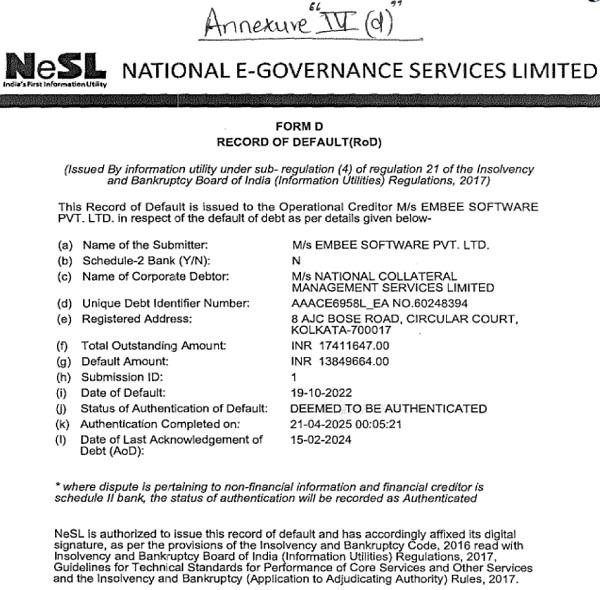
10.29 We agree with the Corporate Debtor that an Information Utility record cannot automatically override a genuine pre-existing dispute. However, in the present case, we do not rely upon NeSL in isolation. It corroborates the invoices, ledger, acknowledgments, payment history and other contemporaneous material already on record.
10.30 The Corporate Debtor has placed considerable reliance upon its Additional Affidavit and the Independent Auditor’s Certificate issued by Walker Chandiok & Co. LLP. Paragraph 10 of the Auditor’s Certificate records that, based upon the procedures performed and the underlying books, GST returns and other records, nothing came to the Auditor’s attention to suggest that the invoice-wise ITC particulars in the statement had not been accurately extracted from the Corporate Debtor’s records. The Auditor’s statement shows that Invoice No. 31727 dated 19.09.2022 for Rs. 9,51,886/- and Invoice No. 30058 dated 17.04.2023 for Rs. 9,50,124/- were booked and ITC was availed. In relation to Invoice No. 31727, the Corporate Debtor’s own statement further records a liability of Rs. 9,51,886/- as at 31.03.2025. At the same time, Invoice Nos. at Serial Nos. 3 to 16 are stated not to have been recorded in the books, and the Corporate Debtor has made a provision for litigation amounting to Rs. 1,22,43,622/- under Ind AS 37.
10.31 The Corporate Debtor seeks to rely upon such non-booking as evidence of a pre-existing dispute. We are unable to accept this contention as decisive. A unilateral accounting treatment within the books of the Corporate Debtor cannot by itself determine the existence or non-existence of an operational debt. What assumes importance under Section 9 is whether the debt was contemporaneously disputed with the Operational Creditor. Significantly, the Auditor’s Certificate does not certify that the invoices are false, fabricated, incorrectly calculated or that the underlying services were never rendered. The certificate is confined to the accuracy of the extraction of ITC/accounting particulars from the Corporate Debtor’s records. Therefore, the non-booking of certain invoices is, at best, an internal accounting circumstance and cannot outweigh the subsequent external communications from the Corporate Debtor acknowledging substantial dues and proposing payments.
10.32 The statement further records that ITC against Invoice No. 30961 dated 18.07.2024 for Rs. 43,150/- and Invoice No. 32601 dated 08.11.2024 for Rs. 10,73,358/-, though the invoices themselves are stated not to have been booked, was claimed by the Respondent. The Operational Creditor has pointed out that reversal of such ITC was carried out only on 17.10.2025, i.e., after institution of the present Petition and after the order dated 25.09.2025 was passed by this Tribunal. The subsequent reversal cannot, in our view, retrospectively establish a dispute existing prior to issuance of the Demand Notice.
10.33 We clarify that availment of ITC by itself is not conclusive proof of operational debt. However, its subsequent reversal after commencement of proceedings equally cannot be relied upon to manufacture or retrospectively establish a pre-existing dispute.
10.34 The Corporate Debtor has further asserted that an amount equivalent to Invoice No. 30058 dated 17.04.2023 for Rs. 9,50,124/- was paid on 31.03.2025. The Operational Creditor has expressly denied receipt of such payment and points out that no bank proof or payment confirmation has been annexed by the Corporate Debtor. On the material presently placed before us, the bald assertion of such payment, unsupported by corresponding banking evidence, cannot dislodge the documentary claim at the admission stage.
10.35 The Corporate Debtor has also alleged suppression/perjury on the ground that the Operational Creditor did not specifically disclose the holding reply dated 31.12.2024 and detailed reply dated 13.01.2025 in its Affidavit of No Dispute.
10.36 We find that the said communications are themselves part of the record before this Tribunal and have been considered by us. Therefore, no prejudice has been caused in the adjudication of the present Petition. We do not find it necessary to return any finding of suppression or perjury merely because the Operational Creditor disputes the legal effect of the objections raised therein.
10.37 The Corporate Debtor has principally relied upon Mobilox Innovations Pvt. Ltd. v. Kirusa Software Pvt. Ltd.; Sabarmati Gas Ltd. v. Shah Alloys Ltd.; Rajendra Bisht v. Satkar Logistics (P) Ltd.; S.S. Engineers v. HPCL; and Korea Trade Insurance Corporation (Ksure) v. Amrit Polychem Pvt. Ltd.
10.38 There is no dispute with the proposition emerging from these decisions that an application under Section 9 cannot be admitted where a genuine pre-existing dispute exists and that the Adjudicating Authority is not required to finally adjudicate the merits of such dispute. However, the application of the said principle necessarily depends upon the factual matrix of each case. In Sabarmati Gas, Rajendra Bisht and East India Udyog, the underlying reconciliation issue formed part of a substantive and subsisting dispute regarding the amount payable. A mere reference to reconciliation cannot therefore be mechanically treated as sufficient to reject every Section 9 application. In the present case, the contemporaneous record reveals that, notwithstanding requests for reconciliation and optimisation, the Corporate Debtor subsequently proposed payment plans, sought time for payment, referred to approximately Rs. 1 Crore as outstanding, continued making part-payments and maintained commercial dealings. Therefore, the authorities relied upon by the Corporate Debtor are distinguishable on facts. The dispute projected from the reconciliation correspondence, when tested against the subsequent conduct of the Corporate Debtor, does not satisfy the threshold of a genuine pre-existing dispute contemplated in Mobilox.
10.39 Similarly, the reliance upon S.S. Engineers v. HPCL for the proposition that the Code cannot be used as a debt recovery mechanism is well founded as a proposition of law but does not assist the Corporate Debtor in the present facts. The present Petition is not being admitted merely because an invoice remains unpaid; the record contains contemporaneous evidence of services, invoices, payment history, acknowledgments and the NeSL Record of Default.
10.40 Upon cumulative examination of the entire material, we find that the correspondence relied upon by the Corporate Debtor demonstrates operational discussions relating to reconciliation, resource optimisation and consumption details, but does not disclose a clear, categorical and consistent repudiation of the operational liability. On the contrary, such correspondence is followed by acknowledgments of substantial dues, requests for time to make payment, payment proposals and actual part-payments. The Corporate Debtor’s subsequent conduct is inconsistent with its present plea that the debt had already become the subject of a genuine dispute. The internal accounting treatment subsequently relied upon by the Corporate Debtor does not alter this conclusion. The Auditor’s Certificate verifies how invoices and ITC were reflected in the Corporate Debtor’s books; it does not certify absence of services or invalidity of the invoices.
10.41 We therefore find that the defence raised by the Corporate Debtor does not constitute a plausible pre-existing dispute of the nature contemplated under Sections 8 and 9 of the Code. The objections raised are insufficient to non-suit the Operational Creditor at the threshold.
10.42 The dues arising out of the services rendered by the Operational Creditor fall within the ambit of operational debt. The total outstanding claimed in the Application is Rs. 1,74,11,647/-, which is substantially above the statutory threshold. The claim is supported by the invoices, ledger, bank/payment records, correspondence and NeSL record. The first default occurred on 19.10.2022 and subsequent invoice-wise defaults continued up to 08.12.2024. The Petition has been instituted within limitation. The precise verification of interest and adjustments may appropriately be undertaken during the CIRP in accordance with law.
10.43 The Applicant has attached the Affidavit under Section 9(3)(b) of the Code stating that there is no dispute raised by the Corporate Debtor with regard to the unpaid operational debt. However, upon perusal of the record, we note that in response to the Demand Notice dated 18.12.2024, the Corporate Debtor, through its Advocates, issued a holding reply dated 31.12.2024, placed at page 141 of the Petition, followed by a detailed reply dated 13.01.2025, placed at pages 142–144 of the Petition, both of which have been brought on record and duly considered by this Tribunal while examining the plea of pre-existing dispute.
10.44 In view of the above findings, it is clear that the Applicant has placed on record the necessary evidences and materials to demonstrate the existence of the operational debt exceeding the minimum threshold of Rs.1 Crore prescribed under Section 4 of the Code due and payable by the CD as well as the default in payment thereof by the CD. The Applicant has served the Demand Notice upon the CD, and that the CD has failed to establish the existence of any pre-existing dispute. The Application is complete as all the relevant documents have been attached by the Applicant along with the Application.
10.45 We find that all pre-requisites of Section 9 of the Code are fulfilled and, accordingly, we are satisfied that the instant Application is fit for admission under Section 9 of the Code. The Applicant has attached all the documents as required and therefore the Application is complete and demands admission.
ORDER
In view of the aforesaid findings, Application bearing C.P.(IB) No.433 /MB/2025 filed under Section 9 of the Code by Embee Software Pvt. Ltd., the Applicant, for initiating CIRP in respect of National Commodities Management Services Limited, the Corporate Debtor, is hereby admitted.
We further declare moratorium under Section 14 of the Code with consequential direction as mentioned below: –
i. We prohibit-
a. the institution of suits or continuation of pending suits or proceedings against the Corporate Debtor including execution of any judgment, decree or order in any court of law, tribunal, arbitration panel or other authority;
b. transferring, encumbering, alienating or disposing of by the Corporate Debtor any of its assets or any legal right or beneficial interest therein;
c. any action to foreclose, recover or enforce any security interest created by the Corporate Debtor in respect of its property including any action under the Securitisation and Reconstruction of Financial Assets and Enforcement of Security Interest Act, 2002;
d. the recovery of any property by an owner or lessor where such property is occupied by or in possession of the Corporate Debtor.
ii. That the supply of essential goods or services to the Corporate Debtor, if continuing, shall not be terminated or suspended or interrupted during the moratorium period.
iii. That the order of moratorium shall have effect from the date of this order till the completion of the CIRP or until this Tribunal approves the resolution plan under Section 31(1) of the Code or passes an order for the liquidation of the Corporate Debtor under Section 33 thereof, as the case may be.
iv. That the public announcement of the CIRP shall be made in immediately as specified under Section 13 of the Code read with Regulation 6 of the IBBI (Insolvency Resolution Process for Corporate Persons) Regulations, 2016 and other Rules and Regulations made thereunder.
v. That this Bench hereby appoints Mr. Devang Sampat, a registered Insolvency Professional having Registration Number IBBI/IPA-001/IP-P00224/2017-18/10423 and e-mail address [email protected] having valid Authorisation for Assignment up to 31.12.2026 as the IRP to carry out the functions under the Code.
vi. That the fee payable to IRP/RP shall be in accordance with such Regulations/Circulars/ Directions as may be issued by the IBBI.
vii. That during the CIRP Period, the management of the Corporate Debtor shall vest in the IRP or, as the case may be, the RP in terms of Section 17 or Section 25, as the case may be, of the Code. The officers and managers of the Corporate Debtor the Corporate Debtor is directed to provide effective assistance to the IRP as and when he takes charge of the assets and management of the Corporate Debtor. The officers and managers of the Corporate Debtor shall provide all documents in their possession and furnish every information in their knowledge to the IRP/RP within a period of one week from the date of receipt of this Order and shall not commit any offence punishable under Chapter VII of Part II of the Code. Coercive steps will follow against them under the provisions of the Code read with Rule 11 of the NCLT Rules for any violation of law.
viii. That the IRP/IP shall submit to this Tribunal quarterly reports with regard to the progress of the CIRP in respect of the Corporate Debtor.
ix. In exercise of the powers under Rule 11 of the NCLT Rules, 2016, the Applicant is directed to deposit a sum of Rs.3,00,000/- (Rupees Three Lakh) with the IRP to meet the initial CIRP cost arising out of issuing public notice and inviting claims, etc. The amount so deposited shall be interim finance and paid back to the Applicant on priority upon the funds available with IRP/RP from the Committee of Creditors (CoC). The expenses incurred by IRP out of this fund are subject to approval by the CoC.
x. A copy of this Order be sent to the Registrar of Companies, Maharashtra, Mumbai for updating the Master Data of the Corporate Debtor.
xi. A copy of the Order shall also be forwarded to the IBBI for record and dissemination on their website.
xii. The Registry is directed to immediately communicate this Order to the Applicant, the Corporate Debtor and the IRP by way of Speed Post, e-mail and WhatsApp.
xiii. The IRP is directed to issue notice of admission upon all the statutory authorities of the Corporate Debtor without fail.
xiv. Compliance report of the order by Designated Registrar is to be submitted today.